GRAND DUCHY
OF
LUXEMBOURG
Groussherzogtum
Lëtzebuerg(Luxembourgish)
Grand-Duché de
Luxembourg (French)
Großherzogtum
Luxemburg (German)
BY: ANGELICA GRACE BARNACHA VALDEZ
GEOGRAPHICAL
LOCATION
LUCK sem boorrg, is one of Europe’s
oldest and smallest independent countries.
It lies in northwest Europe where West
Germany, France, and Belgium meet.
Luxembourg covers an area that is smaller
than Rhode Island and it has about one-
third as many people as that state.
CAPITAL:
LUXEMBOURG CITY
Is the capital city of the Grand Duchy of
Luxembourg. The city is a transportation, financial,
and banking center, and its industries manufacture
clothing, electrical machinery, chemicals, and
processed foods. The Romans built a fort on the
site, because of its strategic location overlooking
the Alzette River; by the 10th century Luxembourg
was one of Europe’s strongest walled towns. The
fortress was razed according to the terms of the
Treaty of London (1867). During both world wars
the city was occupied Germany.
CLIMATE
Luxembourg's climate is temperate and
mild. Summers are generally cool, with a mean
temperature of about 17° C (63° F ); winters are
seldom severe, average temperature being about
0° C (32° F ). The high peaks of the Ardennes in
the north shelter the country from rigorous north
winds, and the prevailing northwesterly winds
have a cooling effect. Rainfall is plentiful in the
extreme southwest; precipitation throughout the
country averages about 75 cm (30 in) annually.
LANGUAGE
Three languages are recognized as official in
Luxembourg: French, German, and Luxembourgish,
a Franconian language of the Moselle region that is also spoken
in neighboring parts of France and Germany.
Luxembourgish is also considered the national language of the
Grand Duchy; it is the mother tongue or "language of the heart"
for nearly all Luxembourgers.
Luxembourgers generally use to speak to each other, but it is
not often used as the written language.
Most official (written) business is carried out in French.
German is usually the first language taught in school and is the
language of much of the media and of the church.
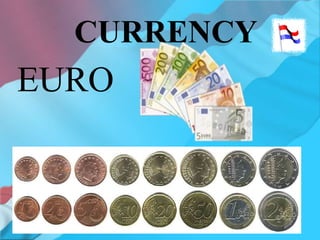
CURRENCY
EURO
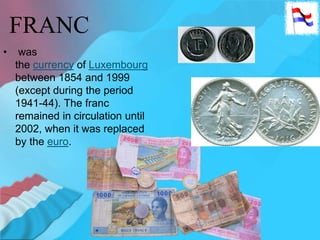
FRANC
• was
the currency of Luxembourg
between 1854 and 1999
(except during the period
1941-44). The franc
remained in circulation until
2002, when it was replaced
by the euro.
BRIEF HISTORY
Luxembourg’s history began in 963 when Count Siegfried of
Ardennes built a castle on the site of the present-day city of
Luxembourg. The castle was called Lucilinburhuc (little castle).
Luxembourg became prominent in 1308 when Count Henry of
Luxembourg became ruler of Germany. Henry’s grandson, Charles
IV, made Luxembourg a duchy, and the Luxembourg family ruled the
duchy until 1443, when The Netherlands took control of Luxembourg.
In 1815, Congress of Vienna made Luxembourg a grand duchy
ruled by the Netherlands.
Germany occupied Luxembourg during World Wars I and II. In the
winter of 1994 and 1945, part of the Battle of the Bulge was fought in
northern Luxembourg.
In 1945, Luxembourg became a member of the United Nations. It
joined an economic union called Benelux in 1948, and became a
member of the North Atlantic Treaty Organization (NATO) in 1949.
TYPE /FORM OF
GOVERNMENT
CONSTITUTIONAL MONARCHY.
The grand duke (or duchess) of the House of Nassau
is the chief executive. He appoints the Cabinet,
which is made up of a prime minister and seven
other ministers. Each minister is in charge of one or
more government departments. The grand duke also
appoints the 21 members of the Council of State for
life. The Chamber of deputies passes all laws.
TOURIST
ATTRACTIONS

LUXEMBOURG

  • 1.
    GRAND DUCHY OF LUXEMBOURG Groussherzogtum Lëtzebuerg(Luxembourgish) Grand-Duché de Luxembourg(French) Großherzogtum Luxemburg (German) BY: ANGELICA GRACE BARNACHA VALDEZ
  • 2.
    GEOGRAPHICAL LOCATION LUCK sem boorrg,is one of Europe’s oldest and smallest independent countries. It lies in northwest Europe where West Germany, France, and Belgium meet. Luxembourg covers an area that is smaller than Rhode Island and it has about one- third as many people as that state.
  • 3.
    CAPITAL: LUXEMBOURG CITY Is thecapital city of the Grand Duchy of Luxembourg. The city is a transportation, financial, and banking center, and its industries manufacture clothing, electrical machinery, chemicals, and processed foods. The Romans built a fort on the site, because of its strategic location overlooking the Alzette River; by the 10th century Luxembourg was one of Europe’s strongest walled towns. The fortress was razed according to the terms of the Treaty of London (1867). During both world wars the city was occupied Germany.
  • 4.
    CLIMATE Luxembourg's climate istemperate and mild. Summers are generally cool, with a mean temperature of about 17° C (63° F ); winters are seldom severe, average temperature being about 0° C (32° F ). The high peaks of the Ardennes in the north shelter the country from rigorous north winds, and the prevailing northwesterly winds have a cooling effect. Rainfall is plentiful in the extreme southwest; precipitation throughout the country averages about 75 cm (30 in) annually.
  • 5.
    LANGUAGE Three languages arerecognized as official in Luxembourg: French, German, and Luxembourgish, a Franconian language of the Moselle region that is also spoken in neighboring parts of France and Germany. Luxembourgish is also considered the national language of the Grand Duchy; it is the mother tongue or "language of the heart" for nearly all Luxembourgers. Luxembourgers generally use to speak to each other, but it is not often used as the written language. Most official (written) business is carried out in French. German is usually the first language taught in school and is the language of much of the media and of the church.
  • 6.
  • 7.
    FRANC • was the currencyof Luxembourg between 1854 and 1999 (except during the period 1941-44). The franc remained in circulation until 2002, when it was replaced by the euro.
  • 8.
    BRIEF HISTORY Luxembourg’s historybegan in 963 when Count Siegfried of Ardennes built a castle on the site of the present-day city of Luxembourg. The castle was called Lucilinburhuc (little castle). Luxembourg became prominent in 1308 when Count Henry of Luxembourg became ruler of Germany. Henry’s grandson, Charles IV, made Luxembourg a duchy, and the Luxembourg family ruled the duchy until 1443, when The Netherlands took control of Luxembourg. In 1815, Congress of Vienna made Luxembourg a grand duchy ruled by the Netherlands. Germany occupied Luxembourg during World Wars I and II. In the winter of 1994 and 1945, part of the Battle of the Bulge was fought in northern Luxembourg. In 1945, Luxembourg became a member of the United Nations. It joined an economic union called Benelux in 1948, and became a member of the North Atlantic Treaty Organization (NATO) in 1949.
  • 9.
    TYPE /FORM OF GOVERNMENT CONSTITUTIONALMONARCHY. The grand duke (or duchess) of the House of Nassau is the chief executive. He appoints the Cabinet, which is made up of a prime minister and seven other ministers. Each minister is in charge of one or more government departments. The grand duke also appoints the 21 members of the Council of State for life. The Chamber of deputies passes all laws.
  • 10.