Tsunami!  What happened & why??? A PROJECT SUBMITED BY- NANDEESH  LAXETTI X ‘C’
2004 Indian Ocean Earthquake  NOAA Undersea earthquake Magnitude 9.0 ( Moment magnitude scale )
http://en.wikipedia.org/wiki/2004_Indian_Ocean_earthquake   Epicenter 150 KM west of Sumatra
Occurred along the subduction zone where the Indian dives under the Eurasian Plate   http://www.nps.gov/prsf/geology/images/plates.gif
Facts The earthquake came just three days after a magnitude 8.1 earthquake in an uninhabited region west of New Zealand  Possible connection between these two earthquakes  Possibility of a seismic chain reaction across neighboring plates has also been considered
Facts Total energy released by a magnitude 9.0 earthquake exceeds the total amount of energy consumed in the U.S. in one month Massive release of energy and shift in mass  insignificantly  altered the Earth's rotation
A  tsunami  (pronounced soo-NAA-mee) is a series of waves (called a "wave train") generated in a body of water by a pulsating or abrupt disturbance that vertically displaces the water column.
Tsunami's are also mistakenly referred to as tidal waves as they often resemble a tide that keeps rising, rather than cresting waves when they reach shore. However, as they are not actually related to tides the term may be misleading, and its use is discouraged by scientists.
Anthony Liekens  15:30, 28 Dec 2004 (UTC)  Tsunamis are created when: Seafloor quickly changes shape Water is displaced Waves are formed as the displaced water mass, which is affected gravity, tries to move back
 
Characteristics Move at high speeds Can travel enormous distances with little energy loss Can cause damage thousands of miles from its origin  May be  several hours  between its creation and its impact on the coast
Warning Systems Many countries around the Pacific, including Hawaii, have warning systems and evacuation procedures in the event of a serious tsunami.
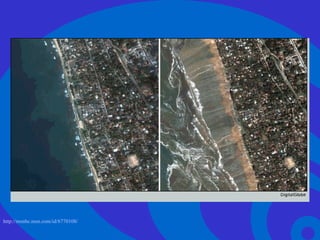
Effects of Tsunamis Destruction of human life (100,000+) Destruction of property Spread of disease Destruction of ecosystems
http://msnbc.msn.com/id/6770108/
http://home.cfl.rr.com/battleshipron/before_after.gif

Tsunami!

  • 1.
    Tsunami! Whathappened & why??? A PROJECT SUBMITED BY- NANDEESH LAXETTI X ‘C’
  • 2.
    2004 Indian OceanEarthquake NOAA Undersea earthquake Magnitude 9.0 ( Moment magnitude scale )
  • 3.
  • 4.
    Occurred along thesubduction zone where the Indian dives under the Eurasian Plate http://www.nps.gov/prsf/geology/images/plates.gif
  • 5.
    Facts The earthquakecame just three days after a magnitude 8.1 earthquake in an uninhabited region west of New Zealand Possible connection between these two earthquakes Possibility of a seismic chain reaction across neighboring plates has also been considered
  • 6.
    Facts Total energyreleased by a magnitude 9.0 earthquake exceeds the total amount of energy consumed in the U.S. in one month Massive release of energy and shift in mass insignificantly altered the Earth's rotation
  • 7.
    A tsunami (pronounced soo-NAA-mee) is a series of waves (called a "wave train") generated in a body of water by a pulsating or abrupt disturbance that vertically displaces the water column.
  • 8.
    Tsunami's are alsomistakenly referred to as tidal waves as they often resemble a tide that keeps rising, rather than cresting waves when they reach shore. However, as they are not actually related to tides the term may be misleading, and its use is discouraged by scientists.
  • 9.
    Anthony Liekens 15:30, 28 Dec 2004 (UTC) Tsunamis are created when: Seafloor quickly changes shape Water is displaced Waves are formed as the displaced water mass, which is affected gravity, tries to move back
  • 10.
  • 11.
    Characteristics Move athigh speeds Can travel enormous distances with little energy loss Can cause damage thousands of miles from its origin May be several hours between its creation and its impact on the coast
  • 12.
    Warning Systems Manycountries around the Pacific, including Hawaii, have warning systems and evacuation procedures in the event of a serious tsunami.
  • 13.
    Effects of TsunamisDestruction of human life (100,000+) Destruction of property Spread of disease Destruction of ecosystems
  • 14.
  • 15.
  • 16.