PRESENTER: MR WM NKAMBULE
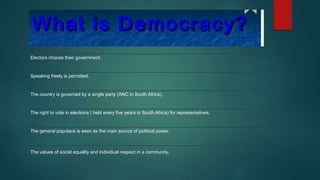
Electors choose their government.
Speaking freely is permitted.
The country is governed by a single party (ANC in South Africa).
The right to vote in elections ( held every five years in South Africa) for representatives.
The general populace is seen as the main source of political power.
The values of social equality and individual respect in a community.
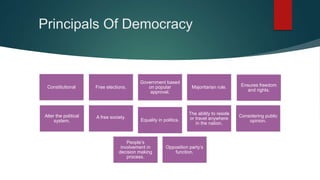
Principals Of Democracy
Constitutional Free elections.
Government based
on popular
approval.
Majoritarian rule. Ensures freedom
and rights.
Alter the political
system.
A free society.
Equality in politics.
The ability to reside
or travel anywhere
in the nation.
Considering public
opinion.
People’s
involvement in
decision making
process.
Opposition party’s
function.
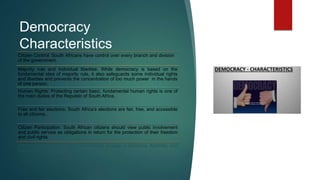
Democracy
Characteristics
Citizen Control: South Africans have control over every branch and division
of the government.
Majority rule and individual liberties: While democracy is based on the
fundamental idea of majority rule, it also safeguards some individual rights
and liberties and prevents the concentration of too much power in the hands
of one person.
Human Rights: Protecting certain basic, fundamental human rights is one of
the main duties of the Republic of South Africa.
Free and fair elections: South Africa’s elections are fair, free, and accessible
to all citizens.
Citizen Participation: South African citizens should view public involvement
and public service as obligations in return for the protection of their freedom
and civil rights.
Tolerance and compromise: Democracies engage in tolerance, flexibility, and
collaboration.
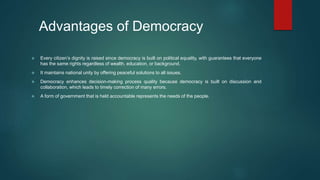
Advantages of Democracy
 Every citizen’s dignity is raised since democracy is built on political equality, with guarantees that everyone
has the same rights regardless of wealth, education, or background.
 It maintains national unity by offering peaceful solutions to all issues.
 Democracy enhances decision-making process quality because democracy is built on discussion and
collaboration, which leads to timely correction of many errors.
 A form of government that is held accountable represents the needs of the people.
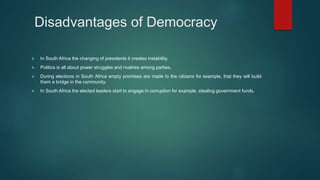
Disadvantages of Democracy
 In South Africa the changing of presidents it creates instability.
 Politics is all about power struggles and rivalries among parties.
 During elections in South Africa empty promises are made to the citizens for example, that they will build
them a bridge in the community.
 In South Africa the elected leaders start to engage in corruption for example, stealing government funds.
What is
human right?
 Is a privilege that is thought to legitimately belong to each and every
person.
 Is the understanding of the inherent worth of every individual, regardless of
their history, place of residence, appearance, thoughts, or religious
believes.
 Is founded on the idea of respecting each individual.
 Their underlying presumptions is that every individual is a morally upright
being deserving of respect.
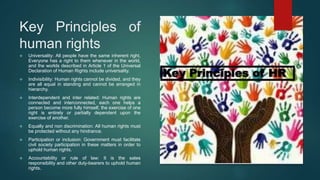
Key Principles of
human rights
 Universality: All people have the same inherent right,
Everyone has a right to them whenever in the world,
and the worlds described in Article 1 of the Universal
Declaration of Human Rights include universality.
 Indivisibility: Human rights cannot be divided, and they
are all equal in standing and cannot be arranged in
hierarchy.
 Interdependent and inter related: Human rights are
connected and interconnected, each one helps a
person become more fully himself, the exercise of one
right is entirely or partially dependent upon the
exercise of another.
 Equally and non discrimination: All human rights must
be protected without any hindrance.
 Participation or inclusion: Government must facilitate
civil society participation in these matters in order to
uphold human rights.
 Accountability or rule of law: It is the sates
responsibility and other duty-bearers to uphold human
rights.
Limitations of human rights
 Our human rights must occasionally be restricted.
 If one person abuses their rights in a way that endangers another person or larger society, such rights may
be restricted.
 For example, would it be okay for the police to search someone if they had a reason to believe they were
carrying a gun?
References:
carlinha183 (2012). Democracy characteristics. [online] Available at:
https://www.slideshare.net/carlinha183/democracy-characteristics [Accessed 20 Aug. 2022].
Iqra ali (2020). Principles of Human Rights. [online] Available at:
https://www.slideshare.net/IQRAALI58/principles-of-human-rights [Accessed 20 Aug. 2022].
Salman Nasär (2013). Democracy. [online] Available at: https://www.slideshare.net/salmansignin/democracy-
27814607
Mahesh Patil. (2017, July 5). Concept of democracy. https://www.slideshare.net/maheshjp05/concept-of-
democracy
NARESH KUMAR (2018). Features of Democracy with merits and demerits. [online] Available at:
https://www.slideshare.net/NARESHKUMAR1438/features-of-democracy-with-merits-and-demerits [Accessed
20 Aug. 2022].


TST 3B SLIDES.pptx

  • 1.
  • 2.
    Electors choose theirgovernment. Speaking freely is permitted. The country is governed by a single party (ANC in South Africa). The right to vote in elections ( held every five years in South Africa) for representatives. The general populace is seen as the main source of political power. The values of social equality and individual respect in a community.
  • 3.
    Principals Of Democracy ConstitutionalFree elections. Government based on popular approval. Majoritarian rule. Ensures freedom and rights. Alter the political system. A free society. Equality in politics. The ability to reside or travel anywhere in the nation. Considering public opinion. People’s involvement in decision making process. Opposition party’s function.
  • 4.
    Democracy Characteristics Citizen Control: SouthAfricans have control over every branch and division of the government. Majority rule and individual liberties: While democracy is based on the fundamental idea of majority rule, it also safeguards some individual rights and liberties and prevents the concentration of too much power in the hands of one person. Human Rights: Protecting certain basic, fundamental human rights is one of the main duties of the Republic of South Africa. Free and fair elections: South Africa’s elections are fair, free, and accessible to all citizens. Citizen Participation: South African citizens should view public involvement and public service as obligations in return for the protection of their freedom and civil rights. Tolerance and compromise: Democracies engage in tolerance, flexibility, and collaboration.
  • 5.
    Advantages of Democracy Every citizen’s dignity is raised since democracy is built on political equality, with guarantees that everyone has the same rights regardless of wealth, education, or background.  It maintains national unity by offering peaceful solutions to all issues.  Democracy enhances decision-making process quality because democracy is built on discussion and collaboration, which leads to timely correction of many errors.  A form of government that is held accountable represents the needs of the people.
  • 6.
    Disadvantages of Democracy In South Africa the changing of presidents it creates instability.  Politics is all about power struggles and rivalries among parties.  During elections in South Africa empty promises are made to the citizens for example, that they will build them a bridge in the community.  In South Africa the elected leaders start to engage in corruption for example, stealing government funds.
  • 7.
    What is human right? Is a privilege that is thought to legitimately belong to each and every person.  Is the understanding of the inherent worth of every individual, regardless of their history, place of residence, appearance, thoughts, or religious believes.  Is founded on the idea of respecting each individual.  Their underlying presumptions is that every individual is a morally upright being deserving of respect.
  • 8.
    Key Principles of humanrights  Universality: All people have the same inherent right, Everyone has a right to them whenever in the world, and the worlds described in Article 1 of the Universal Declaration of Human Rights include universality.  Indivisibility: Human rights cannot be divided, and they are all equal in standing and cannot be arranged in hierarchy.  Interdependent and inter related: Human rights are connected and interconnected, each one helps a person become more fully himself, the exercise of one right is entirely or partially dependent upon the exercise of another.  Equally and non discrimination: All human rights must be protected without any hindrance.  Participation or inclusion: Government must facilitate civil society participation in these matters in order to uphold human rights.  Accountability or rule of law: It is the sates responsibility and other duty-bearers to uphold human rights.
  • 9.
    Limitations of humanrights  Our human rights must occasionally be restricted.  If one person abuses their rights in a way that endangers another person or larger society, such rights may be restricted.  For example, would it be okay for the police to search someone if they had a reason to believe they were carrying a gun?
  • 10.
    References: carlinha183 (2012). Democracycharacteristics. [online] Available at: https://www.slideshare.net/carlinha183/democracy-characteristics [Accessed 20 Aug. 2022]. Iqra ali (2020). Principles of Human Rights. [online] Available at: https://www.slideshare.net/IQRAALI58/principles-of-human-rights [Accessed 20 Aug. 2022]. Salman Nasär (2013). Democracy. [online] Available at: https://www.slideshare.net/salmansignin/democracy- 27814607 Mahesh Patil. (2017, July 5). Concept of democracy. https://www.slideshare.net/maheshjp05/concept-of- democracy NARESH KUMAR (2018). Features of Democracy with merits and demerits. [online] Available at: https://www.slideshare.net/NARESHKUMAR1438/features-of-democracy-with-merits-and-demerits [Accessed 20 Aug. 2022]. 