Chapter One
Introduction to
Constitutional Law
Sultan Kassim
HU COL
Constitution: Meaning
• The supreme law of the land.
• The basic law of a state which sets out how that state
will be organized, the powers and authorities of
government between different political units, and by
stating and the basic principles of the society.
• In Black Law Dictionary,“ The fundamental and
organic law of a nation or state that establishes the
institution and system of government, defines the
scope of governmental sovereign powers, and
guarantees individual civil rights and civil liberties.”
• Tomas Paine remark that,“ Government without a
Constitution is a power without a right.”
constitution
• Difference:-
• A constitution can be defined as the fundamental laws custom,
conventions, rules and regulations, stipulating how a country is
governed, while constitutionalism can be defined as a principle
which is not just a constitution but put limitations to the
activities of individuals and the government.
• The implication of constitutionalism is that in exercising its
powers the government should be limited by law. Its authority
over the people is dependent on its observance of the
limitations under the law. Those limitations are usually
enshrined in the constitution.
• A constitution is a charter of government deriving its whole
authority from the governed. ‘Constitutionalism’ means limited
government or limitation on government. It is antithesis of
arbitrary powers.
constitution
• After the end of the conflict between monarch and the
feudal lords. The results of the revolutions of different
kinds in France, USA, USSR, and the over throw of the
colonial rule in the 3rd world countries, the concept of
“constitutionalism” has taken deep roots.
• Conclusion
• A constitution can be defined as the fundamental laws
custom, conventions, rules and regulations, stipulating
how a country is governed,
• While constitutionalism can be defined as a principle
which is not just a constitution but put limitations to
the activities of individuals and the government.
1.Constitutionalism: Definition
• Constitutionalism comprised of ideas and theories
that essentially put limitations on political power in
general, and of the government’s sway over citizens
in particular.
• Refer to a number of separate but related features
of a democratic political system.
• Constitutionalism is concerned with both the
framework as well as the spirit that breathes within
the provisions in that framework.
• Constitutionalism therefore comprised two key
elements: a) rights provision and b) structural
provision
constitutionalism
• Rights provision – It consists of safeguards for political rights
including the right to free speech, freedom of association, etc.
– These rights operate as legal constraints upon the political
process.
• Structural provision
• They include separation of powers, representative system, etc.
• All are there to ensure that the government will act in the
interests of the public at large, rather than those of the self-
interested representatives.
• Control of government power – Lord Acton – “All power tends
to corrupt & absolute power corrupts absolutely”.
• – The government must be limited by law. – It is interrelated
with the idea of ‘separation of powers’, ‘rule of law’ & ‘limited
government’.
Aspects/ Characteristics
• a. Respect for law
• Implies loyalty to Constitution by citizens & officials
of the State.
• Citizens must accept the limits on their freedom.
• Officials must observe the limits on their powers.
• Similar to the idea of rule of law in which
authorities obtain their powers from the law &
must act within the law – ‘Government by law &
not by men’.
Aspects of constitutionalism
• b. Internalisation of values
• Implies loyalty to the letter as well as the spirit of
the Constitution.
• Requires commitment to & an ‘internalisation’ of
the values & ideals.
• Demands observance of enacted rules & respect for
unwritten & informal practices, conventions, usages
& understandings.
• Sir Ivor Jennings immortal words “provide the flesh
to clothe the dry bones of the law”.
Aspects of constitutionalism
• c. Respect for human rights
• Respect for liberty & equality
• Guarantees for human freedom & dignity
• A fair balance between conflicting demands of:
• Power & liberty,
• freedom & responsibility &
• the might of the state & the rights of the citizens.
• FDRE Constitution contains a chapter 3 on
fundamental Rights and liberties (Articles 13 ff)
Aspects of constitutionalism
• d. Controls over discretionary powers
• Institutional safeguards against abuse & misuse of
powers by authorities
• Checks & balances are put in place in order to
ensure the government acts within their powers &
not exceed.
• The government should not itself be destructive of
the values it was intended to promote
• Effective judicial control of executive discretion is
the litmus test of a rule of law society – judicial
review
Aspects of constitutionalism
• e. Responsible government
• Accountability or answerability of the government
• An obligation to explain & justify decisions made or
action taken
• If individual rights/interests is affected, appropriate
compensation should be given
• Constitutional models & control mechanisms are
introduced including constitutionalism, check &
balance, federalism, judicial review, elections,
statutory tribunals
Aspects of constitutionalism
• f. Entrenchment of constitutional values
• The constitution provides effective legal & political
restraints upon the exercise of state power to
amend or repeal laws dealing with constitutional
safeguards.
• g. Independent judiciary
• According to de Smith, “constitutionalism is
practiced in a country where the government is
genuinely accountable to an entity or organ distinct
from itself… and where there are effective legal
guarantees of civil liberties enforced by an
independent judiciary…”
Aspects of constitutionalism
• h. Free and fair elections
• Free & fair elections are regularly held in order to
elect the government
• However, free & fair elections does not guarantee
that constitutionalism is being practiced.
• Example: Adolf Hitler’s regime came to power
through an election. Successive government in
Israel have succeeded at the polls but genocidal
policies against Palestinians in occupied territories.
2.Democracy: Definition
• What is Democracy?
• The word democracy comes from the two Greek words
"demos", meaning people, and "kratos" meaning power; so
democracy can be thought of as "power of the people": a way of
governing which depends on the will of the people.
• The term “democracy,” refers very generally to a method of
group decision making characterized by a kind of equality among
the participants at an essential stage of the collective decision
making.
• Democracy concerns collective decision making, by which It
means decisions that are made for groups and that are binding
on all the members of the group. There are so many different
models of democratic government around the world that it is
sometimes easier to understand the idea of democracy in terms
of what it definitely is not.
Democracy
• In democracy supreme power is in the hands of
people who exercise this power either directly or
indirectly, thought the elected representatives who
responsible to the people.
• Democracy, then, is not autocracy or dictatorship,
where one person rules; and It is not oligarchy,
where a small segment of society rules.
• Properly understood, democracy should not even
be "rule of the majority", if that means that
minorities' interests are ignored completely.
• A democracy, at least in theory, is government on
behalf of all the people, according to their "will".
Characteristics of democracy
• Sovereignty with the people
• State and government are considered means
• Faith in the rationality of man
• Liberty
• Equality
• Fraternity
• Provision of fundamental rights
• Independent and impartial judiciary
• Rule of majority
Characteristics of Democracy
• Respect of public opinion
• Faith in peaceful and constitutional methods
• Freedom to form opposition parties
• Open competition for political power
• Periodic elections
• Independent means of propaganda
• Rule of law
• Decentralization of power
• Pluralistic character of the society
Democratic Theory
• Why democracy?
• The idea of democracy derives its moral strength – and
popular appeal – from two key principles:
• 1. Individual autonomy: The idea that no-one should be
subject to rules which have been imposed by others. People
should be able to control their own lives (within reason).
• 2. Equality: The idea that everyone should have the same
opportunity to influence the decisions that affect people in
society.
• These principles are intuitively appealing, and they help to
explain why democracy is so popular. Of course we feel it is
fair that we should have as much chance as anyone else to
decide on common rules!
Democratic Theory
• The problems arise when we consider how the
principles can be put into practice, because we
need a mechanism for deciding how to address
conflicting views.
• Because it offers a simple mechanism, democracy
tends to be "rule of the majority"; but rule of the
majority can mean that some people's interests are
never represented.
• A more genuine way of representing everyone's
interests is to use decision making by consensus,
where the aim is to find common points of interest.
Democratic Theory
• The social and economic conditions supporting a
viable representative democracy are complex.
• The following institutional conditions need obtain:
• a) popular election of representatives; by universal
adult suffrage in districts of approximately equal
population for limited terms, to institutions that
allow those representatives to govern;
• b) free entry of citizens to candidacy for electoral
office; and
• c)freedom of political communication and
association.
Democratic Theory
• It is this process that makes governmental action
morally binding - i.e. the people‘s freely choosing
representatives, those representatives‘ debating
and enacting policy and later standing for
reelection, and administrators‘ enforcing that
policy.
• Here, reliance on Aristotlian simple claim is clearly
viable i.e. that the people‘s collective wisdom will
exceed that of any simple person or small group.
• Few democratic theorists assume citizens possess
equal capacity to understand the options or, as a
whole, will always understand the issues.
Democratic Theory
• The chief democratic theorists posit against tyranny
is that the people will not tyrannize themselves.
• As Jefferson asserted, it is the ―mass of citizens”
who are the safest depository of their own rights.
• Thus, democratic theory stems from popular
participation not only for its positive effect of
expressing individual autonomy, but also for its
negative effect of deterring governmental
incursions into individual rights.
• Because voters need to be informed to protect
their interests, democrats advocate freedom of
communication,
Democratic Theory
• Yet, communication and voting are not sufficient for
forming and expressing “the will of the people.”
Democratic theory also demands a right to act in
concert with others.
3. The Rule of Law
• A preference for law & order
• Colin Munro wrote that rule of law has emerged out of
constitutionalism.
• Whereas, Dicey defined rule of law as: a) the supremacy of regular
laws over arbitrary power, b) formal legal equality before the law
& c) the constitution that is defined and enforced by regular
courts.
• The Rule of Law Core Characteristics
• a. Legality
• Requires that a society must be governed by a government of laws
& not by a regime of arbitrary powers.
• Supremacy of laws.
• Government officials must show respect for the law & must
observe their power.
Rule of Law
• b. Controls on discretion
• All powers must be subject to limits.
• There must be controls on executive discretion so that
discretionary authority does not degenerate into
arbitrariness.
• c. Impartial system of justice
• Enforcement by independent judiciary enforcing power
without fear or favour.
• Judiciary must be free from extraneous pressures.
Rule of Law
• d. Just Legality
• Compliance with substantive human rights values.
• Must honor & promote individual liberty, equality &
dignity.
• Limit on the power of state to restrict citizen’s rights.
• Ideals about citizen-state relationship.
• e. Socio-economic Justice
• State support for socio-economic policies to help the
weak, the oppressed & the marginalized.
• State must be involved in social scheme to bring welfare to
those who are unable to actualize their freedoms & rights.
Rule of Law
• f. Effective Government
• Government must be capable of enforcing the law
& order & ensuring socioeconomic & legal justice.
• Citizens must respect the law & accept the results
of the legal & electoral processes.
Fuller’s Conception of Rule of Law
• Lon Fuller‘s view of the “inner morality” of law.
• Rule of Law is not treated in its general sense of government
under law, but in much more specific, comprehensive manner.
• Fuller distinguished between:
• Inner morality of law: the substantive aims or values that
particular legal rules (standards) seek to promote; &
• External morality of law: the values that underlie the concept
of law itself.
• Fuller’s conception of the Rule of Law, not by appealing to
moral values drawn from the external morality but from inner
morality of the law.
• These values are characterized as the eight desiderata.
• These identified eight elements of law, recognized as necessary
for a society aspiring to institute the Rule of law.
• Fuller’s 8 Desederata of law
1. Laws must exist and those laws should be able to win obedience.
2. Laws must be published.
3. Laws must be prospective ( not retroactive) in nature so that the
effect of the law may only take place after the law has been
passed. Laws should be written with reasonable clarity to avoid
unfair enforcement.
4. Law must avoid contradictions. (intelligibility)
5. Law must not command the impossible. ( Non self-
contradictoriness)
6. Law must be general.
7. Laws must stay constant through time to allow the formalization of
rules; however; law also must allow for timely revision when the
underlying and political circumstances have changed.
8. Official action should be consistent with the declared rule.
(Congruency)
• Fuller’s Criteria is helpful in understanding rule of law,
because: it outlines the types of rules; of formal constraints
that societies should develop in order to approach legal
problems in a way that minimizes the abuse of the legal
process and political power.
• Rule of law, however, extends beyond mere regulation and is
also shaped by the so-called institutional constraints and
Informal constraints,
• Institutional Constraints include the existence of an
independent judiciary and developing ways of promoting
transparent governance
• Informal constraints such as local culture or traditions that
may encourage citizens to organize their behavior around
the law
• The very term Rule of Law suggests that the law itself is the sovereign, or
the ruler, in a society.
• As an idea, the rule of law stands for the proposition that no person or
particular branch of government may rise above rules made by selected
political officials.
• These laws reflect the morals of a society, and in a Western Democracy they
are supposed to be pre-established, formalized, neutral, and objective.
• Everyone is subject to their dictates in the same way. The rule of law,
therefore, is supposed to promote equality under the law.
• Thus, rule of law should be clearly differentiated from rule by law; i.e. the
latter does not necessarily mean that the law is legitimate for it might not
satisfy most of the desederatas.
• Rule of law may be most concretely defined as
• “a theory of governance relying upon a series of law, which may be most
concretely designed to encourage order and to prevent arbitrary and
unreasonable exercise of government power.”
1.3. The Functions of a Constitution
• 1. Constitutions can declare and define the
boundaries of the political community
• These boundaries can be territorial (the
geographical borders of a state, as well as its claims
to any other territory or extra-territorial rights) and
personal (the definition of citizenship).
• Thus, a constitution often distinguishes between
those inside and outside the polity.
• 2. Constitutions can declare and define the nature and
authority of the political community.
• They often declare the state’s fundamental principles
and assumptions, as well as where its sovereignty lies.
• For example, the French Constitution declares that
‘France is an indivisible, secular, democratic and social
Republic’ and that ‘National sovereignty belongs to the
people, who exercise it through their representatives
and by means of referendums’.
• The Constitution of Ghana (1992) states that ‘The
Sovereignty of Ghana resides in the people of Ghana in
whose name and for whose welfare the powers of
government are to be exercised’.
• 3. Constitutions can express the identity and values of a
national community.
• As nation-building instruments, constitutions may define
the national flag, anthem and other symbols, and may make
proclamations about the values, history and identity of the
nation.
• 4. Constitutions can declare and define the rights and
duties of citizens.
• Most constitutions include a declaration of fundamental
rights applicable to citizens.
• At a minimum, these will include the basic civil liberties that
are necessary for an open and democratic society.
• (e.g. the freedoms of thought, speech, association
and assembly; due process of law and freedom
from arbitrary arrest or unlawful punishment).
• Many constitutions go beyond this minimum to
include social, economic and cultural rights or the
specific collective rights of minority communities.
• And some rights may apply to both citizens and
non-citizens, such as the right to be free from
torture or physical abuse.
• 5.Constitutions can establish and regulate the political
institutions of the community.
• Constitutions define the various institutions of government;
prescribe their composition, powers and functions; and regulate
relations between them.
• Almost all constitutions establish legislative, executive and
judicial branches of government.
• In addition, there may be a symbolic head of state, institutions to
ensure the integrity of the political process (e.g. an electoral
commission), and institutions to ensure the accountability and
transparency of those in power (e.g. an ombudsman).
• The institutional provisions typically provide mechanisms for the
democratic allocation and peaceful transfer of power (e.g.
elections) and for the restraint and removal of those who abuse
power or who have lost the confidence of the people (e.g.
impeachment procedures).
• 6.Constitutions can divide or share power between
different layers of government or sub-state
communities.
• Many constitutions establish federal, quasi-federal or
decentralized processes for the sharing of power
between provinces, regions or other sub-state
communities.
• These may be geographically defined (as in most
federations, such as Argentina, Canada or India), or
they may be defined by cultural or linguistic
communities (e.g. the 1994 Constitution of Belgium,
which establishes autonomous linguistic communities
in addition to geographical regions).
• 7.Constitutions can declare the official religious identity
of the state and demarcate relationships between sacred
and secular authorities.
• This is particularly important in societies where religious
and national identities are interrelated, or where religious
law has traditionally determined matters of personal
status or the arbitration of disputes between citizens.
• 8.Constitutions can commit states to particular social,
economic or developmental goals.
• This may take the form of judicially enforceable socio-
economic rights, directive principles that are politically
binding on the government, or other expressions of
commitment or intent.
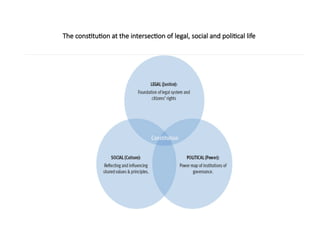
The constitution at the intersection of legal, social and political life
• Constitutions as legal instruments
• A constitution ‘marries power with justice’ (Lutz 2006: 17)—it
makes the operation of power procedurally predictable, upholds
the rule of law, and places limits on the arbitrariness of power.
• It is the supreme law of the land, and it provides the standards
that ordinary statutes have to comply with.
• Constitutions as social declarations
• Constitutions often attempt, to varying degrees, to reflect and
shape society—for example, by expressing the (existing or
intended) common identity and aspirations of the people, or by
proclaiming shared values and ideals.
• These provisions are generally found in preambles and opening
declarations, but can also be found in oaths and mottos or on
flags and other symbols that are defined by the Constitution.
• Other substantive provisions of the constitution, particularly
those defining socio-economic rights, cultural or linguistic
policy, or education, might also belong to this category (Lutz
2006: 16–7).
• Constitutions as political instruments
• The constitution prescribes a country’s decision-making
institutions: constitutions ‘identify the supreme power’,
‘distribute power in a way that leads to effective decision
making’ and ‘provide a framework for continuing political
struggle’ (Lutz 2006: 17).
• The political provisions show how state institutions (parliament,
executive, courts, head of state, local authorities, independent
bodies, etc.) are constituted, what powers they have and how
they relate to one another.
Classification of constitutions
• For purpose of understanding constitutions are
classified in to various categories based on different
criteria.
• 1. By looking at the Nature of the Constitution
itself: Traditional approach.
• A. Written /unwritten, codified/uncodified
• It is generally agreed that the written /unwritten
dichotomy is false distinction.
• There is no constitution which is entirely unwritten
and nor is there a constitution which is entirely
written.
• Written Constitution
• What is meant by a written constitution is, therefore, one
that is reduced into a form of a document having special
sanctity.
• It also designates according to CF Strong: a rather complete
document/instrument in which the framers of the
constitution have attempted to arrange for every
foreseeable contingency in its operation.
• Eg. The USA Constitution
• Unwritten Constitution
• Unwritten constitution on is one which has grown up on the
basis of custom rather than of written law.
• Notable in this regard is the United Kingdom.
• Even if it is called unwritten, but then, there is a great deal
of statute law that could properly fit into the realm of
constitutional law. E.g.
• The 1689 Bill of Rights,
• The various Franchise Acts of the 19th and 20th C. especially the
1911 and 1949 Acts.
• Much of these laws treats fundamental political institutions
in the same way as written constitution does.
• In addition to statutes, Important aspects of constitutional
practice in the United Kingdom are governed by:
• Major judicial decisions of the past (precedents),
• Generally accepted rules of conduct and procedure (convention)
and
• The guidance of such eminent authorities as Dicey, Jennings, and
others.
Classification of constitutions
• B. Rigid/flexible, Conditional/unconditional Classification
• The true ground of division by virtue of the nature of the
constitution itself is whether it is flexible or rigid.
• The rigidity or otherwise flexibility of a constitution hinges on
whether or not its making is identical to the making of other
ordinary laws.
• If the amendment or alteration procedure of a constitution is
not made to depend on some conditions or special
procedures, then it may be called flexible constitution.
• Eg. UK constitution to be amended as ordinary law does
• If some conditions or a special procedure has to be met before
the amendment of a constitution, then it is a rigid
constitution.
• US. Ethiopia etc Constitutions require special Majority
2. By looking at the Nature of the State itself
• Federal/Unitary/Confederal classification
• The classification of constitutions into federal, unitary and confederate
is based upon the principle by which the powers of government are
distributed in the constitution between tiers of governments.
• In a federal constitution,
• Powers of governments are divided between government for the
whole and governments for parts of the country.
• Each government is independent and none is subordinate to the
other,
• Legislature in both cases have limited powers.
• In a unitary constitution, the legislature of the whole country is the
supreme law-making body,
• And it has the mandate to allow other legislatures to exist and exercise
their powers while reserving the right to overrule them as they are
subordinate to it.
• In a confederate constitution, the government of the whole
country is rather subordinate to the governments of the
parts.
• A form of association between governments whereby they
set up a common organization to regulate limited matters of
common concern but retain to themselves, to a greater or
less degree, some control over this common organization.
• Established for dealing with critical issues, such as defense,
foreign relations, internal trade or currency,
• Some countries are federal but may have traditional name
of confederation eg. Switzerland, Canada
• Eg of confederations: US confederation before 1789 &
European Union, Serbia and Montenegro (2003–06).
3. By looking at the nature of the
Government itself
• A. Presidential/Parliamentary Classification and
• If the executive is immediately answerable to the
parliament, then it can be called parliamentary executive.
• But if it is immediately responsible at definitely arranged
intervals to some wider body (usually through Election)
• And is not amenable to removal by the action of the
legislature, then it is called presidential executive.
• In presidential executive, there is a rigid separation of
institutions from the legislature. Hence the president and his
subordinates may not sit in the congress (legislature).
• In parliamentary executive, the heads of department and
ministers may sit in the parliament and hence may be
accountable to the parliament.
• B. Republican/Monarchical Classification
• Where the head of state is a president, then that state is a
republic, and where the head of state is a king, that state is a
monarchy or a kingdom.
• Such classification has a lesser significance nowadays
• Historically it had considerable meaning and importance as it
stood for the difference between what may be called
popular/democratic government and absolutism, autocracy,
or dictatorship
• A monarch, as the name implies, was the sole ruler
responsible to himself alone. But it is difficult today to find
examples of such absolute monarchies
• The transformation of absolute monarchies into constitutional
or limited monarchies all the more diminishes the significance
of the distinction.
4.By looking at the Legislature
• A. Unicameral Legislature
• Uni (One) , Cameral (Chamber)
• Unicameralism is the practice of having only one legislative or
parliamentary chamber.
• Many countries with unicameral legislatures are often small and
homogeneous unitary states and consider an upper house or second
chamber unnecessary;
• The argument is that if an upper house is democratic, it simply mirrors
the equally democratic lower house, and is therefore duplicative.
• The traditional functions of a second chamber, such as reviewing or
revising legislation, can be performed by parliamentary committees,
while further constitutional safeguards can be provided by a written
constitution .
• In many cases, the governments that now have unicameral legislatures
were once bicameral and subsequently eliminated the upper chamber.
• Reasons : Redundancy, unnecessary obstruction of legislation &
inefficiency
• Some have technically bicameral systems that function much
as unicameral systems, because one house is largely
ceremonial and retains few powers.
• Eg. In the United Kingdom control of the House of Commons
determines control of the government
• The unelected House of Lords has the power only to delay
legislation and to recommend amendments.
• Supporters of unicameralism note the need to control
government spending and the elimination of redundant work
done by both chambers.
• Critics of unicameralism point out the double checks and
balances that a bicameral system affords, forcing a greater
level of consensus on legislative issues.
• Unicameral legislatures were and are also common in
Communist and former Communist states
• B. Bicameral Legislature : Bi ( two) Cameral (chambered)
• Historically Ancient Sumer and later ancient Greece, ancient
India, and Rome,
• In medieval Europe bicameralism first arose to provide separate
representation of different classes.
• For example, one house would represent the aristocracy, and
the other would represent the commoners.
• Modern Times the USA Great Compromise
• The Founding Fathers of the United States also favored a
bicameral legislature, though not based on class distinction.
• As part of the Great Compromise, they invented a new
rationale for bicameralism in which the upper house would
have states represented equally, and the lower house would
have them represented by population.
• In subsequent constitution making, federal states have often adopted
bicameralism.
• This solution remains popular when regional differences or sensitivities
require more explicit representation, with the second chamber
representing the constituent states.
• Nevertheless, the older justification for second chambers — providing
opportunities for second thoughts about legislation — has survived.
• A trend towards unicameralism in the 20th century appears now to have
been halted.
• Growing awareness of the complexity of the notion of representation
and the multifunctional nature of modern legislatures may be affording
incipient new rationales for second chambers.
• Some political scientists believe that bicameralism makes meaningful
political reforms more difficult to achieve and increases the risk of
deadlock (particularly in cases where both chambers have similar
powers).
• Others argue strongly for the merits of the 'checks and balances'
provided by the bicameral model.
• Some countries, such as Argentina, Australia, Belgium, Brazil,
Canada, Germany, India, Malaysia, Mexico, Pakistan, Russia,
South Africa, Switzerland, and the United States link their
bicameral systems to their federal political structure.
• In a few countries, bicameralism involves the juxtaposition of
democratic and aristocratic elements. The best known
example is the British House of Lords, which includes a
number of hereditary peers.
• Many bicameral systems are not connected with either
federalism or an aristocracy, however. Japan, France, Italy, the
Netherlands, the Philippines, the Czech Republic, the Republic
of Ireland and Romania are examples of bicameral systems
existing in unitary states.
• In countries such as these, the upper house generally exists
solely for the purpose of scrutinizing and possibly vetoing the
decisions of the lower house.
• C.Tricameral (three Chambered) Legislature
• Tricameralism is the practice of having three legislative or
parliamentary chambers.
• It is contrasted to unicameralism and bicameralism, both of which
are far more common.
• The term was used in South Africa to describe the Parliament
established under the apartheid regime's new Constitution in 1983.
• The South African tricameral parliament consisted of three race-
based chambers:
• House of Assembly — 178 members, reserved for whites
• House of Representatives — 85 members, reserved for Coloured, or
mixed-race, people
• House of Delegates — 45 members, reserved for Asians
• D. Tetracameral
• Tetracameralism (Greek tetra, four + Latin camera, chamber) is
the practice of having four legislative or parliamentary
chambers. It is contrasted to unicameralism and bicameralism,
which are far more common, and tricameralism, which is
rarely used in government.
• Medieval Scandinavian deliberative assemblies were
traditionally tetracameral, with four estates; the nobility, the
clergy, the burghers and the peasants.
• The Swedish and Finnish Riksdag of the Estates maintained
this tradition the longest, having four separate legislative
bodies.
• Finland, as a part of Imperial Russia had tetracameral system
until 1906, when it was followed by the then most modern
legislature, the unicameral Parliament with universal suffrage.
5.By looking at the nature of the Executive
• The quantum, quality and configuration of power
assigned to the executive is the basis of this
classification.
• The classifications are (a) mono cephalous, (b)
bicepalous and (c) acepalous or dispersed leadership.
• The word “cephalous”finds its origin in Greek to refer
to multiple headed Gods. Now, it has been found a
useful way of characterizing various types of
executive.
• Monosepalous Executive
• Bicephalous Executive
• Acephalous Executive (Dispersed Leadership)
6. By looking at the Nature of the Judiciary:
• Prerogative/rule of law system

Constitutional Law Lectures PPT-2-3.pptx

  • 1.
  • 2.
    Constitution: Meaning • Thesupreme law of the land. • The basic law of a state which sets out how that state will be organized, the powers and authorities of government between different political units, and by stating and the basic principles of the society. • In Black Law Dictionary,“ The fundamental and organic law of a nation or state that establishes the institution and system of government, defines the scope of governmental sovereign powers, and guarantees individual civil rights and civil liberties.” • Tomas Paine remark that,“ Government without a Constitution is a power without a right.”
  • 3.
    constitution • Difference:- • Aconstitution can be defined as the fundamental laws custom, conventions, rules and regulations, stipulating how a country is governed, while constitutionalism can be defined as a principle which is not just a constitution but put limitations to the activities of individuals and the government. • The implication of constitutionalism is that in exercising its powers the government should be limited by law. Its authority over the people is dependent on its observance of the limitations under the law. Those limitations are usually enshrined in the constitution. • A constitution is a charter of government deriving its whole authority from the governed. ‘Constitutionalism’ means limited government or limitation on government. It is antithesis of arbitrary powers.
  • 4.
    constitution • After theend of the conflict between monarch and the feudal lords. The results of the revolutions of different kinds in France, USA, USSR, and the over throw of the colonial rule in the 3rd world countries, the concept of “constitutionalism” has taken deep roots. • Conclusion • A constitution can be defined as the fundamental laws custom, conventions, rules and regulations, stipulating how a country is governed, • While constitutionalism can be defined as a principle which is not just a constitution but put limitations to the activities of individuals and the government.
  • 5.
    1.Constitutionalism: Definition • Constitutionalismcomprised of ideas and theories that essentially put limitations on political power in general, and of the government’s sway over citizens in particular. • Refer to a number of separate but related features of a democratic political system. • Constitutionalism is concerned with both the framework as well as the spirit that breathes within the provisions in that framework. • Constitutionalism therefore comprised two key elements: a) rights provision and b) structural provision
  • 6.
    constitutionalism • Rights provision– It consists of safeguards for political rights including the right to free speech, freedom of association, etc. – These rights operate as legal constraints upon the political process. • Structural provision • They include separation of powers, representative system, etc. • All are there to ensure that the government will act in the interests of the public at large, rather than those of the self- interested representatives. • Control of government power – Lord Acton – “All power tends to corrupt & absolute power corrupts absolutely”. • – The government must be limited by law. – It is interrelated with the idea of ‘separation of powers’, ‘rule of law’ & ‘limited government’.
  • 7.
    Aspects/ Characteristics • a.Respect for law • Implies loyalty to Constitution by citizens & officials of the State. • Citizens must accept the limits on their freedom. • Officials must observe the limits on their powers. • Similar to the idea of rule of law in which authorities obtain their powers from the law & must act within the law – ‘Government by law & not by men’.
  • 8.
    Aspects of constitutionalism •b. Internalisation of values • Implies loyalty to the letter as well as the spirit of the Constitution. • Requires commitment to & an ‘internalisation’ of the values & ideals. • Demands observance of enacted rules & respect for unwritten & informal practices, conventions, usages & understandings. • Sir Ivor Jennings immortal words “provide the flesh to clothe the dry bones of the law”.
  • 9.
    Aspects of constitutionalism •c. Respect for human rights • Respect for liberty & equality • Guarantees for human freedom & dignity • A fair balance between conflicting demands of: • Power & liberty, • freedom & responsibility & • the might of the state & the rights of the citizens. • FDRE Constitution contains a chapter 3 on fundamental Rights and liberties (Articles 13 ff)
  • 10.
    Aspects of constitutionalism •d. Controls over discretionary powers • Institutional safeguards against abuse & misuse of powers by authorities • Checks & balances are put in place in order to ensure the government acts within their powers & not exceed. • The government should not itself be destructive of the values it was intended to promote • Effective judicial control of executive discretion is the litmus test of a rule of law society – judicial review
  • 11.
    Aspects of constitutionalism •e. Responsible government • Accountability or answerability of the government • An obligation to explain & justify decisions made or action taken • If individual rights/interests is affected, appropriate compensation should be given • Constitutional models & control mechanisms are introduced including constitutionalism, check & balance, federalism, judicial review, elections, statutory tribunals
  • 12.
    Aspects of constitutionalism •f. Entrenchment of constitutional values • The constitution provides effective legal & political restraints upon the exercise of state power to amend or repeal laws dealing with constitutional safeguards. • g. Independent judiciary • According to de Smith, “constitutionalism is practiced in a country where the government is genuinely accountable to an entity or organ distinct from itself… and where there are effective legal guarantees of civil liberties enforced by an independent judiciary…”
  • 13.
    Aspects of constitutionalism •h. Free and fair elections • Free & fair elections are regularly held in order to elect the government • However, free & fair elections does not guarantee that constitutionalism is being practiced. • Example: Adolf Hitler’s regime came to power through an election. Successive government in Israel have succeeded at the polls but genocidal policies against Palestinians in occupied territories.
  • 14.
    2.Democracy: Definition • Whatis Democracy? • The word democracy comes from the two Greek words "demos", meaning people, and "kratos" meaning power; so democracy can be thought of as "power of the people": a way of governing which depends on the will of the people. • The term “democracy,” refers very generally to a method of group decision making characterized by a kind of equality among the participants at an essential stage of the collective decision making. • Democracy concerns collective decision making, by which It means decisions that are made for groups and that are binding on all the members of the group. There are so many different models of democratic government around the world that it is sometimes easier to understand the idea of democracy in terms of what it definitely is not.
  • 15.
    Democracy • In democracysupreme power is in the hands of people who exercise this power either directly or indirectly, thought the elected representatives who responsible to the people. • Democracy, then, is not autocracy or dictatorship, where one person rules; and It is not oligarchy, where a small segment of society rules. • Properly understood, democracy should not even be "rule of the majority", if that means that minorities' interests are ignored completely. • A democracy, at least in theory, is government on behalf of all the people, according to their "will".
  • 16.
    Characteristics of democracy •Sovereignty with the people • State and government are considered means • Faith in the rationality of man • Liberty • Equality • Fraternity • Provision of fundamental rights • Independent and impartial judiciary • Rule of majority
  • 17.
    Characteristics of Democracy •Respect of public opinion • Faith in peaceful and constitutional methods • Freedom to form opposition parties • Open competition for political power • Periodic elections • Independent means of propaganda • Rule of law • Decentralization of power • Pluralistic character of the society
  • 18.
    Democratic Theory • Whydemocracy? • The idea of democracy derives its moral strength – and popular appeal – from two key principles: • 1. Individual autonomy: The idea that no-one should be subject to rules which have been imposed by others. People should be able to control their own lives (within reason). • 2. Equality: The idea that everyone should have the same opportunity to influence the decisions that affect people in society. • These principles are intuitively appealing, and they help to explain why democracy is so popular. Of course we feel it is fair that we should have as much chance as anyone else to decide on common rules!
  • 19.
    Democratic Theory • Theproblems arise when we consider how the principles can be put into practice, because we need a mechanism for deciding how to address conflicting views. • Because it offers a simple mechanism, democracy tends to be "rule of the majority"; but rule of the majority can mean that some people's interests are never represented. • A more genuine way of representing everyone's interests is to use decision making by consensus, where the aim is to find common points of interest.
  • 20.
    Democratic Theory • Thesocial and economic conditions supporting a viable representative democracy are complex. • The following institutional conditions need obtain: • a) popular election of representatives; by universal adult suffrage in districts of approximately equal population for limited terms, to institutions that allow those representatives to govern; • b) free entry of citizens to candidacy for electoral office; and • c)freedom of political communication and association.
  • 21.
    Democratic Theory • Itis this process that makes governmental action morally binding - i.e. the people‘s freely choosing representatives, those representatives‘ debating and enacting policy and later standing for reelection, and administrators‘ enforcing that policy. • Here, reliance on Aristotlian simple claim is clearly viable i.e. that the people‘s collective wisdom will exceed that of any simple person or small group. • Few democratic theorists assume citizens possess equal capacity to understand the options or, as a whole, will always understand the issues.
  • 22.
    Democratic Theory • Thechief democratic theorists posit against tyranny is that the people will not tyrannize themselves. • As Jefferson asserted, it is the ―mass of citizens” who are the safest depository of their own rights. • Thus, democratic theory stems from popular participation not only for its positive effect of expressing individual autonomy, but also for its negative effect of deterring governmental incursions into individual rights. • Because voters need to be informed to protect their interests, democrats advocate freedom of communication,
  • 23.
    Democratic Theory • Yet,communication and voting are not sufficient for forming and expressing “the will of the people.” Democratic theory also demands a right to act in concert with others.
  • 24.
    3. The Ruleof Law • A preference for law & order • Colin Munro wrote that rule of law has emerged out of constitutionalism. • Whereas, Dicey defined rule of law as: a) the supremacy of regular laws over arbitrary power, b) formal legal equality before the law & c) the constitution that is defined and enforced by regular courts. • The Rule of Law Core Characteristics • a. Legality • Requires that a society must be governed by a government of laws & not by a regime of arbitrary powers. • Supremacy of laws. • Government officials must show respect for the law & must observe their power.
  • 25.
    Rule of Law •b. Controls on discretion • All powers must be subject to limits. • There must be controls on executive discretion so that discretionary authority does not degenerate into arbitrariness. • c. Impartial system of justice • Enforcement by independent judiciary enforcing power without fear or favour. • Judiciary must be free from extraneous pressures.
  • 26.
    Rule of Law •d. Just Legality • Compliance with substantive human rights values. • Must honor & promote individual liberty, equality & dignity. • Limit on the power of state to restrict citizen’s rights. • Ideals about citizen-state relationship. • e. Socio-economic Justice • State support for socio-economic policies to help the weak, the oppressed & the marginalized. • State must be involved in social scheme to bring welfare to those who are unable to actualize their freedoms & rights.
  • 27.
    Rule of Law •f. Effective Government • Government must be capable of enforcing the law & order & ensuring socioeconomic & legal justice. • Citizens must respect the law & accept the results of the legal & electoral processes.
  • 28.
    Fuller’s Conception ofRule of Law • Lon Fuller‘s view of the “inner morality” of law. • Rule of Law is not treated in its general sense of government under law, but in much more specific, comprehensive manner. • Fuller distinguished between: • Inner morality of law: the substantive aims or values that particular legal rules (standards) seek to promote; & • External morality of law: the values that underlie the concept of law itself. • Fuller’s conception of the Rule of Law, not by appealing to moral values drawn from the external morality but from inner morality of the law. • These values are characterized as the eight desiderata. • These identified eight elements of law, recognized as necessary for a society aspiring to institute the Rule of law.
  • 29.
    • Fuller’s 8Desederata of law 1. Laws must exist and those laws should be able to win obedience. 2. Laws must be published. 3. Laws must be prospective ( not retroactive) in nature so that the effect of the law may only take place after the law has been passed. Laws should be written with reasonable clarity to avoid unfair enforcement. 4. Law must avoid contradictions. (intelligibility) 5. Law must not command the impossible. ( Non self- contradictoriness) 6. Law must be general. 7. Laws must stay constant through time to allow the formalization of rules; however; law also must allow for timely revision when the underlying and political circumstances have changed. 8. Official action should be consistent with the declared rule. (Congruency)
  • 30.
    • Fuller’s Criteriais helpful in understanding rule of law, because: it outlines the types of rules; of formal constraints that societies should develop in order to approach legal problems in a way that minimizes the abuse of the legal process and political power. • Rule of law, however, extends beyond mere regulation and is also shaped by the so-called institutional constraints and Informal constraints, • Institutional Constraints include the existence of an independent judiciary and developing ways of promoting transparent governance • Informal constraints such as local culture or traditions that may encourage citizens to organize their behavior around the law
  • 31.
    • The veryterm Rule of Law suggests that the law itself is the sovereign, or the ruler, in a society. • As an idea, the rule of law stands for the proposition that no person or particular branch of government may rise above rules made by selected political officials. • These laws reflect the morals of a society, and in a Western Democracy they are supposed to be pre-established, formalized, neutral, and objective. • Everyone is subject to their dictates in the same way. The rule of law, therefore, is supposed to promote equality under the law. • Thus, rule of law should be clearly differentiated from rule by law; i.e. the latter does not necessarily mean that the law is legitimate for it might not satisfy most of the desederatas. • Rule of law may be most concretely defined as • “a theory of governance relying upon a series of law, which may be most concretely designed to encourage order and to prevent arbitrary and unreasonable exercise of government power.”
  • 32.
    1.3. The Functionsof a Constitution • 1. Constitutions can declare and define the boundaries of the political community • These boundaries can be territorial (the geographical borders of a state, as well as its claims to any other territory or extra-territorial rights) and personal (the definition of citizenship). • Thus, a constitution often distinguishes between those inside and outside the polity.
  • 33.
    • 2. Constitutionscan declare and define the nature and authority of the political community. • They often declare the state’s fundamental principles and assumptions, as well as where its sovereignty lies. • For example, the French Constitution declares that ‘France is an indivisible, secular, democratic and social Republic’ and that ‘National sovereignty belongs to the people, who exercise it through their representatives and by means of referendums’. • The Constitution of Ghana (1992) states that ‘The Sovereignty of Ghana resides in the people of Ghana in whose name and for whose welfare the powers of government are to be exercised’.
  • 34.
    • 3. Constitutionscan express the identity and values of a national community. • As nation-building instruments, constitutions may define the national flag, anthem and other symbols, and may make proclamations about the values, history and identity of the nation. • 4. Constitutions can declare and define the rights and duties of citizens. • Most constitutions include a declaration of fundamental rights applicable to citizens. • At a minimum, these will include the basic civil liberties that are necessary for an open and democratic society.
  • 35.
    • (e.g. thefreedoms of thought, speech, association and assembly; due process of law and freedom from arbitrary arrest or unlawful punishment). • Many constitutions go beyond this minimum to include social, economic and cultural rights or the specific collective rights of minority communities. • And some rights may apply to both citizens and non-citizens, such as the right to be free from torture or physical abuse.
  • 36.
    • 5.Constitutions canestablish and regulate the political institutions of the community. • Constitutions define the various institutions of government; prescribe their composition, powers and functions; and regulate relations between them. • Almost all constitutions establish legislative, executive and judicial branches of government. • In addition, there may be a symbolic head of state, institutions to ensure the integrity of the political process (e.g. an electoral commission), and institutions to ensure the accountability and transparency of those in power (e.g. an ombudsman). • The institutional provisions typically provide mechanisms for the democratic allocation and peaceful transfer of power (e.g. elections) and for the restraint and removal of those who abuse power or who have lost the confidence of the people (e.g. impeachment procedures).
  • 37.
    • 6.Constitutions candivide or share power between different layers of government or sub-state communities. • Many constitutions establish federal, quasi-federal or decentralized processes for the sharing of power between provinces, regions or other sub-state communities. • These may be geographically defined (as in most federations, such as Argentina, Canada or India), or they may be defined by cultural or linguistic communities (e.g. the 1994 Constitution of Belgium, which establishes autonomous linguistic communities in addition to geographical regions).
  • 38.
    • 7.Constitutions candeclare the official religious identity of the state and demarcate relationships between sacred and secular authorities. • This is particularly important in societies where religious and national identities are interrelated, or where religious law has traditionally determined matters of personal status or the arbitration of disputes between citizens. • 8.Constitutions can commit states to particular social, economic or developmental goals. • This may take the form of judicially enforceable socio- economic rights, directive principles that are politically binding on the government, or other expressions of commitment or intent.
  • 39.
    The constitution atthe intersection of legal, social and political life
  • 40.
    • Constitutions aslegal instruments • A constitution ‘marries power with justice’ (Lutz 2006: 17)—it makes the operation of power procedurally predictable, upholds the rule of law, and places limits on the arbitrariness of power. • It is the supreme law of the land, and it provides the standards that ordinary statutes have to comply with. • Constitutions as social declarations • Constitutions often attempt, to varying degrees, to reflect and shape society—for example, by expressing the (existing or intended) common identity and aspirations of the people, or by proclaiming shared values and ideals. • These provisions are generally found in preambles and opening declarations, but can also be found in oaths and mottos or on flags and other symbols that are defined by the Constitution.
  • 41.
    • Other substantiveprovisions of the constitution, particularly those defining socio-economic rights, cultural or linguistic policy, or education, might also belong to this category (Lutz 2006: 16–7). • Constitutions as political instruments • The constitution prescribes a country’s decision-making institutions: constitutions ‘identify the supreme power’, ‘distribute power in a way that leads to effective decision making’ and ‘provide a framework for continuing political struggle’ (Lutz 2006: 17). • The political provisions show how state institutions (parliament, executive, courts, head of state, local authorities, independent bodies, etc.) are constituted, what powers they have and how they relate to one another.
  • 42.
    Classification of constitutions •For purpose of understanding constitutions are classified in to various categories based on different criteria. • 1. By looking at the Nature of the Constitution itself: Traditional approach. • A. Written /unwritten, codified/uncodified • It is generally agreed that the written /unwritten dichotomy is false distinction. • There is no constitution which is entirely unwritten and nor is there a constitution which is entirely written.
  • 43.
    • Written Constitution •What is meant by a written constitution is, therefore, one that is reduced into a form of a document having special sanctity. • It also designates according to CF Strong: a rather complete document/instrument in which the framers of the constitution have attempted to arrange for every foreseeable contingency in its operation. • Eg. The USA Constitution • Unwritten Constitution • Unwritten constitution on is one which has grown up on the basis of custom rather than of written law. • Notable in this regard is the United Kingdom.
  • 44.
    • Even ifit is called unwritten, but then, there is a great deal of statute law that could properly fit into the realm of constitutional law. E.g. • The 1689 Bill of Rights, • The various Franchise Acts of the 19th and 20th C. especially the 1911 and 1949 Acts. • Much of these laws treats fundamental political institutions in the same way as written constitution does. • In addition to statutes, Important aspects of constitutional practice in the United Kingdom are governed by: • Major judicial decisions of the past (precedents), • Generally accepted rules of conduct and procedure (convention) and • The guidance of such eminent authorities as Dicey, Jennings, and others.
  • 45.
    Classification of constitutions •B. Rigid/flexible, Conditional/unconditional Classification • The true ground of division by virtue of the nature of the constitution itself is whether it is flexible or rigid. • The rigidity or otherwise flexibility of a constitution hinges on whether or not its making is identical to the making of other ordinary laws. • If the amendment or alteration procedure of a constitution is not made to depend on some conditions or special procedures, then it may be called flexible constitution. • Eg. UK constitution to be amended as ordinary law does • If some conditions or a special procedure has to be met before the amendment of a constitution, then it is a rigid constitution. • US. Ethiopia etc Constitutions require special Majority
  • 46.
    2. By lookingat the Nature of the State itself • Federal/Unitary/Confederal classification • The classification of constitutions into federal, unitary and confederate is based upon the principle by which the powers of government are distributed in the constitution between tiers of governments. • In a federal constitution, • Powers of governments are divided between government for the whole and governments for parts of the country. • Each government is independent and none is subordinate to the other, • Legislature in both cases have limited powers. • In a unitary constitution, the legislature of the whole country is the supreme law-making body, • And it has the mandate to allow other legislatures to exist and exercise their powers while reserving the right to overrule them as they are subordinate to it.
  • 47.
    • In aconfederate constitution, the government of the whole country is rather subordinate to the governments of the parts. • A form of association between governments whereby they set up a common organization to regulate limited matters of common concern but retain to themselves, to a greater or less degree, some control over this common organization. • Established for dealing with critical issues, such as defense, foreign relations, internal trade or currency, • Some countries are federal but may have traditional name of confederation eg. Switzerland, Canada • Eg of confederations: US confederation before 1789 & European Union, Serbia and Montenegro (2003–06).
  • 48.
    3. By lookingat the nature of the Government itself • A. Presidential/Parliamentary Classification and • If the executive is immediately answerable to the parliament, then it can be called parliamentary executive. • But if it is immediately responsible at definitely arranged intervals to some wider body (usually through Election) • And is not amenable to removal by the action of the legislature, then it is called presidential executive. • In presidential executive, there is a rigid separation of institutions from the legislature. Hence the president and his subordinates may not sit in the congress (legislature). • In parliamentary executive, the heads of department and ministers may sit in the parliament and hence may be accountable to the parliament.
  • 49.
    • B. Republican/MonarchicalClassification • Where the head of state is a president, then that state is a republic, and where the head of state is a king, that state is a monarchy or a kingdom. • Such classification has a lesser significance nowadays • Historically it had considerable meaning and importance as it stood for the difference between what may be called popular/democratic government and absolutism, autocracy, or dictatorship • A monarch, as the name implies, was the sole ruler responsible to himself alone. But it is difficult today to find examples of such absolute monarchies • The transformation of absolute monarchies into constitutional or limited monarchies all the more diminishes the significance of the distinction.
  • 50.
    4.By looking atthe Legislature • A. Unicameral Legislature • Uni (One) , Cameral (Chamber) • Unicameralism is the practice of having only one legislative or parliamentary chamber. • Many countries with unicameral legislatures are often small and homogeneous unitary states and consider an upper house or second chamber unnecessary; • The argument is that if an upper house is democratic, it simply mirrors the equally democratic lower house, and is therefore duplicative. • The traditional functions of a second chamber, such as reviewing or revising legislation, can be performed by parliamentary committees, while further constitutional safeguards can be provided by a written constitution . • In many cases, the governments that now have unicameral legislatures were once bicameral and subsequently eliminated the upper chamber. • Reasons : Redundancy, unnecessary obstruction of legislation & inefficiency
  • 51.
    • Some havetechnically bicameral systems that function much as unicameral systems, because one house is largely ceremonial and retains few powers. • Eg. In the United Kingdom control of the House of Commons determines control of the government • The unelected House of Lords has the power only to delay legislation and to recommend amendments. • Supporters of unicameralism note the need to control government spending and the elimination of redundant work done by both chambers. • Critics of unicameralism point out the double checks and balances that a bicameral system affords, forcing a greater level of consensus on legislative issues. • Unicameral legislatures were and are also common in Communist and former Communist states
  • 52.
    • B. BicameralLegislature : Bi ( two) Cameral (chambered) • Historically Ancient Sumer and later ancient Greece, ancient India, and Rome, • In medieval Europe bicameralism first arose to provide separate representation of different classes. • For example, one house would represent the aristocracy, and the other would represent the commoners. • Modern Times the USA Great Compromise • The Founding Fathers of the United States also favored a bicameral legislature, though not based on class distinction. • As part of the Great Compromise, they invented a new rationale for bicameralism in which the upper house would have states represented equally, and the lower house would have them represented by population.
  • 53.
    • In subsequentconstitution making, federal states have often adopted bicameralism. • This solution remains popular when regional differences or sensitivities require more explicit representation, with the second chamber representing the constituent states. • Nevertheless, the older justification for second chambers — providing opportunities for second thoughts about legislation — has survived. • A trend towards unicameralism in the 20th century appears now to have been halted. • Growing awareness of the complexity of the notion of representation and the multifunctional nature of modern legislatures may be affording incipient new rationales for second chambers. • Some political scientists believe that bicameralism makes meaningful political reforms more difficult to achieve and increases the risk of deadlock (particularly in cases where both chambers have similar powers). • Others argue strongly for the merits of the 'checks and balances' provided by the bicameral model.
  • 54.
    • Some countries,such as Argentina, Australia, Belgium, Brazil, Canada, Germany, India, Malaysia, Mexico, Pakistan, Russia, South Africa, Switzerland, and the United States link their bicameral systems to their federal political structure. • In a few countries, bicameralism involves the juxtaposition of democratic and aristocratic elements. The best known example is the British House of Lords, which includes a number of hereditary peers. • Many bicameral systems are not connected with either federalism or an aristocracy, however. Japan, France, Italy, the Netherlands, the Philippines, the Czech Republic, the Republic of Ireland and Romania are examples of bicameral systems existing in unitary states. • In countries such as these, the upper house generally exists solely for the purpose of scrutinizing and possibly vetoing the decisions of the lower house.
  • 55.
    • C.Tricameral (threeChambered) Legislature • Tricameralism is the practice of having three legislative or parliamentary chambers. • It is contrasted to unicameralism and bicameralism, both of which are far more common. • The term was used in South Africa to describe the Parliament established under the apartheid regime's new Constitution in 1983. • The South African tricameral parliament consisted of three race- based chambers: • House of Assembly — 178 members, reserved for whites • House of Representatives — 85 members, reserved for Coloured, or mixed-race, people • House of Delegates — 45 members, reserved for Asians
  • 56.
    • D. Tetracameral •Tetracameralism (Greek tetra, four + Latin camera, chamber) is the practice of having four legislative or parliamentary chambers. It is contrasted to unicameralism and bicameralism, which are far more common, and tricameralism, which is rarely used in government. • Medieval Scandinavian deliberative assemblies were traditionally tetracameral, with four estates; the nobility, the clergy, the burghers and the peasants. • The Swedish and Finnish Riksdag of the Estates maintained this tradition the longest, having four separate legislative bodies. • Finland, as a part of Imperial Russia had tetracameral system until 1906, when it was followed by the then most modern legislature, the unicameral Parliament with universal suffrage.
  • 57.
    5.By looking atthe nature of the Executive • The quantum, quality and configuration of power assigned to the executive is the basis of this classification. • The classifications are (a) mono cephalous, (b) bicepalous and (c) acepalous or dispersed leadership. • The word “cephalous”finds its origin in Greek to refer to multiple headed Gods. Now, it has been found a useful way of characterizing various types of executive. • Monosepalous Executive
  • 58.
  • 59.
    • Acephalous Executive(Dispersed Leadership)
  • 60.
    6. By lookingat the Nature of the Judiciary: • Prerogative/rule of law system