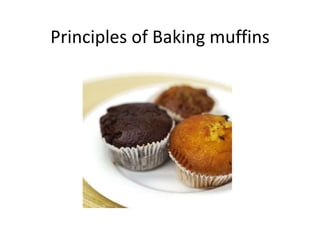
Principles of Baking muffins
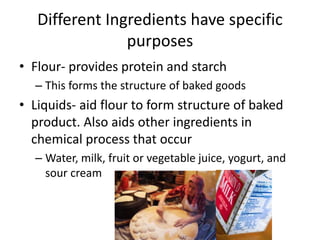
Different Ingredients have specific
purposes
• Flour- provides protein and starch
– This forms the structure of baked goods
• Liquids- aid flour to form structure of baked
product. Also aids other ingredients in
chemical process that occur
– Water, milk, fruit or vegetable juice, yogurt, and
sour cream
Ingredient functions
• Leavening agents
– Baking powder- makes products rise by causing air
or gas to be trapped in the mixture. It this didn’t
happen, products would be flat.
• Fats and oils make products rich and tender,
they also add flavor and help to brown the
crust
• Sweeteners- like sugar give flavor and help
crust to brown.
Ingredient functions
• Eggs make baked products tender, add flavor
and richness, and can help bind mixtures
together
– Beaten egg whites may be used as a leavening
agent
• Flavorings- chocolate, spices, herbs, and
extracts such as vanilla and almond
Dough, Batter, and Gluten
• Dough- thick enough to be shaped by hand or cut
into shapes (biscuits and cookies)
• Batter- thin enough to be poured or dropped
from a spoon (pancakes and MUFFINS)
• 2 reasons for mixing ingredients as recipe states:
– Distribute ingredients evenly
– Develop gluten (elastic substance formed by the
protein in flour) which forms structure to products
• The more you mix the stronger gluten is formed
How leavening agents work
• Add air or another gas to the product, helping
it rise
– Trapped air
– Steam
– Chemical leavening- 2 types
• Baking soda
• Baking powder
• They are not the same thing!
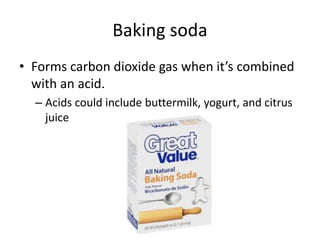
Baking soda
• Forms carbon dioxide gas when it’s combined
with an acid.
– Acids could include buttermilk, yogurt, and citrus
juice
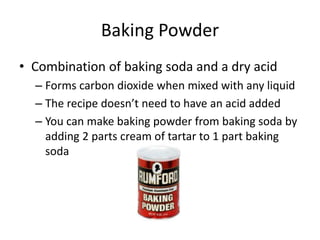
Baking Powder
• Combination of baking soda and a dry acid
– Forms carbon dioxide when mixed with any liquid
– The recipe doesn’t need to have an acid added
– You can make baking powder from baking soda by
adding 2 parts cream of tartar to 1 part baking
soda

BA U 2 SEM 5 principles_of_baking.pptx

  • 1.
  • 2.
    Different Ingredients havespecific purposes • Flour- provides protein and starch – This forms the structure of baked goods • Liquids- aid flour to form structure of baked product. Also aids other ingredients in chemical process that occur – Water, milk, fruit or vegetable juice, yogurt, and sour cream
  • 3.
    Ingredient functions • Leaveningagents – Baking powder- makes products rise by causing air or gas to be trapped in the mixture. It this didn’t happen, products would be flat. • Fats and oils make products rich and tender, they also add flavor and help to brown the crust • Sweeteners- like sugar give flavor and help crust to brown.
  • 4.
    Ingredient functions • Eggsmake baked products tender, add flavor and richness, and can help bind mixtures together – Beaten egg whites may be used as a leavening agent • Flavorings- chocolate, spices, herbs, and extracts such as vanilla and almond
  • 5.
    Dough, Batter, andGluten • Dough- thick enough to be shaped by hand or cut into shapes (biscuits and cookies) • Batter- thin enough to be poured or dropped from a spoon (pancakes and MUFFINS) • 2 reasons for mixing ingredients as recipe states: – Distribute ingredients evenly – Develop gluten (elastic substance formed by the protein in flour) which forms structure to products • The more you mix the stronger gluten is formed
  • 6.
    How leavening agentswork • Add air or another gas to the product, helping it rise – Trapped air – Steam – Chemical leavening- 2 types • Baking soda • Baking powder • They are not the same thing!
  • 7.
    Baking soda • Formscarbon dioxide gas when it’s combined with an acid. – Acids could include buttermilk, yogurt, and citrus juice
  • 8.
    Baking Powder • Combinationof baking soda and a dry acid – Forms carbon dioxide when mixed with any liquid – The recipe doesn’t need to have an acid added – You can make baking powder from baking soda by adding 2 parts cream of tartar to 1 part baking soda