Trion manufactures a variety of plasma etch and deposition systems for the Compound
Semiconductor, MEMS, Opto-Electronic and other markets. Our products feature the smallest
footprint and lowest cost systems in the industry with proven production reliability. If you wish
anything from full-blown production cluster tools to a simple laboratory system, Trion makes it.
Trion Technology
production
Over 20 Years of Innovation
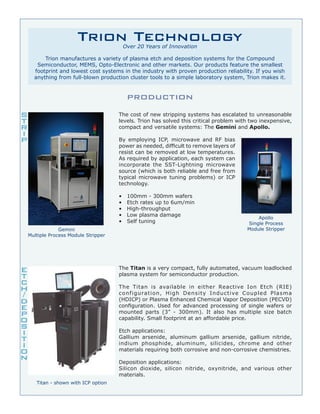
The Titan is a very compact, fully automated, vacuum loadlocked
plasma system for semiconductor production.
The Titan is available in either Reactive Ion Etch (RIE)
configuration, High Density Inductive Coupled Plasma
(HDICP) or Plasma Enhanced Chemical Vapor Deposition (PECVD)
configuration. Used for advanced processing of single wafers or
mounted parts (3” - 300mm). It also has multiple size batch
capability. Small footprint at an affordable price.
Etch applications:
Gallium arsenide, aluminum gallium arsenide, gallium nitride,
indium phosphide, aluminum, silicides, chrome and other
materials requiring both corrosive and non-corrosive chemistries.
Deposition applications:
Silicon dioxide, silicon nitride, oxynitride, and various other
materials.
Titan - shown with ICP option
e
t
c
h
/
d
e
p
o
s
i
t
i
o
n
s
t
r
i
p
The cost of new stripping systems has escalated to unreasonable
levels. Trion has solved this critical problem with two inexpensive,
compact and versatile systems: The Gemini and Apollo.
By employing ICP, microwave and RF bias
power as needed, difficult to remove layers of
resist can be removed at low temperatures.
As required by application, each system can
incorporate the SST-Lightning microwave
source (which is both reliable and free from
typical microwave tuning problems) or ICP
technology.
•  100mm - 300mm wafers
•  Etch rates up to 6um/min
• High-throughput
•  Low plasma damage
•  Self tuning
Gemini
Multiple Process Module Stripper
Apollo
Single Process
Module Stripper
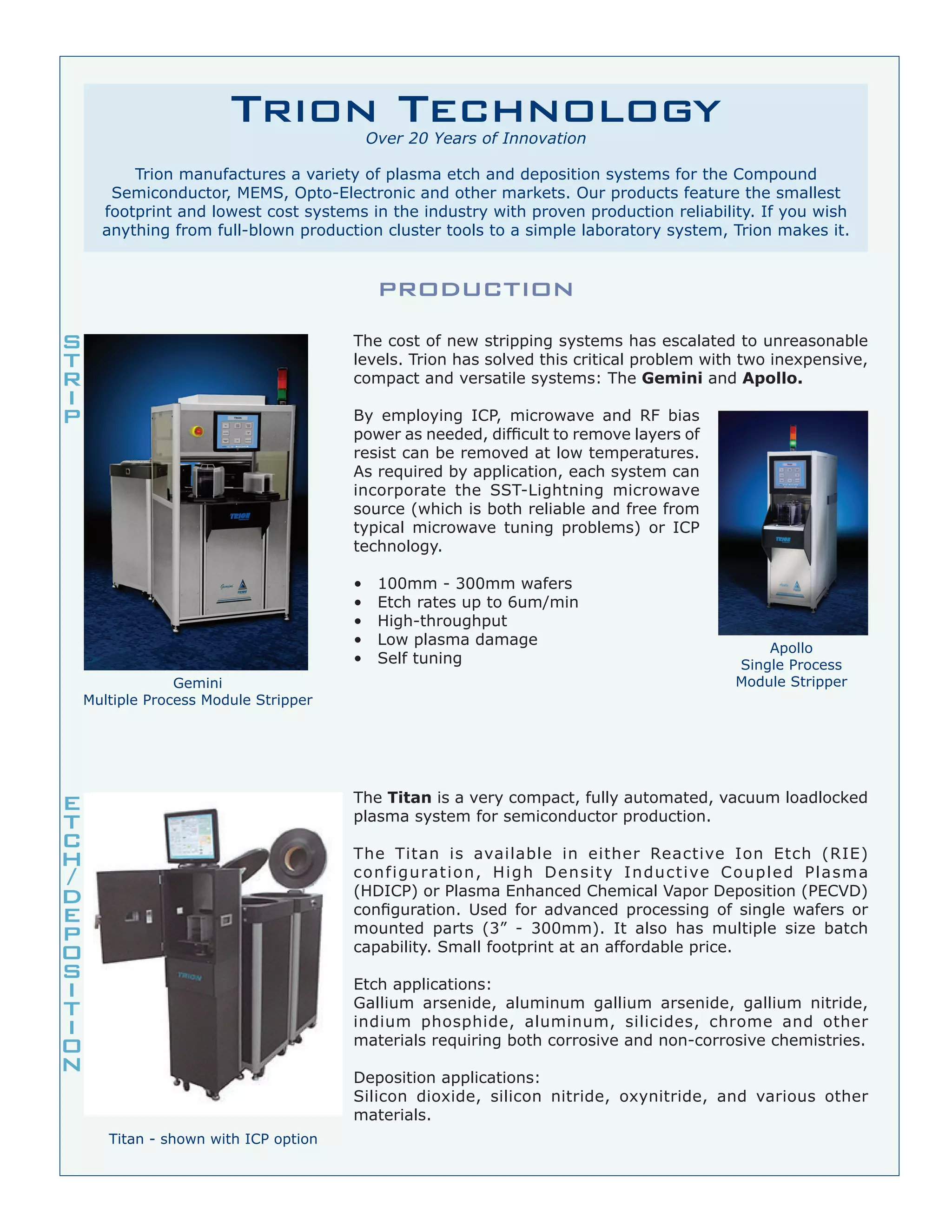
The Oracle III is the smallest full production cluster
system on the market.
It consists of a central vacuum transport (CVT),
vacuum cassette elevators and up to four process
reactors. These process reactors are docked to the central
loadlock and run in production-mode or can be operated
independently as stand-alone systems. The Oracle III
can be configured for either the laboratory environment
(single wafer loading) or for full production (vacuum
cassette elevators) making it the most flexible system
on the market.
Because the Oracle III accommodates up to four
separate process chambers, there are many possible
process combinations, including RIE/ICP etch and PECVD
deposition. Multiple chambers can be run at the same
time. Processes are safely run without atmospheric
contamination since all chambers are vacuum loadlocked.
Oracle III
Cluster Plasma Etch/Deposition System
pilot line/small production
The Minilock-Orion III is a state-of-the-art Plasma Enhanced
Chemical Vapor Deposition (PECVD) system.
The system’s bottom electrode is available in either 200mm or
300mm sizes and depending on electrode configuration, can
process single wafers or mounted parts (3” - 300mm), or
multiple-size batch wafers (4x3”; 3x4”; 7x2”).
The Minilock-Orion III is used for toxic/pyrophoric PECVD processes.
Films deposited: oxides, oxynitrides, nitrides, amorphous silicon
and silicon carbide. Process gases: 100% silane, ammonia, TEOS,
diethylsilane, nitrous oxide, oxygen, nitrogen, trimethylsilane and
methane.
A triode or inductively-coupled plasma (ICP) source is offered as
an option for this tool. The triode allows the user to create higher
density plasma and thereby control film stress.
Samples are loaded into the process chamber via the vacuum
loadlock. This feature increases user safety by preventing contact
with the process chamber and any residual deposit by-products.
The loadlock also allows the chamber to remain permanently
under vacuum thereby keeping the reaction chamber isolated from
the atmosphere.
d
e
p
o
s
i
t
i
o
n
Minilock-Orion III PECVD
production
e
t
c
h
/
d
e
p
o
s
i
t
i
o
n
lab/r&d/f.a.
pilot line/small production
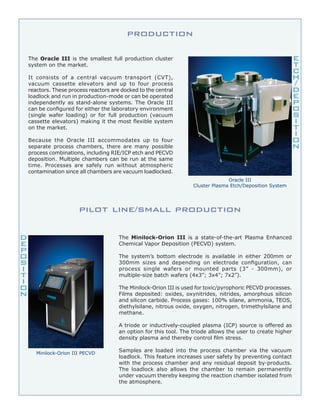
The Minilock-Phantom III is a vacuum loadlocked Reactive Ion
Etcher (RIE).
It is designed to supply laboratories and pilot line production
environments with state-of-the-art etch capability using single
wafers or mounted parts (3” - 300mm). It also has multiple size
batch capability (4x3”; 3x4”; 7x2”).
The system has up to seven process gases which are used
to etch films such as silicon oxide, silicon nitride, polysilicon,
aluminum, gallium arsenide, chrome, copper, indium phosphide and
titanium. This reactor can also be used to strip photoresist and other
organic materials. An electrostatic chuck (E-chuck) is offered as
an option to more effectively keep the wafer cool during the etch
process. This E-chuck uses a helium pressure controller to build up a
cooling layer of helium on the backside of the wafer.
An inductively coupled plasma (ICP) source is offered as an option
for this tool. The ICP allows the user to create a higher density
plasma and thereby increase etch rates and anisotropy.
Samples are loaded into the process chamber via the vacuum
loadlock. This feature increases user safety by preventing contact
with the process chamber and any residual etch by-products. The
loadlock also allows the chamber to remain permanently under
vacuum thereby keeping out moisture and keeping the reaction
chamber free of possible corrosion.
e
t
c
h
The Orion III Plasma Enhanced Chemical Vapor Deposition
(PECVD) system is designed to supply laboratories and pilot line
production environments with state-of-the-art deposition capability
using single wafers, dies or parts up to 300mm.
The Orion III system is used for non-pyrophoric PECVD processes.
Films deposited: oxides, oxynitrides, nitrides and amorphous
silicon. Process gases: <20% silane, ammonia, TEOS, diethylsilane,
nitrous oxide, oxygen and nitrogen.
An ICP or Triode source is offered as an option for this tool. The
Triode allows the user to create higher density plasma and thereby
control film stress.
Samples are loaded into the process chamber by opening the lid
and placing wafers on the electrode surface, or “chuck.”
Orion III PECVD
d
e
p
o
s
i
t
i
o
n
Minilock-Phantom III RIE
shown with ICP option
© 2017 Trion Technology Inc. All rights reserved.
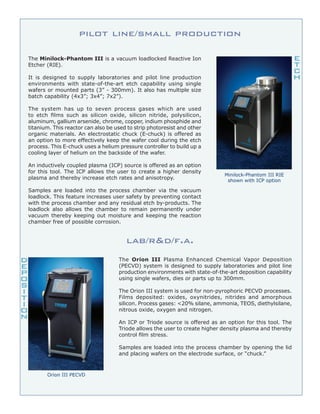
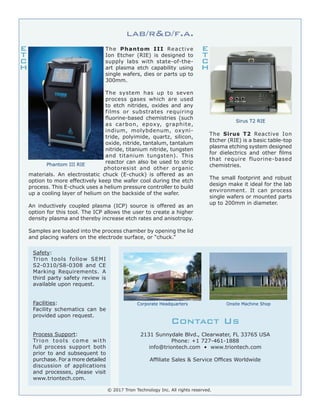
The Sirus T2 Reactive Ion
Etcher (RIE) is a basic table-top
plasma etching system designed
for dielectrics and other films
that require fluorine-based
chemistries.
The small footprint and robust
design make it ideal for the lab
environment. It can process
single wafers or mounted parts
up to 200mm in diameter.
Contact Us
2131 Sunnydale Blvd., Clearwater, FL 33765 USA
Phone: +1 727-461-1888
info@triontech.com • www.triontech.com
Affiliate Sales & Service Offices Worldwide
Corporate Headquarters Onsite Machine Shop
The Phantom III Reactive
Ion Etcher (RIE) is designed to
supply labs with state-of-the-
art plasma etch capability using
single wafers, dies or parts up to
300mm.
The system has up to seven
process gases which are used
to etch nitrides, oxides and any
films or substrates requiring
fluorine-based chemistries (such
as carbon, epoxy, graphite,
indium, molybdenum, oxyni-
tride, polyimide, quartz, silicon,
oxide, nitride, tantalum, tantalum
nitride, titanium nitride, tungsten
and titanium tungsten). This
reactor can also be used to strip
				photoresist and other organic
materials. An electrostatic chuck (E-chuck) is offered as an
option to more effectively keep the wafer cool during the etch
process. This E-chuck uses a helium pressure controller to build
up a cooling layer of helium on the backside of the wafer.
An inductively coupled plasma (ICP) source is offered as an
option for this tool. The ICP allows the user to create a higher
density plasma and thereby increase etch rates and anisotropy.
Samples are loaded into the process chamber by opening the lid
and placing wafers on the electrode surface, or “chuck.”
lab/r&d/f.a.
Safety:
Trion tools follow SEMI
S2-0310/S8-0308 and CE
Marking Requirements. A
third party safety review is
available upon request.
Facilities:
Facility schematics can be
provided upon request.
Process Support:
Trion tools come with
full process support both
prior to and subsequent to
purchase. For a more detailed
discussion of applications
and processes, please visit
www.triontech.com.
e
t
c
h
Sirus T2 RIE
e
t
c
h
Phantom III RIE

Trion English Brochure

  • 1.
    Trion manufactures avariety of plasma etch and deposition systems for the Compound Semiconductor, MEMS, Opto-Electronic and other markets. Our products feature the smallest footprint and lowest cost systems in the industry with proven production reliability. If you wish anything from full-blown production cluster tools to a simple laboratory system, Trion makes it. Trion Technology production Over 20 Years of Innovation The Titan is a very compact, fully automated, vacuum loadlocked plasma system for semiconductor production. The Titan is available in either Reactive Ion Etch (RIE) configuration, High Density Inductive Coupled Plasma (HDICP) or Plasma Enhanced Chemical Vapor Deposition (PECVD) configuration. Used for advanced processing of single wafers or mounted parts (3” - 300mm). It also has multiple size batch capability. Small footprint at an affordable price. Etch applications: Gallium arsenide, aluminum gallium arsenide, gallium nitride, indium phosphide, aluminum, silicides, chrome and other materials requiring both corrosive and non-corrosive chemistries. Deposition applications: Silicon dioxide, silicon nitride, oxynitride, and various other materials. Titan - shown with ICP option e t c h / d e p o s i t i o n s t r i p The cost of new stripping systems has escalated to unreasonable levels. Trion has solved this critical problem with two inexpensive, compact and versatile systems: The Gemini and Apollo. By employing ICP, microwave and RF bias power as needed, difficult to remove layers of resist can be removed at low temperatures. As required by application, each system can incorporate the SST-Lightning microwave source (which is both reliable and free from typical microwave tuning problems) or ICP technology. •  100mm - 300mm wafers •  Etch rates up to 6um/min • High-throughput •  Low plasma damage •  Self tuning Gemini Multiple Process Module Stripper Apollo Single Process Module Stripper
  • 2.
    The Oracle IIIis the smallest full production cluster system on the market. It consists of a central vacuum transport (CVT), vacuum cassette elevators and up to four process reactors. These process reactors are docked to the central loadlock and run in production-mode or can be operated independently as stand-alone systems. The Oracle III can be configured for either the laboratory environment (single wafer loading) or for full production (vacuum cassette elevators) making it the most flexible system on the market. Because the Oracle III accommodates up to four separate process chambers, there are many possible process combinations, including RIE/ICP etch and PECVD deposition. Multiple chambers can be run at the same time. Processes are safely run without atmospheric contamination since all chambers are vacuum loadlocked. Oracle III Cluster Plasma Etch/Deposition System pilot line/small production The Minilock-Orion III is a state-of-the-art Plasma Enhanced Chemical Vapor Deposition (PECVD) system. The system’s bottom electrode is available in either 200mm or 300mm sizes and depending on electrode configuration, can process single wafers or mounted parts (3” - 300mm), or multiple-size batch wafers (4x3”; 3x4”; 7x2”). The Minilock-Orion III is used for toxic/pyrophoric PECVD processes. Films deposited: oxides, oxynitrides, nitrides, amorphous silicon and silicon carbide. Process gases: 100% silane, ammonia, TEOS, diethylsilane, nitrous oxide, oxygen, nitrogen, trimethylsilane and methane. A triode or inductively-coupled plasma (ICP) source is offered as an option for this tool. The triode allows the user to create higher density plasma and thereby control film stress. Samples are loaded into the process chamber via the vacuum loadlock. This feature increases user safety by preventing contact with the process chamber and any residual deposit by-products. The loadlock also allows the chamber to remain permanently under vacuum thereby keeping the reaction chamber isolated from the atmosphere. d e p o s i t i o n Minilock-Orion III PECVD production e t c h / d e p o s i t i o n
  • 3.
    lab/r&d/f.a. pilot line/small production TheMinilock-Phantom III is a vacuum loadlocked Reactive Ion Etcher (RIE). It is designed to supply laboratories and pilot line production environments with state-of-the-art etch capability using single wafers or mounted parts (3” - 300mm). It also has multiple size batch capability (4x3”; 3x4”; 7x2”). The system has up to seven process gases which are used to etch films such as silicon oxide, silicon nitride, polysilicon, aluminum, gallium arsenide, chrome, copper, indium phosphide and titanium. This reactor can also be used to strip photoresist and other organic materials. An electrostatic chuck (E-chuck) is offered as an option to more effectively keep the wafer cool during the etch process. This E-chuck uses a helium pressure controller to build up a cooling layer of helium on the backside of the wafer. An inductively coupled plasma (ICP) source is offered as an option for this tool. The ICP allows the user to create a higher density plasma and thereby increase etch rates and anisotropy. Samples are loaded into the process chamber via the vacuum loadlock. This feature increases user safety by preventing contact with the process chamber and any residual etch by-products. The loadlock also allows the chamber to remain permanently under vacuum thereby keeping out moisture and keeping the reaction chamber free of possible corrosion. e t c h The Orion III Plasma Enhanced Chemical Vapor Deposition (PECVD) system is designed to supply laboratories and pilot line production environments with state-of-the-art deposition capability using single wafers, dies or parts up to 300mm. The Orion III system is used for non-pyrophoric PECVD processes. Films deposited: oxides, oxynitrides, nitrides and amorphous silicon. Process gases: <20% silane, ammonia, TEOS, diethylsilane, nitrous oxide, oxygen and nitrogen. An ICP or Triode source is offered as an option for this tool. The Triode allows the user to create higher density plasma and thereby control film stress. Samples are loaded into the process chamber by opening the lid and placing wafers on the electrode surface, or “chuck.” Orion III PECVD d e p o s i t i o n Minilock-Phantom III RIE shown with ICP option
  • 4.
    © 2017 TrionTechnology Inc. All rights reserved. The Sirus T2 Reactive Ion Etcher (RIE) is a basic table-top plasma etching system designed for dielectrics and other films that require fluorine-based chemistries. The small footprint and robust design make it ideal for the lab environment. It can process single wafers or mounted parts up to 200mm in diameter. Contact Us 2131 Sunnydale Blvd., Clearwater, FL 33765 USA Phone: +1 727-461-1888 info@triontech.com • www.triontech.com Affiliate Sales & Service Offices Worldwide Corporate Headquarters Onsite Machine Shop The Phantom III Reactive Ion Etcher (RIE) is designed to supply labs with state-of-the- art plasma etch capability using single wafers, dies or parts up to 300mm. The system has up to seven process gases which are used to etch nitrides, oxides and any films or substrates requiring fluorine-based chemistries (such as carbon, epoxy, graphite, indium, molybdenum, oxyni- tride, polyimide, quartz, silicon, oxide, nitride, tantalum, tantalum nitride, titanium nitride, tungsten and titanium tungsten). This reactor can also be used to strip photoresist and other organic materials. An electrostatic chuck (E-chuck) is offered as an option to more effectively keep the wafer cool during the etch process. This E-chuck uses a helium pressure controller to build up a cooling layer of helium on the backside of the wafer. An inductively coupled plasma (ICP) source is offered as an option for this tool. The ICP allows the user to create a higher density plasma and thereby increase etch rates and anisotropy. Samples are loaded into the process chamber by opening the lid and placing wafers on the electrode surface, or “chuck.” lab/r&d/f.a. Safety: Trion tools follow SEMI S2-0310/S8-0308 and CE Marking Requirements. A third party safety review is available upon request. Facilities: Facility schematics can be provided upon request. Process Support: Trion tools come with full process support both prior to and subsequent to purchase. For a more detailed discussion of applications and processes, please visit www.triontech.com. e t c h Sirus T2 RIE e t c h Phantom III RIE