1
Signals and Systems
Unit-2
Analysis of Continuous Time
Signals
2
Contents
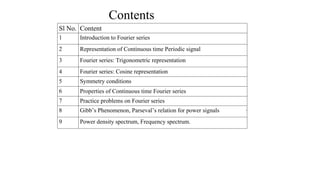
Sl No. Content
1 Introduction to Fourier series
2 Representation of Continuous time Periodic signal
3 Fourier series: Trigonometric representation
4 Fourier series: Cosine representation
5 Symmetry conditions
6 Properties of Continuous time Fourier series
7 Practice problems on Fourier series
8 Gibb’s Phenomenon, Parseval’s relation for power signals
9 Power density spectrum, Frequency spectrum.
3
Introduction to Fourier Series
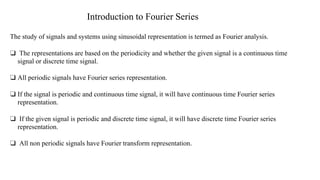
The study of signals and systems using sinusoidal representation is termed as Fourier analysis.
❑ The representations are based on the periodicity and whether the given signal is a continuous time
signal or discrete time signal.
❑ All periodic signals have Fourier series representation.
❑ If the signal is periodic and continuous time signal, it will have continuous time Fourier series
representation.
❑ If the given signal is periodic and discrete time signal, it will have discrete time Fourier series
representation.
❑ All non periodic signals have Fourier transform representation.
Representation of Continuous time Periodic
signals
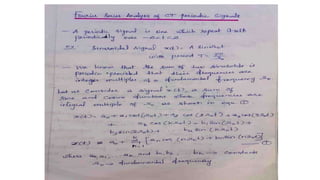
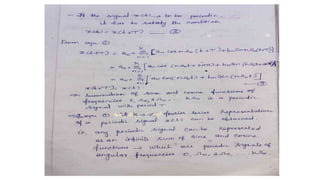
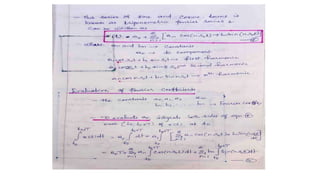
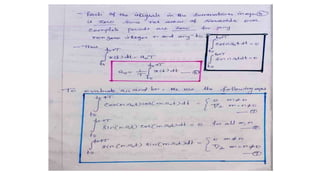
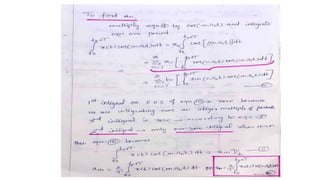
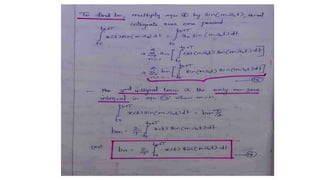
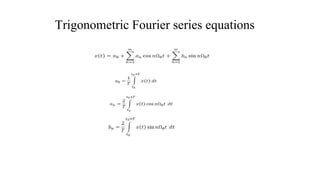
Trigonometric Fourier series equations
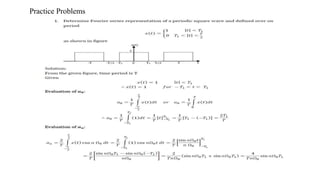
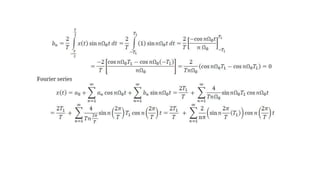
Practice Problems
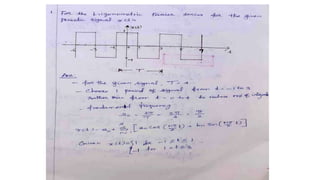
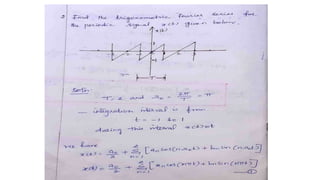
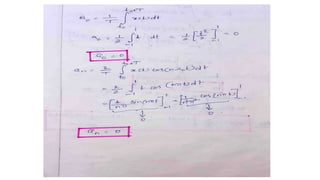
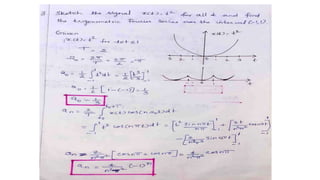
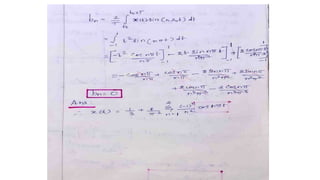
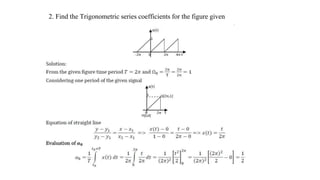
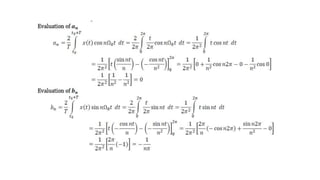
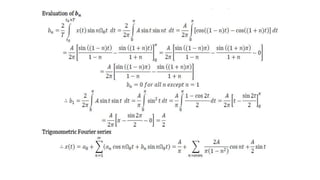
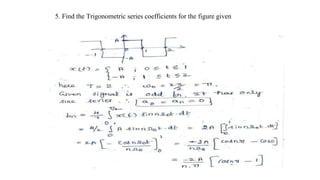
2. Find the Trigonometric series coefficients for the figure given
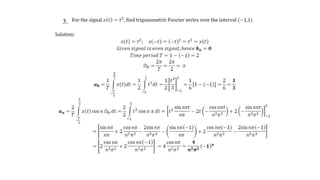
3.
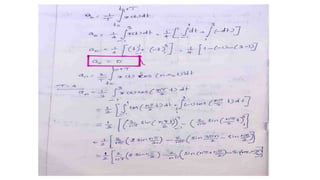
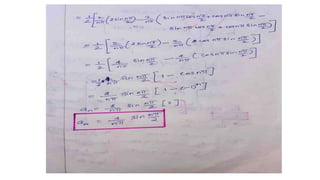
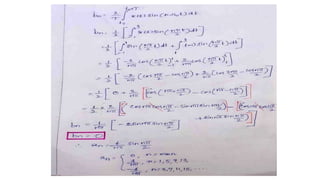
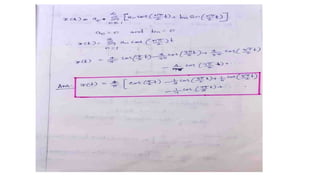
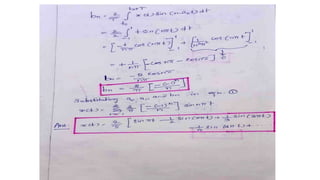
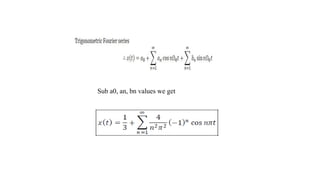
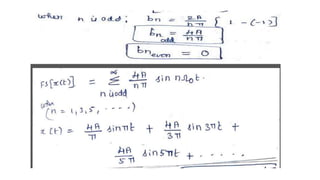
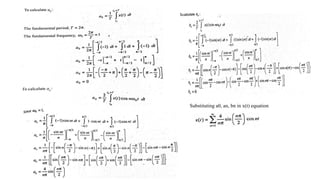
we get Sub a0, an, bn values we get
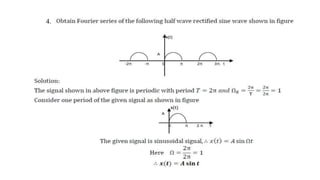
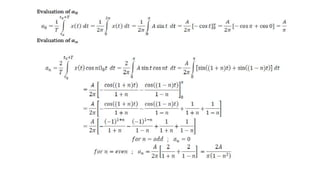
4.
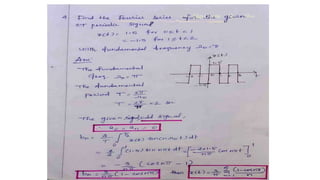
5. Find the Trigonometric series coefficients for the figure given
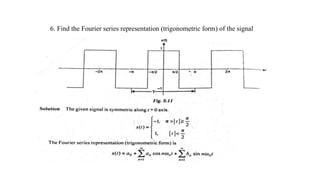
6. Find the Fourier series representation (trigonometric form) of the signal
Substituting a0, an, bn in x(t) equation
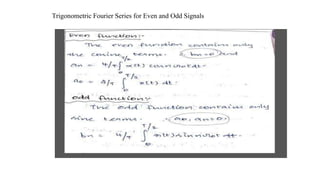
Trigonometric Fourier Series for Even and Odd Signals

Trigonometric Fourier Series.pptx

  • 1.
  • 2.
  • 3.
    Contents Sl No. Content 1Introduction to Fourier series 2 Representation of Continuous time Periodic signal 3 Fourier series: Trigonometric representation 4 Fourier series: Cosine representation 5 Symmetry conditions 6 Properties of Continuous time Fourier series 7 Practice problems on Fourier series 8 Gibb’s Phenomenon, Parseval’s relation for power signals 9 Power density spectrum, Frequency spectrum. 3
  • 4.
    Introduction to FourierSeries The study of signals and systems using sinusoidal representation is termed as Fourier analysis. ❑ The representations are based on the periodicity and whether the given signal is a continuous time signal or discrete time signal. ❑ All periodic signals have Fourier series representation. ❑ If the signal is periodic and continuous time signal, it will have continuous time Fourier series representation. ❑ If the given signal is periodic and discrete time signal, it will have discrete time Fourier series representation. ❑ All non periodic signals have Fourier transform representation.
  • 5.
    Representation of Continuoustime Periodic signals
  • 12.
  • 24.
  • 26.
    2. Find theTrigonometric series coefficients for the figure given
  • 28.
  • 29.
    we get Suba0, an, bn values we get
  • 30.
  • 33.
    5. Find theTrigonometric series coefficients for the figure given
  • 35.
    6. Find theFourier series representation (trigonometric form) of the signal
  • 36.
    Substituting a0, an,bn in x(t) equation
  • 37.
    Trigonometric Fourier Seriesfor Even and Odd Signals