






© Inlumino Consulting, 2019 | 1© Inlumino Consulting, 2018 | 1
IIss CCoonnssttrruuccttiioonn IInndduussttrryy RRiippee FFoorr DDiiggiittaall
DDiissrruuppttiioonn??
Jožek Gruškovnjak, MBA
Managing Partner and Principal Consultant
Inlumino Consulting GmbH inlumino
c o n s u l t i n g
© Inlumino Consulting, 2019 | 3
Does technology matter?
© Inlumino Consulting, 2019 | 4 4
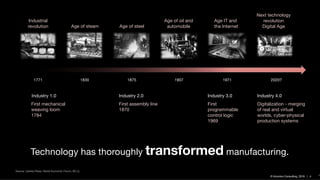
Technology has thoroughly transformed manufacturing.
Industrial
revolution Age of steam Age of steel
Age of oil and
automobile
Age IT and
the Internet
Next technology
revolution
Digital Age
1771 1830 1875 1907 1971 2020?
Source: Carlota Perez; World Economic Forum, BC,G,
Industry 1.0 Industry 2.0 Industry 3.0 Industry 4.0
First mechanical
weaving loom
1784
First assembly line
1870
First
programmable
control logic
1969
Digitalization - merging
of real and virtual
worlds, cyber-physical
production systems
© Inlumino Consulting, 2019 | 5
5
10
15
20
25
#ofEmployees(millions)
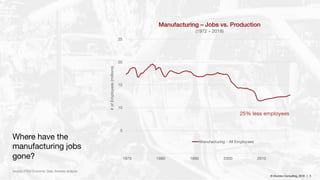
MMaannuuffaaccttuurriinngg –– JJoobbss vvss.. PPrroodduuccttiioonn
(1972 – 2018)
Manufacturing - All Employees
1970 1980 1990 2000 2010
25% less employees
Where have the
manufacturing jobs
gone?
Source: FRED Economic Data, Inlumino analysis
© Inlumino Consulting, 2019 | 5
© Inlumino Consulting, 2019 | 6
0
20
40
60
80
100
120
5
10
15
20
25
IndustrialProduction–Manufacturing(2012=100)
#ofEmployees(millions)
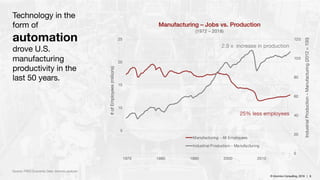
MMaannuuffaaccttuurriinngg –– JJoobbss vvss.. PPrroodduuccttiioonn
(1972 – 2018)
Manufacturing - All Employees
Industrial Production - Manufacturing
1970 1980 1990 2000 2010
Technology in the
form of
automation
drove U.S.
manufacturing
productivity in the
last 50 years.
25% less employees
2.9 x increase in production
Source: FRED Economic Data, Inlumino analysis
© Inlumino Consulting, 2019 | 6
© Inlumino Consulting, 2019 | 7
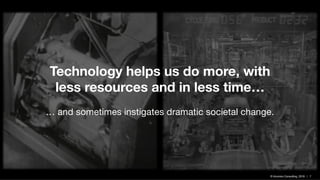
Technology helps us do more, with
less resources and in less time…
… and sometimes instigates dramatic societal change.
© Inlumino Consulting, 2019 | 8
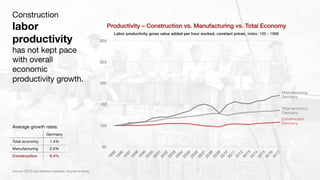
Construction
labor
productivity
has not kept pace
with overall
economic
productivity growth.
50
100
150
200
250
300
1995
1996
1997
1998
1999
2000
2001
2002
2003
2004
2005
2006
2007
2008
2009
2010
2011
2012
2013
2014
2015
2016
2017
Labor productivity gross value added per hour worked, constant prices, index: 100 - 1996
Manufacturing
Germany
Construction
Germany
Total economy
Germany
Average growth rates:
Germany
Total economy 1.4%
Manufacturing 2.5%
Construction 0.4%
Source: OECD.Stat statistics database, Inlumino analysis
PPrroodduuccttiivviittyy –– CCoonnssttrruuccttiioonn vvss.. MMaannuuffaaccttuurriinngg vvss.. TToottaall EEccoonnoommyy
© Inlumino Consulting, 2019 | 9
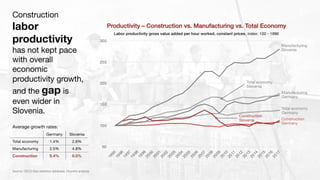
Construction
labor
productivity
has not kept pace
with overall
economic
productivity growth,
and the gap is
even wider in
Slovenia.
50
100
150
200
250
300
1995
1996
1997
1998
1999
2000
2001
2002
2003
2004
2005
2006
2007
2008
2009
2010
2011
2012
2013
2014
2015
2016
2017
Labor productivity gross value added per hour worked, constant prices, index: 100 - 1996
Manufacturing
Germany
Construction
Germany
Manufacturing
Slovenia
Construction
Slovenia
Total economy
Slovenia
Total economy
Germany
Average growth rates:
Germany Slovenia
Total economy 1.4% 2.6%
Manufacturing 2.5% 4.8%
Construction 0.4% 0.5%
Source: OECD.Stat statistics database, Inlumino analysis
PPrroodduuccttiivviittyy –– CCoonnssttrruuccttiioonn vvss.. MMaannuuffaaccttuurriinngg vvss.. TToottaall EEccoonnoommyy
© Inlumino Consulting, 2019 | 10© Inlumino Consulting, 2019 | 10Background photo: Michael Molloy Photography
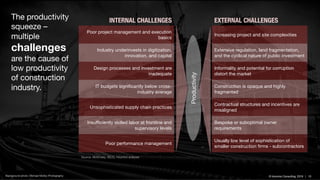
INTERNAL CHALLENGES EXTERNAL CHALLENGES
Poor project management and execution
basics
Increasing project and site complexities
Industry underinvests in digitization,
innovation, and capital
Extensive regulation, land fragmentation,
and the cyclical nature of public investment
Design processes and investment are
inadequate
Informality and potential for corruption
distort the market
IT budgets significantly below cross-
industry average
Construction is opaque and highly
fragmented
Unsophisticated supply chain practices
Contractual structures and incentives are
misaligned
Insufficiently skilled labor at frontline and
supervisory levels
Bespoke or suboptimal owner
requirements
Poor performance management
Usually low level of sophistication of
smaller construction firms - subcontractors
The productivity
squeeze –
multiple
challenges
are the cause of
low productivity
of construction
industry.
Productivity
Source: McKinsey, IBCG, Inlumino analysis
© Inlumino Consulting, 2019 | 11© Inlumino Consulting, 2019 | 11Background photo: Michael Molloy Photography
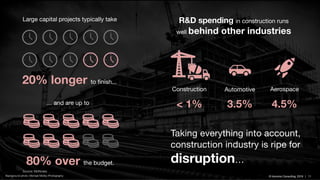
Taking everything into account,
construction industry is ripe for
disruption…
Large capital projects typically take
20% longer to finish...
… and are up to
80% over the budget.
R&D spending in construction runs
well behind other industries
Construction Automotive Aerospace
< 1% 3.5% 4.5%
Source: McKinsey
© Inlumino Consulting, 2019 | 12© Inlumino Consulting, 2019 | 12Background photo: Michael Molloy Photography
“In the 32 years I’ve been in construction, this is the first
time that technology is ahead of what we do. It has
accelerated at a pace I have never seen… There is
technology that can operate machines unmanned.
Figuring out how to make technology work, in stride
with our employees and partners is paramount for us a a
business.”
— Global head of operations, multinational construction company
© Inlumino Consulting, 2019 | 14© Inlumino Consulting, 2019 | 14
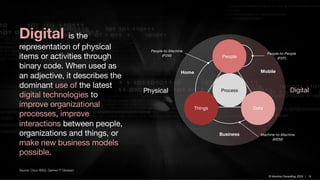
Digital is the
representation of physical
items or activities through
binary code. When used as
an adjective, it describes the
dominant use of the latest
digital technologies to
improve organizational
processes, improve
interactions between people,
organizations and things, or
make new business models
possible.
Process
Things
People
Data
Business
Mobile
Physical
Home
Digital
People-to-People
(P2P)
Machine-to-Machine
(M2M)
People-to-Machine
(P2M)
Source: Cisco IBSG, Gartner IT Glossary
© Inlumino Consulting, 2019 | 15© Inlumino Consulting, 2019 | 15
© Inluceo Consulting, 201615
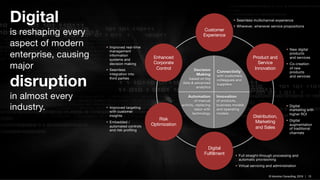
Digital
is reshaping every
aspect of modern
enterprise, causing
major
disruption
in almost every
industry.
Risk
Optimization
Product and
Service
Innovation
Distribution,
Marketing
and Sales
Digital
Fulfillment
Enhanced
Corporate
Control
Customer
Experience
Decision
Making
based on big
data & advanced
analytics
Connectivity
with customers,
colleagues and
suppliers
Automation
of manual
activity, replacing
labor with
technology
Innovation
of products,
business models
and operating
models
§ Seamless multichannel experience
§ Wherever, whenever service propositions
§ New digital
products
and services
§ Co-creation
of new
products
and services
§ Improved real-time
management
information
systems and
decision making
§ Seamless
integration into
third parties
§ Improved targeting
with customer
insights
§ Embedded /
automated controls
and risk profiling
§ Full straight-through processing and
automatic provisioning
§ Virtual servicing and administration
§ Digital
marketing with
higher ROI
§ Digital
augmentation
of traditional
channels
© Inlumino Consulting, 2019 | 16© Inlumino Consulting, 2019 | 16
Internet of
Things
Mobile
Autonomous
Things /
Robotics
Augmented
and Virtual
Reality
…
Cloud
Computing
Cyber
Security
Blockchain
Artificial
Intelligence
Big Data /
Analytics
Illustrative, non
exhaustive
Building
Information
Modelling
Intelligent
Construction
and Robotics
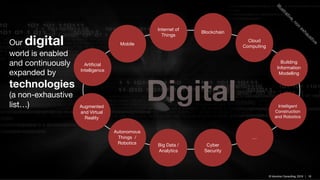
Our digital
world is enabled
and continuously
expanded by
technologies
(a non-exhaustive
list…)
© Inlumino Consulting, 2019 | 17© Inlumino Consulting, 2019 | 17
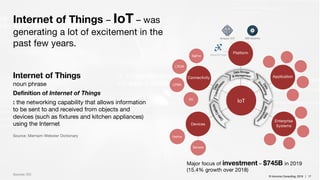
Internet of Things – IoT – was
generating a lot of excitement in the
past few years.
Sources: IDC
Internet of Things
noun phrase
Definition of Internet of Things
: the networking capability that allows information
to be sent to and received from objects and
devices (such as fixtures and kitchen appliances)
using the Internet
Source: Merriam-Webster Dictionary
Devices
Native
5G
LPWA
LTE/M
SigFox
Connectivity
Platform
Enterprise
Systems
Application
IoT
Sensors
Amazon IOT IBM Bluemix
Major focus of investment – $745B in 2019
(15.4% growth over 2018)
© Inlumino Consulting, 2019 | 18© Inlumino Consulting, 2019 | 18
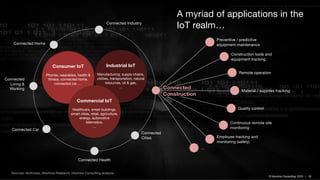
Preventive / predictive
equipment maintenance
Construction tools and
equipment tracking
Remote operation
Quality control
Material / supplies tracking
Continuous remote site
monitoring
Employee tracking and
monitoring (safety)
…
Consumer IoT
Phones, wearables, health &
fitness, connected home,
connected car, …
Industrial IoT
Manufacturing, supply chains,
utilities, transportation, natural
resources, oil & gas,
…
Commercial IoT
Healthcare, smart buildings,
smart cities, retail, agriculture,
energy, automotive
telematics,
…
Connected Car
Connected Industry
Connected Health
Connected Home
Connected
Living &
Working
A myriad of applications in the
IoT realm…
Sources: McKinsey, Machina Research, Inlumino Consulting analysis
Connected
Cities
Connected
Construction
© Inlumino Consulting, 2019 | 19© Inlumino Consulting, 2019 | 19
Consumer IoT
Phones, wearables, health &
fitness, connected home,
connected car, …
Industrial IoT
Manufacturing, supply chains,
utilities, transportation, natural
resources, oil & gas,
…
Commercial IoT
Healthcare, smart buildings,
smart cities, retail, agriculture,
energy, automotive
telematics,
…
Connected Car
Connected Industry
Connected Health
Connected
Cities
Connected Home
Connected
Living &
Working
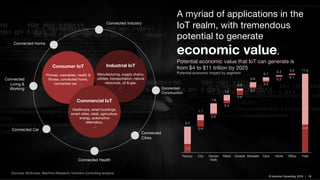
A myriad of applications in the
IoT realm, with tremendous
potential to generate
economic value.
1.2
0.9
0.2
0.4
0.6
0.2
0.2
0.2
0.1
4.0
3.7
1.7
1.6
1.2
0.9
0.9
0.7
0.3 0.2 11.2
Factory City Human
body
Retail Outside Worksite Cars Home Office Total
Sources: McKinsey, Machina Research, Inlumino Consulting analysis
Potential economic value that IoT can generate is
from $4 to $11 trillion by 2025
Potential economic impact by segment
Connected
Construction
© Inlumino Consulting, 2019 | 20© Inlumino Consulting, 2019 | 20
Source: “Accenture, PWC
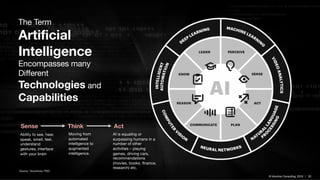
The Term
Artificial
Intelligence
Encompasses many
Different
Technologies and
Capabilities
Sense Think Act
Ability to see, hear,
speak, smell, feel,
understand
gestures, interface
with your brain
Moving from
automated
intelligence to
augmented
intelligence.
AI is equaling or
surpassing humans in a
number of other
activities – playing
games, driving cars,
recommendations
(movies, books, finance,
research) etc.
© Inlumino Consulting, 2019 | 21
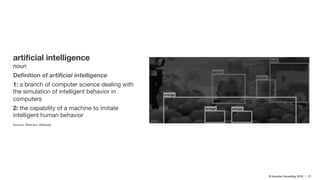
artificial intelligence
noun
Definition of artificial intelligence
1: a branch of computer science dealing with
the simulation of intelligent behavior in
computers
2: the capability of a machine to imitate
intelligent human behavior
Source: Merriam-Webster
© Inlumino Consulting, 2019 | 22© Inlumino Consulting, 2019 | 22
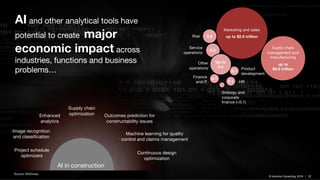
AI and other analytical tools have
potential to create major
economic impact across
industries, functions and business
problems…
Marketing and sales
up to $2.6 trillion
Suplly-chain
management and
manufacturing
up to
$2.6 trillion
0.2
0.1
0.1
0.1
Up to
0.4
0.2Risk
Service
operations
Other
operations
Finance
and IT
Product
development
HR
Strategy and
corporate
finance (<0.1)
AI in construction
Source: McKinsey
Project schedule
optimizers
Image recognition
and classification
Enhanced
analytics
Supply chain
optimization Outcomes prediction for
constructability issues
Machine learning for quality
control and claims management
Continuous design
optimization
© Inlumino Consulting, 2019 | 23© Inlumino Consulting, 2019 | 23
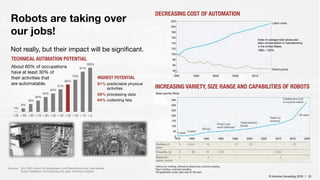
Robots are taking over
our jobs!
Not really, but their impact will be significant.
DECREASING COST OF AUTOMATION
INCREASING VARIETY, SIZE RANGE AND CAPABILITIES OF ROBOTS
Index of average robot prices and
labor compensation in manufacturing
in the United States.
1990 = 100%
Sources: EIU; IMB; Institut für Arbeitsmarkt- und Berufsforschung; International
Robot Federation US Social Security data; McKinsey analysis
1%
8%
18%
26%
34%
42%
51%
62%
73%
91%
100%
100 > 90 > 80 > 70 > 60 > 50 > 40 > 30 > 20 > 10 > 0
About 60% of occupations
have at least 30% of
their activities that
are automatable.
HIGHEST POTENTIAL
81% predictable physical
activities
69% processing data
64% collecting fata
TECHNICAL AUTIMATION POTENTIAL
© Inlumino Consulting, 2019 | 24© Inlumino Consulting, 2019 | 24
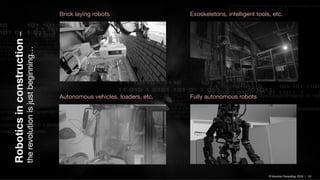
Roboticsinconstruction–
therevolutionisjustbeginning…
Brick laying robots
Autonomous vehicles, loaders, etc. Fully autonomous robots
Exoskeletons, intelligent tools, etc.
© Inlumino Consulting, 2019 | 25
Don’t kick
the robots…
© Inlumino Consulting, 2018 | 26
inlumino
c o n s u l t i n g
inlumino
c o n s u l t i n g
…they may
remember.
© Inlumino Consulting, 2019 | 27© Inlumino Consulting, 2019 | 27
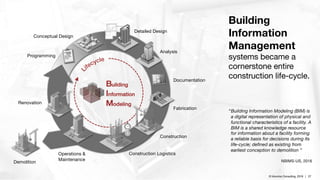
BBuuiillddiinngg
IInnffoorrmmaattiioonn
MMooddeelliinnggRenovation
Programming
Conceptual Design
Detailed Design
Analysis
Documentation
Fabrication
Construction
Construction LogisticsOperations &
Maintenance
Demolition
Building
Information
Management
systems became a
cornerstone entire
construction life-cycle.
“Building Information Modeling (BIM) is
a digital representation of physical and
functional characteristics of a facility. A
BIM is a shared knowledge resource
for information about a facility forming
a reliable basis for decisions during its
life-cycle; defined as existing from
earliest conception to demolition ”
NBIMS-US, 2016
© Inlumino Consulting, 2019 | 28© Inlumino Consulting, 2019 | 28
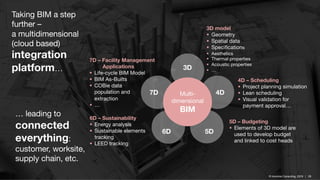
Taking BIM a step
further –
a multidimensional
(cloud based)
integration
platform…
Multi-
dimensional
BIM
3D
4D
5D6D
7D
3D model
§ Geometry
§ Spatial data
§ Specifications
§ Aesthetics
§ Thermal properties
§ Acoustic properties
§ …
4D – Scheduling
§ Project planning simulation
§ Lean scheduling
§ Visual validation for
payment approval…
5D – Budgeting
§ Elements of 3D model are
used to develop budget
and linked to cost heads
6D – Sustainability
§ Energy analysis
§ Sustainable elements
tracking
§ LEED tracking
7D – Facility Management
Applications
§ Life-cycle BIM Model
§ BIM As-Builts
§ COBie data
population and
extraction
§ …
… leading to
connected
everything:
customer, worksite,
supply chain, etc.
© Inlumino Consulting, 2019 | 30© Inlumino Consulting, 2019 | 30
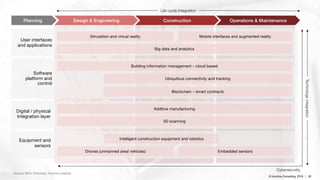
Planning Design & Engineering Construction Operations & Maintenance
Life-cycle Integration
User interfaces
and applications
Digital / physical
Integration layer
Equipment and
sensors
Source: BCG, McKinsey, Inlumino analysis
Software
platform and
control
Simulation and virtual reality Mobile interfaces and augmented reality
Big data and analytics
Cybersecurity
Additive manufacturing
3D scanning
Intelligent construction equipment and robotics
Drones (unmanned areal vehicles) Embedded sensors
Building information management – cloud based
Ubiquitous connectivity and tracking
Blockchain – smart contracts
Technologyintegration
© Inlumino Consulting, 2019 | 32© Inlumino Consulting, 2019 | 32
Planning Design & Engineering Construction Operations & Maintenance
Life-cycle Integration
User interfaces
and applications
Digital / physical
Integration layer
Equipment and
sensors
Software
platform and
control
Simulation and virtual reality Mobile interfaces and augmented reality
Big data and analytics
Additive manufacturing
3D scanning
Intelligent construction equipment and robotics
Drones (unmanned areal vehicles) Embedded sensors
Building information management – cloud based
Ubiquitous connectivity and tracking
Blockchain – smart contracts
Benefits of
BIM enabled
processes
Conflict
detection and
risk mitigation
High level of
customization
and flexibility
Optimization
of scheduling
and costs
Coordination
and
collaboration
Easy
maintenance
of building
life-cycle
Faster
drafting
without loss
of quality
Improved,
lower cost
sales process
Reduced
sourcing
costs
,,,
38%
40%
31%
36%
59%
47%
32%
34%
46%
43%
60%
65%
36%
38%
35%
37%
44%
55%
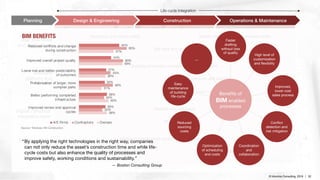
Improved review and approval
cycles
Better performing completed
infrastructure
Prefabrication of larger, more
complex parts
Lower risk and better predictability
of outcomes
Improved overall project quality
Reduced conflicts and change
during construction
A/E Firms Contractors Owners
Source: “McGraw-Hill Construction
BIM BENEFITS
“By applying the right technologies in the right way, companies
can not only reduce the asset’s construction time and while life-
cycle costs but also enhance the quality of processes and
improve safety, working conditions and sustainability.”
— Boston Consulting Group
© Inlumino Consulting, 2019 | 34© Inlumino Consulting, 2019 | 34
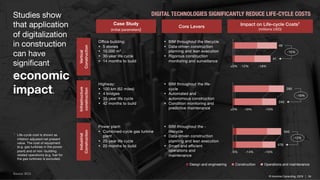
Case Study
(initial parameters)
Core Levers Impact on Life-cycle Costs1
(millions USD)
Vertical
Construction
Office building:
§ 5 stories
§ 10,000 m2
§ 30-year life cycle
§ 14 months to build
§ BIM throughout the lifecycle
§ Data-driven construction
planning and lean execution
§ Rigorous construction
monitoring and surveillance
Infrastructure
construction
Highway:
§ 100 km (62 miles)
§ 4 bridges
§ 35-year life cycle
§ 42 months to build
§ BIM throughout the life-
cycle
§ Automated and
autonomous construction
§ Condition monitoring and
predictive maintenance
Industrial
Construction
Power plant:
§ Combined-cycle gas turbine
plant
§ 25-year life cycle
§ 20 months to build
§ BIM throughout the -
lifecycle
§ Data-driven construction
planning and lean execution
§ Smart and efficient
operations and
maintenance
Studies show
that application
of digitalization
in construction
can have
significant
economic
impact.
49
41
±0% -12% -18%
-15%
285
240
±0% -19% -10%
-16%
540
476
-5% -14% -10%
-12%
◼ Design and engineering ◼ Construction ◼ Operations and maintenance
DIGITAL TECHNOLOGIES SIGNIFICANTLY REDUCE LIFE-CYCLE COSTS
Source: BCG
1
Life-cycle cost is shown as
inflation adjusted net present
value. The cost of equipment
(e.g. gas turbines in the power
plant) and of non –building
related operations (e.g. fuel for
the gas turbines) is excluded.
© Inlumino Consulting, 2019 | 35© Inlumino Consulting, 2019 | 35Background photo: Michael Molloy Photography
Why do digitalization of construction industry and
resulting productivity improvements
matter?
© Inlumino Consulting, 2019 | 36
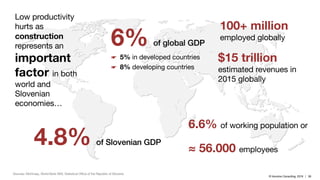
Low productivity
hurts as
construction
represents an
important
factor in both
world and
Slovenian
economies…
6% of global GDP
5% in developed countries
8% developing countries
100+ million
employed globally
$15 trillion
estimated revenues in
2015 globally
4.8% of Slovenian GDP
6.6% of working population or
≈ 56.000 employees
Sources: McKinsey, World Bank WDI, Statistical Office of the Republic of Slovenia
© Inlumino Consulting, 2019 | 37
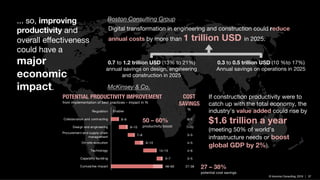
... so, improving
productivity and
overall effectiveness
could have a
major
economic
impact.
Boston Consulting Group
Digital transformation in engineering and construction could reduce
annual costs by more than 1 trillion USD in 2025.
0.7 to 1.2 trillion USD (13% to 21%)
annual savings on design, engineering
and construction in 2025
0.3 to 0.5 trillion USD (10 %to 17%)
Annual savings on operations in 2025
McKinsey & Co.
Cumulative impact
Capability building
Technology
On-site execution
Procurement and supply chain
management
Design and engineering
Collaboration and contracting
Regulation Enabler
8–9
8–10
7–8
6–10
14–15
5–7
48–60
POTENTIAL PRODUCTIVITY IMPROVEMENT
from implementation of best practices – impact in %
6–7
7–10
3–5
4–5
4–6
3–5
27-38
COST
SAVINGS
%
50 – 60%
productivity boost
27 – 38%
potential cost savings
If construction productivity were to
catch up with the total economy, the
industry's value added could rise by
$1.6 trillion a year
(meeting 50% of world’s
infrastructure needs or boost
global GDP by 2%).
© Inlumino Consulting, 2019 | 38© Inlumino Consulting, 2019 | 38
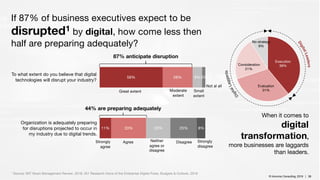
If 87% of business executives expect to be
disrupted1 by digital, how come less then
half are preparing adequately?
1
Source: MIT Sloan Management Review, 2018; 451 Research Voice of the Enterprise Digital Pulse, Budgets & Outlook, 2018
11%
59%
33%
28%
23%
9%
25%
3%
8%
87% anticipate disruption
Great extent Moderate
extent
Small
extent
Not al all
Strongly
agree
Organization is adequately preparing
for disruptions projected to occur in
my industry due to digital trends.
To what extent do you believe that digital
technologies will disrupt your industry?
Agree Neither
agree or
disagree
Disagree Strongly
disagree
44% are preparing adequately
Execution
39%
Evaluation
31%
`Consideration
21%
No strategy
9%
When it comes to
digital
transformation,
more businesses are laggards
than leaders.
© Inlumino Consulting, 2019 | 39© Inlumino Consulting, 2019 | 39
Assets Usage Labor
Sector
Overall
digitalization
Digital
spending
Digitalasset
stock
Transactions
Interactions
Business
processes
Market
Making
Digital
spendingon
workers
Digitalcapital
deepening
Digitalization
ofwork
ICT
Media
Professional services
Finance and insurance
Wholesale trade
Advanced manufacturing
Oil and gas
Utilities
Chemicals and
pharmaceuticals
Basic goods manufacturing
Mining
…
Personnel and local services
Government
Healthcare
Hospitality
Construction
Agriculture and hunting
Relatively low
digitalization
Relatively high
digitalization
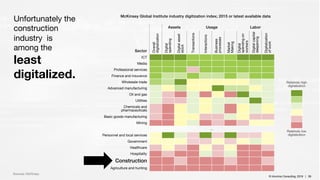
McKinsey Global Institute industry digitization index; 2015 or latest available data
Unfortunately the
construction
industry is
among the
least
digitalized.
Sources: McKinsey
© Inlumino Consulting, 2019 | 40© Inlumino Consulting, 2019 | 40
0.4%
16.7%
19.1%
20.3%
36.9%
46.0%
54.2%
64.6%
Other
Decline in business performance
New standards in regulatory and
compliance
Lack of expertise, literacy and
understanding of digital trends
Proactive investment to fight
disruption
Growth opportunities in new
markets
Increased competitive pressure
Evolving customer and employee
behaviors and preferences
4.2%
6.1%
10.6%
19.7%
23.7%
24.6%
30.1%
30.5%
30.5%
30.9%
31.4%
Respondents have not
experienced any of these…
No leadership driving efforts
Lack of data or ROI to justify
value of digital transformation
No sense of urgency
Human barriers (e.g. politics,
egos, sabotaging, fear)
Legal, risk management, and/or
compliance concerns
Lack of staff resources
Company Culture
Lack of budget
Digital transformation is viewed as
a cost center
Low digital literacy or expertise
among employees and leadership
Source: Altimeter Digital Strategist Survey, August 2017
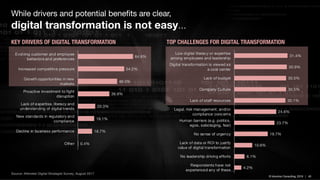
KEY DRIVERS OF DIGITAL TRANSFORMATION TOP CHALLENGES FOR DIGITAL TRANSFORMATION
While drivers and potential benefits are clear,
digital transformation is not easy…
© Inlumino Consulting, 2018 | 41
inlumino
c o n s u l t i n g
inlumino
c o n s u l t i n g
Smart Sensors
Analytics
Cloud
Big Data
Omnichannel
Experience
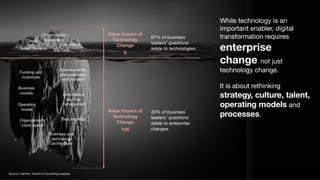
Business skills,
competencies
and mindset
Data strategy
Compliance
and risk
management
Funding and
incentives
Business
models
Operating
model
Organization’s
clock speed
Business and
technology
architecture
Value Impact of
Technology
Change
X
Value Impact of
Technology
Change
15X
While technology is an
important enabler, digital
transformation requires
enterprise
change not just
technology change.
It is about rethinking
strategy, culture, talent,
operating models and
processes.
67% of business
leaders’ questions
relate to technologies
33% of business
leaders’ questions
relate to enterprise
changes
Source: Gartner, Inlumino Consulting analysis
© Inlumino Consulting, 2019 | 42
So what should leaders
focus on?
© Inlumino Consulting, 2019 | 43
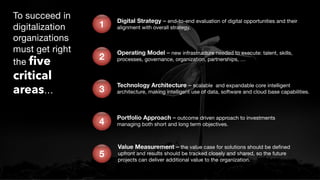
To succeed in
digitalization
organizations
must get right
the five
critical
areas…
Digital Strategy – end-to-end evaluation of digital opportunities and their
alignment with overall strategy.1
Operating Model – new infrastructure needed to execute: talent, skills,
processes, governance, organization, partnerships, …2
Technology Architecture – scalable and expandable core intelligent
architecture, making intelligent use of data, software and cloud base capabilities.
Portfolio Approach – outcome driven approach to investments
managing both short and long term objectives.4
5
Value Measurement – the value case for solutions should be defined
upfront and results should be tracked closely and shared, so the future
projects can deliver additional value to the organization.
3
© Inlumino Consulting, 2019 | 44© Inlumino Consulting, 2019 | 44
“ Other industries have shown that first movers can build a
sustainable competitive advantage. In the construction
sector, this is also likely to be the case. Over the next
decade, these winners of tomorrow will take the lead in
technology innovation and digitization. Resisting change
is no longer an option.”
McKinsey & Company
© Inlumino Consulting, 2019 | 45
“Be strong to stand alone,
smart enough to know when
you need help and brave
enough to ask for it.”
− Multiple authors cited
© Inlumino Consulting, 2018 | 46
inlumino
c o n s u l t i n g
inlumino
c o n s u l t i n g
inlumino
c o n s u l t i n g
jg@Inlumino.ch
Thank you!

Trends in construction, 20190326 final

  • 1.
    © Inlumino Consulting,2019 | 1© Inlumino Consulting, 2018 | 1 IIss CCoonnssttrruuccttiioonn IInndduussttrryy RRiippee FFoorr DDiiggiittaall DDiissrruuppttiioonn?? Jožek Gruškovnjak, MBA Managing Partner and Principal Consultant Inlumino Consulting GmbH inlumino c o n s u l t i n g
  • 2.
    © Inlumino Consulting,2019 | 3 Does technology matter?
  • 3.
    © Inlumino Consulting,2019 | 4 4 Technology has thoroughly transformed manufacturing. Industrial revolution Age of steam Age of steel Age of oil and automobile Age IT and the Internet Next technology revolution Digital Age 1771 1830 1875 1907 1971 2020? Source: Carlota Perez; World Economic Forum, BC,G, Industry 1.0 Industry 2.0 Industry 3.0 Industry 4.0 First mechanical weaving loom 1784 First assembly line 1870 First programmable control logic 1969 Digitalization - merging of real and virtual worlds, cyber-physical production systems
  • 4.
    © Inlumino Consulting,2019 | 5 5 10 15 20 25 #ofEmployees(millions) MMaannuuffaaccttuurriinngg –– JJoobbss vvss.. PPrroodduuccttiioonn (1972 – 2018) Manufacturing - All Employees 1970 1980 1990 2000 2010 25% less employees Where have the manufacturing jobs gone? Source: FRED Economic Data, Inlumino analysis © Inlumino Consulting, 2019 | 5
  • 5.
    © Inlumino Consulting,2019 | 6 0 20 40 60 80 100 120 5 10 15 20 25 IndustrialProduction–Manufacturing(2012=100) #ofEmployees(millions) MMaannuuffaaccttuurriinngg –– JJoobbss vvss.. PPrroodduuccttiioonn (1972 – 2018) Manufacturing - All Employees Industrial Production - Manufacturing 1970 1980 1990 2000 2010 Technology in the form of automation drove U.S. manufacturing productivity in the last 50 years. 25% less employees 2.9 x increase in production Source: FRED Economic Data, Inlumino analysis © Inlumino Consulting, 2019 | 6
  • 6.
    © Inlumino Consulting,2019 | 7 Technology helps us do more, with less resources and in less time… … and sometimes instigates dramatic societal change.
  • 7.
    © Inlumino Consulting,2019 | 8 Construction labor productivity has not kept pace with overall economic productivity growth. 50 100 150 200 250 300 1995 1996 1997 1998 1999 2000 2001 2002 2003 2004 2005 2006 2007 2008 2009 2010 2011 2012 2013 2014 2015 2016 2017 Labor productivity gross value added per hour worked, constant prices, index: 100 - 1996 Manufacturing Germany Construction Germany Total economy Germany Average growth rates: Germany Total economy 1.4% Manufacturing 2.5% Construction 0.4% Source: OECD.Stat statistics database, Inlumino analysis PPrroodduuccttiivviittyy –– CCoonnssttrruuccttiioonn vvss.. MMaannuuffaaccttuurriinngg vvss.. TToottaall EEccoonnoommyy
  • 8.
    © Inlumino Consulting,2019 | 9 Construction labor productivity has not kept pace with overall economic productivity growth, and the gap is even wider in Slovenia. 50 100 150 200 250 300 1995 1996 1997 1998 1999 2000 2001 2002 2003 2004 2005 2006 2007 2008 2009 2010 2011 2012 2013 2014 2015 2016 2017 Labor productivity gross value added per hour worked, constant prices, index: 100 - 1996 Manufacturing Germany Construction Germany Manufacturing Slovenia Construction Slovenia Total economy Slovenia Total economy Germany Average growth rates: Germany Slovenia Total economy 1.4% 2.6% Manufacturing 2.5% 4.8% Construction 0.4% 0.5% Source: OECD.Stat statistics database, Inlumino analysis PPrroodduuccttiivviittyy –– CCoonnssttrruuccttiioonn vvss.. MMaannuuffaaccttuurriinngg vvss.. TToottaall EEccoonnoommyy
  • 9.
    © Inlumino Consulting,2019 | 10© Inlumino Consulting, 2019 | 10Background photo: Michael Molloy Photography INTERNAL CHALLENGES EXTERNAL CHALLENGES Poor project management and execution basics Increasing project and site complexities Industry underinvests in digitization, innovation, and capital Extensive regulation, land fragmentation, and the cyclical nature of public investment Design processes and investment are inadequate Informality and potential for corruption distort the market IT budgets significantly below cross- industry average Construction is opaque and highly fragmented Unsophisticated supply chain practices Contractual structures and incentives are misaligned Insufficiently skilled labor at frontline and supervisory levels Bespoke or suboptimal owner requirements Poor performance management Usually low level of sophistication of smaller construction firms - subcontractors The productivity squeeze – multiple challenges are the cause of low productivity of construction industry. Productivity Source: McKinsey, IBCG, Inlumino analysis
  • 10.
    © Inlumino Consulting,2019 | 11© Inlumino Consulting, 2019 | 11Background photo: Michael Molloy Photography Taking everything into account, construction industry is ripe for disruption… Large capital projects typically take 20% longer to finish... … and are up to 80% over the budget. R&D spending in construction runs well behind other industries Construction Automotive Aerospace < 1% 3.5% 4.5% Source: McKinsey
  • 11.
    © Inlumino Consulting,2019 | 12© Inlumino Consulting, 2019 | 12Background photo: Michael Molloy Photography “In the 32 years I’ve been in construction, this is the first time that technology is ahead of what we do. It has accelerated at a pace I have never seen… There is technology that can operate machines unmanned. Figuring out how to make technology work, in stride with our employees and partners is paramount for us a a business.” — Global head of operations, multinational construction company
  • 12.
    © Inlumino Consulting,2019 | 14© Inlumino Consulting, 2019 | 14 Digital is the representation of physical items or activities through binary code. When used as an adjective, it describes the dominant use of the latest digital technologies to improve organizational processes, improve interactions between people, organizations and things, or make new business models possible. Process Things People Data Business Mobile Physical Home Digital People-to-People (P2P) Machine-to-Machine (M2M) People-to-Machine (P2M) Source: Cisco IBSG, Gartner IT Glossary
  • 13.
    © Inlumino Consulting,2019 | 15© Inlumino Consulting, 2019 | 15 © Inluceo Consulting, 201615 Digital is reshaping every aspect of modern enterprise, causing major disruption in almost every industry. Risk Optimization Product and Service Innovation Distribution, Marketing and Sales Digital Fulfillment Enhanced Corporate Control Customer Experience Decision Making based on big data & advanced analytics Connectivity with customers, colleagues and suppliers Automation of manual activity, replacing labor with technology Innovation of products, business models and operating models § Seamless multichannel experience § Wherever, whenever service propositions § New digital products and services § Co-creation of new products and services § Improved real-time management information systems and decision making § Seamless integration into third parties § Improved targeting with customer insights § Embedded / automated controls and risk profiling § Full straight-through processing and automatic provisioning § Virtual servicing and administration § Digital marketing with higher ROI § Digital augmentation of traditional channels
  • 14.
    © Inlumino Consulting,2019 | 16© Inlumino Consulting, 2019 | 16 Internet of Things Mobile Autonomous Things / Robotics Augmented and Virtual Reality … Cloud Computing Cyber Security Blockchain Artificial Intelligence Big Data / Analytics Illustrative, non exhaustive Building Information Modelling Intelligent Construction and Robotics Our digital world is enabled and continuously expanded by technologies (a non-exhaustive list…)
  • 15.
    © Inlumino Consulting,2019 | 17© Inlumino Consulting, 2019 | 17 Internet of Things – IoT – was generating a lot of excitement in the past few years. Sources: IDC Internet of Things noun phrase Definition of Internet of Things : the networking capability that allows information to be sent to and received from objects and devices (such as fixtures and kitchen appliances) using the Internet Source: Merriam-Webster Dictionary Devices Native 5G LPWA LTE/M SigFox Connectivity Platform Enterprise Systems Application IoT Sensors Amazon IOT IBM Bluemix Major focus of investment – $745B in 2019 (15.4% growth over 2018)
  • 16.
    © Inlumino Consulting,2019 | 18© Inlumino Consulting, 2019 | 18 Preventive / predictive equipment maintenance Construction tools and equipment tracking Remote operation Quality control Material / supplies tracking Continuous remote site monitoring Employee tracking and monitoring (safety) … Consumer IoT Phones, wearables, health & fitness, connected home, connected car, … Industrial IoT Manufacturing, supply chains, utilities, transportation, natural resources, oil & gas, … Commercial IoT Healthcare, smart buildings, smart cities, retail, agriculture, energy, automotive telematics, … Connected Car Connected Industry Connected Health Connected Home Connected Living & Working A myriad of applications in the IoT realm… Sources: McKinsey, Machina Research, Inlumino Consulting analysis Connected Cities Connected Construction
  • 17.
    © Inlumino Consulting,2019 | 19© Inlumino Consulting, 2019 | 19 Consumer IoT Phones, wearables, health & fitness, connected home, connected car, … Industrial IoT Manufacturing, supply chains, utilities, transportation, natural resources, oil & gas, … Commercial IoT Healthcare, smart buildings, smart cities, retail, agriculture, energy, automotive telematics, … Connected Car Connected Industry Connected Health Connected Cities Connected Home Connected Living & Working A myriad of applications in the IoT realm, with tremendous potential to generate economic value. 1.2 0.9 0.2 0.4 0.6 0.2 0.2 0.2 0.1 4.0 3.7 1.7 1.6 1.2 0.9 0.9 0.7 0.3 0.2 11.2 Factory City Human body Retail Outside Worksite Cars Home Office Total Sources: McKinsey, Machina Research, Inlumino Consulting analysis Potential economic value that IoT can generate is from $4 to $11 trillion by 2025 Potential economic impact by segment Connected Construction
  • 18.
    © Inlumino Consulting,2019 | 20© Inlumino Consulting, 2019 | 20 Source: “Accenture, PWC The Term Artificial Intelligence Encompasses many Different Technologies and Capabilities Sense Think Act Ability to see, hear, speak, smell, feel, understand gestures, interface with your brain Moving from automated intelligence to augmented intelligence. AI is equaling or surpassing humans in a number of other activities – playing games, driving cars, recommendations (movies, books, finance, research) etc.
  • 19.
    © Inlumino Consulting,2019 | 21 artificial intelligence noun Definition of artificial intelligence 1: a branch of computer science dealing with the simulation of intelligent behavior in computers 2: the capability of a machine to imitate intelligent human behavior Source: Merriam-Webster
  • 20.
    © Inlumino Consulting,2019 | 22© Inlumino Consulting, 2019 | 22 AI and other analytical tools have potential to create major economic impact across industries, functions and business problems… Marketing and sales up to $2.6 trillion Suplly-chain management and manufacturing up to $2.6 trillion 0.2 0.1 0.1 0.1 Up to 0.4 0.2Risk Service operations Other operations Finance and IT Product development HR Strategy and corporate finance (<0.1) AI in construction Source: McKinsey Project schedule optimizers Image recognition and classification Enhanced analytics Supply chain optimization Outcomes prediction for constructability issues Machine learning for quality control and claims management Continuous design optimization
  • 21.
    © Inlumino Consulting,2019 | 23© Inlumino Consulting, 2019 | 23 Robots are taking over our jobs! Not really, but their impact will be significant. DECREASING COST OF AUTOMATION INCREASING VARIETY, SIZE RANGE AND CAPABILITIES OF ROBOTS Index of average robot prices and labor compensation in manufacturing in the United States. 1990 = 100% Sources: EIU; IMB; Institut für Arbeitsmarkt- und Berufsforschung; International Robot Federation US Social Security data; McKinsey analysis 1% 8% 18% 26% 34% 42% 51% 62% 73% 91% 100% 100 > 90 > 80 > 70 > 60 > 50 > 40 > 30 > 20 > 10 > 0 About 60% of occupations have at least 30% of their activities that are automatable. HIGHEST POTENTIAL 81% predictable physical activities 69% processing data 64% collecting fata TECHNICAL AUTIMATION POTENTIAL
  • 22.
    © Inlumino Consulting,2019 | 24© Inlumino Consulting, 2019 | 24 Roboticsinconstruction– therevolutionisjustbeginning… Brick laying robots Autonomous vehicles, loaders, etc. Fully autonomous robots Exoskeletons, intelligent tools, etc.
  • 23.
    © Inlumino Consulting,2019 | 25 Don’t kick the robots…
  • 24.
    © Inlumino Consulting,2018 | 26 inlumino c o n s u l t i n g inlumino c o n s u l t i n g …they may remember.
  • 25.
    © Inlumino Consulting,2019 | 27© Inlumino Consulting, 2019 | 27 BBuuiillddiinngg IInnffoorrmmaattiioonn MMooddeelliinnggRenovation Programming Conceptual Design Detailed Design Analysis Documentation Fabrication Construction Construction LogisticsOperations & Maintenance Demolition Building Information Management systems became a cornerstone entire construction life-cycle. “Building Information Modeling (BIM) is a digital representation of physical and functional characteristics of a facility. A BIM is a shared knowledge resource for information about a facility forming a reliable basis for decisions during its life-cycle; defined as existing from earliest conception to demolition ” NBIMS-US, 2016
  • 26.
    © Inlumino Consulting,2019 | 28© Inlumino Consulting, 2019 | 28 Taking BIM a step further – a multidimensional (cloud based) integration platform… Multi- dimensional BIM 3D 4D 5D6D 7D 3D model § Geometry § Spatial data § Specifications § Aesthetics § Thermal properties § Acoustic properties § … 4D – Scheduling § Project planning simulation § Lean scheduling § Visual validation for payment approval… 5D – Budgeting § Elements of 3D model are used to develop budget and linked to cost heads 6D – Sustainability § Energy analysis § Sustainable elements tracking § LEED tracking 7D – Facility Management Applications § Life-cycle BIM Model § BIM As-Builts § COBie data population and extraction § … … leading to connected everything: customer, worksite, supply chain, etc.
  • 27.
    © Inlumino Consulting,2019 | 30© Inlumino Consulting, 2019 | 30 Planning Design & Engineering Construction Operations & Maintenance Life-cycle Integration User interfaces and applications Digital / physical Integration layer Equipment and sensors Source: BCG, McKinsey, Inlumino analysis Software platform and control Simulation and virtual reality Mobile interfaces and augmented reality Big data and analytics Cybersecurity Additive manufacturing 3D scanning Intelligent construction equipment and robotics Drones (unmanned areal vehicles) Embedded sensors Building information management – cloud based Ubiquitous connectivity and tracking Blockchain – smart contracts Technologyintegration
  • 28.
    © Inlumino Consulting,2019 | 32© Inlumino Consulting, 2019 | 32 Planning Design & Engineering Construction Operations & Maintenance Life-cycle Integration User interfaces and applications Digital / physical Integration layer Equipment and sensors Software platform and control Simulation and virtual reality Mobile interfaces and augmented reality Big data and analytics Additive manufacturing 3D scanning Intelligent construction equipment and robotics Drones (unmanned areal vehicles) Embedded sensors Building information management – cloud based Ubiquitous connectivity and tracking Blockchain – smart contracts Benefits of BIM enabled processes Conflict detection and risk mitigation High level of customization and flexibility Optimization of scheduling and costs Coordination and collaboration Easy maintenance of building life-cycle Faster drafting without loss of quality Improved, lower cost sales process Reduced sourcing costs ,,, 38% 40% 31% 36% 59% 47% 32% 34% 46% 43% 60% 65% 36% 38% 35% 37% 44% 55% Improved review and approval cycles Better performing completed infrastructure Prefabrication of larger, more complex parts Lower risk and better predictability of outcomes Improved overall project quality Reduced conflicts and change during construction A/E Firms Contractors Owners Source: “McGraw-Hill Construction BIM BENEFITS “By applying the right technologies in the right way, companies can not only reduce the asset’s construction time and while life- cycle costs but also enhance the quality of processes and improve safety, working conditions and sustainability.” — Boston Consulting Group
  • 29.
    © Inlumino Consulting,2019 | 34© Inlumino Consulting, 2019 | 34 Case Study (initial parameters) Core Levers Impact on Life-cycle Costs1 (millions USD) Vertical Construction Office building: § 5 stories § 10,000 m2 § 30-year life cycle § 14 months to build § BIM throughout the lifecycle § Data-driven construction planning and lean execution § Rigorous construction monitoring and surveillance Infrastructure construction Highway: § 100 km (62 miles) § 4 bridges § 35-year life cycle § 42 months to build § BIM throughout the life- cycle § Automated and autonomous construction § Condition monitoring and predictive maintenance Industrial Construction Power plant: § Combined-cycle gas turbine plant § 25-year life cycle § 20 months to build § BIM throughout the - lifecycle § Data-driven construction planning and lean execution § Smart and efficient operations and maintenance Studies show that application of digitalization in construction can have significant economic impact. 49 41 ±0% -12% -18% -15% 285 240 ±0% -19% -10% -16% 540 476 -5% -14% -10% -12% ◼ Design and engineering ◼ Construction ◼ Operations and maintenance DIGITAL TECHNOLOGIES SIGNIFICANTLY REDUCE LIFE-CYCLE COSTS Source: BCG 1 Life-cycle cost is shown as inflation adjusted net present value. The cost of equipment (e.g. gas turbines in the power plant) and of non –building related operations (e.g. fuel for the gas turbines) is excluded.
  • 30.
    © Inlumino Consulting,2019 | 35© Inlumino Consulting, 2019 | 35Background photo: Michael Molloy Photography Why do digitalization of construction industry and resulting productivity improvements matter?
  • 31.
    © Inlumino Consulting,2019 | 36 Low productivity hurts as construction represents an important factor in both world and Slovenian economies… 6% of global GDP 5% in developed countries 8% developing countries 100+ million employed globally $15 trillion estimated revenues in 2015 globally 4.8% of Slovenian GDP 6.6% of working population or ≈ 56.000 employees Sources: McKinsey, World Bank WDI, Statistical Office of the Republic of Slovenia
  • 32.
    © Inlumino Consulting,2019 | 37 ... so, improving productivity and overall effectiveness could have a major economic impact. Boston Consulting Group Digital transformation in engineering and construction could reduce annual costs by more than 1 trillion USD in 2025. 0.7 to 1.2 trillion USD (13% to 21%) annual savings on design, engineering and construction in 2025 0.3 to 0.5 trillion USD (10 %to 17%) Annual savings on operations in 2025 McKinsey & Co. Cumulative impact Capability building Technology On-site execution Procurement and supply chain management Design and engineering Collaboration and contracting Regulation Enabler 8–9 8–10 7–8 6–10 14–15 5–7 48–60 POTENTIAL PRODUCTIVITY IMPROVEMENT from implementation of best practices – impact in % 6–7 7–10 3–5 4–5 4–6 3–5 27-38 COST SAVINGS % 50 – 60% productivity boost 27 – 38% potential cost savings If construction productivity were to catch up with the total economy, the industry's value added could rise by $1.6 trillion a year (meeting 50% of world’s infrastructure needs or boost global GDP by 2%).
  • 33.
    © Inlumino Consulting,2019 | 38© Inlumino Consulting, 2019 | 38 If 87% of business executives expect to be disrupted1 by digital, how come less then half are preparing adequately? 1 Source: MIT Sloan Management Review, 2018; 451 Research Voice of the Enterprise Digital Pulse, Budgets & Outlook, 2018 11% 59% 33% 28% 23% 9% 25% 3% 8% 87% anticipate disruption Great extent Moderate extent Small extent Not al all Strongly agree Organization is adequately preparing for disruptions projected to occur in my industry due to digital trends. To what extent do you believe that digital technologies will disrupt your industry? Agree Neither agree or disagree Disagree Strongly disagree 44% are preparing adequately Execution 39% Evaluation 31% `Consideration 21% No strategy 9% When it comes to digital transformation, more businesses are laggards than leaders.
  • 34.
    © Inlumino Consulting,2019 | 39© Inlumino Consulting, 2019 | 39 Assets Usage Labor Sector Overall digitalization Digital spending Digitalasset stock Transactions Interactions Business processes Market Making Digital spendingon workers Digitalcapital deepening Digitalization ofwork ICT Media Professional services Finance and insurance Wholesale trade Advanced manufacturing Oil and gas Utilities Chemicals and pharmaceuticals Basic goods manufacturing Mining … Personnel and local services Government Healthcare Hospitality Construction Agriculture and hunting Relatively low digitalization Relatively high digitalization McKinsey Global Institute industry digitization index; 2015 or latest available data Unfortunately the construction industry is among the least digitalized. Sources: McKinsey
  • 35.
    © Inlumino Consulting,2019 | 40© Inlumino Consulting, 2019 | 40 0.4% 16.7% 19.1% 20.3% 36.9% 46.0% 54.2% 64.6% Other Decline in business performance New standards in regulatory and compliance Lack of expertise, literacy and understanding of digital trends Proactive investment to fight disruption Growth opportunities in new markets Increased competitive pressure Evolving customer and employee behaviors and preferences 4.2% 6.1% 10.6% 19.7% 23.7% 24.6% 30.1% 30.5% 30.5% 30.9% 31.4% Respondents have not experienced any of these… No leadership driving efforts Lack of data or ROI to justify value of digital transformation No sense of urgency Human barriers (e.g. politics, egos, sabotaging, fear) Legal, risk management, and/or compliance concerns Lack of staff resources Company Culture Lack of budget Digital transformation is viewed as a cost center Low digital literacy or expertise among employees and leadership Source: Altimeter Digital Strategist Survey, August 2017 KEY DRIVERS OF DIGITAL TRANSFORMATION TOP CHALLENGES FOR DIGITAL TRANSFORMATION While drivers and potential benefits are clear, digital transformation is not easy…
  • 36.
    © Inlumino Consulting,2018 | 41 inlumino c o n s u l t i n g inlumino c o n s u l t i n g Smart Sensors Analytics Cloud Big Data Omnichannel Experience Business skills, competencies and mindset Data strategy Compliance and risk management Funding and incentives Business models Operating model Organization’s clock speed Business and technology architecture Value Impact of Technology Change X Value Impact of Technology Change 15X While technology is an important enabler, digital transformation requires enterprise change not just technology change. It is about rethinking strategy, culture, talent, operating models and processes. 67% of business leaders’ questions relate to technologies 33% of business leaders’ questions relate to enterprise changes Source: Gartner, Inlumino Consulting analysis
  • 37.
    © Inlumino Consulting,2019 | 42 So what should leaders focus on?
  • 38.
    © Inlumino Consulting,2019 | 43 To succeed in digitalization organizations must get right the five critical areas… Digital Strategy – end-to-end evaluation of digital opportunities and their alignment with overall strategy.1 Operating Model – new infrastructure needed to execute: talent, skills, processes, governance, organization, partnerships, …2 Technology Architecture – scalable and expandable core intelligent architecture, making intelligent use of data, software and cloud base capabilities. Portfolio Approach – outcome driven approach to investments managing both short and long term objectives.4 5 Value Measurement – the value case for solutions should be defined upfront and results should be tracked closely and shared, so the future projects can deliver additional value to the organization. 3
  • 39.
    © Inlumino Consulting,2019 | 44© Inlumino Consulting, 2019 | 44 “ Other industries have shown that first movers can build a sustainable competitive advantage. In the construction sector, this is also likely to be the case. Over the next decade, these winners of tomorrow will take the lead in technology innovation and digitization. Resisting change is no longer an option.” McKinsey & Company
  • 40.
    © Inlumino Consulting,2019 | 45 “Be strong to stand alone, smart enough to know when you need help and brave enough to ask for it.” − Multiple authors cited
  • 41.
    © Inlumino Consulting,2018 | 46 inlumino c o n s u l t i n g inlumino c o n s u l t i n g inlumino c o n s u l t i n g jg@Inlumino.ch Thank you!