Trends in Banking
Part-IV
Payment Banks
(A threat to universal Banks)
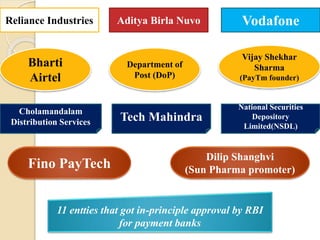
Reliance Industries Aditya Birla Nuvo Vodafone
Bharti
Airtel
Department of
Post (DoP)
Vijay Shekhar
Sharma
(PayTm founder)
Cholamandalam
Distribution Services Tech Mahindra
National Securities
Depository
Limited(NSDL)
Fino PayTech
Dilip Shanghvi
(Sun Pharma promoter)
11 entties that got in-principle approval by RBI
for payment banks
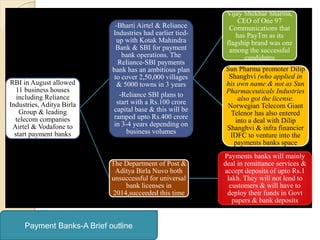
RBI in August allowed
11 business houses
including Reliance
Industries, Aditya Birla
Group & leading
telecom companies
Airtel & Vodafone to
start payment banks
-Bharti Airtel & Reliance
Industries had earlier tied-
up with Kotak Mahindra
Bank & SBI for payment
bank operations. The
Reliance-SBI payments
bank has an ambitious plan
to cover 2,50,000 villages
& 5000 towns in 3 years
-Reliance SBI plans to
start with a Rs.100 crore
capital base & this will be
ramped upto Rs.400 crore
in 3-4 years depending on
business volumes
Vijay Shekhar Sharma,
CEO of One 97
Communications that
has PayTm as its
flagship brand was one
among the successful
candidates
Sun Pharma promoter Dilip
Shanghvi (who applied in
his own name & not as Sun
Pharmaceuticals Industries
also got the license.
Norwegian Telecom Giant
Telenor has also entered
into a deal with Dilip
Shanghvi & infra financier
IDFC to venture into the
payments banks space
The Department of Post &
Aditya Birla Nuvo both
unsuccessful for universal
bank licenses in
2014,succeeded this time
Payments banks will mainly
deal in remittance services &
accept deposits of upto Rs.1
lakh. They will not lend to
customers & will have to
deploy their funds in Govt
papers & bank deposits
Payment Banks-A Brief outline
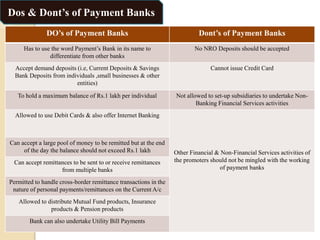
Dos & Dont’s of Payment Banks
DO’s of Payment Banks Dont’s of Payment Banks
Has to use the word Payment’s Bank in its name to
differentiate from other banks
No NRO Deposits should be accepted
Accept demand deposits (i.e, Current Deposits & Savings
Bank Deposits from individuals ,small businesses & other
entities)
Cannot issue Credit Card
To hold a maximum balance of Rs.1 lakh per individual Not allowed to set-up subsidiaries to undertake Non-
Banking Financial Services activities
Allowed to use Debit Cards & also offer Internet Banking
Other Financial & Non-Financial Services activities of
the promoters should not be mingled with the working
of payment banks
Can accept a large pool of money to be remitted but at the end
of the day the balance should not exceed Rs.1 lakh
Can accept remittances to be sent to or receive remittances
from multiple banks
Permitted to handle cross-border remittance transactions in the
nature of personal payments/remittances on the Current A/c
Allowed to distribute Mutual Fund products, Insurance
products & Pension products
Bank can also undertake Utility Bill Payments
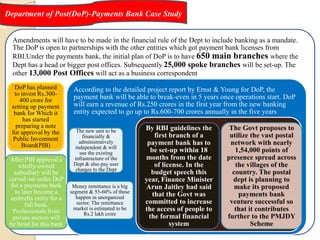
Department of Post(DoP)-Payments Bank Case Study
Amendments will have to be made in the financial rule of the Dept to include banking as a mandate.
The DoP is open to partnerships with the other entities which got payment bank licenses from
RBI.Under the payments bank, the initial plan of DoP is to have 650 main branches where the
Dept has a head or bigger post offices. Subsequently 25,000 spoke branches will be set-up. The
other 13,000 Post Offices will act as a business correspondent
DoP has planned
to invest Rs.300-
400 crore for
setting up payment
bank for Which it
has started
preparing a note
for approval by the
Public Investment
Board(PIB)
After PIB approval a
wholly-owned
subsidiary will be
carved out under DoP
for a payments bank
to later become a
umbrella entity for a
full bank.
Professionals from
private sectors will
be hired for this bank
According to the detailed project report by Ernst & Young for DoP, the
payment bank will be able to break-even in 5 years once operations start. DoP
will earn a revenue of Rs.250 crores in the first year from the new banking
entity expected to go up to Rs.600-700 crores annually in the five years
The new unit to be
financially &
administratively
independent & will
use the existing
infrastructure of the
Dept & also pay user
charges to the Dept
Money remittance is a big
segment & 55-60% of these
happen in unorganized
sector. The remittance
market is estimated to be
Rs.2 lakh crore
By RBI guidelines the
first branch of a
payment bank has to
be set-up within 18
months from the date
of license. In the
budget speech this
year, Finance Minister
Arun Jaitley had said
that the Govt was
committed to increase
the access of people to
the formal financial
system
The Govt proposes to
utilize the vast postal
network with nearly
1,54,000 points of
presence spread across
the villages of the
country. The postal
dept is planning to
make its proposed
payments bank
venture successful so
that it contributes
further to the PMJDY
Scheme
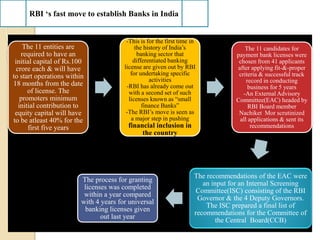
RBI ‘s fast move to establish Banks in India
The 11 entities are
required to have an
initial capital of Rs.100
crore each & will have
to start operations within
18 months from the date
of license. The
promoters minimum
initial contribution to
equity capital will have
to be atleast 40% for the
first five years
-This is for the first time in
the history of India’s
banking sector that
differentiated banking
license are given out by RBI
for undertaking specific
activities
-RBI has already come out
with a second set of such
licenses known as “small
finance Banks”
-The RBI’s move is seen as
a major step in pushing
financial inclusion in
the country
The 11 candidates for
payment bank licenses were
chosen from 41 applicants
after applying fit-&-proper
criteria & successful track
record in conducting
business for 5 years
-An External Advisory
Committee(EAC) headed by
RBI Board member
Nachiket Mor scrutinized
all applications & sent its
recommendations
The recommendations of the EAC were
an input for an Internal Screening
Committee(ISC) consisting of the RBI
Governor & the 4 Deputy Governors.
The ISC prepared a final list of
recommendations for the Committee of
the Central Board(CCB)
The process for granting
licenses was completed
within a year compared
with 4 years for universal
banking licenses given
out last year
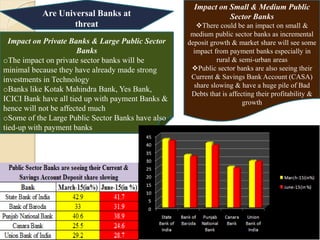
Are Universal Banks at
threat
Impact on Private Banks & Large Public Sector
Banks
oThe impact on private sector banks will be
minimal because they have already made strong
investments in Technology
oBanks like Kotak Mahindra Bank, Yes Bank,
ICICI Bank have all tied up with payment Banks &
hence will not be affected much
oSome of the Large Public Sector Banks have also
tied-up with payment banks
Impact on Small & Medium Public
Sector Banks
There could be an impact on small &
medium public sector banks as incremental
deposit growth & market share will see some
impact from payment banks especially in
rural & semi-urban areas
Public sector banks are also seeing their
Current & Savings Bank Account (CASA)
share slowing & have a huge pile of Bad
Debts that is affecting their profitability &
growth
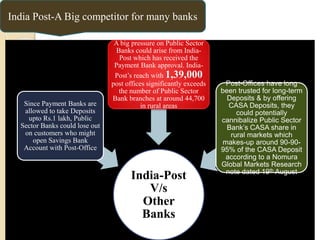
India Post-A Big competitor for many banks
India-Post
V/s
Other
Banks
Since Payment Banks are
allowed to take Deposits
upto Rs.1 lakh, Public
Sector Banks could lose out
on customers who might
open Savings Bank
Account with Post-Office
A big pressure on Public Sector
Banks could arise from India-
Post which has received the
Payment Bank approval. India-
Post’s reach with 1,39,000
post offices significantly exceeds
the number of Public Sector
Bank branches at around 44,700
in rural areas
Post-Offices have long
been trusted for long-term
Deposits & by offering
CASA Deposits, they
could potentially
cannibalize Public Sector
Bank’s CASA share in
rural markets which
makes-up around 90-90-
95% of the CASA Deposit
according to a Nomura
Global Markets Research
note dated 19th August
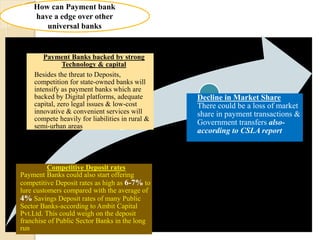
How can Payment bank
have a edge over other
universal banks
Competitive Deposit rates
Payment Banks could also start offering
competitive Deposit rates as high as 6-7% to
lure customers compared with the average of
4% Savings Deposit rates of many Public
Sector Banks-according to Ambit Capital
Pvt.Ltd. This could weigh on the deposit
franchise of Public Sector Banks in the long
run
Payment Banks backed by strong
Technology & capital
Besides the threat to Deposits,
competition for state-owned banks will
intensify as payment banks which are
backed by Digital platforms, adequate
capital, zero legal issues & low-cost
innovative & convenient services will
compete heavily for liabilities in rural &
semi-urban areas
Decline in Market Share
There could be a loss of market
share in payment transactions &
Government transfers also-
according to CSLA report
Is RBI pushing banks for high growth
From 2015,competition is only get tougher &
tougher & RBI has also announced the list of small
finance banks. That means, in the longer term,
some of the small Public Sector Banks may remain
under pressure particularly those that are
strapped for cash & cannot participate fully once a
full-fledged recovery happens
India is far from being the only country where Technology armed with Financial
Apps is challenging traditional banks.
For instance in China-Mobile Apps have mushroomed & have started threatening
the backward & inefficient traditional banks so much so that many customers have
switched directly from Cash Transactions to Banking through Mobile Apps
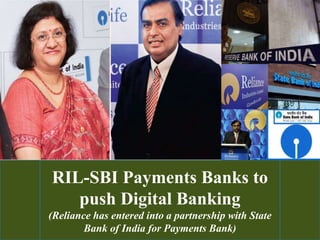
RIL-SBI Payments Banks to
push Digital Banking
(Reliance has entered into a partnership with State
Bank of India for Payments Bank)
RIL which has been granted a Payment Bank license by the
RBI believes that the new bank will be able to push the
digitization of payments in the country.RIL has entered into
a partnership with SBI for payments bank. While RIL is the
promoter, SBI will be the Joint-Venture partner with equity
investment of 30%
The new bank will be able to leverage
Reliance Jio’s Telecom Network & retail
business’s online/offline presence. On the
other hand, SBI will help in enhancing
product capabilities & also provide a strong
distribution network
The payment bank is integral to
RIL’s digital initiative in a rapidly
converging world of telecom,
internet, commerce, media &
financial services
-Mukesh Ambani
RIL-SBI in a first-of-its-kind public-private
partnership have joined on a mission to make India’s
financial services digitally smart. SBI’s vast
experience in structuring financial products for
different customer segments will be combined with
the digital access provided by RIL in completing the
most efficient, simple & affordable delivery model
with utmost focus on Financial Inclusion
The payment bank alliance between
RIL-SBI will help in delivering Digital
Banking products & services & will also
help in promoting digital transactions by
offering simple products conveniently at
a low cost
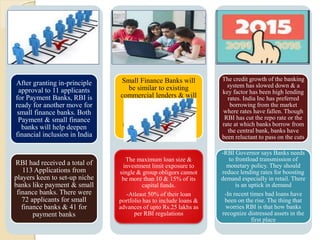
RBI’s one big next move
Small Finance Banks
After granting in-principle
approval to 11 applicants
for Payment Banks, RBI is
ready for another move for
small finance banks. Both
Payment & small finance
banks will help deepen
financial inclusion in India
RBI had received a total of
113 Applications from
players keen to set-up niche
banks like payment & small
finance banks. There were
72 applicants for small
finance banks & 41 for
payment banks
Small Finance Banks will
be similar to existing
commercial lenders & will
undertake basic banking
activities of accepting
deposits & lending to
unserved & under-served
sections.
The maximum loan size &
investment limit exposure to
single & group obligors cannot
be more than 10 & 15% of its
capital funds.
-Atleast 50% of their loan
portfolio has to include loans &
advances of upto Rs.25 lakhs as
per RBI regulations
The credit growth of the banking
system has slowed down & a
key factor has been high lending
rates. India Inc has preferred
borrowing from the market
where rates have fallen. Though
RBI has cut the repo rate or the
rate at which banks borrow from
the central bank, banks have
been reluctant to pass on the cuts
-RBI Governor says Banks needs
to frontload transmission of
monetary policy. They should
reduce lending rates for boosting
demand especially in retail. There
is an uptick in demand
-In recent times bad loans have
been on the rise. The thing that
worries RBI is that how banks
recognize distressed assets in the
first place
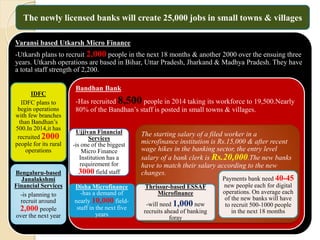
New Banks et to
create 25,000
small town jobs
Varansi based Utkarsh Micro Finance
-Utkarsh plans to recruit 2,000 people in the next 18 months & another 2000 over the ensuing three
years. Utkarsh operations are based in Bihar, Uttar Pradesh, Jharkand & Madhya Pradesh. They have
a total staff strength of 2,200.
IDFC
IDFC plans to
begin operations
with few branches
than Bandhan’s
500.In 2014,it has
recruited 2000
people for its rural
operations
Bengaluru-based
Janalakshmi
Financial Services
-is planning to
recruit around
2,000 people
over the next year
Bandhan Bank
-Has recruited 8,500 people in 2014 taking its workforce to 19,500.Nearly
80% of the Bandhan’s staff is posted in small towns & villages.
Ujjivan Financial
Services
-is one of the biggest
Micro Finance
Institution has a
requirement for
3000 field staff
Disha Microfinance
-has a demand of
nearly 10,000 field-
staff in the next five
years
The starting salary of a filed worker in a
microfinance institution is Rs.15,000 & after recent
wage hikes in the banking sector, the entry level
salary of a bank clerk is Rs.20,000.The new banks
have to match their salary according to the new
changes.
Thrissur-based ESSAF
Microfinance
-will need 1,000 new
recruits ahead of banking
foray
Payments bank need 40-45
new people each for digital
operations. On average each
of the new banks will have
to recruit 500-1000 people
in the next 18 months
The newly licensed banks will create 25,000 jobs in small towns & villages
•Bandhan & IDFC Bank has already recruited
•The data for Au Financiers, Capital Local Area,
Equitas, RGVN is based on informal average
estimates by Industry experts on a conservative
basis
•Approx.25,000 Jobs to be created in this sector
Anup George Rebello
Asst.Manager
The Catholic Syrian Bank Ltd
(anuprebello.6@gmail.com)
http://www.slideshare.net/anuppresentations

Trends in banking part iv

  • 1.
  • 2.
    Payment Banks (A threatto universal Banks)
  • 3.
    Reliance Industries AdityaBirla Nuvo Vodafone Bharti Airtel Department of Post (DoP) Vijay Shekhar Sharma (PayTm founder) Cholamandalam Distribution Services Tech Mahindra National Securities Depository Limited(NSDL) Fino PayTech Dilip Shanghvi (Sun Pharma promoter) 11 entties that got in-principle approval by RBI for payment banks
  • 4.
    RBI in Augustallowed 11 business houses including Reliance Industries, Aditya Birla Group & leading telecom companies Airtel & Vodafone to start payment banks -Bharti Airtel & Reliance Industries had earlier tied- up with Kotak Mahindra Bank & SBI for payment bank operations. The Reliance-SBI payments bank has an ambitious plan to cover 2,50,000 villages & 5000 towns in 3 years -Reliance SBI plans to start with a Rs.100 crore capital base & this will be ramped upto Rs.400 crore in 3-4 years depending on business volumes Vijay Shekhar Sharma, CEO of One 97 Communications that has PayTm as its flagship brand was one among the successful candidates Sun Pharma promoter Dilip Shanghvi (who applied in his own name & not as Sun Pharmaceuticals Industries also got the license. Norwegian Telecom Giant Telenor has also entered into a deal with Dilip Shanghvi & infra financier IDFC to venture into the payments banks space The Department of Post & Aditya Birla Nuvo both unsuccessful for universal bank licenses in 2014,succeeded this time Payments banks will mainly deal in remittance services & accept deposits of upto Rs.1 lakh. They will not lend to customers & will have to deploy their funds in Govt papers & bank deposits Payment Banks-A Brief outline
  • 5.
    Dos & Dont’sof Payment Banks DO’s of Payment Banks Dont’s of Payment Banks Has to use the word Payment’s Bank in its name to differentiate from other banks No NRO Deposits should be accepted Accept demand deposits (i.e, Current Deposits & Savings Bank Deposits from individuals ,small businesses & other entities) Cannot issue Credit Card To hold a maximum balance of Rs.1 lakh per individual Not allowed to set-up subsidiaries to undertake Non- Banking Financial Services activities Allowed to use Debit Cards & also offer Internet Banking Other Financial & Non-Financial Services activities of the promoters should not be mingled with the working of payment banks Can accept a large pool of money to be remitted but at the end of the day the balance should not exceed Rs.1 lakh Can accept remittances to be sent to or receive remittances from multiple banks Permitted to handle cross-border remittance transactions in the nature of personal payments/remittances on the Current A/c Allowed to distribute Mutual Fund products, Insurance products & Pension products Bank can also undertake Utility Bill Payments
  • 6.
    Department of Post(DoP)-PaymentsBank Case Study Amendments will have to be made in the financial rule of the Dept to include banking as a mandate. The DoP is open to partnerships with the other entities which got payment bank licenses from RBI.Under the payments bank, the initial plan of DoP is to have 650 main branches where the Dept has a head or bigger post offices. Subsequently 25,000 spoke branches will be set-up. The other 13,000 Post Offices will act as a business correspondent DoP has planned to invest Rs.300- 400 crore for setting up payment bank for Which it has started preparing a note for approval by the Public Investment Board(PIB) After PIB approval a wholly-owned subsidiary will be carved out under DoP for a payments bank to later become a umbrella entity for a full bank. Professionals from private sectors will be hired for this bank According to the detailed project report by Ernst & Young for DoP, the payment bank will be able to break-even in 5 years once operations start. DoP will earn a revenue of Rs.250 crores in the first year from the new banking entity expected to go up to Rs.600-700 crores annually in the five years The new unit to be financially & administratively independent & will use the existing infrastructure of the Dept & also pay user charges to the Dept Money remittance is a big segment & 55-60% of these happen in unorganized sector. The remittance market is estimated to be Rs.2 lakh crore By RBI guidelines the first branch of a payment bank has to be set-up within 18 months from the date of license. In the budget speech this year, Finance Minister Arun Jaitley had said that the Govt was committed to increase the access of people to the formal financial system The Govt proposes to utilize the vast postal network with nearly 1,54,000 points of presence spread across the villages of the country. The postal dept is planning to make its proposed payments bank venture successful so that it contributes further to the PMJDY Scheme
  • 7.
    RBI ‘s fastmove to establish Banks in India The 11 entities are required to have an initial capital of Rs.100 crore each & will have to start operations within 18 months from the date of license. The promoters minimum initial contribution to equity capital will have to be atleast 40% for the first five years -This is for the first time in the history of India’s banking sector that differentiated banking license are given out by RBI for undertaking specific activities -RBI has already come out with a second set of such licenses known as “small finance Banks” -The RBI’s move is seen as a major step in pushing financial inclusion in the country The 11 candidates for payment bank licenses were chosen from 41 applicants after applying fit-&-proper criteria & successful track record in conducting business for 5 years -An External Advisory Committee(EAC) headed by RBI Board member Nachiket Mor scrutinized all applications & sent its recommendations The recommendations of the EAC were an input for an Internal Screening Committee(ISC) consisting of the RBI Governor & the 4 Deputy Governors. The ISC prepared a final list of recommendations for the Committee of the Central Board(CCB) The process for granting licenses was completed within a year compared with 4 years for universal banking licenses given out last year
  • 8.
    Are Universal Banksat threat Impact on Private Banks & Large Public Sector Banks oThe impact on private sector banks will be minimal because they have already made strong investments in Technology oBanks like Kotak Mahindra Bank, Yes Bank, ICICI Bank have all tied up with payment Banks & hence will not be affected much oSome of the Large Public Sector Banks have also tied-up with payment banks Impact on Small & Medium Public Sector Banks There could be an impact on small & medium public sector banks as incremental deposit growth & market share will see some impact from payment banks especially in rural & semi-urban areas Public sector banks are also seeing their Current & Savings Bank Account (CASA) share slowing & have a huge pile of Bad Debts that is affecting their profitability & growth
  • 9.
    India Post-A Bigcompetitor for many banks India-Post V/s Other Banks Since Payment Banks are allowed to take Deposits upto Rs.1 lakh, Public Sector Banks could lose out on customers who might open Savings Bank Account with Post-Office A big pressure on Public Sector Banks could arise from India- Post which has received the Payment Bank approval. India- Post’s reach with 1,39,000 post offices significantly exceeds the number of Public Sector Bank branches at around 44,700 in rural areas Post-Offices have long been trusted for long-term Deposits & by offering CASA Deposits, they could potentially cannibalize Public Sector Bank’s CASA share in rural markets which makes-up around 90-90- 95% of the CASA Deposit according to a Nomura Global Markets Research note dated 19th August
  • 10.
    How can Paymentbank have a edge over other universal banks Competitive Deposit rates Payment Banks could also start offering competitive Deposit rates as high as 6-7% to lure customers compared with the average of 4% Savings Deposit rates of many Public Sector Banks-according to Ambit Capital Pvt.Ltd. This could weigh on the deposit franchise of Public Sector Banks in the long run Payment Banks backed by strong Technology & capital Besides the threat to Deposits, competition for state-owned banks will intensify as payment banks which are backed by Digital platforms, adequate capital, zero legal issues & low-cost innovative & convenient services will compete heavily for liabilities in rural & semi-urban areas Decline in Market Share There could be a loss of market share in payment transactions & Government transfers also- according to CSLA report
  • 11.
    Is RBI pushingbanks for high growth From 2015,competition is only get tougher & tougher & RBI has also announced the list of small finance banks. That means, in the longer term, some of the small Public Sector Banks may remain under pressure particularly those that are strapped for cash & cannot participate fully once a full-fledged recovery happens India is far from being the only country where Technology armed with Financial Apps is challenging traditional banks. For instance in China-Mobile Apps have mushroomed & have started threatening the backward & inefficient traditional banks so much so that many customers have switched directly from Cash Transactions to Banking through Mobile Apps

  • 12.
    RIL-SBI Payments Banksto push Digital Banking (Reliance has entered into a partnership with State Bank of India for Payments Bank)
  • 13.
    RIL which hasbeen granted a Payment Bank license by the RBI believes that the new bank will be able to push the digitization of payments in the country.RIL has entered into a partnership with SBI for payments bank. While RIL is the promoter, SBI will be the Joint-Venture partner with equity investment of 30% The new bank will be able to leverage Reliance Jio’s Telecom Network & retail business’s online/offline presence. On the other hand, SBI will help in enhancing product capabilities & also provide a strong distribution network The payment bank is integral to RIL’s digital initiative in a rapidly converging world of telecom, internet, commerce, media & financial services -Mukesh Ambani RIL-SBI in a first-of-its-kind public-private partnership have joined on a mission to make India’s financial services digitally smart. SBI’s vast experience in structuring financial products for different customer segments will be combined with the digital access provided by RIL in completing the most efficient, simple & affordable delivery model with utmost focus on Financial Inclusion The payment bank alliance between RIL-SBI will help in delivering Digital Banking products & services & will also help in promoting digital transactions by offering simple products conveniently at a low cost
  • 14.
    RBI’s one bignext move Small Finance Banks
  • 15.
    After granting in-principle approvalto 11 applicants for Payment Banks, RBI is ready for another move for small finance banks. Both Payment & small finance banks will help deepen financial inclusion in India RBI had received a total of 113 Applications from players keen to set-up niche banks like payment & small finance banks. There were 72 applicants for small finance banks & 41 for payment banks Small Finance Banks will be similar to existing commercial lenders & will undertake basic banking activities of accepting deposits & lending to unserved & under-served sections. The maximum loan size & investment limit exposure to single & group obligors cannot be more than 10 & 15% of its capital funds. -Atleast 50% of their loan portfolio has to include loans & advances of upto Rs.25 lakhs as per RBI regulations The credit growth of the banking system has slowed down & a key factor has been high lending rates. India Inc has preferred borrowing from the market where rates have fallen. Though RBI has cut the repo rate or the rate at which banks borrow from the central bank, banks have been reluctant to pass on the cuts -RBI Governor says Banks needs to frontload transmission of monetary policy. They should reduce lending rates for boosting demand especially in retail. There is an uptick in demand -In recent times bad loans have been on the rise. The thing that worries RBI is that how banks recognize distressed assets in the first place
  • 16.
    New Banks etto create 25,000 small town jobs
  • 17.
    Varansi based UtkarshMicro Finance -Utkarsh plans to recruit 2,000 people in the next 18 months & another 2000 over the ensuing three years. Utkarsh operations are based in Bihar, Uttar Pradesh, Jharkand & Madhya Pradesh. They have a total staff strength of 2,200. IDFC IDFC plans to begin operations with few branches than Bandhan’s 500.In 2014,it has recruited 2000 people for its rural operations Bengaluru-based Janalakshmi Financial Services -is planning to recruit around 2,000 people over the next year Bandhan Bank -Has recruited 8,500 people in 2014 taking its workforce to 19,500.Nearly 80% of the Bandhan’s staff is posted in small towns & villages. Ujjivan Financial Services -is one of the biggest Micro Finance Institution has a requirement for 3000 field staff Disha Microfinance -has a demand of nearly 10,000 field- staff in the next five years The starting salary of a filed worker in a microfinance institution is Rs.15,000 & after recent wage hikes in the banking sector, the entry level salary of a bank clerk is Rs.20,000.The new banks have to match their salary according to the new changes. Thrissur-based ESSAF Microfinance -will need 1,000 new recruits ahead of banking foray Payments bank need 40-45 new people each for digital operations. On average each of the new banks will have to recruit 500-1000 people in the next 18 months The newly licensed banks will create 25,000 jobs in small towns & villages
  • 18.
    •Bandhan & IDFCBank has already recruited •The data for Au Financiers, Capital Local Area, Equitas, RGVN is based on informal average estimates by Industry experts on a conservative basis •Approx.25,000 Jobs to be created in this sector
  • 19.
    Anup George Rebello Asst.Manager TheCatholic Syrian Bank Ltd (anuprebello.6@gmail.com) http://www.slideshare.net/anuppresentations