MBA Handbook-5
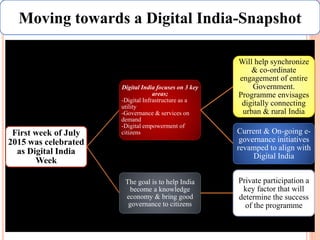
Moving towards a Digital India-Snapshot
First week of July
2015 was celebrated
as Digital India
Week
Digital India focuses on 3 key
areas;
-Digital Infrastructure as a
utility
-Governance & services on
demand
-Digital empowerment of
citizens
Will help synchronize
& co-ordinate
engagement of entire
Government.
Programme envisages
digitally connecting
urban & rural India
Current & On-going e-
governance initiatives
revamped to align with
Digital India
The goal is to help India
become a knowledge
economy & bring good
governance to citizens
Private participation a
key factor that will
determine the success
of the programme
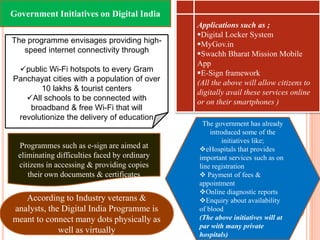
Government Initiatives on Digital India
The programme envisages providing high-
speed internet connectivity through
public Wi-Fi hotspots to every Gram
Panchayat cities with a population of over
10 lakhs & tourist centers
All schools to be connected with
broadband & free Wi-Fi that will
revolutionize the delivery of education
Applications such as ;
Digital Locker System
MyGov.in
Swachh Bharat Mission Mobile
App
E-Sign framework
(All the above will allow citizens to
digitally avail these services online
or on their smartphones )
Programmes such as e-sign are aimed at
eliminating difficulties faced by ordinary
citizens in accessing & providing copies
their own documents & certificates
The government has already
introduced some of the
initiatives like;
eHospitals that provides
important services such as on
line registration
 Payment of fees &
appointment
Online diagnostic reports
Enquiry about availability
of blood
(The above initiatives will at
par with many private
hospitals)
According to Industry veterans &
analysts, the Digital India Programme is
meant to connect many dots physically as
well as virtually
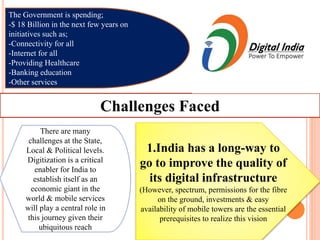
The Government is spending;
-$ 18 Billion in the next few years on
initiatives such as;
-Connectivity for all
-Internet for all
-Providing Healthcare
-Banking education
-Other services
Challenges Faced
There are many
challenges at the State,
Local & Political levels.
Digitization is a critical
enabler for India to
establish itself as an
economic giant in the
world & mobile services
will play a central role in
this journey given their
ubiquitous reach
1.India has a long-way to
go to improve the quality of
its digital infrastructure
(However, spectrum, permissions for the fibre
on the ground, investments & easy
availability of mobile towers are the essential
prerequisites to realize this vision
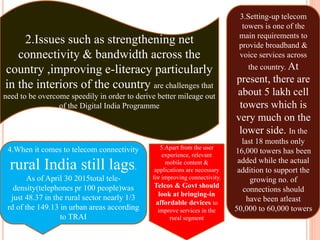
2.Issues such as strengthening net
connectivity & bandwidth across the
country ,improving e-literacy particularly
in the interiors of the country are challenges that
need to be overcome speedily in order to derive better mileage out
of the Digital India Programme
3.Setting-up telecom
towers is one of the
main requirements to
provide broadband &
voice services across
the country. At
present, there are
about 5 lakh cell
towers which is
very much on the
lower side. In the
last 18 months only
16,000 towers has been
added while the actual
addition to support the
growing no. of
connections should
have been atleast
50,000 to 60,000 towers
4.When it comes to telecom connectivity
rural India still lags.
As of April 30 2015total tele-
density(telephones pr 100 people)was
just 48.37 in the rural sector nearly 1/3
rd of the 149.13 in urban areas according
to TRAI
5.Apart from the user
experience, relevant
mobile content &
applications are necessary
for improving connectivity.
Telcos & Govt should
look at bringing-in
affordable devices to
improve services in the
rural segment
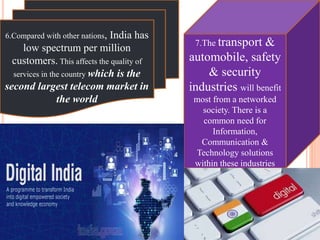
6.Compared with other nations, India has
low spectrum per million
customers. This affects the quality of
services in the country which is the
second largest telecom market in
the world
7.The transport &
automobile, safety
& security
industries will benefit
most from a networked
society. There is a
common need for
Information,
Communication &
Technology solutions
within these industries
After Malls in big cities, multiplexes
are moving into smaller towns.PVR
Cinemas plans to expand to over 1,000
centres by 2018
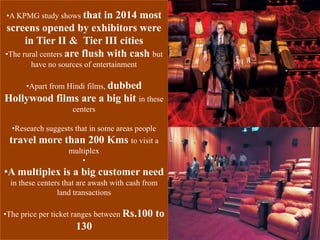
•A KPMG study shows that in 2014 most
screens opened by exhibitors were
in Tier II & Tier III cities
•The rural centers are flush with cash but
have no sources of entertainment
•Apart from Hindi films, dubbed
Hollywood films are a big hit in these
centers
•Research suggests that in some areas people
travel more than 200 Kms to visit a
multiplex
•
•A multiplex is a big customer need
in these centers that are awash with cash from
land transactions
•The price per ticket ranges between Rs.100 to
130
PVR’s decision to open a multiplex at Kolhapur &
Tier II/III cities
Kolhapur district is
known for its sugarcane
farms, mills & footwear
industry. There is a huge
hypermarket that sold
goods worth more than
Rs.3.5 Crores every
month
People@ Kolhapur had
given up watching films at
local cinemas & travelled
upto 200 Kms to larger
cities to catch their favorite
movie at a multiplex
PVR finally decided to include
Kolhapur on a list of cities that
the company would expand
into. There was absolutely no
entertainment in Kolhapur & no
places for young people to date.
This is where PVR targeted
PVR aims to set up as
many as 1,000 screens
across India by 2018 from
the 467 screens that it
operates today. This has set
off the trend of one of the
India’s most sophisticated
brands establishing theatres
in districts known for
farming
People have a misconception that PVR is an
urban brand. This could be on account of the fact
that most people in big cities are unaware of the
pace at which the rural areas are morphing into
small towns complete with malls ,entertainment
complexes & cinema houses
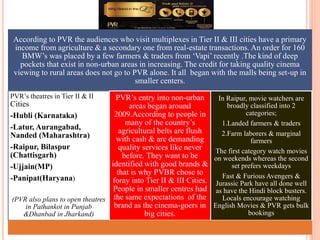
According to PVR the audiences who visit multiplexes in Tier II & III cities have a primary
income from agriculture & a secondary one from real-estate transactions. An order for 160
BMW’s was placed by a few farmers & traders from ‘Vapi’ recently .The kind of deep
pockets that exist in non-urban areas in increasing. The credit for taking quality cinema
viewing to rural areas does not go to PVR alone. It all began with the malls being set-up in
smaller centers.
PVR’s theatres in Tier II & II
Cities
-Hubli (Karnataka)
-Latur, Aurangabad,
Nanded (Maharashtra)
-Raipur, Bilaspur
(Chattisgarh)
-Ujjain(MP)
-Panipat(Haryana)
(PVR also plans to open theatres
in Pathankot in Punjab
&Dhanbad in Jharkand)
PVR’s entry into non-urban
areas began around
2009.According to people in
many of the country’s
agricultural belts are flush
with cash & are demanding
quality services like never
before. They want to be
identified with good brands &
that is why PVBR chose to
foray into Tier II & III Cities.
People in smaller centres had
the same expectations of the
brand as the cinema-goers in
big cities.
In Raipur, movie watchers are
broadly classified into 2
categories;
1.Landed farmers & traders
2.Farm laborers & marginal
farmers
The first category watch movies
on weekends whereas the second
set prefers weekdays
Fast & Furious Avengers &
Jurassic Park have all done well
as have the Hindi block busters.
Locals encourage watching
English Movies & PVR gets bulk
bookings
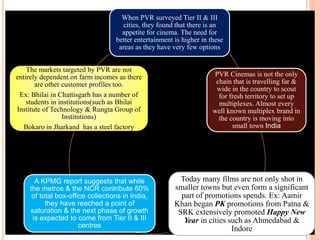
When PVR surveyed Tier II & III
cities, they found that there is an
appetite for cinema. The need for
better entertainment is higher in these
areas as they have very few options
PVR Cinemas is not the only
chain that is travelling far &
wide in the country to scout
for fresh territory to set up
multiplexes. Almost every
well known multiplex brand in
the country is moving into
small town India
Today many films are not only shot in
smaller towns but even form a significant
part of promotions spends. Ex: Aamir
Khan began PK promotions from Patna &
SRK extensively promoted Happy New
Year in cities such as Ahmedabad &
Indore
A KPMG report suggests that while
the metros & the NCR contribute 60%
of total box-office collections in India,
they have reached a point of
saturation & the next phase of growth
is expected to come from Tier II & III
centres
The markets targeted by PVR are not
entirely dependent on farm incomes as there
are other customer profiles too.
Ex: Bhilai in Chattisgarh has a number of
students in institutions(such as Bhilai
Institute of Technology & Rungta Group of
Institutions)
Bokaro in Jharkand has a steel factory
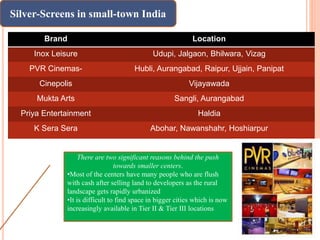
Brand Location
Inox Leisure Udupi, Jalgaon, Bhilwara, Vizag
PVR Cinemas- Hubli, Aurangabad, Raipur, Ujjain, Panipat
Cinepolis Vijayawada
Mukta Arts Sangli, Aurangabad
Priya Entertainment Haldia
K Sera Sera Abohar, Nawanshahr, Hoshiarpur
Silver-Screens in small-town India
There are two significant reasons behind the push
towards smaller centers.
•Most of the centers have many people who are flush
with cash after selling land to developers as the rural
landscape gets rapidly urbanized
•It is difficult to find space in bigger cities which is now
increasingly available in Tier II & Tier III locations
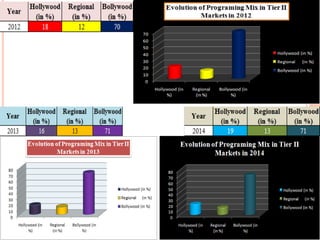
Films-Mass Audience
Now there is nothing called a mass
audience. Producers realize that
there are two orts of audience;
1.Multiplex
2.Single Screen
The business done by Hollywood
films is measured through two
markets;
1.Delhi/UP
2.Mumbai
Till three years ago the above
two major markets accounted for
3/4th of the business done by
Hollywood films in India. But
ever since multiplex chains
moved to smaller centers, the
share of business done in these
two markets has come down to
about 68%which means that
more people are watching these
films in other centers
According to Inox, in small centers
movies with good mix of drama,
romance & action attract the
maximum audience. Inox has seen
guests coming-in with family/friends
for a evening or day of complete
entertainment
Anup George Rebello
Asst.Manager
The Catholic Syrian Bank Ltd
(anuprebello.6@gmail.com)
http://www.slideshare.net/anuppresentations

Mba handbook 5

  • 1.
  • 2.
    Moving towards aDigital India-Snapshot First week of July 2015 was celebrated as Digital India Week Digital India focuses on 3 key areas; -Digital Infrastructure as a utility -Governance & services on demand -Digital empowerment of citizens Will help synchronize & co-ordinate engagement of entire Government. Programme envisages digitally connecting urban & rural India Current & On-going e- governance initiatives revamped to align with Digital India The goal is to help India become a knowledge economy & bring good governance to citizens Private participation a key factor that will determine the success of the programme
  • 3.
    Government Initiatives onDigital India The programme envisages providing high- speed internet connectivity through public Wi-Fi hotspots to every Gram Panchayat cities with a population of over 10 lakhs & tourist centers All schools to be connected with broadband & free Wi-Fi that will revolutionize the delivery of education Applications such as ; Digital Locker System MyGov.in Swachh Bharat Mission Mobile App E-Sign framework (All the above will allow citizens to digitally avail these services online or on their smartphones ) Programmes such as e-sign are aimed at eliminating difficulties faced by ordinary citizens in accessing & providing copies their own documents & certificates The government has already introduced some of the initiatives like; eHospitals that provides important services such as on line registration  Payment of fees & appointment Online diagnostic reports Enquiry about availability of blood (The above initiatives will at par with many private hospitals) According to Industry veterans & analysts, the Digital India Programme is meant to connect many dots physically as well as virtually
  • 4.
    The Government isspending; -$ 18 Billion in the next few years on initiatives such as; -Connectivity for all -Internet for all -Providing Healthcare -Banking education -Other services Challenges Faced There are many challenges at the State, Local & Political levels. Digitization is a critical enabler for India to establish itself as an economic giant in the world & mobile services will play a central role in this journey given their ubiquitous reach 1.India has a long-way to go to improve the quality of its digital infrastructure (However, spectrum, permissions for the fibre on the ground, investments & easy availability of mobile towers are the essential prerequisites to realize this vision
  • 5.
    2.Issues such asstrengthening net connectivity & bandwidth across the country ,improving e-literacy particularly in the interiors of the country are challenges that need to be overcome speedily in order to derive better mileage out of the Digital India Programme 3.Setting-up telecom towers is one of the main requirements to provide broadband & voice services across the country. At present, there are about 5 lakh cell towers which is very much on the lower side. In the last 18 months only 16,000 towers has been added while the actual addition to support the growing no. of connections should have been atleast 50,000 to 60,000 towers 4.When it comes to telecom connectivity rural India still lags. As of April 30 2015total tele- density(telephones pr 100 people)was just 48.37 in the rural sector nearly 1/3 rd of the 149.13 in urban areas according to TRAI 5.Apart from the user experience, relevant mobile content & applications are necessary for improving connectivity. Telcos & Govt should look at bringing-in affordable devices to improve services in the rural segment
  • 6.
    6.Compared with othernations, India has low spectrum per million customers. This affects the quality of services in the country which is the second largest telecom market in the world 7.The transport & automobile, safety & security industries will benefit most from a networked society. There is a common need for Information, Communication & Technology solutions within these industries
  • 7.
    After Malls inbig cities, multiplexes are moving into smaller towns.PVR Cinemas plans to expand to over 1,000 centres by 2018
  • 8.
    •A KPMG studyshows that in 2014 most screens opened by exhibitors were in Tier II & Tier III cities •The rural centers are flush with cash but have no sources of entertainment •Apart from Hindi films, dubbed Hollywood films are a big hit in these centers •Research suggests that in some areas people travel more than 200 Kms to visit a multiplex • •A multiplex is a big customer need in these centers that are awash with cash from land transactions •The price per ticket ranges between Rs.100 to 130
  • 9.
    PVR’s decision toopen a multiplex at Kolhapur & Tier II/III cities Kolhapur district is known for its sugarcane farms, mills & footwear industry. There is a huge hypermarket that sold goods worth more than Rs.3.5 Crores every month People@ Kolhapur had given up watching films at local cinemas & travelled upto 200 Kms to larger cities to catch their favorite movie at a multiplex PVR finally decided to include Kolhapur on a list of cities that the company would expand into. There was absolutely no entertainment in Kolhapur & no places for young people to date. This is where PVR targeted PVR aims to set up as many as 1,000 screens across India by 2018 from the 467 screens that it operates today. This has set off the trend of one of the India’s most sophisticated brands establishing theatres in districts known for farming People have a misconception that PVR is an urban brand. This could be on account of the fact that most people in big cities are unaware of the pace at which the rural areas are morphing into small towns complete with malls ,entertainment complexes & cinema houses
  • 10.
    According to PVRthe audiences who visit multiplexes in Tier II & III cities have a primary income from agriculture & a secondary one from real-estate transactions. An order for 160 BMW’s was placed by a few farmers & traders from ‘Vapi’ recently .The kind of deep pockets that exist in non-urban areas in increasing. The credit for taking quality cinema viewing to rural areas does not go to PVR alone. It all began with the malls being set-up in smaller centers. PVR’s theatres in Tier II & II Cities -Hubli (Karnataka) -Latur, Aurangabad, Nanded (Maharashtra) -Raipur, Bilaspur (Chattisgarh) -Ujjain(MP) -Panipat(Haryana) (PVR also plans to open theatres in Pathankot in Punjab &Dhanbad in Jharkand) PVR’s entry into non-urban areas began around 2009.According to people in many of the country’s agricultural belts are flush with cash & are demanding quality services like never before. They want to be identified with good brands & that is why PVBR chose to foray into Tier II & III Cities. People in smaller centres had the same expectations of the brand as the cinema-goers in big cities. In Raipur, movie watchers are broadly classified into 2 categories; 1.Landed farmers & traders 2.Farm laborers & marginal farmers The first category watch movies on weekends whereas the second set prefers weekdays Fast & Furious Avengers & Jurassic Park have all done well as have the Hindi block busters. Locals encourage watching English Movies & PVR gets bulk bookings
  • 11.
    When PVR surveyedTier II & III cities, they found that there is an appetite for cinema. The need for better entertainment is higher in these areas as they have very few options PVR Cinemas is not the only chain that is travelling far & wide in the country to scout for fresh territory to set up multiplexes. Almost every well known multiplex brand in the country is moving into small town India Today many films are not only shot in smaller towns but even form a significant part of promotions spends. Ex: Aamir Khan began PK promotions from Patna & SRK extensively promoted Happy New Year in cities such as Ahmedabad & Indore A KPMG report suggests that while the metros & the NCR contribute 60% of total box-office collections in India, they have reached a point of saturation & the next phase of growth is expected to come from Tier II & III centres The markets targeted by PVR are not entirely dependent on farm incomes as there are other customer profiles too. Ex: Bhilai in Chattisgarh has a number of students in institutions(such as Bhilai Institute of Technology & Rungta Group of Institutions) Bokaro in Jharkand has a steel factory
  • 12.
    Brand Location Inox LeisureUdupi, Jalgaon, Bhilwara, Vizag PVR Cinemas- Hubli, Aurangabad, Raipur, Ujjain, Panipat Cinepolis Vijayawada Mukta Arts Sangli, Aurangabad Priya Entertainment Haldia K Sera Sera Abohar, Nawanshahr, Hoshiarpur Silver-Screens in small-town India There are two significant reasons behind the push towards smaller centers. •Most of the centers have many people who are flush with cash after selling land to developers as the rural landscape gets rapidly urbanized •It is difficult to find space in bigger cities which is now increasingly available in Tier II & Tier III locations
  • 13.
    Films-Mass Audience Now thereis nothing called a mass audience. Producers realize that there are two orts of audience; 1.Multiplex 2.Single Screen The business done by Hollywood films is measured through two markets; 1.Delhi/UP 2.Mumbai Till three years ago the above two major markets accounted for 3/4th of the business done by Hollywood films in India. But ever since multiplex chains moved to smaller centers, the share of business done in these two markets has come down to about 68%which means that more people are watching these films in other centers According to Inox, in small centers movies with good mix of drama, romance & action attract the maximum audience. Inox has seen guests coming-in with family/friends for a evening or day of complete entertainment
  • 15.
    Anup George Rebello Asst.Manager TheCatholic Syrian Bank Ltd (anuprebello.6@gmail.com) http://www.slideshare.net/anuppresentations