Tree Identification Basics
There are many ways you can identify trees and other plants throughout the
year. By being observant you can learn to notice the characteristics below.
You can use more than one characteristic to identify a tree!
Year-round Characteristics-
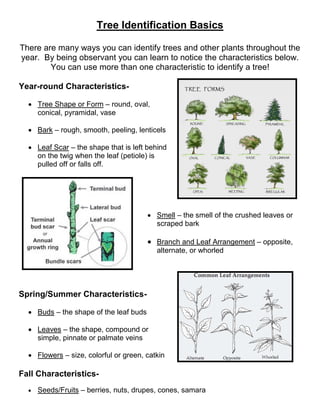
• Tree Shape or Form – round, oval,
conical, pyramidal, vase
• Bark – rough, smooth, peeling, lenticels
• Leaf Scar – the shape that is left behind
on the twig when the leaf (petiole) is
pulled off or falls off.
• Smell – the smell of the crushed leaves or
scraped bark
• Branch and Leaf Arrangement – opposite,
alternate, or whorled
Spring/Summer Characteristics-
• Buds – the shape of the leaf buds
• Leaves – the shape, compound or
simple, pinnate or palmate veins
• Flowers – size, colorful or green, catkin
Fall Characteristics-
• Seeds/Fruits – berries, nuts, drupes, cones, samara
Tree Vocabulary
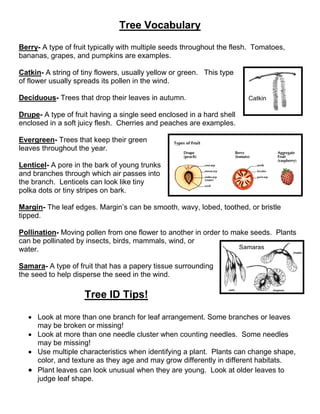
Berry- A type of fruit typically with multiple seeds throughout the flesh. Tomatoes,
bananas, grapes, and pumpkins are examples.
Catkin- A string of tiny flowers, usually yellow or green. This type
of flower usually spreads its pollen in the wind.
Deciduous- Trees that drop their leaves in autumn.
Drupe- A type of fruit having a single seed enclosed in a hard shell
enclosed in a soft juicy flesh. Cherries and peaches are examples.
Evergreen- Trees that keep their green
leaves throughout the year.
Lenticel- A pore in the bark of young trunks
and branches through which air passes into
the branch. Lenticels can look like tiny
polka dots or tiny stripes on bark.
Margin- The leaf edges. Margin’s can be smooth, wavy, lobed, toothed, or bristle
tipped.
Pollination- Moving pollen from one flower to another in order to make seeds. Plants
can be pollinated by insects, birds, mammals, wind, or
water.
Samara- A type of fruit that has a papery tissue surrounding
the seed to help disperse the seed in the wind.
Tree ID Tips!
• Look at more than one branch for leaf arrangement. Some branches or leaves
may be broken or missing!
• Look at more than one needle cluster when counting needles. Some needles
may be missing!
• Use multiple characteristics when identifying a plant. Plants can change shape,
color, and texture as they age and may grow differently in different habitats.
• Plant leaves can look unusual when they are young. Look at older leaves to
judge leaf shape.
Catkin
Samaras

Tree Identification Basics

  • 1.
    Tree Identification Basics Thereare many ways you can identify trees and other plants throughout the year. By being observant you can learn to notice the characteristics below. You can use more than one characteristic to identify a tree! Year-round Characteristics- • Tree Shape or Form – round, oval, conical, pyramidal, vase • Bark – rough, smooth, peeling, lenticels • Leaf Scar – the shape that is left behind on the twig when the leaf (petiole) is pulled off or falls off. • Smell – the smell of the crushed leaves or scraped bark • Branch and Leaf Arrangement – opposite, alternate, or whorled Spring/Summer Characteristics- • Buds – the shape of the leaf buds • Leaves – the shape, compound or simple, pinnate or palmate veins • Flowers – size, colorful or green, catkin Fall Characteristics- • Seeds/Fruits – berries, nuts, drupes, cones, samara
  • 2.
    Tree Vocabulary Berry- Atype of fruit typically with multiple seeds throughout the flesh. Tomatoes, bananas, grapes, and pumpkins are examples. Catkin- A string of tiny flowers, usually yellow or green. This type of flower usually spreads its pollen in the wind. Deciduous- Trees that drop their leaves in autumn. Drupe- A type of fruit having a single seed enclosed in a hard shell enclosed in a soft juicy flesh. Cherries and peaches are examples. Evergreen- Trees that keep their green leaves throughout the year. Lenticel- A pore in the bark of young trunks and branches through which air passes into the branch. Lenticels can look like tiny polka dots or tiny stripes on bark. Margin- The leaf edges. Margin’s can be smooth, wavy, lobed, toothed, or bristle tipped. Pollination- Moving pollen from one flower to another in order to make seeds. Plants can be pollinated by insects, birds, mammals, wind, or water. Samara- A type of fruit that has a papery tissue surrounding the seed to help disperse the seed in the wind. Tree ID Tips! • Look at more than one branch for leaf arrangement. Some branches or leaves may be broken or missing! • Look at more than one needle cluster when counting needles. Some needles may be missing! • Use multiple characteristics when identifying a plant. Plants can change shape, color, and texture as they age and may grow differently in different habitats. • Plant leaves can look unusual when they are young. Look at older leaves to judge leaf shape. Catkin Samaras