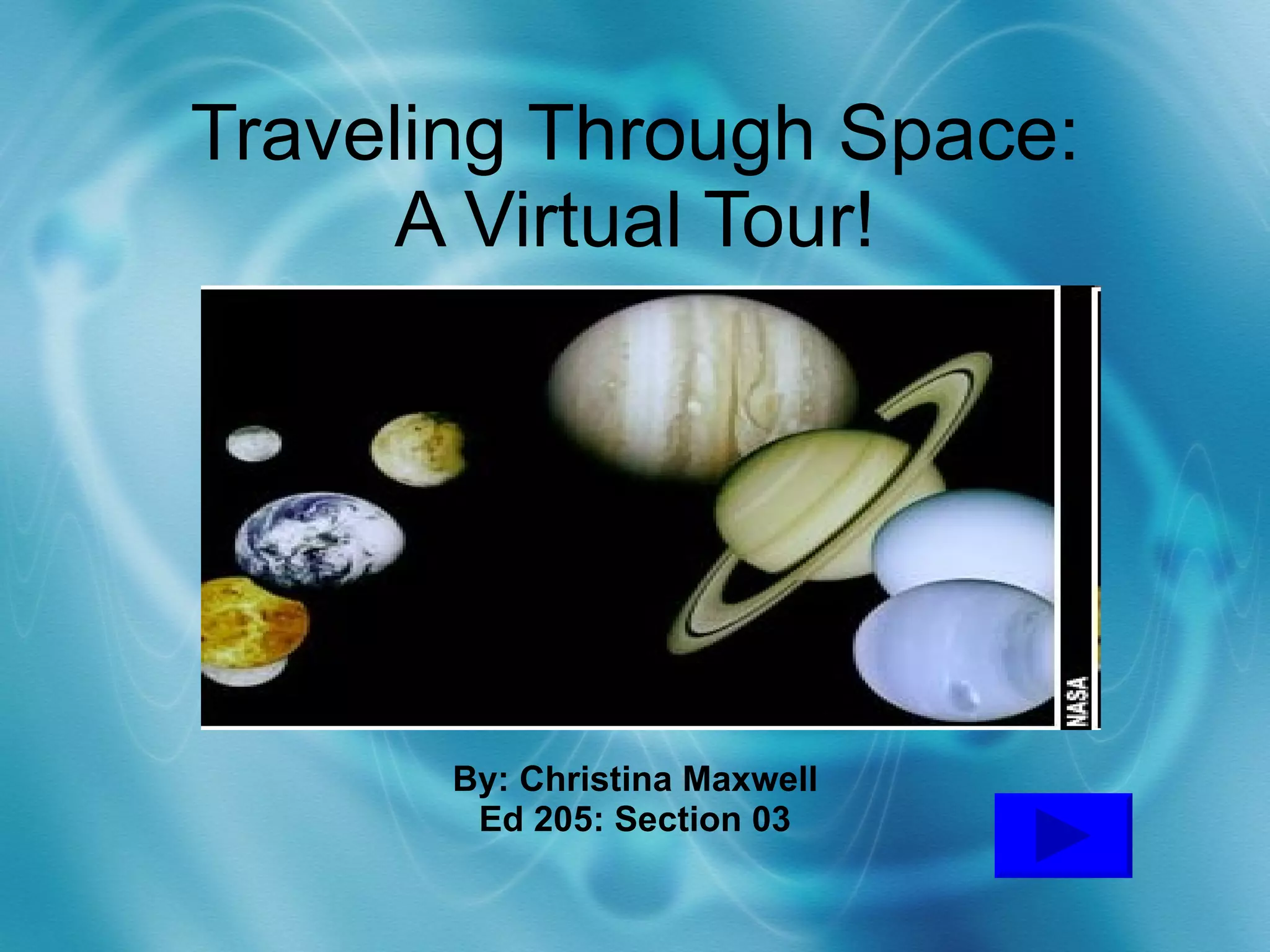
By: Christina Maxwell Ed 205: Section 03 Traveling Through Space: A Virtual Tour!
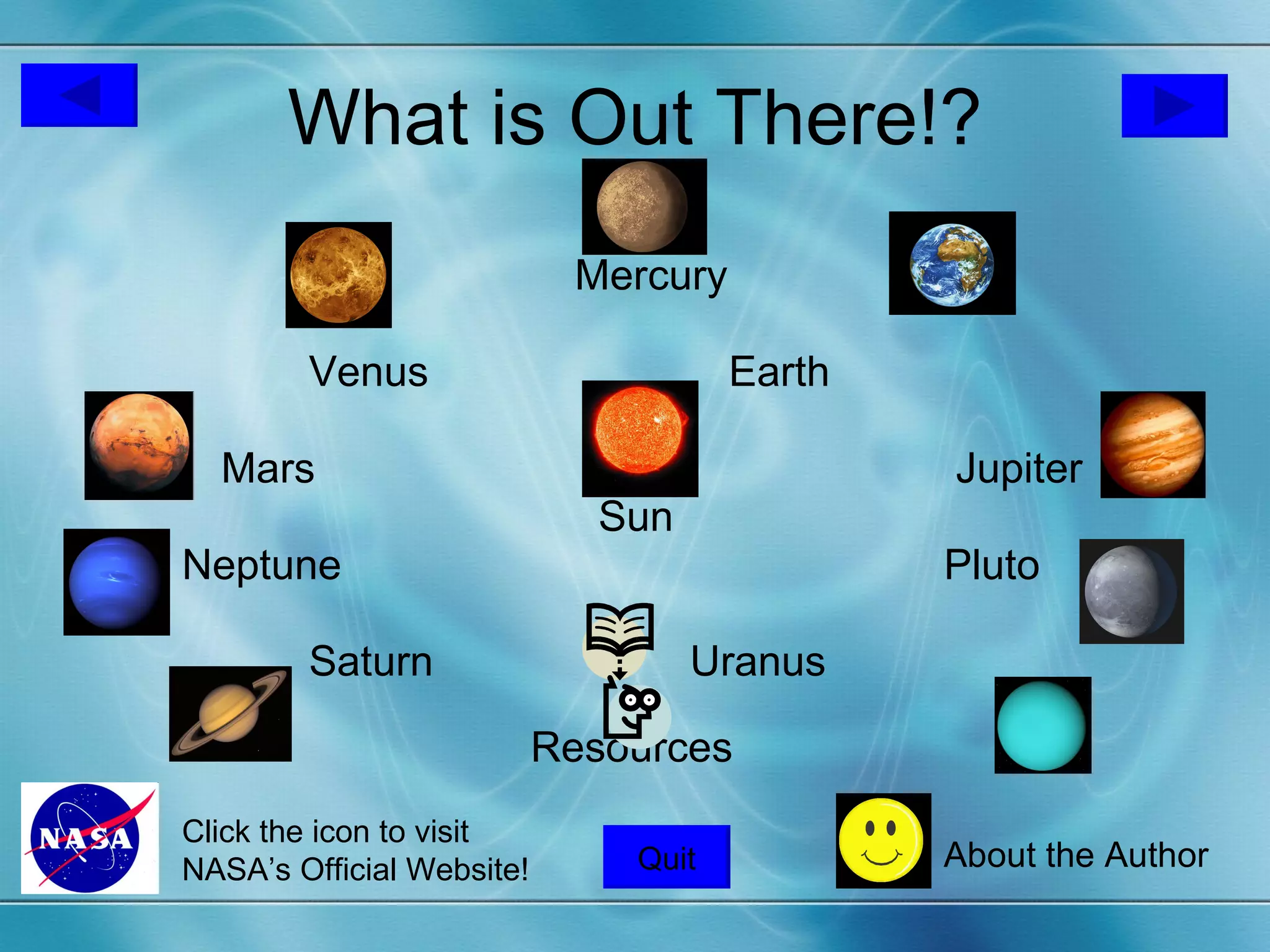
What is Out There!?     Mercury Venus	   Earth   Mars   Jupiter   Sun     Neptune Pluto Saturn	   Uranus      Resources   Click the icon to visit NASA’s Official Website! About the Author  Quit
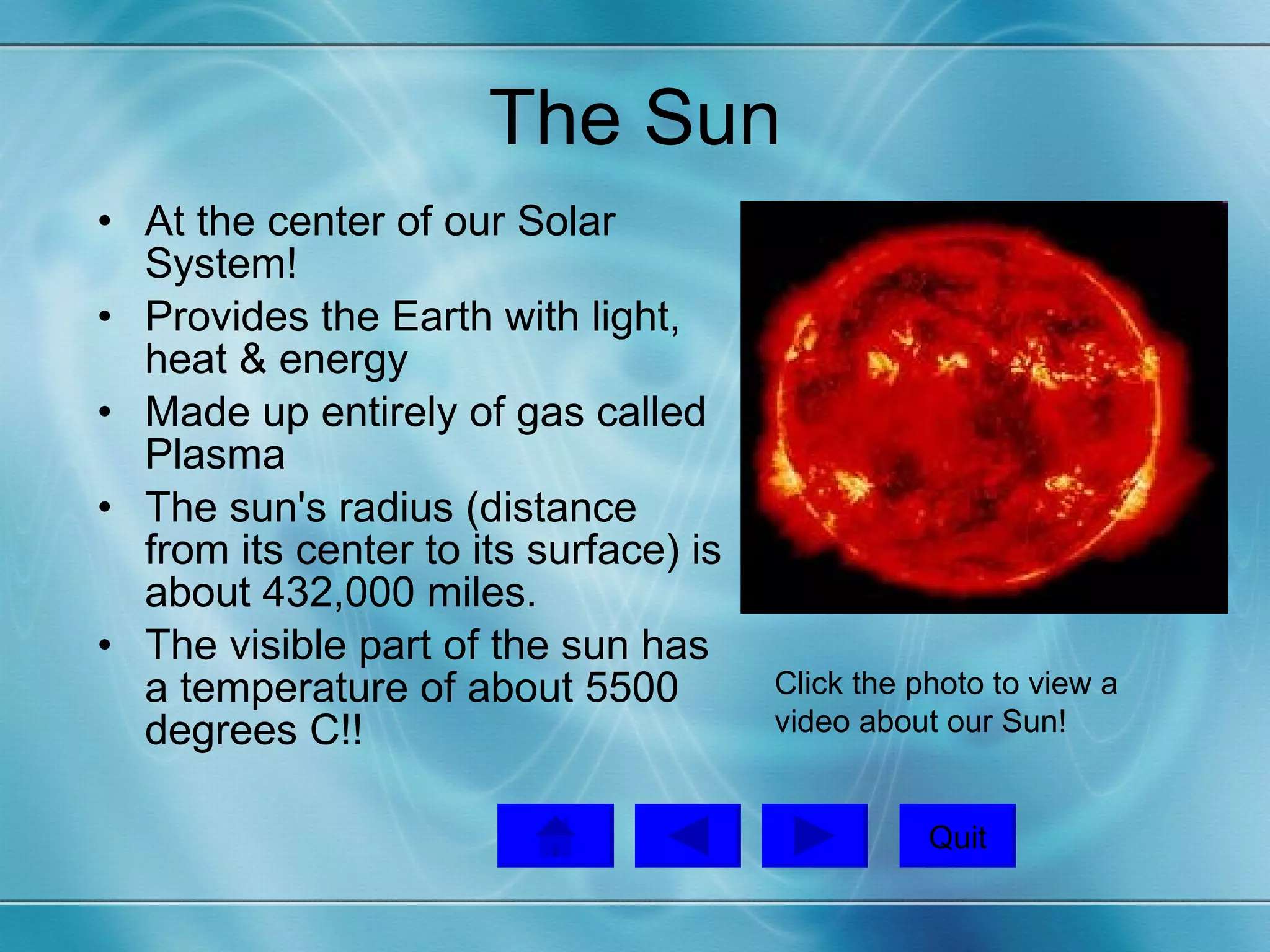
The Sun At the center of our Solar System! Provides the Earth with light, heat & energy Made up entirely of gas called Plasma The sun's radius (distance from its center to its surface) is about 432,000 miles. The visible part of the sun has a temperature of about 5500 degrees C!!  Click the photo to view a video about our Sun!  Quit
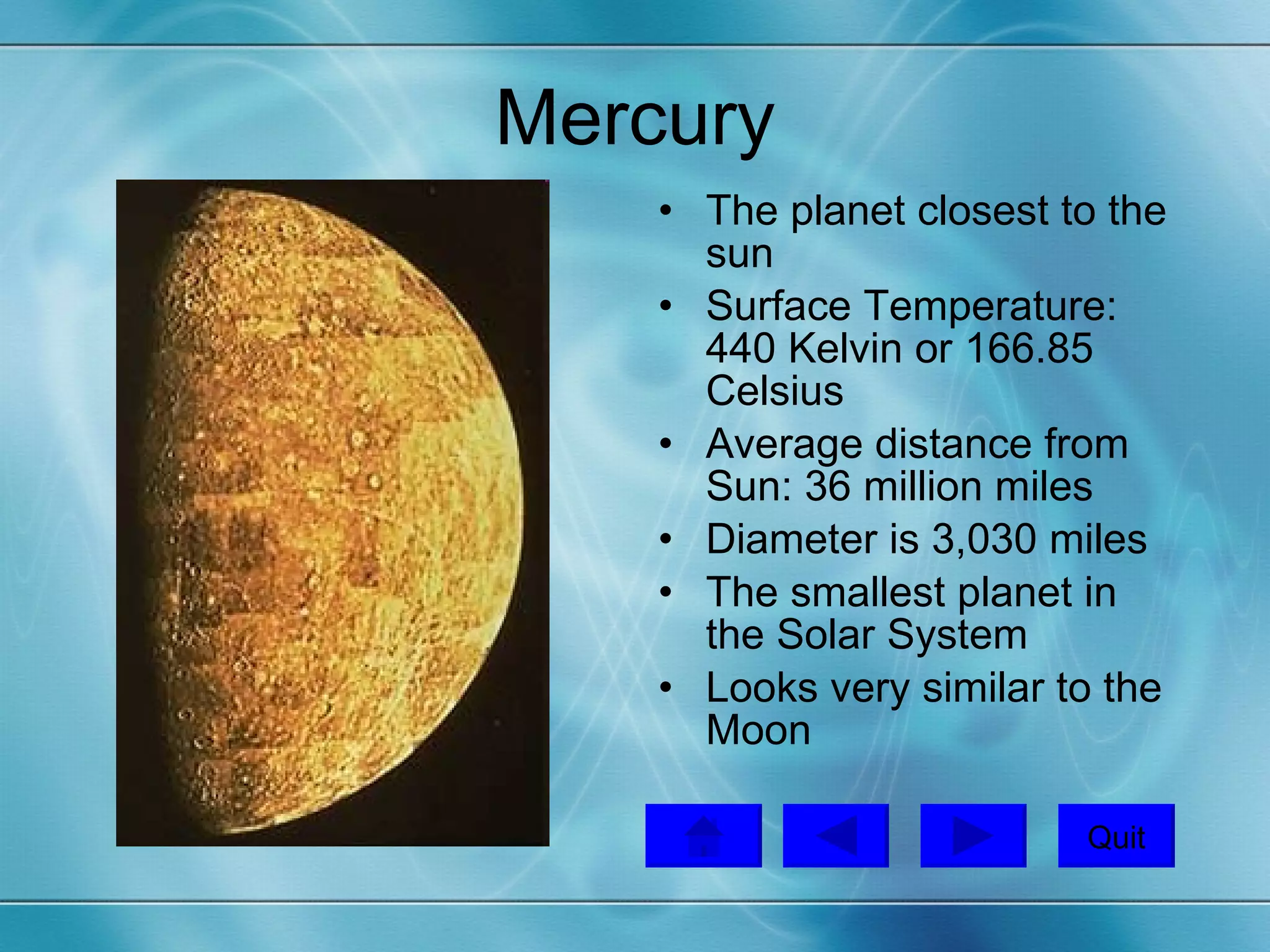
Mercury The planet closest to the sun Surface Temperature: 440 Kelvin or 166.85 Celsius  Average distance from Sun: 36 million miles Diameter is 3,030 miles  The smallest planet in the Solar System Looks very similar to the Moon Quit
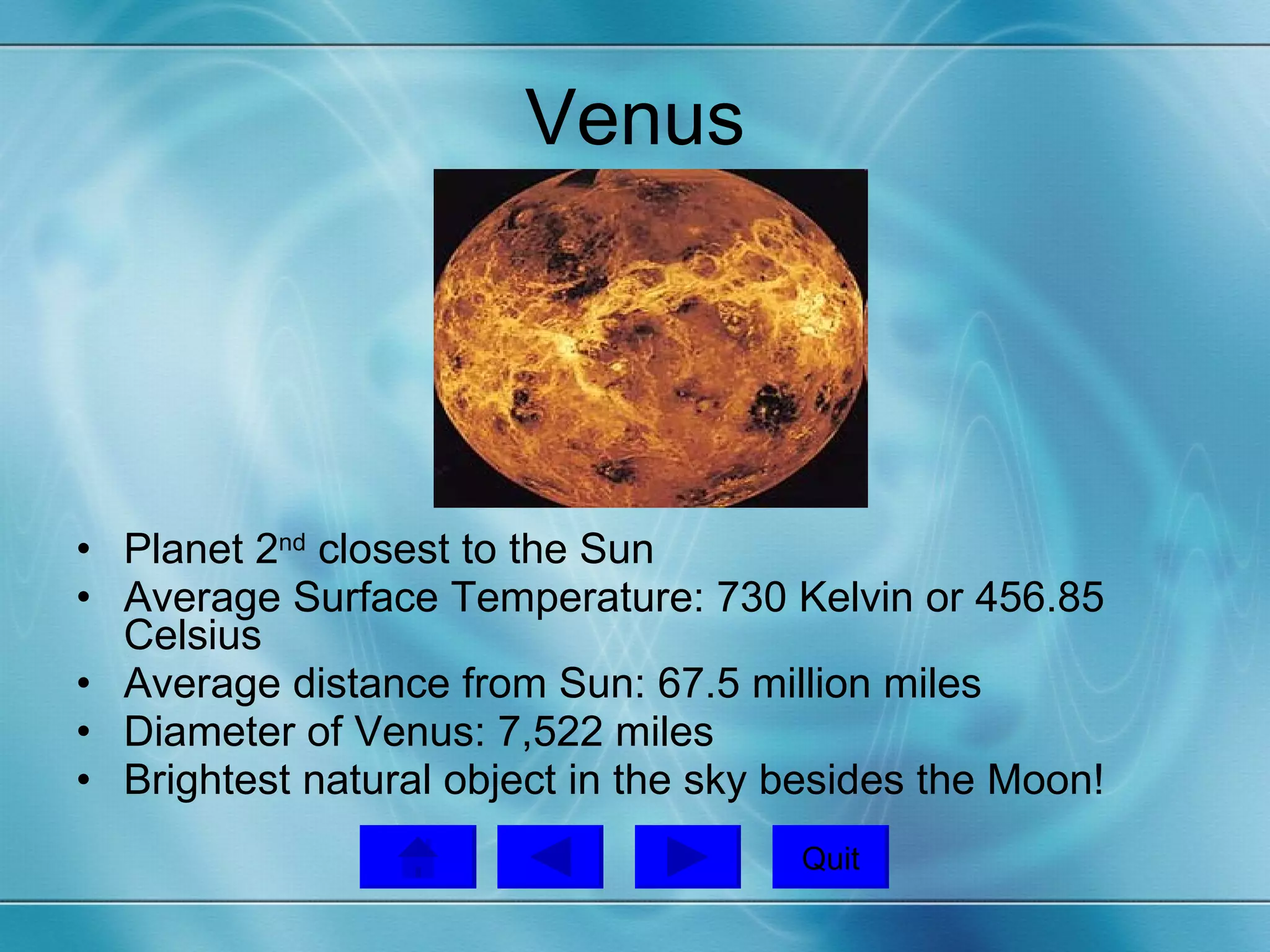
Venus Planet 2 nd  closest to the Sun Average Surface Temperature: 730 Kelvin or 456.85 Celsius Average distance from Sun: 67.5 million miles Diameter of Venus: 7,522 miles  Brightest natural object in the sky besides the Moon! Quit
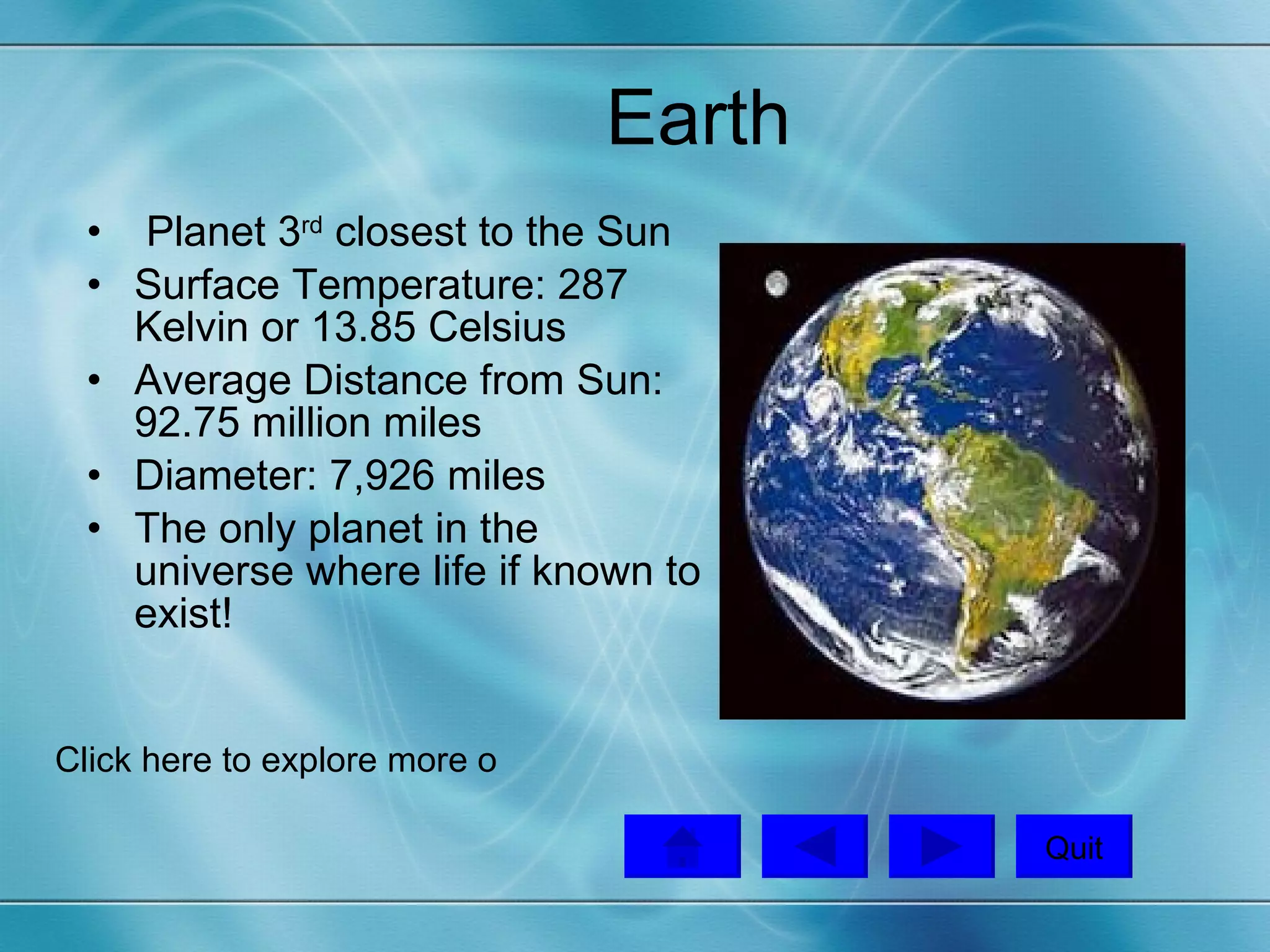
Earth Planet 3 rd  closest to the Sun Surface Temperature: 287 Kelvin or 13.85 Celsius Average Distance from Sun: 92.75 million miles Diameter: 7,926 miles  The only planet in the universe where life if known to exist!  Quit Click here to explore more on Google Earth!
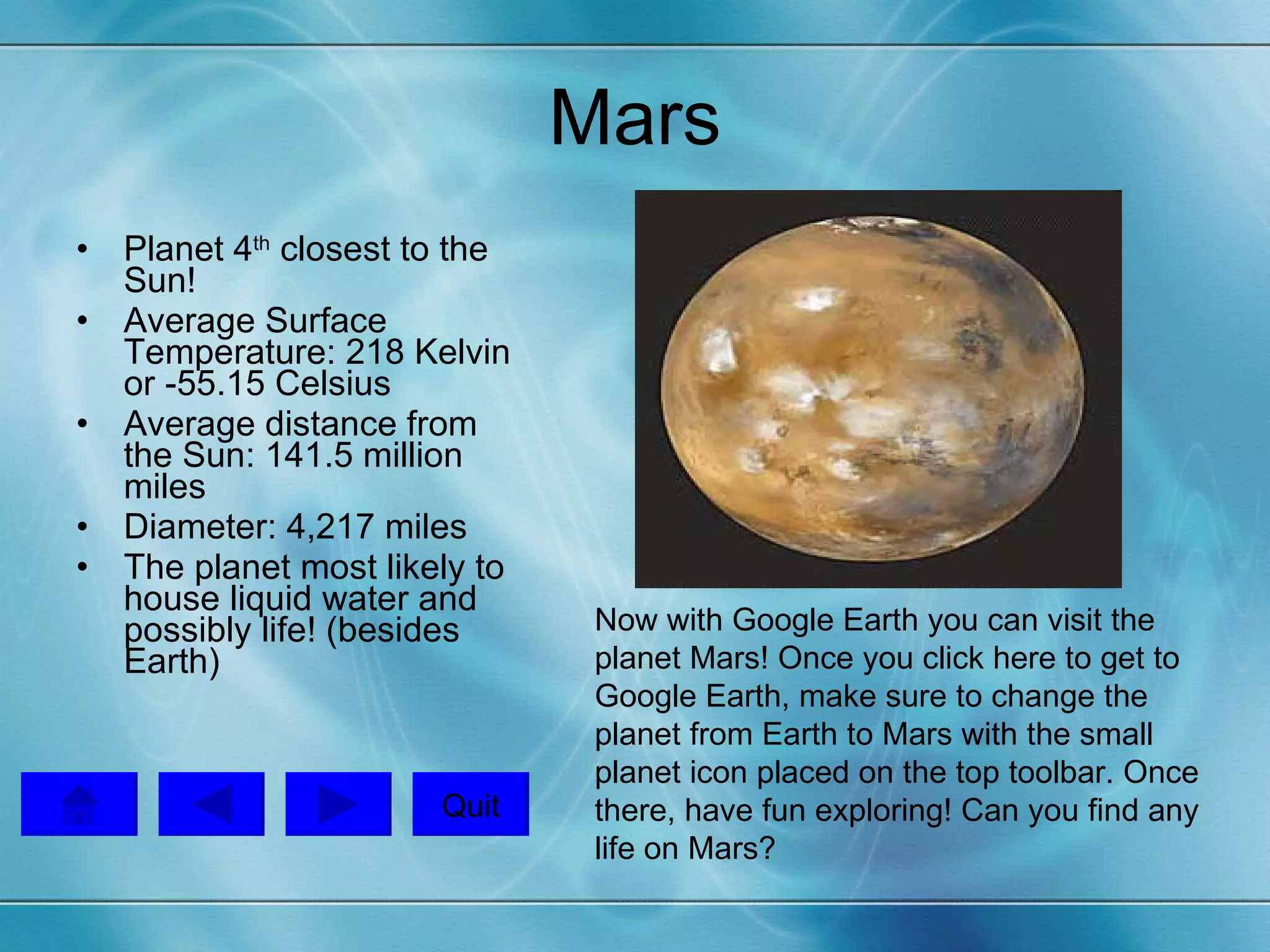
Mars Planet 4 th  closest to the Sun! Average Surface Temperature: 218 Kelvin or -55.15 Celsius Average distance from the Sun: 141.5 million miles Diameter: 4,217 miles The planet most likely to house liquid water and possibly life! (besides Earth) Now with Google Earth you can visit the planet Mars! Once you  click here  to get to Google Earth, make sure to change the planet from Earth to Mars with the small planet icon placed on the top toolbar. Once there, have fun exploring! Can you find any life on Mars?  Quit
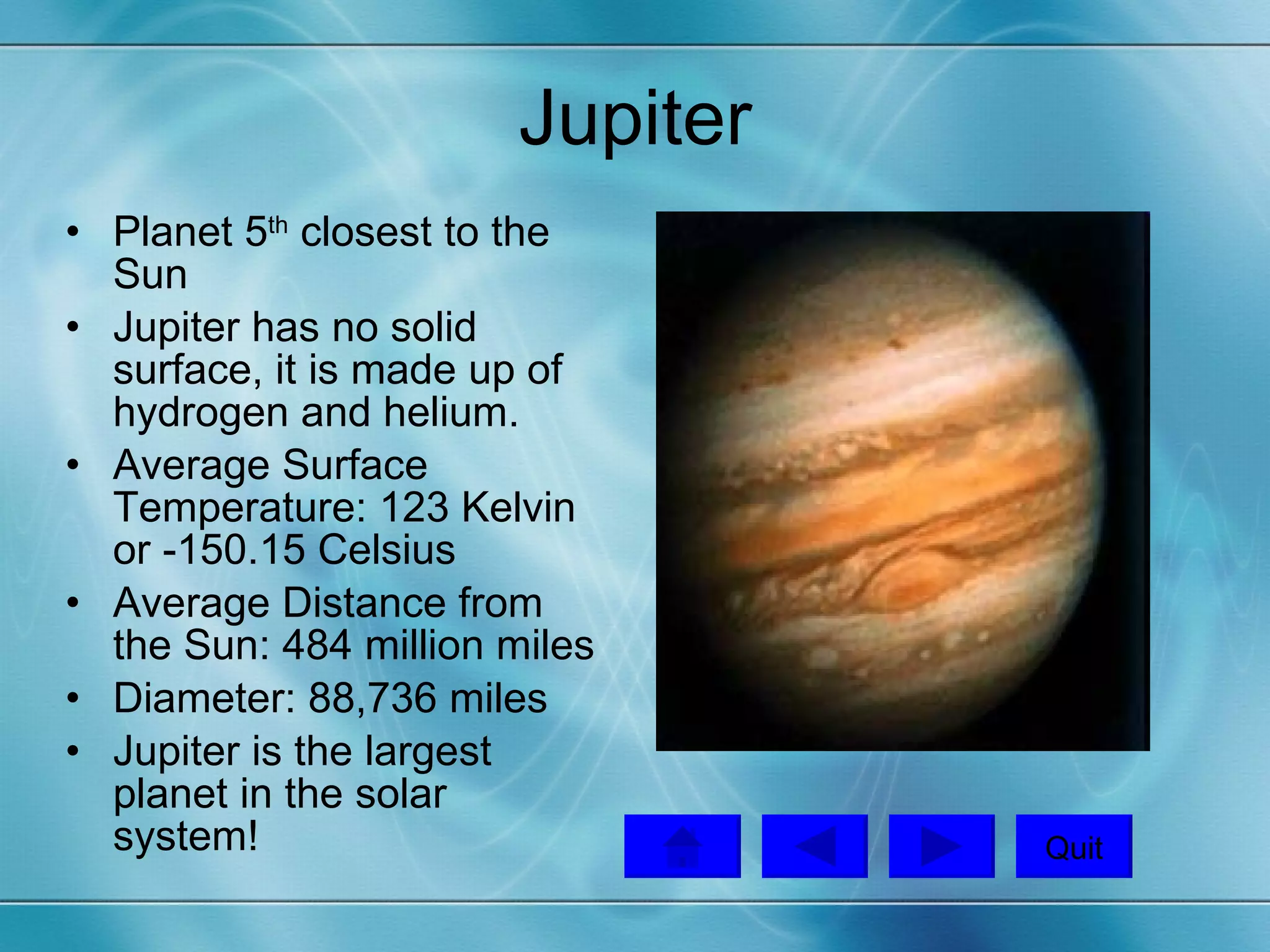
Jupiter Planet 5 th  closest to the Sun Jupiter has no solid surface, it is made up of hydrogen and helium. Average Surface Temperature: 123 Kelvin or -150.15 Celsius Average Distance from the Sun: 484 million miles Diameter: 88,736 miles Jupiter is the largest planet in the solar system! Quit
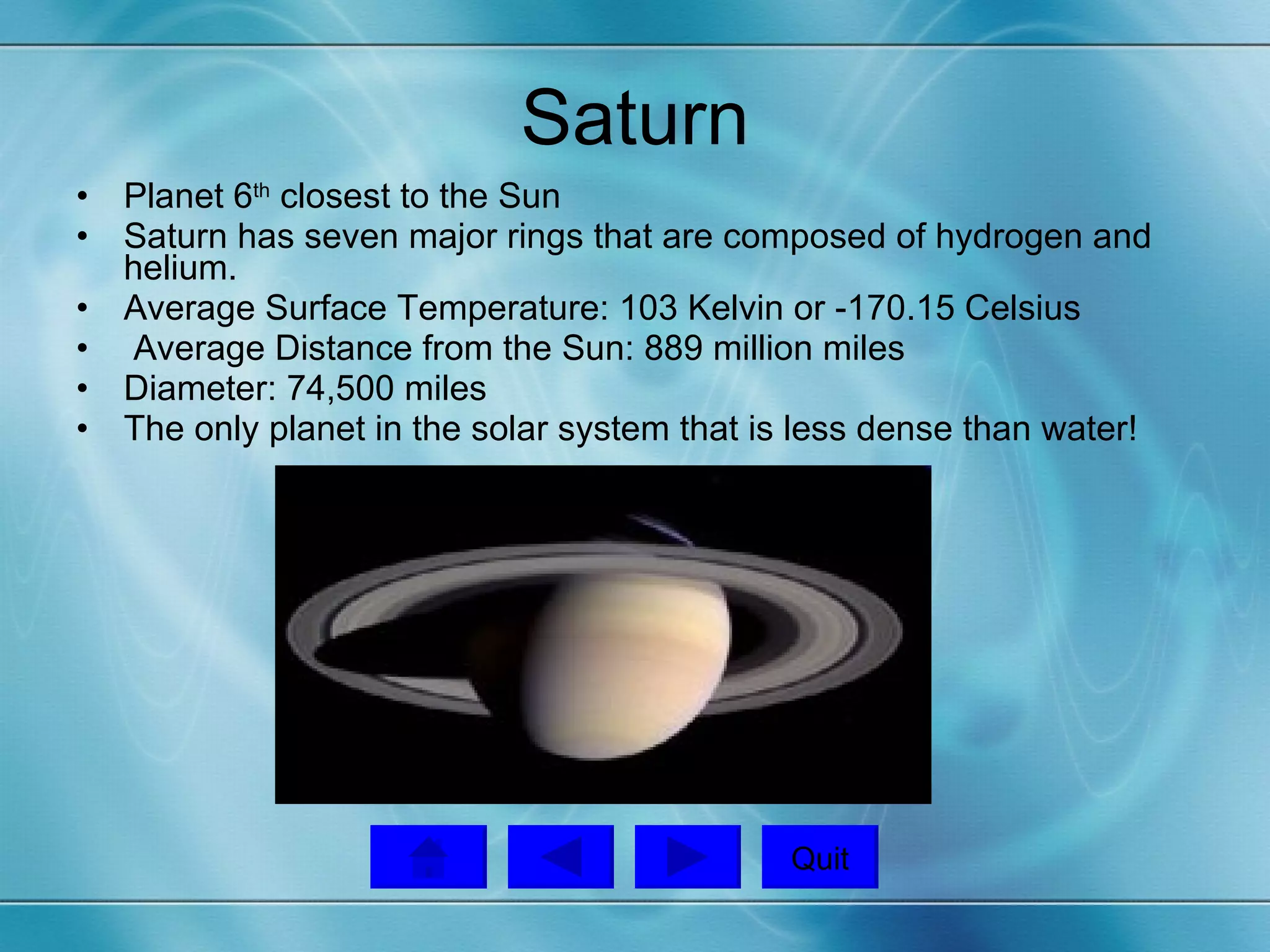
Saturn Planet 6 th  closest to the Sun Saturn has seven major rings that are composed of hydrogen and helium. Average Surface Temperature: 103 Kelvin or -170.15 Celsius Average Distance from the Sun: 889 million miles Diameter: 74,500 miles The only planet in the solar system that is less dense than water! Quit
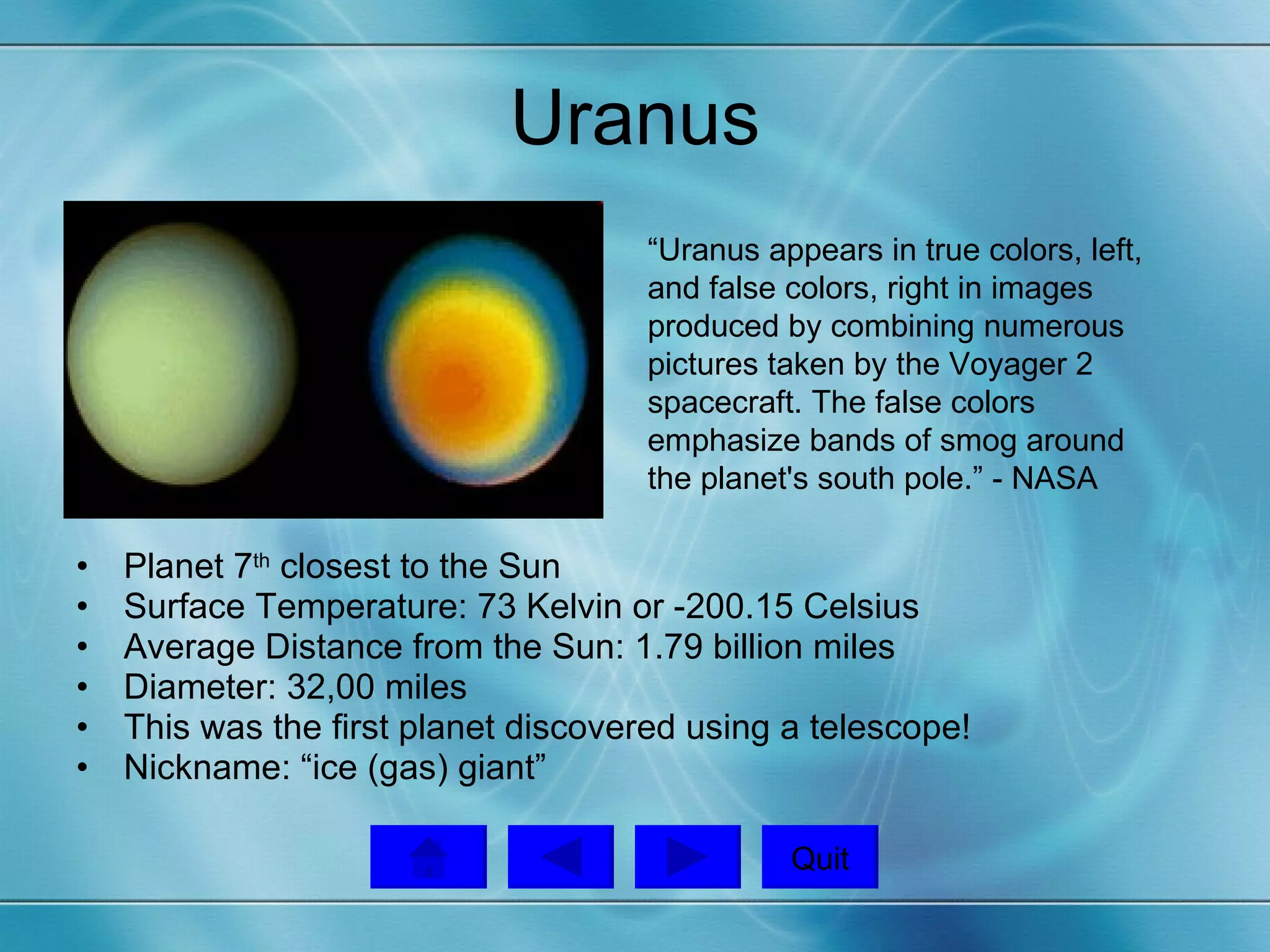
Uranus Planet 7 th  closest to the Sun Surface Temperature: 73 Kelvin or -200.15 Celsius Average Distance from the Sun: 1.79 billion miles Diameter: 32,00 miles This was the first planet discovered using a telescope!  Nickname: “ice (gas) giant”  “Uranus appears in true colors, left, and false colors, right in images produced by combining numerous pictures taken by the Voyager 2 spacecraft. The false colors emphasize bands of smog around the planet's south pole.” - NASA  Quit
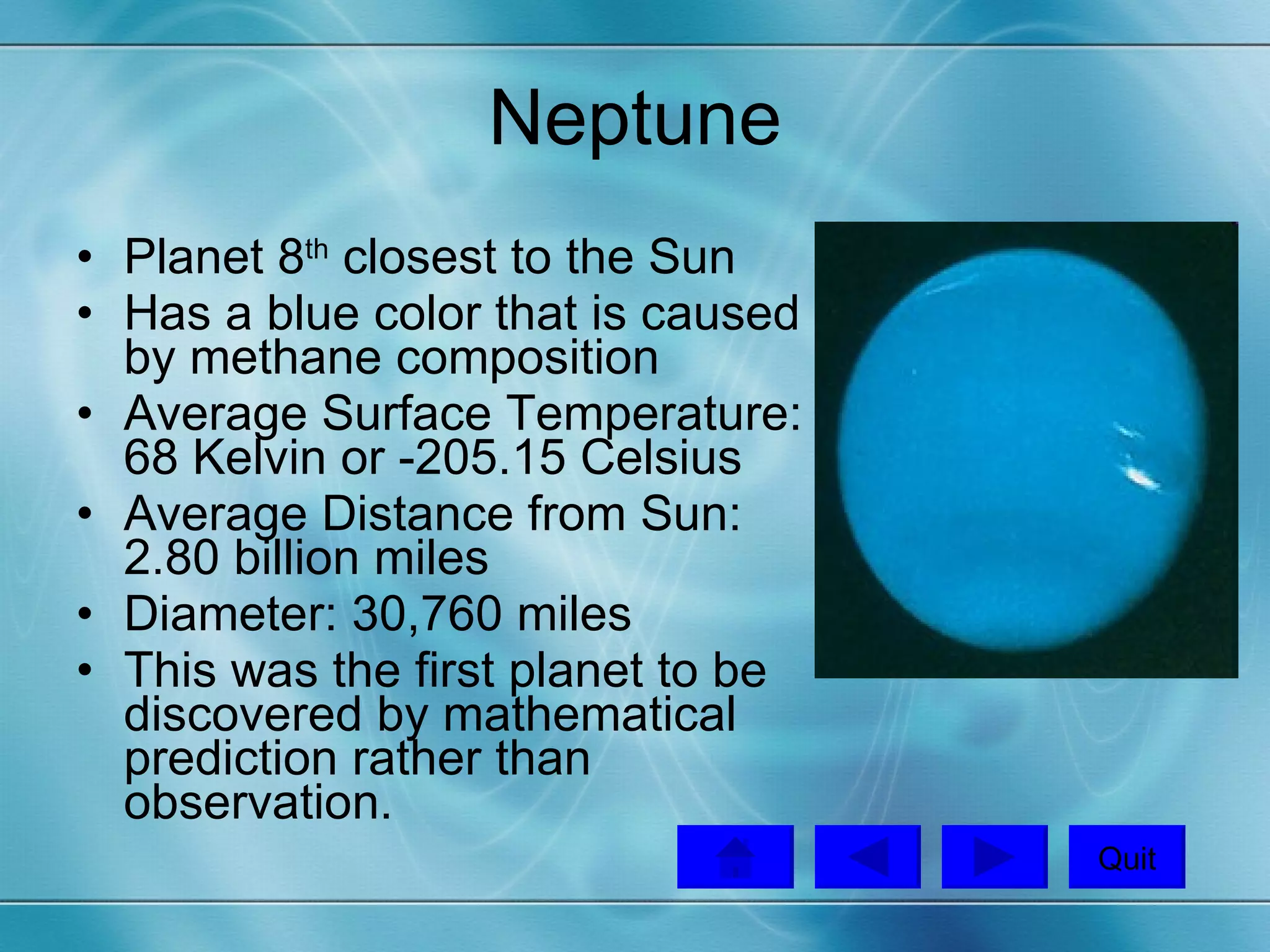
Neptune Planet 8 th  closest to the Sun Has a blue color that is caused by methane composition Average Surface Temperature: 68 Kelvin or -205.15 Celsius Average Distance from Sun: 2.80 billion miles Diameter: 30,760 miles This was the first planet to be discovered by mathematical prediction rather than observation.  Quit
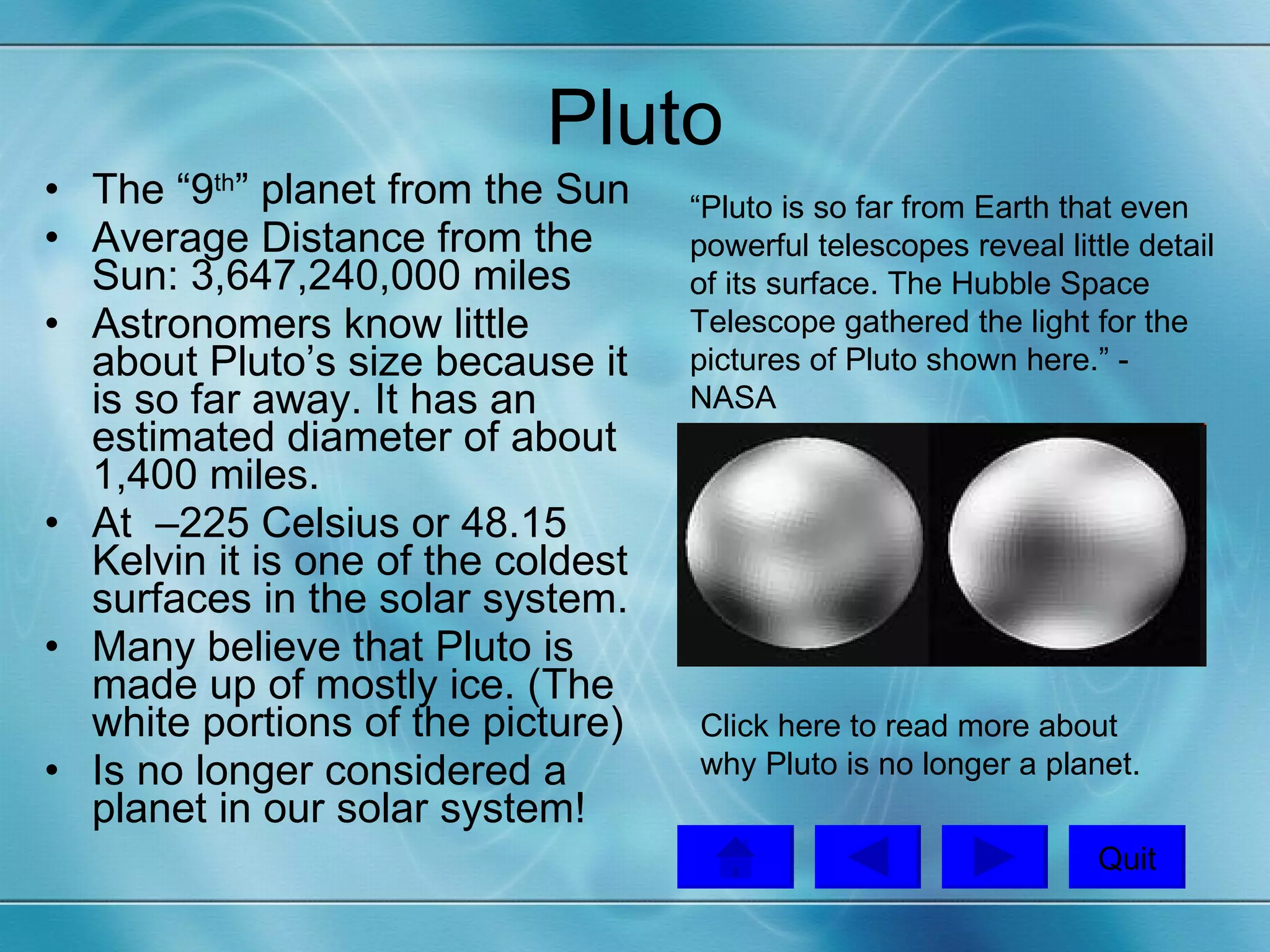
Pluto The “9 th ” planet from the Sun Average Distance from the Sun: 3,647,240,000 miles  Astronomers know little about Pluto’s size because it is so far away. It has an estimated diameter of about 1,400 miles. At  –225 Celsius or 48.15 Kelvin it is one of the coldest surfaces in the solar system. Many believe that Pluto is made up of mostly ice. (The white portions of the picture) Is no longer considered a planet in our solar system!  “Pluto is so far from Earth that even powerful telescopes reveal little detail of its surface. The Hubble Space Telescope gathered the light for the pictures of Pluto shown here.” - NASA  Click here  to read more about why Pluto is no longer a planet. Quit
Resources  Video about The Sun: http://www.youtube.com/watch?v=gdLaPhNBOcU&feature=related Images & Information http://www.nasa.gov/home/index.html Google Earth  Quit
About the Author Hi! I’m Christina Maxwell and I am a senior at Grand Valley State University. I am majoring in Integrated Science which is the reason I chose to do my Interactive PowerPoint on an Astronomy topic. My minor is Elementary Education and I hope to teach in a early elementary aged classroom one day!  Quit Click the mailbox to send me an email!

Traveling Through Space!

  • 1.
    By: Christina MaxwellEd 205: Section 03 Traveling Through Space: A Virtual Tour!
  • 2.
    What is OutThere!? Mercury Venus Earth Mars Jupiter Sun Neptune Pluto Saturn Uranus Resources Click the icon to visit NASA’s Official Website! About the Author Quit
  • 3.
    The Sun Atthe center of our Solar System! Provides the Earth with light, heat & energy Made up entirely of gas called Plasma The sun's radius (distance from its center to its surface) is about 432,000 miles. The visible part of the sun has a temperature of about 5500 degrees C!! Click the photo to view a video about our Sun! Quit
  • 4.
    Mercury The planetclosest to the sun Surface Temperature: 440 Kelvin or 166.85 Celsius Average distance from Sun: 36 million miles Diameter is 3,030 miles The smallest planet in the Solar System Looks very similar to the Moon Quit
  • 5.
    Venus Planet 2nd closest to the Sun Average Surface Temperature: 730 Kelvin or 456.85 Celsius Average distance from Sun: 67.5 million miles Diameter of Venus: 7,522 miles Brightest natural object in the sky besides the Moon! Quit
  • 6.
    Earth Planet 3rd closest to the Sun Surface Temperature: 287 Kelvin or 13.85 Celsius Average Distance from Sun: 92.75 million miles Diameter: 7,926 miles The only planet in the universe where life if known to exist! Quit Click here to explore more on Google Earth!
  • 7.
    Mars Planet 4th closest to the Sun! Average Surface Temperature: 218 Kelvin or -55.15 Celsius Average distance from the Sun: 141.5 million miles Diameter: 4,217 miles The planet most likely to house liquid water and possibly life! (besides Earth) Now with Google Earth you can visit the planet Mars! Once you click here to get to Google Earth, make sure to change the planet from Earth to Mars with the small planet icon placed on the top toolbar. Once there, have fun exploring! Can you find any life on Mars? Quit
  • 8.
    Jupiter Planet 5th closest to the Sun Jupiter has no solid surface, it is made up of hydrogen and helium. Average Surface Temperature: 123 Kelvin or -150.15 Celsius Average Distance from the Sun: 484 million miles Diameter: 88,736 miles Jupiter is the largest planet in the solar system! Quit
  • 9.
    Saturn Planet 6th closest to the Sun Saturn has seven major rings that are composed of hydrogen and helium. Average Surface Temperature: 103 Kelvin or -170.15 Celsius Average Distance from the Sun: 889 million miles Diameter: 74,500 miles The only planet in the solar system that is less dense than water! Quit
  • 10.
    Uranus Planet 7th closest to the Sun Surface Temperature: 73 Kelvin or -200.15 Celsius Average Distance from the Sun: 1.79 billion miles Diameter: 32,00 miles This was the first planet discovered using a telescope! Nickname: “ice (gas) giant” “Uranus appears in true colors, left, and false colors, right in images produced by combining numerous pictures taken by the Voyager 2 spacecraft. The false colors emphasize bands of smog around the planet's south pole.” - NASA Quit
  • 11.
    Neptune Planet 8th closest to the Sun Has a blue color that is caused by methane composition Average Surface Temperature: 68 Kelvin or -205.15 Celsius Average Distance from Sun: 2.80 billion miles Diameter: 30,760 miles This was the first planet to be discovered by mathematical prediction rather than observation. Quit
  • 12.
    Pluto The “9th ” planet from the Sun Average Distance from the Sun: 3,647,240,000 miles Astronomers know little about Pluto’s size because it is so far away. It has an estimated diameter of about 1,400 miles. At –225 Celsius or 48.15 Kelvin it is one of the coldest surfaces in the solar system. Many believe that Pluto is made up of mostly ice. (The white portions of the picture) Is no longer considered a planet in our solar system! “Pluto is so far from Earth that even powerful telescopes reveal little detail of its surface. The Hubble Space Telescope gathered the light for the pictures of Pluto shown here.” - NASA Click here to read more about why Pluto is no longer a planet. Quit
  • 13.
    Resources Videoabout The Sun: http://www.youtube.com/watch?v=gdLaPhNBOcU&feature=related Images & Information http://www.nasa.gov/home/index.html Google Earth Quit
  • 14.
    About the AuthorHi! I’m Christina Maxwell and I am a senior at Grand Valley State University. I am majoring in Integrated Science which is the reason I chose to do my Interactive PowerPoint on an Astronomy topic. My minor is Elementary Education and I hope to teach in a early elementary aged classroom one day! Quit Click the mailbox to send me an email!