Introduction
• The abdominalwall is made up of muscles
that support and protect the abdominal
organs.
• These muscles also help in breathing, posture,
and movement.
3.
Functions of AbdominalWall
• Supports internal organs and maintains
posture.
• Assists in breathing and coughing.
• Helps in bending, twisting, and stabilizing the
trunk.
• Plays a role in urination, childbirth, and
defecation.
4.
Rectus Abdominis
• Along, flat muscle running vertically in the
front of the abdomen.
• Known as the 'six-pack' muscle.
• Helps in flexing the trunk and maintaining
posture.
5.
External Oblique
• Thelargest and outermost muscle of the
abdominal wall.
• Fibers run downward and forward.
• Helps in trunk rotation and side bending.
6.
Internal Oblique
• Liesjust under the external oblique muscle.
• Fibers run upward and forward.
• Supports abdominal wall and aids in trunk
rotation.
7.
Transversus Abdominis
• Thedeepest muscle layer of the abdominal
wall.
• Fibers run horizontally across the abdomen.
• Helps compress abdominal contents and
provides stability.
8.
Associated Structures
• LineaAlba – a fibrous line running down the
midline.
• Inguinal Ligament – supports the lower
abdominal wall.
• Rectus Sheath – encloses the rectus abdominis
muscle.
9.
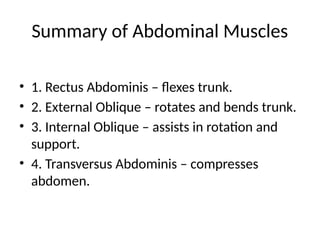
Summary of AbdominalMuscles
• 1. Rectus Abdominis – flexes trunk.
• 2. External Oblique – rotates and bends trunk.
• 3. Internal Oblique – assists in rotation and
support.
• 4. Transversus Abdominis – compresses
abdomen.
10.
Conclusion
• The abdominalwall muscles are essential for
movement, posture, and protection.
• A strong core improves stability and prevents
injuries.
• Thank you!