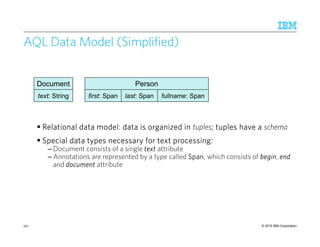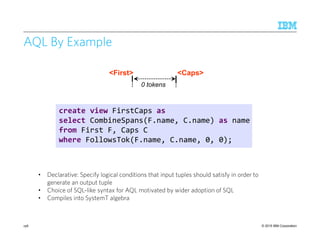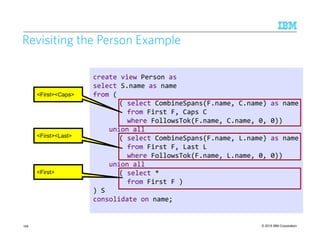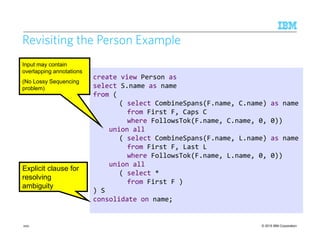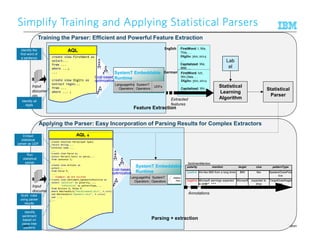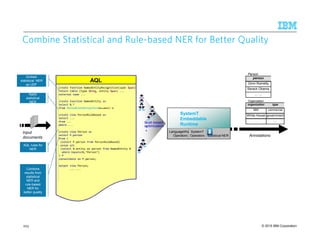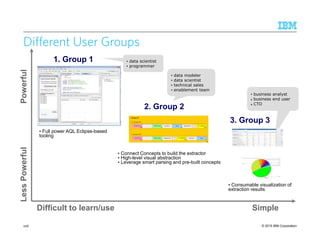
© 2015 IBM Corporation
Transparent Machine LearningTransparent Machine LearningTransparent Machine LearningTransparent Machine Learning
for Information Extractionfor Information Extractionfor Information Extractionfor Information Extraction
Laura Chiticariu
Yunyao Li
Fred Reiss
IBM Research - Almaden
© 2015 IBM Corporation
Motivation
2
© 2015 IBM Corporation
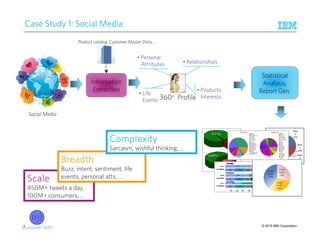
Case Study 1: Social Media
Information
Extraction
Product catalog, Customer Master Data, …
Social Media
• Products
Interests360o Profile
• Relationships
• Personal
Attributes
• Life
Events
Statistical
Analysis,
Report Gen.
Bank
6
23%
Bank
5
20%
Bank
4
21%
Bank
3
5%
Bank
2
15%
Bank
1
15%
ScaleScaleScaleScale
450M+ tweets a day,
100M+ consumers, …
BreadthBreadthBreadthBreadth
Buzz, intent, sentiment, life
events, personal atts, …
ComplexityComplexityComplexityComplexity
Sarcasm, wishful thinking, …
Customer 360º3
© 2015 IBM Corporation
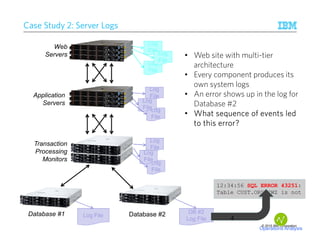
Case Study 2: Server Logs
Web
Servers
Application
Servers
Transaction
Processing
Monitors
Database #1 Database #2
Log
File
Log
File
Log
File
Log
File
Log
File
Log
File
Log
File
Log
File
Log
File
Log File
DB #2
Log File
• Web site with multi-tier
architecture
• Every component produces its
own system logs
• An error shows up in the log for
Database #2
• What sequence of events ledWhat sequence of events ledWhat sequence of events ledWhat sequence of events led
to this error?to this error?to this error?to this error?
12:34:56 SQL ERROR 43251:
Table CUST.ORDERWZ is not
Operations Analysis
4
© 2015 IBM Corporation
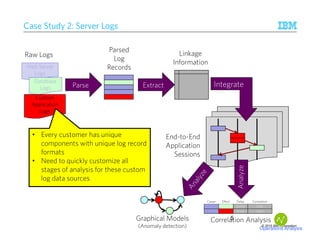
Case Study 2: Server Logs
Web Server
Logs
CustomCustom
Application
Logs
Database
Logs
Raw Logs
Parsed
Log
Records
Parse Extract
Linkage
Information
End-to-End
Application
Sessions
Integrate
Operations Analysis
Graphical Models
(Anomaly detection)
Analyze
5 min 0.85
CauseCause EffectEffect DelayDelay CorrelationCorrelation
10 min 0.62
Correlation Analysis
• Every customer has unique
components with unique log record
formats
• Need to quickly customize all
stages of analysis for these custom
log data sources
5
© 2015 IBM Corporation
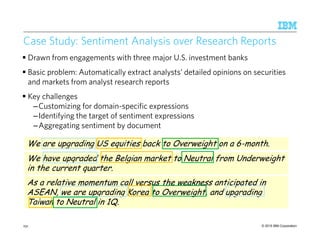
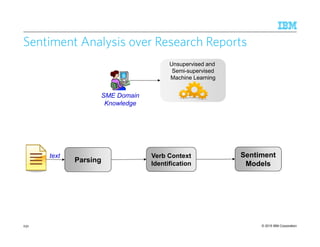
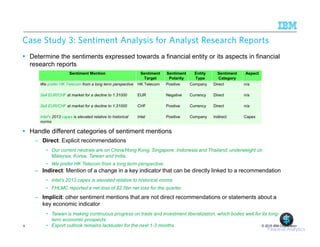
Case Study 3: Sentiment Analysis for Analyst Research ReportsCase Study 3: Sentiment Analysis for Analyst Research ReportsCase Study 3: Sentiment Analysis for Analyst Research ReportsCase Study 3: Sentiment Analysis for Analyst Research Reports
Determine the sentiments expressed towards a financial entity or its aspects in financial
research reports
Handle different categories of sentiment mentions
– Direct: Explicit recommendations
• Our current neutrals are on China/Hong Kong, Singapore, Indonesia and Thailand; underweight on
Malaysia, Korea, Taiwan and India.
• We prefer HK Telecom from a long term perspective.
– Indirect: Mention of a change in a key indicator that can be directly linked to a recommendation
• Intel's 2013 capex is elevated relative to historical norms
• FHLMC reported a net loss of $2.5bn net loss for the quarter.
– Implicit: other sentiment mentions that are not direct recommendations or statements about a
key economic indicator
• Taiwan is making continuous progress on trade and investment liberalization, which bodes well for its long-
term economic prospects
• Export outlook remains lackluster for the next 1-3 months.
Sentiment Mention Sentiment
Target
Sentiment
Polarity
Entity
Type
Sentiment
Category
Aspect
We prefer HK Telecom from a long term perspective HK Telecom Positive Company Direct n/a
Sell EUR/CHF at market for a decline to 1.31000 EUR Negative Currency Direct n/a
Sell EUR/CHF at market for a decline to 1.31000 CHF Positive Currency Direct n/a
Intel's 2013 capex is elevated relative to historical
norms
Intel Positive Company Indirect Capex
Financial Analytics
6
© 2015 IBM Corporation
Requirements for IE in the Enterprise
• Scalability
7
© 2015 IBM Corporation
Scalability Examples
Social Media
–Twitter has 450M+ messages per day; 1TB+ per day 400+ TB per year
–Add to it enterprise-specific Facebook, Tumblr, and tens of thousands of
blogs/forums
Financial Data
–Regulatory filings can be in tens of millions and several TBs
Machine data
–One application server under moderate load at medium logging level
1GB of app server logs per day
–A medium-size data center has tens of thousands of servers Tens of
Terabytes of system logs per day
8
© 2015 IBM Corporation
Requirements for IE in the Enterprise
• Scalability
• Expressivity
9
© 2015 IBM Corporation
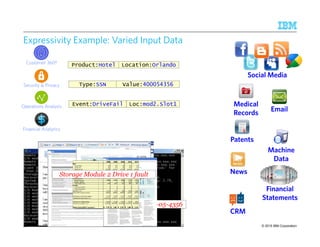
Expressivity Example: Varied Input Data
… hotel close to Seaworld in Orlando?
Planning to go this coming weekend…
Social Media
Customer 360º
Security & Privacy
Operations Analysis
Financial Analytics
my social security # is 400-05-4356
Email
Machine
Data
Financial
Statements
Medical
Records
News
CRM
Patents
Product:Hotel Location:Orlando
Type:SSN Value:400054356
Storage Module 2 Drive 1 fault
Event:DriveFail Loc:mod2.Slot1
10
© 2015 IBM Corporation
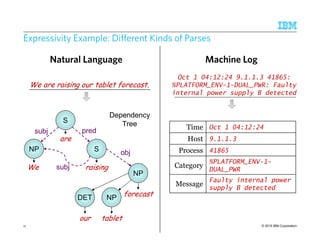
Expressivity Example: Different Kinds of Parses
We are raising our tablet forecast.
S
are
NP
We
S
raising
NP
forecastNP
tablet
DET
our
subj
obj
subj pred
Natural Language Machine Log
Dependency
Tree
Oct 1 04:12:24 9.1.1.3 41865:
%PLATFORM_ENV-1-DUAL_PWR: Faulty
internal power supply B detected
Time Oct 1 04:12:24
Host 9.1.1.3
Process 41865
Category
%PLATFORM_ENV-1-
DUAL_PWR
Message
Faulty internal power
supply B detected
11
© 2015 IBM Corporation
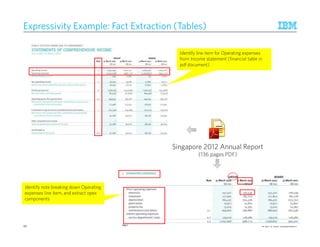
Expressivity Example: Fact Extraction (Tables)
12
Singapore 2012 Annual Report
(136 pages PDF)
Identify note breaking down Operating
expenses line item, and extract opex
components
Identify line item for Operating expenses
from Income statement (financial table in
pdf document)
12
© 2015 IBM Corporation
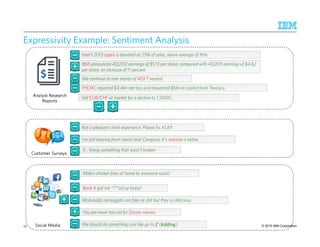
Expressivity Example: Sentiment Analysis
Mcdonalds mcnuggets are fake as shit but they so delicious.
We should do something cool like go to ZZZZ (kiddingkiddingkiddingkidding).
Makin chicken fries at home bc everyone sucks!
You are never too old for Disney movies.
Bank X got me ****ed up today!
Not a pleasant client experience. Please fix ASAP.
I'm still hearing from clients that Company A's website is better.
X... fixing something that wasn't broken
Intel's 2013 capex is elevated at 23% of sales, above average of 16%
IBM announced 4Q2012 earnings of $5.13 per share, compared with 4Q2011 earnings of $4.62
per share, an increase of 11 percent
We continue to rate shares of MSFT neutral.
Sell EUR/CHF at market for a decline to 1.31000…
FHLMC reported $4.4bn net loss and requested $6bn in capital from Treasury.
Customer SurveysCustomer SurveysCustomer SurveysCustomer Surveys
Social MediaSocial MediaSocial MediaSocial Media
Analyst ResearchAnalyst ResearchAnalyst ResearchAnalyst Research
ReportsReportsReportsReports
13
© 2015 IBM Corporation
Requirements for IE in the Enterprise
• Scalability
• Expressivity
• Ease of comprehension
14
© 2015 IBM Corporation
Ease of Comprehension: What not to do (1)
package com.ibm.avatar.algebra.util.sentence;
import java.io.BufferedWriter;
import java.util.ArrayList;
import java.util.HashSet;
import java.util.regex.Matcher;
public class SentenceChunker
{
private Matcher sentenceEndingMatcher = null;
public static BufferedWriter sentenceBufferedWriter = null;
private HashSet<String> abbreviations = new HashSet<String> ();
public SentenceChunker ()
{
}
/** Constructor that takes in the abbreviations directly. */
public SentenceChunker (String[] abbreviations)
{
// Generate the abbreviations directly.
for (String abbr : abbreviations) {
this.abbreviations.add (abbr);
}
}
/**
* @param doc the document text to be analyzed
* @return true if the document contains at least one sentence boundary
*/
public boolean containsSentenceBoundary (String doc)
{
String origDoc = doc;
/*
* Based on getSentenceOffsetArrayList()
*/
// String origDoc = doc;
// int dotpos, quepos, exclpos, newlinepos;
int boundary;
int currentOffset = 0;
do {
/* Get the next tentative boundary for the sentenceString */
setDocumentForObtainingBoundaries (doc);
boundary = getNextCandidateBoundary ();
if (boundary != -1) {doc.substring (0, boundary + 1);
String remainder = doc.substring (boundary + 1);
String candidate = /*
* Looks at the last character of the String. If this last
* character is part of an abbreviation (as detected by
* REGEX) then the sentenceString is not a fullSentence and
* "false” is returned
*/
// while (!(isFullSentence(candidate) &&
// doesNotBeginWithCaps(remainder))) {
while (!(doesNotBeginWithPunctuation (remainder)
&& isFullSentence (candidate))) {
/* Get the next tentative boundary for the sentenceString */
int nextBoundary = getNextCandidateBoundary ();
if (nextBoundary == -1) {
break;
}
boundary = nextBoundary;
candidate = doc.substring (0, boundary + 1);
remainder = doc.substring (boundary + 1);
}
if (candidate.length () > 0) {
// sentences.addElement(candidate.trim().replaceAll("n", "
// "));
// sentenceArrayList.add(new Integer(currentOffset + boundary
// + 1));
// currentOffset += boundary + 1;
// Found a sentence boundary. If the boundary is the last
// character in the string, we don't consider it to be
// contained within the string.
int baseOffset = currentOffset + boundary + 1;
if (baseOffset < origDoc.length ()) {
// System.err.printf("Sentence ends at %d of %dn",
// baseOffset, origDoc.length());
return true;
}
else {
return false;
}
}
// origDoc.substring(0,currentOffset));
// doc = doc.substring(boundary + 1);
doc = remainder;
}
}
while (boundary != -1);
// If we get here, didn't find any boundaries.
return false;
}
public ArrayList<Integer> getSentenceOffsetArrayList (String doc)
{
ArrayList<Integer> sentenceArrayList = new ArrayList<Integer> ();
// String origDoc = doc;
// int dotpos, quepos, exclpos, newlinepos;
int boundary;
int currentOffset = 0;
sentenceArrayList.add (new Integer (0));
do {
/* Get the next tentative boundary for the sentenceString */
setDocumentForObtainingBoundaries (doc);
boundary = getNextCandidateBoundary ();
if (boundary != -1) {
String candidate = doc.substring (0, boundary + 1);
String remainder = doc.substring (boundary + 1);
/*
* Looks at the last character of the String. If this last character
* is part of an abbreviation (as detected by REGEX) then the
* sentenceString is not a fullSentence and "false" is returned
*/
// while (!(isFullSentence(candidate) &&
// doesNotBeginWithCaps(remainder))) {
while (!(doesNotBeginWithPunctuation (remainder) &&
isFullSentence (candidate))) {
/* Get the next tentative boundary for the sentenceString */
int nextBoundary = getNextCandidateBoundary ();
if (nextBoundary == -1) {
break;
}
boundary = nextBoundary;
candidate = doc.substring (0, boundary + 1);
remainder = doc.substring (boundary + 1);
}
if (candidate.length () > 0) {
sentenceArrayList.add (new Integer (currentOffset + boundary + 1));
currentOffset += boundary + 1;
}
// origDoc.substring(0,currentOffset));
// doc = doc.substring(boundary + 1);
doc = remainder;
}
}
while (boundary != -1);
if (doc.length () > 0) {
sentenceArrayList.add (new Integer (currentOffset + doc.length ()));
}
sentenceArrayList.trimToSize ();
return sentenceArrayList;
}
private void setDocumentForObtainingBoundaries (String doc)
{
sentenceEndingMatcher = SentenceConstants.
sentenceEndingPattern.matcher (doc);
}
private int getNextCandidateBoundary ()
{
if (sentenceEndingMatcher.find ()) {
return sentenceEndingMatcher.start ();
}
else
return -1;
}
private boolean doesNotBeginWithPunctuation (String remainder)
{
Matcher m = SentenceConstants.punctuationPattern.matcher (remainder);
return (!m.find ());
}
private String getLastWord (String cand)
{
Matcher lastWordMatcher = SentenceConstants.lastWordPattern.matcher (cand);
if (lastWordMatcher.find ()) {
return lastWordMatcher.group ();
}
else {
return "";
}
}
/*
* Looks at the last character of the String. If this last character is
* par of an abbreviation (as detected by REGEX)
* then the sentenceString is not a fullSentence and "false" is returned
*/
private boolean isFullSentence (String cand)
{
// cand = cand.replaceAll("n", " "); cand = " " + cand;
Matcher validSentenceBoundaryMatcher =
SentenceConstants.validSentenceBoundaryPattern.matcher (cand);
if (validSentenceBoundaryMatcher.find ()) return true;
Matcher abbrevMatcher = SentenceConstants.abbrevPattern.matcher (cand);
if (abbrevMatcher.find ()) {
return false; // Means it ends with an abbreviation
}
else {
// Check if the last word of the sentenceString has an entry in the
// abbreviations dictionary (like Mr etc.)
String lastword = getLastWord (cand);
if (abbreviations.contains (lastword)) { return false; }
}
return true;
}
}
Java Implementation of Sentence Boundary Detection
15
© 2015 IBM Corporation
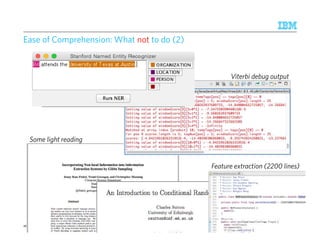
Some light reading
Viterbi debug output
Ease of Comprehension: What not to do (2)
16
Feature extraction (2200 lines)
© 2015 IBM Corporation
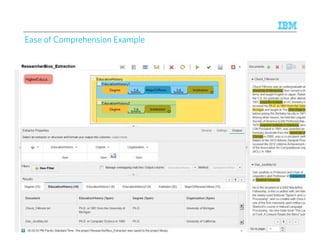
Ease of Comprehension Example
17
© 2015 IBM Corporation
Requirements for IE in the Enterprise
• Scalability
• Expressivity
• Ease of comprehension
• Ease of debugging
18
© 2015 IBM Corporation
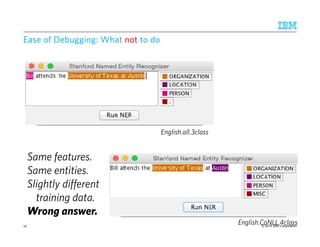
Ease of Debugging: WhatEase of Debugging: WhatEase of Debugging: WhatEase of Debugging: What notnotnotnot to doto doto doto do
19
Same features.
Same entities.
Slightly different
training data.
Wrong answer.
English.CoNLL.4class
English.all.3class
© 2015 IBM Corporation
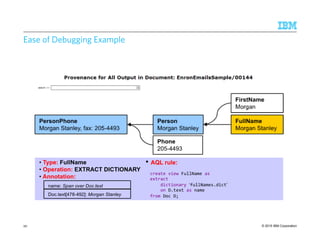
Ease of Debugging Example
20
© 2015 IBM Corporation
Requirements for IE in the Enterprise
• Scalability
• Expressivity
• Ease of comprehension
• Ease of debugging
• Ease of enhancement
21
© 2015 IBM Corporation
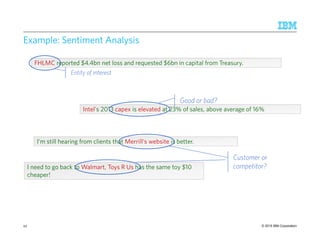
Example: Sentiment Analysis
Intel's 2013 capex is elevated at 23% of sales, above average of 16%
FHLMC reported $4.4bn net loss and requested $6bn in capital from Treasury.
I'm still hearing from clients that Merrill's website is better.
Customer or
competitor?
Good or bad?
Entity of interest
I need to go back to Walmart, Toys R Us has the same toy $10
cheaper!
22
© 2015 IBM Corporation
Requirements for IE in the Enterprise
• Scalability
• Expressivity
• Ease of comprehension
• Ease of debugging
• Ease of enhancement
Transparency
23
© 2015 IBM Corporation
Road map
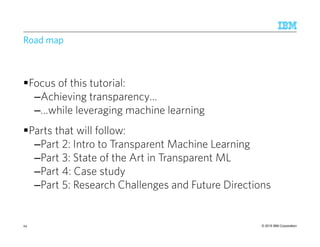
Focus of this tutorial:
–Achieving transparency…
–…while leveraging machine learning
Parts that will follow:
–Part 2: Intro to Transparent Machine Learning
–Part 3: State of the Art in Transparent ML
–Part 4: Case study
–Part 5: Research Challenges and Future Directions
24
© 2015 IBM Corporation
Transparent ML: Intro
25
© 2015 IBM Corporation
A Brief History of IE
1978-1997: MUC (Message
Understanding Conference) – DARPA
competition 1987 to 1997
– FRUMP [DeJong82]
– FASTUS [Appelt93],
– TextPro, PROTEUS
1998: Common Pattern Specification
Language (CPSL) standard [Appelt98]
– Standard for subsequent rule-based
systems
1999-2010: Commercial products, GATE
2006 – Declarative IE started in
Universities and Industrial Labs
At first: Simple techniques like Naive
Bayes
1990’s: Learning Rules
– AUTOSLOG [Riloff93]
– CRYSTAL [Soderland98]
– SRV [Freitag98]
2000’s: More specialized models
– Hidden Markov Models [Leek97]
– Maximum Entropy Markov Models
[McCallum00]
– Conditional Random Fields
[Lafferty01]
– Automatic feature expansion
Rule-Based Machine Learning
26
© 2015 IBM Corporation
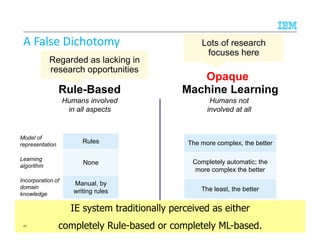
A False Dichotomy
Rule-Based Machine Learning
Model of
representation
Rules
Learning
algorithm
None
Incorporation of
domain
knowledge
Manual, by
writing rules
Humans involved
in all aspects
Humans not
involved at all
IE system traditionally perceived as either
completely Rule-based or completely ML-based.
Regarded as lacking in
research opportunities
Regarded as lacking in
research opportunities
Lots of research
focuses here
Lots of research
focuses here
Opaque
The more complex, the better
Completely automatic; the
more complex the better
The least, the better
27
© 2015 IBM Corporation
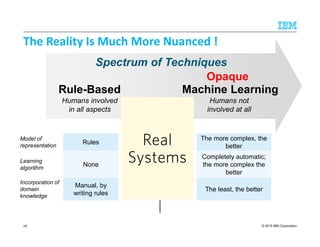
Spectrum of Techniques
The Reality Is Much More Nuanced !
Rule-Based Machine Learning
Model of
representation
Rules
The more complex, the
better
Learning
algorithm
None
Completely automatic;
the more complex the
better
Incorporation of
domain
knowledge
Manual, by
writing rules
The least, the better
Humans involved
in all aspects
Humans not
involved at all
Opaque
RealRealRealReal
SystemsSystemsSystemsSystems
RealRealRealReal
SystemsSystemsSystemsSystems
28
© 2015 IBM Corporation
Real Systems: A Practical PerspectiveReal Systems: A Practical PerspectiveReal Systems: A Practical PerspectiveReal Systems: A Practical Perspective
• Entity extraction
• EMNLP, ACL,
NAACL, 2003-
2012
• 54 industrial
vendors (Who’s
Who in Text
Analytics, 2012)
[Chiticariu, Li, Reiss, EMNLP 2013]
PrimarilyPrimarilyPrimarilyPrimarily
RuleRuleRuleRule----
basedbasedbasedbased
HybridHybridHybridHybrid
PrimarilyPrimarilyPrimarilyPrimarily
MachineMachineMachineMachine
LearningLearningLearningLearning----
basedbasedbasedbased
29
© 2015 IBM Corporation
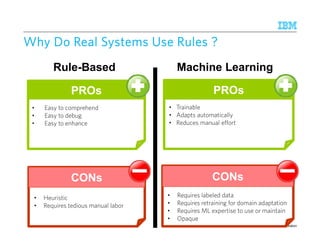
PROs
• Easy to comprehend
• Easy to debug
• Easy to enhance
PROs
• Trainable
• Adapts automatically
• Reduces manual effort
CONs
• Heuristic
• Requires tedious manual labor
Rule-based IE ML-based IE
CONs
• Requires labeled data
• Requires retraining for domain adaptation
• Requires ML expertise to use or maintain
• Opaque
Rule-Based Machine Learning
Why Do Real Systems Use Rules ?Why Do Real Systems Use Rules ?Why Do Real Systems Use Rules ?Why Do Real Systems Use Rules ?
© 2015 IBM Corporation
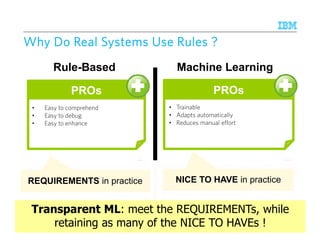
PROs
• Easy to comprehend
• Easy to debug
• Easy to enhance
PROs
• Trainable
• Adapts automatically
• Reduces manual effort
CONs
• Heuristic
• Requires tedious manual labor
Rule-based IE ML-based IE
CONs
• Requires labeled data
• Requires retraining for domain adaptation
• Requires ML expertise to use or maintain
• Opaque
Rule-Based Machine Learning
Why Do Real Systems Use Rules ?Why Do Real Systems Use Rules ?Why Do Real Systems Use Rules ?Why Do Real Systems Use Rules ?
REQUIREMENTS in practiceREQUIREMENTS in practice NICE TO HAVE in practiceNICE TO HAVE in practice
Transparent ML: meet the REQUIREMENTs, while
retaining as many of the NICE TO HAVEs !
© 2015 IBM Corporation
Transparent Machine Learning (Transparent ML)Transparent Machine Learning (Transparent ML)Transparent Machine Learning (Transparent ML)Transparent Machine Learning (Transparent ML)
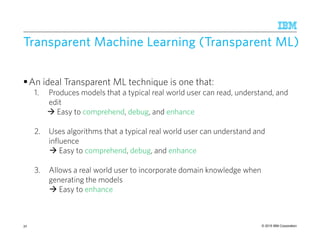
An ideal Transparent ML technique is one that:
1. Produces models that a typical real world user can read, understand, and
edit
Easy to comprehend, debug, and enhance
2. Uses algorithms that a typical real world user can understand and
influence
Easy to comprehend, debug, and enhance
3. Allows a real world user to incorporate domain knowledge when
generating the models
Easy to enhance
32
© 2015 IBM Corporation
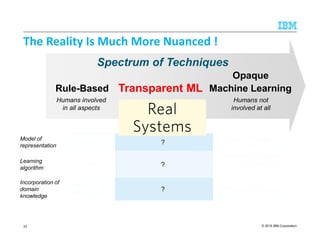
Spectrum of Techniques
The Reality Is Much More Nuanced !
Model of
representation
Rules ?
The more complex, the
better
Learning
algorithm
None ?
Completely automatic;
the more complex the
better
Incorporation of
domain
knowledge
Manual, by
writing rules
? The least, the better
Rule-Based
Humans involved
in all aspects
Machine Learning
Humans not
involved at all
Opaque
RealRealRealReal
SystemsSystemsSystemsSystems
RealRealRealReal
SystemsSystemsSystemsSystems
Transparent ML
33
© 2015 IBM Corporation
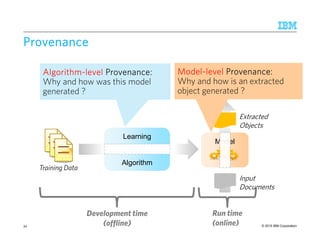
ProvenanceProvenanceProvenanceProvenance
34
Training Data
Learning
Algorithm
Learning
Algorithm
ModelModel
Input
Documents
Extracted
Objects
Development time
(offline)
Run time
(online)
AlgorithmAlgorithmAlgorithmAlgorithm----levellevellevellevel Provenance:Provenance:Provenance:Provenance:
Why and how was this model
generated ?
AlgorithmAlgorithmAlgorithmAlgorithm----levellevellevellevel Provenance:Provenance:Provenance:Provenance:
Why and how was this model
generated ?
ModelModelModelModel----levellevellevellevel Provenance:Provenance:Provenance:Provenance:
Why and how is an extracted
object generated ?
ModelModelModelModel----levellevellevellevel Provenance:Provenance:Provenance:Provenance:
Why and how is an extracted
object generated ?
© 2015 IBM Corporation
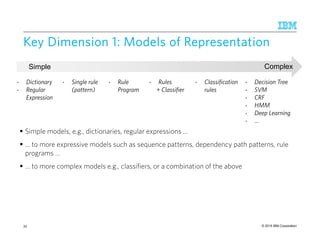
Key Dimension 1: ModelsKey Dimension 1: ModelsKey Dimension 1: ModelsKey Dimension 1: Models of Representationof Representationof Representationof Representation
35
Simple models, e.g., dictionaries, regular expressions …
… to more expressive models such as sequence patterns, dependency path patterns, rule
programs …
… to more complex models e.g., classifiers, or a combination of the above
• Dictionary
• Regular
Expression
• Single rule
(pattern)
• Rule
Program
• Decision Tree
• SVM
• CRF
• HMM
• Deep Learning
• …
• Classification
rules
• Rules
+ Classifier
Simple Complex
© 2015 IBM Corporation
Organization CandidateOrganization Candidate
Spectrum ofSpectrum ofSpectrum ofSpectrum of ModelsModelsModelsModels ofofofof Representation (1/4): Sequence Pattern RulesRepresentation (1/4): Sequence Pattern RulesRepresentation (1/4): Sequence Pattern RulesRepresentation (1/4): Sequence Pattern Rules
A rule matches a linear sequence of tokens
E.g., CPSL-style sequence rules [Appelt 1998]
Components include:
– Orthographic features: e.g., matches for a regular expression
– Lexical features: e.g., matches of a dictionary of terms
– Syntactic features. e.g., Part of Speech (POS) tags, Noun Phrase (NP) chunks
– Semantic features: e.g., named entity tags
36
Token
Dictionary=‘Org. Prefix’
Token
Dictionary=‘Org. Prefix’
Token
string=‘of’
Token
string=‘of’
Token
Dictionary=‘City Name’
Token
Dictionary=‘City Name’
© 2015 IBM Corporation
Spectrum ofSpectrum ofSpectrum ofSpectrum of ModelsModelsModelsModels ofofofof Representation (2/4): Path Pattern RulesRepresentation (2/4): Path Pattern RulesRepresentation (2/4): Path Pattern RulesRepresentation (2/4): Path Pattern Rules
A rule matches a subgraph of a parse tree
[Sudo et al., 2003]
Predicate-argument (PA) structure
–Based on direct relation with a predicate
Chain Model
–Based on a chain of modifiers of a
predicate
Subtree Model
–Any connected subtree of a dependency
parse
–Provide reliable contexts (like PA model)
–Captures long-distance relationship (like
Chain model)37
triggered
<Person> explosion
triggered
<Person>
triggered
explosion
triggered
heart
the city
triggered
<Person> explosion heart
the city
© 2015 IBM Corporation
Spectrum of Models of Representation (3/4): PredicateSpectrum of Models of Representation (3/4): PredicateSpectrum of Models of Representation (3/4): PredicateSpectrum of Models of Representation (3/4): Predicate----based Rulesbased Rulesbased Rulesbased Rules
Rule program expressed using first order logic
SQL-like [Krishnamurthy et al., ICDE 2008]
create view Person as …; create view PhoneNum as …;
create view Sentence as …;
create view PersonPhone as
select P.name as person, N.number as phone
from Person P, PhoneNum N, Sentence S
where
Follows(P.name, N.number, 0, 30)
and Contains(S.sentence, P.name) and Contains(S.sentence, N.number)
and ContainsRegex(/b(phone|at)b/, SpanBetween(P.name, N.number));
Prolog-like [Shen et al., 2007]
Person(d, person) ⇐ …; PhoneNum(d, phone) ⇐ …; Sentence(d, person) ⇐ …;
PersonPhone(d, person, phone) ⇐ Person(d, person), PhoneNum(d, phone), Sentence(d, sentence),
before(person, phone, 0, 30),
match(spanBetween(person, phone), /b(phone|at)b/),
contains(sentence, person), contains(sentence, phone);
38
Within asinglesentence
<Person> <PhoneNum>
0-30chars
Contains“phone” or “at”
Within asinglesentence
<Person> <PhoneNum>
0-30chars
Contains“phone” or “at”
© 2015 IBM Corporation
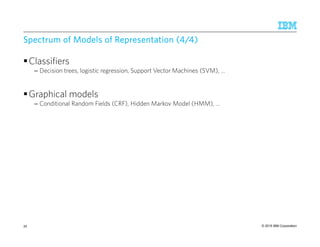
Spectrum ofSpectrum ofSpectrum ofSpectrum of ModelsModelsModelsModels ofofofof Representation (4/4)Representation (4/4)Representation (4/4)Representation (4/4)
Classifiers
– Decision trees, logistic regression, Support Vector Machines (SVM), …
Graphical models
– Conditional Random Fields (CRF), Hidden Markov Model (HMM), …
39
© 2015 IBM Corporation
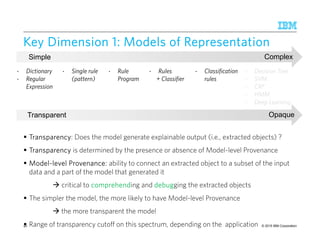
Key Dimension 1: ModelsKey Dimension 1: ModelsKey Dimension 1: ModelsKey Dimension 1: Models of Representationof Representationof Representationof Representation
40
Simple Complex
Transparent Opaque
TransparencyTransparencyTransparencyTransparency: Does the model generate explainable output (i.e., extracted objects) ?
TransparencyTransparencyTransparencyTransparency is determined by the presence or absence of Model-level Provenance
ModelModelModelModel----level Provenance:level Provenance:level Provenance:level Provenance: ability to connect an extracted object to a subset of the input
data and a part of the model that generated it
critical to comprehendcomprehendcomprehendcomprehending and debugdebugdebugdebugging the extracted objects
The simpler the model, the more likely to have Model-level Provenance
the more transparent the model
Range of transparency cutoff on this spectrum, depending on the application
• Dictionary
• Regular
Expression
• Single rule
(pattern)
• Rule
Program
• Decision Tree
• SVM
• CRF
• HMM
• Deep Learning
• …
• Classification
rules
• Rules
+ Classifier
© 2015 IBM Corporation
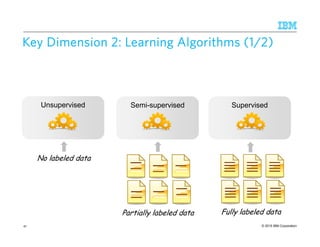
Key Dimension 2:Key Dimension 2:Key Dimension 2:Key Dimension 2: Learning Algorithms (1/2)Learning Algorithms (1/2)Learning Algorithms (1/2)Learning Algorithms (1/2)
UnsupervisedUnsupervised Semi-supervisedSemi-supervised SupervisedSupervised
No labeled data
Partially labeled data Fully labeled data
41
© 2015 IBM Corporation
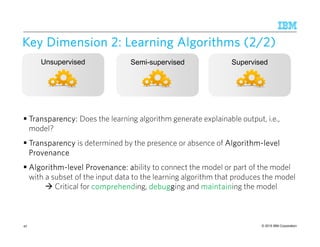
Key Dimension 2: LearningKey Dimension 2: LearningKey Dimension 2: LearningKey Dimension 2: Learning Algorithms (2/2)Algorithms (2/2)Algorithms (2/2)Algorithms (2/2)
UnsupervisedUnsupervised Semi-supervisedSemi-supervised SupervisedSupervised
Transparency:Transparency:Transparency:Transparency: Does the learning algorithm generate explainable output, i.e.,
model?
TransparencyTransparencyTransparencyTransparency is determined by the presence or absence of AlgorithmAlgorithmAlgorithmAlgorithm----levellevellevellevel
ProvenanceProvenanceProvenanceProvenance
AlgorithmAlgorithmAlgorithmAlgorithm----level Provenance: alevel Provenance: alevel Provenance: alevel Provenance: ability to connect the model or part of the model
with a subset of the input data to the learning algorithm that produces the model
Critical for comprehendcomprehendcomprehendcomprehending, debugdebugdebugdebuggggging and maintainmaintainmaintainmaintaining the model
42
© 2015 IBM Corporation
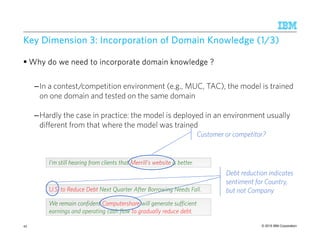
Key Dimension 3: Incorporation of Domain Knowledge (Key Dimension 3: Incorporation of Domain Knowledge (Key Dimension 3: Incorporation of Domain Knowledge (Key Dimension 3: Incorporation of Domain Knowledge (1/3)1/3)1/3)1/3)
WhyWhyWhyWhy do we need to incorporate domain knowledge ?do we need to incorporate domain knowledge ?do we need to incorporate domain knowledge ?do we need to incorporate domain knowledge ?
–In a contest/competition environment (e.g., MUC, TAC), the model is trained
on one domain and tested on the same domain
–Hardly the case in practice: the model is deployed in an environment usually
different from that where the model was trained
I'm still hearing from clients that Merrill's website is better.
Customer or competitor?
U.S. to Reduce Debt Next Quarter After Borrowing Needs Fall.
We remain confident Computershare will generate sufficient
earnings and operating cash flow to gradually reduce debt.
Debt reduction indicates
sentiment for Country,
but not Company
43
© 2015 IBM Corporation
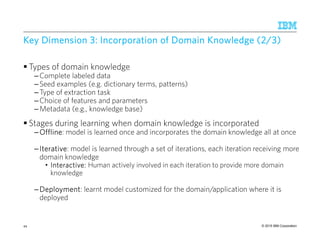
Key Dimension 3: IncorporationKey Dimension 3: IncorporationKey Dimension 3: IncorporationKey Dimension 3: Incorporation ofofofof Domain Knowledge (2/3)Domain Knowledge (2/3)Domain Knowledge (2/3)Domain Knowledge (2/3)
Types of domain knowledge
–Complete labeled data
–Seed examples (e.g. dictionary terms, patterns)
–Type of extraction task
–Choice of features and parameters
–Metadata (e.g., knowledge base)
Stages during learning when domain knowledge is incorporated
–OfflineOfflineOfflineOffline: model is learned once and incorporates the domain knowledge all at once
–IterativeIterativeIterativeIterative: model is learned through a set of iterations, each iteration receiving more
domain knowledge
• Interactive:Interactive:Interactive:Interactive: Human actively involved in each iteration to provide more domain
knowledge
–DeploymentDeploymentDeploymentDeployment: learnt model customized for the domain/application where it is
deployed
44
© 2015 IBM Corporation
Key Dimension 3: IncorporationKey Dimension 3: IncorporationKey Dimension 3: IncorporationKey Dimension 3: Incorporation ofofofof Domain Knowledge (3/3)Domain Knowledge (3/3)Domain Knowledge (3/3)Domain Knowledge (3/3)
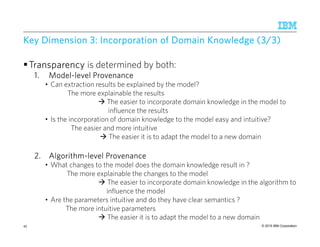
TransparencyTransparencyTransparencyTransparency is determined by both:
1.1.1.1. ModelModelModelModel----levellevellevellevel ProvenanceProvenanceProvenanceProvenance
• Can extraction results be explained by the model?
The more explainable the results
The easier to incorporate domain knowledge in the model to
influence the results
• Is the incorporation of domain knowledge to the model easy and intuitive?
The easier and more intuitive
The easier it is to adapt the model to a new domain
2.2.2.2. AlgorithmAlgorithmAlgorithmAlgorithm----level Provenancelevel Provenancelevel Provenancelevel Provenance
• What changes to the model does the domain knowledge result in ?
The more explainable the changes to the model
The easier to incorporate domain knowledge in the algorithm to
influence the model
• Are the parameters intuitive and do they have clear semantics ?
The more intuitive parameters
The easier it is to adapt the model to a new domain
45
© 2015 IBM Corporation
RecapRecapRecapRecap
The false dichotomy
Transparent Machine Learning
Provenance: Model and algorithm-level
Ensuring provenance in
–Model
–Learning algorithm
–Domain adaptation
46
© 2015 IBM Corporation
Transparent ML:
State of the Art
47
© 2015 IBM Corporation
ObjectiveObjectiveObjectiveObjective
Highlight some existing techniques exhibiting Transparent ML
–Breath over depth
Mix of techniques: Recent or/and influential
–Not an exhaustive list !
48
© 2015 IBM Corporation
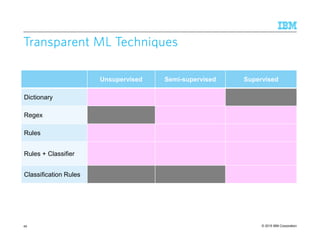
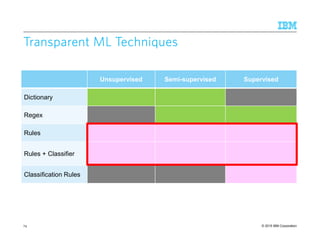
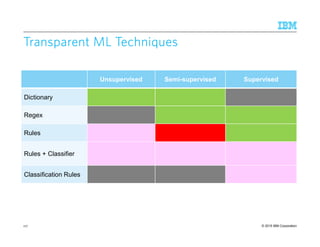
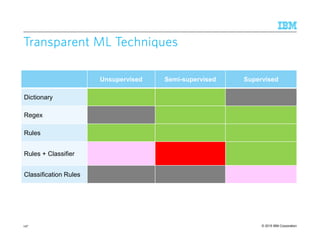
Transparent ML TechniquesTransparent ML TechniquesTransparent ML TechniquesTransparent ML Techniques
49
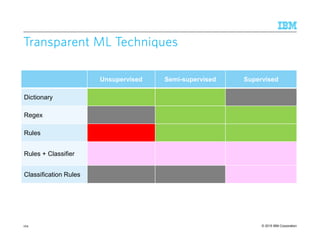
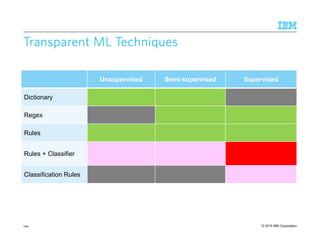
Unsupervised Semi-supervised Supervised
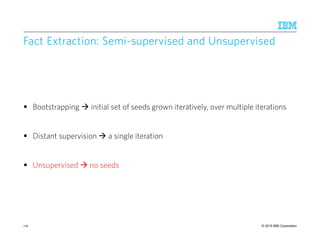
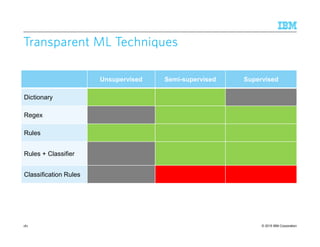
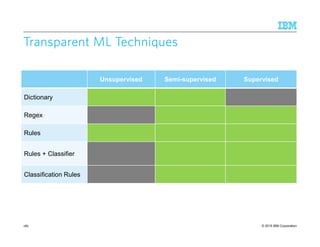
Dictionary
Regex
Rules
Rules + Classifier
Classification Rules
© 2015 IBM Corporation
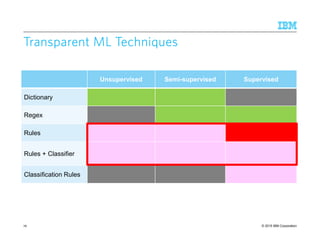
Transparent ML TechniquesTransparent ML TechniquesTransparent ML TechniquesTransparent ML Techniques
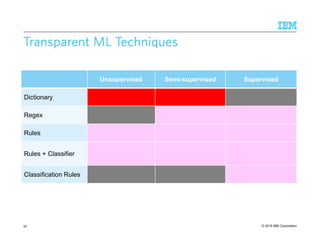
50
Unsupervised Semi-supervised Supervised
Dictionary
Regex
Rules
Rules + Classifier
Classification Rules
© 2015 IBM Corporation51
DictionariesDictionariesDictionariesDictionaries
A dictionary (gazetteer) contains terms for a particular concept
Very important for IE tasks
–E.g. list of country names, common first names, organization suffixes
–Highly data dependent Crucial for domain adaptation
© 2015 IBM Corporation52
General Approaches for DictionaryGeneral Approaches for DictionaryGeneral Approaches for DictionaryGeneral Approaches for Dictionary LearningLearningLearningLearning
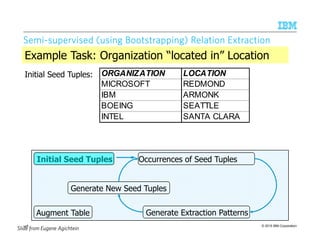
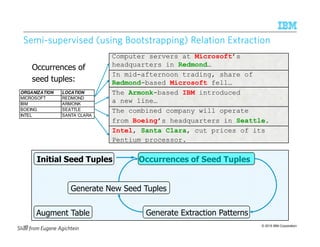
Dictionary Learning/Lexicon Induction:Dictionary Learning/Lexicon Induction:Dictionary Learning/Lexicon Induction:Dictionary Learning/Lexicon Induction: learn a new dictionary
–Semi-supervised (also known as Set Expansion)
• Often used in practice because it allows for targeting specific entity classes
• Dominant approach: Bootstrapping: e.g. [Riloff & Jones AAAI 1999]
Seed entries (semi-)automatically expand the list based on context
–Unsupervised: Cluster related terms
• Use targeted patterns or co-occurrence statistics, e.g. [Gerow 2014]
Dictionary Refinement:Dictionary Refinement:Dictionary Refinement:Dictionary Refinement: update an existing dictionary
–E.g., by removing ambiguous terms (e.g., [Baldwin et al., ACL 2013])
–Related problem:Related problem:Related problem:Related problem: Dictionary refinement in the context of a rule program
(see later)
© 2015 IBM Corporation
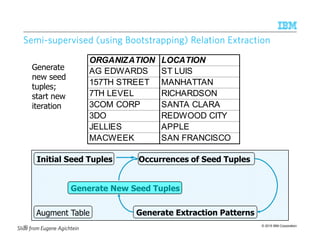
Meta BootstrappingMeta Bootstrapping
Dictionary Learning: BootstrappingDictionary Learning: BootstrappingDictionary Learning: BootstrappingDictionary Learning: Bootstrapping [[[[RiloffRiloffRiloffRiloff & Jones AAAI 1999]& Jones AAAI 1999]& Jones AAAI 1999]& Jones AAAI 1999]
Input:Input:Input:Input: Corpus, Candidate Extraction Patterns, Seed Words
Mutual Bootstrapping:Mutual Bootstrapping:Mutual Bootstrapping:Mutual Bootstrapping: find the Extraction Pattern (EP) that is most useful to extracting known
category members; add all its extracted NPs to the dictionary
– Scoring heuristic tries to balance pattern reliability and number of known terms extracted
Meta Bootstrapping:Meta Bootstrapping:Meta Bootstrapping:Meta Bootstrapping: guard against semantic drift due to few bad words extracted by “Best EP”
– Scoring heuristic rewards NPs extracted by many category EPs
Mutual BootstrappingMutual Bootstrapping
Select best EP
NPs extracted
by best EP
Candidate Extraction Patterns
and their extractions
5 best NPs
Seed words
bolivia,
san miguel
Temporary
dictionary
bolivia,
san miguel,
guatemala,
left side
Category
Extraction
Patterns
“born in <X>”
“shot in <X>”
Permanent
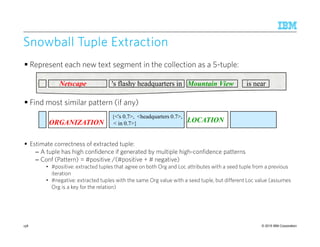
dictionary
bolivia,
san miguel,
guatemala
Initialize
53
© 2015 IBM Corporation
Dictionary Learning: SemiDictionary Learning: SemiDictionary Learning: SemiDictionary Learning: Semi----supervisedsupervisedsupervisedsupervised
Reducing semantic drift
– Multi-category bootstrapping, e.g., BASILISK [Thellen & Riloff EMNLP 2002]
– Distributional similarity to detect terms that could lead to semantic drift, e.g., [McIntosh &
Curran, ACL 2009]
– Discover negative categories, e.g., [McIntosh EMNLP 2010]
– Hybrid: bootstrapping + semantic tagger + coreference, e.g., [Qadir & Riloff, *SEM 2012]
– Incorporate user interaction: [Coden et al., Sem. Web Eval. Challenge 2014]
Exploit the Web, e.g., [Downey et al., IJCAI 2007]
Multi-word expressions, e.g., [Qadir et al. AAAI 2015]
54
© 2015 IBM Corporation
Dictionary Learning: Unsupervised [Dictionary Learning: Unsupervised [Dictionary Learning: Unsupervised [Dictionary Learning: Unsupervised [GerowGerowGerowGerow, ACL 2014], ACL 2014], ACL 2014], ACL 2014]
InputInputInputInput: a corpus
GoalGoalGoalGoal: extract qualifiable sets of specialist terms found
in the corpus
Algorithm
– Construct co-occurrence graph of all words in the
corpus
• Two words are connected if they are observed
in a n-word window
– Identify communities in the graph using a
community detection algorithm
– Rank words by their centrality in the community
Minimal preprocessing
– No document structure
– No semantic relationship
– No threshold
55
Communities from NIPS Proceedings
© 2015 IBM Corporation
Term Ambiguity Detection (TAD) [Baldwin et al, ACL 2013]Term Ambiguity Detection (TAD) [Baldwin et al, ACL 2013]Term Ambiguity Detection (TAD) [Baldwin et al, ACL 2013]Term Ambiguity Detection (TAD) [Baldwin et al, ACL 2013]
CameraEOS 5D
Video GameA New Beginning
MovieSkyfall 007
MovieBrave
CategoryTerm
Video GameA New Beginning
MovieBrave
CategoryTerm
Ambiguous
CameraEOS 5D
MovieSkyfall 007
CategoryTerm
Unambiguous
TAD
56
Movie night watching brave with Cammie n Isla n loads munchies
This brave girl deserves endless retweets!
Watching brave with the kiddos!
watching Bregor playing Civ 5: Brave New World and thinking of getting it
Perform term disambiguation at the
term, not instance level
– Given term T and its category C, do allallallall the
mentions of the term reference a member of
that category?
Motivation for IE
– Simpler model if the term unambiguous
– More complex model otherwise
56
© 2015 IBM Corporation57
Step 1: N-gram
Does the term share a name
with a common word/phrase?
Step 2: Ontology
Wiktionary + Wikipedia
Step 3: Clustering
Cluster the contexts in which
the term appears
Ambiguous
Unambiguous
Term Ambiguity Detection (TAD) [Baldwin et al, ACL 2013]Term Ambiguity Detection (TAD) [Baldwin et al, ACL 2013]Term Ambiguity Detection (TAD) [Baldwin et al, ACL 2013]Term Ambiguity Detection (TAD) [Baldwin et al, ACL 2013]
© 2015 IBM Corporation
Transparent ML in Dictionary Learning/RefinementTransparent ML in Dictionary Learning/RefinementTransparent ML in Dictionary Learning/RefinementTransparent ML in Dictionary Learning/Refinement
Transparency in Model of Representation
– Very simple
– Model-level Provenance: trivial to connect an extracted object with the input text and the part of the
model that determined it
Transparency in Learning Algorithm
–Bootstrapping [Riloff & Jones, AAAI 1999] Algorithm-level Provenance
• Every change in the model can be justified by the extraction pattern that extracts it
• In turn, the extraction pattern can be explained by the seed terms matching the pattern
–TAD [Baldwin et al., ACL 2013] Some transparency
• Coarse granularity of transparency in terms of each level of filtering
• Finer granularity of transparency within some of the filters, e.g., based on Wikipedia/Wiktionary
–[Gerow 2014] No transparency
Transparency in Incorporation of Domain Knowledge (DK)
– Offline, for majority of techniques
– But, easy to incorporate DK at deployment (by further modifying the dictionary)
– Interactive techniques potentially fruitful to explore in semi-supervised settings
58
© 2015 IBM Corporation
Transparent ML TechniquesTransparent ML TechniquesTransparent ML TechniquesTransparent ML Techniques
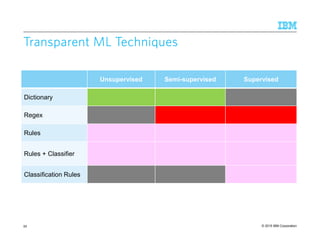
59
Unsupervised Semi-supervised Supervised
Dictionary
Regex
Rules
Rules + Classifier
Classification Rules
© 2015 IBM Corporation60
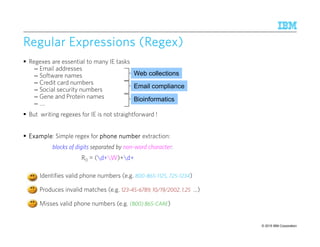
Regular Expressions (Regex)Regular Expressions (Regex)Regular Expressions (Regex)Regular Expressions (Regex)
Regexes are essential to many IE tasks
– Email addresses
– Software names
– Credit card numbers
– Social security numbers
– Gene and Protein names
– ….
But writing regexes for IE is not straightforward !
ExampleExampleExampleExample: Simple regex for phone numberphone numberphone numberphone number extraction:
blocks of digits separated by non-word character:
R0 = (d+W)+d+
– Identifies valid phone numbers (e.g. 800-865-1125, 725-1234)
– Produces invalid matches (e.g. 123-45-6789, 10/19/2002, 1.25 …)
– Misses valid phone numbers (e.g. (800) 865-CARE)
Web collections
Email compliance
Bioinformatics
© 2015 IBM Corporation61
Learning Regular ExpressionsLearning Regular ExpressionsLearning Regular ExpressionsLearning Regular Expressions
Supervised
– Refine regex given positive and negative examples [Li et al., EMNLP 2008]
Semi-supervised
– Learning regex from positive examples [Brauer et al., CIKM 2011]
© 2015 IBM Corporation62
Conventional Regex Writing Process for IE
Regex0
Sample
Documents
Match 1
Match 2
Good
Enough?
N
Y
Regexfinal
(d+W)+d+(d+W)+d{4}
800-865-1125
725-1234
123-45-6789
10/19/2002
1.25
Regex1Regex2Regex3 (d+[.s-])+d{4}(d{3}[.s-])+d{4}
© 2015 IBM Corporation63
Learning Regexfinal automatically in ReLIE [Li et al., EMNLP 2008]
Regex0
Sample
Documents
Match 1
Match 2
NegMatch 1
NegMatch m0
PosMatch 1
PosMatch n0
Labeled Matches ReLIE
Regexfinal
© 2015 IBM Corporation64
ReLIEReLIEReLIEReLIE IntuitionIntuitionIntuitionIntuition
R0
([A-Z][a-zA-Z]{1,10}s){1,5}s*(w{0,2}d[.]?){1,4}
([A-Z][a-zA-Z]{1,10}s){1,5}s*( [a-zA-Z] {0,2}d[.]?){1,4}
([A-Z][a-zA-Z]{1,10}s){1,2}s*(w{0,2}d[.]?){1,4}
([A-Z][a-zA-Z]{1,10}s){1,5}s*
(?!(201| |330))(w{0,2}d[.]?){1,4}
([A-Z] [a-z] {1,10}s){1,5}s*(w{0,2}d[.]?){1,4}
([A-Z][a-zA-Z]{1,10}s){2,4}s*(w{0,2}d[.]?){1,4}
Compute F-measure
F1
F7
F8
F34
F48
((?!(Copyright|Page|Physics|Question| — — — |Article|Issue)
[A-Z][a-zA-Z]{1,10}s){1,5}s*(w{0,2}d[.]?){1,4}
F35
R’
([A-Z] [a-z] {1,10}s){1,5}s*( [a-zA-z] {0,2}d[.]?){1,4}
([A-Z] [a-z] {1,10}s) {1,2} s*(w{0,2}d[.]?){1,4}
(((?!(Copyright|Page|Physics|Question| — — — |Article|Issue)
[A-Z] [a-z] {1,10}s){1,5}s*(w{0,2}d[.]?){1,4}
([A-Z] [a-z] {1,10}s){1,5} s*( d {0,2}d[.]?){1,4}
([A-Z] [a-z] {1,10}s){1,5} s*(w{0,2}d[.]?){1,3}
([A-Z] [a-z] {1,10}s){1,5}s*
(?!(201| |330))(w{0,2}d[.]?){1,4}
..
• Generate candidate regular expressions by modifying current regular expression
• Select the “best candidate” R’
• If R’ is better than current regular expression, repeat the process
• Use a validation set to avoid overfitting
© 2015 IBM Corporation
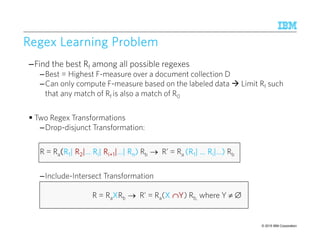
–Find the best Rf among all possible regexes
–Best = Highest F-measure over a document collection D
–Can only compute F-measure based on the labeled data Limit Rf such
that any match of Rf is also a match of R0
Two Regex Transformations
–Drop-disjunct Transformation:
R = Ra((((RRRR1111|||| RRRR2222||||………… RRRRiiii|||| RRRRi+1i+1i+1i+1||||…| R…| R…| R…| Rnnnn)))) Rb → R’ = Ra (R(R(R(R1111| …| …| …| … RRRRiiii|…)|…)|…)|…) Rb
–Include-Intersect Transformation
R = RaXXXXRb → R’ = Ra(XXXX ∩∩∩∩YYYY) Rb, where Y ≠ ∅
65
Regex Learning ProblemRegex Learning ProblemRegex Learning ProblemRegex Learning Problem
© 2015 IBM Corporation
Character Class Restriction
E.g. To restrict the matching of non-word characters
(d+WWWW)+d+ → (d+[[[[....ssss----]]]])+d+
Quantifier Restriction
E.g. To restrict the number of digits in a block
66
(d+W)+d+ →→→→ (d{3}W)+d+
Applying Drop-Disjunct Transformation
© 2015 IBM Corporation67
Applying Include-Intersect Transformation
Negative Dictionaries
–Disallow certain words from matching specific portions of the regex
E.g. a simple pattern for software name extraction:
blocks of capitalized words followed by version number:
R0 = ([A-Z]w*s*)+[Vv]?(d+.?)+
–Identifies valid software name (e.g. Eclipse 3.2, Windows 2000Eclipse 3.2, Windows 2000Eclipse 3.2, Windows 2000Eclipse 3.2, Windows 2000)
–Produces invalid matches (e.g. ENGLISH 123, Room 301, Chapter 1.2ENGLISH 123, Room 301, Chapter 1.2ENGLISH 123, Room 301, Chapter 1.2ENGLISH 123, Room 301, Chapter 1.2)
Rf = (?! ENGLISH|Room|Chapter) ([A-Z]w*s*)+[Vv]?(d+.?)+
© 2015 IBM Corporation
Learning regex from positive examples [Brauer et al. 2011]
InputInputInputInput: set of examples
OutputOutputOutputOutput: one regex
68
z800
z800 AAB
d700 ASE
z40y
d50t ATX
(d|z)([0-9]0{2}|[0-9]0[a-z]) ([A-Z]+)?
Notebook models
© 2015 IBM Corporation
LearningLearningLearningLearning a Regexa Regexa Regexa Regex from Pfrom Pfrom Pfrom Positive Examplesositive Examplesositive Examplesositive Examples
[[[[BrauerBrauerBrauerBrauer et al.et al.et al.et al. CIKM 2011CIKM 2011CIKM 2011CIKM 2011]]]]
Step 1:Step 1:Step 1:Step 1: Build automata to capture all features of the examples
• Features: class vs. instance level and token vs. character level
• Transitions encode the sequential ordering of features in the examples
69
z800
z800 AAB
d700 ASE
z40y
d50t ATX
InstancesInstancesInstancesInstances
Features at (character) class levelFeatures at (character) class level
Features at instance levelFeatures at instance level
Token
features
Character
features
© 2015 IBM Corporation
LearningLearningLearningLearning a Regexa Regexa Regexa Regex from Pfrom Pfrom Pfrom Positive Examplesositive Examplesositive Examplesositive Examples
[[[[BrauerBrauerBrauerBrauer et al.et al.et al.et al. CIKM 2011CIKM 2011CIKM 2011CIKM 2011]]]]
Step 2:Step 2:Step 2:Step 2: Choose among class vs. instance feature
• Prefer instance feature if very common in the examples
• Parameter β to further influence the feature selection towards class features
(for higher recall) vs. instance (for higher precision)
70
z800
z800 AAB
d700 ASE
z40y
d50t ATX
InstancesInstancesInstancesInstances
Features at (character) class levelFeatures at (character) class level
Features at instance levelFeatures at instance level
Token
features
Character
features
© 2015 IBM Corporation
Learning a Regex from Positive ExamplesLearning a Regex from Positive ExamplesLearning a Regex from Positive ExamplesLearning a Regex from Positive Examples
[[[[BrauerBrauerBrauerBrauer et al. CIKM 2011]et al. CIKM 2011]et al. CIKM 2011]et al. CIKM 2011]
Step 3:Step 3:Step 3:Step 3: Choose among token vs. character feature
• Use the Minimum Description Length (MDL) principle to choose most
promising abstraction layer
• To balance model complexity with its fitness to encode the data
71
z800
z800 AAB
d700 ASE
z40y
d50t ATX
InstancesInstancesInstancesInstances
Features at (character) class levelFeatures at (character) class level
Features at instance levelFeatures at instance level
Token
features
Character
features
© 2015 IBM Corporation
LearningLearningLearningLearning a Regexa Regexa Regexa Regex from Pfrom Pfrom Pfrom Positive Examplesositive Examplesositive Examplesositive Examples
[[[[BrauerBrauerBrauerBrauer et al.et al.et al.et al. CIKM 2011CIKM 2011CIKM 2011CIKM 2011]]]]
Step 4:Step 4:Step 4:Step 4: Generate regular expressions for each end state
• Pick the expression with smallest MDL from begin to end state
• Apply some simplification rules, e.g. cardinality
• Final regex: (z|d) ((<NB>0{2}) | (<NB>0<LC>)) ( _<UC>+){0,1}
72
z800
z800 AAB
d700 ASE
z40y
d50t ATX
InstancesInstancesInstancesInstances
Features at (character) class levelFeatures at (character) class level
Features at instance levelFeatures at instance level
Token
features
Character
features
© 2015 IBM Corporation
Transparent ML in Regex Learning/RefinementTransparent ML in Regex Learning/RefinementTransparent ML in Regex Learning/RefinementTransparent ML in Regex Learning/Refinement
Transparency in Model of Representation
– Simple
– Model-level provenance: easy to connect a result of the model with the input text that
determined it
Transparency in Learning Algorithm
– No algorithm-level provenance
– RELIE [Li et al., EMNLP 2008] some transparency in terms of influencing the model via the
initial regular expression
– [Brauer et al., CIKM 2011] some transparency in influencing feature selection
Transparency in Incorporation of Domain Knowledge (DK)
– Offline
– But, easy to incorporate DK at deployment (by modifying the regex)
– Interactive techniques potentially useful
73
© 2015 IBM Corporation
Transparent ML TechniquesTransparent ML TechniquesTransparent ML TechniquesTransparent ML Techniques
74
Unsupervised Semi-supervised Supervised
Dictionary
Regex
Rules
Rules + Classifier
Classification Rules
© 2015 IBM Corporation
Fact ExtractionFact ExtractionFact ExtractionFact Extraction
Fact (or concept):Fact (or concept):Fact (or concept):Fact (or concept): can be an entity, relation, event, …
75
Traditional IE
Open IE
[Banko et el., 2007]
Input Corpus (+ labeled data) Corpus
Type Specified in advance
Discovered automatically,
or specified via ontology
Extractor Type-specific Type-independent
Several papers, and two tutorials in this EMNLP:Several papers, and two tutorials in this EMNLP:Several papers, and two tutorials in this EMNLP:Several papers, and two tutorials in this EMNLP:
• Knowledge Acquisition for Web Search (now)
• Learning Semantic Relations from Text (Friday morning)
Several papers, and two tutorials in this EMNLP:Several papers, and two tutorials in this EMNLP:Several papers, and two tutorials in this EMNLP:Several papers, and two tutorials in this EMNLP:
• Knowledge Acquisition for Web Search (now)
• Learning Semantic Relations from Text (Friday morning)
© 2015 IBM Corporation
Transparent ML TechniquesTransparent ML TechniquesTransparent ML TechniquesTransparent ML Techniques
76
Unsupervised Semi-supervised Supervised
Dictionary
Regex
Rules
Rules + Classifier
Classification Rules
© 2015 IBM Corporation77
Fact Extraction: Supervised
Fact (or concept):Fact (or concept):Fact (or concept):Fact (or concept): can be an entity, relation, event, …
Context:Context:Context:Context: Traditional IE
Input:Input:Input:Input: Document collection, labeled with the target concept
Goal:Goal:Goal:Goal: induce rules that capture the target concept
Earlier work:Earlier work:Earlier work:Earlier work: Sequence patterns (CPSL-style) as target language
Recent work:Recent work:Recent work:Recent work: Predicate-based rule program as target language
© 2015 IBM Corporation78
Fact Extraction: Supervised
Fact (or concept):Fact (or concept):Fact (or concept):Fact (or concept): can be an entity, relation, event, …
Context:Context:Context:Context: Traditional IE
Input:Input:Input:Input: Document collection, labeled with the target concept
Goal:Goal:Goal:Goal: induce rules that capture the target concept
Earlier work:Earlier work:Earlier work:Earlier work: Sequence patterns (CPSL-style) as target language
Recent work:Recent work:Recent work:Recent work: Predicate-based rule program as target language
© 2015 IBM Corporation
Supervised Learning of Sequence Patterns
Input:Input:Input:Input:
– Collection of text documents, labeled with target concept
– Available basic features: tokens, orthography, parts of speech, dictionaries, entities, …
Goal:Goal:Goal:Goal: Define the smallest set of rules that cover the maximum number of training cases
with high precision
Model of Representation:Model of Representation:Model of Representation:Model of Representation: unordered disjunction of sequence pattern rules
General framework:General framework:General framework:General framework: greedy hill climbing strategy to learn one rule at a time
1. S is the set of rules, initially empty
2.While there exists a training concept not covered by any rule in S
• Generate new rules around it
• Add new rules to S
3.Post process rules to prune away redundant rules
Techniques:Techniques:Techniques:Techniques: Bottom-up and top-down
SurveysSurveysSurveysSurveys: [Muslea, AAAI Workshop on ML in IE 1999]
[Sarawagi, Foundations and Trends in Databases, 2008]
79
© 2015 IBM Corporation80
Bottom-up Techniques: Generalize a Specific Rule
Start with a specific rule covering a single instance (100% precision)
Generalize the rule to increase its coverage, with a possible loss of precision
– Many strategies: e.g., dropping a token, or replacing a token by a more general
feature
Remove instances covered by the rule from the training set
Example systems: RAPIER [Califf & Mooney AAAI 1999, JML 2003], (LP)2
[Ciravegna IJCAI 2001]
© 2015 IBM Corporation81
Bottom-up Technique Example: (LP)2 [Ciravegna IJCAI 2001]
ExampleExampleExampleExample text:text:text:text:
Initial rule:Initial rule:Initial rule:Initial rule: snippet of w tokens to the left and right of the labeled instance
<Token>[string=“studying”] <Token>[string=“at”]
(<Token>[string=“University”] <Token>[string=“of”] <Token>[string=“Chicago”]):ORG
Some generalizations of the initial rule:Some generalizations of the initial rule:Some generalizations of the initial rule:Some generalizations of the initial rule:
– Two tokens generalized to orthography type
<Token>[string=“studying”] <Token>[string=“at”]
(<Token>[orth=“CapsWord”] <Token>[string=“of”] <Token>[orth=“CapsWord”]):ORG
– Two tokens are dropped, two tokens generalized by whether they appear in dictionaries
(<Token>[Lookup=“OrgPrefix”] <Token>[string=“of”] <Token>[Lookup=“CityName”]):ORG
Exponential number of generalizationsExponential number of generalizationsExponential number of generalizationsExponential number of generalizations heuristics to reduce the search space
– Greedily select the best single step of generalization
– User-specified maximum number of generalizations retained
Top-k “best” generalizations are added to the “best rules pool”
– Based on a combination of measures of quality of rules, including precision, overall coverage, and
coverage of instances not covered by other rules
I am studying at University of Chicago.University of Chicago.University of Chicago.University of Chicago.
© 2015 IBM Corporation82
Top-down Techniques: Specialize a Generic Rule
Start with a generic rule covering all instances (100% coverage)
Specialize the rule in various ways to get a set of rules with high precision (inductive logic – style)
Example systems: WHISK [Soderland, ML 1999], [Aitken, ECAI 2002]
© 2015 IBM Corporation
Top-down Technique Example: WHISK [Soderland, ML 1999]
83
Seed labeled instance:Seed labeled instance:Seed labeled instance:Seed labeled instance:
Initial rule: *Initial rule: *Initial rule: *Initial rule: * ( * )( * )( * )( * ) **** ( * )( * )( * )( * ) **** ( * )( * )( * )( * )
Some specializations of the initial rule:Some specializations of the initial rule:Some specializations of the initial rule:Some specializations of the initial rule:
– First slot anchored inside: **** (((( NeighborhoodNeighborhoodNeighborhoodNeighborhood )))) **** ( * )( * )( * )( * ) **** ( * )( * )( * )( * )
– First slot anchored outside: @start ( *) ‘@start ( *) ‘@start ( *) ‘@start ( *) ‘----’’’’ **** ( * )( * )( * )( * ) **** ( * )( * )( * )( * )
Greedily select the best single step of generalization
– Capture the seed and minimize error on training set
– Heuristics to prefer the least restrictive rule that fits the data, e.g., choose semantic class and
syntactic tags over literals
Semi-supervised and interactive
– Start with a random sample of unlabeled instances, possibly satisfying some keywords
– In each iteration, automatically select instances from 3 sets for the user to label
• Covered by an existing rule increase support for the rule or provide counter example
• “Near” misses of existing rules
• Not covered by any rule
Capitol Hill – 1 br townhome, all inclusive $675
© 2015 IBM Corporation
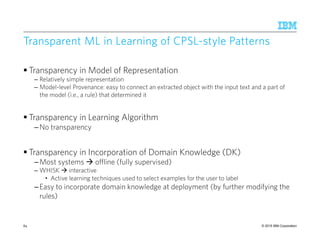
Transparent ML inTransparent ML inTransparent ML inTransparent ML in Learning of CPSLLearning of CPSLLearning of CPSLLearning of CPSL----style Patternsstyle Patternsstyle Patternsstyle Patterns
Transparency in Model of Representation
– Relatively simple representation
– Model-level Provenance: easy to connect an extracted object with the input text and a part of
the model (i.e., a rule) that determined it
Transparency in Learning Algorithm
–No transparency
Transparency in Incorporation of Domain Knowledge (DK)
–Most systems offline (fully supervised)
– WHISK interactive
• Active learning techniques used to select examples for the user to label
–Easy to incorporate domain knowledge at deployment (by further modifying the
rules)
84
© 2015 IBM Corporation85
Fact Extraction:Fact Extraction:Fact Extraction:Fact Extraction: SupervisedSupervisedSupervisedSupervised
Earlier work:Earlier work:Earlier work:Earlier work: Sequence patterns ((((CPSL-style) as target language
Recent work:Recent work:Recent work:Recent work: Predicate-based rule program as target language
© 2015 IBM Corporation
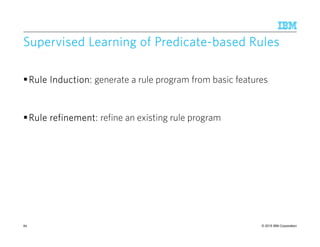
Supervised Learning of PredicateSupervised Learning of PredicateSupervised Learning of PredicateSupervised Learning of Predicate----based Rulesbased Rulesbased Rulesbased Rules
Rule Induction:Rule Induction:Rule Induction:Rule Induction: generate a rule program from basic features
Rule refinement:Rule refinement:Rule refinement:Rule refinement: refine an existing rule program
86
© 2015 IBM Corporation
Supervised Learning of PredicateSupervised Learning of PredicateSupervised Learning of PredicateSupervised Learning of Predicate----based Rulesbased Rulesbased Rulesbased Rules
Rule Induction:Rule Induction:Rule Induction:Rule Induction: generate a rule program from basic features
–E.g., [Nagesh et al., 2012]
Rule refinement:Rule refinement:Rule refinement:Rule refinement: refine an existing rule program
87
© 2015 IBM Corporation88
NER Rule InductionNER Rule InductionNER Rule InductionNER Rule Induction [[[[NageshNageshNageshNagesh et al., EMNLP 2012]et al., EMNLP 2012]et al., EMNLP 2012]et al., EMNLP 2012]
InputInputInputInput:
–Basic features (dictionaries & regular expressions)
–Fully labeled document collection (PER, ORG, LOC)
GoalGoalGoalGoal: Induce an initial set of named-entity rules that can be refined /
customized by domain-expert
© 2015 IBM Corporation89
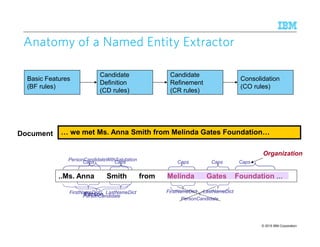
Anatomy of aAnatomy of aAnatomy of aAnatomy of a Named EntityNamed EntityNamed EntityNamed Entity EEEExtractorxtractorxtractorxtractor
Basic Features
(BF rules)
Candidate
Definition
(CD rules)
Candidate
Refinement
(CR rules)
Consolidation
(CO rules)
we met Ms. Anna Smith from Melinda Gates FoundationDocument
Caps
..Ms. Anna Smith from Melinda Gates Foundation
FirstNameDict
Caps Caps Caps Caps
LastNameDict FirstNameDict LastNameDict
PersonCandidate
PersonCandidate
PersonCandidateWithSalutation
Organization
Person
© 2015 IBM Corporation90
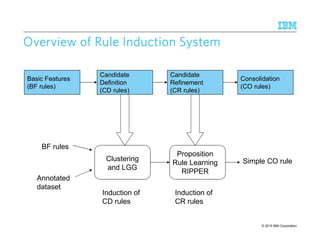
Overview ofOverview ofOverview ofOverview of Rule InductionRule InductionRule InductionRule Induction SSSSystemystemystemystem
Basic Features
(BF rules)
Candidate
Definition
(CD rules)
Candidate
Refinement
(CR rules)
Consolidation
(CO rules)
Induction of
CD rules
Induction of
CR rules
Clustering
and LGG
Proposition
Rule Learning
RIPPER
BF rules
Annotated
dataset
Simple CO rule
© 2015 IBM Corporation91
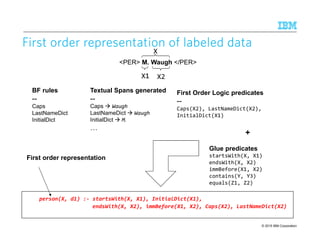
First order representation ofFirst order representation ofFirst order representation ofFirst order representation of labeled datalabeled datalabeled datalabeled data
<PER> M. Waugh </PER>
BF rules
--
Caps
LastNameDict
InitialDict
Textual Spans generated
--
Caps Waugh
LastNameDict Waugh
InitialDict M.
First Order Logic predicates
--
Caps(X2), LastNameDict(X2),
InitialDict(X1)
Glue predicates
startsWith(X, X1)
endsWith(X, X2)
immBefore(X1, X2)
contains(Y, Y3)
equals(Z1, Z2)
+
person(X, d1) :- startsWith(X, X1), InitialDict(X1),
endsWith(X, X2), immBefore(X1, X2), Caps(X2), LastNameDict(X2)
First order representation
X1 X2
X
© 2015 IBM Corporation92
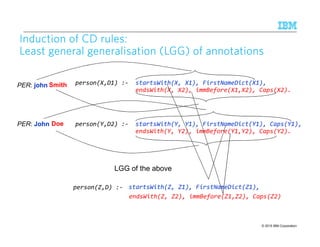
Induction of CD rules:Induction of CD rules:Induction of CD rules:Induction of CD rules:
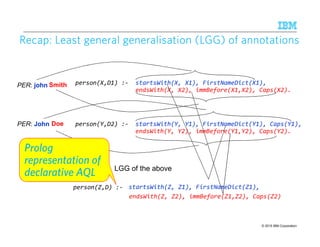
Least general generalisation (LGG) of annotationsLeast general generalisation (LGG) of annotationsLeast general generalisation (LGG) of annotationsLeast general generalisation (LGG) of annotations
person(X,D1) :- startsWith(X, X1), FirstNameDict(X1),
endsWith(X, X2), immBefore(X1,X2), Caps(X2).
person(Y,D2) :- startsWith(Y, Y1), FirstNameDict(Y1), Caps(Y1),
endsWith(Y, Y2), immBefore(Y1,Y2), Caps(Y2).
startsWith(Z, Z1), FirstNameDict(Z1),
PER: john
PER: John
Smith
Doe
LGG of the above
endsWith(Z, Z2), immBefore(Z1,Z2), Caps(Z2)
person(Z,D) :-
© 2015 IBM Corporation93
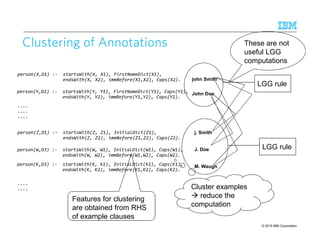
Clustering of AnnotationsClustering of AnnotationsClustering of AnnotationsClustering of Annotations
person(X,D1) :- startsWith(X, X1), FirstNameDict(X1),
endsWith(X, X2), immBefore(X1,X2), Caps(X2).
person(Y,D2) :- startsWith(Y, Y1), FirstNameDict(Y1), Caps(Y1),
endsWith(Y, Y2), immBefore(Y1,Y2), Caps(Y2).
person(Z,D1) :- startsWith(Z, Z1), InitialDict(Z1),
endsWith(Z, Z2), immBefore(Z1,Z2), Caps(Z2).
person(W,D3) :- startsWith(W, W1), InitialDict(W1), Caps(W1),
endsWith(W, W2), immBefore(W1,W2), Caps(W2).
....
....
....
....
....
J. Doe
John Doe
j. Smith
john Smith
These are not
useful LGG
computations
Cluster examples
reduce the
computation
Features for clustering
are obtained from RHS
of example clauses
M. Waughperson(K,D3) :- startsWith(K, K1), InitialDict(K1), Caps(K1),
endsWith(K, K2), immBefore(K1,K2), Caps(K2).
LGG rule
LGG rule
© 2015 IBM Corporation94
Induction of CRInduction of CRInduction of CRInduction of CR rulesrulesrulesrules
Build a table encoding whether a span generated by one CD rule matches (M) or
overlaps (O) with a span generated by any other CD rule
Learn compositions of CD rules via the RIPPER propositional learner [Furnkranz and
Widmer, 1994]
Inductive Bias to model rule developer expertise and restrict the size of generated rules
1. Disallow the BFs for one entity type from appearing in CD rules for another type
• Avoids: PerCD  [FirstNameDict][CapsPerson ^ CapsOrg]
2. Restriction of type of CD views that can appear in a CR
• Avoids: PerCR  (OrgCD = M) AND (LocCD != O)
LOC  (locCDi = M) AND (orgCDj != O)
A span of text
is a LOC
matches
a Loc-CD rule
does not
overlap with
a org-CD rule
““““Washington”””” in Washington Post will be filtered due to this rule
© 2015 IBM Corporation
Supervised Learning of PredicateSupervised Learning of PredicateSupervised Learning of PredicateSupervised Learning of Predicate----based Rulesbased Rulesbased Rulesbased Rules
Rule Induction:Rule Induction:Rule Induction:Rule Induction: generate a rule program from basic features
Rule refinement:Rule refinement:Rule refinement:Rule refinement: refine an existing rule program
–Refine rules [Liu et al., 2010]
–Refine dictionaries used by the rules [Roy et al., 2013]
95
© 2015 IBM Corporation96
Rule Refinement [Liu et al. VLDB 2010]
R1: create view Phone as
Regex(‘d{3}-d{4}’, Document, text);
R2: create view Person as
Dictionary(‘first_names.dict’, Document, text);
Dictionary file first_names.dict:
anna, james, john, peter
R3: create table PersonPhone(match span);
insert into PersonPhone
select Merge(F.match, P.match) as match
from Person F, Phone P
where Follows(F.match, P.match, 0, 60);
Document:
text
Anna at James St. office (555-
5555), or James, her assistant
– 777-7777 have the details.
Phone:
match
555-5555
777-7777
Person:
match
Anna
James
James
Person PhonePerson Person Phone
Anna at James St. office (555-5555), or James, her assistant - 777-7777 have the details.
Rules expressed in SQL
– Select, Project, Join, Union all, Except all
– Text-specific extensions
• Regex, Dictionary table functions
• New selection/join predicates
– Can express core functionality of IE rule languages
• AQL, CPSL, XLog
Relational data model
– Tuples and views
– New data type span: region of text in a document
© 2015 IBM Corporation97
Rule Refinement [Liu et al. VLDB 2010]
R1: create view Phone as
Regex(‘d{3}-d{4}’, Document, text);
R2: create view Person as
Dictionary(‘first_names.dict’, Document, text);
Dictionary file first_names.dict:
anna, james, john, peter
R3: create table PersonPhone(match span);
insert into PersonPhone
select Merge(F.match, P.match) as match
from Person F, Phone P
where Follows(F.match, P.match, 0, 60);
Document:
text
Anna at James St. office (555-
5555), or James, her assistant
– 777-7777 have the details.
Phone:
match
555-5555
777-7777
Person:
match
Anna
James
James
Person PhonePerson Person Phone
Anna at James St. office (555-5555), or James, her assistant - 777-7777 have the details.
Rules expressed in SQL
– Select, Project, Join, Union all, Except all
– Text-specific extensions
• Regex, Dictionary table functions
• New selection/join predicates
– Can express core functionality of IE rule languages
• AQL, CPSL, XLog
Relational data model
– Tuples and views
– New data type span: region of text in a documentChallengesChallengesChallengesChallenges
• Which rule to refine and how?
• What are the effects and side-effects?
ChallengesChallengesChallengesChallenges
• Which rule to refine and how?
• What are the effects and side-effects?
© 2015 IBM Corporation
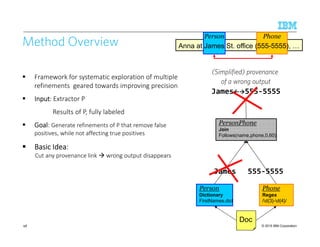
Method Overview
Framework for systematic exploration of multiple
refinements geared towards improving precision
InputInputInputInput: Extractor P
Results of P, fully labeled
GoalGoalGoalGoal: Generate refinements of P that remove false
positives, while not affecting true positives
Basic IdeaBasic IdeaBasic IdeaBasic Idea:
Cut any provenance link wrong output disappears
Person
Dictionary
FirstNames.dict
Doc
PersonPhone
Join
Follows(name,phone,0,60)
James
James 555-5555
(Simplified) provenance
of a wrong output
Phone
Regex
/d{3}-d{4}/
555-5555
PhonePerson
Anna at James St. office (555-5555),
98
© 2015 IBM Corporation99
99
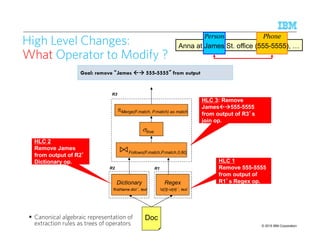
HLC 2
Remove James
from output of R2’’’’
Dictionary op.
HLC 3: Remove
James 555-5555
from output of R3’’’’s
join op.
HLC 1
Remove 555-5555
from output of
R1’’’’s Regex op.
σtrue
πMerge(F.match, P.match) as match
⋈Follows(F.match,P.match,0,60)
Dictionary
‘firstName.dict’, text
Regex
‘d{3}-d{4}’, text
R2 R1
R3
Doc
Goal: remove ““““James  555-5555”””” from output
High Level Changes:
What Operator to Modify ?
Canonical algebraic representation of
extraction rules as trees of operators
PhonePerson
Anna at James St. office (555-5555),
© 2015 IBM Corporation10
0
100
σtrue
πMerge(F.match, P.match) as match
⋈Follows(F.match,P.match,0,60)
Dictionary
‘firstName.dict’, text
Regex
‘d{3}-d{4}’, text
R2 R1
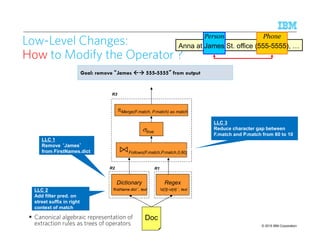
R3
Doc
Goal: remove ““““James  555-5555”””” from output
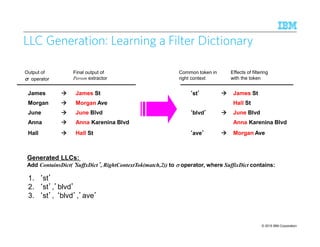
LLC 1
Remove ‘‘‘‘James’’’’
from FirstNames.dict
LLC 2
Add filter pred. on
street suffix in right
context of match
LLC 3
Reduce character gap between
F.match and P.match from 60 to 10
Low-Level Changes:
How to Modify the Operator ?
Canonical algebraic representation of
extraction rules as trees of operators
PhonePerson
Anna at James St. office (555-5555),
© 2015 IBM Corporation10
1
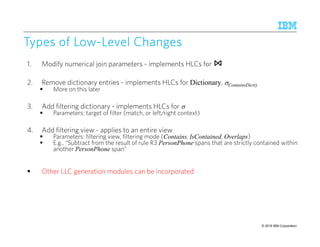
Types of LowTypes of LowTypes of LowTypes of Low----Level ChangesLevel ChangesLevel ChangesLevel Changes
1. Modify numerical join parameters - implements HLCs for ⋈
2. Remove dictionary entries - implements HLCs for Dictionary, σContainsDict()
More on this later
3. Add filtering dictionary - implements HLCs for σ
Parameters: target of filter (match, or left/right context)
4. Add filtering view - applies to an entire view
Parameters: filtering view, filtering mode (Contains, IsContained, Overlaps)
E.g., “Subtract from the result of rule R3 PersonPhone spans that are strictly contained within
another PersonPhone span”
Other LLC generation modules can be incorporated
© 2015 IBM Corporation10
2
ComputingComputingComputingComputing ModelModelModelModel----level Provenancelevel Provenancelevel Provenancelevel Provenance
PersonPhone rule:
insert into PersonPhone
select Merge(F.match, P.match) as match
from Person F, Phone P
where Follows(F.match, P.match, 0, 60);
match
Anna at James St. office (555-5555
James St. office (555-5555
PersonPhone
(Model-level) Provenance: Explains output data in terms of the input data, the
intermediate data, and the transformation (e.g., SQL query, ETL, workflow)
– Surveys: [Davidson & Freire, SIGMOD 2008] [Cheney et al., Found. Databases 2009]
For predicate-based rule languages (e.g., SQL), can be computed automatically!
Person PhonePerson
Anna at James St. office (555-5555) .
© 2015 IBM Corporation10
3
Computing ModelComputing ModelComputing ModelComputing Model----level Provenancelevel Provenancelevel Provenancelevel Provenance
Rewritten PersonPhone rule:
insert into PersonPhone
select Merge(F.match, P.match) as match,
GenerateID() as ID,
P.id as nameProv, Ph.id as numberProv
‘AND’ as how
from Person F, Phone P
where Follows(F.match, P.match, 0, 60);
Person PhonePerson
Anna at James St. office (555-5555) .
ID: 1 ID: 2 ID: 3
1 3AND
2 3AND
match
Anna at James St. office (555-5555
James St. office (555-5555
PersonPhone
Provenance
(Model-level) Provenance: Explains output data in terms of the input data, the
intermediate data, and the transformation (e.g., SQL query, ETL, workflow)
– Surveys: [Davidson & Freire, SIGMOD 2008] [Cheney et al., Found. Databases 2009]
For predicate-based rule languages (e.g., SQL), can be computed automatically!
© 2015 IBM Corporation10
4
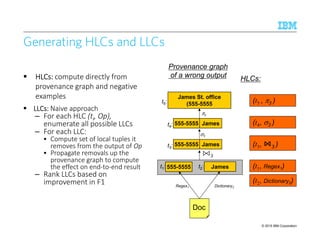
Generating HLCs and LLCs
HLCs:HLCs:HLCs:HLCs: compute directly from
provenance graph and negative
examples
LLCs:LLCs:LLCs:LLCs: Naive approach
– For each HLC (ti, Op),
enumerate all possible LLCs
– For each LLC:
• Compute set of local tuples it
removes from the output of Op
• Propagate removals up the
provenance graph to compute
the effect on end-to-end result
– Rank LLCs based on
improvement in F1
(t5 , π3 )
(t4, σ3 )
(t3, ⋈3 )
(t1, Regex1)
(t2, Dictionary2)
HLCs:
James St. office
(555-5555
π3
555-5555 James
σ3
⋈3
555-5555
Regex1
James
Dictionary2
t5:
t2:t1:
t4:
t3:
555-5555 James
Provenance graph
of a wrong output
Doc
© 2015 IBM Corporation
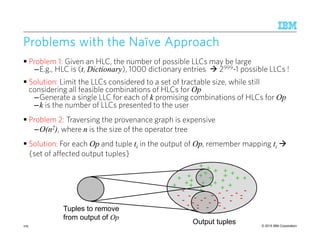
Problems with the Naïve ApproachProblems with the Naïve ApproachProblems with the Naïve ApproachProblems with the Naïve Approach
Problem 1: Given an HLC, the number of possible LLCs may be large
–E.g., HLC is (t, Dictionary), 1000 dictionary entries 2999-1 possible LLCs !
Solution: Limit the LLCs considered to a set of tractable size, while still
considering all feasible combinations of HLCs for Op
–Generate a single LLC for each of k promising combinations of HLCs for Op
–k is the number of LLCs presented to the user
Problem 2: Traversing the provenance graph is expensive
–O(n2), where n is the size of the operator tree
Solution: For each Op and tuple ti in the output of Op, remember mapping ti
{set of affected output tuples}
++
+
+
+
++
+ +
+
+ +
+
+ + +
+
+
+ +
+
+
+++
-
- - --
- --
- - --
-
-
- - --
-
-
-
-
-
-
- -
-Tuples to remove
from output of Op
Output tuples105
© 2015 IBM Corporation10
6
LLC Generation: Learning a Filter Dictionary
James James St
Morgan Morgan Ave
June June Blvd
Anna Anna Karenina Blvd
Hall Hall St
Output of
σσσσ operator
Final output of
Person extractor
‘‘‘‘st’’’’ James St
Hall St
‘‘‘‘blvd’’’’ June Blvd
Anna Karenina Blvd
‘‘‘‘ave’’’’ Morgan Ave
Common token in
right context
Effects of filtering
with the token
Generated LLCs:
Add ContainsDict(‘‘‘‘SuffxDict’’’’, RightContextTok(match,2)) to σσσσ operator, where SuffixDict contains:
1. ‘st’
2. ‘st’,’blvd’
3. ‘st’, ‘blvd’,’ave’
© 2015 IBM Corporation
Supervised Learning of PredicateSupervised Learning of PredicateSupervised Learning of PredicateSupervised Learning of Predicate----based Rulesbased Rulesbased Rulesbased Rules
Rule Induction:Rule Induction:Rule Induction:Rule Induction: generate a rule program from basic features
Rule refinement:Rule refinement:Rule refinement:Rule refinement: refine an existing rule program
–Refine rules [Liu et al., 2010]
–Refine dictionaries used by the rules [Roy et al., 2013]
107
© 2015 IBM Corporation
“ This April, mark your calendars for the first derby of the season: Arsenal at Chelsea.
.,..April Smith and John Lee reporting live from .. David said that ”
10
8
Dictionary Refinement Problem [Roy et al, SIGMOD 2013]Dictionary Refinement Problem [Roy et al, SIGMOD 2013]Dictionary Refinement Problem [Roy et al, SIGMOD 2013]Dictionary Refinement Problem [Roy et al, SIGMOD 2013]
Goal: Maximize F-score
Select a set S of entries to remove from dictionaries
that maximizes the new F-score
subject to |S| ≤ k
or new recall ≥ r
Size Constraint
(limit #deleted entries) Recall Constraint
(limit #true positives deleted)
April
Chelsea
April Smith
John Lee
David
w5 + w3 w4
w3
Input:
• Predicate-based rule program (SQL-like)
• Boolean model-level provenance of each result
• / Label of each result
Input:
• Predicate-based rule program (SQL-like)
• Boolean model-level provenance of each result
• / Label of each result
w7
w1
w2 w6
We also studied
the incomplete labeling case
S =
Possible output
New F-score = 1 ☺
w1: chelsea
w3: april
© 2015 IBM Corporation
“ This April, mark your calendars for the first derby of the season: Arsenal at Chelsea.
.,..April Smith and John Lee reporting live from .. David said that ”
10
9
Dictionary Refinement Problem [Roy et al, SIGMOD 2013]Dictionary Refinement Problem [Roy et al, SIGMOD 2013]Dictionary Refinement Problem [Roy et al, SIGMOD 2013]Dictionary Refinement Problem [Roy et al, SIGMOD 2013]
Goal: Maximize F-score
Select a set S of entries to remove from dictionaries
that maximizes the new F-score
subject to |S| ≤ k
or new recall ≥ r
Size Constraint
(limit #deleted entries) Recall Constraint
(limit #true positives deleted)
April
Chelsea
April Smith
John Lee
David
w5 + w3 w4
w3
Input:
• Predicate-based rule program (SQL-like)
• Boolean model-level provenance of each result
• / Label of each result
Input:
• Predicate-based rule program (SQL-like)
• Boolean model-level provenance of each result
• / Label of each result
w7
w1
w2 w6
We also studied
the incomplete labeling case
S =
Possible output
New F-score = 1 ☺
w1: chelsea
w3: april
ChallengesChallengesChallengesChallenges
• Complex input-output dependencies
• Complex objective function
ChallengesChallengesChallengesChallenges
• Complex input-output dependencies
• Complex objective function
© 2015 IBM Corporation11
0
Complex Objective FunctionComplex Objective FunctionComplex Objective FunctionComplex Objective Function
2 * G-s
Go + G-s + B-s
New F-score after deleting S =
Go = original #true positives
G-s = remaining #true positives after deleting S
B-s = remaining #false positives after deleting S
Both numerator and denominator depend on S
(even if we try to rewrite the expression)
© 2015 IBM Corporation11
1
Results: Simple RulesResults: Simple RulesResults: Simple RulesResults: Simple Rules
(remaining true
positives after
deleting S ≥ r)
Some details next
NP-hard
(reduction from
the subset-sum problem)
“Near optimal” Algorithm
(simple, provably close to
optimal)
Optimal Algorithm
• Provenance has a simple form
• One input to many results
• Provenance has a simple form
• One input to many results
© 2015 IBM Corporation11
2
Sketch of Optimal AlgorithmSketch of Optimal AlgorithmSketch of Optimal AlgorithmSketch of Optimal Algorithm
for Simple Rules, Size Constraint |S|for Simple Rules, Size Constraint |S|for Simple Rules, Size Constraint |S|for Simple Rules, Size Constraint |S| ≤ kkkk
1. Guess the optimal F-score θ
2. Verify if there exists a subset S,
|S|≤ k, giving this F-score θ
3. Repeat by binary-search in [0, 1]
until the optimal θ is found
2 * G-s
Go + G-s + B-s
F-s =
G-s (2 - θ) - θB-s - θGo ≥ 0
≥ θ
G-s = Go - ΣΣΣΣ w∈∈∈∈SGw B-s = Bo - ΣΣΣΣ w∈∈∈∈SBw
ΣΣΣΣ w∈∈∈∈Sf(Gw,Bw) ≥ Const, where |S| ≤ k
Does not work for
general case
(many-to-many)
Binary search on real
numbers in [0, 1]
(still poly-time) Top-k problem,
poly-time!
© 2015 IBM Corporation11
3
Results: Complex RulesResults: Complex RulesResults: Complex RulesResults: Complex Rules
Simple Rules
Provenance: w
Optimal Algorithm
(bound on the true
positives retained)
NP-hard
“Near optimal” Algorithm
• Efficient Heuristics
•Sketch:
•Find an initial solution
•Improve solution by
hill-climbing
NP-hard
even for two dictionaries
(reduction from
the k-densest subgraph problem)
• Arbitrary extraction rules
• Arbitrary provenance
• Many to many dependency
• Arbitrary extraction rules
• Arbitrary provenance
• Many to many dependency
© 2015 IBM Corporation11
4
What if not all the results are labeled?
April
Chelsea
April Smith
John Lee
David
w5 + w3 w4
w3
w7
w1
w2 w6
ignoring unlabeled results may lead to over-fitting
So far we assumed all results are labeled as
true positive / false positive
© 2015 IBM Corporation11
5
Simple Rules Complex Rules
Estimating Missing LabelsEstimating Missing LabelsEstimating Missing LabelsEstimating Missing Labels
April Smith
John Lee
David
w5 + w3 w4
w3
w2 w6
April
Chelsea
David
April
Chelsea
April
David
w3
w7
w1
w3
w7
w3
w1
Possible approach:
Label of an entry =
Empirical fraction of true positives
w3 april: 0.33
w1 chelsea: 0.50
w7 david: 1.00
Empirical estimation does not work!
• Arbitrary monotone Boolean
expressions
• Very few or no labels available!
• We assume a statistical model and
estimate labels using
Expectation-Maximization algorithm
0
1
w7
w3
w1
Chelsea
April
David
0.33
© 2015 IBM Corporation
Transparent ML inTransparent ML inTransparent ML inTransparent ML in LearningLearningLearningLearning of Predicateof Predicateof Predicateof Predicate----based Rulesbased Rulesbased Rulesbased Rules
Transparency in Model of Representation
– Predicate-based rules, completely declarative
– Model-level provenance computed automatically
– Interesting issue: Interpretability of program
• Induced program is declarative, but there is a more subjective aspect of “code quality”
Two equivalent programs may have very different levels of “interpretability”
• Applies primarily to Rule Induction
• Applies to Rule Refinement to a considerable smaller extent because: (1) learning is constrained
by the initial program, and (2) user guides the learning interactively
• Initial investigation [Nagesh et. Al, 2012]; more work is needed
Transparency in Learning Algorithm
– Some transparency in terms of the user influencing the model
• Rule Induction inductive bias
• Rule Refinement user selects among suggested refinements
Transparency in Incorporation of Domain Knowledge (DK)
– Offline (Rule Induction) or Interactive (Rule Refinement)
– Easy to incorporate DK at deployment (by further modifying the rules)
116
© 2015 IBM Corporation
Transparent ML TechniquesTransparent ML TechniquesTransparent ML TechniquesTransparent ML Techniques
117
Unsupervised Semi-supervised Supervised
Dictionary
Regex
Rules
Rules + Classifier
Classification Rules
© 2015 IBM Corporation
FlashExtract [Le &FlashExtract [Le &FlashExtract [Le &FlashExtract [Le & Gulwani, PLDI 2014Gulwani, PLDI 2014Gulwani, PLDI 2014Gulwani, PLDI 2014]]]]
GoalGoalGoalGoal: Data Extraction from semi-structured text
documents
User InteractionUser InteractionUser InteractionUser Interaction: Positive/negative examples of
rectangular regions on a document
– Interactive
Different colors & nested regions enables data extraction
into a data structure with struct/sequence constructs
SeqSeqSeqSeq([blueblueblueblue] StructStructStructStruct(Name: [greengreengreengreen] String,
City: [yellowyellowyellowyellow] String))
Techniques borrowed from program synthesis
118
© 2015 IBM Corporation
FlashExtract: Learning AlgorithmFlashExtract: Learning AlgorithmFlashExtract: Learning AlgorithmFlashExtract: Learning Algorithm
Model of Representation:Model of Representation:Model of Representation:Model of Representation: Program consisting of
core operations:
– Map, Filter, Merge, Pair
Learning Algorithm:Learning Algorithm:Learning Algorithm:Learning Algorithm: Inductive on the grammar
structure
– Learn programs from positive examples
– Discard those that capture the negative
examples
Learn city extractor = learn a Map operator
– The lineslineslineslines that hold the city
– The pairpairpairpair that identifies the city within a line
Learn lines = learn a Boolean filter
119
© 2015 IBM Corporation
FlashExtract: City ExtractorFlashExtract: City ExtractorFlashExtract: City ExtractorFlashExtract: City Extractor
1.1.1.1. FilterFilterFilterFilter lines that end with
“WA”
120
© 2015 IBM Corporation
FlashExtract: CityFlashExtract: CityFlashExtract: CityFlashExtract: City ExtractorExtractorExtractorExtractor
1.1.1.1. FilterFilterFilterFilter lines that end with
“WA”
2.2.2.2. MapMapMapMap each selected line
to a pairpairpairpair of positions
121
© 2015 IBM Corporation
FlashExtract: City ExtractorFlashExtract: City ExtractorFlashExtract: City ExtractorFlashExtract: City Extractor
1.1.1.1. FilterFilterFilterFilter lines that end with
“WA”
2.2.2.2. MapMapMapMap each selected line
to a pairpairpairpair of positions
3. Learn two leaf
expressions for the
start/end positions
• Begin of line
• ‘, ‘
122
© 2015 IBM Corporation
Transparent ML inTransparent ML inTransparent ML inTransparent ML in FlashExtractFlashExtractFlashExtractFlashExtract
Transparency in Model of Representation
– Simple domain-specific language easy to comprehend
– Language is imperative no model-level provenance
• Output can be explained only by watching program execution
Transparency in Learning Algorithm
– No transparency
Transparency in Incorporation of Domain Knowledge (DK)
–Interactive
–Can incorporate DK at deployment (by further modifying the program)
123
© 2015 IBM Corporation
Transparent ML TechniquesTransparent ML TechniquesTransparent ML TechniquesTransparent ML Techniques
124
Unsupervised Semi-supervised Supervised
Dictionary
Regex
Rules
Rules + Classifier
Classification Rules
© 2015 IBM Corporation
Rule Learning: UnsupervisedRule Learning: UnsupervisedRule Learning: UnsupervisedRule Learning: Unsupervised
Traditional IE:Traditional IE:Traditional IE:Traditional IE: Pattern Discovery [Li et al., CIKM 2011]
Open IE:Open IE:Open IE:Open IE: ClauseIE [DelCorro & Gemulla, WWW 2013]
125
© 2015 IBM Corporation
Rule Learning: UnsupervisedRule Learning: UnsupervisedRule Learning: UnsupervisedRule Learning: Unsupervised
Traditional IE:Traditional IE:Traditional IE:Traditional IE: Pattern Discovery [Li et al., CIKM 2011]
Open IE:Open IE:Open IE:Open IE: ClauseIE [DelCorro & Gemulla, WWW 2013]
126
© 2015 IBM Corporation12
7
Pattern Discovery [LiPattern Discovery [LiPattern Discovery [LiPattern Discovery [Li et al., CIKM 2011]et al., CIKM 2011]et al., CIKM 2011]et al., CIKM 2011]
Manually identify patterns tedious + time consuming
–〈PERSON〉 .* at .* 〈PHONE_NUMBER〉
–〈PERSON〉’s (cell|office|home)? number is 〈PHONE_NUMBER〉
Basic idea:
–Group similar strings together to facilitate pattern discovery
Kristen’s phone number is (281)584-1405
Andrea Walter’s office number is x345763
…
Curt’s number is 713-789-0090
〈PERSON〉’s (cell|office|home)? Number is 〈PHONE_NUMBER〉
© 2015 IBM Corporation128
Practical RequirementsPractical RequirementsPractical RequirementsPractical Requirements
ConfigurableConfigurableConfigurableConfigurable
–Grouping may be done along multiple aspects of the data
DeclarativeDeclarativeDeclarativeDeclarative
–Providing justification for group membership for debugging
ScalableScalableScalableScalable
–We expect to have many instances and possibly many groups
© 2015 IBM Corporation129
Overview: Clustering based onOverview: Clustering based onOverview: Clustering based onOverview: Clustering based on SemanticSemanticSemanticSemantic----SignatureSignatureSignatureSignature
Input
Sequence
Mining
Generating
Drop Rules
Grouping
Sequence DB
Computing
Correlation
Generating
Semantic-
Signature
Configuration
Potentially offline
© 2015 IBM Corporation130
Running Example: Person Phone
ID Input Contextual String
1 can be reached at
2 can be reached at her cell
3 can also be reached at
4 may be reached at her office #
Input
John can be reached at (408)123-4567
Jane can be reached at her cell (212)888-1234
Mr. Doe can also be reached at (123)111-2222
Mary may be reached at her office # (111)222-3333
© 2015 IBM Corporation131
Input Contextual StringID
may be reached at her office #4
can also be reached at3
can be reached at her cell2
can be reached at1
Input Contextual StringID
may be reached at her office #4
can also be reached at3
can be reached at her cell2
can be reached at1 be reached
reached at
be
at
can
Sequence
be reached
reached at
be
at
can
Sequence
Step 1. Sequence MiningStep 1. Sequence MiningStep 1. Sequence MiningStep 1. Sequence Mining
Input Sequence
Mining
Generating
Drop Rules
GroupingComputing
Correlation
Generating
Semantic
Signature
Configurable by
–ffffminminminmin: Minimum support of the sequence
–llllminminminmin: Minimum sequence length
–llllmaxmaxmaxmax: Maximum sequence length
Example: Given fmin=3, lmin=1, lmax=2
© 2015 IBM Corporation132
Step 2. Computing CorrelationStep 2. Computing CorrelationStep 2. Computing CorrelationStep 2. Computing Correlation
Input Sequence
Mining
Generating
Drop Rules
GroupingComputing
Correlation
Generating
Semantic
Signature
Different measures of correlation can be used
– The presence of one sequence predicates the other
– Uncertainty Coefficient
Example
0.2930.029atcan
0.2770.022atbe reached
0.7500.946be reachedcan
U(Y|X)U(X|Y)Sequence YSequence X
0.2930.029atcan
0.2770.022atbe reached
0.7500.946be reachedcan
U(Y|X)U(X|Y)Sequence YSequence X
© 2015 IBM Corporation133
Step 3. Generating Drop RulesStep 3. Generating Drop RulesStep 3. Generating Drop RulesStep 3. Generating Drop Rules ---- IIII
Input Sequence
Mining
Generating
Drop Rules
GroupingComputing
Correlation
Applying
Drop Rules
Rule format:
– DROP sequence X IF sequence X AND sequence Y (present in the same contextual
string)
Generated based on threshold over correlation measure
Generating
Semantic
Signature
© 2015 IBM Corporation134
Step 3. Generating Drop Rules - II
Input Sequence
Mining
Generating
Drop Rules
GroupingComputing
Correlation
Applying
Drop Rules
Example: If U(X|Y) > 0.25 or U(Y|X) > 0.25, generate a drop rule
Confidence
score
DROP “can” IF “can” AND “be reached”
DROP “be reached” IF “can” AND “be reached”
DROP “at” IF “be reached” AND “at”
DROP “at” IF “can” AND “at”
Sequence X Sequence Y U(X|Y) U(Y|X)
can be reached 0.946 0.750
be reached at 0.022 0.277
can at 0.029 0.293
Generating
Semantic
Signature
© 2015 IBM Corporation135
Step 4. Generating Semantic SignatureStep 4. Generating Semantic SignatureStep 4. Generating Semantic SignatureStep 4. Generating Semantic Signature
Applying drop rules in the decreasing order of their associated confidence score
Example:
DROP “can” IF “can” AND “be reached”
DROP “be reached” IF “can” AND “be reached”
DROP “at” IF “be reached” AND “at”
DROP “at” IF “can” AND “at”
can; be reached; at
Input Sequence
Mining
Generating
Drop Rules
GroupingComputing
Correlation
Applying
Drop Rules
Generating
Semantic
Signature
© 2015 IBM Corporation136
Step 5. GroupingStep 5. GroupingStep 5. GroupingStep 5. Grouping
Step 1: Sequences with the same semantic signature form a group
Step 2: Further merge groups of small size with similarsimilarsimilarsimilar semantic signatures to those of the larger
ones
reduce the number of clusters to be examined
Input Sequence
Mining
Generating
Drop Rules
GroupingComputing
Correlation
Applying
Drop Rules
Generating
Semantic
Signature
© 2015 IBM Corporation
Transparent ML in Pattern DiscoveryTransparent ML in Pattern DiscoveryTransparent ML in Pattern DiscoveryTransparent ML in Pattern Discovery
Transparency in Model of Representation
– Sequence Patterns
– Model-level Provenance
Transparency in Learning Algorithm
–Some algorithm-level provenance: final sequences can be explained through the
chain of drop rules
–User can influence the model through the initial configuration
Transparency in Incorporation of Domain Knowledge (DK)
–Offline
–But, easy to incorporate domain knowledge at deployment (by further modifying
the rules)
137
© 2015 IBM Corporation
Rule Learning: UnsupervisedRule Learning: UnsupervisedRule Learning: UnsupervisedRule Learning: Unsupervised
Traditional IE:Traditional IE:Traditional IE:Traditional IE: Pattern Discovery [Li et al., CIKM 2011]
Open IE:Open IE:Open IE:Open IE: ClauseIE [DelCorro & Gemulla, WWW 2013]
138
© 2015 IBM Corporation
ClausIEClausIEClausIEClausIE [Del[Del[Del[Del CorroCorroCorroCorro &&&& GemullaGemullaGemullaGemulla, WWW, WWW, WWW, WWW 2013]2013]2013]2013]
Goal:Goal:Goal:Goal: Separate the identification of information from its representation
Identifies essential and optional arguments in a clause
– 7 essential clauses: SV, SVA, SVO, SVC, SVOOind, SVOA, SVOC
– A minimal clause is a clause without the optional adverbials (A)
AlgorithmAlgorithmAlgorithmAlgorithm
1. Clause Identification: Walk the dependency tree and identify clauses using a deterministic
flow chart of decision questions
2. Proposition Generation: For each clause, generate one or more propositions
139
© 2015 IBM Corporation
ClausIEClausIEClausIEClausIE: Example: Example: Example: Example
140
Bell, a telecommunication company, which is based in Los Angeles,
makes and distributes electronic and building products.
Bell, a telecommunication company, which is based in Los Angeles,
makes and distributes electronic and building products.
(S: Bell, V: ‘is’, C: a telecommunication company)
(S: Bell, V: is based, A: in Los Angeles)
(S: Bell, V: makes, O: electronic products)
(S: Bell, V: makes, O: computer products)
(S: Bell, V: makes, O: building products)
(S: Bell, V: distributes, O: electronic products)
(S: Bell, V: distributes, O: computer products)
(S: Bell, V: distributes, O: building products)
© 2015 IBM Corporation
ClausIEClausIEClausIEClausIE: Example: Example: Example: Example
141
Bell, a telecommunication company, which is based in Los Angeles,
makes and distributes electronic and building products.
Bell, a telecommunication company, which is based in Los Angeles,
makes and distributes electronic and building products.
(S: Bell, V: ‘is’, C: a telecommunication company)
(S: Bell, V: is based, A: in Los Angeles)
(S: Bell, V: makes, O: electronic products)
(S: Bell, V: makes, O: computer products)
(S: Bell, V: makes, O: building products)
(S: Bell, V: distributes, O: electronic products)
(S: Bell, V: distributes, O: computer products)
(S: Bell, V: distributes, O: building products)
© 2015 IBM Corporation
Clause Identification Flow ChartClause Identification Flow ChartClause Identification Flow ChartClause Identification Flow Chart
142
© 2015 IBM Corporation
Transparent MLTransparent MLTransparent MLTransparent ML inininin ClausIEClausIEClausIEClausIE
Transparency in Model of Representation
– Essential clauses = abstraction of dependency path patterns
– Easier to comprehend compared to path patterns
– Model-level provenance (partial):
• Can connect an extracted object with the part of the model (i.e., clause) that determined it
• Comprehending why the clause matches the parse tree of the input text requires reasoning
about the clause identification flow chart
Transparency in Learning Algorithm
–User can influence the model through customizing the types of generated
propositions
• Type of relations: Messi plays in Barcelona plays or plays in
• Triples or n-ary propositions: (Messi, plays football in, Barcelona) or (Messi, plays, football,
in Barcelona)
Transparency in Incorporation of Domain Knowledge (DK)
–Offline
143
© 2015 IBM Corporation
Transparent ML TechniquesTransparent ML TechniquesTransparent ML TechniquesTransparent ML Techniques
144
Unsupervised Semi-supervised Supervised
Dictionary
Regex
Rules
Rules + Classifier
Classification Rules
© 2015 IBM Corporation
Fact Extraction: SupervisedFact Extraction: SupervisedFact Extraction: SupervisedFact Extraction: Supervised
145
Set of extraction patterns that, collectively,
can extract every NP in the training corpus.
Semantically constrain the types of noun
phrases that are legitimate extractions for
opinion sources
Count number of correct and incorrect
extractions for each pattern; estimate
probability that the pattern will extract an
opinion source in new texts
AutoSlog heuristicsAutoSlog heuristics
Semantic restrictionSemantic restriction
Apply patterns to corpus;
gather statistics
Apply patterns to corpus;
gather statistics
CRFCRF
AutoSlog-SE [Choi et al., EMNLP 2005]: Identifying sources of opinions with CRF and extraction
patterns
Basic features:
orthographic, lexical,
syntactic, semantic
Basic features:
orthographic, lexical,
syntactic, semantic
Incorporate extraction patterns as
features to increase recall of CRF model.
© 2015 IBM Corporation
Transparent MLTransparent MLTransparent MLTransparent ML in AutoSlogin AutoSlogin AutoSlogin AutoSlog----SESESESE
Transparency in Model of Representation
– Path patterns + CRF
– Model-level provenance (partial)
• Provenance at the level of patterns
• No provenance at the level of the CRF overall, cannot explain an extracted object
Transparency in Learning Algorithm
–CRF training is not transparent
Transparency in Incorporation of Domain Knowledge (DK)
–Offline
146
© 2015 IBM Corporation
Transparent ML TechniquesTransparent ML TechniquesTransparent ML TechniquesTransparent ML Techniques
147
Unsupervised Semi-supervised Supervised
Dictionary
Regex
Rules
Rules + Classifier
Classification Rules
© 2015 IBM Corporation
SemiSemiSemiSemi----supervised (using Bootstrapping) Relation Extractionsupervised (using Bootstrapping) Relation Extractionsupervised (using Bootstrapping) Relation Extractionsupervised (using Bootstrapping) Relation Extraction
Initial Seed Tuples:
Initial Seed Tuples Occurrences of Seed Tuples
Generate Extraction Patterns
Generate New Seed Tuples
Augment Table
ORGANIZATION LOCATION
MICROSOFT REDMOND
IBM ARMONK
BOEING SEATTLE
INTEL SANTA CLARA
Example Task: Organization “located in” Location
Slide from Eugene Agichtein
148
© 2015 IBM Corporation
SemiSemiSemiSemi----supervised (using Bootstrapping) Relation Extractionsupervised (using Bootstrapping) Relation Extractionsupervised (using Bootstrapping) Relation Extractionsupervised (using Bootstrapping) Relation Extraction
Occurrences of
seed tuples:
Computer servers at Microsoft’s
headquarters in Redmond…
In mid-afternoon trading, share of
Redmond-based Microsoft fell…
The Armonk-based IBM introduced
a new line…
The combined company will operate
from Boeing’s headquarters in Seattle.
Intel, Santa Clara, cut prices of its
Pentium processor.
ORGANIZATION LOCATION
MICROSOFT REDMOND
IBM ARMONK
BOEING SEATTLE
INTEL SANTA CLARA
Initial Seed Tuples Occurrences of Seed Tuples
Generate Extraction Patterns
Generate New Seed Tuples
Augment Table
Slide from Eugene Agichtein
149
© 2015 IBM Corporation
• <STRING1>’s headquarters in <STRING2>
•<STRING2> -based <STRING1>
•<STRING1> , <STRING2>
SemiSemiSemiSemi----supervised (using Bootstrapping) Relation Extractionsupervised (using Bootstrapping) Relation Extractionsupervised (using Bootstrapping) Relation Extractionsupervised (using Bootstrapping) Relation Extraction
Initial Seed Tuples Occurrences of Seed Tuples
Generate Extraction Patterns
Generate New Seed Tuples
Augment Table
DIPRE Patterns
[Brin, WebDB 1998]
Slide from Eugene Agichtein
150
© 2015 IBM Corporation
SemiSemiSemiSemi----supervised (using Bootstrapping) Relation Extractionsupervised (using Bootstrapping) Relation Extractionsupervised (using Bootstrapping) Relation Extractionsupervised (using Bootstrapping) Relation Extraction
Initial Seed Tuples Occurrences of Seed Tuples
Generate Extraction Patterns
Generate New Seed Tuples
Augment Table
Generate
new seed
tuples;
start new
iteration
ORGANIZATION LOCATION
AG EDWARDS ST LUIS
157TH STREET MANHATTAN
7TH LEVEL RICHARDSON
3COM CORP SANTA CLARA
3DO REDWOOD CITY
JELLIES APPLE
MACWEEK SAN FRANCISCO
Slide from Eugene Agichtein
151
© 2015 IBM Corporation
Fact Extraction: SemiFact Extraction: SemiFact Extraction: SemiFact Extraction: Semi----supervised and Unsupervisedsupervised and Unsupervisedsupervised and Unsupervisedsupervised and Unsupervised
Systems differ in:
Model of Representation
Learning Algorithm and Incorporation of Domain Knowledge:
– Bootstrapping initial set of seeds grown iteratively, over multiple iterations
– Distant supervision a single iteration
– Unsupervised no seeds
152
© 2015 IBM Corporation
Fact Extraction: SemiFact Extraction: SemiFact Extraction: SemiFact Extraction: Semi----supervised and Unsupervisedsupervised and Unsupervisedsupervised and Unsupervisedsupervised and Unsupervised
Bootstrapping initial set of seeds grown iteratively, over multiple iterations
Distant supervision a single iteration
Unsupervised no seeds
153
© 2015 IBM Corporation
Bootstrapping: Example SystemsBootstrapping: Example SystemsBootstrapping: Example SystemsBootstrapping: Example Systems
• AutoSlog-TS [Riloff, AAAI 1996]
• DIPRE [Brin, WebDB 1998]
• Snowball [Agichtein & Gravano, DL 2000]
• KnowItAll [Etzioni et al., J. AI 2005]
• KnowItNow [Cafarella et al., HLT 2005]
• Fact Extraction on the Web [Pasca et al., ACL 2006]
• Coupled Pattern Learning (part of NELL) [Carlson et al., WSDM 2010]
• [Gupta & Manning, ACL 2014]
• INSTAREAD [Hoffman et al., CoRR abs. 2015]
• …
154
© 2015 IBM Corporation
Bootstrapping: Example SystemsBootstrapping: Example SystemsBootstrapping: Example SystemsBootstrapping: Example Systems
• AutoSlog-TS [Riloff, AAAI 1996]
• DIPRE [Brin, WebDB 1998]
• Snowball [Agichtein & Gravano, DL 2000]
• KnowItAll [Etzioni et al., J. AI 2005]
• KnowItNow [Cafarella et al., HLT 2005]
• Fact Extraction on the Web [Pasca et al., ACL 2006]
• Coupled Pattern Learning (part of NELL) [Carlson et al., WSDM 2010]
• [Gupta & Manning, ACL 2014]
• INSTAREAD [Hoffman et al., CoRR abs. 2015]
• …
155
© 2015 IBM Corporation
SnowballSnowballSnowballSnowball [Agichtein[Agichtein[Agichtein[Agichtein &&&& Gravano, DL 2000Gravano, DL 2000Gravano, DL 2000Gravano, DL 2000]]]]
5-tuple: <left, tag1, middle, tag2, rightleft, tag1, middle, tag2, rightleft, tag1, middle, tag2, rightleft, tag1, middle, tag2, right>,
–tag1tag1tag1tag1, tag2tag2tag2tag2 are named-entity tags (from a NER component)
–leftleftleftleft, middlemiddlemiddlemiddle, and rightrightrightright are vectors of weighed terms.
ORGANIZATION LOCATION
< left , tag1 , middle , tag2 , right >
ORGANIZATION 's central headquarters in LOCATION is home to...
{<'s 0.5>, <central 0.5>
<headquarters 0.5>, < in 0.5>}
{<is 0.75>,
<home 0.75> }
156
© 2015 IBM Corporation
{<servers 0.75>
<at 0.75>}
Snowball Pattern GenerationSnowball Pattern GenerationSnowball Pattern GenerationSnowball Pattern Generation
{<’s 0.5> <central 0.5>
<headquarters 0.5> <in
0.5>}
ORGANIZATION LOCATION
{<shares 0.75>
<of 0.75>}
{<- 0.75>
<based 0.75> }
{<fell 1>}
{<the 1>} {<- 0.75>
<based 0.75> }
ORGANIZATION
LOCATION
{<introduced
0.75> <a 0.75>}
LOCATION
ORGANIZATION
{<operate 0.75>
<from 0.75>}
{<’s 0.7> <headquarters
0.7> <in 0.7>}ORGANIZATION LOCATION
Cluster 1
Cluster 2
Occurrences of seed tuples converted to Pattern Representation.
The weight of each term is a function of the frequency of the term in the corresponding context.
Patterns clustered using a similarity metric
Patterns are formed as centroidscentroidscentroidscentroids of the clusters.
157
© 2015 IBM Corporation
SnowballSnowballSnowballSnowball Tuple ExtractionTuple ExtractionTuple ExtractionTuple Extraction
Represent each new text segment in the collection as a 5-tuple:
Find most similar pattern (if any)
Estimate correctness of extracted tuple:
– A tuple has high confidence if generated by multiple high-confidence patterns
– Conf (Pattern) = #positive /(#positive + # negative)
• #positive: extracted tuples that agree on both Org and Loc attributes with a seed tuple from a previous
iteration
• #negative: extracted tuples with the same Org value with a seed tuple, but different Loc value (assumes
Org is a key for the relation)
Netscape 's flashy headquarters in Mountain View is near
LOCATIONORGANIZATION
{<'s 0.7>, <headquarters 0.7>,
< in 0.7>}
158
© 2015 IBM Corporation
KnowItAllKnowItAllKnowItAllKnowItAll [[[[Etzioni etEtzioni etEtzioni etEtzioni et al., J. AI 2005al., J. AI 2005al., J. AI 2005al., J. AI 2005]]]]
Predicates
Country(X)
Domain-independent
Rule Templates
<class> “such as” NP
Bootstrapping
Extraction Rules
“countries such as” NP
Discriminators
“country X”
ExtractorWorld Wide Web
Extractions
Country(“France”)
Assessor
Validated Extractions
Country(“France”), prob=0.999
Slide from Dan Weld
159
© 2015 IBM Corporation
KnowItAll RulesKnowItAll RulesKnowItAll RulesKnowItAll Rules
Rule TemplateRule TemplateRule TemplateRule Template (domain-independent):
Predicate: predName(Class1)
Pattern: NP1 “such as” NPList2
Contraints: head(NP1) = plural(label(Class1)
properNoun(head(each(NPList2)))
Bindings: instanceOf(Class1, head(each(NPList2)))
Extraction RuleExtraction RuleExtraction RuleExtraction Rule (substituting “instanceOf” and “Country”)
Predicate: instanceOf(Country)
Pattern: NP1 “such as” NPList2
Contraints: head(NP1) = “nations”
properNoun(head(each(NPList2)))
Bindings: instanceOf(Country, head(each(NPList2)))
Keywords: “nations such as”
SentenceSentenceSentenceSentence: Other nations such as France, India and Pakistan, have conducted recent tests.
ExtractionsExtractionsExtractionsExtractions:
instanceOf(Country, France), instanceOf(Country, India), instanceOf(Country, Pakistan)
160
© 2015 IBM Corporation
KnowItAll Pattern Learning
Goal:Goal:Goal:Goal: supplement domain-independent patterns with domain-specific patterns
”Headquarted in <city>”
To increase recall (by learning extractors) and precision (by learning discriminators)
Bootstrapping algorithm:
– Start with seed instances generated by domain-independent extractors
– For each seed, issue a Web search query and return the documents
– For each occurrence in each document, form a context string by taking the w
words to its left and right
– Output the best patterns according to some metric. A pattern is any substring
of the context string that includes the occurrence and at least one other word
161
© 2015 IBM Corporation
Coupled Pattern Learning [CarlsonCoupled Pattern Learning [CarlsonCoupled Pattern Learning [CarlsonCoupled Pattern Learning [Carlson et al., 2010et al., 2010et al., 2010et al., 2010]]]]
162
hardhardhardhard (under constrained)
semi-supervised learning problem
easiereasiereasiereasier (more constrained)
semi-supervised learning problem
Basic Idea:Basic Idea:Basic Idea:Basic Idea: coupled training via multiple functions to avoid semantic drift
use the output of one classification function
to compare to another and vice versa
© 2015 IBM Corporation
Coupled Pattern Learning [Carlson et al., 2010]Coupled Pattern Learning [Carlson et al., 2010]Coupled Pattern Learning [Carlson et al., 2010]Coupled Pattern Learning [Carlson et al., 2010]
InputInputInputInput: Ontology of entity and relation types; seed tuples
Model of RepresentationModel of RepresentationModel of RepresentationModel of Representation: Sequence Patterns + Ranking Function
Types ofTypes ofTypes ofTypes of Coupled ConstraintsCoupled ConstraintsCoupled ConstraintsCoupled Constraints
– Mutual exclusion
• Mutually exclusive predicates cannot both be satisfied by the same input
– Argument type-checking
• E.g., arguments of CompanyIsInEconomicSector relation have to be of type Company and
EconomicSector
Coupled Pattern Learning:Coupled Pattern Learning:Coupled Pattern Learning:Coupled Pattern Learning:
1. Generate patterns (for both entity and relation)
2. Extract candidate tuples
3. (New) Filter tuples based on constraints
4. Rank patterns and tuples; decide which to promote
5. Repeat
Part of the NELL system [Mitchell et al., AAAI 2015]
163
© 2015 IBM Corporation
Iterative Feedback in NELL [MitchellIterative Feedback in NELL [MitchellIterative Feedback in NELL [MitchellIterative Feedback in NELL [Mitchell et al., AAAI 2015et al., AAAI 2015et al., AAAI 2015et al., AAAI 2015]]]]
164
Model-level
Provenance
User feedback incorporated
in next iterations of learning
© 2015 IBM Corporation
Transparent ML in Bootstrapping SystemsTransparent ML in Bootstrapping SystemsTransparent ML in Bootstrapping SystemsTransparent ML in Bootstrapping Systems
Transparency in Model of Representation
– Sequence Patterns + Ranking function
– Partial Model-level Provenance: Extracted objects explained by the supporting patterns
• Snowball: Term weights make patterns more difficult to comprehend, loosing some
transparency
• Cannot typically explain why the extracted object is above the ranking threshold
Transparency in Learning Algorithm
– Algorithm-level Provenance in KnowItAll and CPL
• Learning of each patternLearning of each patternLearning of each patternLearning of each pattern can be explained by the supporting tuplessupporting tuplessupporting tuplessupporting tuples
• Extraction of each tupleExtraction of each tupleExtraction of each tupleExtraction of each tuple can be explained by the supporting patternssupporting patternssupporting patternssupporting patterns
– Snowball more diffused provenance because patters are centroids of clusters, hence
explainable by support tuples of all patterns in the cluster
– KnowItAll: some transparency in influencing the model based on initial keywords
– SPIED-Viz [Gupta & Manning 2014] Visually explain patterns/tuples (see Part 4)
Transparency in Incorporation of Domain Knowledge (DK)
–Offline (Snowball, KnowItAll) or Interactive (CPL)
–Possible to incorporate DK at deployment (by reviewing the patterns)
• CPL crowdsourced review of tuples for continuous learning
165
© 2015 IBM Corporation
INSTAREAD [Hoffmann etINSTAREAD [Hoffmann etINSTAREAD [Hoffmann etINSTAREAD [Hoffmann et al.,al.,al.,al., CoRRCoRRCoRRCoRR abs. 2015abs. 2015abs. 2015abs. 2015]]]]
ModelModelModelModel of Representation:of Representation:of Representation:of Representation: Prolog-like predicate-based rules
killNoun(‘murder’);
killOfVictim(c, b) ⇐ prep-of(c, b) ∧ token(c, d) ∧ killNoun(d);
killed(a, b) ⇐ person(a) ∧ person(b) ∧ nsubjpass(c, a)
∧ token(c, ‘sentenced’) ∧ prep-for(c, d) ∧ killOfVictim(d, b);
Mr. Williams was sentenced for the murder of Wright.
killOfVictim(murder, Wright), killed(Williams, Wright)
Support for disjunction (∨), negation (¬), existential (∃) and universal (∀) quantification
Rich set of predicates:
– Built-in: tokenBefore, isCapitalized, …
– Output of other NLP systems: Phrase structure, Typed dependencies parser, Co-reference resolution,
Named entities
166
© 2015 IBM Corporation
INSTAREAD [Hoffmann et al.,INSTAREAD [Hoffmann et al.,INSTAREAD [Hoffmann et al.,INSTAREAD [Hoffmann et al., CoRRCoRRCoRRCoRR abs. 2015abs. 2015abs. 2015abs. 2015]]]]
Semi-automatic rule generation with user in the loop
1.1.1.1. Core Linguistic Rules:Core Linguistic Rules:Core Linguistic Rules:Core Linguistic Rules: Prepopulate the system with syntactic lexical patterns
– Given subject X, object Y and verb ‘kill’, generate rules to capture ‘X killed Y’, ‘Y was killed by
X’,…
2.2.2.2. BootstrappedBootstrappedBootstrappedBootstrapped RRRRule induction:ule induction:ule induction:ule induction: Use results of existing rules to generate seed tuples to
automatically generate ranked list of new rules
– Two ranking criteria: PMI and number of extractions
– Allow the user to manually inspect the rules and select the rules
3.3.3.3. WordWordWordWord----level distributional similarity:level distributional similarity:level distributional similarity:level distributional similarity: Given seed keyword, automatically suggest similar
keywords
– Generate new rules based on user keyword selection
167
© 2015 IBM Corporation
Transparent ML inTransparent ML inTransparent ML inTransparent ML in INSTAREADINSTAREADINSTAREADINSTAREAD
Transparency in Model of Representation
– Predicate-based rules, declarative
– Model-level Provenance
Transparency in Learning Algorithm
– Transparency in terms of user influencing the model by selecting rules
– User-friendly visual interface (see Part 4)
Transparency in Incorporation of Domain Knowledge (DK)
–InteractiveInteractiveInteractiveInteractive: User can modify/remove a generated rule, or define a new rule, e.g., based on
suggested keywords
–Easy to incorporate DK at deployment (by further modifying the rules)
168
© 2015 IBM Corporation
Fact Extraction: SemiFact Extraction: SemiFact Extraction: SemiFact Extraction: Semi----supervised and Unsupervisedsupervised and Unsupervisedsupervised and Unsupervisedsupervised and Unsupervised
Bootstrapping initial set of seeds grown iteratively, over multiple iterations
Distant supervision a single iteration
Unsupervised no seeds
169
© 2015 IBM Corporation
Fact Extraction: Distant SupervisionFact Extraction: Distant SupervisionFact Extraction: Distant SupervisionFact Extraction: Distant Supervision
• General Framework
1. Construct training set of seed tuples
2. Distant supervision: generalize training set into extraction patterns
3. Execute patterns
4. Score extracted tuples
• Example systems:
• OLLIE [Mausam et al., EMNLP 2012]
• RENOUN [Yahya et al. EMNLP 2014]
170
© 2015 IBM Corporation
OLLIE [Mausam et al., EMNLP 2012]OLLIE [Mausam et al., EMNLP 2012]OLLIE [Mausam et al., EMNLP 2012]OLLIE [Mausam et al., EMNLP 2012]
InputInputInputInput: Seed triplets <arg1, {rel}, arg2>
Model of Representation:Model of Representation:Model of Representation:Model of Representation: Path Patterns + Classifier
– Patterns centered around verbs, nouns, adjectives, etc.
Pattern Learning:Pattern Learning:Pattern Learning:Pattern Learning: Generalize from sentences that are “paraphrases” of seed tuples
Classifier (factual vs. nonClassifier (factual vs. nonClassifier (factual vs. nonClassifier (factual vs. non----factual):factual):factual):factual):
– Context analysis (dependency-based): to discard invalid facts, e.g., conditional, or attributed to
someone else
– Logistic regression classifier to identify other likely non-factual tuples
• Trained on manually labeled triples extracted from 1000 sentences
171
© 2015 IBM Corporation
OLLIE Pattern LearningOLLIE Pattern LearningOLLIE Pattern LearningOLLIE Pattern Learning
172
Annacone: arg1, NN
nsubj dobj
hired: postag=VBD
Federer:
arg2, NN
Dependency Parse
Delexicalize relation nodes
Retain lexical constraints on slot
nodes, and generalize based on seed
sentences where the fully
delexicalized pattern was seen
(Annacone; is the coach of; Federer)
Federer hired Annacone as coach
coach: rel, NN
prep
Seed tuple
NN: arg1
nsubj dobjslot: postag=VBD
lex: hired
NN: arg2
NN: rel
prep
NN: arg1
nsubj
dobjslot: postag=VBD
lex: hired,
named, assigned
NN: arg2
NN: rel
prep
“Paraphrase” of seed tuple
sentence contains content words
linked by a linear dependency path
© 2015 IBM Corporation
RENOUN [YahyaRENOUN [YahyaRENOUN [YahyaRENOUN [Yahya etetetet alalalal., EMNLP., EMNLP., EMNLP., EMNLP 2014201420142014]]]]
Focus on facts centered around noun phrases:
‘The CEO of Google, Larry Page’ Google CEO (Attribute) Larry Page
Model of Representation:Model of Representation:Model of Representation:Model of Representation: Path Patterns + Ranking function
Input: OInput: OInput: OInput: Ontology of nominal attributes (e.g., Biperdia)
8 manually crafted high-precision patterns to find seed tuples in corpus
E.g., <Attribute> of <Subject>, <Object>
PatternPatternPatternPattern LearningLearningLearningLearning:::: Generalize from seed tuples
Fact Scoring:Fact Scoring:Fact Scoring:Fact Scoring: Score(t) = Σ frequency(pi) x coherence(pi), for all patterns pi that support t
– A pattern has high coherence if it applies to attributes that are similar as per their word vectors
– Rank facts by the score, and consider top-K, where K is set by the user
173
© 2015 IBM Corporation
RENOUNRENOUNRENOUNRENOUN Pattern LearningPattern LearningPattern LearningPattern Learning
174
Dependency Parse
Minimal subgraph containing head
tokens of S, A, O
Delexicalize the S, A, O nodes; lift
noun POS tags to N; Discard
patterns supported by less than 10
seed tuples
Google CEO (Attribute) Larry Page
A CEO, like Larry Page of Google is…
Seed tuple (Biperdia + 8 patterns)
“Paraphrase” of seed tuple
contains Attribute of the seed, with
Subject and Object as in seed
© 2015 IBM Corporation
Transparent ML in Distant Supervision SystemsTransparent ML in Distant Supervision SystemsTransparent ML in Distant Supervision SystemsTransparent ML in Distant Supervision Systems
Transparency in Model of Representation
– Path Patterns + Classifier/Ranking function
– Model-level provenance (partial)
• Extracted objects explained by the supporting patterns
• Ranking function (RENOUN) typically easier to understand than a logistic regression
classifier (OLLIE)
• OLLIE dependency-based context analysis portion of the classifier is transparent
Transparency in Learning Algorithm
– Algorithm-level Provenance: LearningLearningLearningLearning of each patternof each patternof each patternof each pattern can be explained by the supportingsupportingsupportingsupporting
tuplestuplestuplestuples
– RENOUN some additional transparency in terms of user influencing the model via the
threshold K
Transparency in Incorporation of Domain Knowledge (DK)
–Offline
–Possible to incorporate DK at deployment (by reviewing the patterns)
175
© 2015 IBM Corporation
Fact Extraction: SemiFact Extraction: SemiFact Extraction: SemiFact Extraction: Semi----supervised and Unsupervisedsupervised and Unsupervisedsupervised and Unsupervisedsupervised and Unsupervised
Bootstrapping initial set of seeds grown iteratively, over multiple iterations
Distant supervision a single iteration
Unsupervised no seeds
176
© 2015 IBM Corporation
Fact Extraction: UnsupervisedFact Extraction: UnsupervisedFact Extraction: UnsupervisedFact Extraction: Unsupervised
Traditional IE:Traditional IE:Traditional IE:Traditional IE: [Sudo et al., ACL 2003]
Open IE:Open IE:Open IE:Open IE: REVERB [Fader et al., EMNLP 2011]
177
© 2015 IBM Corporation178
An Improved Extraction Pattern Representation Model for AutomaticAn Improved Extraction Pattern Representation Model for AutomaticAn Improved Extraction Pattern Representation Model for AutomaticAn Improved Extraction Pattern Representation Model for Automatic
IE Pattern Acquisition [IE Pattern Acquisition [IE Pattern Acquisition [IE Pattern Acquisition [SudoSudoSudoSudo et al.,et al.,et al.,et al., ACL 2003ACL 2003ACL 2003ACL 2003]]]]
Scope:Scope:Scope:Scope: Traditional IE, w/ extraction task specified by TREC-like narrative
description
Preprocessing:Preprocessing:Preprocessing:Preprocessing: Dependency Analysis, NE-tagging
Model:Model:Model:Model: Path patterns
Learning AlgorithmLearning AlgorithmLearning AlgorithmLearning Algorithm
1. Retrieve relevant documents R
• Issue search query using sentences from narrative description
2. Count all possible subtrees in R
• Make a Pattern List of those that conform the pattern model
3. Rank each subtree (inspired by TF/IDF):
• β trained to prioritize among overlapping patterns, preferring more specific patterns
R
β














⋅=
i
ii
df
N
tfscore log
tfi # of times
subtree i
occurred in
documents in R
dfi # of source
documents which
contain subtree i
© 2015 IBM Corporation
REVERB [Fader et alREVERB [Fader et alREVERB [Fader et alREVERB [Fader et al., EMNLP., EMNLP., EMNLP., EMNLP 2011]2011]2011]2011]
Scope:Scope:Scope:Scope: Open IE of relations centered around verbs
Preprocessing:Preprocessing:Preprocessing:Preprocessing: POS tagging, NP chunking
Model:Model:Model:Model: Fixed syntactic pattern + classifier
Pattern:Pattern:Pattern:Pattern: <NP1> … < VP> … <NP2>
– <VP> satisfies:
• Syntactic constraint: V|VP|VW*P to allow light-verb constructions (e.g., “give a talk at’)
• Lexical constraint to avoid over-specified relations
• Based on large dictionary of generic relation phrases, automatically discovered from 500M Web
pages
• Adjacent/overlapping VPs are merged into a single VP
– <NP1> and <NP2> are the noun phrases closest to <VP> to the left/right
• Exclude relative pronoun, who-adverb and existential “there”
Learning Algorithm:Learning Algorithm:Learning Algorithm:Learning Algorithm:
– Find all matches for the syntactic pattern
– Use logistic regression to assign a confidence to each extracted triple
• Classifier trained manually labeled extracted triples from 1000 sentences
– Trade precision for recall using a confidence threshold
179
© 2015 IBM Corporation
Transparent ML in Unsupervised Fact ExtractionTransparent ML in Unsupervised Fact ExtractionTransparent ML in Unsupervised Fact ExtractionTransparent ML in Unsupervised Fact Extraction
Transparency in Model of Representation
– Sequence/Path Patterns + Classifier/Ranking function
– Model-level Provenance (partial)
• Extracted objects explained by the supporting patterns
• Ranking function ([Sudo 2013]) typically easier to understand compared to a
logistic regression classifier (REVERB)
Transparency in Learning Algorithm
– No transparency
Transparency in Incorporation of Domain Knowledge (DK)
–Offline
–Can incorporate DK at deployment, by reviewing the patterns (not for
REVERB)
180
© 2015 IBM Corporation
Transparent ML TechniquesTransparent ML TechniquesTransparent ML TechniquesTransparent ML Techniques
181
Unsupervised Semi-supervised Supervised
Dictionary
Regex
Rules
Rules + Classifier
Classification Rules
© 2015 IBM Corporation
RIPPER [Cohen, ICML 1995]RIPPER [Cohen, ICML 1995]RIPPER [Cohen, ICML 1995]RIPPER [Cohen, ICML 1995]
• Classic propositional rule learner algorithm that:
• Performs efficiently on large noisy data
• Extends naturally to first order logic representations
• Competitive in generalization performance
• InputInputInputInput: positive and negative examples
• Algorithm (sketch)Algorithm (sketch)Algorithm (sketch)Algorithm (sketch)
1. Building stage: Repeat until <stopping condition>
1. Split examples into two sets: Grow and Prune
2. Grow one rule by greedily adding conditions until the rule is 100% precise on
Grow set
3. Incrementally prune each rule based on Prune set to avoid overfitting
2. Optimization stage: Simplify ruleset by deleting rules in order to reduce total
description length
• Useful for learning Predicate-based rules for IE, e.g. rule induction [Nagesh et al., 2012]
• Extensions: e.g., SLIPPER [Cohen & Singer 1999]
182
© 2015 IBM Corporation
CHIMERACHIMERACHIMERACHIMERA [[[[SuganthanSuganthanSuganthanSuganthan etetetet al.,al.,al.,al., SIGMOD 2015]SIGMOD 2015]SIGMOD 2015]SIGMOD 2015]
Rule generation for product classification: (motor | engine) oils? motor oil
1. Tool to increase the recall of a single classification rule
183
(motor | syn ) oils?
Automotive
Truck
ATV
…
• Rank candidate synonyms based on context similarity with known
synonyms
• User feedback on some candidates re-rank remaining candidates
• Rank candidate synonyms based on context similarity with known
synonyms
• User feedback on some candidates re-rank remaining candidates
© 2015 IBM Corporation
CHIMERACHIMERACHIMERACHIMERA [[[[SuganthanSuganthanSuganthanSuganthan etetetet al.,al.,al.,al., SIGMOD 2015]SIGMOD 2015]SIGMOD 2015]SIGMOD 2015]
Rule generation for product classification: (motor | engine) oils? motor oil
2. Tool to generate classification rules from examples
– Sequence mining to generate candidate rules from labeled product titles
– Greedy algorithm to select a subset of rules that provide good coverage and high precision
184
© 2015 IBM Corporation
Transparent ML in Learning of Classification RulesTransparent ML in Learning of Classification RulesTransparent ML in Learning of Classification RulesTransparent ML in Learning of Classification Rules
Transparency in Model of Representation
– Classification rules
– Model-level Provenance
Transparency in Learning Algorithm
– RIPPER No transparency
– CHIMERA transparency in terms of the user influencing the learning via (1) the initial rule and
(2) selection of candidate synonyms
Transparency in Incorporation of Domain Knowledge (DK)
–Offline (RIPPER), or interactive (CHIMERA)
–Possible to incorporate DK at deployment (by modifying the rules)
185
© 2015 IBM Corporation
Transparent ML TechniquesTransparent ML TechniquesTransparent ML TechniquesTransparent ML Techniques
186
Unsupervised Semi-supervised Supervised
Dictionary
Regex
Rules
Rules + Classifier
Classification Rules
© 2015 IBM Corporation
Recap
Transparency in Model
–Model-level provenance available in most surveyed systems, with some
exceptions: imperative language (FlashExtract), complex rules w/ weights
(Snowball), using a CRF (AutoSlog-SE)
Transparency in Learning Algorithm
–Algorithm-level provenance available in a few systems, to various extents
–User ability to influence the model a variety of ways
Transparency in Incorporation of Domain Knowledge
–Interactive few systems: WHISK, INSTAREAD, CHIMERA
–Deployment mostly depends on model-level provenance
187
© 2015 IBM Corporation
Transparent ML:
Building an End-to-end
Transparent IE System
188
© 2015 IBM Corporation
Outline
Building a Transparent IE System
Transparent Machine Learning
Building Developer Tools around Transparent IE
Case Study and Demo
189
© 2015 IBM Corporation
Background: The SystemT Project
Early 2000’s: NLP group starts at IBM Research – Almaden
Initial focus: Collection-level machine learning problems
Observation: Most time spent on feature extraction
–Technology used: Cascading finite state automata
190
© 2015 IBM Corporation
Problems with Cascading Automata
• Scalability
• Expressivity
• Ease of comprehension
• Ease of debugging
• Ease of enhancement
Transparency
191
© 2015 IBM Corporation
Lorem ipsum dolor sit amet, consectetuer adipiscing elit. Proin, in sagittis facilisis, volutpat dapibus, ultrices sit amet, sem , volutpat dapibus, ultrices sit amet,
sem Tomorrow, we will meet Mark Scott, Howard Smith and amet lt arcu tincidunt orci. Pellentesque justo tellus , scelerisque quis, facilisis nunc
volutpat enim, quis viverra lacus nulla sit lectus. Curabitur cursus tincidunt orci. Pellentesque justo tellus , scelerisque quis, facilisis quis, interdum non, ante.
Suspendisse
Lorem ipsum dolor sit amet, consectetuer adipiscing elit. Proin elementum neque at justo. Aliquam erat volutpat. Curabitur a massa. Vivamus luctus, risus in
sagittis facilisis arcu Tomorrow, we will meet Mark Scott, Howard Smith and hendrerit faucibus pede mi ipsum. Curabitur cursus tincidunt orci.
Pellentesque justo tellus , scelerisque quis, facilisis quis, interdum non, ante. Suspendisse feugiat, erat in
Lack of Transparency in Cascading Automata
Tokenization
(preprocessing step)
Level 1
〈Gazetteer〉[type = LastGaz] 〈Last〉
〈Gazetteer〉[type = FirstGaz] 〈First〉
〈Token〉[~ “[A-Z]w+”] 〈Caps〉
Rule priority used to prefer
First over Caps
Rule priority used to prefer First over Caps.
First preferred over Last since it was declared earlier
© 2015 IBM Corporation
Lorem ipsum dolor sit amet, consectetuer adipiscing elit. Proin, in sagittis facilisis, volutpat dapibus, ultrices sit amet, sem , volutpat dapibus, ultrices sit amet,
sem Tomorrow, we will meet Mark Scott, Howard Smith and amet lt arcu tincidunt orci. Pellentesque justo tellus , scelerisque quis, facilisis nunc
volutpat enim, quis viverra lacus nulla sit lectus. Curabitur cursus tincidunt orci. Pellentesque justo tellus , scelerisque quis, facilisis quis, interdum non, ante.
Suspendisse
Lorem ipsum dolor sit amet, consectetuer adipiscing elit. Proin elementum neque at justo. Aliquam erat volutpat. Curabitur a massa. Vivamus luctus, risus in
sagittis facilisis arcu Tomorrow, we will meet Mark Scott, Howard Smith and hendrerit faucibus pede mi ipsum. Curabitur cursus tincidunt orci.
Pellentesque justo tellus , scelerisque quis, facilisis quis, interdum non, ante. Suspendisse feugiat, erat in
Lorem ipsum dolor sit amet, consectetuer adipiscing elit. Proin elementum neque at justo. Aliquam erat volutpat. Curabitur a massa. Vivamus luctus, risus in e
sagittis Tomorrow, we will meet Mark Scott, Howard Smith and hendrerit faucibus pede mi sed ipsum. Curabitur cursus tincidunt orci.
Pellentesque justo tellus , scelerisque quis, facilisis quis, interdum non, ante. Suspendisse feugiat, erat in feugiat tincidunt, est nunc volutpat enim, quis viverra
lacus nulla sit amet lectus. Nulla odio lorem, feugiat et, volutpat dapibus, ultrices sit amet, sem. Vestibulum quis dui vitae massa euismod faucibus. Pellentesque
id neque id tellus hendrerit tincidunt. Etiam augue. Class aptent
Lack of Transparency in Cascading Automata
Tokenization
(preprocessing step)
Level 1
〈Gazetteer〉[type = LastGaz] 〈Last〉
〈Gazetteer〉[type = FirstGaz] 〈First〉
〈Token〉[~ “[A-Z]w+”] 〈Caps〉
Level 2 〈First〉 〈Last〉 〈Person〉
〈First〉 〈Caps〉 〈Person〉
〈First〉 〈Person〉
Rigid Rule Priority in Level 1
caused partial results
© 2015 IBM Corporation
Problems with Cascading Automata
• Scalability: Redundant passes over document
• Expressivity: Frequent use of custom code
• Ease of comprehension
• Ease of debugging
• Ease of enhancement
Operational
semantics
+ custom code
= no provenance
© 2015 IBM Corporation
Outline
Building a Transparent IE System
Transparent Machine Learning
Building Developer Tools around Transparent IE
Case Study and Demo
195
© 2015 IBM Corporation
Bringing Transparency to Feature ExtractionBringing Transparency to Feature ExtractionBringing Transparency to Feature ExtractionBringing Transparency to Feature Extraction
Our approach: Use a declarative language
–Decouple meaning of extraction rules from execution plan
Our language: AQL (Annotator Query Language)
–Semantics based on relational calculus
–Syntax based on SQL
196
© 2015 IBM Corporation
Document
text: String
Person
last: Spanfirst: Span fullname: Span
AQL Data Model (Simplified)
Relational data modelRelational data modelRelational data modelRelational data model: data is organized in: data is organized in: data is organized in: data is organized in tuples; tuples have a; tuples have a; tuples have a; tuples have a schema
SpecialSpecialSpecialSpecial data types necessarydata types necessarydata types necessarydata types necessary for text processing:for text processing:for text processing:for text processing:
– Document consists of a single texttexttexttext attribute
– Annotations are represented by a type called SpanSpanSpanSpan, which consists of beginbeginbeginbegin, endendendend
and documentdocumentdocumentdocument attribute
197
© 2015 IBM Corporation
create view FirstCaps as
select CombineSpans(F.name, C.name) as name
from First F, Caps C
where FollowsTok(F.name, C.name, 0, 0);
<First> <Caps>
0 tokens
• Declarative: Specify logical conditions that input tuples should satisfy in order to
generate an output tuple
• Choice of SQL-like syntax for AQL motivated by wider adoption of SQL
• Compiles into SystemT algebra
AQL By Example
198
© 2015 IBM Corporation
create view Person as
select S.name as name
from (
( select CombineSpans(F.name, C.name) as name
from First F, Caps C
where FollowsTok(F.name, C.name, 0, 0))
union all
( select CombineSpans(F.name, L.name) as name
from First F, Last L
where FollowsTok(F.name, L.name, 0, 0))
union all
( select *
from First F )
) S
consolidate on name;
<First><Caps>
<First><Last>
<First>
Revisiting the Person Example
199
© 2015 IBM Corporation
create view Person as
select S.name as name
from (
( select CombineSpans(F.name, C.name) as name
from First F, Caps C
where FollowsTok(F.name, C.name, 0, 0))
union all
( select CombineSpans(F.name, L.name) as name
from First F, Last L
where FollowsTok(F.name, L.name, 0, 0))
union all
( select *
from First F )
) S
consolidate on name;
Explicit clause for
resolving
ambiguity
Input may contain
overlapping annotations
(No Lossy Sequencing
problem)
Revisiting the Person Example
200
© 2015 IBM Corporation201
Compiling and Executing AQL
AQL Language
Optimizer
Operator
Graph
Specify extractor semantics
declaratively (express logic of
computation, not control flow)
Choose efficient execution
plan that implements
semantics
Optimized execution plan
executed at runtime
© 2015 IBM Corporation
Regular Expression Extraction Operator
202
[A-Z][a-z]+
DocumentInput Tuple
we will meet Mark
Scott and
Output Tuple 2 Span 2Document
Span 1Output Tuple 1 Document
Regex
© 2015 IBM Corporation
How AQL Solved our Problems
• Scalability: Cost-based query optimization
• Expressivity: Complex tasks, no custom code
• Ease of comprehension
• Ease of debugging
• Ease of enhancement
Clear and Simple
Provenance
203
© 2015 IBM Corporation20
4
ComputingComputingComputingComputing ModelModelModelModel----level Provenancelevel Provenancelevel Provenancelevel Provenance
PersonPhone rule:
insert into PersonPhone
select Merge(F.match, P.match) as match
from Person F, Phone P
where Follows(F.match, P.match, 0, 60);
match
Anna at James St. office (555-5555
James St. office (555-5555
PersonPhone
(Model-level) Provenance: Explains output data in terms of the input data, the
intermediate data, and the transformation (e.g., SQL query, ETL, workflow)
– Surveys: [Davidson & Freire, SIGMOD 2008] [Cheney et al., Found. Databases 2009]
For predicate-based rule languages (e.g., SQL), can be computed automatically!
Person PhonePerson
Anna at James St. office (555-5555) .
© 2015 IBM Corporation20
5
Computing ModelComputing ModelComputing ModelComputing Model----level Provenancelevel Provenancelevel Provenancelevel Provenance
Rewritten PersonPhone rule:
insert into PersonPhone
select Merge(F.match, P.match) as match,
GenerateID() as ID,
P.id as nameProv, Ph.id as numberProv
‘AND’ as how
from Person F, Phone P
where Follows(F.match, P.match, 0, 60);
Person PhonePerson
Anna at James St. office (555-5555) .
ID: 1 ID: 2 ID: 3
1 3AND
2 3AND
match
Anna at James St. office (555-5555
James St. office (555-5555
PersonPhone
Provenance
(Model-level) Provenance: Explains output data in terms of the input data, the
intermediate data, and the transformation (e.g., SQL query, ETL, workflow)
– Surveys: [Davidson & Freire, SIGMOD 2008] [Cheney et al., Found. Databases 2009]
For predicate-based rule languages (e.g., SQL), can be computed automatically!
© 2015 IBM Corporation
AQL: Going beyond feature extractionAQL: Going beyond feature extractionAQL: Going beyond feature extractionAQL: Going beyond feature extraction
Dataset Entity Type System Precision Recall F-measure
CoNLL 2003
Location
SystemT 93.11 91.61 92.35
Florian 90.59 91.73 91.15
Organization
SystemT 92.25 85.31 88.65
Florian 85.93 83.44 84.67
Person
SystemT 96.32 92.39 94.32
Florian 92.49 95.24 93.85
Enron Person
SystemT 87.27 81.82 84.46
Minkov 81.1 74.9 77.9
206
ExtractionExtractionExtractionExtraction Task:Task:Task:Task: Named-entity extraction
SystemsSystemsSystemsSystems compared:compared:compared:compared: SystemT (customized) vs. [Florian et al.’03] [Minkov et al.’05]
[Chiticariu et al., EMNLP’10]
Transparency without machine learning
outperforms machine learning without
transparency.
© 2015 IBM Corporation
Outline
Building a Transparent IE System
Transparent Machine Learning
Building Developer Tools around Transparent IE
Case Study and Demo
207
© 2015 IBM Corporation
Machine Learning inMachine Learning inMachine Learning inMachine Learning in SystemTSystemTSystemTSystemT
AQL provides a foundation of transparency
Next step: Add machine learning without losing transparency
Major machine learning efforts:
–Low-level features
–Rule refinement
–Rule induction
–Normalization
–Embedded Models
208
© 2015 IBM Corporation
Machine Learning inMachine Learning inMachine Learning inMachine Learning in SystemTSystemTSystemTSystemT
Low-level features
Rule refinement
Rule induction
Normalization
Embedded Models
209
© 2015 IBM Corporation21
0
Recap from Part 3: Regular Expression learning with ReLIE
[Li et al., EMNLP 2008]
Regex0
Sample
Documents
Match 1
Match 2
NegMatch 1
NegMatch m0
PosMatch 1
PosMatch n0
Labeled Matches ReLIE
Regexfinal
Clear
semantics
presented to
the user.
© 2015 IBM Corporation211
Recap from Part 3: Pattern discoveryRecap from Part 3: Pattern discoveryRecap from Part 3: Pattern discoveryRecap from Part 3: Pattern discovery for dictionariesfor dictionariesfor dictionariesfor dictionaries
[Li[Li[Li[Li et al., CIKM 2011]et al., CIKM 2011]et al., CIKM 2011]et al., CIKM 2011]
© 2015 IBM Corporation
Machine Learning inMachine Learning inMachine Learning inMachine Learning in SystemTSystemTSystemTSystemT
Low-level features
Rule refinement
Rule induction
Normalization
Embedded Models
212
© 2015 IBM Corporation21
3
Recap: Rule Refinement [Liu et al. VLDB 2010]
R1: create view Phone as
Regex(‘d{3}-d{4}’, Document, text);
R2: create view Person as
Dictionary(‘first_names.dict’, Document, text);
Dictionary file first_names.dict:
anna, james, john, peter
R3: create table PersonPhone(match span);
insert into PersonPhone
select Merge(F.match, P.match) as match
from Person F, Phone P
where Follows(F.match, P.match, 0, 60);
Document:
text
Anna at James St. office (555-
5555), or James, her assistant
– 777-7777 have the details.
Phone:
match
555-5555
777-7777
Person:
match
Anna
James
James
Person PhonePerson Person Phone
Anna at James St. office (555-5555), or James, her assistant - 777-7777 have the details.
Rules expressed in SQL
– Select, Project, Join, Union all, Except all
– Text-specific extensions
• Regex, Dictionary table functions
• New selection/join predicates
– Can express core functionality of IE rule languages
• AQL, CPSL, XLog
Relational data model
– Tuples and views
– New data type span: region of text in a document
© 2015 IBM Corporation21
4
Method Overview [Liu et al. VLDB 2010]
Framework for systematic exploration of multiple
refinements geared towards improving precision
InputInputInputInput: Extractor P
Labeled results in the output of P
GoalGoalGoalGoal: Generate refinements of P that remove false
positives, while not affecting true positives
Basic IdeaBasic IdeaBasic IdeaBasic Idea:
Cut any provenance link wrong output disappears
Person
Dictionary
FirstNames.dict
Doc
PersonPhone
Join
Follows(name,phone,0,60)
James
James 555-5555
(Simplified) provenance
of a wrong output
Phone
Regex
/d{3}-d{4}/
555-5555
Provenance (transparency)
enables automatic rule
refinement.
© 2015 IBM Corporation
Machine Learning inMachine Learning inMachine Learning inMachine Learning in SystemTSystemTSystemTSystemT
Low-level features
Rule refinement
Rule induction
Normalization
Embedded Models
215
© 2015 IBM Corporation21
6
Recap from Part 3: Rule InductionRecap from Part 3: Rule InductionRecap from Part 3: Rule InductionRecap from Part 3: Rule Induction
[[[[NageshNageshNageshNagesh et al., EMNLP 2012]et al., EMNLP 2012]et al., EMNLP 2012]et al., EMNLP 2012]
Basic Features
(BF rules)
Candidate
Definition
(CD rules)
Candidate
Refinement
(CR rules)
Consolidation
(CO rules)
Induction of
CD rules
Induction of
CR rules
Clustering
and LGG
Proposition
Rule Learning
RIPPER
Basic
Feature
rules
Annotated
dataset
Simple CO rule
© 2015 IBM Corporation21
7
RecapRecapRecapRecap:::: LeastLeastLeastLeast general generalisation (LGG) of annotationsgeneral generalisation (LGG) of annotationsgeneral generalisation (LGG) of annotationsgeneral generalisation (LGG) of annotations
person(X,D1) :- startsWith(X, X1), FirstNameDict(X1),
endsWith(X, X2), immBefore(X1,X2), Caps(X2).
person(Y,D2) :- startsWith(Y, Y1), FirstNameDict(Y1), Caps(Y1),
endsWith(Y, Y2), immBefore(Y1,Y2), Caps(Y2).
startsWith(Z, Z1), FirstNameDict(Z1),
PER: john
PER: John
Smith
Doe
LGG of the above
endsWith(Z, Z2), immBefore(Z1,Z2), Caps(Z2)
person(Z,D) :-
Prolog
representation of
declarative AQL
© 2015 IBM Corporation
Machine Learning inMachine Learning inMachine Learning inMachine Learning in SystemTSystemTSystemTSystemT
Low-level features
Rule refinement
Rule induction
Normalization
Embedded Models
218
© 2015 IBM Corporation219
Normalization
To deep-parse social media (tweets), we need to normalize the
text into a more grammatical form
Designed a normalizer based on a graph model
–Zhang, Baldwin, Ho, Kimelfeld, Li: Adaptive Parser-Centric Text
Normalization, ACL 2013
Parameters tuned by supervised machine learning
Customizable by mapping dictionaries
–Contractions, abbreviations, etc.
–Example: kinda kind of, rep the representative
© 2015 IBM Corporation220
Normalization Example
Ay woudent of see em.
Generated
replacements
Targeted use of
machine learning
© 2015 IBM Corporation
Machine Learning inMachine Learning inMachine Learning inMachine Learning in SystemTSystemTSystemTSystemT
Low-level features
Rule refinement
Rule induction
Normalization
Embedded Models
221
© 2015 IBM Corporation
Input
Documents
Extracted
features
SystemT Embeddable
Runtime
LanguageWare
Operators
SystemT
Operators
Statistical
Learning
Algorithm
Lab
el
Feature Extraction
Training the Parser: Efficient and Powerful Feature Extraction
AQL
create view FirstWord as
select...
from ...
where ...;
...
create view Digits as
extract regex...
from ...
where ... ;
Input
docume
nts
English FirstWord: I, We,
This,
Digits: 360, 2014
Capitalized: We,
IBM,
German FirstWord: Ich,
Wir,Dies,
Digits: 360, 2014
Capitalized: Wir,
IBM,
Statistical
Parser
Annotations
AQL
create function Parse(span Span)
return String ...
external name ...
...
create view Parse as
select Parse(S.text) as parse,...
from sentence S;
create view Actions as
select...
from Parse P;
...
-- Example: We are excited
create view Sentiment_SpeakerIsPositive as
select ‘positive’ as polarity, ...
‘isPositive’ as patternType,...
from Actions A, Roles R
where MatchesDict(‘PositiveVerb.dict’, A.verb)
and MatchesDict(‘Speakers.dict’, R.value)
and ...;
...
Input
docume
nts
Applying the Parser: Easy Incorporation of Parsing Results for Complex Extractors
UDFs
SentimentMention
polarity mention target clue patternType
positive We like IBM from a long timer IBM like SpeakerDoesPosi
tive
negative Microsoft earnings expected
to drop
Microsoft expected to
drop
TargetDoesNegat
ive… …
Parsing + extraction
Cost-based
optimization
LanguageWare
Operators
SystemT
Operators
SystemT Embeddable
Runtime
Embed
statistical
parser as UDF
Cost-based
optimization
Run
statistical
parser
Build rules
using parser
results
Identify
sentiment
based on
parse tree
patterns
Identify the
first word of
a sentence
Identify all
digits
Simplify Training and Applying StatisticalSimplify Training and Applying StatisticalSimplify Training and Applying StatisticalSimplify Training and Applying Statistical PPPParsersarsersarsersarsers
222
© 2015 IBM Corporation
SystemT
Embeddable
Runtime
LanguageWare
Operators
SystemT
Operators
Cost-based
optimization
...
AQL
create function NamedEntityRecognition(span Span)
return table (type String, entity Span) ...
external name ...
create function NamedEntity as
select N.*
from NamedEntityRecognition(Document) N;
create view PersonRuleBased as
select ...
from ...
where ...
create view Person as
select P.person
from (
(select P.person from PersonRuleBased)
union all
(select N.entity as person from NamedEntity N
where Equals(N,’Person’)
) P
consolidate on P.person;
output view Person;
... ...
Input
documents statistical NER Annotations
Embed
statistical NER
as UDF
Apply
statistical
NER
AQL rules for
NER
Combine
results from
statistical
NER and
rule-based
NER for
better quality
Person
person
Ginni Rometty
Barack Obama
Organization
organization type
IBM commercial
White House government
..
CombineCombineCombineCombine Statistical and RuleStatistical and RuleStatistical and RuleStatistical and Rule----based NER for Better Qualitybased NER for Better Qualitybased NER for Better Qualitybased NER for Better Quality
223
© 2015 IBM Corporation
Outline
Building a Transparent IE System
Transparent Machine Learning
Building Developer Tools around Transparent IE
Case Study and Demo
224
© 2015 IBM Corporation
Transparent ML at different stages in Extractor Development
2
2
Develop
TestAnalyze
Development
Deploy
Refine
Test
Maintenance
Task Analysis
• Concordance Viewer
and Labeling Tool
[Chiticariu ‘12]
•Extraction plan
[Li’12]
• Track provenance [Liu ’10]
• Contextual clue discovery [Li ‘11]
• Regex Learning [Li ’08]
• Rule Refinement [Liu ’10]
• Rule Induction [Nagesh’12]
• Dictionary Refinement [Roy ’13]
• Visual Programming [Li ‘15]
• NE Interface [Chiticariu ’10b]
• Visual Programming [Li ‘15]
© 2015 IBM Corporation
• Consumable visualization of
extraction results
Simple
• business analyst
business end user
CTO
3. Group 3
Different User Groups
226
Difficult to learn/use
Powerful
1. Group 1
2. Group 2
• data scientist
• programmer
• Connect Concepts to build the extractor
• High-level visual abstraction
• Leverage smart parsing and pre-built concepts
• Full power AQL Eclipse-based
tooling
LessPowerful
3. Group 3
• data modeler
• data scientist
• technical sales
• enablement team
© 2015 IBM Corporation
Eclipse Tools Overview
227
Ease of
Programming
Performance
Tuning
Automatic
Discovery
AQL Editor
Explain
Pattern Discovery
Result Viewer
Regex Learner
AQL Editor: syntax highlighting, auto-complete,
hyperlink navigation
Result Viewer: visualize/compare/evaluate
Explain: show how each result was generated
Workflow UI: end-to-end development wizard
Regex Generator: generate regular expressions
from examples
Pattern Discovery: identify patterns in the
data
Profiler: identify performance bottlenecks to be
hand tuned
© 2015 IBM Corporation
Web Tools Overview
228
Ease of
Programming
Ease of
Sharing
Canvas: Visual construction of extractors,
Customization of existing extractors
Result Viewer: visualize/compare/evaluate
Concept catalog: share concepts
Project: share extractor development
© 2015 IBM Corporation
InfoSphere
StreamsStreamsStreamsStreams
Development EnvironmentDevelopment EnvironmentDevelopment EnvironmentDevelopment Environment
Cost-based
optimization
............
SystemT: Overall Architecture
Transparent ML tools for
AQL development
InfoSphere
BigInsightsBigInsightsBigInsightsBigInsights
ETL ETL
SystemT RuntimeSystemT RuntimeSystemT RuntimeSystemT RuntimeSystemT RuntimeSystemT RuntimeSystemT RuntimeSystemT Runtime
Input
Documents
Extracted
Objects
SystemTSystemTSystemTSystemTSystemTSystemTSystemTSystemT
IBM EnginesIBM EnginesIBM EnginesIBM Engines
Rule language with familiar SQL-like syntax
Specify extractor semantics declaratively
Choose an efficient execution plan that
implements the semantics
Embeddable Java runtime
Highly scalable, small memory
footprint
Declarative AQL language
229
© 2015 IBM Corporation
Outline
Building a Transparent IE System
Transparent Machine Learning
Building Developer Tools around Transparent IE
Case Study and Demo
230
© 2015 IBM Corporation
Case Study: Sentiment Analysis over Research Reports
Drawn from engagements with three major U.S. investment banks
Basic problem: Automatically extract analysts’ detailed opinions on securities
and markets from analyst research reports
Key challenges
–Customizing for domain-specific expressions
–Identifying the target of sentiment expressions
–Aggregating sentiment by document
231
We are upgrading US equities back to Overweight on a 6-month.We are upgrading US equities back to Overweight on a 6-month.
We have upgraded the Belgian market to Neutral from Underweight
in the current quarter.
We have upgraded the Belgian market to Neutral from Underweight
in the current quarter.
As a relative momentum call versus the weakness anticipated in
ASEAN, we are upgrading Korea to Overweight, and upgrading
Taiwan to Neutral in 1Q.
As a relative momentum call versus the weakness anticipated in
ASEAN, we are upgrading Korea to Overweight, and upgrading
Taiwan to Neutral in 1Q.
© 2015 IBM Corporation
Sentiment Analysis over Research Reports
232
Parsing
Verb Context
Identification
text Sentiment
Models
SME Domain
Knowledge
Unsupervised and
Semi-supervised
Machine Learning
Unsupervised and
Semi-supervised
Machine Learning
© 2015 IBM Corporation
Phase 1: ParsePhase 1: ParsePhase 1: ParsePhase 1: Parse
233
We have upgraded US equities from 3M Neutral to 3M Overweight.We have upgraded US equities from 3M Neutral to 3M Overweight.
Clause
verb, auxiliary, present
Subject Complement
have
Noun Phrase
We
Clause
verb, past participle
Subject Object Complement
upgraded
Noun Phrase
equities
Prepositional Phrase
Subject Object
to Noun Phrase
OverweightNoun Phrase
3M
Noun Phrase
US
Prepositional Phrase
Subject Object
from Noun Phrase
NeutralNoun Phrase
3M
© 2015 IBM Corporation
Transparent Machine Learning in the Parsing Phase
Adaptive Text Normalization [Zhang et al., 2013]
– Model targeted towards generating
sentences that can be successfully parsed
– Sequential rules + graph model
• Explainable to a certain extent
– Allows incorporation of domain knowledge
at deployment
The IBM English Slot Grammar Parser [McCord
et al., 2012]
– Candidate generation is rule-driven
– Ranking is less transparent
– Allows incorporation of domain knowledge
at deployment
• E.g., list of noun phrases, additional
word senses
234
© 2015 IBM Corporation
Other Semantic Linguistic Constructs
calculated from multiple Syntactic Constructs
Other Semantic Linguistic Constructs
calculated from multiple Syntactic Constructs
Verb calculated from multiple
Syntactic Linguistic Constructs
Verb calculated from multiple
Syntactic Linguistic Constructs
We have upgraded US equities from 3M Neutral to 3M Overweight.We have upgraded US equities from 3M Neutral to 3M Overweight.
Object Context
Preposition ‘to’
Verb
Present perfect tense
Clause
verb, auxiliary, present
have Clause
verb, past participle
upgraded
Noun Phrase
Equities
Clause
verb, past participla
Object Complement
upgraded
Prepositional Phrase
to
Noun Phrase
US
Noun Phrase
OverweightNoun Phrase
3M
Phase 2: Identify Context
235
© 2015 IBM Corporation
Transparent Machine Learning in the Context Identification Phase
Dictionary Learning [Roy et al., 2013]
Refine dictionaries within an AQL rule set
Recall from Part 3
Pattern Discovery [Li et al., 2011]
– Unsupervised discovery of contextual
patterns
• E.g., financial metrics, asset class
synonyms
– Recall from Part 3
236
© 2015 IBM Corporation
We have upgraded US equities from 3M Neutral to 3M Overweight.We have upgraded US equities from 3M Neutral to 3M Overweight.
Verb
Present perfect tense
Context
Preposition ‘to’
Domain knowledgeDomain knowledgeDomain knowledgeDomain knowledge
• Polarity determined by recommendation (Overweight) not Verb (upgrade)
• Statements in present perfect are relevant
Domain knowledgeDomain knowledgeDomain knowledgeDomain knowledge
• Polarity determined by recommendation (Overweight) not Verb (upgrade)
• Statements in present perfect are relevant
Object
Outlook ModelOutlook ModelOutlook ModelOutlook Model
Assign PositiveAssign PositiveAssign PositiveAssign Positive polarity if:polarity if:polarity if:polarity if:
• Verb is in present/future/infinitive tense
• Object contains entity
• Context w/ preposition ‘to’ contains positive
recommendation (e.g. ‘Overweight’)
Outlook ModelOutlook ModelOutlook ModelOutlook Model
Assign PositiveAssign PositiveAssign PositiveAssign Positive polarity if:polarity if:polarity if:polarity if:
• Verb is in present/future/infinitive tense
• Object contains entity
• Context w/ preposition ‘to’ contains positive
recommendation (e.g. ‘Overweight’)
Phase 3: AssignPhase 3: AssignPhase 3: AssignPhase 3: Assign PolarityPolarityPolarityPolarity
237
© 2015 IBM Corporation
Transparent Machine Learning in the Polarity Assignment Phase
The sentiment model: AQL rules
– Exposes customization points:
• Dictionaries of sentiment clues
• Disable or change the behavior of certain
rules (e.g., discard past tense sentiments)
– Generic model adapted for the domain,
mostly manually
– Automatic adaptation of dictionaries not
possible due to absence of labeled data
Sentiment Aggregation as a
Classification Problem
– Given individual sentiment instances for an
entity from a document, classify the
document-level polarity for the entity
– SVM model trained based on
(entity/polarity) pairs in 100 documents
– Model embedded in AQL for scoring
238
© 2015 IBM Corporation
Sentiment Analysis over Research Reports: Transparent ML
239
Parsing
Verb Context
Identification
text Sentiment
Models
Expert
Domain
Knowledge
Unsupervised and
Semi-supervised
Machine Learning
Unsupervised and
Semi-supervised
Machine Learning
• Adaptive Text Normalization
• Transparent Deep Parser
• Adaptive Text Normalization
• Transparent Deep Parser
• Automatic Dictionary
Refinement and Contextual
Clue Discovery
• Automatic Dictionary
Refinement and Contextual
Clue Discovery
• Transparent Sentiment
Model
• Embedded Classifier
• Transparent Sentiment
Model
• Embedded Classifier
© 2015 IBM Corporation
Demo
© 2015 IBM Corporation
FindFindFindFind OOOOutututut MMMMore aboutore aboutore aboutore about SystemTSystemTSystemTSystemT!!!!
241
https://ibm.biz/BdF4GQ
© 2015 IBM Corporation
FindFindFindFind OOOOutututut MMMMore aboutore aboutore aboutore about SystemTSystemTSystemTSystemT!!!!
242
https://ibm.biz/BdF4GQ
Try out SystemT
Watch a demo
Learn about using
SystemT in
unversity courses
© 2015 IBM Corporation
Other SystemsOther SystemsOther SystemsOther Systems
PropMiner (TU Berlin) [Akbik et al., 2013]
ICE (New York University) [He and Grishman, 2015]
SPIED (Stanford) [Gupta and Manning, 2014]
CHIMERA (WalmartLabs, U. Wisconsin-Madison) [Sun et al, 2014]
BBN Technologies System [Freeman et al., 2011]
INSTAREAD (U. Washington) [Hoffman et al., 2015]
243
© 2015 IBM Corporation
PropMinerPropMinerPropMinerPropMiner (TU Berlin(TU Berlin(TU Berlin(TU Berlin)))) [[[[AkbikAkbikAkbikAkbik et al, 2013]et al, 2013]et al, 2013]et al, 2013]
244
1. Construct Example Sentence
2. Annotate Relation Triple
3. Parse Tree Visualization
5. Relevant Existing Rules
4. i. Auto-Generated Rule & Corresponding Results
ii. Edit Rules / Label Results
Additional features:
1. Sentence suggestion
2. Conflict resolution
© 2015 IBM Corporation245
1. A ranked list of key phrases. Key phrases
appear more often in the in-domain corpus
than in general language will rank higher.
2. Given user-given or auto-constructed
seeds, automatically construct a ranked list
of similar terms in the corpus.
3. Linearize lexicalized dependency path for
easier understanding.
4. Auto-construct exact and fuzzy
dependency-path based relation extractors
with bootstrapping user input
ICE (ICE (ICE (ICE (New York University)New York University)New York University)New York University) [[[[He and Grishman, 2015]He and Grishman, 2015]He and Grishman, 2015]He and Grishman, 2015]
© 2015 IBM Corporation
SPIED (SPIED (SPIED (SPIED (StanfordStanfordStanfordStanford)))) [[[[Gupta and Manning, 2014]Gupta and Manning, 2014]Gupta and Manning, 2014]Gupta and Manning, 2014]
246 EntityEntityEntityEntity----centric viewcentric viewcentric viewcentric view
© 2015 IBM Corporation247 PatternPatternPatternPattern----centric viewcentric viewcentric viewcentric view
SPIED (SPIED (SPIED (SPIED (StanfordStanfordStanfordStanford)))) [[[[Gupta and Manning, 2014]Gupta and Manning, 2014]Gupta and Manning, 2014]Gupta and Manning, 2014]
© 2015 IBM Corporation
CHIMERA (WalmartLabs, Univ. Wisconsin-Madison) [Sun et al, 2014]
248
Combine ruleCombine ruleCombine ruleCombine rule----based and machine learning based approaches to overcomebased and machine learning based approaches to overcomebased and machine learning based approaches to overcomebased and machine learning based approaches to overcome
Challenges for MLChallenges for MLChallenges for MLChallenges for ML----based approach:based approach:based approach:based approach:
1. Difficult to generate training data
2. Difficult to Generate Representative Sample
3. Difficult to Handle “Corner Cases”
4. Concept Drift & Changing Distribution
Challenges for ruleChallenges for ruleChallenges for ruleChallenges for rule----based approach:based approach:based approach:based approach:
1. Labor intensive
2. Time consuming
3. Cannot utilize existing labeled data
© 2015 IBM Corporation
BBN Technologies System [Freeman et al, 2011]
249
Third-party Ontology and Resources
(guidelines/examples/sample documents)
Third-party Ontology and Resources
(guidelines/examples/sample documents)
Domain-Specialization
- Class detector based on unsupervised clustering
- Manually-added coreference heuristics
- Seed-based bootstrap relation learner
- Manually-developed rules in a pattern language
Domain-Specialization
- Class detector based on unsupervised clustering
- Manually-added coreference heuristics
- Seed-based bootstrap relation learner
- Manually-developed rules in a pattern language
Existing ACE-
specific Extractors
Existing ACE-
specific Extractors
Sample patterns for possibleTreatment
Opaque step
© 2015 IBM Corporation
INSTAREAD (University of Washington)INSTAREAD (University of Washington)INSTAREAD (University of Washington)INSTAREAD (University of Washington) [[[[Hoffman et al. 2015]Hoffman et al. 2015]Hoffman et al. 2015]Hoffman et al. 2015]
250
1. Identify examples
by search.
2. Suggest
related terms
for more
examples
3. User-
created/refined rule
4. Auto-suggested
rules via
bootstrapping
© 2015 IBM Corporation
Transparent ML for
Information Extraction:
Research Challenges
and Future Directions
251
© 2015 IBM Corporation
Research Challenges
How to make transparent
ML for IE more
principled, effective,
and efficient?
252
© 2015 IBM Corporation
Future Directions - 1
DefineDefineDefineDefine a standard IEa standard IEa standard IEa standard IE languagelanguagelanguagelanguage and dataand dataand dataand data modelmodelmodelmodel
What is the right data model to capture text, annotations over text, and their
properties?
Can we establish a standard declarative extensible language to solve most IE tasks
encountered so far?
Desired characteristics:
• Expressivity:
Able to represent and combine different kinds of transparent models of
representation
• Extensibility:
Allow new models to be added in the future
• Declarativity:
Enable optimization, scalability, explainability
253
© 2015 IBM Corporation
Future Directions - 2
SystemsSystemsSystemsSystems research based on a standard IEresearch based on a standard IEresearch based on a standard IEresearch based on a standard IE languagelanguagelanguagelanguage
Data representation
Automatic performance optimization
Exploring modern hardware
254
© 2015 IBM Corporation
Future Directions - 3
MLMLMLML research based on a standard IEresearch based on a standard IEresearch based on a standard IEresearch based on a standard IE languagelanguagelanguagelanguage
How to learn basic primitives such as regular expressions and dictionaries?
How to automatically generate models that are comprehensible and debuggable ?
How to design learning algorithms that are more comprehensible and debuggable ?
How to enable easy incorporation of domain knowledge?
255
© 2015 IBM Corporation
References
[Agichtein & Gravano 2000] Eugene Agichtein, Luis Gravano. Snowball: extracting relations from large plain-text collections. ACM Conference on Digital Libraries, 2000
[Aitken 2002] Learning information extraction rules: An inductive logic programming approach, European Conference on Artificial Intelligence, 2002
[Baldwin et al, 2013] Tyler Baldwin, Yunyao Li, Bogdan Alexe, Ioana R Stanoi. Automatic Term Ambiguity Detection. ACL 2013
[Banko et al., 2007] Michele Banko, Michael J. Cafarella, Stephen Soderland, Matthew Broadhead, Oren Etzioni: Open Information Extraction from the Web. IJCAI 2007: 2670-
2676
[Brauer et al., 2011] Falk Brauer, Robert Rieger, Adrian Mocan, Wojciech M. Barczynski:Enabling information extraction by inference of regular expressions from sample entities.
CIKM 2011
[Brin 1998] Sergey Brin. Extracting Patterns and Relations from the World Wide Web. WebDB, 1998
[Cafarella et al., 2005] Michael J. Cafarella, Doug Downey, Stephen Soderland, Oren Etzioni . KnowItNow: fast, scalable information extraction from the web. HLT 2005
[Califf & Mooney 1999] M. E. Calif and R. J. Mooney, Relational learning of pattern-match rules for information extraction, AAAI 1999
[Califf & Mooney 2003] M. Calif and R. Mooney, Bottom-up Relational Learning of Pattern Matching Rules for Information Extraction, Journal of Machine Learning 2003.
[Carlson et al. 2010] Andrew Carlson, Justin Betteridge, Richard C. Wang, Estevam R. Hruschka, Jr., Tom M. Mitchell , Coupled semi-supervised learning for information
extraction, WSDM 2010
[Chang & Manning 2014] Angel X. Chang and Christopher D. Manning. 2014. TokensRegex: Defining cascaded regular expressions over tokens. Stanford University Technical
Report, 2014.
[Chiticariu et al., 2010] Laura Chiticariu, Rajasekar Krishnamurthy, Yunyao Li, Frederick Reiss, Shivakumar Vaithyanathan. Domain adaptation of rule-based annotators for
named-entity recognition tasks. EMNLP 2010
[Cheney et al, 2009] James Cheney, Laura Chiticariu, Wang Chiew Tan: Provenance in Databases: Why, How, and Where. Foundations and Trends in Databases 1(4): 379-474
(2009)
[Choi et al., 2005] Yejin Choi, Claire Cardie, Ellen Riloff, Siddharth Patwardhan: Identifying Sources of Opinions with Conditional Random Fields and Extraction Patterns. EMNLP
2005
[Ciravegna 2001] F. Ciravegna, Adaptive information extraction from text by rule induction and generalization. IJCAI 2001
[Coden 2014] Anni Coden, Daniel Gruhl, Neal Lewis, Pablo N. Mendes, Meena Nagarajan, Cartic Ramakrishnan, Steve Welch: Semantic Lexicon Expansion for Concept-Based
Aspect-Aware Sentiment Analysis. SemWebEval@ESWC 2014: 34-40
[Cohen 1995] W. Cohen. Fast effective Rule Induction. ICML 1995
[Cohen & Singer 1999] W. Cohen, Y. Singer. A Simple, Fast and Effective Rule Learner. AAAI 1999
[Davidson & Freire, 2008] Susan B. Davidson, Juliana Freire: Provenance and scientific workflows: challenges and opportunities. SIGMOD 2008
[Del Corro & Gemulla 2013] Luciano Del Corro, Rainer Gemulla. ClausIE: clause-based open information extraction. WWW 2013
[Downey et al., 2004] Doug Downey, Oren Etzioni, Stephen Soderland, and Daniel S. Weld. Learning Text Patterns for Web Information Extraction and Assessment. AAAI
Workshop on Adaptive Text Extraction and Mining, 2004
[Downey et al. 2007] Doug Downey, Matthew Broadhead, Oren Etzioni: Locating Complex Named Entities in Web Text. IJCAI 2007
[Etzioni et al, 2005] Oren Etzioni, Michael Cafarella, Doug Downey, Ana-Maria Popescu, Tal Shaked, Stephen Soderland, Daniel S. Weld, Alexander Yates. Unsupervised named-
entity extraction from the web: an experimental study. J Artificial Intelligence 2005
256
© 2015 IBM Corporation
References
[Fader et al. 2011] Anthony Fader, Stephen Soderland, Oren Etzioni. Identifying relations for open information extraction. EMNLP 2011
[Gerow 2014 A. Gerow. Extracting clusters of specialist terms from unstructured text. EMNLP 2014
[Grishman &Min 2010] New York University KBP 2010 Slot‐Filling System, Ralph Grishman and Bonan Min, TAC Workshop 2010
[Gupta & Manning, 2014] Sonal Gupta and Christopher Manning. Improved Pattern Learning for Bootstrapped Entity Extraction. ACL
2014
[Hoffman et al. 2015] R. Hoffmann, L. Zettlemoyer, D.S. Weld . Extreme Extraction: Only One Hour per Relation. June 2015.
[Ji et al, 2010] H Ji, R Grishman, HT Dang, K Griffitt, J Ellis, Overview of the TAC 2010 Knowledge Base Population Track, TAC
Workshop, 2010
[Krishnamurthy et al., 2008] Rajasekar Krishnamurthy, Yunyao Li, Sriram Raghavan, Frederick Reiss, Shivakumar Vaithyanathan,
Huaiyu Zhu: SystemT: a system for declarative information extraction. SIGMOD Record 37(4): 7-13 (2008)
[Kudo & Matsumoto 2004] T. Kudo and Y. Matsumoto. 2004. A boosting algorithm for classification of semi-structured text.
EMNLP 2004
[Kobayashi et al. 2007] Nozomi Kobayashi , Kentaro Inui , Yuji Matsumoto .Extracting Aspect-Evaluation and Aspect-Of Relations in
Opinion Mining , EMNLP 2007
[Le & Gulwani 2014] Vu Le, Sumit Gulwani: FlashExtract: a framework for data extraction by examples. PLDI 2014
[Li et al., 2008] Yunyao Li, Rajasekar Krishnamurthy, Sriram Raghavan, Shivakumar Vaithyanathan, H. V. Jagadish: Regular Expression
Learning for Information Extraction. EMNLP 2008
[Li et al, 2011] Y. Li, V. Chu, S. Blohm, H. Zhu, H. Ho. Facilitating pattern discovery for relation extraction with semantic-signature-
based clustering. CIKM 2011
[Liu et al, 2010] Automatic Rule Refinement for Information Extraction, Bin Liu, Laura Chiticariu, Vivian Chu, H. V. Jagadish, Frederick
Reiss, PVLDB 3(1), 2010
[Mausam et al. 2012] Mausam, Michael Schmitz, Robert Bart, Stephen Soderland, Oren Etzioni. Open language learning for
information extraction. EMNLP 2012
[McIntosh & Curran 2009] Tara McIntosh, James R. Curran: Reducing Semantic Drift with Bagging and Distributional Similarity.
ACL/IJCNLP 2009
[McIntosh 2010] T. McIntosh: Unsupervised Discovery of Negative Categories in Lexicon Bootstrapping. EMNLP 2010
257
© 2015 IBM Corporation
References
[Mitchell et al. 2015] T. Mitchell, W. Cohen, E. Hruschka, P. Talukdar, J. Betteridge, A. Carlson, B. Dalvi, M. Gardner, B. Kisiel, J. Krishnamurthy, N. Lao, K.
Mazaitis, T. Mohamed, N. Nakashole, E. Platanios, A. Ritter, M. Samadi, B. Settles, R. Wang, D. Wijaya, A. Gupta, X. Chen, A. Saparov, M. Greaves, J. Welling.
Never Ending Learning. AAAI 2015
[Muslea 1999] Ion Muslea. Extraction patterns for information extraction tasks: A survey. In: AAAI Workshop on Machine Learning for Information Extraction,
1999
[Nagesh et al, 2012] Ajay Nagesh, Ganesh Ramakrishnan, Laura Chiticariu, Rajasekar Krishnamurthy, Ankush Dharkar, Pushpak Bhattacharyya. Towards
Efficient Named-Entity Rule Induction for Customizability, EMNLP-CoNLL, 2012
[Pasca et al., 2006] Marius Paşca, Dekang Lin, Jeffrey Bigham, Andrei Lifchits, Alpa Jain. Names and similarities on the web: fact extraction in the fast lane. ACL
2006
[Prasse et al., 2012] Paul Prasse, Christoph Sawade, Niels Landwehr, Tobias Scheffer: Learning to Identify Regular Expressions that Describe Email Campaigns.
ICML 2012
[Qadir 2012] Qadir, A. and Riloff, E. Ensemble-based Semantic Lexicon Induction for Semantic Tagging, SEM 2012
[Riloff 1993], Ellen Riloff: Automatically Constructing a Dictionary for Information Extraction Tasks. AAAI 1993
[Riloff 1996] Ellen Riloff:Automatically Generating Extraction Patterns from Untagged Text. AAAI 1996
[Riloff & Jones 1999] Riloff, E. and Jones, R. Learning Dictionaries for Information Extraction by Multi-Level Bootstrapping, AAAI 1999
[Roy et al, 2013], Provenance-based dictionary refinement in information extraction, Sudeepa Roy, Laura Chiticariu, Vitaly Feldman, Frederick Reiss, Huaiyu
Zhu, SIGMOD, 2013
[Qadir & Riloff, 2012] A. Qudir, E. Riloff. Ensemble-based Semantic Lexicon Induction for Semantic Tagging, *SEM 2012
[Qadir et al., 2015] A. Qudir, P. Mendes, D. Gruhl, N. Lewis. Semantic lexicon induction from Twitter with pattern relatedness and flexible term length. AAAI
2015
[Qiu & Zhang 2014] Likun Qiu, Yue Zhang. ZORE: A Syntax-based System for Chinese Open Relation Extraction. EMNLP 2014
[Sarawagi 2008] Sunita Sarawagi: Information Extraction. Foundations and Trends in Databases 1(3): 261-377 (2008)
[Shen et al., 2007] W. Shen, A.Doan, J. F. Naughton, R. Ramakrishnan. Declarative Information Extraction Using Datalog with Embedded Extraction Predicates.
VLDB 2007
[Soderland 1999] S. Soderland, Learning information extraction rules for semi-structured and free text, Machine Learning, vol. 34, 1999.
[Sudo et al., 2003] Kiyoshi Sudo, Satoshi Sekine, Ralph Grishman. An improved extraction pattern representation model for automatic IE pattern acquisition.
ACL 2003
[Surdeanu et al., 2003] Mihai Surdeanu, Sanda Harabagiu, John Williams, Paul Aarseth. Using predicate-argument structures for information extraction. ACL
2003
[Surdeanu 2013] Mihai Surdeanu. Overview of the TAC2013 Knowledge Base Population Evaluation: English Slot Filling and Temporal Slot Filling, TAC
Workshop, 2013
[Yahya et al. 2014] Mohamed Yahya, Steven Whang, Rahul Gupta, Alon Y. Halevy. ReNoun: Fact Extraction for Nominal Attributes. EMNLP 2014
258
© 2015 IBM Corporation
References
[Akbik et al, 2013] Propminer: A Workflow for Interactive Information Extraction and. Exploration using Dependency Trees. ACL 2013
[Atasu et al., 2013] Kubilay Atasu, Raphael Polig, Christoph Hagleitner, Frederick R. Reiss: Hardware-accelerated regular expression matching for high-
throughput text analytics. FPL 2013
[Chiticariu et al., 2011] Laura Chiticariu, Vivian Chu, Sajib Dasgupta, Thilo W. Goetz, Howard Ho, Rajasekar Krishnamurthy, Alexander Lang, Yunyao Li, Bin Liu,
Sriram Raghavan, Frederick Reiss, Shivakumar Vaithyanathan, Huaiyu Zhu:The SystemT IDE: an integrated development environment for information extraction
rules. SIGMOD Demo 2011
[Chiticariu et al., 2010b] Laura Chiticariu, Rajasekar Krishnamurthy, Yunyao Li, Frederick Reiss, Shivakumar Vaithyanathan: Domain Adaptation of Rule-Based
Annotators for Named-Entity Recognition Tasks. EMNLP 2010
[Cunningham et al., 2002] Hamish Cunningham, Diana Maynard, Kalina Bontcheva, Valentin Tablan: A framework and graphical development environment for
robust NLP tools and applications. ACL 2002
[Fagin et al., 2013] Ronald Fagin, Benny Kimelfeld, Frederick Reiss, Stijn Vansummeren: Spanners: a formal framework for information extraction. PODS 2013
[Fagin et al., 2014] Ronald Fagin, Benny Kimelfeld, Frederick Reiss, Stijn Vansummeren: Cleaning inconsistencies in information extraction via prioritized repairs.
PODS 2014
[Freeman et al, 2011] Extreme Extraction --Machine Reading in a Week, EMNLP 2011
[Gupta and Manning, 2014] SPIED: Stanford Pattern-based Information Extraction and Diagnostics, CoNLL 2014
[He and Grishman, 2015] ICE: Rapid Information Extraction Customization for NLP Novices, NAACL 2015
[Hoffman et al. 2015] R. Hoffmann, L. Zettlemoyer, D.S. Weld . Extreme Extraction: Only One Hour per Relation. June 2015
[Li et al., 2012] Yunyao Li, Laura Chiticariu, Huahai Yang, Frederick Reiss, Arnaldo Carreno-Fuentes: WizIE: A Best Practices Guided Development Environment
for Information Extraction. ACL (System Demonstrations) 2012
[Li et al., 2015] Yunyao Li, Elmer Kim; Marc Touchette; Ramiya Venkatachalam; Hao Wang. VINERy: A Visual IDE for Information Extraction. VLDB Demo, 2015
[McCord et al., 2012] Michael C. McCord, J. William Murdock, Branimir Boguraev: Deep parsing in Watson. IBM Journal of Research and Development 56(3): 3
(2012)
[Polig et al., 2014a] Raphael Polig, Kubilay Atasu, Laura Chiticariu, Christoph Hagleitner, H. Peter Hofstee, Frederick R. Reiss, Huaiyu Zhu, Eva Sitaridi: Giving
Text Analytics a Boost. IEEE Micro 34(4): 6-14 (2014)
[Polig et al., 2014b] Raphael Polig, Kubilay Atasu, Heiner Giefers, Laura Chiticariu: Compiling text analytics queries to FPGAs. FPL 2014
[Sun et al, 2014] Chimera: Large-Scale Classification using Machine Learning, Rules, and Crowdsourcing, VLDB 2014
[Zhang et el., 2013] Congle Zhang, Tyler Baldwin, Howard Ho, Benny Kimelfeld, Yunyao Li: Adaptive Parser-Centric Text Normalization. ACL (1) 2013
259

Transparent Machine Learning for Information Extraction: State-of-the-Art and the Future

  • 1.
    © 2015 IBMCorporation Transparent Machine LearningTransparent Machine LearningTransparent Machine LearningTransparent Machine Learning for Information Extractionfor Information Extractionfor Information Extractionfor Information Extraction Laura Chiticariu Yunyao Li Fred Reiss IBM Research - Almaden
  • 2.
    © 2015 IBMCorporation Motivation 2
  • 3.
    © 2015 IBMCorporation Case Study 1: Social Media Information Extraction Product catalog, Customer Master Data, … Social Media • Products Interests360o Profile • Relationships • Personal Attributes • Life Events Statistical Analysis, Report Gen. Bank 6 23% Bank 5 20% Bank 4 21% Bank 3 5% Bank 2 15% Bank 1 15% ScaleScaleScaleScale 450M+ tweets a day, 100M+ consumers, … BreadthBreadthBreadthBreadth Buzz, intent, sentiment, life events, personal atts, … ComplexityComplexityComplexityComplexity Sarcasm, wishful thinking, … Customer 360º3
  • 4.
    © 2015 IBMCorporation Case Study 2: Server Logs Web Servers Application Servers Transaction Processing Monitors Database #1 Database #2 Log File Log File Log File Log File Log File Log File Log File Log File Log File Log File DB #2 Log File • Web site with multi-tier architecture • Every component produces its own system logs • An error shows up in the log for Database #2 • What sequence of events ledWhat sequence of events ledWhat sequence of events ledWhat sequence of events led to this error?to this error?to this error?to this error? 12:34:56 SQL ERROR 43251: Table CUST.ORDERWZ is not Operations Analysis 4
  • 5.
    © 2015 IBMCorporation Case Study 2: Server Logs Web Server Logs CustomCustom Application Logs Database Logs Raw Logs Parsed Log Records Parse Extract Linkage Information End-to-End Application Sessions Integrate Operations Analysis Graphical Models (Anomaly detection) Analyze 5 min 0.85 CauseCause EffectEffect DelayDelay CorrelationCorrelation 10 min 0.62 Correlation Analysis • Every customer has unique components with unique log record formats • Need to quickly customize all stages of analysis for these custom log data sources 5
  • 6.
    © 2015 IBMCorporation Case Study 3: Sentiment Analysis for Analyst Research ReportsCase Study 3: Sentiment Analysis for Analyst Research ReportsCase Study 3: Sentiment Analysis for Analyst Research ReportsCase Study 3: Sentiment Analysis for Analyst Research Reports Determine the sentiments expressed towards a financial entity or its aspects in financial research reports Handle different categories of sentiment mentions – Direct: Explicit recommendations • Our current neutrals are on China/Hong Kong, Singapore, Indonesia and Thailand; underweight on Malaysia, Korea, Taiwan and India. • We prefer HK Telecom from a long term perspective. – Indirect: Mention of a change in a key indicator that can be directly linked to a recommendation • Intel's 2013 capex is elevated relative to historical norms • FHLMC reported a net loss of $2.5bn net loss for the quarter. – Implicit: other sentiment mentions that are not direct recommendations or statements about a key economic indicator • Taiwan is making continuous progress on trade and investment liberalization, which bodes well for its long- term economic prospects • Export outlook remains lackluster for the next 1-3 months. Sentiment Mention Sentiment Target Sentiment Polarity Entity Type Sentiment Category Aspect We prefer HK Telecom from a long term perspective HK Telecom Positive Company Direct n/a Sell EUR/CHF at market for a decline to 1.31000 EUR Negative Currency Direct n/a Sell EUR/CHF at market for a decline to 1.31000 CHF Positive Currency Direct n/a Intel's 2013 capex is elevated relative to historical norms Intel Positive Company Indirect Capex Financial Analytics 6
  • 7.
    © 2015 IBMCorporation Requirements for IE in the Enterprise • Scalability 7
  • 8.
    © 2015 IBMCorporation Scalability Examples Social Media –Twitter has 450M+ messages per day; 1TB+ per day 400+ TB per year –Add to it enterprise-specific Facebook, Tumblr, and tens of thousands of blogs/forums Financial Data –Regulatory filings can be in tens of millions and several TBs Machine data –One application server under moderate load at medium logging level 1GB of app server logs per day –A medium-size data center has tens of thousands of servers Tens of Terabytes of system logs per day 8
  • 9.
    © 2015 IBMCorporation Requirements for IE in the Enterprise • Scalability • Expressivity 9
  • 10.
    © 2015 IBMCorporation Expressivity Example: Varied Input Data … hotel close to Seaworld in Orlando? Planning to go this coming weekend… Social Media Customer 360º Security & Privacy Operations Analysis Financial Analytics my social security # is 400-05-4356 Email Machine Data Financial Statements Medical Records News CRM Patents Product:Hotel Location:Orlando Type:SSN Value:400054356 Storage Module 2 Drive 1 fault Event:DriveFail Loc:mod2.Slot1 10
  • 11.
    © 2015 IBMCorporation Expressivity Example: Different Kinds of Parses We are raising our tablet forecast. S are NP We S raising NP forecastNP tablet DET our subj obj subj pred Natural Language Machine Log Dependency Tree Oct 1 04:12:24 9.1.1.3 41865: %PLATFORM_ENV-1-DUAL_PWR: Faulty internal power supply B detected Time Oct 1 04:12:24 Host 9.1.1.3 Process 41865 Category %PLATFORM_ENV-1- DUAL_PWR Message Faulty internal power supply B detected 11
  • 12.
    © 2015 IBMCorporation Expressivity Example: Fact Extraction (Tables) 12 Singapore 2012 Annual Report (136 pages PDF) Identify note breaking down Operating expenses line item, and extract opex components Identify line item for Operating expenses from Income statement (financial table in pdf document) 12
  • 13.
    © 2015 IBMCorporation Expressivity Example: Sentiment Analysis Mcdonalds mcnuggets are fake as shit but they so delicious. We should do something cool like go to ZZZZ (kiddingkiddingkiddingkidding). Makin chicken fries at home bc everyone sucks! You are never too old for Disney movies. Bank X got me ****ed up today! Not a pleasant client experience. Please fix ASAP. I'm still hearing from clients that Company A's website is better. X... fixing something that wasn't broken Intel's 2013 capex is elevated at 23% of sales, above average of 16% IBM announced 4Q2012 earnings of $5.13 per share, compared with 4Q2011 earnings of $4.62 per share, an increase of 11 percent We continue to rate shares of MSFT neutral. Sell EUR/CHF at market for a decline to 1.31000… FHLMC reported $4.4bn net loss and requested $6bn in capital from Treasury. Customer SurveysCustomer SurveysCustomer SurveysCustomer Surveys Social MediaSocial MediaSocial MediaSocial Media Analyst ResearchAnalyst ResearchAnalyst ResearchAnalyst Research ReportsReportsReportsReports 13
  • 14.
    © 2015 IBMCorporation Requirements for IE in the Enterprise • Scalability • Expressivity • Ease of comprehension 14
  • 15.
    © 2015 IBMCorporation Ease of Comprehension: What not to do (1) package com.ibm.avatar.algebra.util.sentence; import java.io.BufferedWriter; import java.util.ArrayList; import java.util.HashSet; import java.util.regex.Matcher; public class SentenceChunker { private Matcher sentenceEndingMatcher = null; public static BufferedWriter sentenceBufferedWriter = null; private HashSet<String> abbreviations = new HashSet<String> (); public SentenceChunker () { } /** Constructor that takes in the abbreviations directly. */ public SentenceChunker (String[] abbreviations) { // Generate the abbreviations directly. for (String abbr : abbreviations) { this.abbreviations.add (abbr); } } /** * @param doc the document text to be analyzed * @return true if the document contains at least one sentence boundary */ public boolean containsSentenceBoundary (String doc) { String origDoc = doc; /* * Based on getSentenceOffsetArrayList() */ // String origDoc = doc; // int dotpos, quepos, exclpos, newlinepos; int boundary; int currentOffset = 0; do { /* Get the next tentative boundary for the sentenceString */ setDocumentForObtainingBoundaries (doc); boundary = getNextCandidateBoundary (); if (boundary != -1) {doc.substring (0, boundary + 1); String remainder = doc.substring (boundary + 1); String candidate = /* * Looks at the last character of the String. If this last * character is part of an abbreviation (as detected by * REGEX) then the sentenceString is not a fullSentence and * "false” is returned */ // while (!(isFullSentence(candidate) && // doesNotBeginWithCaps(remainder))) { while (!(doesNotBeginWithPunctuation (remainder) && isFullSentence (candidate))) { /* Get the next tentative boundary for the sentenceString */ int nextBoundary = getNextCandidateBoundary (); if (nextBoundary == -1) { break; } boundary = nextBoundary; candidate = doc.substring (0, boundary + 1); remainder = doc.substring (boundary + 1); } if (candidate.length () > 0) { // sentences.addElement(candidate.trim().replaceAll("n", " // ")); // sentenceArrayList.add(new Integer(currentOffset + boundary // + 1)); // currentOffset += boundary + 1; // Found a sentence boundary. If the boundary is the last // character in the string, we don't consider it to be // contained within the string. int baseOffset = currentOffset + boundary + 1; if (baseOffset < origDoc.length ()) { // System.err.printf("Sentence ends at %d of %dn", // baseOffset, origDoc.length()); return true; } else { return false; } } // origDoc.substring(0,currentOffset)); // doc = doc.substring(boundary + 1); doc = remainder; } } while (boundary != -1); // If we get here, didn't find any boundaries. return false; } public ArrayList<Integer> getSentenceOffsetArrayList (String doc) { ArrayList<Integer> sentenceArrayList = new ArrayList<Integer> (); // String origDoc = doc; // int dotpos, quepos, exclpos, newlinepos; int boundary; int currentOffset = 0; sentenceArrayList.add (new Integer (0)); do { /* Get the next tentative boundary for the sentenceString */ setDocumentForObtainingBoundaries (doc); boundary = getNextCandidateBoundary (); if (boundary != -1) { String candidate = doc.substring (0, boundary + 1); String remainder = doc.substring (boundary + 1); /* * Looks at the last character of the String. If this last character * is part of an abbreviation (as detected by REGEX) then the * sentenceString is not a fullSentence and "false" is returned */ // while (!(isFullSentence(candidate) && // doesNotBeginWithCaps(remainder))) { while (!(doesNotBeginWithPunctuation (remainder) && isFullSentence (candidate))) { /* Get the next tentative boundary for the sentenceString */ int nextBoundary = getNextCandidateBoundary (); if (nextBoundary == -1) { break; } boundary = nextBoundary; candidate = doc.substring (0, boundary + 1); remainder = doc.substring (boundary + 1); } if (candidate.length () > 0) { sentenceArrayList.add (new Integer (currentOffset + boundary + 1)); currentOffset += boundary + 1; } // origDoc.substring(0,currentOffset)); // doc = doc.substring(boundary + 1); doc = remainder; } } while (boundary != -1); if (doc.length () > 0) { sentenceArrayList.add (new Integer (currentOffset + doc.length ())); } sentenceArrayList.trimToSize (); return sentenceArrayList; } private void setDocumentForObtainingBoundaries (String doc) { sentenceEndingMatcher = SentenceConstants. sentenceEndingPattern.matcher (doc); } private int getNextCandidateBoundary () { if (sentenceEndingMatcher.find ()) { return sentenceEndingMatcher.start (); } else return -1; } private boolean doesNotBeginWithPunctuation (String remainder) { Matcher m = SentenceConstants.punctuationPattern.matcher (remainder); return (!m.find ()); } private String getLastWord (String cand) { Matcher lastWordMatcher = SentenceConstants.lastWordPattern.matcher (cand); if (lastWordMatcher.find ()) { return lastWordMatcher.group (); } else { return ""; } } /* * Looks at the last character of the String. If this last character is * par of an abbreviation (as detected by REGEX) * then the sentenceString is not a fullSentence and "false" is returned */ private boolean isFullSentence (String cand) { // cand = cand.replaceAll("n", " "); cand = " " + cand; Matcher validSentenceBoundaryMatcher = SentenceConstants.validSentenceBoundaryPattern.matcher (cand); if (validSentenceBoundaryMatcher.find ()) return true; Matcher abbrevMatcher = SentenceConstants.abbrevPattern.matcher (cand); if (abbrevMatcher.find ()) { return false; // Means it ends with an abbreviation } else { // Check if the last word of the sentenceString has an entry in the // abbreviations dictionary (like Mr etc.) String lastword = getLastWord (cand); if (abbreviations.contains (lastword)) { return false; } } return true; } } Java Implementation of Sentence Boundary Detection 15
  • 16.
    © 2015 IBMCorporation Some light reading Viterbi debug output Ease of Comprehension: What not to do (2) 16 Feature extraction (2200 lines)
  • 17.
    © 2015 IBMCorporation Ease of Comprehension Example 17
  • 18.
    © 2015 IBMCorporation Requirements for IE in the Enterprise • Scalability • Expressivity • Ease of comprehension • Ease of debugging 18
  • 19.
    © 2015 IBMCorporation Ease of Debugging: WhatEase of Debugging: WhatEase of Debugging: WhatEase of Debugging: What notnotnotnot to doto doto doto do 19 Same features. Same entities. Slightly different training data. Wrong answer. English.CoNLL.4class English.all.3class
  • 20.
    © 2015 IBMCorporation Ease of Debugging Example 20
  • 21.
    © 2015 IBMCorporation Requirements for IE in the Enterprise • Scalability • Expressivity • Ease of comprehension • Ease of debugging • Ease of enhancement 21
  • 22.
    © 2015 IBMCorporation Example: Sentiment Analysis Intel's 2013 capex is elevated at 23% of sales, above average of 16% FHLMC reported $4.4bn net loss and requested $6bn in capital from Treasury. I'm still hearing from clients that Merrill's website is better. Customer or competitor? Good or bad? Entity of interest I need to go back to Walmart, Toys R Us has the same toy $10 cheaper! 22
  • 23.
    © 2015 IBMCorporation Requirements for IE in the Enterprise • Scalability • Expressivity • Ease of comprehension • Ease of debugging • Ease of enhancement Transparency 23
  • 24.
    © 2015 IBMCorporation Road map Focus of this tutorial: –Achieving transparency… –…while leveraging machine learning Parts that will follow: –Part 2: Intro to Transparent Machine Learning –Part 3: State of the Art in Transparent ML –Part 4: Case study –Part 5: Research Challenges and Future Directions 24
  • 25.
    © 2015 IBMCorporation Transparent ML: Intro 25
  • 26.
    © 2015 IBMCorporation A Brief History of IE 1978-1997: MUC (Message Understanding Conference) – DARPA competition 1987 to 1997 – FRUMP [DeJong82] – FASTUS [Appelt93], – TextPro, PROTEUS 1998: Common Pattern Specification Language (CPSL) standard [Appelt98] – Standard for subsequent rule-based systems 1999-2010: Commercial products, GATE 2006 – Declarative IE started in Universities and Industrial Labs At first: Simple techniques like Naive Bayes 1990’s: Learning Rules – AUTOSLOG [Riloff93] – CRYSTAL [Soderland98] – SRV [Freitag98] 2000’s: More specialized models – Hidden Markov Models [Leek97] – Maximum Entropy Markov Models [McCallum00] – Conditional Random Fields [Lafferty01] – Automatic feature expansion Rule-Based Machine Learning 26
  • 27.
    © 2015 IBMCorporation A False Dichotomy Rule-Based Machine Learning Model of representation Rules Learning algorithm None Incorporation of domain knowledge Manual, by writing rules Humans involved in all aspects Humans not involved at all IE system traditionally perceived as either completely Rule-based or completely ML-based. Regarded as lacking in research opportunities Regarded as lacking in research opportunities Lots of research focuses here Lots of research focuses here Opaque The more complex, the better Completely automatic; the more complex the better The least, the better 27
  • 28.
    © 2015 IBMCorporation Spectrum of Techniques The Reality Is Much More Nuanced ! Rule-Based Machine Learning Model of representation Rules The more complex, the better Learning algorithm None Completely automatic; the more complex the better Incorporation of domain knowledge Manual, by writing rules The least, the better Humans involved in all aspects Humans not involved at all Opaque RealRealRealReal SystemsSystemsSystemsSystems RealRealRealReal SystemsSystemsSystemsSystems 28
  • 29.
    © 2015 IBMCorporation Real Systems: A Practical PerspectiveReal Systems: A Practical PerspectiveReal Systems: A Practical PerspectiveReal Systems: A Practical Perspective • Entity extraction • EMNLP, ACL, NAACL, 2003- 2012 • 54 industrial vendors (Who’s Who in Text Analytics, 2012) [Chiticariu, Li, Reiss, EMNLP 2013] PrimarilyPrimarilyPrimarilyPrimarily RuleRuleRuleRule---- basedbasedbasedbased HybridHybridHybridHybrid PrimarilyPrimarilyPrimarilyPrimarily MachineMachineMachineMachine LearningLearningLearningLearning---- basedbasedbasedbased 29
  • 30.
    © 2015 IBMCorporation PROs • Easy to comprehend • Easy to debug • Easy to enhance PROs • Trainable • Adapts automatically • Reduces manual effort CONs • Heuristic • Requires tedious manual labor Rule-based IE ML-based IE CONs • Requires labeled data • Requires retraining for domain adaptation • Requires ML expertise to use or maintain • Opaque Rule-Based Machine Learning Why Do Real Systems Use Rules ?Why Do Real Systems Use Rules ?Why Do Real Systems Use Rules ?Why Do Real Systems Use Rules ?
  • 31.
    © 2015 IBMCorporation PROs • Easy to comprehend • Easy to debug • Easy to enhance PROs • Trainable • Adapts automatically • Reduces manual effort CONs • Heuristic • Requires tedious manual labor Rule-based IE ML-based IE CONs • Requires labeled data • Requires retraining for domain adaptation • Requires ML expertise to use or maintain • Opaque Rule-Based Machine Learning Why Do Real Systems Use Rules ?Why Do Real Systems Use Rules ?Why Do Real Systems Use Rules ?Why Do Real Systems Use Rules ? REQUIREMENTS in practiceREQUIREMENTS in practice NICE TO HAVE in practiceNICE TO HAVE in practice Transparent ML: meet the REQUIREMENTs, while retaining as many of the NICE TO HAVEs !
  • 32.
    © 2015 IBMCorporation Transparent Machine Learning (Transparent ML)Transparent Machine Learning (Transparent ML)Transparent Machine Learning (Transparent ML)Transparent Machine Learning (Transparent ML) An ideal Transparent ML technique is one that: 1. Produces models that a typical real world user can read, understand, and edit Easy to comprehend, debug, and enhance 2. Uses algorithms that a typical real world user can understand and influence Easy to comprehend, debug, and enhance 3. Allows a real world user to incorporate domain knowledge when generating the models Easy to enhance 32
  • 33.
    © 2015 IBMCorporation Spectrum of Techniques The Reality Is Much More Nuanced ! Model of representation Rules ? The more complex, the better Learning algorithm None ? Completely automatic; the more complex the better Incorporation of domain knowledge Manual, by writing rules ? The least, the better Rule-Based Humans involved in all aspects Machine Learning Humans not involved at all Opaque RealRealRealReal SystemsSystemsSystemsSystems RealRealRealReal SystemsSystemsSystemsSystems Transparent ML 33
  • 34.
    © 2015 IBMCorporation ProvenanceProvenanceProvenanceProvenance 34 Training Data Learning Algorithm Learning Algorithm ModelModel Input Documents Extracted Objects Development time (offline) Run time (online) AlgorithmAlgorithmAlgorithmAlgorithm----levellevellevellevel Provenance:Provenance:Provenance:Provenance: Why and how was this model generated ? AlgorithmAlgorithmAlgorithmAlgorithm----levellevellevellevel Provenance:Provenance:Provenance:Provenance: Why and how was this model generated ? ModelModelModelModel----levellevellevellevel Provenance:Provenance:Provenance:Provenance: Why and how is an extracted object generated ? ModelModelModelModel----levellevellevellevel Provenance:Provenance:Provenance:Provenance: Why and how is an extracted object generated ?
  • 35.
    © 2015 IBMCorporation Key Dimension 1: ModelsKey Dimension 1: ModelsKey Dimension 1: ModelsKey Dimension 1: Models of Representationof Representationof Representationof Representation 35 Simple models, e.g., dictionaries, regular expressions … … to more expressive models such as sequence patterns, dependency path patterns, rule programs … … to more complex models e.g., classifiers, or a combination of the above • Dictionary • Regular Expression • Single rule (pattern) • Rule Program • Decision Tree • SVM • CRF • HMM • Deep Learning • … • Classification rules • Rules + Classifier Simple Complex
  • 36.
    © 2015 IBMCorporation Organization CandidateOrganization Candidate Spectrum ofSpectrum ofSpectrum ofSpectrum of ModelsModelsModelsModels ofofofof Representation (1/4): Sequence Pattern RulesRepresentation (1/4): Sequence Pattern RulesRepresentation (1/4): Sequence Pattern RulesRepresentation (1/4): Sequence Pattern Rules A rule matches a linear sequence of tokens E.g., CPSL-style sequence rules [Appelt 1998] Components include: – Orthographic features: e.g., matches for a regular expression – Lexical features: e.g., matches of a dictionary of terms – Syntactic features. e.g., Part of Speech (POS) tags, Noun Phrase (NP) chunks – Semantic features: e.g., named entity tags 36 Token Dictionary=‘Org. Prefix’ Token Dictionary=‘Org. Prefix’ Token string=‘of’ Token string=‘of’ Token Dictionary=‘City Name’ Token Dictionary=‘City Name’
  • 37.
    © 2015 IBMCorporation Spectrum ofSpectrum ofSpectrum ofSpectrum of ModelsModelsModelsModels ofofofof Representation (2/4): Path Pattern RulesRepresentation (2/4): Path Pattern RulesRepresentation (2/4): Path Pattern RulesRepresentation (2/4): Path Pattern Rules A rule matches a subgraph of a parse tree [Sudo et al., 2003] Predicate-argument (PA) structure –Based on direct relation with a predicate Chain Model –Based on a chain of modifiers of a predicate Subtree Model –Any connected subtree of a dependency parse –Provide reliable contexts (like PA model) –Captures long-distance relationship (like Chain model)37 triggered <Person> explosion triggered <Person> triggered explosion triggered heart the city triggered <Person> explosion heart the city
  • 38.
    © 2015 IBMCorporation Spectrum of Models of Representation (3/4): PredicateSpectrum of Models of Representation (3/4): PredicateSpectrum of Models of Representation (3/4): PredicateSpectrum of Models of Representation (3/4): Predicate----based Rulesbased Rulesbased Rulesbased Rules Rule program expressed using first order logic SQL-like [Krishnamurthy et al., ICDE 2008] create view Person as …; create view PhoneNum as …; create view Sentence as …; create view PersonPhone as select P.name as person, N.number as phone from Person P, PhoneNum N, Sentence S where Follows(P.name, N.number, 0, 30) and Contains(S.sentence, P.name) and Contains(S.sentence, N.number) and ContainsRegex(/b(phone|at)b/, SpanBetween(P.name, N.number)); Prolog-like [Shen et al., 2007] Person(d, person) ⇐ …; PhoneNum(d, phone) ⇐ …; Sentence(d, person) ⇐ …; PersonPhone(d, person, phone) ⇐ Person(d, person), PhoneNum(d, phone), Sentence(d, sentence), before(person, phone, 0, 30), match(spanBetween(person, phone), /b(phone|at)b/), contains(sentence, person), contains(sentence, phone); 38 Within asinglesentence <Person> <PhoneNum> 0-30chars Contains“phone” or “at” Within asinglesentence <Person> <PhoneNum> 0-30chars Contains“phone” or “at”
  • 39.
    © 2015 IBMCorporation Spectrum ofSpectrum ofSpectrum ofSpectrum of ModelsModelsModelsModels ofofofof Representation (4/4)Representation (4/4)Representation (4/4)Representation (4/4) Classifiers – Decision trees, logistic regression, Support Vector Machines (SVM), … Graphical models – Conditional Random Fields (CRF), Hidden Markov Model (HMM), … 39
  • 40.
    © 2015 IBMCorporation Key Dimension 1: ModelsKey Dimension 1: ModelsKey Dimension 1: ModelsKey Dimension 1: Models of Representationof Representationof Representationof Representation 40 Simple Complex Transparent Opaque TransparencyTransparencyTransparencyTransparency: Does the model generate explainable output (i.e., extracted objects) ? TransparencyTransparencyTransparencyTransparency is determined by the presence or absence of Model-level Provenance ModelModelModelModel----level Provenance:level Provenance:level Provenance:level Provenance: ability to connect an extracted object to a subset of the input data and a part of the model that generated it critical to comprehendcomprehendcomprehendcomprehending and debugdebugdebugdebugging the extracted objects The simpler the model, the more likely to have Model-level Provenance the more transparent the model Range of transparency cutoff on this spectrum, depending on the application • Dictionary • Regular Expression • Single rule (pattern) • Rule Program • Decision Tree • SVM • CRF • HMM • Deep Learning • … • Classification rules • Rules + Classifier
  • 41.
    © 2015 IBMCorporation Key Dimension 2:Key Dimension 2:Key Dimension 2:Key Dimension 2: Learning Algorithms (1/2)Learning Algorithms (1/2)Learning Algorithms (1/2)Learning Algorithms (1/2) UnsupervisedUnsupervised Semi-supervisedSemi-supervised SupervisedSupervised No labeled data Partially labeled data Fully labeled data 41
  • 42.
    © 2015 IBMCorporation Key Dimension 2: LearningKey Dimension 2: LearningKey Dimension 2: LearningKey Dimension 2: Learning Algorithms (2/2)Algorithms (2/2)Algorithms (2/2)Algorithms (2/2) UnsupervisedUnsupervised Semi-supervisedSemi-supervised SupervisedSupervised Transparency:Transparency:Transparency:Transparency: Does the learning algorithm generate explainable output, i.e., model? TransparencyTransparencyTransparencyTransparency is determined by the presence or absence of AlgorithmAlgorithmAlgorithmAlgorithm----levellevellevellevel ProvenanceProvenanceProvenanceProvenance AlgorithmAlgorithmAlgorithmAlgorithm----level Provenance: alevel Provenance: alevel Provenance: alevel Provenance: ability to connect the model or part of the model with a subset of the input data to the learning algorithm that produces the model Critical for comprehendcomprehendcomprehendcomprehending, debugdebugdebugdebuggggging and maintainmaintainmaintainmaintaining the model 42
  • 43.
    © 2015 IBMCorporation Key Dimension 3: Incorporation of Domain Knowledge (Key Dimension 3: Incorporation of Domain Knowledge (Key Dimension 3: Incorporation of Domain Knowledge (Key Dimension 3: Incorporation of Domain Knowledge (1/3)1/3)1/3)1/3) WhyWhyWhyWhy do we need to incorporate domain knowledge ?do we need to incorporate domain knowledge ?do we need to incorporate domain knowledge ?do we need to incorporate domain knowledge ? –In a contest/competition environment (e.g., MUC, TAC), the model is trained on one domain and tested on the same domain –Hardly the case in practice: the model is deployed in an environment usually different from that where the model was trained I'm still hearing from clients that Merrill's website is better. Customer or competitor? U.S. to Reduce Debt Next Quarter After Borrowing Needs Fall. We remain confident Computershare will generate sufficient earnings and operating cash flow to gradually reduce debt. Debt reduction indicates sentiment for Country, but not Company 43
  • 44.
    © 2015 IBMCorporation Key Dimension 3: IncorporationKey Dimension 3: IncorporationKey Dimension 3: IncorporationKey Dimension 3: Incorporation ofofofof Domain Knowledge (2/3)Domain Knowledge (2/3)Domain Knowledge (2/3)Domain Knowledge (2/3) Types of domain knowledge –Complete labeled data –Seed examples (e.g. dictionary terms, patterns) –Type of extraction task –Choice of features and parameters –Metadata (e.g., knowledge base) Stages during learning when domain knowledge is incorporated –OfflineOfflineOfflineOffline: model is learned once and incorporates the domain knowledge all at once –IterativeIterativeIterativeIterative: model is learned through a set of iterations, each iteration receiving more domain knowledge • Interactive:Interactive:Interactive:Interactive: Human actively involved in each iteration to provide more domain knowledge –DeploymentDeploymentDeploymentDeployment: learnt model customized for the domain/application where it is deployed 44
  • 45.
    © 2015 IBMCorporation Key Dimension 3: IncorporationKey Dimension 3: IncorporationKey Dimension 3: IncorporationKey Dimension 3: Incorporation ofofofof Domain Knowledge (3/3)Domain Knowledge (3/3)Domain Knowledge (3/3)Domain Knowledge (3/3) TransparencyTransparencyTransparencyTransparency is determined by both: 1.1.1.1. ModelModelModelModel----levellevellevellevel ProvenanceProvenanceProvenanceProvenance • Can extraction results be explained by the model? The more explainable the results The easier to incorporate domain knowledge in the model to influence the results • Is the incorporation of domain knowledge to the model easy and intuitive? The easier and more intuitive The easier it is to adapt the model to a new domain 2.2.2.2. AlgorithmAlgorithmAlgorithmAlgorithm----level Provenancelevel Provenancelevel Provenancelevel Provenance • What changes to the model does the domain knowledge result in ? The more explainable the changes to the model The easier to incorporate domain knowledge in the algorithm to influence the model • Are the parameters intuitive and do they have clear semantics ? The more intuitive parameters The easier it is to adapt the model to a new domain 45
  • 46.
    © 2015 IBMCorporation RecapRecapRecapRecap The false dichotomy Transparent Machine Learning Provenance: Model and algorithm-level Ensuring provenance in –Model –Learning algorithm –Domain adaptation 46
  • 47.
    © 2015 IBMCorporation Transparent ML: State of the Art 47
  • 48.
    © 2015 IBMCorporation ObjectiveObjectiveObjectiveObjective Highlight some existing techniques exhibiting Transparent ML –Breath over depth Mix of techniques: Recent or/and influential –Not an exhaustive list ! 48
  • 49.
    © 2015 IBMCorporation Transparent ML TechniquesTransparent ML TechniquesTransparent ML TechniquesTransparent ML Techniques 49 Unsupervised Semi-supervised Supervised Dictionary Regex Rules Rules + Classifier Classification Rules
  • 50.
    © 2015 IBMCorporation Transparent ML TechniquesTransparent ML TechniquesTransparent ML TechniquesTransparent ML Techniques 50 Unsupervised Semi-supervised Supervised Dictionary Regex Rules Rules + Classifier Classification Rules
  • 51.
    © 2015 IBMCorporation51 DictionariesDictionariesDictionariesDictionaries A dictionary (gazetteer) contains terms for a particular concept Very important for IE tasks –E.g. list of country names, common first names, organization suffixes –Highly data dependent Crucial for domain adaptation
  • 52.
    © 2015 IBMCorporation52 General Approaches for DictionaryGeneral Approaches for DictionaryGeneral Approaches for DictionaryGeneral Approaches for Dictionary LearningLearningLearningLearning Dictionary Learning/Lexicon Induction:Dictionary Learning/Lexicon Induction:Dictionary Learning/Lexicon Induction:Dictionary Learning/Lexicon Induction: learn a new dictionary –Semi-supervised (also known as Set Expansion) • Often used in practice because it allows for targeting specific entity classes • Dominant approach: Bootstrapping: e.g. [Riloff & Jones AAAI 1999] Seed entries (semi-)automatically expand the list based on context –Unsupervised: Cluster related terms • Use targeted patterns or co-occurrence statistics, e.g. [Gerow 2014] Dictionary Refinement:Dictionary Refinement:Dictionary Refinement:Dictionary Refinement: update an existing dictionary –E.g., by removing ambiguous terms (e.g., [Baldwin et al., ACL 2013]) –Related problem:Related problem:Related problem:Related problem: Dictionary refinement in the context of a rule program (see later)
  • 53.
    © 2015 IBMCorporation Meta BootstrappingMeta Bootstrapping Dictionary Learning: BootstrappingDictionary Learning: BootstrappingDictionary Learning: BootstrappingDictionary Learning: Bootstrapping [[[[RiloffRiloffRiloffRiloff & Jones AAAI 1999]& Jones AAAI 1999]& Jones AAAI 1999]& Jones AAAI 1999] Input:Input:Input:Input: Corpus, Candidate Extraction Patterns, Seed Words Mutual Bootstrapping:Mutual Bootstrapping:Mutual Bootstrapping:Mutual Bootstrapping: find the Extraction Pattern (EP) that is most useful to extracting known category members; add all its extracted NPs to the dictionary – Scoring heuristic tries to balance pattern reliability and number of known terms extracted Meta Bootstrapping:Meta Bootstrapping:Meta Bootstrapping:Meta Bootstrapping: guard against semantic drift due to few bad words extracted by “Best EP” – Scoring heuristic rewards NPs extracted by many category EPs Mutual BootstrappingMutual Bootstrapping Select best EP NPs extracted by best EP Candidate Extraction Patterns and their extractions 5 best NPs Seed words bolivia, san miguel Temporary dictionary bolivia, san miguel, guatemala, left side Category Extraction Patterns “born in <X>” “shot in <X>” Permanent dictionary bolivia, san miguel, guatemala Initialize 53
  • 54.
    © 2015 IBMCorporation Dictionary Learning: SemiDictionary Learning: SemiDictionary Learning: SemiDictionary Learning: Semi----supervisedsupervisedsupervisedsupervised Reducing semantic drift – Multi-category bootstrapping, e.g., BASILISK [Thellen & Riloff EMNLP 2002] – Distributional similarity to detect terms that could lead to semantic drift, e.g., [McIntosh & Curran, ACL 2009] – Discover negative categories, e.g., [McIntosh EMNLP 2010] – Hybrid: bootstrapping + semantic tagger + coreference, e.g., [Qadir & Riloff, *SEM 2012] – Incorporate user interaction: [Coden et al., Sem. Web Eval. Challenge 2014] Exploit the Web, e.g., [Downey et al., IJCAI 2007] Multi-word expressions, e.g., [Qadir et al. AAAI 2015] 54
  • 55.
    © 2015 IBMCorporation Dictionary Learning: Unsupervised [Dictionary Learning: Unsupervised [Dictionary Learning: Unsupervised [Dictionary Learning: Unsupervised [GerowGerowGerowGerow, ACL 2014], ACL 2014], ACL 2014], ACL 2014] InputInputInputInput: a corpus GoalGoalGoalGoal: extract qualifiable sets of specialist terms found in the corpus Algorithm – Construct co-occurrence graph of all words in the corpus • Two words are connected if they are observed in a n-word window – Identify communities in the graph using a community detection algorithm – Rank words by their centrality in the community Minimal preprocessing – No document structure – No semantic relationship – No threshold 55 Communities from NIPS Proceedings
  • 56.
    © 2015 IBMCorporation Term Ambiguity Detection (TAD) [Baldwin et al, ACL 2013]Term Ambiguity Detection (TAD) [Baldwin et al, ACL 2013]Term Ambiguity Detection (TAD) [Baldwin et al, ACL 2013]Term Ambiguity Detection (TAD) [Baldwin et al, ACL 2013] CameraEOS 5D Video GameA New Beginning MovieSkyfall 007 MovieBrave CategoryTerm Video GameA New Beginning MovieBrave CategoryTerm Ambiguous CameraEOS 5D MovieSkyfall 007 CategoryTerm Unambiguous TAD 56 Movie night watching brave with Cammie n Isla n loads munchies This brave girl deserves endless retweets! Watching brave with the kiddos! watching Bregor playing Civ 5: Brave New World and thinking of getting it Perform term disambiguation at the term, not instance level – Given term T and its category C, do allallallall the mentions of the term reference a member of that category? Motivation for IE – Simpler model if the term unambiguous – More complex model otherwise 56
  • 57.
    © 2015 IBMCorporation57 Step 1: N-gram Does the term share a name with a common word/phrase? Step 2: Ontology Wiktionary + Wikipedia Step 3: Clustering Cluster the contexts in which the term appears Ambiguous Unambiguous Term Ambiguity Detection (TAD) [Baldwin et al, ACL 2013]Term Ambiguity Detection (TAD) [Baldwin et al, ACL 2013]Term Ambiguity Detection (TAD) [Baldwin et al, ACL 2013]Term Ambiguity Detection (TAD) [Baldwin et al, ACL 2013]
  • 58.
    © 2015 IBMCorporation Transparent ML in Dictionary Learning/RefinementTransparent ML in Dictionary Learning/RefinementTransparent ML in Dictionary Learning/RefinementTransparent ML in Dictionary Learning/Refinement Transparency in Model of Representation – Very simple – Model-level Provenance: trivial to connect an extracted object with the input text and the part of the model that determined it Transparency in Learning Algorithm –Bootstrapping [Riloff & Jones, AAAI 1999] Algorithm-level Provenance • Every change in the model can be justified by the extraction pattern that extracts it • In turn, the extraction pattern can be explained by the seed terms matching the pattern –TAD [Baldwin et al., ACL 2013] Some transparency • Coarse granularity of transparency in terms of each level of filtering • Finer granularity of transparency within some of the filters, e.g., based on Wikipedia/Wiktionary –[Gerow 2014] No transparency Transparency in Incorporation of Domain Knowledge (DK) – Offline, for majority of techniques – But, easy to incorporate DK at deployment (by further modifying the dictionary) – Interactive techniques potentially fruitful to explore in semi-supervised settings 58
  • 59.
    © 2015 IBMCorporation Transparent ML TechniquesTransparent ML TechniquesTransparent ML TechniquesTransparent ML Techniques 59 Unsupervised Semi-supervised Supervised Dictionary Regex Rules Rules + Classifier Classification Rules
  • 60.
    © 2015 IBMCorporation60 Regular Expressions (Regex)Regular Expressions (Regex)Regular Expressions (Regex)Regular Expressions (Regex) Regexes are essential to many IE tasks – Email addresses – Software names – Credit card numbers – Social security numbers – Gene and Protein names – …. But writing regexes for IE is not straightforward ! ExampleExampleExampleExample: Simple regex for phone numberphone numberphone numberphone number extraction: blocks of digits separated by non-word character: R0 = (d+W)+d+ – Identifies valid phone numbers (e.g. 800-865-1125, 725-1234) – Produces invalid matches (e.g. 123-45-6789, 10/19/2002, 1.25 …) – Misses valid phone numbers (e.g. (800) 865-CARE) Web collections Email compliance Bioinformatics
  • 61.
    © 2015 IBMCorporation61 Learning Regular ExpressionsLearning Regular ExpressionsLearning Regular ExpressionsLearning Regular Expressions Supervised – Refine regex given positive and negative examples [Li et al., EMNLP 2008] Semi-supervised – Learning regex from positive examples [Brauer et al., CIKM 2011]
  • 62.
    © 2015 IBMCorporation62 Conventional Regex Writing Process for IE Regex0 Sample Documents Match 1 Match 2 Good Enough? N Y Regexfinal (d+W)+d+(d+W)+d{4} 800-865-1125 725-1234 123-45-6789 10/19/2002 1.25 Regex1Regex2Regex3 (d+[.s-])+d{4}(d{3}[.s-])+d{4}
  • 63.
    © 2015 IBMCorporation63 Learning Regexfinal automatically in ReLIE [Li et al., EMNLP 2008] Regex0 Sample Documents Match 1 Match 2 NegMatch 1 NegMatch m0 PosMatch 1 PosMatch n0 Labeled Matches ReLIE Regexfinal
  • 64.
    © 2015 IBMCorporation64 ReLIEReLIEReLIEReLIE IntuitionIntuitionIntuitionIntuition R0 ([A-Z][a-zA-Z]{1,10}s){1,5}s*(w{0,2}d[.]?){1,4} ([A-Z][a-zA-Z]{1,10}s){1,5}s*( [a-zA-Z] {0,2}d[.]?){1,4} ([A-Z][a-zA-Z]{1,10}s){1,2}s*(w{0,2}d[.]?){1,4} ([A-Z][a-zA-Z]{1,10}s){1,5}s* (?!(201| |330))(w{0,2}d[.]?){1,4} ([A-Z] [a-z] {1,10}s){1,5}s*(w{0,2}d[.]?){1,4} ([A-Z][a-zA-Z]{1,10}s){2,4}s*(w{0,2}d[.]?){1,4} Compute F-measure F1 F7 F8 F34 F48 ((?!(Copyright|Page|Physics|Question| — — — |Article|Issue) [A-Z][a-zA-Z]{1,10}s){1,5}s*(w{0,2}d[.]?){1,4} F35 R’ ([A-Z] [a-z] {1,10}s){1,5}s*( [a-zA-z] {0,2}d[.]?){1,4} ([A-Z] [a-z] {1,10}s) {1,2} s*(w{0,2}d[.]?){1,4} (((?!(Copyright|Page|Physics|Question| — — — |Article|Issue) [A-Z] [a-z] {1,10}s){1,5}s*(w{0,2}d[.]?){1,4} ([A-Z] [a-z] {1,10}s){1,5} s*( d {0,2}d[.]?){1,4} ([A-Z] [a-z] {1,10}s){1,5} s*(w{0,2}d[.]?){1,3} ([A-Z] [a-z] {1,10}s){1,5}s* (?!(201| |330))(w{0,2}d[.]?){1,4} .. • Generate candidate regular expressions by modifying current regular expression • Select the “best candidate” R’ • If R’ is better than current regular expression, repeat the process • Use a validation set to avoid overfitting
  • 65.
    © 2015 IBMCorporation –Find the best Rf among all possible regexes –Best = Highest F-measure over a document collection D –Can only compute F-measure based on the labeled data Limit Rf such that any match of Rf is also a match of R0 Two Regex Transformations –Drop-disjunct Transformation: R = Ra((((RRRR1111|||| RRRR2222||||………… RRRRiiii|||| RRRRi+1i+1i+1i+1||||…| R…| R…| R…| Rnnnn)))) Rb → R’ = Ra (R(R(R(R1111| …| …| …| … RRRRiiii|…)|…)|…)|…) Rb –Include-Intersect Transformation R = RaXXXXRb → R’ = Ra(XXXX ∩∩∩∩YYYY) Rb, where Y ≠ ∅ 65 Regex Learning ProblemRegex Learning ProblemRegex Learning ProblemRegex Learning Problem
  • 66.
    © 2015 IBMCorporation Character Class Restriction E.g. To restrict the matching of non-word characters (d+WWWW)+d+ → (d+[[[[....ssss----]]]])+d+ Quantifier Restriction E.g. To restrict the number of digits in a block 66 (d+W)+d+ →→→→ (d{3}W)+d+ Applying Drop-Disjunct Transformation
  • 67.
    © 2015 IBMCorporation67 Applying Include-Intersect Transformation Negative Dictionaries –Disallow certain words from matching specific portions of the regex E.g. a simple pattern for software name extraction: blocks of capitalized words followed by version number: R0 = ([A-Z]w*s*)+[Vv]?(d+.?)+ –Identifies valid software name (e.g. Eclipse 3.2, Windows 2000Eclipse 3.2, Windows 2000Eclipse 3.2, Windows 2000Eclipse 3.2, Windows 2000) –Produces invalid matches (e.g. ENGLISH 123, Room 301, Chapter 1.2ENGLISH 123, Room 301, Chapter 1.2ENGLISH 123, Room 301, Chapter 1.2ENGLISH 123, Room 301, Chapter 1.2) Rf = (?! ENGLISH|Room|Chapter) ([A-Z]w*s*)+[Vv]?(d+.?)+
  • 68.
    © 2015 IBMCorporation Learning regex from positive examples [Brauer et al. 2011] InputInputInputInput: set of examples OutputOutputOutputOutput: one regex 68 z800 z800 AAB d700 ASE z40y d50t ATX (d|z)([0-9]0{2}|[0-9]0[a-z]) ([A-Z]+)? Notebook models
  • 69.
    © 2015 IBMCorporation LearningLearningLearningLearning a Regexa Regexa Regexa Regex from Pfrom Pfrom Pfrom Positive Examplesositive Examplesositive Examplesositive Examples [[[[BrauerBrauerBrauerBrauer et al.et al.et al.et al. CIKM 2011CIKM 2011CIKM 2011CIKM 2011]]]] Step 1:Step 1:Step 1:Step 1: Build automata to capture all features of the examples • Features: class vs. instance level and token vs. character level • Transitions encode the sequential ordering of features in the examples 69 z800 z800 AAB d700 ASE z40y d50t ATX InstancesInstancesInstancesInstances Features at (character) class levelFeatures at (character) class level Features at instance levelFeatures at instance level Token features Character features
  • 70.
    © 2015 IBMCorporation LearningLearningLearningLearning a Regexa Regexa Regexa Regex from Pfrom Pfrom Pfrom Positive Examplesositive Examplesositive Examplesositive Examples [[[[BrauerBrauerBrauerBrauer et al.et al.et al.et al. CIKM 2011CIKM 2011CIKM 2011CIKM 2011]]]] Step 2:Step 2:Step 2:Step 2: Choose among class vs. instance feature • Prefer instance feature if very common in the examples • Parameter β to further influence the feature selection towards class features (for higher recall) vs. instance (for higher precision) 70 z800 z800 AAB d700 ASE z40y d50t ATX InstancesInstancesInstancesInstances Features at (character) class levelFeatures at (character) class level Features at instance levelFeatures at instance level Token features Character features
  • 71.
    © 2015 IBMCorporation Learning a Regex from Positive ExamplesLearning a Regex from Positive ExamplesLearning a Regex from Positive ExamplesLearning a Regex from Positive Examples [[[[BrauerBrauerBrauerBrauer et al. CIKM 2011]et al. CIKM 2011]et al. CIKM 2011]et al. CIKM 2011] Step 3:Step 3:Step 3:Step 3: Choose among token vs. character feature • Use the Minimum Description Length (MDL) principle to choose most promising abstraction layer • To balance model complexity with its fitness to encode the data 71 z800 z800 AAB d700 ASE z40y d50t ATX InstancesInstancesInstancesInstances Features at (character) class levelFeatures at (character) class level Features at instance levelFeatures at instance level Token features Character features
  • 72.
    © 2015 IBMCorporation LearningLearningLearningLearning a Regexa Regexa Regexa Regex from Pfrom Pfrom Pfrom Positive Examplesositive Examplesositive Examplesositive Examples [[[[BrauerBrauerBrauerBrauer et al.et al.et al.et al. CIKM 2011CIKM 2011CIKM 2011CIKM 2011]]]] Step 4:Step 4:Step 4:Step 4: Generate regular expressions for each end state • Pick the expression with smallest MDL from begin to end state • Apply some simplification rules, e.g. cardinality • Final regex: (z|d) ((<NB>0{2}) | (<NB>0<LC>)) ( _<UC>+){0,1} 72 z800 z800 AAB d700 ASE z40y d50t ATX InstancesInstancesInstancesInstances Features at (character) class levelFeatures at (character) class level Features at instance levelFeatures at instance level Token features Character features
  • 73.
    © 2015 IBMCorporation Transparent ML in Regex Learning/RefinementTransparent ML in Regex Learning/RefinementTransparent ML in Regex Learning/RefinementTransparent ML in Regex Learning/Refinement Transparency in Model of Representation – Simple – Model-level provenance: easy to connect a result of the model with the input text that determined it Transparency in Learning Algorithm – No algorithm-level provenance – RELIE [Li et al., EMNLP 2008] some transparency in terms of influencing the model via the initial regular expression – [Brauer et al., CIKM 2011] some transparency in influencing feature selection Transparency in Incorporation of Domain Knowledge (DK) – Offline – But, easy to incorporate DK at deployment (by modifying the regex) – Interactive techniques potentially useful 73
  • 74.
    © 2015 IBMCorporation Transparent ML TechniquesTransparent ML TechniquesTransparent ML TechniquesTransparent ML Techniques 74 Unsupervised Semi-supervised Supervised Dictionary Regex Rules Rules + Classifier Classification Rules
  • 75.
    © 2015 IBMCorporation Fact ExtractionFact ExtractionFact ExtractionFact Extraction Fact (or concept):Fact (or concept):Fact (or concept):Fact (or concept): can be an entity, relation, event, … 75 Traditional IE Open IE [Banko et el., 2007] Input Corpus (+ labeled data) Corpus Type Specified in advance Discovered automatically, or specified via ontology Extractor Type-specific Type-independent Several papers, and two tutorials in this EMNLP:Several papers, and two tutorials in this EMNLP:Several papers, and two tutorials in this EMNLP:Several papers, and two tutorials in this EMNLP: • Knowledge Acquisition for Web Search (now) • Learning Semantic Relations from Text (Friday morning) Several papers, and two tutorials in this EMNLP:Several papers, and two tutorials in this EMNLP:Several papers, and two tutorials in this EMNLP:Several papers, and two tutorials in this EMNLP: • Knowledge Acquisition for Web Search (now) • Learning Semantic Relations from Text (Friday morning)
  • 76.
    © 2015 IBMCorporation Transparent ML TechniquesTransparent ML TechniquesTransparent ML TechniquesTransparent ML Techniques 76 Unsupervised Semi-supervised Supervised Dictionary Regex Rules Rules + Classifier Classification Rules
  • 77.
    © 2015 IBMCorporation77 Fact Extraction: Supervised Fact (or concept):Fact (or concept):Fact (or concept):Fact (or concept): can be an entity, relation, event, … Context:Context:Context:Context: Traditional IE Input:Input:Input:Input: Document collection, labeled with the target concept Goal:Goal:Goal:Goal: induce rules that capture the target concept Earlier work:Earlier work:Earlier work:Earlier work: Sequence patterns (CPSL-style) as target language Recent work:Recent work:Recent work:Recent work: Predicate-based rule program as target language
  • 78.
    © 2015 IBMCorporation78 Fact Extraction: Supervised Fact (or concept):Fact (or concept):Fact (or concept):Fact (or concept): can be an entity, relation, event, … Context:Context:Context:Context: Traditional IE Input:Input:Input:Input: Document collection, labeled with the target concept Goal:Goal:Goal:Goal: induce rules that capture the target concept Earlier work:Earlier work:Earlier work:Earlier work: Sequence patterns (CPSL-style) as target language Recent work:Recent work:Recent work:Recent work: Predicate-based rule program as target language
  • 79.
    © 2015 IBMCorporation Supervised Learning of Sequence Patterns Input:Input:Input:Input: – Collection of text documents, labeled with target concept – Available basic features: tokens, orthography, parts of speech, dictionaries, entities, … Goal:Goal:Goal:Goal: Define the smallest set of rules that cover the maximum number of training cases with high precision Model of Representation:Model of Representation:Model of Representation:Model of Representation: unordered disjunction of sequence pattern rules General framework:General framework:General framework:General framework: greedy hill climbing strategy to learn one rule at a time 1. S is the set of rules, initially empty 2.While there exists a training concept not covered by any rule in S • Generate new rules around it • Add new rules to S 3.Post process rules to prune away redundant rules Techniques:Techniques:Techniques:Techniques: Bottom-up and top-down SurveysSurveysSurveysSurveys: [Muslea, AAAI Workshop on ML in IE 1999] [Sarawagi, Foundations and Trends in Databases, 2008] 79
  • 80.
    © 2015 IBMCorporation80 Bottom-up Techniques: Generalize a Specific Rule Start with a specific rule covering a single instance (100% precision) Generalize the rule to increase its coverage, with a possible loss of precision – Many strategies: e.g., dropping a token, or replacing a token by a more general feature Remove instances covered by the rule from the training set Example systems: RAPIER [Califf & Mooney AAAI 1999, JML 2003], (LP)2 [Ciravegna IJCAI 2001]
  • 81.
    © 2015 IBMCorporation81 Bottom-up Technique Example: (LP)2 [Ciravegna IJCAI 2001] ExampleExampleExampleExample text:text:text:text: Initial rule:Initial rule:Initial rule:Initial rule: snippet of w tokens to the left and right of the labeled instance <Token>[string=“studying”] <Token>[string=“at”] (<Token>[string=“University”] <Token>[string=“of”] <Token>[string=“Chicago”]):ORG Some generalizations of the initial rule:Some generalizations of the initial rule:Some generalizations of the initial rule:Some generalizations of the initial rule: – Two tokens generalized to orthography type <Token>[string=“studying”] <Token>[string=“at”] (<Token>[orth=“CapsWord”] <Token>[string=“of”] <Token>[orth=“CapsWord”]):ORG – Two tokens are dropped, two tokens generalized by whether they appear in dictionaries (<Token>[Lookup=“OrgPrefix”] <Token>[string=“of”] <Token>[Lookup=“CityName”]):ORG Exponential number of generalizationsExponential number of generalizationsExponential number of generalizationsExponential number of generalizations heuristics to reduce the search space – Greedily select the best single step of generalization – User-specified maximum number of generalizations retained Top-k “best” generalizations are added to the “best rules pool” – Based on a combination of measures of quality of rules, including precision, overall coverage, and coverage of instances not covered by other rules I am studying at University of Chicago.University of Chicago.University of Chicago.University of Chicago.
  • 82.
    © 2015 IBMCorporation82 Top-down Techniques: Specialize a Generic Rule Start with a generic rule covering all instances (100% coverage) Specialize the rule in various ways to get a set of rules with high precision (inductive logic – style) Example systems: WHISK [Soderland, ML 1999], [Aitken, ECAI 2002]
  • 83.
    © 2015 IBMCorporation Top-down Technique Example: WHISK [Soderland, ML 1999] 83 Seed labeled instance:Seed labeled instance:Seed labeled instance:Seed labeled instance: Initial rule: *Initial rule: *Initial rule: *Initial rule: * ( * )( * )( * )( * ) **** ( * )( * )( * )( * ) **** ( * )( * )( * )( * ) Some specializations of the initial rule:Some specializations of the initial rule:Some specializations of the initial rule:Some specializations of the initial rule: – First slot anchored inside: **** (((( NeighborhoodNeighborhoodNeighborhoodNeighborhood )))) **** ( * )( * )( * )( * ) **** ( * )( * )( * )( * ) – First slot anchored outside: @start ( *) ‘@start ( *) ‘@start ( *) ‘@start ( *) ‘----’’’’ **** ( * )( * )( * )( * ) **** ( * )( * )( * )( * ) Greedily select the best single step of generalization – Capture the seed and minimize error on training set – Heuristics to prefer the least restrictive rule that fits the data, e.g., choose semantic class and syntactic tags over literals Semi-supervised and interactive – Start with a random sample of unlabeled instances, possibly satisfying some keywords – In each iteration, automatically select instances from 3 sets for the user to label • Covered by an existing rule increase support for the rule or provide counter example • “Near” misses of existing rules • Not covered by any rule Capitol Hill – 1 br townhome, all inclusive $675
  • 84.
    © 2015 IBMCorporation Transparent ML inTransparent ML inTransparent ML inTransparent ML in Learning of CPSLLearning of CPSLLearning of CPSLLearning of CPSL----style Patternsstyle Patternsstyle Patternsstyle Patterns Transparency in Model of Representation – Relatively simple representation – Model-level Provenance: easy to connect an extracted object with the input text and a part of the model (i.e., a rule) that determined it Transparency in Learning Algorithm –No transparency Transparency in Incorporation of Domain Knowledge (DK) –Most systems offline (fully supervised) – WHISK interactive • Active learning techniques used to select examples for the user to label –Easy to incorporate domain knowledge at deployment (by further modifying the rules) 84
  • 85.
    © 2015 IBMCorporation85 Fact Extraction:Fact Extraction:Fact Extraction:Fact Extraction: SupervisedSupervisedSupervisedSupervised Earlier work:Earlier work:Earlier work:Earlier work: Sequence patterns ((((CPSL-style) as target language Recent work:Recent work:Recent work:Recent work: Predicate-based rule program as target language
  • 86.
    © 2015 IBMCorporation Supervised Learning of PredicateSupervised Learning of PredicateSupervised Learning of PredicateSupervised Learning of Predicate----based Rulesbased Rulesbased Rulesbased Rules Rule Induction:Rule Induction:Rule Induction:Rule Induction: generate a rule program from basic features Rule refinement:Rule refinement:Rule refinement:Rule refinement: refine an existing rule program 86
  • 87.
    © 2015 IBMCorporation Supervised Learning of PredicateSupervised Learning of PredicateSupervised Learning of PredicateSupervised Learning of Predicate----based Rulesbased Rulesbased Rulesbased Rules Rule Induction:Rule Induction:Rule Induction:Rule Induction: generate a rule program from basic features –E.g., [Nagesh et al., 2012] Rule refinement:Rule refinement:Rule refinement:Rule refinement: refine an existing rule program 87
  • 88.
    © 2015 IBMCorporation88 NER Rule InductionNER Rule InductionNER Rule InductionNER Rule Induction [[[[NageshNageshNageshNagesh et al., EMNLP 2012]et al., EMNLP 2012]et al., EMNLP 2012]et al., EMNLP 2012] InputInputInputInput: –Basic features (dictionaries & regular expressions) –Fully labeled document collection (PER, ORG, LOC) GoalGoalGoalGoal: Induce an initial set of named-entity rules that can be refined / customized by domain-expert
  • 89.
    © 2015 IBMCorporation89 Anatomy of aAnatomy of aAnatomy of aAnatomy of a Named EntityNamed EntityNamed EntityNamed Entity EEEExtractorxtractorxtractorxtractor Basic Features (BF rules) Candidate Definition (CD rules) Candidate Refinement (CR rules) Consolidation (CO rules) we met Ms. Anna Smith from Melinda Gates FoundationDocument Caps ..Ms. Anna Smith from Melinda Gates Foundation FirstNameDict Caps Caps Caps Caps LastNameDict FirstNameDict LastNameDict PersonCandidate PersonCandidate PersonCandidateWithSalutation Organization Person
  • 90.
    © 2015 IBMCorporation90 Overview ofOverview ofOverview ofOverview of Rule InductionRule InductionRule InductionRule Induction SSSSystemystemystemystem Basic Features (BF rules) Candidate Definition (CD rules) Candidate Refinement (CR rules) Consolidation (CO rules) Induction of CD rules Induction of CR rules Clustering and LGG Proposition Rule Learning RIPPER BF rules Annotated dataset Simple CO rule
  • 91.
    © 2015 IBMCorporation91 First order representation ofFirst order representation ofFirst order representation ofFirst order representation of labeled datalabeled datalabeled datalabeled data <PER> M. Waugh </PER> BF rules -- Caps LastNameDict InitialDict Textual Spans generated -- Caps Waugh LastNameDict Waugh InitialDict M. First Order Logic predicates -- Caps(X2), LastNameDict(X2), InitialDict(X1) Glue predicates startsWith(X, X1) endsWith(X, X2) immBefore(X1, X2) contains(Y, Y3) equals(Z1, Z2) + person(X, d1) :- startsWith(X, X1), InitialDict(X1), endsWith(X, X2), immBefore(X1, X2), Caps(X2), LastNameDict(X2) First order representation X1 X2 X
  • 92.
    © 2015 IBMCorporation92 Induction of CD rules:Induction of CD rules:Induction of CD rules:Induction of CD rules: Least general generalisation (LGG) of annotationsLeast general generalisation (LGG) of annotationsLeast general generalisation (LGG) of annotationsLeast general generalisation (LGG) of annotations person(X,D1) :- startsWith(X, X1), FirstNameDict(X1), endsWith(X, X2), immBefore(X1,X2), Caps(X2). person(Y,D2) :- startsWith(Y, Y1), FirstNameDict(Y1), Caps(Y1), endsWith(Y, Y2), immBefore(Y1,Y2), Caps(Y2). startsWith(Z, Z1), FirstNameDict(Z1), PER: john PER: John Smith Doe LGG of the above endsWith(Z, Z2), immBefore(Z1,Z2), Caps(Z2) person(Z,D) :-
  • 93.
    © 2015 IBMCorporation93 Clustering of AnnotationsClustering of AnnotationsClustering of AnnotationsClustering of Annotations person(X,D1) :- startsWith(X, X1), FirstNameDict(X1), endsWith(X, X2), immBefore(X1,X2), Caps(X2). person(Y,D2) :- startsWith(Y, Y1), FirstNameDict(Y1), Caps(Y1), endsWith(Y, Y2), immBefore(Y1,Y2), Caps(Y2). person(Z,D1) :- startsWith(Z, Z1), InitialDict(Z1), endsWith(Z, Z2), immBefore(Z1,Z2), Caps(Z2). person(W,D3) :- startsWith(W, W1), InitialDict(W1), Caps(W1), endsWith(W, W2), immBefore(W1,W2), Caps(W2). .... .... .... .... .... J. Doe John Doe j. Smith john Smith These are not useful LGG computations Cluster examples reduce the computation Features for clustering are obtained from RHS of example clauses M. Waughperson(K,D3) :- startsWith(K, K1), InitialDict(K1), Caps(K1), endsWith(K, K2), immBefore(K1,K2), Caps(K2). LGG rule LGG rule
  • 94.
    © 2015 IBMCorporation94 Induction of CRInduction of CRInduction of CRInduction of CR rulesrulesrulesrules Build a table encoding whether a span generated by one CD rule matches (M) or overlaps (O) with a span generated by any other CD rule Learn compositions of CD rules via the RIPPER propositional learner [Furnkranz and Widmer, 1994] Inductive Bias to model rule developer expertise and restrict the size of generated rules 1. Disallow the BFs for one entity type from appearing in CD rules for another type • Avoids: PerCD  [FirstNameDict][CapsPerson ^ CapsOrg] 2. Restriction of type of CD views that can appear in a CR • Avoids: PerCR  (OrgCD = M) AND (LocCD != O) LOC  (locCDi = M) AND (orgCDj != O) A span of text is a LOC matches a Loc-CD rule does not overlap with a org-CD rule ““““Washington”””” in Washington Post will be filtered due to this rule
  • 95.
    © 2015 IBMCorporation Supervised Learning of PredicateSupervised Learning of PredicateSupervised Learning of PredicateSupervised Learning of Predicate----based Rulesbased Rulesbased Rulesbased Rules Rule Induction:Rule Induction:Rule Induction:Rule Induction: generate a rule program from basic features Rule refinement:Rule refinement:Rule refinement:Rule refinement: refine an existing rule program –Refine rules [Liu et al., 2010] –Refine dictionaries used by the rules [Roy et al., 2013] 95
  • 96.
    © 2015 IBMCorporation96 Rule Refinement [Liu et al. VLDB 2010] R1: create view Phone as Regex(‘d{3}-d{4}’, Document, text); R2: create view Person as Dictionary(‘first_names.dict’, Document, text); Dictionary file first_names.dict: anna, james, john, peter R3: create table PersonPhone(match span); insert into PersonPhone select Merge(F.match, P.match) as match from Person F, Phone P where Follows(F.match, P.match, 0, 60); Document: text Anna at James St. office (555- 5555), or James, her assistant – 777-7777 have the details. Phone: match 555-5555 777-7777 Person: match Anna James James Person PhonePerson Person Phone Anna at James St. office (555-5555), or James, her assistant - 777-7777 have the details. Rules expressed in SQL – Select, Project, Join, Union all, Except all – Text-specific extensions • Regex, Dictionary table functions • New selection/join predicates – Can express core functionality of IE rule languages • AQL, CPSL, XLog Relational data model – Tuples and views – New data type span: region of text in a document
  • 97.
    © 2015 IBMCorporation97 Rule Refinement [Liu et al. VLDB 2010] R1: create view Phone as Regex(‘d{3}-d{4}’, Document, text); R2: create view Person as Dictionary(‘first_names.dict’, Document, text); Dictionary file first_names.dict: anna, james, john, peter R3: create table PersonPhone(match span); insert into PersonPhone select Merge(F.match, P.match) as match from Person F, Phone P where Follows(F.match, P.match, 0, 60); Document: text Anna at James St. office (555- 5555), or James, her assistant – 777-7777 have the details. Phone: match 555-5555 777-7777 Person: match Anna James James Person PhonePerson Person Phone Anna at James St. office (555-5555), or James, her assistant - 777-7777 have the details. Rules expressed in SQL – Select, Project, Join, Union all, Except all – Text-specific extensions • Regex, Dictionary table functions • New selection/join predicates – Can express core functionality of IE rule languages • AQL, CPSL, XLog Relational data model – Tuples and views – New data type span: region of text in a documentChallengesChallengesChallengesChallenges • Which rule to refine and how? • What are the effects and side-effects? ChallengesChallengesChallengesChallenges • Which rule to refine and how? • What are the effects and side-effects?
  • 98.
    © 2015 IBMCorporation Method Overview Framework for systematic exploration of multiple refinements geared towards improving precision InputInputInputInput: Extractor P Results of P, fully labeled GoalGoalGoalGoal: Generate refinements of P that remove false positives, while not affecting true positives Basic IdeaBasic IdeaBasic IdeaBasic Idea: Cut any provenance link wrong output disappears Person Dictionary FirstNames.dict Doc PersonPhone Join Follows(name,phone,0,60) James James 555-5555 (Simplified) provenance of a wrong output Phone Regex /d{3}-d{4}/ 555-5555 PhonePerson Anna at James St. office (555-5555), 98
  • 99.
    © 2015 IBMCorporation99 99 HLC 2 Remove James from output of R2’’’’ Dictionary op. HLC 3: Remove James 555-5555 from output of R3’’’’s join op. HLC 1 Remove 555-5555 from output of R1’’’’s Regex op. σtrue πMerge(F.match, P.match) as match ⋈Follows(F.match,P.match,0,60) Dictionary ‘firstName.dict’, text Regex ‘d{3}-d{4}’, text R2 R1 R3 Doc Goal: remove ““““James  555-5555”””” from output High Level Changes: What Operator to Modify ? Canonical algebraic representation of extraction rules as trees of operators PhonePerson Anna at James St. office (555-5555),
  • 100.
    © 2015 IBMCorporation10 0 100 σtrue πMerge(F.match, P.match) as match ⋈Follows(F.match,P.match,0,60) Dictionary ‘firstName.dict’, text Regex ‘d{3}-d{4}’, text R2 R1 R3 Doc Goal: remove ““““James  555-5555”””” from output LLC 1 Remove ‘‘‘‘James’’’’ from FirstNames.dict LLC 2 Add filter pred. on street suffix in right context of match LLC 3 Reduce character gap between F.match and P.match from 60 to 10 Low-Level Changes: How to Modify the Operator ? Canonical algebraic representation of extraction rules as trees of operators PhonePerson Anna at James St. office (555-5555),
  • 101.
    © 2015 IBMCorporation10 1 Types of LowTypes of LowTypes of LowTypes of Low----Level ChangesLevel ChangesLevel ChangesLevel Changes 1. Modify numerical join parameters - implements HLCs for ⋈ 2. Remove dictionary entries - implements HLCs for Dictionary, σContainsDict() More on this later 3. Add filtering dictionary - implements HLCs for σ Parameters: target of filter (match, or left/right context) 4. Add filtering view - applies to an entire view Parameters: filtering view, filtering mode (Contains, IsContained, Overlaps) E.g., “Subtract from the result of rule R3 PersonPhone spans that are strictly contained within another PersonPhone span” Other LLC generation modules can be incorporated
  • 102.
    © 2015 IBMCorporation10 2 ComputingComputingComputingComputing ModelModelModelModel----level Provenancelevel Provenancelevel Provenancelevel Provenance PersonPhone rule: insert into PersonPhone select Merge(F.match, P.match) as match from Person F, Phone P where Follows(F.match, P.match, 0, 60); match Anna at James St. office (555-5555 James St. office (555-5555 PersonPhone (Model-level) Provenance: Explains output data in terms of the input data, the intermediate data, and the transformation (e.g., SQL query, ETL, workflow) – Surveys: [Davidson & Freire, SIGMOD 2008] [Cheney et al., Found. Databases 2009] For predicate-based rule languages (e.g., SQL), can be computed automatically! Person PhonePerson Anna at James St. office (555-5555) .
  • 103.
    © 2015 IBMCorporation10 3 Computing ModelComputing ModelComputing ModelComputing Model----level Provenancelevel Provenancelevel Provenancelevel Provenance Rewritten PersonPhone rule: insert into PersonPhone select Merge(F.match, P.match) as match, GenerateID() as ID, P.id as nameProv, Ph.id as numberProv ‘AND’ as how from Person F, Phone P where Follows(F.match, P.match, 0, 60); Person PhonePerson Anna at James St. office (555-5555) . ID: 1 ID: 2 ID: 3 1 3AND 2 3AND match Anna at James St. office (555-5555 James St. office (555-5555 PersonPhone Provenance (Model-level) Provenance: Explains output data in terms of the input data, the intermediate data, and the transformation (e.g., SQL query, ETL, workflow) – Surveys: [Davidson & Freire, SIGMOD 2008] [Cheney et al., Found. Databases 2009] For predicate-based rule languages (e.g., SQL), can be computed automatically!
  • 104.
    © 2015 IBMCorporation10 4 Generating HLCs and LLCs HLCs:HLCs:HLCs:HLCs: compute directly from provenance graph and negative examples LLCs:LLCs:LLCs:LLCs: Naive approach – For each HLC (ti, Op), enumerate all possible LLCs – For each LLC: • Compute set of local tuples it removes from the output of Op • Propagate removals up the provenance graph to compute the effect on end-to-end result – Rank LLCs based on improvement in F1 (t5 , π3 ) (t4, σ3 ) (t3, ⋈3 ) (t1, Regex1) (t2, Dictionary2) HLCs: James St. office (555-5555 π3 555-5555 James σ3 ⋈3 555-5555 Regex1 James Dictionary2 t5: t2:t1: t4: t3: 555-5555 James Provenance graph of a wrong output Doc
  • 105.
    © 2015 IBMCorporation Problems with the Naïve ApproachProblems with the Naïve ApproachProblems with the Naïve ApproachProblems with the Naïve Approach Problem 1: Given an HLC, the number of possible LLCs may be large –E.g., HLC is (t, Dictionary), 1000 dictionary entries 2999-1 possible LLCs ! Solution: Limit the LLCs considered to a set of tractable size, while still considering all feasible combinations of HLCs for Op –Generate a single LLC for each of k promising combinations of HLCs for Op –k is the number of LLCs presented to the user Problem 2: Traversing the provenance graph is expensive –O(n2), where n is the size of the operator tree Solution: For each Op and tuple ti in the output of Op, remember mapping ti {set of affected output tuples} ++ + + + ++ + + + + + + + + + + + + + + + +++ - - - -- - -- - - -- - - - - -- - - - - - - - - -Tuples to remove from output of Op Output tuples105
  • 106.
    © 2015 IBMCorporation10 6 LLC Generation: Learning a Filter Dictionary James James St Morgan Morgan Ave June June Blvd Anna Anna Karenina Blvd Hall Hall St Output of σσσσ operator Final output of Person extractor ‘‘‘‘st’’’’ James St Hall St ‘‘‘‘blvd’’’’ June Blvd Anna Karenina Blvd ‘‘‘‘ave’’’’ Morgan Ave Common token in right context Effects of filtering with the token Generated LLCs: Add ContainsDict(‘‘‘‘SuffxDict’’’’, RightContextTok(match,2)) to σσσσ operator, where SuffixDict contains: 1. ‘st’ 2. ‘st’,’blvd’ 3. ‘st’, ‘blvd’,’ave’
  • 107.
    © 2015 IBMCorporation Supervised Learning of PredicateSupervised Learning of PredicateSupervised Learning of PredicateSupervised Learning of Predicate----based Rulesbased Rulesbased Rulesbased Rules Rule Induction:Rule Induction:Rule Induction:Rule Induction: generate a rule program from basic features Rule refinement:Rule refinement:Rule refinement:Rule refinement: refine an existing rule program –Refine rules [Liu et al., 2010] –Refine dictionaries used by the rules [Roy et al., 2013] 107
  • 108.
    © 2015 IBMCorporation “ This April, mark your calendars for the first derby of the season: Arsenal at Chelsea. .,..April Smith and John Lee reporting live from .. David said that ” 10 8 Dictionary Refinement Problem [Roy et al, SIGMOD 2013]Dictionary Refinement Problem [Roy et al, SIGMOD 2013]Dictionary Refinement Problem [Roy et al, SIGMOD 2013]Dictionary Refinement Problem [Roy et al, SIGMOD 2013] Goal: Maximize F-score Select a set S of entries to remove from dictionaries that maximizes the new F-score subject to |S| ≤ k or new recall ≥ r Size Constraint (limit #deleted entries) Recall Constraint (limit #true positives deleted) April Chelsea April Smith John Lee David w5 + w3 w4 w3 Input: • Predicate-based rule program (SQL-like) • Boolean model-level provenance of each result • / Label of each result Input: • Predicate-based rule program (SQL-like) • Boolean model-level provenance of each result • / Label of each result w7 w1 w2 w6 We also studied the incomplete labeling case S = Possible output New F-score = 1 ☺ w1: chelsea w3: april
  • 109.
    © 2015 IBMCorporation “ This April, mark your calendars for the first derby of the season: Arsenal at Chelsea. .,..April Smith and John Lee reporting live from .. David said that ” 10 9 Dictionary Refinement Problem [Roy et al, SIGMOD 2013]Dictionary Refinement Problem [Roy et al, SIGMOD 2013]Dictionary Refinement Problem [Roy et al, SIGMOD 2013]Dictionary Refinement Problem [Roy et al, SIGMOD 2013] Goal: Maximize F-score Select a set S of entries to remove from dictionaries that maximizes the new F-score subject to |S| ≤ k or new recall ≥ r Size Constraint (limit #deleted entries) Recall Constraint (limit #true positives deleted) April Chelsea April Smith John Lee David w5 + w3 w4 w3 Input: • Predicate-based rule program (SQL-like) • Boolean model-level provenance of each result • / Label of each result Input: • Predicate-based rule program (SQL-like) • Boolean model-level provenance of each result • / Label of each result w7 w1 w2 w6 We also studied the incomplete labeling case S = Possible output New F-score = 1 ☺ w1: chelsea w3: april ChallengesChallengesChallengesChallenges • Complex input-output dependencies • Complex objective function ChallengesChallengesChallengesChallenges • Complex input-output dependencies • Complex objective function
  • 110.
    © 2015 IBMCorporation11 0 Complex Objective FunctionComplex Objective FunctionComplex Objective FunctionComplex Objective Function 2 * G-s Go + G-s + B-s New F-score after deleting S = Go = original #true positives G-s = remaining #true positives after deleting S B-s = remaining #false positives after deleting S Both numerator and denominator depend on S (even if we try to rewrite the expression)
  • 111.
    © 2015 IBMCorporation11 1 Results: Simple RulesResults: Simple RulesResults: Simple RulesResults: Simple Rules (remaining true positives after deleting S ≥ r) Some details next NP-hard (reduction from the subset-sum problem) “Near optimal” Algorithm (simple, provably close to optimal) Optimal Algorithm • Provenance has a simple form • One input to many results • Provenance has a simple form • One input to many results
  • 112.
    © 2015 IBMCorporation11 2 Sketch of Optimal AlgorithmSketch of Optimal AlgorithmSketch of Optimal AlgorithmSketch of Optimal Algorithm for Simple Rules, Size Constraint |S|for Simple Rules, Size Constraint |S|for Simple Rules, Size Constraint |S|for Simple Rules, Size Constraint |S| ≤ kkkk 1. Guess the optimal F-score θ 2. Verify if there exists a subset S, |S|≤ k, giving this F-score θ 3. Repeat by binary-search in [0, 1] until the optimal θ is found 2 * G-s Go + G-s + B-s F-s = G-s (2 - θ) - θB-s - θGo ≥ 0 ≥ θ G-s = Go - ΣΣΣΣ w∈∈∈∈SGw B-s = Bo - ΣΣΣΣ w∈∈∈∈SBw ΣΣΣΣ w∈∈∈∈Sf(Gw,Bw) ≥ Const, where |S| ≤ k Does not work for general case (many-to-many) Binary search on real numbers in [0, 1] (still poly-time) Top-k problem, poly-time!
  • 113.
    © 2015 IBMCorporation11 3 Results: Complex RulesResults: Complex RulesResults: Complex RulesResults: Complex Rules Simple Rules Provenance: w Optimal Algorithm (bound on the true positives retained) NP-hard “Near optimal” Algorithm • Efficient Heuristics •Sketch: •Find an initial solution •Improve solution by hill-climbing NP-hard even for two dictionaries (reduction from the k-densest subgraph problem) • Arbitrary extraction rules • Arbitrary provenance • Many to many dependency • Arbitrary extraction rules • Arbitrary provenance • Many to many dependency
  • 114.
    © 2015 IBMCorporation11 4 What if not all the results are labeled? April Chelsea April Smith John Lee David w5 + w3 w4 w3 w7 w1 w2 w6 ignoring unlabeled results may lead to over-fitting So far we assumed all results are labeled as true positive / false positive
  • 115.
    © 2015 IBMCorporation11 5 Simple Rules Complex Rules Estimating Missing LabelsEstimating Missing LabelsEstimating Missing LabelsEstimating Missing Labels April Smith John Lee David w5 + w3 w4 w3 w2 w6 April Chelsea David April Chelsea April David w3 w7 w1 w3 w7 w3 w1 Possible approach: Label of an entry = Empirical fraction of true positives w3 april: 0.33 w1 chelsea: 0.50 w7 david: 1.00 Empirical estimation does not work! • Arbitrary monotone Boolean expressions • Very few or no labels available! • We assume a statistical model and estimate labels using Expectation-Maximization algorithm 0 1 w7 w3 w1 Chelsea April David 0.33
  • 116.
    © 2015 IBMCorporation Transparent ML inTransparent ML inTransparent ML inTransparent ML in LearningLearningLearningLearning of Predicateof Predicateof Predicateof Predicate----based Rulesbased Rulesbased Rulesbased Rules Transparency in Model of Representation – Predicate-based rules, completely declarative – Model-level provenance computed automatically – Interesting issue: Interpretability of program • Induced program is declarative, but there is a more subjective aspect of “code quality” Two equivalent programs may have very different levels of “interpretability” • Applies primarily to Rule Induction • Applies to Rule Refinement to a considerable smaller extent because: (1) learning is constrained by the initial program, and (2) user guides the learning interactively • Initial investigation [Nagesh et. Al, 2012]; more work is needed Transparency in Learning Algorithm – Some transparency in terms of the user influencing the model • Rule Induction inductive bias • Rule Refinement user selects among suggested refinements Transparency in Incorporation of Domain Knowledge (DK) – Offline (Rule Induction) or Interactive (Rule Refinement) – Easy to incorporate DK at deployment (by further modifying the rules) 116
  • 117.
    © 2015 IBMCorporation Transparent ML TechniquesTransparent ML TechniquesTransparent ML TechniquesTransparent ML Techniques 117 Unsupervised Semi-supervised Supervised Dictionary Regex Rules Rules + Classifier Classification Rules
  • 118.
    © 2015 IBMCorporation FlashExtract [Le &FlashExtract [Le &FlashExtract [Le &FlashExtract [Le & Gulwani, PLDI 2014Gulwani, PLDI 2014Gulwani, PLDI 2014Gulwani, PLDI 2014]]]] GoalGoalGoalGoal: Data Extraction from semi-structured text documents User InteractionUser InteractionUser InteractionUser Interaction: Positive/negative examples of rectangular regions on a document – Interactive Different colors & nested regions enables data extraction into a data structure with struct/sequence constructs SeqSeqSeqSeq([blueblueblueblue] StructStructStructStruct(Name: [greengreengreengreen] String, City: [yellowyellowyellowyellow] String)) Techniques borrowed from program synthesis 118
  • 119.
    © 2015 IBMCorporation FlashExtract: Learning AlgorithmFlashExtract: Learning AlgorithmFlashExtract: Learning AlgorithmFlashExtract: Learning Algorithm Model of Representation:Model of Representation:Model of Representation:Model of Representation: Program consisting of core operations: – Map, Filter, Merge, Pair Learning Algorithm:Learning Algorithm:Learning Algorithm:Learning Algorithm: Inductive on the grammar structure – Learn programs from positive examples – Discard those that capture the negative examples Learn city extractor = learn a Map operator – The lineslineslineslines that hold the city – The pairpairpairpair that identifies the city within a line Learn lines = learn a Boolean filter 119
  • 120.
    © 2015 IBMCorporation FlashExtract: City ExtractorFlashExtract: City ExtractorFlashExtract: City ExtractorFlashExtract: City Extractor 1.1.1.1. FilterFilterFilterFilter lines that end with “WA” 120
  • 121.
    © 2015 IBMCorporation FlashExtract: CityFlashExtract: CityFlashExtract: CityFlashExtract: City ExtractorExtractorExtractorExtractor 1.1.1.1. FilterFilterFilterFilter lines that end with “WA” 2.2.2.2. MapMapMapMap each selected line to a pairpairpairpair of positions 121
  • 122.
    © 2015 IBMCorporation FlashExtract: City ExtractorFlashExtract: City ExtractorFlashExtract: City ExtractorFlashExtract: City Extractor 1.1.1.1. FilterFilterFilterFilter lines that end with “WA” 2.2.2.2. MapMapMapMap each selected line to a pairpairpairpair of positions 3. Learn two leaf expressions for the start/end positions • Begin of line • ‘, ‘ 122
  • 123.
    © 2015 IBMCorporation Transparent ML inTransparent ML inTransparent ML inTransparent ML in FlashExtractFlashExtractFlashExtractFlashExtract Transparency in Model of Representation – Simple domain-specific language easy to comprehend – Language is imperative no model-level provenance • Output can be explained only by watching program execution Transparency in Learning Algorithm – No transparency Transparency in Incorporation of Domain Knowledge (DK) –Interactive –Can incorporate DK at deployment (by further modifying the program) 123
  • 124.
    © 2015 IBMCorporation Transparent ML TechniquesTransparent ML TechniquesTransparent ML TechniquesTransparent ML Techniques 124 Unsupervised Semi-supervised Supervised Dictionary Regex Rules Rules + Classifier Classification Rules
  • 125.
    © 2015 IBMCorporation Rule Learning: UnsupervisedRule Learning: UnsupervisedRule Learning: UnsupervisedRule Learning: Unsupervised Traditional IE:Traditional IE:Traditional IE:Traditional IE: Pattern Discovery [Li et al., CIKM 2011] Open IE:Open IE:Open IE:Open IE: ClauseIE [DelCorro & Gemulla, WWW 2013] 125
  • 126.
    © 2015 IBMCorporation Rule Learning: UnsupervisedRule Learning: UnsupervisedRule Learning: UnsupervisedRule Learning: Unsupervised Traditional IE:Traditional IE:Traditional IE:Traditional IE: Pattern Discovery [Li et al., CIKM 2011] Open IE:Open IE:Open IE:Open IE: ClauseIE [DelCorro & Gemulla, WWW 2013] 126
  • 127.
    © 2015 IBMCorporation12 7 Pattern Discovery [LiPattern Discovery [LiPattern Discovery [LiPattern Discovery [Li et al., CIKM 2011]et al., CIKM 2011]et al., CIKM 2011]et al., CIKM 2011] Manually identify patterns tedious + time consuming –〈PERSON〉 .* at .* 〈PHONE_NUMBER〉 –〈PERSON〉’s (cell|office|home)? number is 〈PHONE_NUMBER〉 Basic idea: –Group similar strings together to facilitate pattern discovery Kristen’s phone number is (281)584-1405 Andrea Walter’s office number is x345763 … Curt’s number is 713-789-0090 〈PERSON〉’s (cell|office|home)? Number is 〈PHONE_NUMBER〉
  • 128.
    © 2015 IBMCorporation128 Practical RequirementsPractical RequirementsPractical RequirementsPractical Requirements ConfigurableConfigurableConfigurableConfigurable –Grouping may be done along multiple aspects of the data DeclarativeDeclarativeDeclarativeDeclarative –Providing justification for group membership for debugging ScalableScalableScalableScalable –We expect to have many instances and possibly many groups
  • 129.
    © 2015 IBMCorporation129 Overview: Clustering based onOverview: Clustering based onOverview: Clustering based onOverview: Clustering based on SemanticSemanticSemanticSemantic----SignatureSignatureSignatureSignature Input Sequence Mining Generating Drop Rules Grouping Sequence DB Computing Correlation Generating Semantic- Signature Configuration Potentially offline
  • 130.
    © 2015 IBMCorporation130 Running Example: Person Phone ID Input Contextual String 1 can be reached at 2 can be reached at her cell 3 can also be reached at 4 may be reached at her office # Input John can be reached at (408)123-4567 Jane can be reached at her cell (212)888-1234 Mr. Doe can also be reached at (123)111-2222 Mary may be reached at her office # (111)222-3333
  • 131.
    © 2015 IBMCorporation131 Input Contextual StringID may be reached at her office #4 can also be reached at3 can be reached at her cell2 can be reached at1 Input Contextual StringID may be reached at her office #4 can also be reached at3 can be reached at her cell2 can be reached at1 be reached reached at be at can Sequence be reached reached at be at can Sequence Step 1. Sequence MiningStep 1. Sequence MiningStep 1. Sequence MiningStep 1. Sequence Mining Input Sequence Mining Generating Drop Rules GroupingComputing Correlation Generating Semantic Signature Configurable by –ffffminminminmin: Minimum support of the sequence –llllminminminmin: Minimum sequence length –llllmaxmaxmaxmax: Maximum sequence length Example: Given fmin=3, lmin=1, lmax=2
  • 132.
    © 2015 IBMCorporation132 Step 2. Computing CorrelationStep 2. Computing CorrelationStep 2. Computing CorrelationStep 2. Computing Correlation Input Sequence Mining Generating Drop Rules GroupingComputing Correlation Generating Semantic Signature Different measures of correlation can be used – The presence of one sequence predicates the other – Uncertainty Coefficient Example 0.2930.029atcan 0.2770.022atbe reached 0.7500.946be reachedcan U(Y|X)U(X|Y)Sequence YSequence X 0.2930.029atcan 0.2770.022atbe reached 0.7500.946be reachedcan U(Y|X)U(X|Y)Sequence YSequence X
  • 133.
    © 2015 IBMCorporation133 Step 3. Generating Drop RulesStep 3. Generating Drop RulesStep 3. Generating Drop RulesStep 3. Generating Drop Rules ---- IIII Input Sequence Mining Generating Drop Rules GroupingComputing Correlation Applying Drop Rules Rule format: – DROP sequence X IF sequence X AND sequence Y (present in the same contextual string) Generated based on threshold over correlation measure Generating Semantic Signature
  • 134.
    © 2015 IBMCorporation134 Step 3. Generating Drop Rules - II Input Sequence Mining Generating Drop Rules GroupingComputing Correlation Applying Drop Rules Example: If U(X|Y) > 0.25 or U(Y|X) > 0.25, generate a drop rule Confidence score DROP “can” IF “can” AND “be reached” DROP “be reached” IF “can” AND “be reached” DROP “at” IF “be reached” AND “at” DROP “at” IF “can” AND “at” Sequence X Sequence Y U(X|Y) U(Y|X) can be reached 0.946 0.750 be reached at 0.022 0.277 can at 0.029 0.293 Generating Semantic Signature
  • 135.
    © 2015 IBMCorporation135 Step 4. Generating Semantic SignatureStep 4. Generating Semantic SignatureStep 4. Generating Semantic SignatureStep 4. Generating Semantic Signature Applying drop rules in the decreasing order of their associated confidence score Example: DROP “can” IF “can” AND “be reached” DROP “be reached” IF “can” AND “be reached” DROP “at” IF “be reached” AND “at” DROP “at” IF “can” AND “at” can; be reached; at Input Sequence Mining Generating Drop Rules GroupingComputing Correlation Applying Drop Rules Generating Semantic Signature
  • 136.
    © 2015 IBMCorporation136 Step 5. GroupingStep 5. GroupingStep 5. GroupingStep 5. Grouping Step 1: Sequences with the same semantic signature form a group Step 2: Further merge groups of small size with similarsimilarsimilarsimilar semantic signatures to those of the larger ones reduce the number of clusters to be examined Input Sequence Mining Generating Drop Rules GroupingComputing Correlation Applying Drop Rules Generating Semantic Signature
  • 137.
    © 2015 IBMCorporation Transparent ML in Pattern DiscoveryTransparent ML in Pattern DiscoveryTransparent ML in Pattern DiscoveryTransparent ML in Pattern Discovery Transparency in Model of Representation – Sequence Patterns – Model-level Provenance Transparency in Learning Algorithm –Some algorithm-level provenance: final sequences can be explained through the chain of drop rules –User can influence the model through the initial configuration Transparency in Incorporation of Domain Knowledge (DK) –Offline –But, easy to incorporate domain knowledge at deployment (by further modifying the rules) 137
  • 138.
    © 2015 IBMCorporation Rule Learning: UnsupervisedRule Learning: UnsupervisedRule Learning: UnsupervisedRule Learning: Unsupervised Traditional IE:Traditional IE:Traditional IE:Traditional IE: Pattern Discovery [Li et al., CIKM 2011] Open IE:Open IE:Open IE:Open IE: ClauseIE [DelCorro & Gemulla, WWW 2013] 138
  • 139.
    © 2015 IBMCorporation ClausIEClausIEClausIEClausIE [Del[Del[Del[Del CorroCorroCorroCorro &&&& GemullaGemullaGemullaGemulla, WWW, WWW, WWW, WWW 2013]2013]2013]2013] Goal:Goal:Goal:Goal: Separate the identification of information from its representation Identifies essential and optional arguments in a clause – 7 essential clauses: SV, SVA, SVO, SVC, SVOOind, SVOA, SVOC – A minimal clause is a clause without the optional adverbials (A) AlgorithmAlgorithmAlgorithmAlgorithm 1. Clause Identification: Walk the dependency tree and identify clauses using a deterministic flow chart of decision questions 2. Proposition Generation: For each clause, generate one or more propositions 139
  • 140.
    © 2015 IBMCorporation ClausIEClausIEClausIEClausIE: Example: Example: Example: Example 140 Bell, a telecommunication company, which is based in Los Angeles, makes and distributes electronic and building products. Bell, a telecommunication company, which is based in Los Angeles, makes and distributes electronic and building products. (S: Bell, V: ‘is’, C: a telecommunication company) (S: Bell, V: is based, A: in Los Angeles) (S: Bell, V: makes, O: electronic products) (S: Bell, V: makes, O: computer products) (S: Bell, V: makes, O: building products) (S: Bell, V: distributes, O: electronic products) (S: Bell, V: distributes, O: computer products) (S: Bell, V: distributes, O: building products)
  • 141.
    © 2015 IBMCorporation ClausIEClausIEClausIEClausIE: Example: Example: Example: Example 141 Bell, a telecommunication company, which is based in Los Angeles, makes and distributes electronic and building products. Bell, a telecommunication company, which is based in Los Angeles, makes and distributes electronic and building products. (S: Bell, V: ‘is’, C: a telecommunication company) (S: Bell, V: is based, A: in Los Angeles) (S: Bell, V: makes, O: electronic products) (S: Bell, V: makes, O: computer products) (S: Bell, V: makes, O: building products) (S: Bell, V: distributes, O: electronic products) (S: Bell, V: distributes, O: computer products) (S: Bell, V: distributes, O: building products)
  • 142.
    © 2015 IBMCorporation Clause Identification Flow ChartClause Identification Flow ChartClause Identification Flow ChartClause Identification Flow Chart 142
  • 143.
    © 2015 IBMCorporation Transparent MLTransparent MLTransparent MLTransparent ML inininin ClausIEClausIEClausIEClausIE Transparency in Model of Representation – Essential clauses = abstraction of dependency path patterns – Easier to comprehend compared to path patterns – Model-level provenance (partial): • Can connect an extracted object with the part of the model (i.e., clause) that determined it • Comprehending why the clause matches the parse tree of the input text requires reasoning about the clause identification flow chart Transparency in Learning Algorithm –User can influence the model through customizing the types of generated propositions • Type of relations: Messi plays in Barcelona plays or plays in • Triples or n-ary propositions: (Messi, plays football in, Barcelona) or (Messi, plays, football, in Barcelona) Transparency in Incorporation of Domain Knowledge (DK) –Offline 143
  • 144.
    © 2015 IBMCorporation Transparent ML TechniquesTransparent ML TechniquesTransparent ML TechniquesTransparent ML Techniques 144 Unsupervised Semi-supervised Supervised Dictionary Regex Rules Rules + Classifier Classification Rules
  • 145.
    © 2015 IBMCorporation Fact Extraction: SupervisedFact Extraction: SupervisedFact Extraction: SupervisedFact Extraction: Supervised 145 Set of extraction patterns that, collectively, can extract every NP in the training corpus. Semantically constrain the types of noun phrases that are legitimate extractions for opinion sources Count number of correct and incorrect extractions for each pattern; estimate probability that the pattern will extract an opinion source in new texts AutoSlog heuristicsAutoSlog heuristics Semantic restrictionSemantic restriction Apply patterns to corpus; gather statistics Apply patterns to corpus; gather statistics CRFCRF AutoSlog-SE [Choi et al., EMNLP 2005]: Identifying sources of opinions with CRF and extraction patterns Basic features: orthographic, lexical, syntactic, semantic Basic features: orthographic, lexical, syntactic, semantic Incorporate extraction patterns as features to increase recall of CRF model.
  • 146.
    © 2015 IBMCorporation Transparent MLTransparent MLTransparent MLTransparent ML in AutoSlogin AutoSlogin AutoSlogin AutoSlog----SESESESE Transparency in Model of Representation – Path patterns + CRF – Model-level provenance (partial) • Provenance at the level of patterns • No provenance at the level of the CRF overall, cannot explain an extracted object Transparency in Learning Algorithm –CRF training is not transparent Transparency in Incorporation of Domain Knowledge (DK) –Offline 146
  • 147.
    © 2015 IBMCorporation Transparent ML TechniquesTransparent ML TechniquesTransparent ML TechniquesTransparent ML Techniques 147 Unsupervised Semi-supervised Supervised Dictionary Regex Rules Rules + Classifier Classification Rules
  • 148.
    © 2015 IBMCorporation SemiSemiSemiSemi----supervised (using Bootstrapping) Relation Extractionsupervised (using Bootstrapping) Relation Extractionsupervised (using Bootstrapping) Relation Extractionsupervised (using Bootstrapping) Relation Extraction Initial Seed Tuples: Initial Seed Tuples Occurrences of Seed Tuples Generate Extraction Patterns Generate New Seed Tuples Augment Table ORGANIZATION LOCATION MICROSOFT REDMOND IBM ARMONK BOEING SEATTLE INTEL SANTA CLARA Example Task: Organization “located in” Location Slide from Eugene Agichtein 148
  • 149.
    © 2015 IBMCorporation SemiSemiSemiSemi----supervised (using Bootstrapping) Relation Extractionsupervised (using Bootstrapping) Relation Extractionsupervised (using Bootstrapping) Relation Extractionsupervised (using Bootstrapping) Relation Extraction Occurrences of seed tuples: Computer servers at Microsoft’s headquarters in Redmond… In mid-afternoon trading, share of Redmond-based Microsoft fell… The Armonk-based IBM introduced a new line… The combined company will operate from Boeing’s headquarters in Seattle. Intel, Santa Clara, cut prices of its Pentium processor. ORGANIZATION LOCATION MICROSOFT REDMOND IBM ARMONK BOEING SEATTLE INTEL SANTA CLARA Initial Seed Tuples Occurrences of Seed Tuples Generate Extraction Patterns Generate New Seed Tuples Augment Table Slide from Eugene Agichtein 149
  • 150.
    © 2015 IBMCorporation • <STRING1>’s headquarters in <STRING2> •<STRING2> -based <STRING1> •<STRING1> , <STRING2> SemiSemiSemiSemi----supervised (using Bootstrapping) Relation Extractionsupervised (using Bootstrapping) Relation Extractionsupervised (using Bootstrapping) Relation Extractionsupervised (using Bootstrapping) Relation Extraction Initial Seed Tuples Occurrences of Seed Tuples Generate Extraction Patterns Generate New Seed Tuples Augment Table DIPRE Patterns [Brin, WebDB 1998] Slide from Eugene Agichtein 150
  • 151.
    © 2015 IBMCorporation SemiSemiSemiSemi----supervised (using Bootstrapping) Relation Extractionsupervised (using Bootstrapping) Relation Extractionsupervised (using Bootstrapping) Relation Extractionsupervised (using Bootstrapping) Relation Extraction Initial Seed Tuples Occurrences of Seed Tuples Generate Extraction Patterns Generate New Seed Tuples Augment Table Generate new seed tuples; start new iteration ORGANIZATION LOCATION AG EDWARDS ST LUIS 157TH STREET MANHATTAN 7TH LEVEL RICHARDSON 3COM CORP SANTA CLARA 3DO REDWOOD CITY JELLIES APPLE MACWEEK SAN FRANCISCO Slide from Eugene Agichtein 151
  • 152.
    © 2015 IBMCorporation Fact Extraction: SemiFact Extraction: SemiFact Extraction: SemiFact Extraction: Semi----supervised and Unsupervisedsupervised and Unsupervisedsupervised and Unsupervisedsupervised and Unsupervised Systems differ in: Model of Representation Learning Algorithm and Incorporation of Domain Knowledge: – Bootstrapping initial set of seeds grown iteratively, over multiple iterations – Distant supervision a single iteration – Unsupervised no seeds 152
  • 153.
    © 2015 IBMCorporation Fact Extraction: SemiFact Extraction: SemiFact Extraction: SemiFact Extraction: Semi----supervised and Unsupervisedsupervised and Unsupervisedsupervised and Unsupervisedsupervised and Unsupervised Bootstrapping initial set of seeds grown iteratively, over multiple iterations Distant supervision a single iteration Unsupervised no seeds 153
  • 154.
    © 2015 IBMCorporation Bootstrapping: Example SystemsBootstrapping: Example SystemsBootstrapping: Example SystemsBootstrapping: Example Systems • AutoSlog-TS [Riloff, AAAI 1996] • DIPRE [Brin, WebDB 1998] • Snowball [Agichtein & Gravano, DL 2000] • KnowItAll [Etzioni et al., J. AI 2005] • KnowItNow [Cafarella et al., HLT 2005] • Fact Extraction on the Web [Pasca et al., ACL 2006] • Coupled Pattern Learning (part of NELL) [Carlson et al., WSDM 2010] • [Gupta & Manning, ACL 2014] • INSTAREAD [Hoffman et al., CoRR abs. 2015] • … 154
  • 155.
    © 2015 IBMCorporation Bootstrapping: Example SystemsBootstrapping: Example SystemsBootstrapping: Example SystemsBootstrapping: Example Systems • AutoSlog-TS [Riloff, AAAI 1996] • DIPRE [Brin, WebDB 1998] • Snowball [Agichtein & Gravano, DL 2000] • KnowItAll [Etzioni et al., J. AI 2005] • KnowItNow [Cafarella et al., HLT 2005] • Fact Extraction on the Web [Pasca et al., ACL 2006] • Coupled Pattern Learning (part of NELL) [Carlson et al., WSDM 2010] • [Gupta & Manning, ACL 2014] • INSTAREAD [Hoffman et al., CoRR abs. 2015] • … 155
  • 156.
    © 2015 IBMCorporation SnowballSnowballSnowballSnowball [Agichtein[Agichtein[Agichtein[Agichtein &&&& Gravano, DL 2000Gravano, DL 2000Gravano, DL 2000Gravano, DL 2000]]]] 5-tuple: <left, tag1, middle, tag2, rightleft, tag1, middle, tag2, rightleft, tag1, middle, tag2, rightleft, tag1, middle, tag2, right>, –tag1tag1tag1tag1, tag2tag2tag2tag2 are named-entity tags (from a NER component) –leftleftleftleft, middlemiddlemiddlemiddle, and rightrightrightright are vectors of weighed terms. ORGANIZATION LOCATION < left , tag1 , middle , tag2 , right > ORGANIZATION 's central headquarters in LOCATION is home to... {<'s 0.5>, <central 0.5> <headquarters 0.5>, < in 0.5>} {<is 0.75>, <home 0.75> } 156
  • 157.
    © 2015 IBMCorporation {<servers 0.75> <at 0.75>} Snowball Pattern GenerationSnowball Pattern GenerationSnowball Pattern GenerationSnowball Pattern Generation {<’s 0.5> <central 0.5> <headquarters 0.5> <in 0.5>} ORGANIZATION LOCATION {<shares 0.75> <of 0.75>} {<- 0.75> <based 0.75> } {<fell 1>} {<the 1>} {<- 0.75> <based 0.75> } ORGANIZATION LOCATION {<introduced 0.75> <a 0.75>} LOCATION ORGANIZATION {<operate 0.75> <from 0.75>} {<’s 0.7> <headquarters 0.7> <in 0.7>}ORGANIZATION LOCATION Cluster 1 Cluster 2 Occurrences of seed tuples converted to Pattern Representation. The weight of each term is a function of the frequency of the term in the corresponding context. Patterns clustered using a similarity metric Patterns are formed as centroidscentroidscentroidscentroids of the clusters. 157
  • 158.
    © 2015 IBMCorporation SnowballSnowballSnowballSnowball Tuple ExtractionTuple ExtractionTuple ExtractionTuple Extraction Represent each new text segment in the collection as a 5-tuple: Find most similar pattern (if any) Estimate correctness of extracted tuple: – A tuple has high confidence if generated by multiple high-confidence patterns – Conf (Pattern) = #positive /(#positive + # negative) • #positive: extracted tuples that agree on both Org and Loc attributes with a seed tuple from a previous iteration • #negative: extracted tuples with the same Org value with a seed tuple, but different Loc value (assumes Org is a key for the relation) Netscape 's flashy headquarters in Mountain View is near LOCATIONORGANIZATION {<'s 0.7>, <headquarters 0.7>, < in 0.7>} 158
  • 159.
    © 2015 IBMCorporation KnowItAllKnowItAllKnowItAllKnowItAll [[[[Etzioni etEtzioni etEtzioni etEtzioni et al., J. AI 2005al., J. AI 2005al., J. AI 2005al., J. AI 2005]]]] Predicates Country(X) Domain-independent Rule Templates <class> “such as” NP Bootstrapping Extraction Rules “countries such as” NP Discriminators “country X” ExtractorWorld Wide Web Extractions Country(“France”) Assessor Validated Extractions Country(“France”), prob=0.999 Slide from Dan Weld 159
  • 160.
    © 2015 IBMCorporation KnowItAll RulesKnowItAll RulesKnowItAll RulesKnowItAll Rules Rule TemplateRule TemplateRule TemplateRule Template (domain-independent): Predicate: predName(Class1) Pattern: NP1 “such as” NPList2 Contraints: head(NP1) = plural(label(Class1) properNoun(head(each(NPList2))) Bindings: instanceOf(Class1, head(each(NPList2))) Extraction RuleExtraction RuleExtraction RuleExtraction Rule (substituting “instanceOf” and “Country”) Predicate: instanceOf(Country) Pattern: NP1 “such as” NPList2 Contraints: head(NP1) = “nations” properNoun(head(each(NPList2))) Bindings: instanceOf(Country, head(each(NPList2))) Keywords: “nations such as” SentenceSentenceSentenceSentence: Other nations such as France, India and Pakistan, have conducted recent tests. ExtractionsExtractionsExtractionsExtractions: instanceOf(Country, France), instanceOf(Country, India), instanceOf(Country, Pakistan) 160
  • 161.
    © 2015 IBMCorporation KnowItAll Pattern Learning Goal:Goal:Goal:Goal: supplement domain-independent patterns with domain-specific patterns ”Headquarted in <city>” To increase recall (by learning extractors) and precision (by learning discriminators) Bootstrapping algorithm: – Start with seed instances generated by domain-independent extractors – For each seed, issue a Web search query and return the documents – For each occurrence in each document, form a context string by taking the w words to its left and right – Output the best patterns according to some metric. A pattern is any substring of the context string that includes the occurrence and at least one other word 161
  • 162.
    © 2015 IBMCorporation Coupled Pattern Learning [CarlsonCoupled Pattern Learning [CarlsonCoupled Pattern Learning [CarlsonCoupled Pattern Learning [Carlson et al., 2010et al., 2010et al., 2010et al., 2010]]]] 162 hardhardhardhard (under constrained) semi-supervised learning problem easiereasiereasiereasier (more constrained) semi-supervised learning problem Basic Idea:Basic Idea:Basic Idea:Basic Idea: coupled training via multiple functions to avoid semantic drift use the output of one classification function to compare to another and vice versa
  • 163.
    © 2015 IBMCorporation Coupled Pattern Learning [Carlson et al., 2010]Coupled Pattern Learning [Carlson et al., 2010]Coupled Pattern Learning [Carlson et al., 2010]Coupled Pattern Learning [Carlson et al., 2010] InputInputInputInput: Ontology of entity and relation types; seed tuples Model of RepresentationModel of RepresentationModel of RepresentationModel of Representation: Sequence Patterns + Ranking Function Types ofTypes ofTypes ofTypes of Coupled ConstraintsCoupled ConstraintsCoupled ConstraintsCoupled Constraints – Mutual exclusion • Mutually exclusive predicates cannot both be satisfied by the same input – Argument type-checking • E.g., arguments of CompanyIsInEconomicSector relation have to be of type Company and EconomicSector Coupled Pattern Learning:Coupled Pattern Learning:Coupled Pattern Learning:Coupled Pattern Learning: 1. Generate patterns (for both entity and relation) 2. Extract candidate tuples 3. (New) Filter tuples based on constraints 4. Rank patterns and tuples; decide which to promote 5. Repeat Part of the NELL system [Mitchell et al., AAAI 2015] 163
  • 164.
    © 2015 IBMCorporation Iterative Feedback in NELL [MitchellIterative Feedback in NELL [MitchellIterative Feedback in NELL [MitchellIterative Feedback in NELL [Mitchell et al., AAAI 2015et al., AAAI 2015et al., AAAI 2015et al., AAAI 2015]]]] 164 Model-level Provenance User feedback incorporated in next iterations of learning
  • 165.
    © 2015 IBMCorporation Transparent ML in Bootstrapping SystemsTransparent ML in Bootstrapping SystemsTransparent ML in Bootstrapping SystemsTransparent ML in Bootstrapping Systems Transparency in Model of Representation – Sequence Patterns + Ranking function – Partial Model-level Provenance: Extracted objects explained by the supporting patterns • Snowball: Term weights make patterns more difficult to comprehend, loosing some transparency • Cannot typically explain why the extracted object is above the ranking threshold Transparency in Learning Algorithm – Algorithm-level Provenance in KnowItAll and CPL • Learning of each patternLearning of each patternLearning of each patternLearning of each pattern can be explained by the supporting tuplessupporting tuplessupporting tuplessupporting tuples • Extraction of each tupleExtraction of each tupleExtraction of each tupleExtraction of each tuple can be explained by the supporting patternssupporting patternssupporting patternssupporting patterns – Snowball more diffused provenance because patters are centroids of clusters, hence explainable by support tuples of all patterns in the cluster – KnowItAll: some transparency in influencing the model based on initial keywords – SPIED-Viz [Gupta & Manning 2014] Visually explain patterns/tuples (see Part 4) Transparency in Incorporation of Domain Knowledge (DK) –Offline (Snowball, KnowItAll) or Interactive (CPL) –Possible to incorporate DK at deployment (by reviewing the patterns) • CPL crowdsourced review of tuples for continuous learning 165
  • 166.
    © 2015 IBMCorporation INSTAREAD [Hoffmann etINSTAREAD [Hoffmann etINSTAREAD [Hoffmann etINSTAREAD [Hoffmann et al.,al.,al.,al., CoRRCoRRCoRRCoRR abs. 2015abs. 2015abs. 2015abs. 2015]]]] ModelModelModelModel of Representation:of Representation:of Representation:of Representation: Prolog-like predicate-based rules killNoun(‘murder’); killOfVictim(c, b) ⇐ prep-of(c, b) ∧ token(c, d) ∧ killNoun(d); killed(a, b) ⇐ person(a) ∧ person(b) ∧ nsubjpass(c, a) ∧ token(c, ‘sentenced’) ∧ prep-for(c, d) ∧ killOfVictim(d, b); Mr. Williams was sentenced for the murder of Wright. killOfVictim(murder, Wright), killed(Williams, Wright) Support for disjunction (∨), negation (¬), existential (∃) and universal (∀) quantification Rich set of predicates: – Built-in: tokenBefore, isCapitalized, … – Output of other NLP systems: Phrase structure, Typed dependencies parser, Co-reference resolution, Named entities 166
  • 167.
    © 2015 IBMCorporation INSTAREAD [Hoffmann et al.,INSTAREAD [Hoffmann et al.,INSTAREAD [Hoffmann et al.,INSTAREAD [Hoffmann et al., CoRRCoRRCoRRCoRR abs. 2015abs. 2015abs. 2015abs. 2015]]]] Semi-automatic rule generation with user in the loop 1.1.1.1. Core Linguistic Rules:Core Linguistic Rules:Core Linguistic Rules:Core Linguistic Rules: Prepopulate the system with syntactic lexical patterns – Given subject X, object Y and verb ‘kill’, generate rules to capture ‘X killed Y’, ‘Y was killed by X’,… 2.2.2.2. BootstrappedBootstrappedBootstrappedBootstrapped RRRRule induction:ule induction:ule induction:ule induction: Use results of existing rules to generate seed tuples to automatically generate ranked list of new rules – Two ranking criteria: PMI and number of extractions – Allow the user to manually inspect the rules and select the rules 3.3.3.3. WordWordWordWord----level distributional similarity:level distributional similarity:level distributional similarity:level distributional similarity: Given seed keyword, automatically suggest similar keywords – Generate new rules based on user keyword selection 167
  • 168.
    © 2015 IBMCorporation Transparent ML inTransparent ML inTransparent ML inTransparent ML in INSTAREADINSTAREADINSTAREADINSTAREAD Transparency in Model of Representation – Predicate-based rules, declarative – Model-level Provenance Transparency in Learning Algorithm – Transparency in terms of user influencing the model by selecting rules – User-friendly visual interface (see Part 4) Transparency in Incorporation of Domain Knowledge (DK) –InteractiveInteractiveInteractiveInteractive: User can modify/remove a generated rule, or define a new rule, e.g., based on suggested keywords –Easy to incorporate DK at deployment (by further modifying the rules) 168
  • 169.
    © 2015 IBMCorporation Fact Extraction: SemiFact Extraction: SemiFact Extraction: SemiFact Extraction: Semi----supervised and Unsupervisedsupervised and Unsupervisedsupervised and Unsupervisedsupervised and Unsupervised Bootstrapping initial set of seeds grown iteratively, over multiple iterations Distant supervision a single iteration Unsupervised no seeds 169
  • 170.
    © 2015 IBMCorporation Fact Extraction: Distant SupervisionFact Extraction: Distant SupervisionFact Extraction: Distant SupervisionFact Extraction: Distant Supervision • General Framework 1. Construct training set of seed tuples 2. Distant supervision: generalize training set into extraction patterns 3. Execute patterns 4. Score extracted tuples • Example systems: • OLLIE [Mausam et al., EMNLP 2012] • RENOUN [Yahya et al. EMNLP 2014] 170
  • 171.
    © 2015 IBMCorporation OLLIE [Mausam et al., EMNLP 2012]OLLIE [Mausam et al., EMNLP 2012]OLLIE [Mausam et al., EMNLP 2012]OLLIE [Mausam et al., EMNLP 2012] InputInputInputInput: Seed triplets <arg1, {rel}, arg2> Model of Representation:Model of Representation:Model of Representation:Model of Representation: Path Patterns + Classifier – Patterns centered around verbs, nouns, adjectives, etc. Pattern Learning:Pattern Learning:Pattern Learning:Pattern Learning: Generalize from sentences that are “paraphrases” of seed tuples Classifier (factual vs. nonClassifier (factual vs. nonClassifier (factual vs. nonClassifier (factual vs. non----factual):factual):factual):factual): – Context analysis (dependency-based): to discard invalid facts, e.g., conditional, or attributed to someone else – Logistic regression classifier to identify other likely non-factual tuples • Trained on manually labeled triples extracted from 1000 sentences 171
  • 172.
    © 2015 IBMCorporation OLLIE Pattern LearningOLLIE Pattern LearningOLLIE Pattern LearningOLLIE Pattern Learning 172 Annacone: arg1, NN nsubj dobj hired: postag=VBD Federer: arg2, NN Dependency Parse Delexicalize relation nodes Retain lexical constraints on slot nodes, and generalize based on seed sentences where the fully delexicalized pattern was seen (Annacone; is the coach of; Federer) Federer hired Annacone as coach coach: rel, NN prep Seed tuple NN: arg1 nsubj dobjslot: postag=VBD lex: hired NN: arg2 NN: rel prep NN: arg1 nsubj dobjslot: postag=VBD lex: hired, named, assigned NN: arg2 NN: rel prep “Paraphrase” of seed tuple sentence contains content words linked by a linear dependency path
  • 173.
    © 2015 IBMCorporation RENOUN [YahyaRENOUN [YahyaRENOUN [YahyaRENOUN [Yahya etetetet alalalal., EMNLP., EMNLP., EMNLP., EMNLP 2014201420142014]]]] Focus on facts centered around noun phrases: ‘The CEO of Google, Larry Page’ Google CEO (Attribute) Larry Page Model of Representation:Model of Representation:Model of Representation:Model of Representation: Path Patterns + Ranking function Input: OInput: OInput: OInput: Ontology of nominal attributes (e.g., Biperdia) 8 manually crafted high-precision patterns to find seed tuples in corpus E.g., <Attribute> of <Subject>, <Object> PatternPatternPatternPattern LearningLearningLearningLearning:::: Generalize from seed tuples Fact Scoring:Fact Scoring:Fact Scoring:Fact Scoring: Score(t) = Σ frequency(pi) x coherence(pi), for all patterns pi that support t – A pattern has high coherence if it applies to attributes that are similar as per their word vectors – Rank facts by the score, and consider top-K, where K is set by the user 173
  • 174.
    © 2015 IBMCorporation RENOUNRENOUNRENOUNRENOUN Pattern LearningPattern LearningPattern LearningPattern Learning 174 Dependency Parse Minimal subgraph containing head tokens of S, A, O Delexicalize the S, A, O nodes; lift noun POS tags to N; Discard patterns supported by less than 10 seed tuples Google CEO (Attribute) Larry Page A CEO, like Larry Page of Google is… Seed tuple (Biperdia + 8 patterns) “Paraphrase” of seed tuple contains Attribute of the seed, with Subject and Object as in seed
  • 175.
    © 2015 IBMCorporation Transparent ML in Distant Supervision SystemsTransparent ML in Distant Supervision SystemsTransparent ML in Distant Supervision SystemsTransparent ML in Distant Supervision Systems Transparency in Model of Representation – Path Patterns + Classifier/Ranking function – Model-level provenance (partial) • Extracted objects explained by the supporting patterns • Ranking function (RENOUN) typically easier to understand than a logistic regression classifier (OLLIE) • OLLIE dependency-based context analysis portion of the classifier is transparent Transparency in Learning Algorithm – Algorithm-level Provenance: LearningLearningLearningLearning of each patternof each patternof each patternof each pattern can be explained by the supportingsupportingsupportingsupporting tuplestuplestuplestuples – RENOUN some additional transparency in terms of user influencing the model via the threshold K Transparency in Incorporation of Domain Knowledge (DK) –Offline –Possible to incorporate DK at deployment (by reviewing the patterns) 175
  • 176.
    © 2015 IBMCorporation Fact Extraction: SemiFact Extraction: SemiFact Extraction: SemiFact Extraction: Semi----supervised and Unsupervisedsupervised and Unsupervisedsupervised and Unsupervisedsupervised and Unsupervised Bootstrapping initial set of seeds grown iteratively, over multiple iterations Distant supervision a single iteration Unsupervised no seeds 176
  • 177.
    © 2015 IBMCorporation Fact Extraction: UnsupervisedFact Extraction: UnsupervisedFact Extraction: UnsupervisedFact Extraction: Unsupervised Traditional IE:Traditional IE:Traditional IE:Traditional IE: [Sudo et al., ACL 2003] Open IE:Open IE:Open IE:Open IE: REVERB [Fader et al., EMNLP 2011] 177
  • 178.
    © 2015 IBMCorporation178 An Improved Extraction Pattern Representation Model for AutomaticAn Improved Extraction Pattern Representation Model for AutomaticAn Improved Extraction Pattern Representation Model for AutomaticAn Improved Extraction Pattern Representation Model for Automatic IE Pattern Acquisition [IE Pattern Acquisition [IE Pattern Acquisition [IE Pattern Acquisition [SudoSudoSudoSudo et al.,et al.,et al.,et al., ACL 2003ACL 2003ACL 2003ACL 2003]]]] Scope:Scope:Scope:Scope: Traditional IE, w/ extraction task specified by TREC-like narrative description Preprocessing:Preprocessing:Preprocessing:Preprocessing: Dependency Analysis, NE-tagging Model:Model:Model:Model: Path patterns Learning AlgorithmLearning AlgorithmLearning AlgorithmLearning Algorithm 1. Retrieve relevant documents R • Issue search query using sentences from narrative description 2. Count all possible subtrees in R • Make a Pattern List of those that conform the pattern model 3. Rank each subtree (inspired by TF/IDF): • β trained to prioritize among overlapping patterns, preferring more specific patterns R β               ⋅= i ii df N tfscore log tfi # of times subtree i occurred in documents in R dfi # of source documents which contain subtree i
  • 179.
    © 2015 IBMCorporation REVERB [Fader et alREVERB [Fader et alREVERB [Fader et alREVERB [Fader et al., EMNLP., EMNLP., EMNLP., EMNLP 2011]2011]2011]2011] Scope:Scope:Scope:Scope: Open IE of relations centered around verbs Preprocessing:Preprocessing:Preprocessing:Preprocessing: POS tagging, NP chunking Model:Model:Model:Model: Fixed syntactic pattern + classifier Pattern:Pattern:Pattern:Pattern: <NP1> … < VP> … <NP2> – <VP> satisfies: • Syntactic constraint: V|VP|VW*P to allow light-verb constructions (e.g., “give a talk at’) • Lexical constraint to avoid over-specified relations • Based on large dictionary of generic relation phrases, automatically discovered from 500M Web pages • Adjacent/overlapping VPs are merged into a single VP – <NP1> and <NP2> are the noun phrases closest to <VP> to the left/right • Exclude relative pronoun, who-adverb and existential “there” Learning Algorithm:Learning Algorithm:Learning Algorithm:Learning Algorithm: – Find all matches for the syntactic pattern – Use logistic regression to assign a confidence to each extracted triple • Classifier trained manually labeled extracted triples from 1000 sentences – Trade precision for recall using a confidence threshold 179
  • 180.
    © 2015 IBMCorporation Transparent ML in Unsupervised Fact ExtractionTransparent ML in Unsupervised Fact ExtractionTransparent ML in Unsupervised Fact ExtractionTransparent ML in Unsupervised Fact Extraction Transparency in Model of Representation – Sequence/Path Patterns + Classifier/Ranking function – Model-level Provenance (partial) • Extracted objects explained by the supporting patterns • Ranking function ([Sudo 2013]) typically easier to understand compared to a logistic regression classifier (REVERB) Transparency in Learning Algorithm – No transparency Transparency in Incorporation of Domain Knowledge (DK) –Offline –Can incorporate DK at deployment, by reviewing the patterns (not for REVERB) 180
  • 181.
    © 2015 IBMCorporation Transparent ML TechniquesTransparent ML TechniquesTransparent ML TechniquesTransparent ML Techniques 181 Unsupervised Semi-supervised Supervised Dictionary Regex Rules Rules + Classifier Classification Rules
  • 182.
    © 2015 IBMCorporation RIPPER [Cohen, ICML 1995]RIPPER [Cohen, ICML 1995]RIPPER [Cohen, ICML 1995]RIPPER [Cohen, ICML 1995] • Classic propositional rule learner algorithm that: • Performs efficiently on large noisy data • Extends naturally to first order logic representations • Competitive in generalization performance • InputInputInputInput: positive and negative examples • Algorithm (sketch)Algorithm (sketch)Algorithm (sketch)Algorithm (sketch) 1. Building stage: Repeat until <stopping condition> 1. Split examples into two sets: Grow and Prune 2. Grow one rule by greedily adding conditions until the rule is 100% precise on Grow set 3. Incrementally prune each rule based on Prune set to avoid overfitting 2. Optimization stage: Simplify ruleset by deleting rules in order to reduce total description length • Useful for learning Predicate-based rules for IE, e.g. rule induction [Nagesh et al., 2012] • Extensions: e.g., SLIPPER [Cohen & Singer 1999] 182
  • 183.
    © 2015 IBMCorporation CHIMERACHIMERACHIMERACHIMERA [[[[SuganthanSuganthanSuganthanSuganthan etetetet al.,al.,al.,al., SIGMOD 2015]SIGMOD 2015]SIGMOD 2015]SIGMOD 2015] Rule generation for product classification: (motor | engine) oils? motor oil 1. Tool to increase the recall of a single classification rule 183 (motor | syn ) oils? Automotive Truck ATV … • Rank candidate synonyms based on context similarity with known synonyms • User feedback on some candidates re-rank remaining candidates • Rank candidate synonyms based on context similarity with known synonyms • User feedback on some candidates re-rank remaining candidates
  • 184.
    © 2015 IBMCorporation CHIMERACHIMERACHIMERACHIMERA [[[[SuganthanSuganthanSuganthanSuganthan etetetet al.,al.,al.,al., SIGMOD 2015]SIGMOD 2015]SIGMOD 2015]SIGMOD 2015] Rule generation for product classification: (motor | engine) oils? motor oil 2. Tool to generate classification rules from examples – Sequence mining to generate candidate rules from labeled product titles – Greedy algorithm to select a subset of rules that provide good coverage and high precision 184
  • 185.
    © 2015 IBMCorporation Transparent ML in Learning of Classification RulesTransparent ML in Learning of Classification RulesTransparent ML in Learning of Classification RulesTransparent ML in Learning of Classification Rules Transparency in Model of Representation – Classification rules – Model-level Provenance Transparency in Learning Algorithm – RIPPER No transparency – CHIMERA transparency in terms of the user influencing the learning via (1) the initial rule and (2) selection of candidate synonyms Transparency in Incorporation of Domain Knowledge (DK) –Offline (RIPPER), or interactive (CHIMERA) –Possible to incorporate DK at deployment (by modifying the rules) 185
  • 186.
    © 2015 IBMCorporation Transparent ML TechniquesTransparent ML TechniquesTransparent ML TechniquesTransparent ML Techniques 186 Unsupervised Semi-supervised Supervised Dictionary Regex Rules Rules + Classifier Classification Rules
  • 187.
    © 2015 IBMCorporation Recap Transparency in Model –Model-level provenance available in most surveyed systems, with some exceptions: imperative language (FlashExtract), complex rules w/ weights (Snowball), using a CRF (AutoSlog-SE) Transparency in Learning Algorithm –Algorithm-level provenance available in a few systems, to various extents –User ability to influence the model a variety of ways Transparency in Incorporation of Domain Knowledge –Interactive few systems: WHISK, INSTAREAD, CHIMERA –Deployment mostly depends on model-level provenance 187
  • 188.
    © 2015 IBMCorporation Transparent ML: Building an End-to-end Transparent IE System 188
  • 189.
    © 2015 IBMCorporation Outline Building a Transparent IE System Transparent Machine Learning Building Developer Tools around Transparent IE Case Study and Demo 189
  • 190.
    © 2015 IBMCorporation Background: The SystemT Project Early 2000’s: NLP group starts at IBM Research – Almaden Initial focus: Collection-level machine learning problems Observation: Most time spent on feature extraction –Technology used: Cascading finite state automata 190
  • 191.
    © 2015 IBMCorporation Problems with Cascading Automata • Scalability • Expressivity • Ease of comprehension • Ease of debugging • Ease of enhancement Transparency 191
  • 192.
    © 2015 IBMCorporation Lorem ipsum dolor sit amet, consectetuer adipiscing elit. Proin, in sagittis facilisis, volutpat dapibus, ultrices sit amet, sem , volutpat dapibus, ultrices sit amet, sem Tomorrow, we will meet Mark Scott, Howard Smith and amet lt arcu tincidunt orci. Pellentesque justo tellus , scelerisque quis, facilisis nunc volutpat enim, quis viverra lacus nulla sit lectus. Curabitur cursus tincidunt orci. Pellentesque justo tellus , scelerisque quis, facilisis quis, interdum non, ante. Suspendisse Lorem ipsum dolor sit amet, consectetuer adipiscing elit. Proin elementum neque at justo. Aliquam erat volutpat. Curabitur a massa. Vivamus luctus, risus in sagittis facilisis arcu Tomorrow, we will meet Mark Scott, Howard Smith and hendrerit faucibus pede mi ipsum. Curabitur cursus tincidunt orci. Pellentesque justo tellus , scelerisque quis, facilisis quis, interdum non, ante. Suspendisse feugiat, erat in Lack of Transparency in Cascading Automata Tokenization (preprocessing step) Level 1 〈Gazetteer〉[type = LastGaz] 〈Last〉 〈Gazetteer〉[type = FirstGaz] 〈First〉 〈Token〉[~ “[A-Z]w+”] 〈Caps〉 Rule priority used to prefer First over Caps Rule priority used to prefer First over Caps. First preferred over Last since it was declared earlier
  • 193.
    © 2015 IBMCorporation Lorem ipsum dolor sit amet, consectetuer adipiscing elit. Proin, in sagittis facilisis, volutpat dapibus, ultrices sit amet, sem , volutpat dapibus, ultrices sit amet, sem Tomorrow, we will meet Mark Scott, Howard Smith and amet lt arcu tincidunt orci. Pellentesque justo tellus , scelerisque quis, facilisis nunc volutpat enim, quis viverra lacus nulla sit lectus. Curabitur cursus tincidunt orci. Pellentesque justo tellus , scelerisque quis, facilisis quis, interdum non, ante. Suspendisse Lorem ipsum dolor sit amet, consectetuer adipiscing elit. Proin elementum neque at justo. Aliquam erat volutpat. Curabitur a massa. Vivamus luctus, risus in sagittis facilisis arcu Tomorrow, we will meet Mark Scott, Howard Smith and hendrerit faucibus pede mi ipsum. Curabitur cursus tincidunt orci. Pellentesque justo tellus , scelerisque quis, facilisis quis, interdum non, ante. Suspendisse feugiat, erat in Lorem ipsum dolor sit amet, consectetuer adipiscing elit. Proin elementum neque at justo. Aliquam erat volutpat. Curabitur a massa. Vivamus luctus, risus in e sagittis Tomorrow, we will meet Mark Scott, Howard Smith and hendrerit faucibus pede mi sed ipsum. Curabitur cursus tincidunt orci. Pellentesque justo tellus , scelerisque quis, facilisis quis, interdum non, ante. Suspendisse feugiat, erat in feugiat tincidunt, est nunc volutpat enim, quis viverra lacus nulla sit amet lectus. Nulla odio lorem, feugiat et, volutpat dapibus, ultrices sit amet, sem. Vestibulum quis dui vitae massa euismod faucibus. Pellentesque id neque id tellus hendrerit tincidunt. Etiam augue. Class aptent Lack of Transparency in Cascading Automata Tokenization (preprocessing step) Level 1 〈Gazetteer〉[type = LastGaz] 〈Last〉 〈Gazetteer〉[type = FirstGaz] 〈First〉 〈Token〉[~ “[A-Z]w+”] 〈Caps〉 Level 2 〈First〉 〈Last〉 〈Person〉 〈First〉 〈Caps〉 〈Person〉 〈First〉 〈Person〉 Rigid Rule Priority in Level 1 caused partial results
  • 194.
    © 2015 IBMCorporation Problems with Cascading Automata • Scalability: Redundant passes over document • Expressivity: Frequent use of custom code • Ease of comprehension • Ease of debugging • Ease of enhancement Operational semantics + custom code = no provenance
  • 195.
    © 2015 IBMCorporation Outline Building a Transparent IE System Transparent Machine Learning Building Developer Tools around Transparent IE Case Study and Demo 195
  • 196.
    © 2015 IBMCorporation Bringing Transparency to Feature ExtractionBringing Transparency to Feature ExtractionBringing Transparency to Feature ExtractionBringing Transparency to Feature Extraction Our approach: Use a declarative language –Decouple meaning of extraction rules from execution plan Our language: AQL (Annotator Query Language) –Semantics based on relational calculus –Syntax based on SQL 196
  • 197.
    © 2015 IBMCorporation Document text: String Person last: Spanfirst: Span fullname: Span AQL Data Model (Simplified) Relational data modelRelational data modelRelational data modelRelational data model: data is organized in: data is organized in: data is organized in: data is organized in tuples; tuples have a; tuples have a; tuples have a; tuples have a schema SpecialSpecialSpecialSpecial data types necessarydata types necessarydata types necessarydata types necessary for text processing:for text processing:for text processing:for text processing: – Document consists of a single texttexttexttext attribute – Annotations are represented by a type called SpanSpanSpanSpan, which consists of beginbeginbeginbegin, endendendend and documentdocumentdocumentdocument attribute 197
  • 198.
    © 2015 IBMCorporation create view FirstCaps as select CombineSpans(F.name, C.name) as name from First F, Caps C where FollowsTok(F.name, C.name, 0, 0); <First> <Caps> 0 tokens • Declarative: Specify logical conditions that input tuples should satisfy in order to generate an output tuple • Choice of SQL-like syntax for AQL motivated by wider adoption of SQL • Compiles into SystemT algebra AQL By Example 198
  • 199.
    © 2015 IBMCorporation create view Person as select S.name as name from ( ( select CombineSpans(F.name, C.name) as name from First F, Caps C where FollowsTok(F.name, C.name, 0, 0)) union all ( select CombineSpans(F.name, L.name) as name from First F, Last L where FollowsTok(F.name, L.name, 0, 0)) union all ( select * from First F ) ) S consolidate on name; <First><Caps> <First><Last> <First> Revisiting the Person Example 199
  • 200.
    © 2015 IBMCorporation create view Person as select S.name as name from ( ( select CombineSpans(F.name, C.name) as name from First F, Caps C where FollowsTok(F.name, C.name, 0, 0)) union all ( select CombineSpans(F.name, L.name) as name from First F, Last L where FollowsTok(F.name, L.name, 0, 0)) union all ( select * from First F ) ) S consolidate on name; Explicit clause for resolving ambiguity Input may contain overlapping annotations (No Lossy Sequencing problem) Revisiting the Person Example 200
  • 201.
    © 2015 IBMCorporation201 Compiling and Executing AQL AQL Language Optimizer Operator Graph Specify extractor semantics declaratively (express logic of computation, not control flow) Choose efficient execution plan that implements semantics Optimized execution plan executed at runtime
  • 202.
    © 2015 IBMCorporation Regular Expression Extraction Operator 202 [A-Z][a-z]+ DocumentInput Tuple we will meet Mark Scott and Output Tuple 2 Span 2Document Span 1Output Tuple 1 Document Regex
  • 203.
    © 2015 IBMCorporation How AQL Solved our Problems • Scalability: Cost-based query optimization • Expressivity: Complex tasks, no custom code • Ease of comprehension • Ease of debugging • Ease of enhancement Clear and Simple Provenance 203
  • 204.
    © 2015 IBMCorporation20 4 ComputingComputingComputingComputing ModelModelModelModel----level Provenancelevel Provenancelevel Provenancelevel Provenance PersonPhone rule: insert into PersonPhone select Merge(F.match, P.match) as match from Person F, Phone P where Follows(F.match, P.match, 0, 60); match Anna at James St. office (555-5555 James St. office (555-5555 PersonPhone (Model-level) Provenance: Explains output data in terms of the input data, the intermediate data, and the transformation (e.g., SQL query, ETL, workflow) – Surveys: [Davidson & Freire, SIGMOD 2008] [Cheney et al., Found. Databases 2009] For predicate-based rule languages (e.g., SQL), can be computed automatically! Person PhonePerson Anna at James St. office (555-5555) .
  • 205.
    © 2015 IBMCorporation20 5 Computing ModelComputing ModelComputing ModelComputing Model----level Provenancelevel Provenancelevel Provenancelevel Provenance Rewritten PersonPhone rule: insert into PersonPhone select Merge(F.match, P.match) as match, GenerateID() as ID, P.id as nameProv, Ph.id as numberProv ‘AND’ as how from Person F, Phone P where Follows(F.match, P.match, 0, 60); Person PhonePerson Anna at James St. office (555-5555) . ID: 1 ID: 2 ID: 3 1 3AND 2 3AND match Anna at James St. office (555-5555 James St. office (555-5555 PersonPhone Provenance (Model-level) Provenance: Explains output data in terms of the input data, the intermediate data, and the transformation (e.g., SQL query, ETL, workflow) – Surveys: [Davidson & Freire, SIGMOD 2008] [Cheney et al., Found. Databases 2009] For predicate-based rule languages (e.g., SQL), can be computed automatically!
  • 206.
    © 2015 IBMCorporation AQL: Going beyond feature extractionAQL: Going beyond feature extractionAQL: Going beyond feature extractionAQL: Going beyond feature extraction Dataset Entity Type System Precision Recall F-measure CoNLL 2003 Location SystemT 93.11 91.61 92.35 Florian 90.59 91.73 91.15 Organization SystemT 92.25 85.31 88.65 Florian 85.93 83.44 84.67 Person SystemT 96.32 92.39 94.32 Florian 92.49 95.24 93.85 Enron Person SystemT 87.27 81.82 84.46 Minkov 81.1 74.9 77.9 206 ExtractionExtractionExtractionExtraction Task:Task:Task:Task: Named-entity extraction SystemsSystemsSystemsSystems compared:compared:compared:compared: SystemT (customized) vs. [Florian et al.’03] [Minkov et al.’05] [Chiticariu et al., EMNLP’10] Transparency without machine learning outperforms machine learning without transparency.
  • 207.
    © 2015 IBMCorporation Outline Building a Transparent IE System Transparent Machine Learning Building Developer Tools around Transparent IE Case Study and Demo 207
  • 208.
    © 2015 IBMCorporation Machine Learning inMachine Learning inMachine Learning inMachine Learning in SystemTSystemTSystemTSystemT AQL provides a foundation of transparency Next step: Add machine learning without losing transparency Major machine learning efforts: –Low-level features –Rule refinement –Rule induction –Normalization –Embedded Models 208
  • 209.
    © 2015 IBMCorporation Machine Learning inMachine Learning inMachine Learning inMachine Learning in SystemTSystemTSystemTSystemT Low-level features Rule refinement Rule induction Normalization Embedded Models 209
  • 210.
    © 2015 IBMCorporation21 0 Recap from Part 3: Regular Expression learning with ReLIE [Li et al., EMNLP 2008] Regex0 Sample Documents Match 1 Match 2 NegMatch 1 NegMatch m0 PosMatch 1 PosMatch n0 Labeled Matches ReLIE Regexfinal Clear semantics presented to the user.
  • 211.
    © 2015 IBMCorporation211 Recap from Part 3: Pattern discoveryRecap from Part 3: Pattern discoveryRecap from Part 3: Pattern discoveryRecap from Part 3: Pattern discovery for dictionariesfor dictionariesfor dictionariesfor dictionaries [Li[Li[Li[Li et al., CIKM 2011]et al., CIKM 2011]et al., CIKM 2011]et al., CIKM 2011]
  • 212.
    © 2015 IBMCorporation Machine Learning inMachine Learning inMachine Learning inMachine Learning in SystemTSystemTSystemTSystemT Low-level features Rule refinement Rule induction Normalization Embedded Models 212
  • 213.
    © 2015 IBMCorporation21 3 Recap: Rule Refinement [Liu et al. VLDB 2010] R1: create view Phone as Regex(‘d{3}-d{4}’, Document, text); R2: create view Person as Dictionary(‘first_names.dict’, Document, text); Dictionary file first_names.dict: anna, james, john, peter R3: create table PersonPhone(match span); insert into PersonPhone select Merge(F.match, P.match) as match from Person F, Phone P where Follows(F.match, P.match, 0, 60); Document: text Anna at James St. office (555- 5555), or James, her assistant – 777-7777 have the details. Phone: match 555-5555 777-7777 Person: match Anna James James Person PhonePerson Person Phone Anna at James St. office (555-5555), or James, her assistant - 777-7777 have the details. Rules expressed in SQL – Select, Project, Join, Union all, Except all – Text-specific extensions • Regex, Dictionary table functions • New selection/join predicates – Can express core functionality of IE rule languages • AQL, CPSL, XLog Relational data model – Tuples and views – New data type span: region of text in a document
  • 214.
    © 2015 IBMCorporation21 4 Method Overview [Liu et al. VLDB 2010] Framework for systematic exploration of multiple refinements geared towards improving precision InputInputInputInput: Extractor P Labeled results in the output of P GoalGoalGoalGoal: Generate refinements of P that remove false positives, while not affecting true positives Basic IdeaBasic IdeaBasic IdeaBasic Idea: Cut any provenance link wrong output disappears Person Dictionary FirstNames.dict Doc PersonPhone Join Follows(name,phone,0,60) James James 555-5555 (Simplified) provenance of a wrong output Phone Regex /d{3}-d{4}/ 555-5555 Provenance (transparency) enables automatic rule refinement.
  • 215.
    © 2015 IBMCorporation Machine Learning inMachine Learning inMachine Learning inMachine Learning in SystemTSystemTSystemTSystemT Low-level features Rule refinement Rule induction Normalization Embedded Models 215
  • 216.
    © 2015 IBMCorporation21 6 Recap from Part 3: Rule InductionRecap from Part 3: Rule InductionRecap from Part 3: Rule InductionRecap from Part 3: Rule Induction [[[[NageshNageshNageshNagesh et al., EMNLP 2012]et al., EMNLP 2012]et al., EMNLP 2012]et al., EMNLP 2012] Basic Features (BF rules) Candidate Definition (CD rules) Candidate Refinement (CR rules) Consolidation (CO rules) Induction of CD rules Induction of CR rules Clustering and LGG Proposition Rule Learning RIPPER Basic Feature rules Annotated dataset Simple CO rule
  • 217.
    © 2015 IBMCorporation21 7 RecapRecapRecapRecap:::: LeastLeastLeastLeast general generalisation (LGG) of annotationsgeneral generalisation (LGG) of annotationsgeneral generalisation (LGG) of annotationsgeneral generalisation (LGG) of annotations person(X,D1) :- startsWith(X, X1), FirstNameDict(X1), endsWith(X, X2), immBefore(X1,X2), Caps(X2). person(Y,D2) :- startsWith(Y, Y1), FirstNameDict(Y1), Caps(Y1), endsWith(Y, Y2), immBefore(Y1,Y2), Caps(Y2). startsWith(Z, Z1), FirstNameDict(Z1), PER: john PER: John Smith Doe LGG of the above endsWith(Z, Z2), immBefore(Z1,Z2), Caps(Z2) person(Z,D) :- Prolog representation of declarative AQL
  • 218.
    © 2015 IBMCorporation Machine Learning inMachine Learning inMachine Learning inMachine Learning in SystemTSystemTSystemTSystemT Low-level features Rule refinement Rule induction Normalization Embedded Models 218
  • 219.
    © 2015 IBMCorporation219 Normalization To deep-parse social media (tweets), we need to normalize the text into a more grammatical form Designed a normalizer based on a graph model –Zhang, Baldwin, Ho, Kimelfeld, Li: Adaptive Parser-Centric Text Normalization, ACL 2013 Parameters tuned by supervised machine learning Customizable by mapping dictionaries –Contractions, abbreviations, etc. –Example: kinda kind of, rep the representative
  • 220.
    © 2015 IBMCorporation220 Normalization Example Ay woudent of see em. Generated replacements Targeted use of machine learning
  • 221.
    © 2015 IBMCorporation Machine Learning inMachine Learning inMachine Learning inMachine Learning in SystemTSystemTSystemTSystemT Low-level features Rule refinement Rule induction Normalization Embedded Models 221
  • 222.
    © 2015 IBMCorporation Input Documents Extracted features SystemT Embeddable Runtime LanguageWare Operators SystemT Operators Statistical Learning Algorithm Lab el Feature Extraction Training the Parser: Efficient and Powerful Feature Extraction AQL create view FirstWord as select... from ... where ...; ... create view Digits as extract regex... from ... where ... ; Input docume nts English FirstWord: I, We, This, Digits: 360, 2014 Capitalized: We, IBM, German FirstWord: Ich, Wir,Dies, Digits: 360, 2014 Capitalized: Wir, IBM, Statistical Parser Annotations AQL create function Parse(span Span) return String ... external name ... ... create view Parse as select Parse(S.text) as parse,... from sentence S; create view Actions as select... from Parse P; ... -- Example: We are excited create view Sentiment_SpeakerIsPositive as select ‘positive’ as polarity, ... ‘isPositive’ as patternType,... from Actions A, Roles R where MatchesDict(‘PositiveVerb.dict’, A.verb) and MatchesDict(‘Speakers.dict’, R.value) and ...; ... Input docume nts Applying the Parser: Easy Incorporation of Parsing Results for Complex Extractors UDFs SentimentMention polarity mention target clue patternType positive We like IBM from a long timer IBM like SpeakerDoesPosi tive negative Microsoft earnings expected to drop Microsoft expected to drop TargetDoesNegat ive… … Parsing + extraction Cost-based optimization LanguageWare Operators SystemT Operators SystemT Embeddable Runtime Embed statistical parser as UDF Cost-based optimization Run statistical parser Build rules using parser results Identify sentiment based on parse tree patterns Identify the first word of a sentence Identify all digits Simplify Training and Applying StatisticalSimplify Training and Applying StatisticalSimplify Training and Applying StatisticalSimplify Training and Applying Statistical PPPParsersarsersarsersarsers 222
  • 223.
    © 2015 IBMCorporation SystemT Embeddable Runtime LanguageWare Operators SystemT Operators Cost-based optimization ... AQL create function NamedEntityRecognition(span Span) return table (type String, entity Span) ... external name ... create function NamedEntity as select N.* from NamedEntityRecognition(Document) N; create view PersonRuleBased as select ... from ... where ... create view Person as select P.person from ( (select P.person from PersonRuleBased) union all (select N.entity as person from NamedEntity N where Equals(N,’Person’) ) P consolidate on P.person; output view Person; ... ... Input documents statistical NER Annotations Embed statistical NER as UDF Apply statistical NER AQL rules for NER Combine results from statistical NER and rule-based NER for better quality Person person Ginni Rometty Barack Obama Organization organization type IBM commercial White House government .. CombineCombineCombineCombine Statistical and RuleStatistical and RuleStatistical and RuleStatistical and Rule----based NER for Better Qualitybased NER for Better Qualitybased NER for Better Qualitybased NER for Better Quality 223
  • 224.
    © 2015 IBMCorporation Outline Building a Transparent IE System Transparent Machine Learning Building Developer Tools around Transparent IE Case Study and Demo 224
  • 225.
    © 2015 IBMCorporation Transparent ML at different stages in Extractor Development 2 2 Develop TestAnalyze Development Deploy Refine Test Maintenance Task Analysis • Concordance Viewer and Labeling Tool [Chiticariu ‘12] •Extraction plan [Li’12] • Track provenance [Liu ’10] • Contextual clue discovery [Li ‘11] • Regex Learning [Li ’08] • Rule Refinement [Liu ’10] • Rule Induction [Nagesh’12] • Dictionary Refinement [Roy ’13] • Visual Programming [Li ‘15] • NE Interface [Chiticariu ’10b] • Visual Programming [Li ‘15]
  • 226.
    © 2015 IBMCorporation • Consumable visualization of extraction results Simple • business analyst business end user CTO 3. Group 3 Different User Groups 226 Difficult to learn/use Powerful 1. Group 1 2. Group 2 • data scientist • programmer • Connect Concepts to build the extractor • High-level visual abstraction • Leverage smart parsing and pre-built concepts • Full power AQL Eclipse-based tooling LessPowerful 3. Group 3 • data modeler • data scientist • technical sales • enablement team
  • 227.
    © 2015 IBMCorporation Eclipse Tools Overview 227 Ease of Programming Performance Tuning Automatic Discovery AQL Editor Explain Pattern Discovery Result Viewer Regex Learner AQL Editor: syntax highlighting, auto-complete, hyperlink navigation Result Viewer: visualize/compare/evaluate Explain: show how each result was generated Workflow UI: end-to-end development wizard Regex Generator: generate regular expressions from examples Pattern Discovery: identify patterns in the data Profiler: identify performance bottlenecks to be hand tuned
  • 228.
    © 2015 IBMCorporation Web Tools Overview 228 Ease of Programming Ease of Sharing Canvas: Visual construction of extractors, Customization of existing extractors Result Viewer: visualize/compare/evaluate Concept catalog: share concepts Project: share extractor development
  • 229.
    © 2015 IBMCorporation InfoSphere StreamsStreamsStreamsStreams Development EnvironmentDevelopment EnvironmentDevelopment EnvironmentDevelopment Environment Cost-based optimization ............ SystemT: Overall Architecture Transparent ML tools for AQL development InfoSphere BigInsightsBigInsightsBigInsightsBigInsights ETL ETL SystemT RuntimeSystemT RuntimeSystemT RuntimeSystemT RuntimeSystemT RuntimeSystemT RuntimeSystemT RuntimeSystemT Runtime Input Documents Extracted Objects SystemTSystemTSystemTSystemTSystemTSystemTSystemTSystemT IBM EnginesIBM EnginesIBM EnginesIBM Engines Rule language with familiar SQL-like syntax Specify extractor semantics declaratively Choose an efficient execution plan that implements the semantics Embeddable Java runtime Highly scalable, small memory footprint Declarative AQL language 229
  • 230.
    © 2015 IBMCorporation Outline Building a Transparent IE System Transparent Machine Learning Building Developer Tools around Transparent IE Case Study and Demo 230
  • 231.
    © 2015 IBMCorporation Case Study: Sentiment Analysis over Research Reports Drawn from engagements with three major U.S. investment banks Basic problem: Automatically extract analysts’ detailed opinions on securities and markets from analyst research reports Key challenges –Customizing for domain-specific expressions –Identifying the target of sentiment expressions –Aggregating sentiment by document 231 We are upgrading US equities back to Overweight on a 6-month.We are upgrading US equities back to Overweight on a 6-month. We have upgraded the Belgian market to Neutral from Underweight in the current quarter. We have upgraded the Belgian market to Neutral from Underweight in the current quarter. As a relative momentum call versus the weakness anticipated in ASEAN, we are upgrading Korea to Overweight, and upgrading Taiwan to Neutral in 1Q. As a relative momentum call versus the weakness anticipated in ASEAN, we are upgrading Korea to Overweight, and upgrading Taiwan to Neutral in 1Q.
  • 232.
    © 2015 IBMCorporation Sentiment Analysis over Research Reports 232 Parsing Verb Context Identification text Sentiment Models SME Domain Knowledge Unsupervised and Semi-supervised Machine Learning Unsupervised and Semi-supervised Machine Learning
  • 233.
    © 2015 IBMCorporation Phase 1: ParsePhase 1: ParsePhase 1: ParsePhase 1: Parse 233 We have upgraded US equities from 3M Neutral to 3M Overweight.We have upgraded US equities from 3M Neutral to 3M Overweight. Clause verb, auxiliary, present Subject Complement have Noun Phrase We Clause verb, past participle Subject Object Complement upgraded Noun Phrase equities Prepositional Phrase Subject Object to Noun Phrase OverweightNoun Phrase 3M Noun Phrase US Prepositional Phrase Subject Object from Noun Phrase NeutralNoun Phrase 3M
  • 234.
    © 2015 IBMCorporation Transparent Machine Learning in the Parsing Phase Adaptive Text Normalization [Zhang et al., 2013] – Model targeted towards generating sentences that can be successfully parsed – Sequential rules + graph model • Explainable to a certain extent – Allows incorporation of domain knowledge at deployment The IBM English Slot Grammar Parser [McCord et al., 2012] – Candidate generation is rule-driven – Ranking is less transparent – Allows incorporation of domain knowledge at deployment • E.g., list of noun phrases, additional word senses 234
  • 235.
    © 2015 IBMCorporation Other Semantic Linguistic Constructs calculated from multiple Syntactic Constructs Other Semantic Linguistic Constructs calculated from multiple Syntactic Constructs Verb calculated from multiple Syntactic Linguistic Constructs Verb calculated from multiple Syntactic Linguistic Constructs We have upgraded US equities from 3M Neutral to 3M Overweight.We have upgraded US equities from 3M Neutral to 3M Overweight. Object Context Preposition ‘to’ Verb Present perfect tense Clause verb, auxiliary, present have Clause verb, past participle upgraded Noun Phrase Equities Clause verb, past participla Object Complement upgraded Prepositional Phrase to Noun Phrase US Noun Phrase OverweightNoun Phrase 3M Phase 2: Identify Context 235
  • 236.
    © 2015 IBMCorporation Transparent Machine Learning in the Context Identification Phase Dictionary Learning [Roy et al., 2013] Refine dictionaries within an AQL rule set Recall from Part 3 Pattern Discovery [Li et al., 2011] – Unsupervised discovery of contextual patterns • E.g., financial metrics, asset class synonyms – Recall from Part 3 236
  • 237.
    © 2015 IBMCorporation We have upgraded US equities from 3M Neutral to 3M Overweight.We have upgraded US equities from 3M Neutral to 3M Overweight. Verb Present perfect tense Context Preposition ‘to’ Domain knowledgeDomain knowledgeDomain knowledgeDomain knowledge • Polarity determined by recommendation (Overweight) not Verb (upgrade) • Statements in present perfect are relevant Domain knowledgeDomain knowledgeDomain knowledgeDomain knowledge • Polarity determined by recommendation (Overweight) not Verb (upgrade) • Statements in present perfect are relevant Object Outlook ModelOutlook ModelOutlook ModelOutlook Model Assign PositiveAssign PositiveAssign PositiveAssign Positive polarity if:polarity if:polarity if:polarity if: • Verb is in present/future/infinitive tense • Object contains entity • Context w/ preposition ‘to’ contains positive recommendation (e.g. ‘Overweight’) Outlook ModelOutlook ModelOutlook ModelOutlook Model Assign PositiveAssign PositiveAssign PositiveAssign Positive polarity if:polarity if:polarity if:polarity if: • Verb is in present/future/infinitive tense • Object contains entity • Context w/ preposition ‘to’ contains positive recommendation (e.g. ‘Overweight’) Phase 3: AssignPhase 3: AssignPhase 3: AssignPhase 3: Assign PolarityPolarityPolarityPolarity 237
  • 238.
    © 2015 IBMCorporation Transparent Machine Learning in the Polarity Assignment Phase The sentiment model: AQL rules – Exposes customization points: • Dictionaries of sentiment clues • Disable or change the behavior of certain rules (e.g., discard past tense sentiments) – Generic model adapted for the domain, mostly manually – Automatic adaptation of dictionaries not possible due to absence of labeled data Sentiment Aggregation as a Classification Problem – Given individual sentiment instances for an entity from a document, classify the document-level polarity for the entity – SVM model trained based on (entity/polarity) pairs in 100 documents – Model embedded in AQL for scoring 238
  • 239.
    © 2015 IBMCorporation Sentiment Analysis over Research Reports: Transparent ML 239 Parsing Verb Context Identification text Sentiment Models Expert Domain Knowledge Unsupervised and Semi-supervised Machine Learning Unsupervised and Semi-supervised Machine Learning • Adaptive Text Normalization • Transparent Deep Parser • Adaptive Text Normalization • Transparent Deep Parser • Automatic Dictionary Refinement and Contextual Clue Discovery • Automatic Dictionary Refinement and Contextual Clue Discovery • Transparent Sentiment Model • Embedded Classifier • Transparent Sentiment Model • Embedded Classifier
  • 240.
    © 2015 IBMCorporation Demo
  • 241.
    © 2015 IBMCorporation FindFindFindFind OOOOutututut MMMMore aboutore aboutore aboutore about SystemTSystemTSystemTSystemT!!!! 241 https://ibm.biz/BdF4GQ
  • 242.
    © 2015 IBMCorporation FindFindFindFind OOOOutututut MMMMore aboutore aboutore aboutore about SystemTSystemTSystemTSystemT!!!! 242 https://ibm.biz/BdF4GQ Try out SystemT Watch a demo Learn about using SystemT in unversity courses
  • 243.
    © 2015 IBMCorporation Other SystemsOther SystemsOther SystemsOther Systems PropMiner (TU Berlin) [Akbik et al., 2013] ICE (New York University) [He and Grishman, 2015] SPIED (Stanford) [Gupta and Manning, 2014] CHIMERA (WalmartLabs, U. Wisconsin-Madison) [Sun et al, 2014] BBN Technologies System [Freeman et al., 2011] INSTAREAD (U. Washington) [Hoffman et al., 2015] 243
  • 244.
    © 2015 IBMCorporation PropMinerPropMinerPropMinerPropMiner (TU Berlin(TU Berlin(TU Berlin(TU Berlin)))) [[[[AkbikAkbikAkbikAkbik et al, 2013]et al, 2013]et al, 2013]et al, 2013] 244 1. Construct Example Sentence 2. Annotate Relation Triple 3. Parse Tree Visualization 5. Relevant Existing Rules 4. i. Auto-Generated Rule & Corresponding Results ii. Edit Rules / Label Results Additional features: 1. Sentence suggestion 2. Conflict resolution
  • 245.
    © 2015 IBMCorporation245 1. A ranked list of key phrases. Key phrases appear more often in the in-domain corpus than in general language will rank higher. 2. Given user-given or auto-constructed seeds, automatically construct a ranked list of similar terms in the corpus. 3. Linearize lexicalized dependency path for easier understanding. 4. Auto-construct exact and fuzzy dependency-path based relation extractors with bootstrapping user input ICE (ICE (ICE (ICE (New York University)New York University)New York University)New York University) [[[[He and Grishman, 2015]He and Grishman, 2015]He and Grishman, 2015]He and Grishman, 2015]
  • 246.
    © 2015 IBMCorporation SPIED (SPIED (SPIED (SPIED (StanfordStanfordStanfordStanford)))) [[[[Gupta and Manning, 2014]Gupta and Manning, 2014]Gupta and Manning, 2014]Gupta and Manning, 2014] 246 EntityEntityEntityEntity----centric viewcentric viewcentric viewcentric view
  • 247.
    © 2015 IBMCorporation247 PatternPatternPatternPattern----centric viewcentric viewcentric viewcentric view SPIED (SPIED (SPIED (SPIED (StanfordStanfordStanfordStanford)))) [[[[Gupta and Manning, 2014]Gupta and Manning, 2014]Gupta and Manning, 2014]Gupta and Manning, 2014]
  • 248.
    © 2015 IBMCorporation CHIMERA (WalmartLabs, Univ. Wisconsin-Madison) [Sun et al, 2014] 248 Combine ruleCombine ruleCombine ruleCombine rule----based and machine learning based approaches to overcomebased and machine learning based approaches to overcomebased and machine learning based approaches to overcomebased and machine learning based approaches to overcome Challenges for MLChallenges for MLChallenges for MLChallenges for ML----based approach:based approach:based approach:based approach: 1. Difficult to generate training data 2. Difficult to Generate Representative Sample 3. Difficult to Handle “Corner Cases” 4. Concept Drift & Changing Distribution Challenges for ruleChallenges for ruleChallenges for ruleChallenges for rule----based approach:based approach:based approach:based approach: 1. Labor intensive 2. Time consuming 3. Cannot utilize existing labeled data
  • 249.
    © 2015 IBMCorporation BBN Technologies System [Freeman et al, 2011] 249 Third-party Ontology and Resources (guidelines/examples/sample documents) Third-party Ontology and Resources (guidelines/examples/sample documents) Domain-Specialization - Class detector based on unsupervised clustering - Manually-added coreference heuristics - Seed-based bootstrap relation learner - Manually-developed rules in a pattern language Domain-Specialization - Class detector based on unsupervised clustering - Manually-added coreference heuristics - Seed-based bootstrap relation learner - Manually-developed rules in a pattern language Existing ACE- specific Extractors Existing ACE- specific Extractors Sample patterns for possibleTreatment Opaque step
  • 250.
    © 2015 IBMCorporation INSTAREAD (University of Washington)INSTAREAD (University of Washington)INSTAREAD (University of Washington)INSTAREAD (University of Washington) [[[[Hoffman et al. 2015]Hoffman et al. 2015]Hoffman et al. 2015]Hoffman et al. 2015] 250 1. Identify examples by search. 2. Suggest related terms for more examples 3. User- created/refined rule 4. Auto-suggested rules via bootstrapping
  • 251.
    © 2015 IBMCorporation Transparent ML for Information Extraction: Research Challenges and Future Directions 251
  • 252.
    © 2015 IBMCorporation Research Challenges How to make transparent ML for IE more principled, effective, and efficient? 252
  • 253.
    © 2015 IBMCorporation Future Directions - 1 DefineDefineDefineDefine a standard IEa standard IEa standard IEa standard IE languagelanguagelanguagelanguage and dataand dataand dataand data modelmodelmodelmodel What is the right data model to capture text, annotations over text, and their properties? Can we establish a standard declarative extensible language to solve most IE tasks encountered so far? Desired characteristics: • Expressivity: Able to represent and combine different kinds of transparent models of representation • Extensibility: Allow new models to be added in the future • Declarativity: Enable optimization, scalability, explainability 253
  • 254.
    © 2015 IBMCorporation Future Directions - 2 SystemsSystemsSystemsSystems research based on a standard IEresearch based on a standard IEresearch based on a standard IEresearch based on a standard IE languagelanguagelanguagelanguage Data representation Automatic performance optimization Exploring modern hardware 254
  • 255.
    © 2015 IBMCorporation Future Directions - 3 MLMLMLML research based on a standard IEresearch based on a standard IEresearch based on a standard IEresearch based on a standard IE languagelanguagelanguagelanguage How to learn basic primitives such as regular expressions and dictionaries? How to automatically generate models that are comprehensible and debuggable ? How to design learning algorithms that are more comprehensible and debuggable ? How to enable easy incorporation of domain knowledge? 255
  • 256.
    © 2015 IBMCorporation References [Agichtein & Gravano 2000] Eugene Agichtein, Luis Gravano. Snowball: extracting relations from large plain-text collections. ACM Conference on Digital Libraries, 2000 [Aitken 2002] Learning information extraction rules: An inductive logic programming approach, European Conference on Artificial Intelligence, 2002 [Baldwin et al, 2013] Tyler Baldwin, Yunyao Li, Bogdan Alexe, Ioana R Stanoi. Automatic Term Ambiguity Detection. ACL 2013 [Banko et al., 2007] Michele Banko, Michael J. Cafarella, Stephen Soderland, Matthew Broadhead, Oren Etzioni: Open Information Extraction from the Web. IJCAI 2007: 2670- 2676 [Brauer et al., 2011] Falk Brauer, Robert Rieger, Adrian Mocan, Wojciech M. Barczynski:Enabling information extraction by inference of regular expressions from sample entities. CIKM 2011 [Brin 1998] Sergey Brin. Extracting Patterns and Relations from the World Wide Web. WebDB, 1998 [Cafarella et al., 2005] Michael J. Cafarella, Doug Downey, Stephen Soderland, Oren Etzioni . KnowItNow: fast, scalable information extraction from the web. HLT 2005 [Califf & Mooney 1999] M. E. Calif and R. J. Mooney, Relational learning of pattern-match rules for information extraction, AAAI 1999 [Califf & Mooney 2003] M. Calif and R. Mooney, Bottom-up Relational Learning of Pattern Matching Rules for Information Extraction, Journal of Machine Learning 2003. [Carlson et al. 2010] Andrew Carlson, Justin Betteridge, Richard C. Wang, Estevam R. Hruschka, Jr., Tom M. Mitchell , Coupled semi-supervised learning for information extraction, WSDM 2010 [Chang & Manning 2014] Angel X. Chang and Christopher D. Manning. 2014. TokensRegex: Defining cascaded regular expressions over tokens. Stanford University Technical Report, 2014. [Chiticariu et al., 2010] Laura Chiticariu, Rajasekar Krishnamurthy, Yunyao Li, Frederick Reiss, Shivakumar Vaithyanathan. Domain adaptation of rule-based annotators for named-entity recognition tasks. EMNLP 2010 [Cheney et al, 2009] James Cheney, Laura Chiticariu, Wang Chiew Tan: Provenance in Databases: Why, How, and Where. Foundations and Trends in Databases 1(4): 379-474 (2009) [Choi et al., 2005] Yejin Choi, Claire Cardie, Ellen Riloff, Siddharth Patwardhan: Identifying Sources of Opinions with Conditional Random Fields and Extraction Patterns. EMNLP 2005 [Ciravegna 2001] F. Ciravegna, Adaptive information extraction from text by rule induction and generalization. IJCAI 2001 [Coden 2014] Anni Coden, Daniel Gruhl, Neal Lewis, Pablo N. Mendes, Meena Nagarajan, Cartic Ramakrishnan, Steve Welch: Semantic Lexicon Expansion for Concept-Based Aspect-Aware Sentiment Analysis. SemWebEval@ESWC 2014: 34-40 [Cohen 1995] W. Cohen. Fast effective Rule Induction. ICML 1995 [Cohen & Singer 1999] W. Cohen, Y. Singer. A Simple, Fast and Effective Rule Learner. AAAI 1999 [Davidson & Freire, 2008] Susan B. Davidson, Juliana Freire: Provenance and scientific workflows: challenges and opportunities. SIGMOD 2008 [Del Corro & Gemulla 2013] Luciano Del Corro, Rainer Gemulla. ClausIE: clause-based open information extraction. WWW 2013 [Downey et al., 2004] Doug Downey, Oren Etzioni, Stephen Soderland, and Daniel S. Weld. Learning Text Patterns for Web Information Extraction and Assessment. AAAI Workshop on Adaptive Text Extraction and Mining, 2004 [Downey et al. 2007] Doug Downey, Matthew Broadhead, Oren Etzioni: Locating Complex Named Entities in Web Text. IJCAI 2007 [Etzioni et al, 2005] Oren Etzioni, Michael Cafarella, Doug Downey, Ana-Maria Popescu, Tal Shaked, Stephen Soderland, Daniel S. Weld, Alexander Yates. Unsupervised named- entity extraction from the web: an experimental study. J Artificial Intelligence 2005 256
  • 257.
    © 2015 IBMCorporation References [Fader et al. 2011] Anthony Fader, Stephen Soderland, Oren Etzioni. Identifying relations for open information extraction. EMNLP 2011 [Gerow 2014 A. Gerow. Extracting clusters of specialist terms from unstructured text. EMNLP 2014 [Grishman &Min 2010] New York University KBP 2010 Slot‐Filling System, Ralph Grishman and Bonan Min, TAC Workshop 2010 [Gupta & Manning, 2014] Sonal Gupta and Christopher Manning. Improved Pattern Learning for Bootstrapped Entity Extraction. ACL 2014 [Hoffman et al. 2015] R. Hoffmann, L. Zettlemoyer, D.S. Weld . Extreme Extraction: Only One Hour per Relation. June 2015. [Ji et al, 2010] H Ji, R Grishman, HT Dang, K Griffitt, J Ellis, Overview of the TAC 2010 Knowledge Base Population Track, TAC Workshop, 2010 [Krishnamurthy et al., 2008] Rajasekar Krishnamurthy, Yunyao Li, Sriram Raghavan, Frederick Reiss, Shivakumar Vaithyanathan, Huaiyu Zhu: SystemT: a system for declarative information extraction. SIGMOD Record 37(4): 7-13 (2008) [Kudo & Matsumoto 2004] T. Kudo and Y. Matsumoto. 2004. A boosting algorithm for classification of semi-structured text. EMNLP 2004 [Kobayashi et al. 2007] Nozomi Kobayashi , Kentaro Inui , Yuji Matsumoto .Extracting Aspect-Evaluation and Aspect-Of Relations in Opinion Mining , EMNLP 2007 [Le & Gulwani 2014] Vu Le, Sumit Gulwani: FlashExtract: a framework for data extraction by examples. PLDI 2014 [Li et al., 2008] Yunyao Li, Rajasekar Krishnamurthy, Sriram Raghavan, Shivakumar Vaithyanathan, H. V. Jagadish: Regular Expression Learning for Information Extraction. EMNLP 2008 [Li et al, 2011] Y. Li, V. Chu, S. Blohm, H. Zhu, H. Ho. Facilitating pattern discovery for relation extraction with semantic-signature- based clustering. CIKM 2011 [Liu et al, 2010] Automatic Rule Refinement for Information Extraction, Bin Liu, Laura Chiticariu, Vivian Chu, H. V. Jagadish, Frederick Reiss, PVLDB 3(1), 2010 [Mausam et al. 2012] Mausam, Michael Schmitz, Robert Bart, Stephen Soderland, Oren Etzioni. Open language learning for information extraction. EMNLP 2012 [McIntosh & Curran 2009] Tara McIntosh, James R. Curran: Reducing Semantic Drift with Bagging and Distributional Similarity. ACL/IJCNLP 2009 [McIntosh 2010] T. McIntosh: Unsupervised Discovery of Negative Categories in Lexicon Bootstrapping. EMNLP 2010 257
  • 258.
    © 2015 IBMCorporation References [Mitchell et al. 2015] T. Mitchell, W. Cohen, E. Hruschka, P. Talukdar, J. Betteridge, A. Carlson, B. Dalvi, M. Gardner, B. Kisiel, J. Krishnamurthy, N. Lao, K. Mazaitis, T. Mohamed, N. Nakashole, E. Platanios, A. Ritter, M. Samadi, B. Settles, R. Wang, D. Wijaya, A. Gupta, X. Chen, A. Saparov, M. Greaves, J. Welling. Never Ending Learning. AAAI 2015 [Muslea 1999] Ion Muslea. Extraction patterns for information extraction tasks: A survey. In: AAAI Workshop on Machine Learning for Information Extraction, 1999 [Nagesh et al, 2012] Ajay Nagesh, Ganesh Ramakrishnan, Laura Chiticariu, Rajasekar Krishnamurthy, Ankush Dharkar, Pushpak Bhattacharyya. Towards Efficient Named-Entity Rule Induction for Customizability, EMNLP-CoNLL, 2012 [Pasca et al., 2006] Marius Paşca, Dekang Lin, Jeffrey Bigham, Andrei Lifchits, Alpa Jain. Names and similarities on the web: fact extraction in the fast lane. ACL 2006 [Prasse et al., 2012] Paul Prasse, Christoph Sawade, Niels Landwehr, Tobias Scheffer: Learning to Identify Regular Expressions that Describe Email Campaigns. ICML 2012 [Qadir 2012] Qadir, A. and Riloff, E. Ensemble-based Semantic Lexicon Induction for Semantic Tagging, SEM 2012 [Riloff 1993], Ellen Riloff: Automatically Constructing a Dictionary for Information Extraction Tasks. AAAI 1993 [Riloff 1996] Ellen Riloff:Automatically Generating Extraction Patterns from Untagged Text. AAAI 1996 [Riloff & Jones 1999] Riloff, E. and Jones, R. Learning Dictionaries for Information Extraction by Multi-Level Bootstrapping, AAAI 1999 [Roy et al, 2013], Provenance-based dictionary refinement in information extraction, Sudeepa Roy, Laura Chiticariu, Vitaly Feldman, Frederick Reiss, Huaiyu Zhu, SIGMOD, 2013 [Qadir & Riloff, 2012] A. Qudir, E. Riloff. Ensemble-based Semantic Lexicon Induction for Semantic Tagging, *SEM 2012 [Qadir et al., 2015] A. Qudir, P. Mendes, D. Gruhl, N. Lewis. Semantic lexicon induction from Twitter with pattern relatedness and flexible term length. AAAI 2015 [Qiu & Zhang 2014] Likun Qiu, Yue Zhang. ZORE: A Syntax-based System for Chinese Open Relation Extraction. EMNLP 2014 [Sarawagi 2008] Sunita Sarawagi: Information Extraction. Foundations and Trends in Databases 1(3): 261-377 (2008) [Shen et al., 2007] W. Shen, A.Doan, J. F. Naughton, R. Ramakrishnan. Declarative Information Extraction Using Datalog with Embedded Extraction Predicates. VLDB 2007 [Soderland 1999] S. Soderland, Learning information extraction rules for semi-structured and free text, Machine Learning, vol. 34, 1999. [Sudo et al., 2003] Kiyoshi Sudo, Satoshi Sekine, Ralph Grishman. An improved extraction pattern representation model for automatic IE pattern acquisition. ACL 2003 [Surdeanu et al., 2003] Mihai Surdeanu, Sanda Harabagiu, John Williams, Paul Aarseth. Using predicate-argument structures for information extraction. ACL 2003 [Surdeanu 2013] Mihai Surdeanu. Overview of the TAC2013 Knowledge Base Population Evaluation: English Slot Filling and Temporal Slot Filling, TAC Workshop, 2013 [Yahya et al. 2014] Mohamed Yahya, Steven Whang, Rahul Gupta, Alon Y. Halevy. ReNoun: Fact Extraction for Nominal Attributes. EMNLP 2014 258
  • 259.
    © 2015 IBMCorporation References [Akbik et al, 2013] Propminer: A Workflow for Interactive Information Extraction and. Exploration using Dependency Trees. ACL 2013 [Atasu et al., 2013] Kubilay Atasu, Raphael Polig, Christoph Hagleitner, Frederick R. Reiss: Hardware-accelerated regular expression matching for high- throughput text analytics. FPL 2013 [Chiticariu et al., 2011] Laura Chiticariu, Vivian Chu, Sajib Dasgupta, Thilo W. Goetz, Howard Ho, Rajasekar Krishnamurthy, Alexander Lang, Yunyao Li, Bin Liu, Sriram Raghavan, Frederick Reiss, Shivakumar Vaithyanathan, Huaiyu Zhu:The SystemT IDE: an integrated development environment for information extraction rules. SIGMOD Demo 2011 [Chiticariu et al., 2010b] Laura Chiticariu, Rajasekar Krishnamurthy, Yunyao Li, Frederick Reiss, Shivakumar Vaithyanathan: Domain Adaptation of Rule-Based Annotators for Named-Entity Recognition Tasks. EMNLP 2010 [Cunningham et al., 2002] Hamish Cunningham, Diana Maynard, Kalina Bontcheva, Valentin Tablan: A framework and graphical development environment for robust NLP tools and applications. ACL 2002 [Fagin et al., 2013] Ronald Fagin, Benny Kimelfeld, Frederick Reiss, Stijn Vansummeren: Spanners: a formal framework for information extraction. PODS 2013 [Fagin et al., 2014] Ronald Fagin, Benny Kimelfeld, Frederick Reiss, Stijn Vansummeren: Cleaning inconsistencies in information extraction via prioritized repairs. PODS 2014 [Freeman et al, 2011] Extreme Extraction --Machine Reading in a Week, EMNLP 2011 [Gupta and Manning, 2014] SPIED: Stanford Pattern-based Information Extraction and Diagnostics, CoNLL 2014 [He and Grishman, 2015] ICE: Rapid Information Extraction Customization for NLP Novices, NAACL 2015 [Hoffman et al. 2015] R. Hoffmann, L. Zettlemoyer, D.S. Weld . Extreme Extraction: Only One Hour per Relation. June 2015 [Li et al., 2012] Yunyao Li, Laura Chiticariu, Huahai Yang, Frederick Reiss, Arnaldo Carreno-Fuentes: WizIE: A Best Practices Guided Development Environment for Information Extraction. ACL (System Demonstrations) 2012 [Li et al., 2015] Yunyao Li, Elmer Kim; Marc Touchette; Ramiya Venkatachalam; Hao Wang. VINERy: A Visual IDE for Information Extraction. VLDB Demo, 2015 [McCord et al., 2012] Michael C. McCord, J. William Murdock, Branimir Boguraev: Deep parsing in Watson. IBM Journal of Research and Development 56(3): 3 (2012) [Polig et al., 2014a] Raphael Polig, Kubilay Atasu, Laura Chiticariu, Christoph Hagleitner, H. Peter Hofstee, Frederick R. Reiss, Huaiyu Zhu, Eva Sitaridi: Giving Text Analytics a Boost. IEEE Micro 34(4): 6-14 (2014) [Polig et al., 2014b] Raphael Polig, Kubilay Atasu, Heiner Giefers, Laura Chiticariu: Compiling text analytics queries to FPGAs. FPL 2014 [Sun et al, 2014] Chimera: Large-Scale Classification using Machine Learning, Rules, and Crowdsourcing, VLDB 2014 [Zhang et el., 2013] Congle Zhang, Tyler Baldwin, Howard Ho, Benny Kimelfeld, Yunyao Li: Adaptive Parser-Centric Text Normalization. ACL (1) 2013 259