Transparency for the Modern Evidence Ecosystem:
Trust and Accountability to Support Effective Policymaking
Nick Hart, PhD
Data Coalition CEO
Bipartisan Commission on Evidence-Based Policymaking
formulated to study government data access and use issues
● 15 politically appointed members included researchers, former heads of
statistical agencies, and privacy experts
● Concluded with 22 unanimous recommendations
● Issued report in Sept. 2017
● Half of the recommendations are now embodied in a law called the
Foundations for Evidence-Based Policymaking Act of 2018
Ryan-Murray Evidence Commission
Final report highlighted critical role of transparency to
support evidence-based policymaking in the United States
● Viewed that enhanced privacy protections and greater prevalence of
data access and/or linkage must be paired with increased transparency
● Concluded that even with strong legal framework, transparency had to
be featured prominently to demonstrate to the American public how
government data were being used
● “Government also can dramatically improve transparency about its
collection and use of data improving the American public’s ability to hold
the government accountable.”
● Perceived that transparency that supported accountability was a route to
sustaining and improving public trust
● Critical of existing practice of providing general, but not specific project-
level notice about uses of confidential records
● Define as “giving the public information about how the government is
using their data to improve its effectiveness and efficiency.” --CEP 2017, p. 75
CEP Approach to Transparency
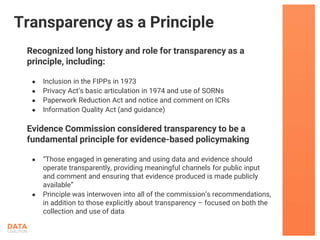
Recognized long history and role for transparency as a
principle, including:
● Inclusion in the FIPPs in 1973
● Privacy Act’s basic articulation in 1974 and use of SORNs
● Paperwork Reduction Act and notice and comment on ICRs
● Information Quality Act (and guidance)
Evidence Commission considered transparency to be a
fundamental principle for evidence-based policymaking
● “Those engaged in generating and using data and evidence should
operate transparently, providing meaningful channels for public input
and comment and ensuring that evidence produced is made publicly
available”
● Principle was interwoven into all of the commission’s recommendations,
in addition to those explicitly about transparency – focused on both the
collection and use of data
Transparency as a Principle
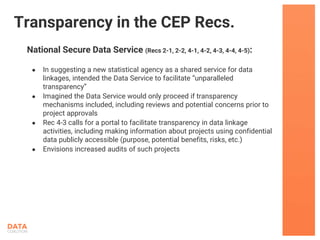
National Secure Data Service (Recs 2-1, 2-2, 4-1, 4-2, 4-3, 4-4, 4-5):
● In suggesting a new statistical agency as a shared service for data
linkages, intended the Data Service to facilitate “unparalleled
transparency”
● Imagined the Data Service would only proceed if transparency
mechanisms included, including reviews and potential concerns prior to
project approvals
● Rec 4-3 calls for a portal to facilitate transparency in data linkage
activities, including making information about projects using confidential
data publicly accessible (purpose, potential benefits, risks, etc.)
● Envisions increased audits of such projects
Transparency in the CEP Recs.
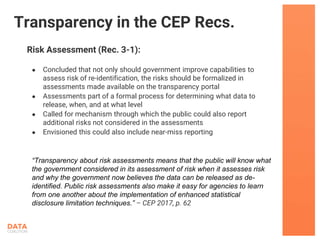
Risk Assessment (Rec. 3-1):
● Concluded that not only should government improve capabilities to
assess risk of re-identification, the risks should be formalized in
assessments made available on the transparency portal
● Assessments part of a formal process for determining what data to
release, when, and at what level
● Called for mechanism through which the public could also report
additional risks not considered in the assessments
● Envisioned this could also include near-miss reporting
“Transparency about risk assessments means that the public will know what
the government considered in its assessment of risk when it assesses risk
and why the government now believes the data can be released as de-
identified. Public risk assessments also make it easy for agencies to learn
from one another about the implementation of enhanced statistical
disclosure limitation techniques.” – CEP 2017, p. 62
Transparency in the CEP Recs.
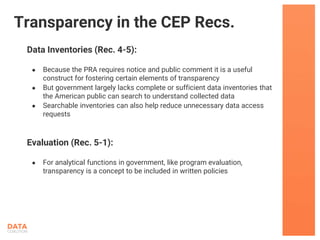
Data Inventories (Rec. 4-5):
● Because the PRA requires notice and public comment it is a useful
construct for fostering certain elements of transparency
● But government largely lacks complete or sufficient data inventories that
the American public can search to understand collected data
● Searchable inventories can also help reduce unnecessary data access
requests
Evaluation (Rec. 5-1):
● For analytical functions in government, like program evaluation,
transparency is a concept to be included in written policies
Transparency in the CEP Recs.
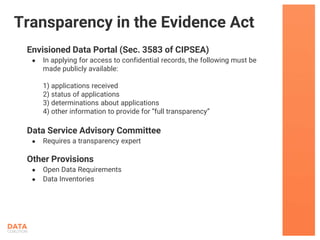
Envisioned Data Portal (Sec. 3583 of CIPSEA)
● In applying for access to confidential records, the following must be
made publicly available:
1) applications received
2) status of applications
3) determinations about applications
4) other information to provide for “full transparency”
Data Service Advisory Committee
● Requires a transparency expert
Other Provisions
● Open Data Requirements
● Data Inventories
Transparency in the Evidence Act
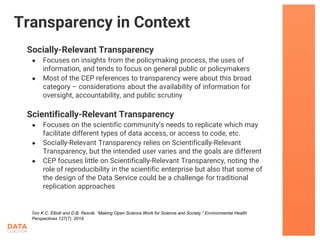
Socially-Relevant Transparency
● Focuses on insights from the policymaking process, the uses of
information, and tends to focus on general public or policymakers
● Most of the CEP references to transparency were about this broad
category – considerations about the availability of information for
oversight, accountability, and public scrutiny
Scientifically-Relevant Transparency
● Focuses on the scientific community’s needs to replicate which may
facilitate different types of data access, or access to code, etc.
● Socially-Relevant Transparency relies on Scientifically-Relevant
Transparency, but the intended user varies and the goals are different
● CEP focuses little on Scientifically-Relevant Transparency, noting the
role of reproducibility in the scientific enterprise but also that some of
the design of the Data Service could be a challenge for traditional
replication approaches
See K.C. Elliott and D.B. Resnik. “Making Open Science Work for Science and Society.” Environmental Health
Perspectives 127(7), 2019.
Transparency in Context
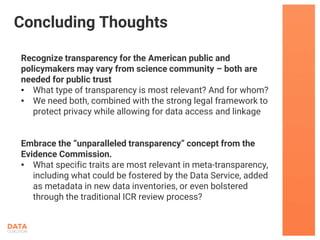
Recognize transparency for the American public and
policymakers may vary from science community – both are
needed for public trust
• What type of transparency is most relevant? And for whom?
• We need both, combined with the strong legal framework to
protect privacy while allowing for data access and linkage
Embrace the “unparalleled transparency” concept from the
Evidence Commission.
• What specific traits are most relevant in meta-transparency,
including what could be fostered by the Data Service, added
as metadata in new data inventories, or even bolstered
through the traditional ICR review process?
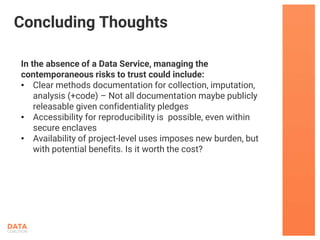
Concluding Thoughts
In the absence of a Data Service, managing the
contemporaneous risks to trust could include:
• Clear methods documentation for collection, imputation,
analysis (+code) – Not all documentation maybe publicly
releasable given confidentiality pledges
• Accessibility for reproducibility is possible, even within
secure enclaves
• Availability of project-level uses imposes new burden, but
with potential benefits. Is it worth the cost?
Concluding Thoughts
Auditing processes have a clear role that can support
transparency
• No existing IG particularly suited to conduct audits of the
statistical system; CEP noted one could/should be
designated
• Audits using the yellow-book standards are process
focused, so can assess components of informational
requirements and compliance with standards without
questioning scientific or statistical legitimacy
Concluding Thoughts
1. Encourage adoption of remaining Evidence Commission
recommendations – more work remains to fully realize the
vision
2. Promote sustained attention on implementing existing
Evidence Act (and CIPSEA) requirements – including the
FSS serving as the model for other agencies on how to
meet the intent, advancing project-based transparency, and
designing auditable approaches
3. Capitalize on Congress’s bipartisan reauthorization of
CIPSEA, reinforcing existing confidentiality protections and
calling for improved risk assessments beyond the
statistical system
4. Prioritize resources for improving disclosure avoidance
techniques and protocols, including emerging privacy-
preserving technologies
5. Suggest an auditing process that works for the statistical
system while also addressing core accountability needs
Recommendations
nick.hart@datacoalition.org
www.GovDATAx.com
Contact

Transparency for the Modern Evidence Ecosystem

  • 1.
    Transparency for theModern Evidence Ecosystem: Trust and Accountability to Support Effective Policymaking Nick Hart, PhD Data Coalition CEO
  • 2.
    Bipartisan Commission onEvidence-Based Policymaking formulated to study government data access and use issues ● 15 politically appointed members included researchers, former heads of statistical agencies, and privacy experts ● Concluded with 22 unanimous recommendations ● Issued report in Sept. 2017 ● Half of the recommendations are now embodied in a law called the Foundations for Evidence-Based Policymaking Act of 2018 Ryan-Murray Evidence Commission
  • 3.
    Final report highlightedcritical role of transparency to support evidence-based policymaking in the United States ● Viewed that enhanced privacy protections and greater prevalence of data access and/or linkage must be paired with increased transparency ● Concluded that even with strong legal framework, transparency had to be featured prominently to demonstrate to the American public how government data were being used ● “Government also can dramatically improve transparency about its collection and use of data improving the American public’s ability to hold the government accountable.” ● Perceived that transparency that supported accountability was a route to sustaining and improving public trust ● Critical of existing practice of providing general, but not specific project- level notice about uses of confidential records ● Define as “giving the public information about how the government is using their data to improve its effectiveness and efficiency.” --CEP 2017, p. 75 CEP Approach to Transparency
  • 4.
    Recognized long historyand role for transparency as a principle, including: ● Inclusion in the FIPPs in 1973 ● Privacy Act’s basic articulation in 1974 and use of SORNs ● Paperwork Reduction Act and notice and comment on ICRs ● Information Quality Act (and guidance) Evidence Commission considered transparency to be a fundamental principle for evidence-based policymaking ● “Those engaged in generating and using data and evidence should operate transparently, providing meaningful channels for public input and comment and ensuring that evidence produced is made publicly available” ● Principle was interwoven into all of the commission’s recommendations, in addition to those explicitly about transparency – focused on both the collection and use of data Transparency as a Principle
  • 5.
    National Secure DataService (Recs 2-1, 2-2, 4-1, 4-2, 4-3, 4-4, 4-5): ● In suggesting a new statistical agency as a shared service for data linkages, intended the Data Service to facilitate “unparalleled transparency” ● Imagined the Data Service would only proceed if transparency mechanisms included, including reviews and potential concerns prior to project approvals ● Rec 4-3 calls for a portal to facilitate transparency in data linkage activities, including making information about projects using confidential data publicly accessible (purpose, potential benefits, risks, etc.) ● Envisions increased audits of such projects Transparency in the CEP Recs.
  • 6.
    Risk Assessment (Rec.3-1): ● Concluded that not only should government improve capabilities to assess risk of re-identification, the risks should be formalized in assessments made available on the transparency portal ● Assessments part of a formal process for determining what data to release, when, and at what level ● Called for mechanism through which the public could also report additional risks not considered in the assessments ● Envisioned this could also include near-miss reporting “Transparency about risk assessments means that the public will know what the government considered in its assessment of risk when it assesses risk and why the government now believes the data can be released as de- identified. Public risk assessments also make it easy for agencies to learn from one another about the implementation of enhanced statistical disclosure limitation techniques.” – CEP 2017, p. 62 Transparency in the CEP Recs.
  • 7.
    Data Inventories (Rec.4-5): ● Because the PRA requires notice and public comment it is a useful construct for fostering certain elements of transparency ● But government largely lacks complete or sufficient data inventories that the American public can search to understand collected data ● Searchable inventories can also help reduce unnecessary data access requests Evaluation (Rec. 5-1): ● For analytical functions in government, like program evaluation, transparency is a concept to be included in written policies Transparency in the CEP Recs.
  • 8.
    Envisioned Data Portal(Sec. 3583 of CIPSEA) ● In applying for access to confidential records, the following must be made publicly available: 1) applications received 2) status of applications 3) determinations about applications 4) other information to provide for “full transparency” Data Service Advisory Committee ● Requires a transparency expert Other Provisions ● Open Data Requirements ● Data Inventories Transparency in the Evidence Act
  • 9.
    Socially-Relevant Transparency ● Focuseson insights from the policymaking process, the uses of information, and tends to focus on general public or policymakers ● Most of the CEP references to transparency were about this broad category – considerations about the availability of information for oversight, accountability, and public scrutiny Scientifically-Relevant Transparency ● Focuses on the scientific community’s needs to replicate which may facilitate different types of data access, or access to code, etc. ● Socially-Relevant Transparency relies on Scientifically-Relevant Transparency, but the intended user varies and the goals are different ● CEP focuses little on Scientifically-Relevant Transparency, noting the role of reproducibility in the scientific enterprise but also that some of the design of the Data Service could be a challenge for traditional replication approaches See K.C. Elliott and D.B. Resnik. “Making Open Science Work for Science and Society.” Environmental Health Perspectives 127(7), 2019. Transparency in Context
  • 10.
    Recognize transparency forthe American public and policymakers may vary from science community – both are needed for public trust • What type of transparency is most relevant? And for whom? • We need both, combined with the strong legal framework to protect privacy while allowing for data access and linkage Embrace the “unparalleled transparency” concept from the Evidence Commission. • What specific traits are most relevant in meta-transparency, including what could be fostered by the Data Service, added as metadata in new data inventories, or even bolstered through the traditional ICR review process? Concluding Thoughts
  • 11.
    In the absenceof a Data Service, managing the contemporaneous risks to trust could include: • Clear methods documentation for collection, imputation, analysis (+code) – Not all documentation maybe publicly releasable given confidentiality pledges • Accessibility for reproducibility is possible, even within secure enclaves • Availability of project-level uses imposes new burden, but with potential benefits. Is it worth the cost? Concluding Thoughts
  • 12.
    Auditing processes havea clear role that can support transparency • No existing IG particularly suited to conduct audits of the statistical system; CEP noted one could/should be designated • Audits using the yellow-book standards are process focused, so can assess components of informational requirements and compliance with standards without questioning scientific or statistical legitimacy Concluding Thoughts
  • 13.
    1. Encourage adoptionof remaining Evidence Commission recommendations – more work remains to fully realize the vision 2. Promote sustained attention on implementing existing Evidence Act (and CIPSEA) requirements – including the FSS serving as the model for other agencies on how to meet the intent, advancing project-based transparency, and designing auditable approaches 3. Capitalize on Congress’s bipartisan reauthorization of CIPSEA, reinforcing existing confidentiality protections and calling for improved risk assessments beyond the statistical system 4. Prioritize resources for improving disclosure avoidance techniques and protocols, including emerging privacy- preserving technologies 5. Suggest an auditing process that works for the statistical system while also addressing core accountability needs Recommendations
  • 14.