TRANSMEDIA
STORYTELLING
Gual Barwell - Head of Strategy, REBORN
What are we here for?
CONTEXT
Change consumer behaviour by
generating salience for our product
and service through
communications?
POSIT
WHY TRANSMEDIA
STORYTELLING?
HOW?
CHALLENGES
OUTPUTS
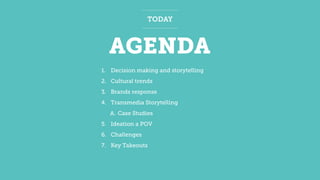
AGENDA
TODAY
1. Decision making and storytelling
2. Cultural trends
3. Brands response
4. Transmedia Storytelling
A. Case Studies
5. Ideation a POV
6. Challenges
7. Key Takeouts
AND STORYTELLING
1. DECISION MAKING
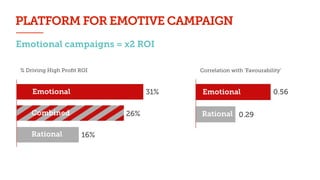
Emotional campaigns = x2 ROI
PLATFORM FOR EMOTIVE CAMPAIGN
% Driving High Profit ROI Correlation with ‘Favourability’
Emotional
Combined
Rational
Emotional
Rational
31%
26%
16%
0.56
0.29
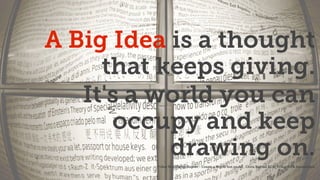
A Big Idea is a thought
that keeps giving.
It's a world you can
occupy and keep
drawing on.
Tribal Worldwide Report - Create a World not an Ad , Chris Bayliss ECD, Tribal DDB Amsterdam
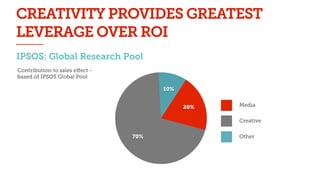
CREATIVITY PROVIDES GREATEST
LEVERAGE OVER ROI
IPSOS: Global Research Pool
Contribution to sales effect -
based of IPSOS Global Pool
70%
20%
10%
Media
Creative
Other
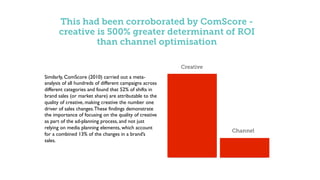
52%
13%
CREATIVE
CHANNEL
Similarly, ComScore (2010) carried out a meta-
analysis of all hundreds of different campaigns across
different categories and found that 52% of shifts in
brand sales (or market share) are attributable to the
quality of creative, making creative the number one
driver of sales changes.These findings demonstrate
the importance of focusing on the quality of creative
as part of the ad-planning process, and not just
relying on media planning elements, which account
for a combined 13% of the changes in a brand’s
sales.
This%has%been%corroborated%by%ComScore%3%%
crea4ve%is%500%%greater%determinant%of%ROI%
than%channel%op4misa4on%(13)%
This had been corroborated by ComScore -
creative is 500% greater determinant of ROI
than channel optimisation
Creative
Channel
DESIGN
AND INTERCONNECTIVITY
2. MEDIA CONVERGENCE,
INSTRUMENTALISATION
“We are entering an era where media will be everywhere, and we
will use all kinds of media in relation to one another...”
!
Henry Jenkins, Convergence? I Diverge, 2001
MEDIA CONVERGENCE
What is ‘Convergence Culture’?
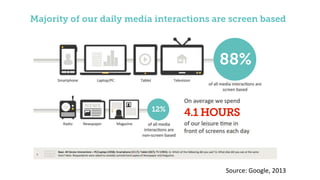
Source:(Google,(2013((
Majority of our daily media interactions are screen based
88%
12%
4.1 HOURS
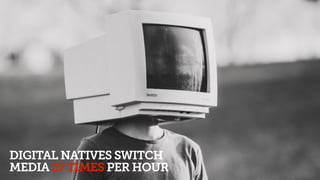
DIGITAL NATIVES SWITCH
MEDIA 27 TIMES PER HOUR
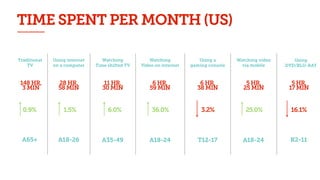
TIME SPENT PER MONTH (US)
Traditional
TV
Using internet
on a computer
Watching
Time shifted TV
Watching
Video on internet
Using a
gaming console
Watching video
via mobile
Using
DVD/BLU-RAY
148 HR,
3 MIN
28 HR,
58 MIN
11 HR,
30 MIN
6 HR,
59 MIN
6 HR,
38 MIN
5 HR,
25 MIN
5 HR,
17 MIN
0.9% 1.5% 6.0% 36.0% 3.2% 16.1%25.0%
A65+ A18-26 A35-49 A18-24 T12-17 A18-24 K2-11
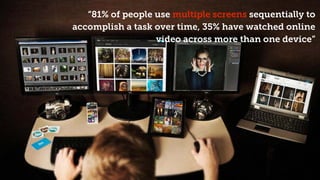
“81% of people use multiple screens sequentially to
accomplish a task over time, 35% have watched online
video across more than one device”
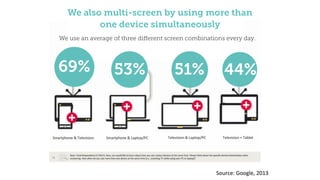
Source:(Google,(2013((
We also multi-screen by using more than
one device simultaneously
We use an average of three different screen combinations every day.
69% 53% 51% 44%
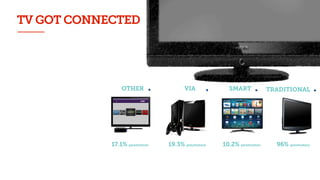
TV#got#
Connected#
TRADITIONALSMARTVIA
CONSOLE
OTHER
1.4B
volume
96%
penetration
10.2%
penetration
17.1%
penetration
19.3%
penetration
13MM(AppleTVs)|5MM(Roku
Players)
volume
TV GOT CONNECTED
OTHER VIA SMART TRADITIONAL
17.1% penetration 19.3% penetration 10.2% penetration 96% penetration
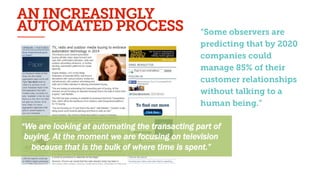
“Some observers are
predicting that by 2020
companies could
manage 85% of their
customer
relationships without
talking to a human
being.”
“We are looking at automating the transacting part of
buying. At the moment we are focusing on television
because that is the bulk of where time is spent.”
An#increasingly#automated#process#(5/6)#
“Some observers are
predicting that by 2020
companies could
manage 85% of their
customer relationships
without talking to a
human being.”
AN INCREASINGLY
AUTOMATED PROCESS
AND THEIR RESPONSE
3. BRANDS
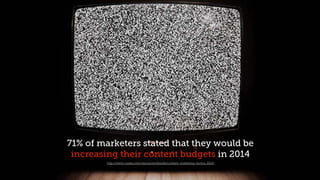
71% of marketers stated that they would be
increasing their content budgets in 2014
http://www.curata.com/resources/ebooks/content-marketing-tactics-2014/
• TEXT:
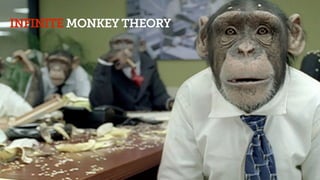
• Infinite Monkey Theorem…
INFINITE MONKEY THEORY
STORYTELLING
4. TRANSMEDIA
TRANSMEDIA STORYTELLING
“A transmedia story unfolds across multiple media platforms, with each text
making a distinctive and valuable contribution to the whole.”
!
Henry Jenkins, Convergence? I Diverge, 2001
WHAT IS TRANSMEDIA
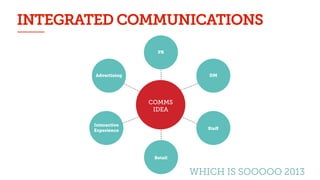
WHICH IS SOOOOO 2013
COMMS
IDEA
PR
DM
Staff
Retail
Interactive
Experience
Advertising
INTEGRATED COMMUNICATIONS
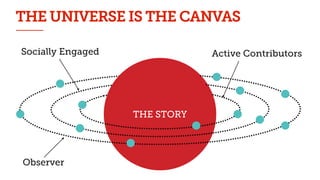
THE STORY
Observer
Socially Engaged Active Contributors
THE UNIVERSE IS THE CANVAS
STUDIES
A. CASE
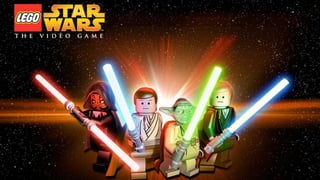
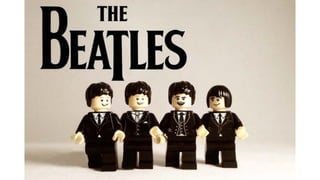
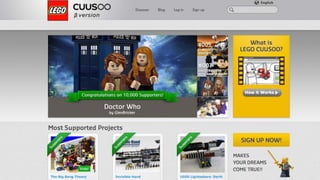
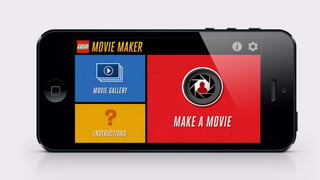
LEGO
ONE PRODUCT,
ONE BRAND,
ONE PROMISE,
AND
MILLIONS OF STORIES
LEGO
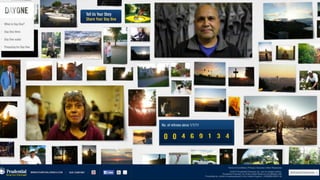
SCREEN SHOT of: http://www.dayonestories.com/#
DAY ONE STORIES
A POV
7. IDEATION
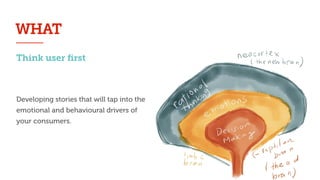
Think user first
Developing stories that will tap into the
emotional and behavioural drivers of
your consumers.
WHAT
Think user again
HOW
What tech are they using. How are they using it.
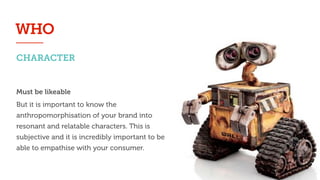
CHARACTER
WHO
Must be likeable
But it is important to know the
anthropomorphisation of your brand into
resonant and relatable characters. This is
subjective and it is incredibly important to be
able to empathise with your consumer.
TO OVERCOME
5. CHALLENGES
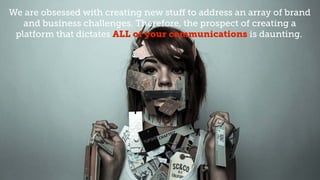
We are obsessed with creating new stuff to address and array of brand and business challenges. Therefore,
the prospect of creating a platform that dictates ALL of your communications is daunting.

We are obsessed with creating new stuff to address an array of brand
and business challenges. Therefore, the prospect of creating a
platform that dictates ALL of your communications is daunting.
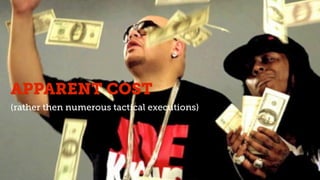
APPARENT COST
(rather then numerous tactical executions)
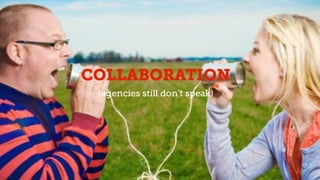
• c. Collaboration (agencies still don’t really speak)COLLABORATION
(agencies still don’t speak)
• Complexity (it is hard to execute)
COMPLEXITY
(it’s hard to execute!)
ASSUME
INDIFFERENCE
Existing conventions of advertising
(always think in 15, 30 sec slots)
• Attempting to achieve reciprocity with your brand opens you up to a personal
critique of your own understanding of the people you are trying to connect with
Attempting to achieve reciprocity with your brand opens
you up to a personal critique of your own understanding
of the people you are trying to connect with.
TAKEOUTS
9. KEY
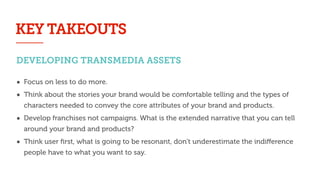
DEVELOPING TRANSMEDIA ASSETS
• Focus on less to do more.
• Think about the stories your brand would be comfortable telling and the types of
characters needed to convey the core attributes of your brand and products.
• Develop franchises not campaigns. What is the extended narrative that you can tell
around your brand and products?
• Think user first, what is going to be resonant, don’t underestimate the indifference
people have to what you want to say.
KEY TAKEOUTS
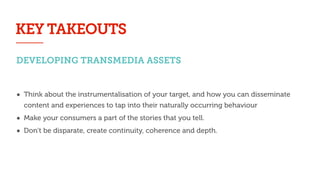
DEVELOPING TRANSMEDIA ASSETS
• Think about the instrumentalisation of your target, and how you can disseminate
content and experiences to tap into their naturally occurring behaviour
• Make your consumers a part of the stories that you tell.
• Don’t be disparate, create continuity, coherence and depth.
KEY TAKEOUTS
It is hard, but we hope we have given you
the foundations,the rationale and the
courage to tell your story.
QUESTIONS
10. THANKS
Gual Barwell
HEAD OF STRATEGY
REBORN
First floor, 46 -52 Meagher Street, Chippendale, Sydney  NSW 2008 
P  +61 2 8507 6895 / M  +61 410 927 617  
E  gual@reborn.com.au

Transmedia Storytelling

  • 1.
  • 2.
    What are wehere for? CONTEXT
  • 3.
    Change consumer behaviourby generating salience for our product and service through communications? POSIT
  • 4.
  • 5.
    AGENDA TODAY 1. Decision makingand storytelling 2. Cultural trends 3. Brands response 4. Transmedia Storytelling A. Case Studies 5. Ideation a POV 6. Challenges 7. Key Takeouts
  • 6.
  • 8.
    Emotional campaigns =x2 ROI PLATFORM FOR EMOTIVE CAMPAIGN % Driving High Profit ROI Correlation with ‘Favourability’ Emotional Combined Rational Emotional Rational 31% 26% 16% 0.56 0.29
  • 11.
    A Big Ideais a thought that keeps giving. It's a world you can occupy and keep drawing on. Tribal Worldwide Report - Create a World not an Ad , Chris Bayliss ECD, Tribal DDB Amsterdam
  • 12.
    CREATIVITY PROVIDES GREATEST LEVERAGEOVER ROI IPSOS: Global Research Pool Contribution to sales effect - based of IPSOS Global Pool 70% 20% 10% Media Creative Other
  • 13.
    52% 13% CREATIVE CHANNEL Similarly, ComScore (2010)carried out a meta- analysis of all hundreds of different campaigns across different categories and found that 52% of shifts in brand sales (or market share) are attributable to the quality of creative, making creative the number one driver of sales changes.These findings demonstrate the importance of focusing on the quality of creative as part of the ad-planning process, and not just relying on media planning elements, which account for a combined 13% of the changes in a brand’s sales. This%has%been%corroborated%by%ComScore%3%% crea4ve%is%500%%greater%determinant%of%ROI% than%channel%op4misa4on%(13)% This had been corroborated by ComScore - creative is 500% greater determinant of ROI than channel optimisation Creative Channel
  • 14.
  • 17.
    AND INTERCONNECTIVITY 2. MEDIACONVERGENCE, INSTRUMENTALISATION
  • 18.
    “We are enteringan era where media will be everywhere, and we will use all kinds of media in relation to one another...” ! Henry Jenkins, Convergence? I Diverge, 2001 MEDIA CONVERGENCE What is ‘Convergence Culture’?
  • 20.
    Source:(Google,(2013(( Majority of ourdaily media interactions are screen based 88% 12% 4.1 HOURS
  • 21.
  • 22.
    TIME SPENT PERMONTH (US) Traditional TV Using internet on a computer Watching Time shifted TV Watching Video on internet Using a gaming console Watching video via mobile Using DVD/BLU-RAY 148 HR, 3 MIN 28 HR, 58 MIN 11 HR, 30 MIN 6 HR, 59 MIN 6 HR, 38 MIN 5 HR, 25 MIN 5 HR, 17 MIN 0.9% 1.5% 6.0% 36.0% 3.2% 16.1%25.0% A65+ A18-26 A35-49 A18-24 T12-17 A18-24 K2-11
  • 23.
    “81% of peopleuse multiple screens sequentially to accomplish a task over time, 35% have watched online video across more than one device”
  • 24.
    Source:(Google,(2013(( We also multi-screenby using more than one device simultaneously We use an average of three different screen combinations every day. 69% 53% 51% 44%
  • 25.
  • 26.
    “Some observers are predictingthat by 2020 companies could manage 85% of their customer relationships without talking to a human being.” “We are looking at automating the transacting part of buying. At the moment we are focusing on television because that is the bulk of where time is spent.” An#increasingly#automated#process#(5/6)# “Some observers are predicting that by 2020 companies could manage 85% of their customer relationships without talking to a human being.” AN INCREASINGLY AUTOMATED PROCESS
  • 28.
  • 29.
    71% of marketersstated that they would be increasing their content budgets in 2014 http://www.curata.com/resources/ebooks/content-marketing-tactics-2014/
  • 30.
    • TEXT: • InfiniteMonkey Theorem… INFINITE MONKEY THEORY
  • 32.
  • 33.
    TRANSMEDIA STORYTELLING “A transmediastory unfolds across multiple media platforms, with each text making a distinctive and valuable contribution to the whole.” ! Henry Jenkins, Convergence? I Diverge, 2001 WHAT IS TRANSMEDIA
  • 34.
    WHICH IS SOOOOO2013 COMMS IDEA PR DM Staff Retail Interactive Experience Advertising INTEGRATED COMMUNICATIONS
  • 35.
    THE STORY Observer Socially EngagedActive Contributors THE UNIVERSE IS THE CANVAS
  • 38.
  • 39.
    LEGO ONE PRODUCT, ONE BRAND, ONEPROMISE, AND MILLIONS OF STORIES
  • 43.
  • 48.
    SCREEN SHOT of:http://www.dayonestories.com/# DAY ONE STORIES
  • 49.
  • 50.
    Think user first Developingstories that will tap into the emotional and behavioural drivers of your consumers. WHAT
  • 51.
    Think user again HOW Whattech are they using. How are they using it.
  • 52.
    CHARACTER WHO Must be likeable Butit is important to know the anthropomorphisation of your brand into resonant and relatable characters. This is subjective and it is incredibly important to be able to empathise with your consumer.
  • 53.
  • 54.
    We are obsessedwith creating new stuff to address and array of brand and business challenges. Therefore, the prospect of creating a platform that dictates ALL of your communications is daunting. We are obsessed with creating new stuff to address an array of brand and business challenges. Therefore, the prospect of creating a platform that dictates ALL of your communications is daunting.
  • 55.
    APPARENT COST (rather thennumerous tactical executions)
  • 56.
    • c. Collaboration(agencies still don’t really speak)COLLABORATION (agencies still don’t speak)
  • 57.
    • Complexity (itis hard to execute) COMPLEXITY (it’s hard to execute!)
  • 58.
  • 59.
    Existing conventions ofadvertising (always think in 15, 30 sec slots)
  • 60.
    • Attempting toachieve reciprocity with your brand opens you up to a personal critique of your own understanding of the people you are trying to connect with Attempting to achieve reciprocity with your brand opens you up to a personal critique of your own understanding of the people you are trying to connect with.
  • 61.
  • 62.
    DEVELOPING TRANSMEDIA ASSETS •Focus on less to do more. • Think about the stories your brand would be comfortable telling and the types of characters needed to convey the core attributes of your brand and products. • Develop franchises not campaigns. What is the extended narrative that you can tell around your brand and products? • Think user first, what is going to be resonant, don’t underestimate the indifference people have to what you want to say. KEY TAKEOUTS
  • 63.
    DEVELOPING TRANSMEDIA ASSETS •Think about the instrumentalisation of your target, and how you can disseminate content and experiences to tap into their naturally occurring behaviour • Make your consumers a part of the stories that you tell. • Don’t be disparate, create continuity, coherence and depth. KEY TAKEOUTS
  • 64.
    It is hard,but we hope we have given you the foundations,the rationale and the courage to tell your story.
  • 65.
  • 66.
    Gual Barwell HEAD OFSTRATEGY REBORN First floor, 46 -52 Meagher Street, Chippendale, Sydney  NSW 2008  P  +61 2 8507 6895 / M  +61 410 927 617   E  gual@reborn.com.au