TRANSITION
SIGNALS
•are one of the main ways to
achieve good cohesion and
coherence in your writing
•Transition signals are used to
signal relationships between
ideas in your writing
•a way to help ensure that
your ideas and
sentences cohere or 'stick
together‘
1.) Additive Transition
•are those you used when you
want to show that the
current point is an addition to
the previous one
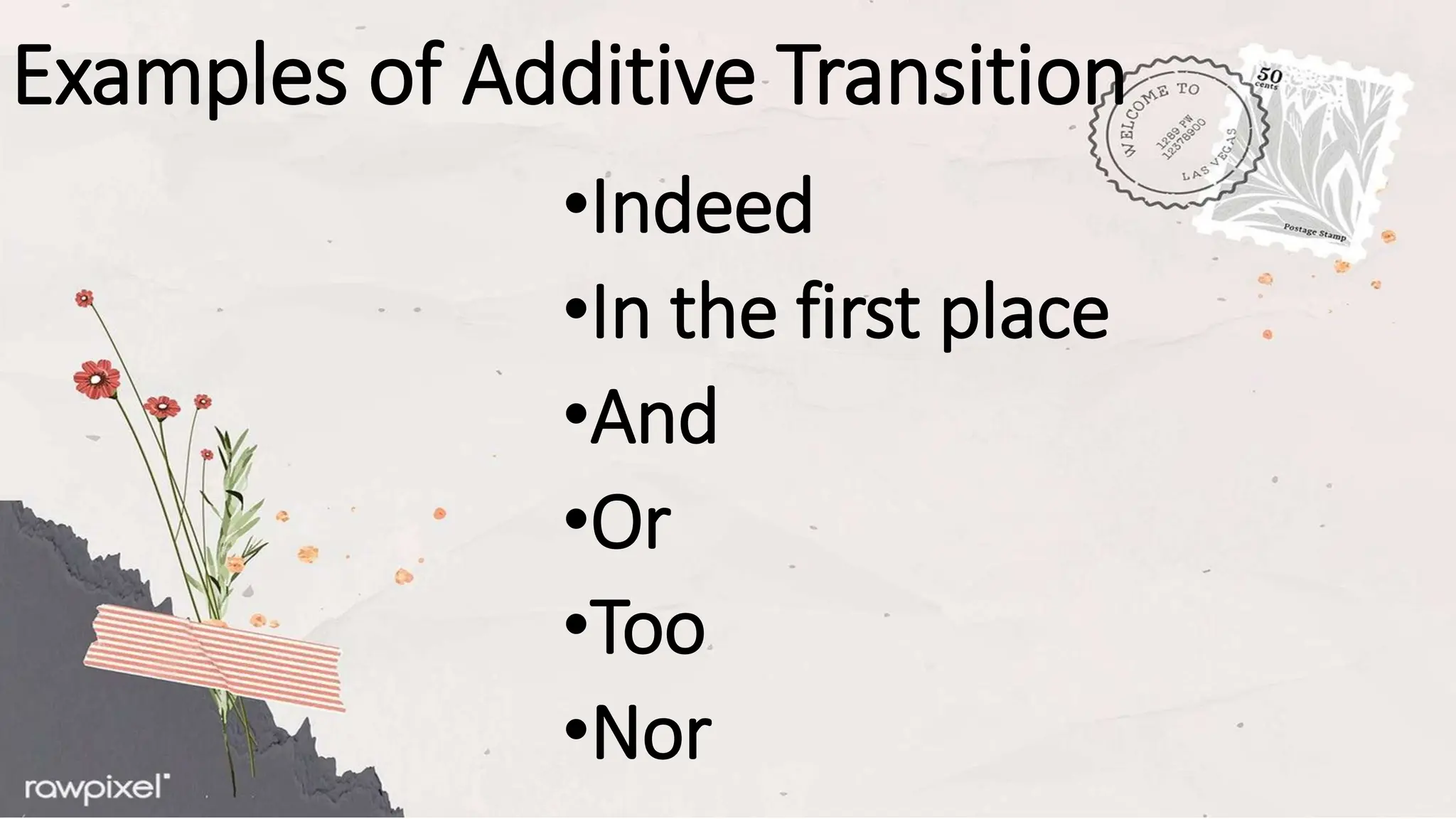
Examples of Additive Transition
•Indeed
•In the first place
•And
•Or
•Too
•Nor
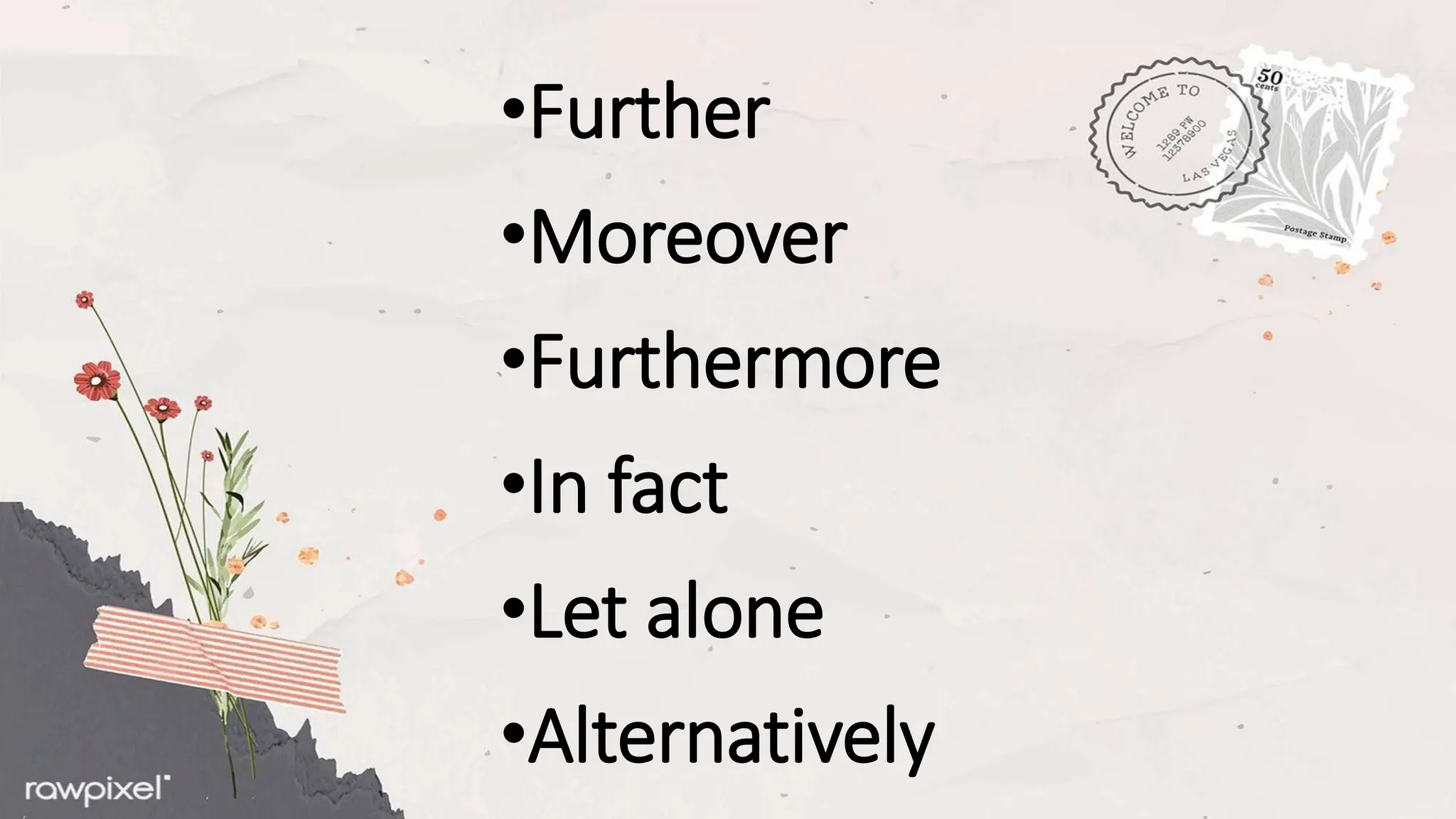
•Further
•Moreover
•Furthermore
•In fact
•Let alone
•Alternatively
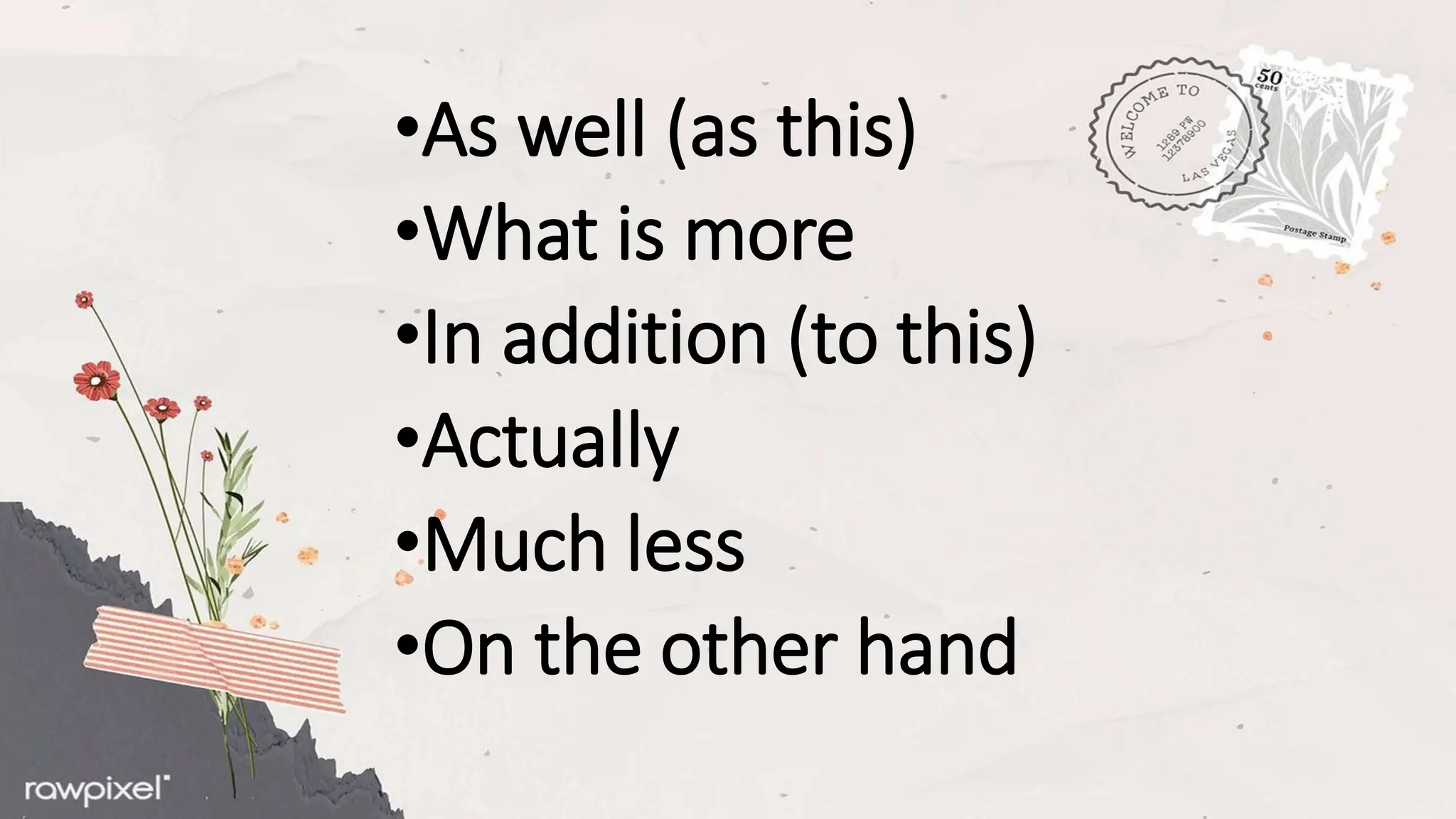
•As well (as this)
•What is more
•In addition (to this)
•Actually
•Much less
•On the other hand
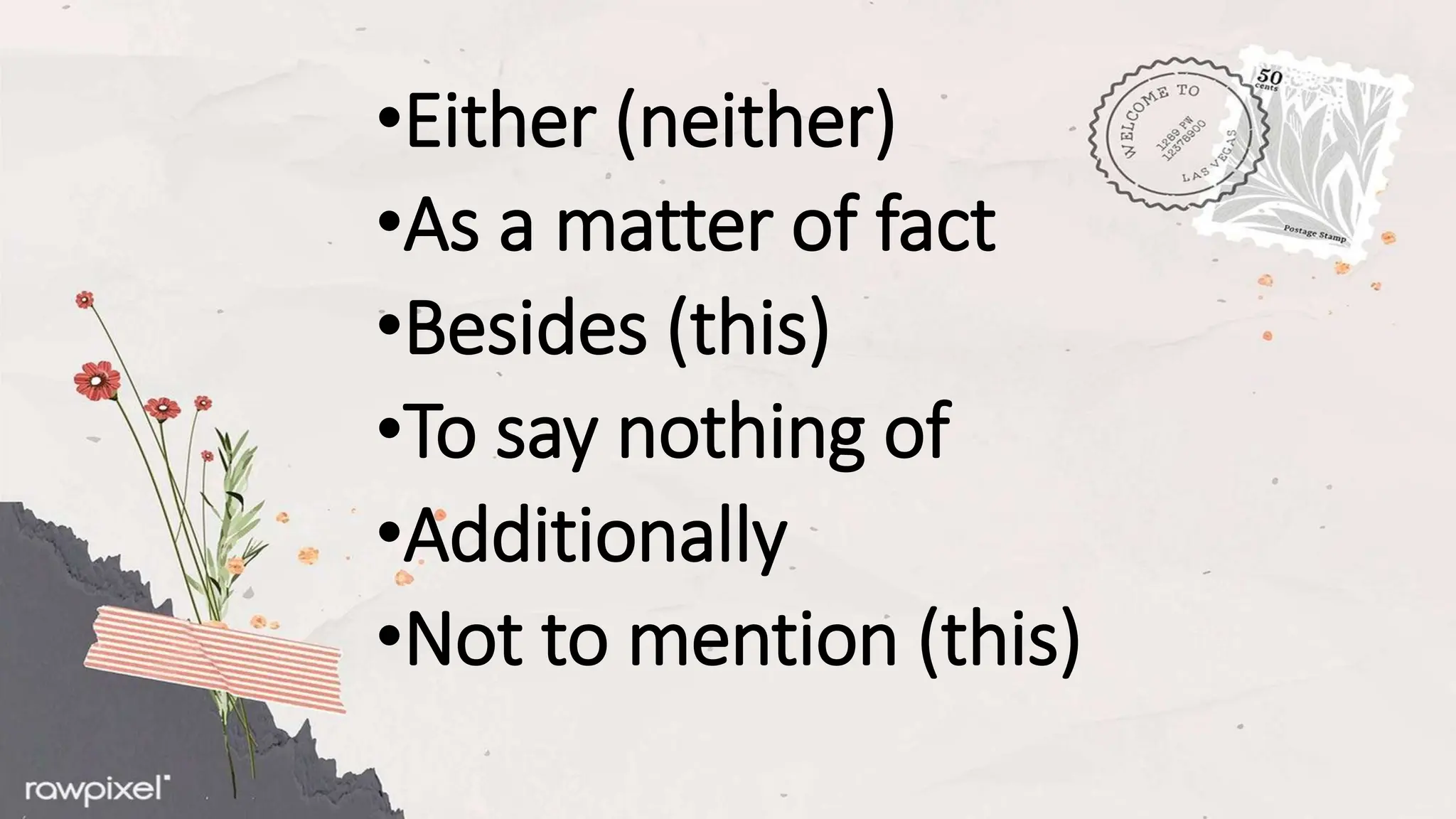
•Either (neither)
•As a matter of fact
•Besides (this)
•To say nothing of
•Additionally
•Not to mention (this)
•Not only (this) but also
(that) as well
•In all honesty
•To tell the truth
EXAMPLES:
1.) Texting while driving is
dangerous; moreover, it’s
illegal in some states.
2.) In addition to being
kind, she is also honest.
3.) The report is badly
presented. As a matter of
fact, it contains
inaccuracies.
4.) I love wearing
earrings. I design and
make them
___________.
5.)__________, to
French, she also speaks
Spanish.
2.) Adversative Transition
•are used to signal
conflict, contradiction,
concession, and dismissal.
EXAMPLES:
•But
•However
•On the other hand
•In contrast
•While
•Whereas
•Conversely
•Even more
•Above all
•But even so
•Nevertheless
•Nonetheless
•Although
•Though However
•(And) still
•(And) yet
•Either way
•In either case
•(Or) at least
•Whichever happens
•Whatever happens
•In other event
EXAMPLES:
1.) She seems timid,
however, she’s really an
outgoing person.
2.)Ana was unkind to
Greg and yet he still
helped her when she fell
down the stairs.
3.) He is a quiet person,
on the other hand, his
sister is very talkative .
4.) I want to go to the
party, but _______ I
ought to be studying.
5.) They are playing
______ waiting for the
bell.
3.) Causative Transitions
•also called cause-and-
effect transitions
•show how certain
circumstances or events
were caused by other
factors
•It helps readers to follow the
logic of the arguments and
clauses represented in paper.
EXAMPLES:
•Accordingly
•And so
•As a result
•Consequently
•For this reason
•Hence
•So
•Then
•Therefore
•Thus
•On the condition (that)
•As a result (of this)
•Because (of this)
•As a consequence
•Consequently
•In consequence
•So much (so) that
•For the purpose of
•With this intention
•With this in mind
•Under those circumstances
•That being the case
•Then
5.) Clarifying Transitions
•lead readers into
statements that clarify or
emphasize.
EXAMPLES:
•In other words
•In this case
•Put another way
•That is to say
•Under certain
circumstances
•Up to a point
•For instance
•In fact
•In addition
EXAMPLES:
1.) You cannot rely on
her, for instance, she
arrived an hour late for an
important meeting
yesterday.
2.) She didn’t want to
attend the party, in other
words, she preferred to
stay home.
3.) The contract can be
extended under certain
circumstances.
4.) He looks younger,
but in fact, he is 60 years
old.
5.) Sometimes our printer
runs out of ink. In this
case, we must write out
all of our forms manually.
TRANSITION SIGNALS ENGLISH 8  PPTX..pptx

TRANSITION SIGNALS ENGLISH 8 PPTX..pptx