Transition-Based
Dependency Parsing
Saarbrücken, December 23rd 2011
David Przybilla – davida@coli.uni-saarland.de
Outline
1. MaltParser
2. Transition Based Parsing
a. Example
b. Oracle
3. Integrating Graph and Transition Based
4. Non –Projective Dependency Parsing
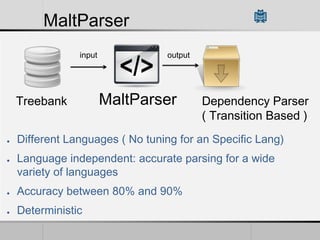
MaltParser
● Different Languages ( No tuning for an Specific Lang)
● Language independent: accurate parsing for a wide
variety of languages
● Accuracy between 80% and 90%
● Deterministic
Treebank MaltParser Dependency Parser
( Transition Based )
input output
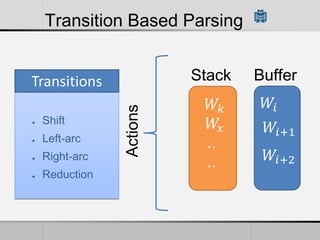
Transition Based Parsing
Stack Buffer
𝑊𝑖
𝑊𝑖+1
𝑊𝑖+2
𝑊𝑘
𝑊𝑥
..
..
● Shift
● Left-arc
● Right-arc
● Reduction
Transitions
Actions
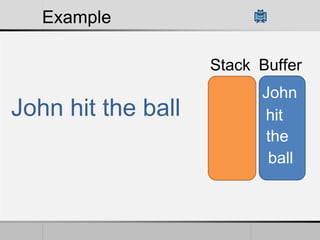
Example
John hit the ball
Stack Buffer
John
hit
the
ball
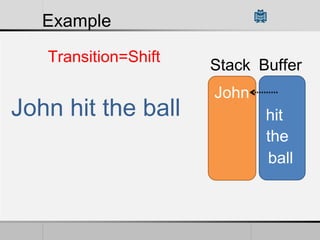
Example
John hit the ball
Stack Buffer
John
hit
the
ball
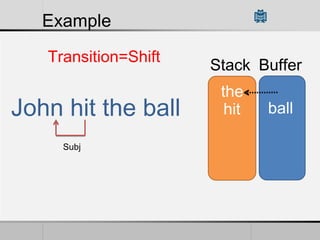
Transition=Shift
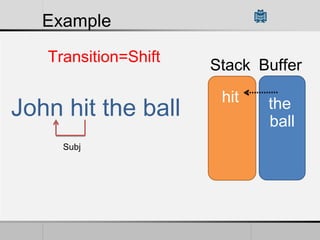
Example
John hit the ball
Stack Buffer
John
hit
the
ball
Transition=left Arc
Subj
Only if ℎ(𝑗𝑜ℎ𝑛) = 0
Example
John hit the ball
Stack Buffer
hit
ball
Transition=Shift
Subj
the
Example
John hit the ball
Stack Buffer
hit
the
ball
Transition=Shift
Subj
Example
John hit the ball
Stack Buffer
hit
the
ball
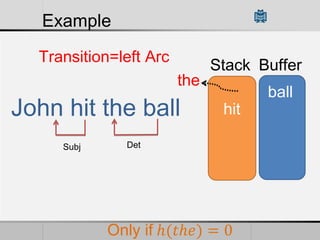
Transition=left Arc
Subj Det
Only if ℎ(𝑡ℎ𝑒) = 0
Example
John hit the ball
Stack Buffer
hit
ball
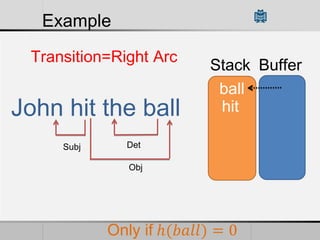
Transition=Right Arc
Subj Det
Obj
Only if ℎ(𝑏𝑎𝑙𝑙) = 0
Example
John hit the ball
Stack Buffer
hit
ball
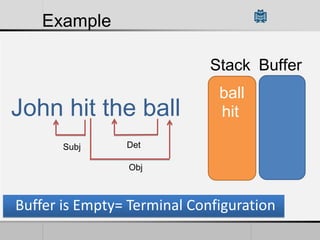
Subj Det
Obj
Buffer is Empty= Terminal Configuration
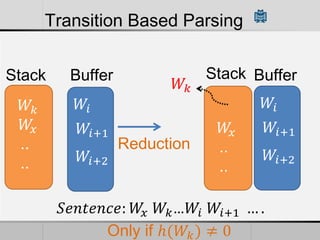
Transition Based Parsing
Stack Buffer
𝑊𝑖
𝑊𝑖+1
𝑊𝑖+2
𝑊𝑘
𝑊𝑥
..
..
Reduction
Stack
𝑊𝑥
..
..
Buffer
𝑊𝑖
𝑊𝑖+1
𝑊𝑖+2
𝑊𝑘
𝑆𝑒𝑛𝑡𝑒𝑛𝑐𝑒: 𝑊𝑥 𝑊𝑘…𝑊𝑖 𝑊𝑖+1 … .
Only if ℎ(𝑊𝑘) ≠ 0
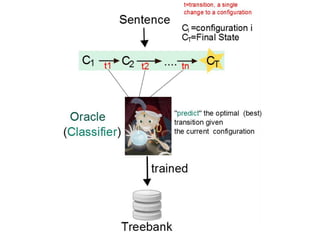
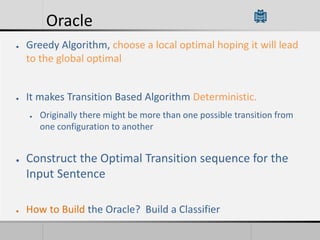
Oracle
● Greedy Algorithm, choose a local optimal hoping it will lead
to the global optimal
● It makes Transition Based Algorithm Deterministic.
● Originally there might be more than one possible transition from
one configuration to another
● Construct the Optimal Transition sequence for the
Input Sentence
● How to Build the Oracle? Build a Classifier
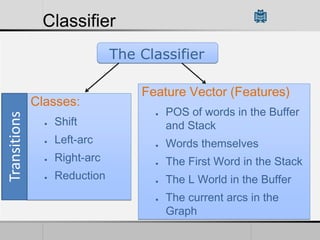
Classifier
The Classifier
Classes:
● Shift
● Left-arc
● Right-arc
● Reduction
Feature Vector (Features)
● POS of words in the Buffer
and Stack
● Words themselves
● The First Word in the Stack
● The L World in the Buffer
● The current arcs in the
Graph
Results of the MaltParser
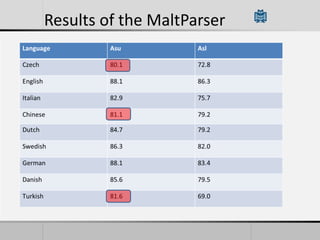
● Evaluation Metrics:
● ASU (Unlabeled Attachment Score): Proportion of Tokens assigned
the correct head
● ASL(Labeled Attachment Score): Proportion of tokens assigned with
the correct head and the correct dependency type
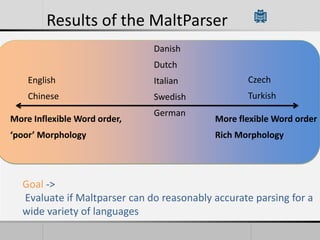
Results of the MaltParser
More flexible Word order
Rich Morphology
More Inflexible Word order,
‘poor’ Morphology
English
Chinese
Czech
Turkish
Danish
Dutch
Italian
Swedish
German
Goal ->
Evaluate if Maltparser can do reasonably accurate parsing for a
wide variety of languages
Results of the MaltParser
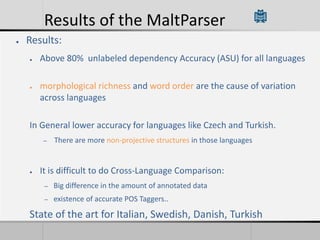
● Results:
● Above 80% unlabeled dependency Accuracy (ASU) for all languages
● morphological richness and word order are the cause of variation
across languages
In General lower accuracy for languages like Czech and Turkish.
– There are more non-projective structures in those languages
● It is difficult to do Cross-Language Comparison:
– Big difference in the amount of annotated data
– existence of accurate POS Taggers..
State of the art for Italian, Swedish, Danish, Turkish
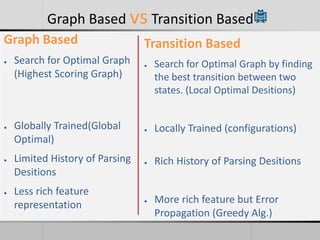
Graph Based vs Transition Based
Graph Based
● Search for Optimal Graph
(Highest Scoring Graph)
● Globally Trained(Global
Optimal)
● Limited History of Parsing
Desitions
● Less rich feature
representation
Transition Based
● Search for Optimal Graph by finding
the best transition between two
states. (Local Optimal Desitions)
● Locally Trained (configurations)
● Rich History of Parsing Desitions
● More rich feature but Error
Propagation (Greedy Alg.)
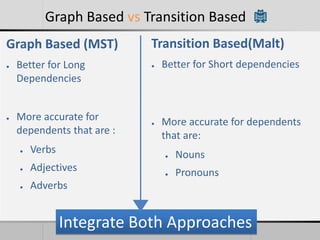
Graph Based vs Transition Based
Graph Based (MST)
● Better for Long
Dependencies
● More accurate for
dependents that are :
● Verbs
● Adjectives
● Adverbs
Transition Based(Malt)
● Better for Short dependencies
● More accurate for dependents
that are:
● Nouns
● Pronouns
Integrate Both Approaches
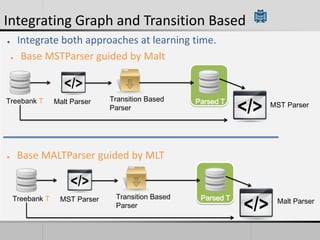
Integrating Graph and Transition Based
Treebank T Malt Parser Transition Based
Parser
Parsed T
● Integrate both approaches at learning time.
MST Parser
● Base MSTParser guided by Malt
Treebank T MST Parser Transition Based
Parser
Malt Parser
● Base MALTParser guided by MLT
Parsed T
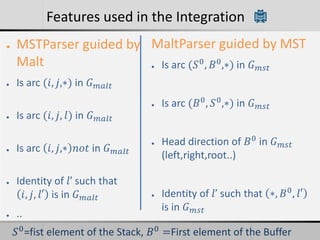
Features used in the Integration
● MSTParser guided by
Malt
● Is arc (𝑖, 𝑗,∗) in 𝐺 𝑚𝑎𝑙𝑡
● Is arc (𝑖, 𝑗, 𝑙) in 𝐺 𝑚𝑎𝑙𝑡
● Is arc 𝑖, 𝑗,∗ 𝑛𝑜𝑡 in 𝐺 𝑚𝑎𝑙𝑡
● Identity of 𝑙’ such that
𝑖, 𝑗, 𝑙′ is in 𝐺 𝑚𝑎𝑙𝑡
● ..
MaltParser guided by MST
● Is arc (𝑆0
, 𝐵0
,∗) in 𝐺 𝑚𝑠𝑡
● Is arc (𝐵0, 𝑆0,∗) in 𝐺 𝑚𝑠𝑡
● Head direction of 𝐵0 in 𝐺 𝑚𝑠𝑡
(left,right,root..)
● Identity of 𝑙’ such that ∗, 𝐵0, 𝑙′
is in 𝐺 𝑚𝑠𝑡
𝑆0
=fist element of the Stack, 𝐵0
=First element of the Buffer
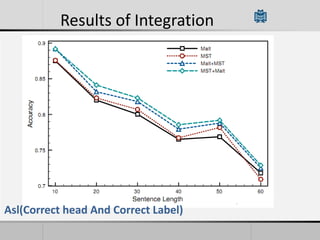
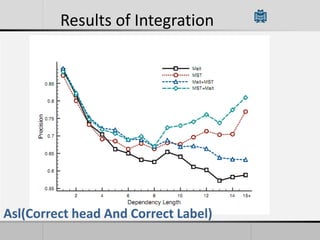
Results of Integration
Asl(Correct head And Correct Label)
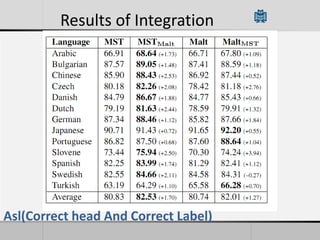
Results of Integration
Asl(Correct head And Correct Label)
Results of Integration
Asl(Correct head And Correct Label)
Results of Integration
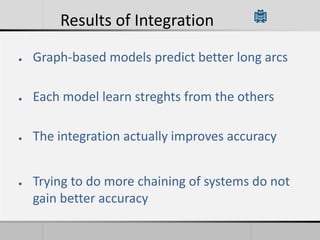
● Graph-based models predict better long arcs
● Each model learn streghts from the others
● The integration actually improves accuracy
● Trying to do more chaining of systems do not
gain better accuracy
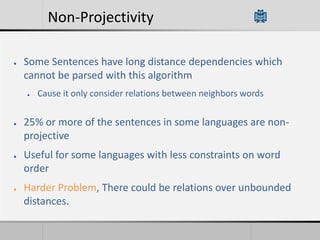
Non-Projectivity
● Some Sentences have long distance dependencies which
cannot be parsed with this algorithm
● Cause it only consider relations between neighbors words
● 25% or more of the sentences in some languages are non-
projective
● Useful for some languages with less constraints on word
order
● Harder Problem, There could be relations over unbounded
distances.
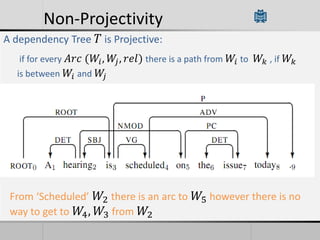
Non-Projectivity
A dependency Tree 𝑇 is Projective:
if for every 𝐴𝑟𝑐 (𝑊𝑖, 𝑊𝑗, 𝑟𝑒𝑙) there is a path from 𝑊𝑖 to 𝑊𝑘 , if 𝑊𝑘
is between 𝑊𝑖 and 𝑊𝑗
From ‘Scheduled’ 𝑊2 there is an arc to 𝑊5 however there is no
way to get to 𝑊4, 𝑊3 from 𝑊2
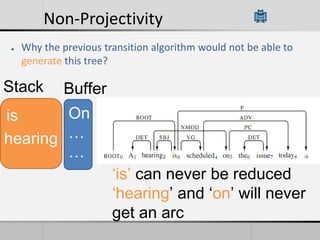
Non-Projectivity
● Why the previous transition algorithm would not be able to
generate this tree?
Stack Buffer
is
hearing
On
…
…
‘is’ can never be reduced
‘hearing’ and ‘on’ will never
get an arc
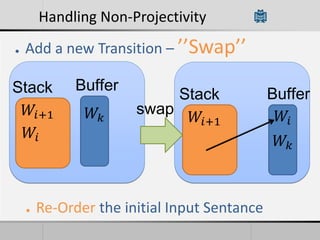
Handling Non-Projectivity
● Add a new Transition – ’’Swap’’
Stack Buffer
𝑊𝑘
𝑊𝑖
𝑊𝑖+1
Stack Buffer
𝑊𝑘
𝑊𝑖𝑊𝑖+1
swap
● Re-Order the initial Input Sentance
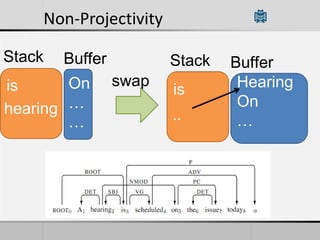
Non-Projectivity
Stack Buffer
is
hearing
On
…
…
Stack Buffer
is
..
Hearing
On
…
swap
Non-Projective Dependency Parsing
● Useful for some languages with less constraints on word
order
Theoretically
● Best case 𝑂(𝑁), , that is: no swaps
● Worst Case 𝑂(𝑁2
),
Results
Non-Projective Dependency Parsing
Running Time
● Test on 5 languages( Danish, Arabic, Czech, Slovene, Turkish)
● In practice the running time is 𝑂 𝑁 .
Parsing Accuracy
● Criteria
● Attachment Score: Percentage of tokens with correct head and
dependency label
● Exact match: completely correct labeled dependency tree
Results
Non-Projective Dependency Parsing
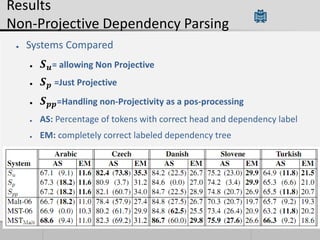
● Systems Compared
● 𝑺 𝒖= allowing Non Projective
● 𝑺 𝒑 =Just Projective
● 𝑺 𝒑𝒑=Handling non-Projectivity as a pos-processing
● AS: Percentage of tokens with correct head and dependency label
● EM: completely correct labeled dependency tree
Results
Non-Projective Dependency Parsing
● AS
● Performance of 𝑆 𝑢 is better for for:
– Czech and Slovene  more non-porjective arcs in this languages.
● In AS 𝑆 𝑢 is lower than 𝑆 𝑝, however the drop is not really significant
● For Arabic the results are not meaningful since there are only 11 non-
projective arcs in the whole set
● ME
● 𝑆 𝑢 outperforms all other parsers.
● The positive effect of 𝑆 𝑢 is dependent on the non-projectivity arcs in the
language
References
● Joakim Nivre, Jens Nilsson, Johan Hall, Atanas Chanev, Gülsen Eryigit, Sandra
Kübler, Svetoslav Marinov, and Erwin Marsi. Maltparser: a language-
independent system for data-driven dependency parsing. Natural Language
Engineering, 13(1):1–41, 2007.
● Joakim Nivre and Ryan McDonald. Integrating graph-based and transition-
based dependency parsers. In Proceedings of ACL-08: HLT, pages 950–958,
Columbus, Ohio, June 2008.
● Joakim Nivre. Non-projective dependency parsing in expected linear time.
In Proceedings of the Joint Conference of the 47th Annual Meeting of the ACL
and the 4th International Joint Conference on Natural Language Processing of
the AFNLP, pages 351–359, Suntec, Singapore, 2009.
● Sandra Kübler, Ryan McDonald, Joakim Nivre. Dependency Parsing, Morgan &
Claypool Publishers, 2009

Transition Based Dependency Parsing

  • 1.
    Transition-Based Dependency Parsing Saarbrücken, December23rd 2011 David Przybilla – davida@coli.uni-saarland.de
  • 2.
    Outline 1. MaltParser 2. TransitionBased Parsing a. Example b. Oracle 3. Integrating Graph and Transition Based 4. Non –Projective Dependency Parsing
  • 3.
    MaltParser ● Different Languages( No tuning for an Specific Lang) ● Language independent: accurate parsing for a wide variety of languages ● Accuracy between 80% and 90% ● Deterministic Treebank MaltParser Dependency Parser ( Transition Based ) input output
  • 4.
    Transition Based Parsing StackBuffer 𝑊𝑖 𝑊𝑖+1 𝑊𝑖+2 𝑊𝑘 𝑊𝑥 .. .. ● Shift ● Left-arc ● Right-arc ● Reduction Transitions Actions
  • 6.
    Example John hit theball Stack Buffer John hit the ball
  • 7.
    Example John hit theball Stack Buffer John hit the ball Transition=Shift
  • 8.
    Example John hit theball Stack Buffer John hit the ball Transition=left Arc Subj Only if ℎ(𝑗𝑜ℎ𝑛) = 0
  • 9.
    Example John hit theball Stack Buffer hit ball Transition=Shift Subj the
  • 10.
    Example John hit theball Stack Buffer hit the ball Transition=Shift Subj
  • 11.
    Example John hit theball Stack Buffer hit the ball Transition=left Arc Subj Det Only if ℎ(𝑡ℎ𝑒) = 0
  • 12.
    Example John hit theball Stack Buffer hit ball Transition=Right Arc Subj Det Obj Only if ℎ(𝑏𝑎𝑙𝑙) = 0
  • 13.
    Example John hit theball Stack Buffer hit ball Subj Det Obj Buffer is Empty= Terminal Configuration
  • 14.
    Transition Based Parsing StackBuffer 𝑊𝑖 𝑊𝑖+1 𝑊𝑖+2 𝑊𝑘 𝑊𝑥 .. .. Reduction Stack 𝑊𝑥 .. .. Buffer 𝑊𝑖 𝑊𝑖+1 𝑊𝑖+2 𝑊𝑘 𝑆𝑒𝑛𝑡𝑒𝑛𝑐𝑒: 𝑊𝑥 𝑊𝑘…𝑊𝑖 𝑊𝑖+1 … . Only if ℎ(𝑊𝑘) ≠ 0
  • 15.
    Oracle ● Greedy Algorithm,choose a local optimal hoping it will lead to the global optimal ● It makes Transition Based Algorithm Deterministic. ● Originally there might be more than one possible transition from one configuration to another ● Construct the Optimal Transition sequence for the Input Sentence ● How to Build the Oracle? Build a Classifier
  • 16.
    Classifier The Classifier Classes: ● Shift ●Left-arc ● Right-arc ● Reduction Feature Vector (Features) ● POS of words in the Buffer and Stack ● Words themselves ● The First Word in the Stack ● The L World in the Buffer ● The current arcs in the Graph
  • 17.
    Results of theMaltParser ● Evaluation Metrics: ● ASU (Unlabeled Attachment Score): Proportion of Tokens assigned the correct head ● ASL(Labeled Attachment Score): Proportion of tokens assigned with the correct head and the correct dependency type
  • 18.
    Results of theMaltParser More flexible Word order Rich Morphology More Inflexible Word order, ‘poor’ Morphology English Chinese Czech Turkish Danish Dutch Italian Swedish German Goal -> Evaluate if Maltparser can do reasonably accurate parsing for a wide variety of languages
  • 19.
    Results of theMaltParser
  • 20.
    Results of theMaltParser ● Results: ● Above 80% unlabeled dependency Accuracy (ASU) for all languages ● morphological richness and word order are the cause of variation across languages In General lower accuracy for languages like Czech and Turkish. – There are more non-projective structures in those languages ● It is difficult to do Cross-Language Comparison: – Big difference in the amount of annotated data – existence of accurate POS Taggers.. State of the art for Italian, Swedish, Danish, Turkish
  • 21.
    Graph Based vsTransition Based Graph Based ● Search for Optimal Graph (Highest Scoring Graph) ● Globally Trained(Global Optimal) ● Limited History of Parsing Desitions ● Less rich feature representation Transition Based ● Search for Optimal Graph by finding the best transition between two states. (Local Optimal Desitions) ● Locally Trained (configurations) ● Rich History of Parsing Desitions ● More rich feature but Error Propagation (Greedy Alg.)
  • 22.
    Graph Based vsTransition Based Graph Based (MST) ● Better for Long Dependencies ● More accurate for dependents that are : ● Verbs ● Adjectives ● Adverbs Transition Based(Malt) ● Better for Short dependencies ● More accurate for dependents that are: ● Nouns ● Pronouns Integrate Both Approaches
  • 23.
    Integrating Graph andTransition Based Treebank T Malt Parser Transition Based Parser Parsed T ● Integrate both approaches at learning time. MST Parser ● Base MSTParser guided by Malt Treebank T MST Parser Transition Based Parser Malt Parser ● Base MALTParser guided by MLT Parsed T
  • 24.
    Features used inthe Integration ● MSTParser guided by Malt ● Is arc (𝑖, 𝑗,∗) in 𝐺 𝑚𝑎𝑙𝑡 ● Is arc (𝑖, 𝑗, 𝑙) in 𝐺 𝑚𝑎𝑙𝑡 ● Is arc 𝑖, 𝑗,∗ 𝑛𝑜𝑡 in 𝐺 𝑚𝑎𝑙𝑡 ● Identity of 𝑙’ such that 𝑖, 𝑗, 𝑙′ is in 𝐺 𝑚𝑎𝑙𝑡 ● .. MaltParser guided by MST ● Is arc (𝑆0 , 𝐵0 ,∗) in 𝐺 𝑚𝑠𝑡 ● Is arc (𝐵0, 𝑆0,∗) in 𝐺 𝑚𝑠𝑡 ● Head direction of 𝐵0 in 𝐺 𝑚𝑠𝑡 (left,right,root..) ● Identity of 𝑙’ such that ∗, 𝐵0, 𝑙′ is in 𝐺 𝑚𝑠𝑡 𝑆0 =fist element of the Stack, 𝐵0 =First element of the Buffer
  • 25.
    Results of Integration Asl(Correcthead And Correct Label)
  • 26.
    Results of Integration Asl(Correcthead And Correct Label)
  • 27.
    Results of Integration Asl(Correcthead And Correct Label)
  • 28.
    Results of Integration ●Graph-based models predict better long arcs ● Each model learn streghts from the others ● The integration actually improves accuracy ● Trying to do more chaining of systems do not gain better accuracy
  • 29.
    Non-Projectivity ● Some Sentenceshave long distance dependencies which cannot be parsed with this algorithm ● Cause it only consider relations between neighbors words ● 25% or more of the sentences in some languages are non- projective ● Useful for some languages with less constraints on word order ● Harder Problem, There could be relations over unbounded distances.
  • 30.
    Non-Projectivity A dependency Tree𝑇 is Projective: if for every 𝐴𝑟𝑐 (𝑊𝑖, 𝑊𝑗, 𝑟𝑒𝑙) there is a path from 𝑊𝑖 to 𝑊𝑘 , if 𝑊𝑘 is between 𝑊𝑖 and 𝑊𝑗 From ‘Scheduled’ 𝑊2 there is an arc to 𝑊5 however there is no way to get to 𝑊4, 𝑊3 from 𝑊2
  • 31.
    Non-Projectivity ● Why theprevious transition algorithm would not be able to generate this tree? Stack Buffer is hearing On … … ‘is’ can never be reduced ‘hearing’ and ‘on’ will never get an arc
  • 32.
    Handling Non-Projectivity ● Adda new Transition – ’’Swap’’ Stack Buffer 𝑊𝑘 𝑊𝑖 𝑊𝑖+1 Stack Buffer 𝑊𝑘 𝑊𝑖𝑊𝑖+1 swap ● Re-Order the initial Input Sentance
  • 33.
  • 34.
    Non-Projective Dependency Parsing ●Useful for some languages with less constraints on word order Theoretically ● Best case 𝑂(𝑁), , that is: no swaps ● Worst Case 𝑂(𝑁2 ),
  • 35.
    Results Non-Projective Dependency Parsing RunningTime ● Test on 5 languages( Danish, Arabic, Czech, Slovene, Turkish) ● In practice the running time is 𝑂 𝑁 . Parsing Accuracy ● Criteria ● Attachment Score: Percentage of tokens with correct head and dependency label ● Exact match: completely correct labeled dependency tree
  • 36.
    Results Non-Projective Dependency Parsing ●Systems Compared ● 𝑺 𝒖= allowing Non Projective ● 𝑺 𝒑 =Just Projective ● 𝑺 𝒑𝒑=Handling non-Projectivity as a pos-processing ● AS: Percentage of tokens with correct head and dependency label ● EM: completely correct labeled dependency tree
  • 37.
    Results Non-Projective Dependency Parsing ●AS ● Performance of 𝑆 𝑢 is better for for: – Czech and Slovene  more non-porjective arcs in this languages. ● In AS 𝑆 𝑢 is lower than 𝑆 𝑝, however the drop is not really significant ● For Arabic the results are not meaningful since there are only 11 non- projective arcs in the whole set ● ME ● 𝑆 𝑢 outperforms all other parsers. ● The positive effect of 𝑆 𝑢 is dependent on the non-projectivity arcs in the language
  • 39.
    References ● Joakim Nivre,Jens Nilsson, Johan Hall, Atanas Chanev, Gülsen Eryigit, Sandra Kübler, Svetoslav Marinov, and Erwin Marsi. Maltparser: a language- independent system for data-driven dependency parsing. Natural Language Engineering, 13(1):1–41, 2007. ● Joakim Nivre and Ryan McDonald. Integrating graph-based and transition- based dependency parsers. In Proceedings of ACL-08: HLT, pages 950–958, Columbus, Ohio, June 2008. ● Joakim Nivre. Non-projective dependency parsing in expected linear time. In Proceedings of the Joint Conference of the 47th Annual Meeting of the ACL and the 4th International Joint Conference on Natural Language Processing of the AFNLP, pages 351–359, Suntec, Singapore, 2009. ● Sandra Kübler, Ryan McDonald, Joakim Nivre. Dependency Parsing, Morgan & Claypool Publishers, 2009