Transistors
By
A.Arputharaj
Asst Professor
Department of Electronics
St.Jospehs College
Lecture Overview
• What is a Transistor?
• History
• Types
• Characteristics
• Applications
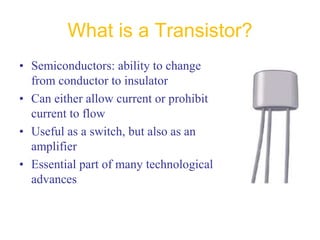
What is a Transistor?
• Semiconductors: ability to change
from conductor to insulator
• Can either allow current or prohibit
current to flow
• Useful as a switch, but also as an
amplifier
• Essential part of many technological
advances
A Brief History
• Guglielmo Marconi invents radio in 1895
• Problem: For long distance travel, signal must
be amplified
• Lee De Forest improves on Fleming’s original
vacuum tube to amplify signals
• Made use of third electrode
• Too bulky for most applications
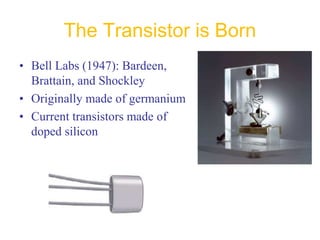
The Transistor is Born
• Bell Labs (1947): Bardeen,
Brattain, and Shockley
• Originally made of germanium
• Current transistors made of
doped silicon
How Transistors Work
• Doping: adding small amounts of other
elements to create additional protons or
electrons
• P-Type: dopants lack a fourth valence electron
(Boron, Aluminum)
• N-Type: dopants have an additional (5th)
valence electron (Phosphorus, Arsenic)
• Importance: Current only flows from P to N
Diodes and Bias
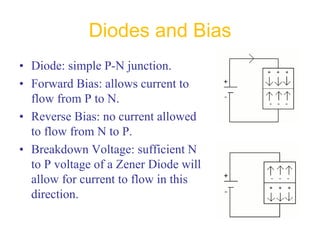
• Diode: simple P-N junction.
• Forward Bias: allows current to
flow from P to N.
• Reverse Bias: no current allowed
to flow from N to P.
• Breakdown Voltage: sufficient N
to P voltage of a Zener Diode will
allow for current to flow in this
direction.
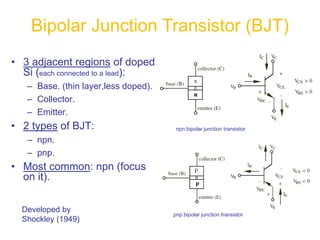
• 3 adjacent regions of doped
Si (each connected to a lead):
– Base. (thin layer,less doped).
– Collector.
– Emitter.
• 2 types of BJT:
– npn.
– pnp.
• Most common: npn (focus
on it).
Bipolar Junction Transistor (BJT)
npn bipolar junction transistor
pnp bipolar junction transistor
Developed by
Shockley (1949)
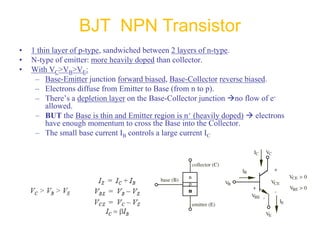
• 1 thin layer of p-type, sandwiched between 2 layers of n-type.
• N-type of emitter: more heavily doped than collector.
• With VC>VB>VE:
– Base-Emitter junction forward biased, Base-Collector reverse biased.
– Electrons diffuse from Emitter to Base (from n to p).
– There’s a depletion layer on the Base-Collector junction no flow of e-
allowed.
– BUT the Base is thin and Emitter region is n+ (heavily doped)  electrons
have enough momentum to cross the Base into the Collector.
– The small base current IB controls a large current IC
BJT NPN Transistor
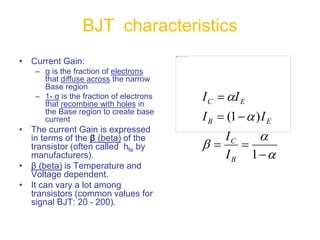
• Current Gain:
– α is the fraction of electrons
that diffuse across the narrow
Base region
– 1- α is the fraction of electrons
that recombine with holes in
the Base region to create base
current
• The current Gain is expressed
in terms of the β (beta) of the
transistor (often called hfe by
manufacturers).
• β (beta) is Temperature and
Voltage dependent.
• It can vary a lot among
transistors (common values for
signal BJT: 20 - 200).
BJT characteristics











1
)
1
(
B
C
E
B
E
C
I
I
I
I
I
I
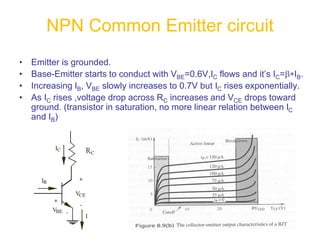
• Emitter is grounded.
• Base-Emitter starts to conduct with VBE=0.6V,IC flows and it’s IC=*IB.
• Increasing IB, VBE slowly increases to 0.7V but IC rises exponentially.
• As IC rises ,voltage drop across RC increases and VCE drops toward
ground. (transistor in saturation, no more linear relation between IC
and IB)
NPN Common Emitter circuit
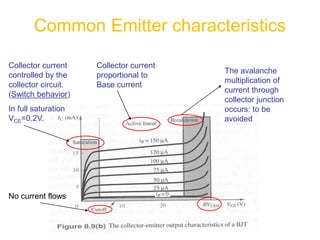
Common Emitter characteristics
No current flows
Collector current
controlled by the
collector circuit.
(Switch behavior)
In full saturation
VCE=0.2V.
Collector current
proportional to
Base current
The avalanche
multiplication of
current through
collector junction
occurs: to be
avoided
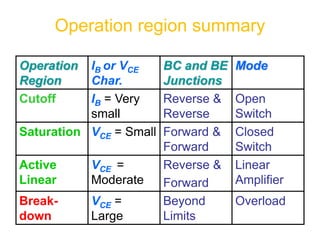
Operation
Region
IB or VCE
Char.
BC and BE
Junctions
Mode
Cutoff IB = Very
small
Reverse &
Reverse
Open
Switch
Saturation VCE = Small Forward &
Forward
Closed
Switch
Active
Linear
VCE =
Moderate
Reverse &
Forward
Linear
Amplifier
Break-
down
VCE =
Large
Beyond
Limits
Overload
Operation region summary
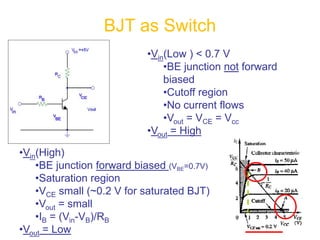
BJT as Switch
•Vin(Low ) < 0.7 V
•BE junction not forward
biased
•Cutoff region
•No current flows
•Vout = VCE = Vcc
•Vout = High
•Vin(High)
•BE junction forward biased (VBE=0.7V)
•Saturation region
•VCE small (~0.2 V for saturated BJT)
•Vout = small
•IB = (Vin-VB)/RB
•Vout = Low
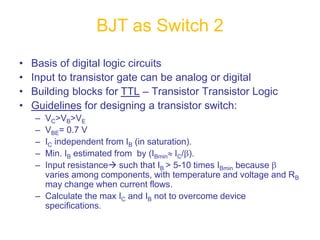
• Basis of digital logic circuits
• Input to transistor gate can be analog or digital
• Building blocks for TTL – Transistor Transistor Logic
• Guidelines for designing a transistor switch:
– VC>VB>VE
– VBE= 0.7 V
– IC independent from IB (in saturation).
– Min. IB estimated from by (IBminIC/).
– Input resistance such that IB > 5-10 times IBmin because 
varies among components, with temperature and voltage and RB
may change when current flows.
– Calculate the max IC and IB not to overcome device
specifications.
BJT as Switch 2
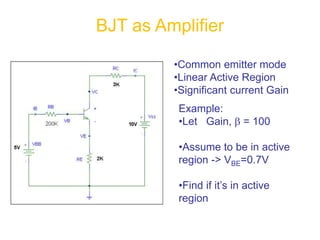
•Common emitter mode
•Linear Active Region
•Significant current Gain
Example:
•Let Gain,  = 100
•Assume to be in active
region -> VBE=0.7V
•Find if it’s in active
region
BJT as Amplifier
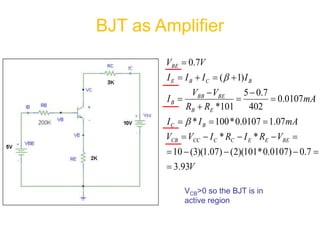
BJT as Amplifier
V
V
R
I
R
I
V
V
mA
I
I
mA
R
R
V
V
I
I
I
I
I
V
V
BE
E
E
C
C
CC
CB
B
C
E
B
BE
BB
B
B
C
B
E
BE
93
.
3
7
.
0
)
0107
.
0
*
101
)(
2
(
)
07
.
1
)(
3
(
10
*
*
07
.
1
0107
.
0
*
100
*
0107
.
0
402
7
.
0
5
101
*
)
1
(
7
.
0



























VCB>0 so the BJT is in
active region
References
• www.lucent.com
• http://transistors.globalspec.com
• http://www.kpsec.freeuk.com
• www.Howstuffworks.com
• www.allaboutcircuits.com
Thank u

Transistor history, working and principles

  • 1.
  • 2.
    Lecture Overview • Whatis a Transistor? • History • Types • Characteristics • Applications
  • 3.
    What is aTransistor? • Semiconductors: ability to change from conductor to insulator • Can either allow current or prohibit current to flow • Useful as a switch, but also as an amplifier • Essential part of many technological advances
  • 4.
    A Brief History •Guglielmo Marconi invents radio in 1895 • Problem: For long distance travel, signal must be amplified • Lee De Forest improves on Fleming’s original vacuum tube to amplify signals • Made use of third electrode • Too bulky for most applications
  • 5.
    The Transistor isBorn • Bell Labs (1947): Bardeen, Brattain, and Shockley • Originally made of germanium • Current transistors made of doped silicon
  • 6.
    How Transistors Work •Doping: adding small amounts of other elements to create additional protons or electrons • P-Type: dopants lack a fourth valence electron (Boron, Aluminum) • N-Type: dopants have an additional (5th) valence electron (Phosphorus, Arsenic) • Importance: Current only flows from P to N
  • 7.
    Diodes and Bias •Diode: simple P-N junction. • Forward Bias: allows current to flow from P to N. • Reverse Bias: no current allowed to flow from N to P. • Breakdown Voltage: sufficient N to P voltage of a Zener Diode will allow for current to flow in this direction.
  • 8.
    • 3 adjacentregions of doped Si (each connected to a lead): – Base. (thin layer,less doped). – Collector. – Emitter. • 2 types of BJT: – npn. – pnp. • Most common: npn (focus on it). Bipolar Junction Transistor (BJT) npn bipolar junction transistor pnp bipolar junction transistor Developed by Shockley (1949)
  • 9.
    • 1 thinlayer of p-type, sandwiched between 2 layers of n-type. • N-type of emitter: more heavily doped than collector. • With VC>VB>VE: – Base-Emitter junction forward biased, Base-Collector reverse biased. – Electrons diffuse from Emitter to Base (from n to p). – There’s a depletion layer on the Base-Collector junction no flow of e- allowed. – BUT the Base is thin and Emitter region is n+ (heavily doped)  electrons have enough momentum to cross the Base into the Collector. – The small base current IB controls a large current IC BJT NPN Transistor
  • 10.
    • Current Gain: –α is the fraction of electrons that diffuse across the narrow Base region – 1- α is the fraction of electrons that recombine with holes in the Base region to create base current • The current Gain is expressed in terms of the β (beta) of the transistor (often called hfe by manufacturers). • β (beta) is Temperature and Voltage dependent. • It can vary a lot among transistors (common values for signal BJT: 20 - 200). BJT characteristics            1 ) 1 ( B C E B E C I I I I I I
  • 11.
    • Emitter isgrounded. • Base-Emitter starts to conduct with VBE=0.6V,IC flows and it’s IC=*IB. • Increasing IB, VBE slowly increases to 0.7V but IC rises exponentially. • As IC rises ,voltage drop across RC increases and VCE drops toward ground. (transistor in saturation, no more linear relation between IC and IB) NPN Common Emitter circuit
  • 12.
    Common Emitter characteristics Nocurrent flows Collector current controlled by the collector circuit. (Switch behavior) In full saturation VCE=0.2V. Collector current proportional to Base current The avalanche multiplication of current through collector junction occurs: to be avoided
  • 13.
    Operation Region IB or VCE Char. BCand BE Junctions Mode Cutoff IB = Very small Reverse & Reverse Open Switch Saturation VCE = Small Forward & Forward Closed Switch Active Linear VCE = Moderate Reverse & Forward Linear Amplifier Break- down VCE = Large Beyond Limits Overload Operation region summary
  • 14.
    BJT as Switch •Vin(Low) < 0.7 V •BE junction not forward biased •Cutoff region •No current flows •Vout = VCE = Vcc •Vout = High •Vin(High) •BE junction forward biased (VBE=0.7V) •Saturation region •VCE small (~0.2 V for saturated BJT) •Vout = small •IB = (Vin-VB)/RB •Vout = Low
  • 15.
    • Basis ofdigital logic circuits • Input to transistor gate can be analog or digital • Building blocks for TTL – Transistor Transistor Logic • Guidelines for designing a transistor switch: – VC>VB>VE – VBE= 0.7 V – IC independent from IB (in saturation). – Min. IB estimated from by (IBminIC/). – Input resistance such that IB > 5-10 times IBmin because  varies among components, with temperature and voltage and RB may change when current flows. – Calculate the max IC and IB not to overcome device specifications. BJT as Switch 2
  • 16.
    •Common emitter mode •LinearActive Region •Significant current Gain Example: •Let Gain,  = 100 •Assume to be in active region -> VBE=0.7V •Find if it’s in active region BJT as Amplifier
  • 17.
  • 18.
    References • www.lucent.com • http://transistors.globalspec.com •http://www.kpsec.freeuk.com • www.Howstuffworks.com • www.allaboutcircuits.com Thank u