

TRANSFORMING INDIA


   By Empowerment of the people of India through
                                              g
       relevant Education & Vocational Training
   Prof. Pawan Gupta‐ Educational & Management
Consultants 9372404408(M) pawan@SoftTech‐Engr.com1
EDUCATION
• A process of teaching, training and learning
                teaching                learning,
  especially in schools or colleges, to improve
  knowledge and d l skills
  k    l d       d develop kill
• Technical sense education is the process by
  which society deliberately transmits its
  accumulated k
         l t d knowledge, skills and values
                     l d      kill  d    l
  from one generation to another

                   WWW.eLearning-SoftTech.com       2
Purpose of Education
1.   The need for more knowledge / learning
2.
2    How will it benefit me & my Family?
3.   Can I start my own business?
4.
4    How t do
     H to d something b tt / f t ?
                      thi better faster?
5.   The need for benchmarking & improving
6.
6    The
     Th urge & need to b
                     d become W ld Cl
                                    World Class
7.   To excel in any particular field of activity
8.   To reduce growth rate of population
          d           h       f       l


                       WWW.eLearning-SoftTech.com   3
Contd…..

8. To reduce Law & Order problems
                          problems`
9. To reduce the incidence of AIDS
10.To improve SECURITY within INDIA
10 T i                    ithi
11.To improve personal hygiene
12.To improve general health and reduce disease
13.To improve productivity
14.To reduce pollution & improve environment
15.Find
15 Fi d new ways t solve old problems
                  to l      ld   bl
                 WWW.eLearning-SoftTech.com   4
VOCATIONAL EDUCATION & TRAINING


It s
It’s any formal post‐compulsory education that develops
         formal, post compulsory
knowledge, skills and attributes linked to particular forms of
employment,
employment although in some interpretations this would
exclude professional education
VET i di tl li k d t employment generation
    is directly linked to l   t       ti
It’s related to employment and income generation
In developed countries nearly 70% to 95% of the work force
is vocationally trained

                      WWW.eLearning-SoftTech.com             5
Contd..
• In developed countries the total expenditure
  towards Innovation, R&D, VET and Education
  is inching towards 12% of GDP


                 WWW.eLearning-SoftTech.com      6
FOCUS AREAS
• Education
• Governance
• Economy
• Employment generation
     p y     g

          WWW.eLearning-SoftTech.com   7
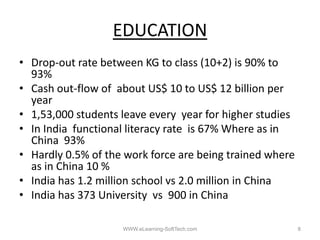
EDUCATION
• Drop‐out rate between KG to class (10+2) is 90% to
  93%
• Cash out‐flow of about US$ 10 to US$ 12 billion per
  year
• 1,53,000 students leave every year for higher studies
• In India functional literacy rate is 67% Where as in
  China
  Chi 93%
• Hardly 0.5% of the work force are being trained where
  as in China 10 %
• India has 1.2 million school vs 2.0 million in China
• India has 373 University vs 900 in China

                    WWW.eLearning-SoftTech.com            8
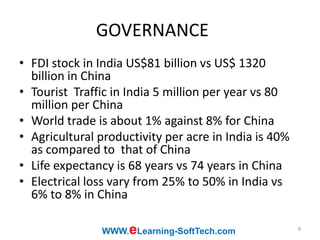
GOVERNANCE
• FDI stock in India US$81 billion vs US$ 1320
                         $                $
  billion in China
• Tourist Traffic in India 5 million per year vs 80
  million per China
• World trade is about 1% against 8% for China
• Agricultural productivity per acre in India is 40%
  as compared to that of China
• Life expectancy is 68 years vs 74 years in China
         p        y       y           y
• Electrical loss vary from 25% to 50% in India vs
  6% to 8% in China

                     e
               WWW. Learning-SoftTech.com              9
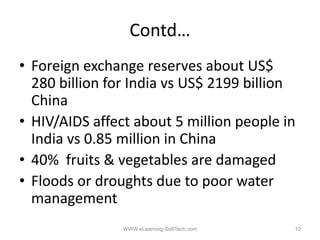
Contd…
• Foreign exchange reserves about US$
  280 billion for India vs US$ 2199 billion
  China
• HIV/AIDS affect about 5 million people in
  India vs 0 85 million in China
           0.85
• 40% fruits & vegetables are damaged
• Floods or droughts due to poor water
  management
        g
                WWW.eLearning-SoftTech.com   10
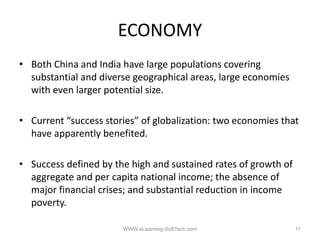
ECONOMY
• Both China and India have large populations covering
                                g p p                  g
  substantial and diverse geographical areas, large economies
  with even larger potential size.

• Current “success stories” of globalization: two economies that
  have apparently benefited.
        pp      y

• Success defined by the high and sustained rates of growth of
  aggregate and per capita national income; the absence of
  major financial crises; and substantial reduction in income
  poverty.

                       WWW.eLearning-SoftTech.com                11
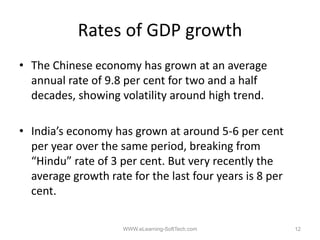
Rates of GDP growth
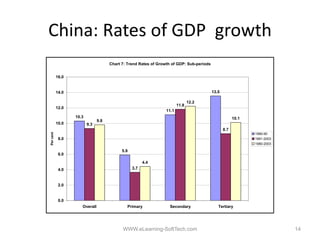
• The Chinese economy has grown at an average
  annual rate of 9.8 per cent for two and a half
  decades, showing volatility around high trend.

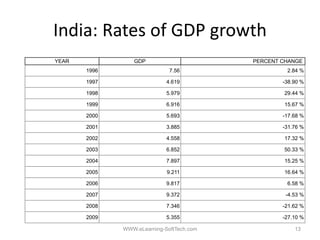
• India’s economy has grown at around 5‐6 per cent
                 y     g                    p
  per year over the same period, breaking from
  “Hindu” rate of 3 per cent. But very recently the
  average growth rate f the l f
                h      for h last four years is 8 per
  cent.

                    WWW.eLearning-SoftTech.com          12
India: Rates of GDP growth
YEAR             GDP                       PERCENT CHANGE
       1996                   7.56
                                 6                  2.84
                                                    2 84 %

       1997                  4.619                 -38.90 %

       1998                  5.979                 29.44 %

       1999                  6.916
                             6 916                 15.67
                                                   15 67 %

       2000                  5.693                 -17.68 %

       2001                  3.885                 -31.76 %

       2002                  4.558
                             4 558                 17.32
                                                   17 32 %

       2003                  6.852                 50.33 %

       2004                  7.897                 15.25 %

       2005                  9.211
                             9 211                 16.64
                                                   16 64 %

       2006                  9.817                  6.58 %

       2007                  9.372                  -4.53 %

       2008                  7.346
                             7 346                 -21.62 %
                                                    21 62

       2009                  5.355                 -27.10 %

              WWW.eLearning-SoftTech.com               13
China: Rates of GDP growth
                                     Chart 7: Trend Rates of Growth of GDP: Sub-periods


           16.0


           14.0                                                                           13.5

                                                                               12.2
                                                                               12 2
                                                                        11.8
           12.0
                                                                 11.1
                  10.3                                                                                 10.1
                               9.8
           10.0          9.3
                                                                                                 8.7
                                                                                                              1980-90
Per cent


            8.0                                                                                               1991-2003
                                                                                                              1980-2003

                                           5.9
            6.0

                                                       4.4
            4.0                                  3.7


            2.0


            0.0
                     Overall
                     O    ll                 Primary
                                             Pi                   Secondary
                                                                  S    d                     Tertiary
                                                                                             T ti


                                           WWW.eLearning-SoftTech.com                                                     14
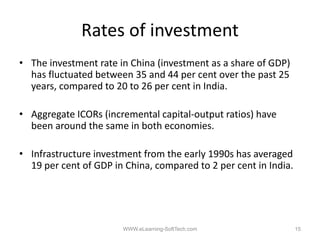
Rates of investment
• The investment rate in China (investment as a share of GDP)
  has fluctuated between 35 and 44 per cent over the past 25
  years, compared to 20 to 26 per cent in India.

• Aggregate ICORs (incremental capital‐output ratios) have
  been around the same in both economies.

• Infrastructure investment from the early 1990s has averaged
  19 per cent of GDP in China, compared to 2 per cent in India.


                       WWW.eLearning-SoftTech.com                 15
Role of FDI in China
• Argued that China can afford to have such a high investment
  rate because it has attracted so much foreign direct
  investment (FDI)
• But FDI has accounted for only 3‐5 per cent of GDP in China
                                  35
  since 1990, and at its peak was 8 per cent. In the period after
  2000, FDI was only 6 per cent of domestic investment
• Recent inflows of capital have not added to the domestic
  investment rate at all, macro economically speaking, but have
  led to the further accumulation of international reserves, now
  increasing by more than $120 billion per year
                                           year.


                        WWW.eLearning-SoftTech.com             16
Employment Generation
• India has 300 million registered unemployed
  in the age group of 18 to 50 years
• Avg. age of India is 25 years compared to
  Chinese is 34 years
• India spends 0.1% of its GDP where as china
  spends 2.5% of its GDP on VET (Vocational
  Education & Training)
• VET will create one of the biggest pool of
  young

                 WWW.eLearning-SoftTech.com     17
Vision 2020 – the Building Blocks
1.
1 Good Governance & Effective
   Administration
2.
2 100% P iPrimary Lit
                  Literacy
3. Vocational Education & Training, VET
4. SME’s (Small & Medium Enterprises,
   93% of Indians work here) )
5. Exports & Tourism

             WWW.eLearning-SoftTech.com   18
Planning for the Youth of INDIA

1. Emphasis on 100% Primary Literacy
       p                     y       y
2. Empowerment of the Female Child
3. Entrepreneurial Skill Development (ESD) from
         p                     p
   Primary Stages
4. Vocational Education & Training (VET) to start at
   the
   th earliest stages, b d on lik and preferences
           li t t      based    likes d     f
5. Emphasis on ESD & VET rather than the present
   college system


                   WWW.eLearning-SoftTech.com          19
WHY eLearning
• Providing access to a range of resources and materials
  which may not otherwise be available or accessible for
                                            accessible,
  example graphics, sound, animation, multimedia
• Giving control to students over when and where they
  study & allowing students to study at their own pace
     d      ll i       d          d      h i
• providing a student centred learning environment
  which can be tailored to meet the learning needs of
                                            g
  individual students
• providing frequent and timely individual feedback, for
  example through computer assisted assessment and
                                      assessment,
  positive reinforcement


                    WWW.eLearning-SoftTech.com        20
CONCLUSIONS

• Realization has already started
• Synergy are visible
• All performers eager to move to
  next steps
           p


              WWW.eLearning-SoftTech.com   21
WWW.eLearning-SoftTech.com   22
NEED SOLUTIONS
Problem Facing:
• Lack of Preparedness
• Attrition & Impatience
• Limited Computer Skills
• I f
  Information R t i l & A
           ti Retrieval Assessment
                                 t


               WWW.eLearning-SoftTech.com   23
Possibilities Influencing Education by 2030
•   National programs f i
    N i      l         for improving collective i lli
                                   i   ll i intelligence
•   Just –in‐time knowledge and learning
•   Individualized education
•   Use of simulations
•   Continuous evaluation of individual learning processes
    designed to prevent people from growing unstable or
    becoming mentally ill.
•   Improved individual nutrition
•   Genetically increased intelligence
•   Use f l b l li
    U of global online simulations as a primary social
                          i l ti           i         i l
    science research tool
•   Use of public communications to reinforce pursuit of
    knowledge
                       WWW.eLearning-SoftTech.com        24
Continued…
• P t bl artificial i t lli
  Portable tifi i l intelligence d i
                                  devices
• Complete mapping of human synapses to discover
  how learning occurs and thereby develop strategies
  for improvement of learning
• Means for keeping adult brains healthier for longer
  periods
        d
• Chemistry for brain enhancement
• W b 17.0
  Web 17 0
• Integrated life long learning systems
• Programs aimed at eliminating prejudice and hate
• E‐Teaching
• Smarter than human computers
• Artificial microbes enhance intelligence.
                    WWW.eLearning-SoftTech.com     25

Transforming india voc edu

  • 1.
    TRANSFORMING INDIA By Empowerment of the people of India through g relevant Education & Vocational Training Prof. Pawan Gupta‐ Educational & Management Consultants 9372404408(M) pawan@SoftTech‐Engr.com1
  • 2.
    EDUCATION • A processof teaching, training and learning teaching learning, especially in schools or colleges, to improve knowledge and d l skills k l d d develop kill • Technical sense education is the process by which society deliberately transmits its accumulated k l t d knowledge, skills and values l d kill d l from one generation to another WWW.eLearning-SoftTech.com 2
  • 3.
    Purpose of Education 1. The need for more knowledge / learning 2. 2 How will it benefit me & my Family? 3. Can I start my own business? 4. 4 How t do H to d something b tt / f t ? thi better faster? 5. The need for benchmarking & improving 6. 6 The Th urge & need to b d become W ld Cl World Class 7. To excel in any particular field of activity 8. To reduce growth rate of population d h f l WWW.eLearning-SoftTech.com 3
  • 4.
    Contd….. 8. To reduceLaw & Order problems problems` 9. To reduce the incidence of AIDS 10.To improve SECURITY within INDIA 10 T i ithi 11.To improve personal hygiene 12.To improve general health and reduce disease 13.To improve productivity 14.To reduce pollution & improve environment 15.Find 15 Fi d new ways t solve old problems to l ld bl WWW.eLearning-SoftTech.com 4
  • 5.
    VOCATIONAL EDUCATION &TRAINING It s It’s any formal post‐compulsory education that develops formal, post compulsory knowledge, skills and attributes linked to particular forms of employment, employment although in some interpretations this would exclude professional education VET i di tl li k d t employment generation is directly linked to l t ti It’s related to employment and income generation In developed countries nearly 70% to 95% of the work force is vocationally trained WWW.eLearning-SoftTech.com 5
  • 6.
    Contd.. • In developedcountries the total expenditure towards Innovation, R&D, VET and Education is inching towards 12% of GDP WWW.eLearning-SoftTech.com 6
  • 7.
    FOCUS AREAS • Education •Governance • Economy • Employment generation p y g WWW.eLearning-SoftTech.com 7
  • 8.
    EDUCATION • Drop‐out ratebetween KG to class (10+2) is 90% to 93% • Cash out‐flow of about US$ 10 to US$ 12 billion per year • 1,53,000 students leave every year for higher studies • In India functional literacy rate is 67% Where as in China Chi 93% • Hardly 0.5% of the work force are being trained where as in China 10 % • India has 1.2 million school vs 2.0 million in China • India has 373 University vs 900 in China WWW.eLearning-SoftTech.com 8
  • 9.
    GOVERNANCE • FDI stockin India US$81 billion vs US$ 1320 $ $ billion in China • Tourist Traffic in India 5 million per year vs 80 million per China • World trade is about 1% against 8% for China • Agricultural productivity per acre in India is 40% as compared to that of China • Life expectancy is 68 years vs 74 years in China p y y y • Electrical loss vary from 25% to 50% in India vs 6% to 8% in China e WWW. Learning-SoftTech.com 9
  • 10.
    Contd… • Foreign exchangereserves about US$ 280 billion for India vs US$ 2199 billion China • HIV/AIDS affect about 5 million people in India vs 0 85 million in China 0.85 • 40% fruits & vegetables are damaged • Floods or droughts due to poor water management g WWW.eLearning-SoftTech.com 10
  • 11.
    ECONOMY • Both Chinaand India have large populations covering g p p g substantial and diverse geographical areas, large economies with even larger potential size. • Current “success stories” of globalization: two economies that have apparently benefited. pp y • Success defined by the high and sustained rates of growth of aggregate and per capita national income; the absence of major financial crises; and substantial reduction in income poverty. WWW.eLearning-SoftTech.com 11
  • 12.
    Rates of GDPgrowth • The Chinese economy has grown at an average annual rate of 9.8 per cent for two and a half decades, showing volatility around high trend. • India’s economy has grown at around 5‐6 per cent y g p per year over the same period, breaking from “Hindu” rate of 3 per cent. But very recently the average growth rate f the l f h for h last four years is 8 per cent. WWW.eLearning-SoftTech.com 12
  • 13.
    India: Rates ofGDP growth YEAR GDP PERCENT CHANGE 1996 7.56 6 2.84 2 84 % 1997 4.619 -38.90 % 1998 5.979 29.44 % 1999 6.916 6 916 15.67 15 67 % 2000 5.693 -17.68 % 2001 3.885 -31.76 % 2002 4.558 4 558 17.32 17 32 % 2003 6.852 50.33 % 2004 7.897 15.25 % 2005 9.211 9 211 16.64 16 64 % 2006 9.817 6.58 % 2007 9.372 -4.53 % 2008 7.346 7 346 -21.62 % 21 62 2009 5.355 -27.10 % WWW.eLearning-SoftTech.com 13
  • 14.
    China: Rates ofGDP growth Chart 7: Trend Rates of Growth of GDP: Sub-periods 16.0 14.0 13.5 12.2 12 2 11.8 12.0 11.1 10.3 10.1 9.8 10.0 9.3 8.7 1980-90 Per cent 8.0 1991-2003 1980-2003 5.9 6.0 4.4 4.0 3.7 2.0 0.0 Overall O ll Primary Pi Secondary S d Tertiary T ti WWW.eLearning-SoftTech.com 14
  • 15.
    Rates of investment •The investment rate in China (investment as a share of GDP) has fluctuated between 35 and 44 per cent over the past 25 years, compared to 20 to 26 per cent in India. • Aggregate ICORs (incremental capital‐output ratios) have been around the same in both economies. • Infrastructure investment from the early 1990s has averaged 19 per cent of GDP in China, compared to 2 per cent in India. WWW.eLearning-SoftTech.com 15
  • 16.
    Role of FDIin China • Argued that China can afford to have such a high investment rate because it has attracted so much foreign direct investment (FDI) • But FDI has accounted for only 3‐5 per cent of GDP in China 35 since 1990, and at its peak was 8 per cent. In the period after 2000, FDI was only 6 per cent of domestic investment • Recent inflows of capital have not added to the domestic investment rate at all, macro economically speaking, but have led to the further accumulation of international reserves, now increasing by more than $120 billion per year year. WWW.eLearning-SoftTech.com 16
  • 17.
    Employment Generation • Indiahas 300 million registered unemployed in the age group of 18 to 50 years • Avg. age of India is 25 years compared to Chinese is 34 years • India spends 0.1% of its GDP where as china spends 2.5% of its GDP on VET (Vocational Education & Training) • VET will create one of the biggest pool of young WWW.eLearning-SoftTech.com 17
  • 18.
    Vision 2020 –the Building Blocks 1. 1 Good Governance & Effective Administration 2. 2 100% P iPrimary Lit Literacy 3. Vocational Education & Training, VET 4. SME’s (Small & Medium Enterprises, 93% of Indians work here) ) 5. Exports & Tourism WWW.eLearning-SoftTech.com 18
  • 19.
    Planning for theYouth of INDIA 1. Emphasis on 100% Primary Literacy p y y 2. Empowerment of the Female Child 3. Entrepreneurial Skill Development (ESD) from p p Primary Stages 4. Vocational Education & Training (VET) to start at the th earliest stages, b d on lik and preferences li t t based likes d f 5. Emphasis on ESD & VET rather than the present college system WWW.eLearning-SoftTech.com 19
  • 20.
    WHY eLearning • Providingaccess to a range of resources and materials which may not otherwise be available or accessible for accessible, example graphics, sound, animation, multimedia • Giving control to students over when and where they study & allowing students to study at their own pace d ll i d d h i • providing a student centred learning environment which can be tailored to meet the learning needs of g individual students • providing frequent and timely individual feedback, for example through computer assisted assessment and assessment, positive reinforcement WWW.eLearning-SoftTech.com 20
  • 21.
    CONCLUSIONS • Realization hasalready started • Synergy are visible • All performers eager to move to next steps p WWW.eLearning-SoftTech.com 21
  • 22.
  • 23.
    NEED SOLUTIONS Problem Facing: •Lack of Preparedness • Attrition & Impatience • Limited Computer Skills • I f Information R t i l & A ti Retrieval Assessment t WWW.eLearning-SoftTech.com 23
  • 24.
    Possibilities Influencing Educationby 2030 • National programs f i N i l for improving collective i lli i ll i intelligence • Just –in‐time knowledge and learning • Individualized education • Use of simulations • Continuous evaluation of individual learning processes designed to prevent people from growing unstable or becoming mentally ill. • Improved individual nutrition • Genetically increased intelligence • Use f l b l li U of global online simulations as a primary social i l ti i i l science research tool • Use of public communications to reinforce pursuit of knowledge WWW.eLearning-SoftTech.com 24
  • 25.
    Continued… • P tbl artificial i t lli Portable tifi i l intelligence d i devices • Complete mapping of human synapses to discover how learning occurs and thereby develop strategies for improvement of learning • Means for keeping adult brains healthier for longer periods d • Chemistry for brain enhancement • W b 17.0 Web 17 0 • Integrated life long learning systems • Programs aimed at eliminating prejudice and hate • E‐Teaching • Smarter than human computers • Artificial microbes enhance intelligence. WWW.eLearning-SoftTech.com 25