City College Norwich
Transforming Education
      in Norfolk
“
 My whole world
  has changed as
   a result of this
    project. We’re
doing something       Dick Palmer
that is reshaping
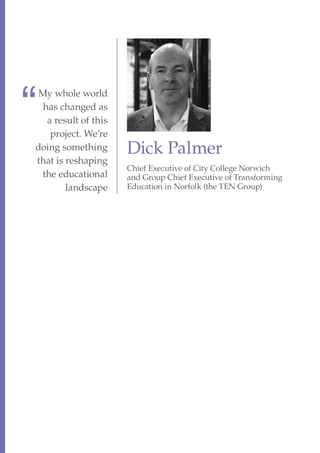
                      Chief Executive of City College Norwich
  the educational     and Group Chief Executive of Transforming
        landscape     Education in Norfolk (the TEN Group)
Introduction


When Dick Palmer and his team decided to look at improving quality and cutting costs by sharing
back-office services with other institutions, they didn’t tinker at the edges. Their vision was simple in
essence, though challenging in practice. The main aim was to remove from curriculum teams anything
that could distract them from the central job of crafting high-quality teaching and learning experiences.
So everything that wasn’t teaching and learning had to go – somewhere else!


Vision


Looking back over his journey, Dick Palmer is quick to point out that their eventual ideas for achieving
these ambitions were very different from those at the outset. Their challenging and extensive journey
has produced a new paradigm for education, certainly in Norfolk, and quite possibly for the rest of
country.


The journey


The journey began                   The College (as lead sponsor of the new Academy) helped the
back in 2009 when the               school remove all non-core distractions and provided it with the
College looked at taking            sort of back-office expertise available only to larger organisations.
                                    This approach helped Dick Palmer and his team extrapolate a
over a failing school. At
                                    vision of a distraction-free environment for all their curriculum
the time, just 6% of the            staff, not just those in the school. And if this could work for two
school’s pupils achieved            organisations, then why not three.. or four..?
five GCSE passes at A –
C, making it the fourth             As this vision for a new paradigm began to take shape, with the
worst in England. Earlham           College at the head of the structure and a number of schools below,
High School was to                  so the plans started by Government in 2005 to open up the sector
become City Academy                 to competition were being realised in the new ‘freedoms and
Norwich and leave Local             flexibilities’.
Authority control. With
that reformation came               Long-term plans then began to take shape for the eventual addition
the opportunity to choose           of another school – Wayland Academy Norfolk – and a new
                                    University Technical College (UTC) in 2014 – Norfolk University
from whom it bought its
                                    Technical College. Again, both of these would be structured
back-office services: from a        around the central shared services company. When new grant
commercial private sector           money became available from the Skills Funding Agency (SFA), the
provider, back with the             timescale for the project quickly reduced.
Local Authority, or from
another institution within          The added benefit for the Further Education (FE) sector of City
the public education sector         College Norwich using grant funding for the development of its
– namely the College.               business model and implementation plan was the whole sector
                                    would then have unrestricted access to the model, the legal advice,
                                    and the all-important lessons learned.
Shared Services model and legal structure


“It’s been quite a fraught     The final vision, was sculpted by the needs of staff, the aspirations
journey, to be honest”,        of the partners and, most importantly, the legal demands of key
admits Dick. “We started       stakeholders. By September 2012, the Instruments and Articles of
off with a very different      the College and the Articles of Association of the academies were
model to the one we’ve         amended. The new education federation, Transforming Education
                               in Norfolk (the TEN Group) was formed – the TEN Group being
ended up with”, originally
                               created as an educational charity. To hear more from Dick Palmer
having “the College at         you can view the film produced by the Association of Colleges
the top and the schools        (AoC) on the shared services section of the AoC website: (www.aoc.
underneath”. There             co.uk/shared-services/materials/gf-videos)
was concern from some
quarters that the College
was putting itself into a      Dick Palmer reflects “being nimble and willing to adapt”, as
position of regional control   the options and restrictions buffeted their ideas, was essential.
– a takeover rather than a     Original plans to move academic staff over to the new federation
partnership.                   were frustrated by the rules surrounding the Teachers’ Pension
                               Scheme. Next was the issue of the 300 business support staff who
                               were prevented from being transferred directly into the new shared
                               services company (Norfolk Educational Services Ltd (NES)). Dick
                               Palmer states “The Local Government Pension Scheme (LGPS)
                               didn’t recognise our new charitable organisation as ‘having any
                               history or credibility’”. Each hurdle eventually shaped the final
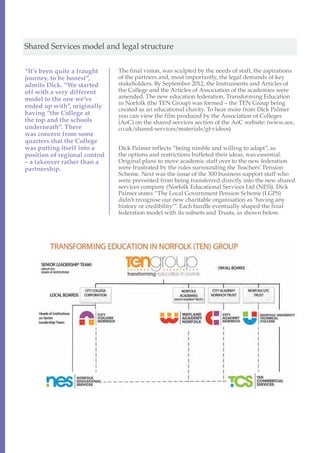
                               federation model with its subsets and Trusts, as shown below.
Norfolk Educational Services Ltd (NES) is wholly owned by the member organisations. This new
company now provides all services for all partners that are not front-line teaching and learning.
Unusually, NES is a company limited by shares rather than by guarantee; going against the trend
of many other new FE shared service companies. The two shareholders are the TEN Group (the
overarching group) and City College Norwich. The only
reason the College is a shareholder is due to the reluctance of the LGPS to recognise the new charitable
organisation.

The group decided on the ‘limited by shares’ option rather than ‘limited by guarantee with charitable
status’ as it gives them certain options in the near future. These include the ability to raise investment
and make profits. These profits, or surpluses as Dick Palmer prefers, will be donated to the individual
member organisations using the charities rules and, therefore, will not be subject to corporation tax –
keeping more money for front-line services.

The cost of the legal advice to navigate the many regulations and develop the model was considerable,
but this is now being made available to the whole sector so that other providers can short-circuit
the development process if they choose to develop their own regional federations. Full details
can be found at this link on AoC’s website. (www.aoc.co.uk/shared-services/citycollegenorwich-
federationdevelopment)


Leadership, culture and process

Managing business-as-                Finally, all members of staff needed to have their voices heard
usual, while creating                so that the project could take everyone along, and ultimately be
the new vision and                   successful. “You have to manage the staff engagement regularly
structure was something              – you can’t do it with one roadshow and an email.” Dick Palmer
of a challenge; one                  met with every member of staff from all partner organisations.
                                     He listened to the objections and engaged with their views, using
which began with
                                     these to shape the project and help it, and the staff, move forward
the governing Board.                 together.
Governors had to give
away their responsibility            They developed a new suite of processes, including finance
for governing the College            systems, HR systems and work-flow systems, by process-mapping
when they agreed to the              and re-engineering their existing routines. This was then used to
formation of the over-               define the aspiration for a ‘third way’ that would meet all partners’
arching federation. Once             needs.
they had whole-heartedly
bought into the idea, the
next challenge was the
senior team. “They have
to walk it and talk it and
smell it and drink it”,
states Dick Palmer.
Involving a private training provider

The rules surrounding the VAT cost-sharing exception and competitions law mean that private training
providers cannot be part of a shared service company as they are subject to VAT, and their involvement
would unfairly distort commercial competition. It was therefore a surprise to hear that the partnership
wanted to include such a company in the TEN Group. However, Dick Palmer was quick to point out
that while the company is classified as a private training provider by the SFA, it is actually a not-for-
profit charitable organisation, and therefore does not fall foul of the regulations.


Outcomes for the project


Dick Palmer is clear that           A divisive issue, when looking at the progress of pupils from
the TEN group is a long             institution to institution, can be the over inflation of their
game, and that the best             ‘attainment’ as they leave one school followed by the deflation
                                    of attainment when they enter the next. Any such ‘massaging’ of
– improving outcomes
                                    value-added data is arguably an unfortunate side effect of league
for learners – is yet to            tables. The TEN Group, however, are all partners bound together,
come. Looking at the early          not just by the federation structure but by a common, single data
indicators, it’s clear to           system that focuses on learners’ success, rather than institution
see that the investment             success, from age five onwards.
in a considered and
coordinated education               Financially, the partners have already made savings on a range of
ladder from age five to 19          renegotiated contracts, including buildings insurance and catering.
has been worth it.                  As regards staffing, there have been very limited redundancies
                                    during this significant reorganisation. Dick Plamer is clear that this
                                    is due firstly to not replacing staff who have left, but also because
                                    the shared service processes they now operate are far more lean
                                    and efficient. Within the period of the project funding, the team
                                    estimate that they have already saved close to £1 million, and
                                    forecast a further £3.45 million over the next five years. Details of
                                    all the team’s strategies and approaches can be found on the shared
                                    services section of the AoC website: (www.aoc.co.uk/shared-
                                    services/CityCollegeNorwichfederationdevelopment )

                                    What can be said of the failing Earlham High School, now City
                                    Academy Norwich? In September 2011, Ofsted commented in its
                                    re-inspection report that: “Its improvement has been rapid.
                                    Students’ achievement is improving well and is good”. Indeed,
                                    the school’s overall effectiveness and capacity for sustained
                                    improvement was judged to be ‘good’. From special measures to an
                                    Ofsted “good” in just three years is impressive.
Outcomes for the Sector - Guide to Federation & Shared Services
Development

“There’s clearly a land-       The model is replicable and expandable. From 2014 it will include
grab going on with             the new Norfolk UTC, and could go on to include other FE
Academies”, states Dick        Colleges, Academies and Free Schools. Dick Palmer states “time
Palmer. “there are chains      will tell if it ends up achieving its end game - as an enabling,
                               transformational service”, but all of the signs so far are good.
and federations of schools
being established that         For the rest of the sector the benefit from the project is the
can buy services, and          development of a Guide to Federation & Shared Services
clearly the private sector     Development created by City College Norwich. The Guide is
is going to step into this     available for all Colleges to access and learn from, avaliable on
space very quickly.” Dick      the shared services section of the AoC website: (www.aoc.co.uk/
Palmer is happy with this      shared-services/citycollegenorwich-federationdevelopment)
competitive arena and
urges other Colleges and
schools to consider the
federation model, as its
unique selling point is that
all monies remain within
the public domain, rather
than being syphoned off
for commercial gain by
outsiders. “This is a huge
opportunity for the sector
to get involved.”


“     Time will tell if
it ends up achieving
       its end game -
      as an enabling,
    transformational
              service.
© Association of Colleges 2013
         2 - 5 Stedham Place, London WC1A 1HU
            Tel: 020 7034 9900 Fax: 020 7034 9950
Email: sharedservices@aoc.co.uk Website: www.aoc.co.uk
                         @info_AoC

Transforming Education in Norfolk

  • 1.
  • 2.
    “ My wholeworld has changed as a result of this project. We’re doing something Dick Palmer that is reshaping Chief Executive of City College Norwich the educational and Group Chief Executive of Transforming landscape Education in Norfolk (the TEN Group)
  • 3.
    Introduction When Dick Palmerand his team decided to look at improving quality and cutting costs by sharing back-office services with other institutions, they didn’t tinker at the edges. Their vision was simple in essence, though challenging in practice. The main aim was to remove from curriculum teams anything that could distract them from the central job of crafting high-quality teaching and learning experiences. So everything that wasn’t teaching and learning had to go – somewhere else! Vision Looking back over his journey, Dick Palmer is quick to point out that their eventual ideas for achieving these ambitions were very different from those at the outset. Their challenging and extensive journey has produced a new paradigm for education, certainly in Norfolk, and quite possibly for the rest of country. The journey The journey began The College (as lead sponsor of the new Academy) helped the back in 2009 when the school remove all non-core distractions and provided it with the College looked at taking sort of back-office expertise available only to larger organisations. This approach helped Dick Palmer and his team extrapolate a over a failing school. At vision of a distraction-free environment for all their curriculum the time, just 6% of the staff, not just those in the school. And if this could work for two school’s pupils achieved organisations, then why not three.. or four..? five GCSE passes at A – C, making it the fourth As this vision for a new paradigm began to take shape, with the worst in England. Earlham College at the head of the structure and a number of schools below, High School was to so the plans started by Government in 2005 to open up the sector become City Academy to competition were being realised in the new ‘freedoms and Norwich and leave Local flexibilities’. Authority control. With that reformation came Long-term plans then began to take shape for the eventual addition the opportunity to choose of another school – Wayland Academy Norfolk – and a new University Technical College (UTC) in 2014 – Norfolk University from whom it bought its Technical College. Again, both of these would be structured back-office services: from a around the central shared services company. When new grant commercial private sector money became available from the Skills Funding Agency (SFA), the provider, back with the timescale for the project quickly reduced. Local Authority, or from another institution within The added benefit for the Further Education (FE) sector of City the public education sector College Norwich using grant funding for the development of its – namely the College. business model and implementation plan was the whole sector would then have unrestricted access to the model, the legal advice, and the all-important lessons learned.
  • 4.
    Shared Services modeland legal structure “It’s been quite a fraught The final vision, was sculpted by the needs of staff, the aspirations journey, to be honest”, of the partners and, most importantly, the legal demands of key admits Dick. “We started stakeholders. By September 2012, the Instruments and Articles of off with a very different the College and the Articles of Association of the academies were model to the one we’ve amended. The new education federation, Transforming Education in Norfolk (the TEN Group) was formed – the TEN Group being ended up with”, originally created as an educational charity. To hear more from Dick Palmer having “the College at you can view the film produced by the Association of Colleges the top and the schools (AoC) on the shared services section of the AoC website: (www.aoc. underneath”. There co.uk/shared-services/materials/gf-videos) was concern from some quarters that the College was putting itself into a Dick Palmer reflects “being nimble and willing to adapt”, as position of regional control the options and restrictions buffeted their ideas, was essential. – a takeover rather than a Original plans to move academic staff over to the new federation partnership. were frustrated by the rules surrounding the Teachers’ Pension Scheme. Next was the issue of the 300 business support staff who were prevented from being transferred directly into the new shared services company (Norfolk Educational Services Ltd (NES)). Dick Palmer states “The Local Government Pension Scheme (LGPS) didn’t recognise our new charitable organisation as ‘having any history or credibility’”. Each hurdle eventually shaped the final federation model with its subsets and Trusts, as shown below.
  • 5.
    Norfolk Educational ServicesLtd (NES) is wholly owned by the member organisations. This new company now provides all services for all partners that are not front-line teaching and learning. Unusually, NES is a company limited by shares rather than by guarantee; going against the trend of many other new FE shared service companies. The two shareholders are the TEN Group (the overarching group) and City College Norwich. The only reason the College is a shareholder is due to the reluctance of the LGPS to recognise the new charitable organisation. The group decided on the ‘limited by shares’ option rather than ‘limited by guarantee with charitable status’ as it gives them certain options in the near future. These include the ability to raise investment and make profits. These profits, or surpluses as Dick Palmer prefers, will be donated to the individual member organisations using the charities rules and, therefore, will not be subject to corporation tax – keeping more money for front-line services. The cost of the legal advice to navigate the many regulations and develop the model was considerable, but this is now being made available to the whole sector so that other providers can short-circuit the development process if they choose to develop their own regional federations. Full details can be found at this link on AoC’s website. (www.aoc.co.uk/shared-services/citycollegenorwich- federationdevelopment) Leadership, culture and process Managing business-as- Finally, all members of staff needed to have their voices heard usual, while creating so that the project could take everyone along, and ultimately be the new vision and successful. “You have to manage the staff engagement regularly structure was something – you can’t do it with one roadshow and an email.” Dick Palmer of a challenge; one met with every member of staff from all partner organisations. He listened to the objections and engaged with their views, using which began with these to shape the project and help it, and the staff, move forward the governing Board. together. Governors had to give away their responsibility They developed a new suite of processes, including finance for governing the College systems, HR systems and work-flow systems, by process-mapping when they agreed to the and re-engineering their existing routines. This was then used to formation of the over- define the aspiration for a ‘third way’ that would meet all partners’ arching federation. Once needs. they had whole-heartedly bought into the idea, the next challenge was the senior team. “They have to walk it and talk it and smell it and drink it”, states Dick Palmer.
  • 6.
    Involving a privatetraining provider The rules surrounding the VAT cost-sharing exception and competitions law mean that private training providers cannot be part of a shared service company as they are subject to VAT, and their involvement would unfairly distort commercial competition. It was therefore a surprise to hear that the partnership wanted to include such a company in the TEN Group. However, Dick Palmer was quick to point out that while the company is classified as a private training provider by the SFA, it is actually a not-for- profit charitable organisation, and therefore does not fall foul of the regulations. Outcomes for the project Dick Palmer is clear that A divisive issue, when looking at the progress of pupils from the TEN group is a long institution to institution, can be the over inflation of their game, and that the best ‘attainment’ as they leave one school followed by the deflation of attainment when they enter the next. Any such ‘massaging’ of – improving outcomes value-added data is arguably an unfortunate side effect of league for learners – is yet to tables. The TEN Group, however, are all partners bound together, come. Looking at the early not just by the federation structure but by a common, single data indicators, it’s clear to system that focuses on learners’ success, rather than institution see that the investment success, from age five onwards. in a considered and coordinated education Financially, the partners have already made savings on a range of ladder from age five to 19 renegotiated contracts, including buildings insurance and catering. has been worth it. As regards staffing, there have been very limited redundancies during this significant reorganisation. Dick Plamer is clear that this is due firstly to not replacing staff who have left, but also because the shared service processes they now operate are far more lean and efficient. Within the period of the project funding, the team estimate that they have already saved close to £1 million, and forecast a further £3.45 million over the next five years. Details of all the team’s strategies and approaches can be found on the shared services section of the AoC website: (www.aoc.co.uk/shared- services/CityCollegeNorwichfederationdevelopment ) What can be said of the failing Earlham High School, now City Academy Norwich? In September 2011, Ofsted commented in its re-inspection report that: “Its improvement has been rapid. Students’ achievement is improving well and is good”. Indeed, the school’s overall effectiveness and capacity for sustained improvement was judged to be ‘good’. From special measures to an Ofsted “good” in just three years is impressive.
  • 7.
    Outcomes for theSector - Guide to Federation & Shared Services Development “There’s clearly a land- The model is replicable and expandable. From 2014 it will include grab going on with the new Norfolk UTC, and could go on to include other FE Academies”, states Dick Colleges, Academies and Free Schools. Dick Palmer states “time Palmer. “there are chains will tell if it ends up achieving its end game - as an enabling, transformational service”, but all of the signs so far are good. and federations of schools being established that For the rest of the sector the benefit from the project is the can buy services, and development of a Guide to Federation & Shared Services clearly the private sector Development created by City College Norwich. The Guide is is going to step into this available for all Colleges to access and learn from, avaliable on space very quickly.” Dick the shared services section of the AoC website: (www.aoc.co.uk/ Palmer is happy with this shared-services/citycollegenorwich-federationdevelopment) competitive arena and urges other Colleges and schools to consider the federation model, as its unique selling point is that all monies remain within the public domain, rather than being syphoned off for commercial gain by outsiders. “This is a huge opportunity for the sector to get involved.” “ Time will tell if it ends up achieving its end game - as an enabling, transformational service.
  • 8.
    © Association ofColleges 2013 2 - 5 Stedham Place, London WC1A 1HU Tel: 020 7034 9900 Fax: 020 7034 9950 Email: sharedservices@aoc.co.uk Website: www.aoc.co.uk @info_AoC