Another structural transformation of the public sphere?  On recent challenges and current research projects   Dr. Jan-Hinrik Schmidt Senior Researcher for digital interactive media  and political communication Ume å , January 2011
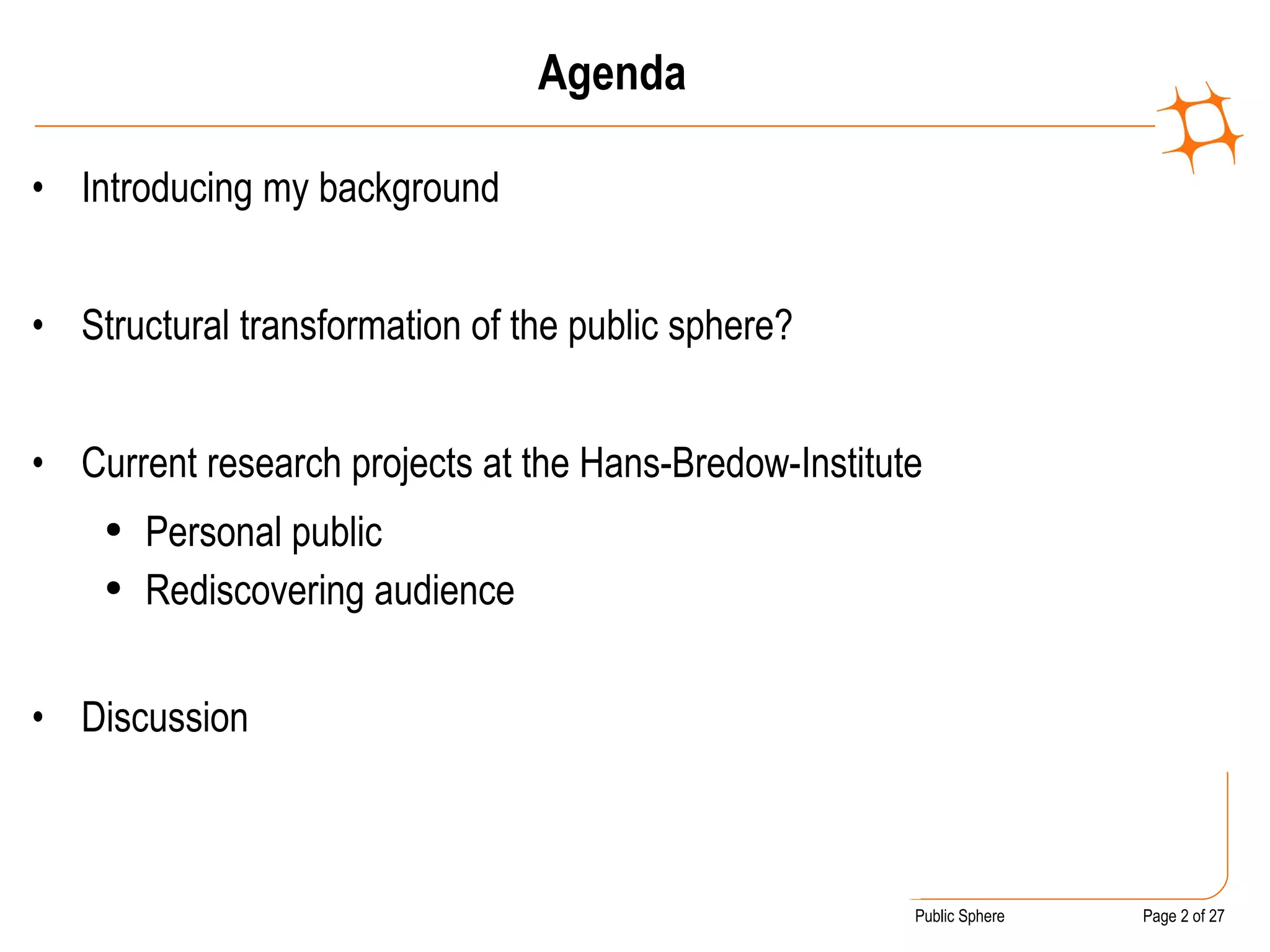
Agenda Introducing my background Structural transformation of the public sphere? Current research projects at the Hans-Bredow-Institute Personal public Rediscovering audience Discussion
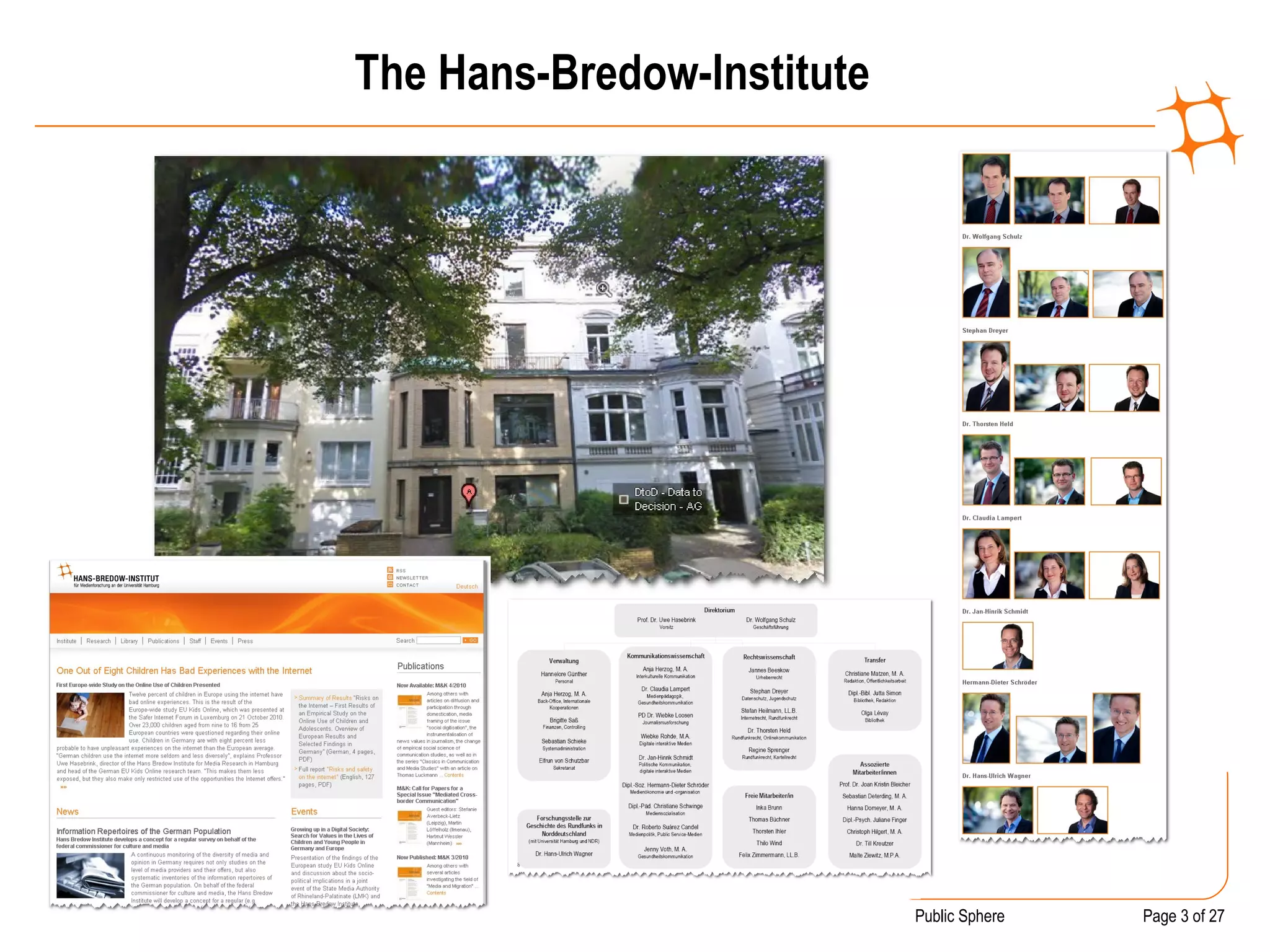
The Hans-Bredow-Institute
The Hans-Bredow-Institute Founded in 1950 – leading independent media research institute in Germany, funded by City of Hamburg and various other public institutions (e.g. Federal Media Authorities) as well as by competitive research grants  Named after Hans Bredow (1879-1959) – originally a broadcast technician; Commissioner for Broadcasting in the Ministry of Posts in the Weimar Republic; banned from work after the Nazis got into power; central figure in building public broadcasting system after 1945 Scope of Research:  Focussing on the structure of mediated public communication - understanding the underlying determinants, assessing future opportunities and risks, and providing orientation for the actors involved Interdisciplinary perspective : combining social sciences and legal studies within various research programmes
Research Programmes „ Foundations of societal information“  – how does society keep itself informed?  e.g. project on the media repertoires of the german population „ Types of public communication“  – how is the changing media system structured? e.g. study on „ Leitmedium  Internet?“ for German Parliament „ Between reception, interaction, and production“  – how do users‘s roles change? e.g. study on adolescents and Web 2.0 „ Long-term media effects “  – are there any, and if yes: which and how? z.B. the role of television in forming images, attitudes & beliefs about the Holocaust
Agenda Introducing my background Structural transformation of the public sphere? Current research projects at the Hans-Bredow-Institute Personal public Rediscovering audience Discussion
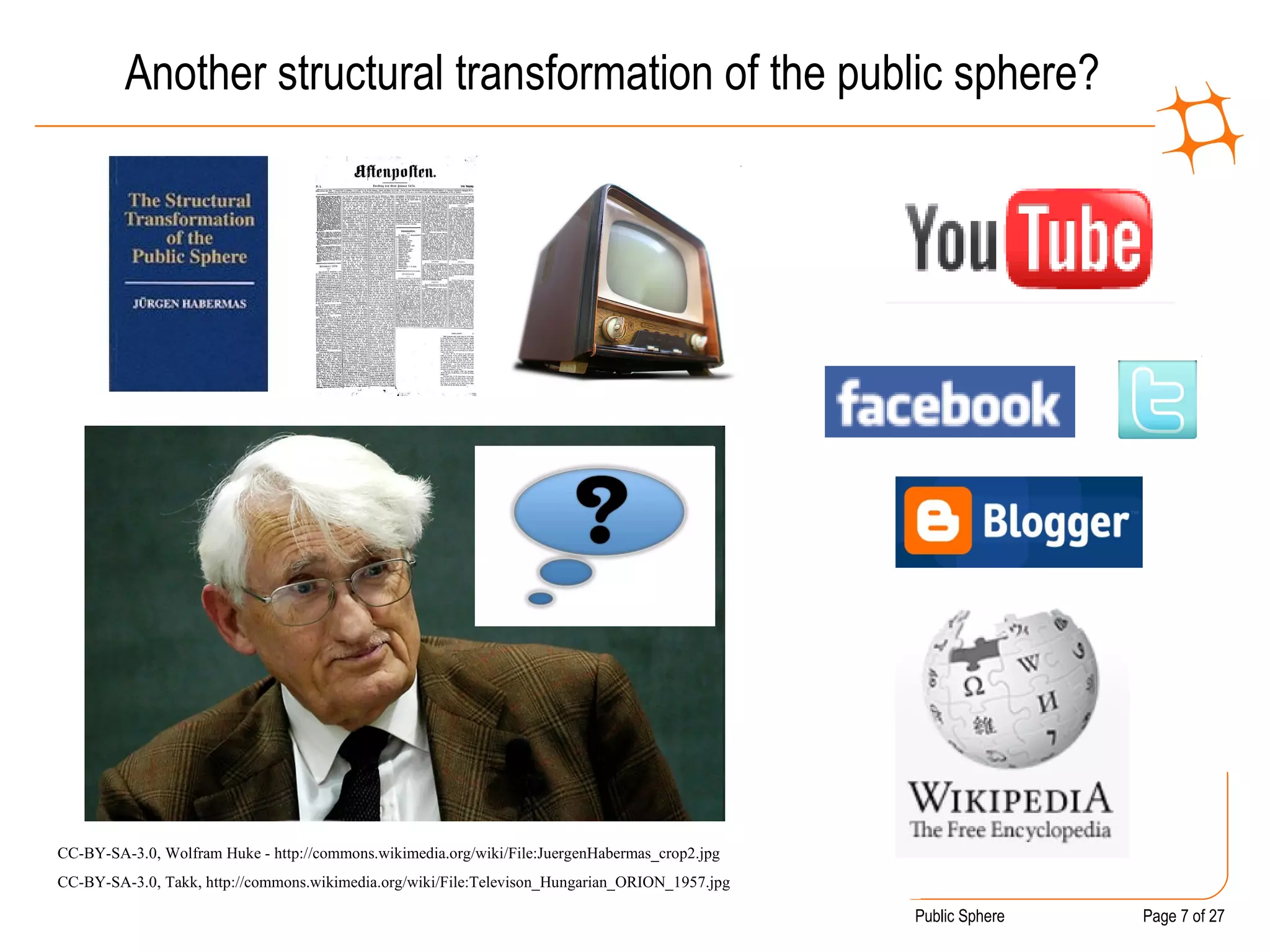
Another structural transformation of the public sphere? CC-BY-SA-3.0, Wolfram Huke - http://commons.wikimedia.org/wiki/File:JuergenHabermas_crop2.jpg CC-BY-SA-3.0, Takk, http://commons.wikimedia.org/wiki/File:Televison_Hungarian_ORION_1957.jpg
The context (in brief) Basic trends contributing to structural changes in the public sphere today:  The Technological Convergence / Digitization The Political-Economical Globalization, „marketization“  The Social Networked Individualism   Not only the social contexts, but also the internal structures of mediated spaces are changing Governing / Regulating mediated spaces Producing public spheres
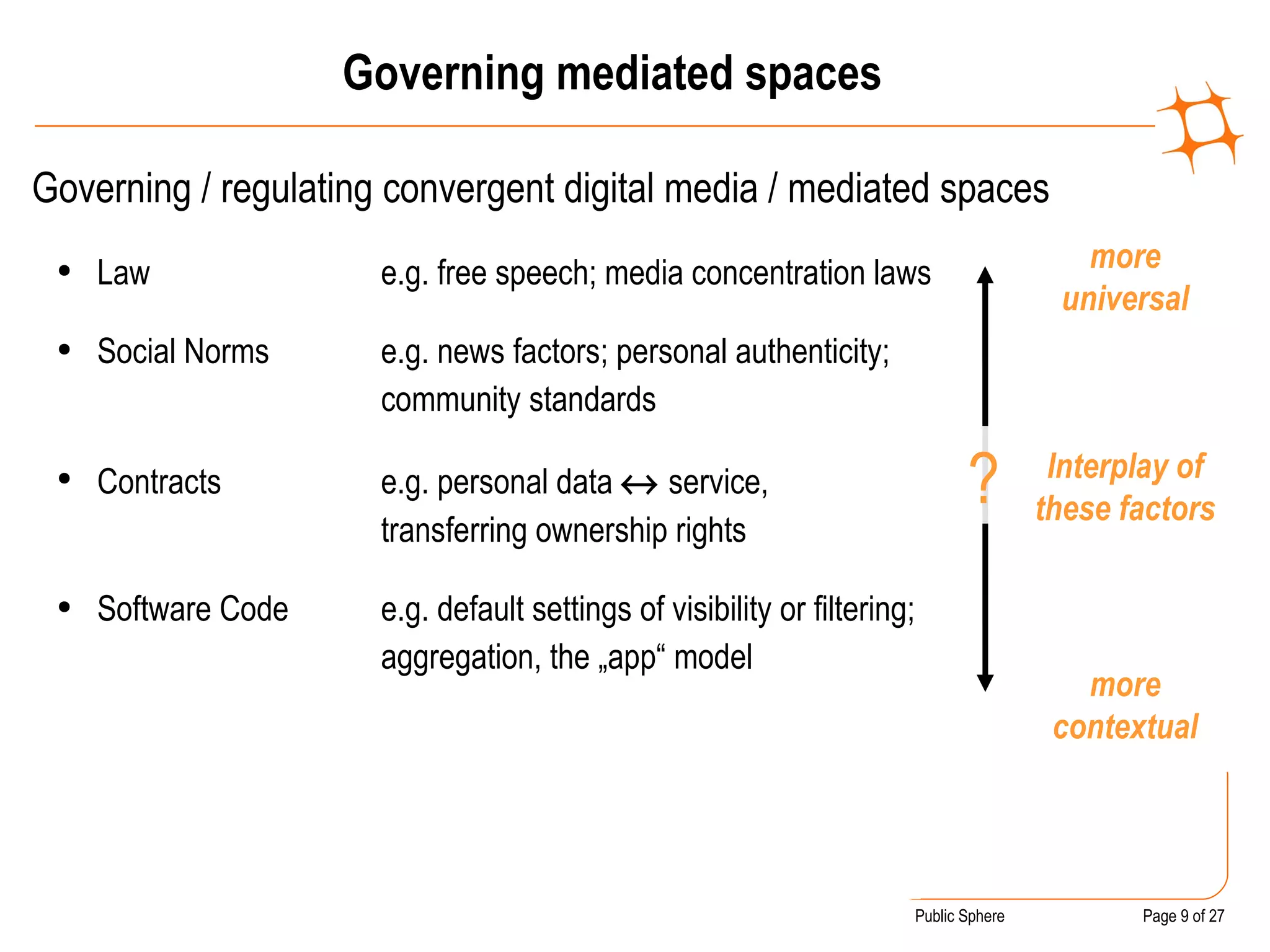
Governing mediated spaces Governing / regulating convergent digital media / mediated spaces   Law e.g. free speech; media concentration laws   Social Norms  e.g. news factors; personal authenticity;  community standards  Contracts e.g. personal data    service,  transferring ownership rights Software Code e.g. default settings of visibility or filtering;  aggregation, the „app“ model more universal more contextual ? Interplay of these factors
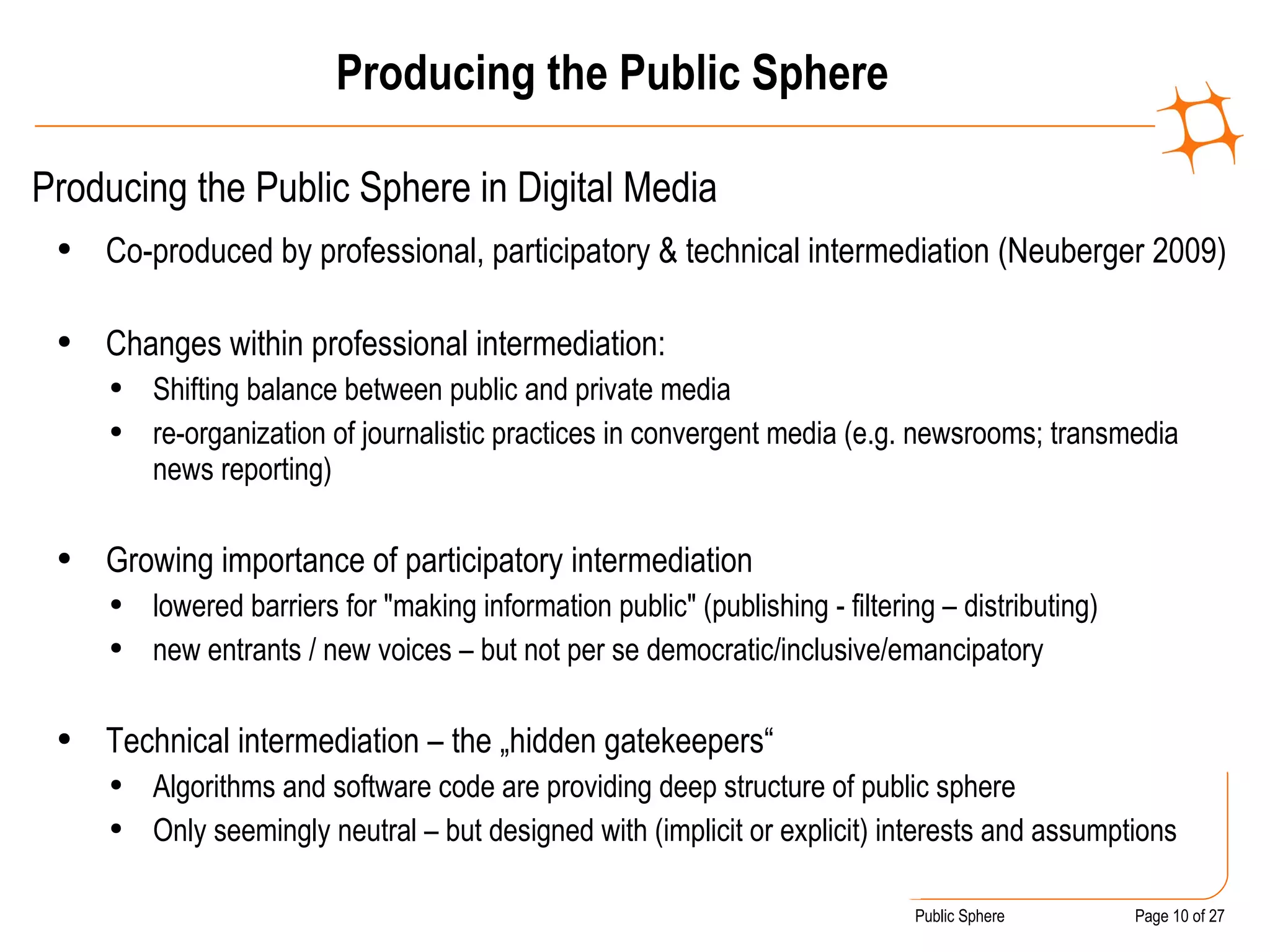
Producing the Public Sphere Producing the Public Sphere in Digital Media  Co-produced by professional, participatory & technical intermediation (Neuberger 2009) Changes within professional intermediation: Shifting balance between public and private media  re-organization of journalistic practices in convergent media (e.g. newsrooms; transmedia news reporting) Growing importance of participatory intermediation  lowered barriers for "making information public" (publishing - filtering – distributing)  new entrants / new voices – but not per se democratic/inclusive/emancipatory Technical intermediation – the „hidden gatekeepers“ Algorithms and software code are providing deep structure of public sphere Only seemingly neutral – but designed with (implicit or explicit) interests and assumptions
Agenda Introducing my background Structural transformation of the public sphere? Current research projects at the Hans-Bredow-Institute Personal publics Rediscovering audience Discussion
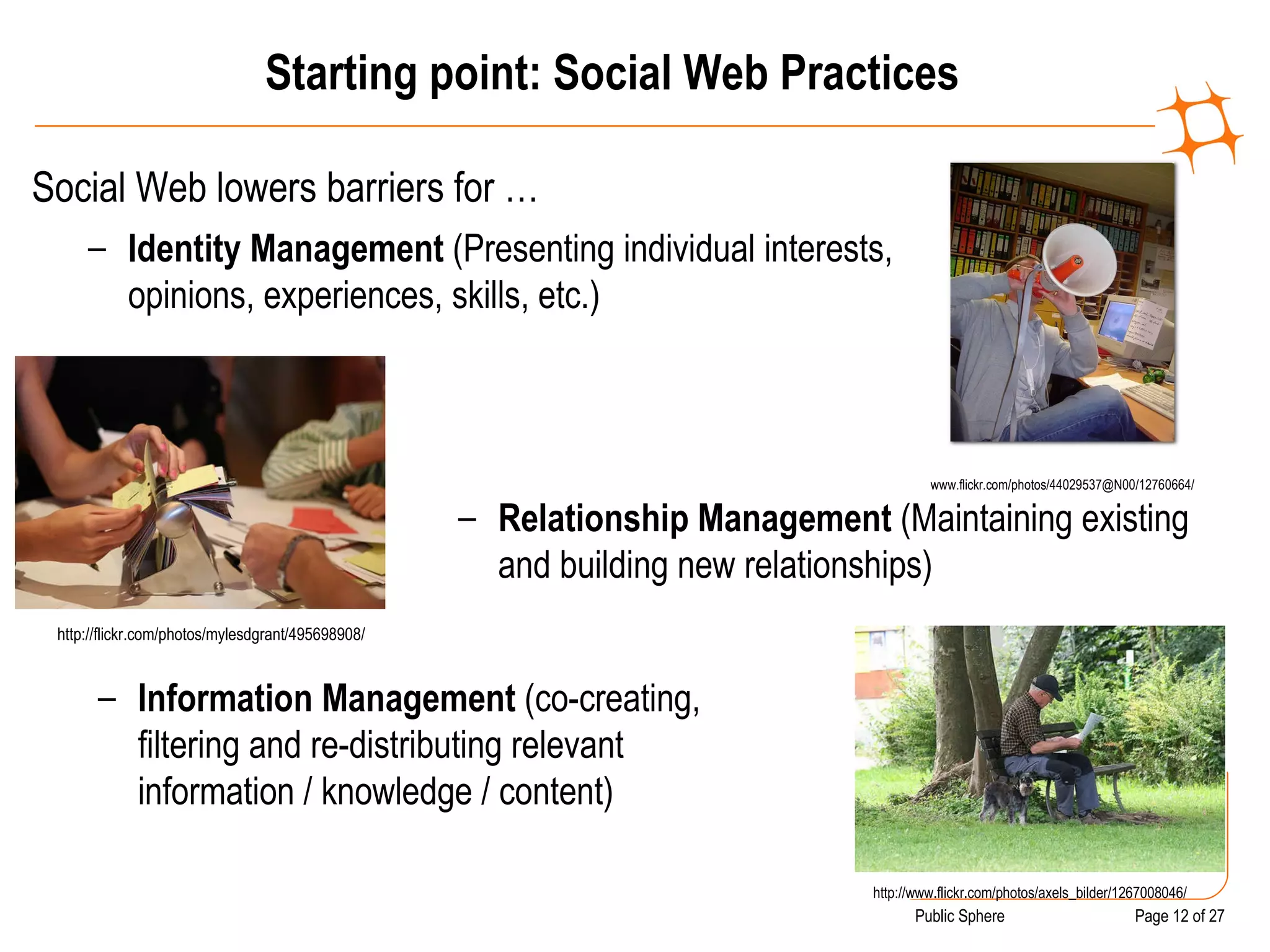
Starting point: Social Web Practices Social Web lowers barriers for … www.flickr.com/photos/44029537@N00/12760664/ Identity Management  (Presenting individual interests, opinions, experiences, skills, etc.) http://flickr.com/photos/mylesdgrant/495698908/ Relationship Management  (Maintaining existing and building new relationships) http://www.flickr.com/photos/axels_bilder/1267008046/ Information Management  (co-creating, filtering and re-distributing relevant information / knowledge / content)
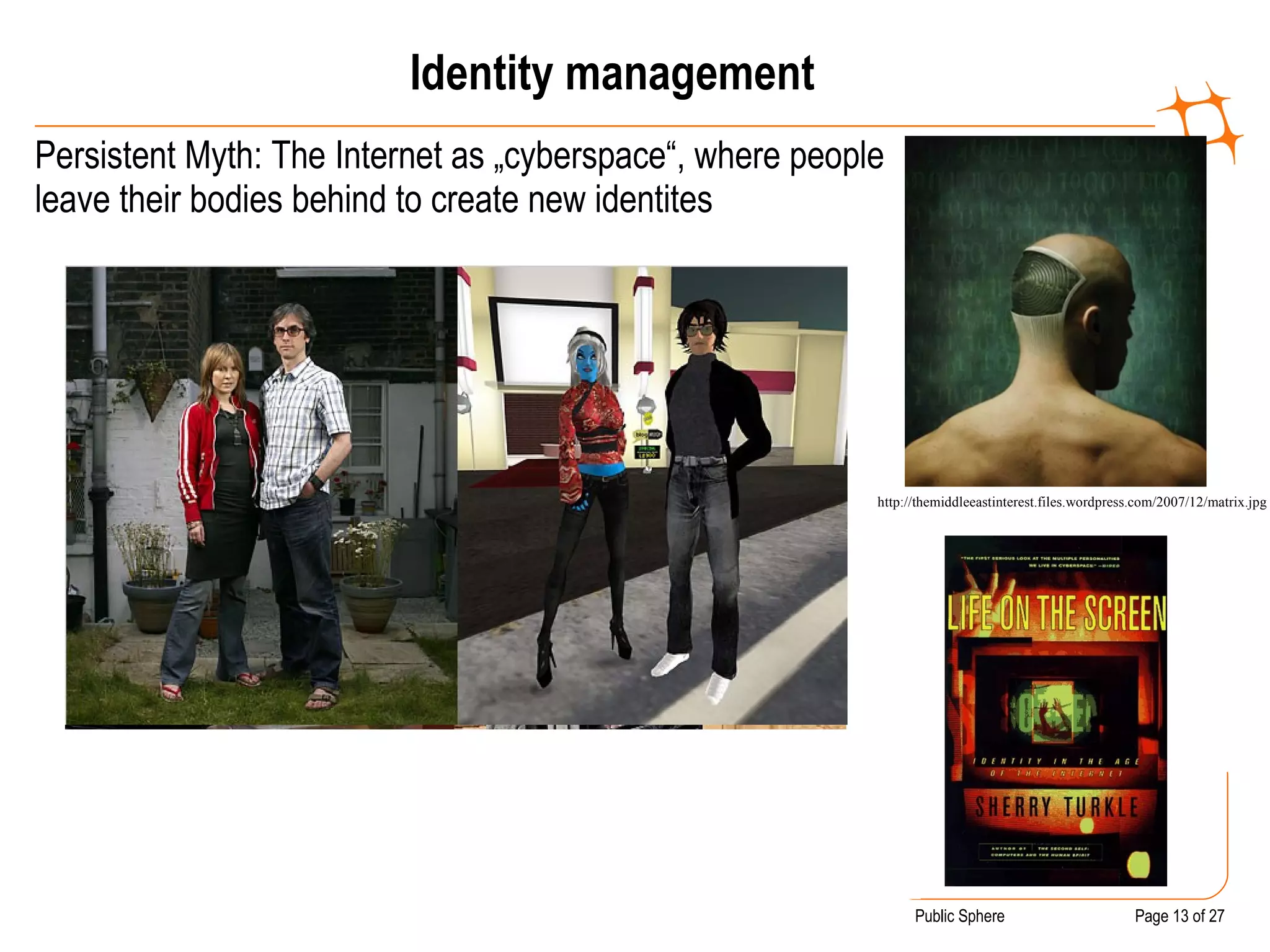
Identity management Persistent Myth: The Internet as „cyberspace“, where people leave their bodies behind to create new identites http://themiddleeastinterest.files.wordpress.com/2007/12/matrix.jpg
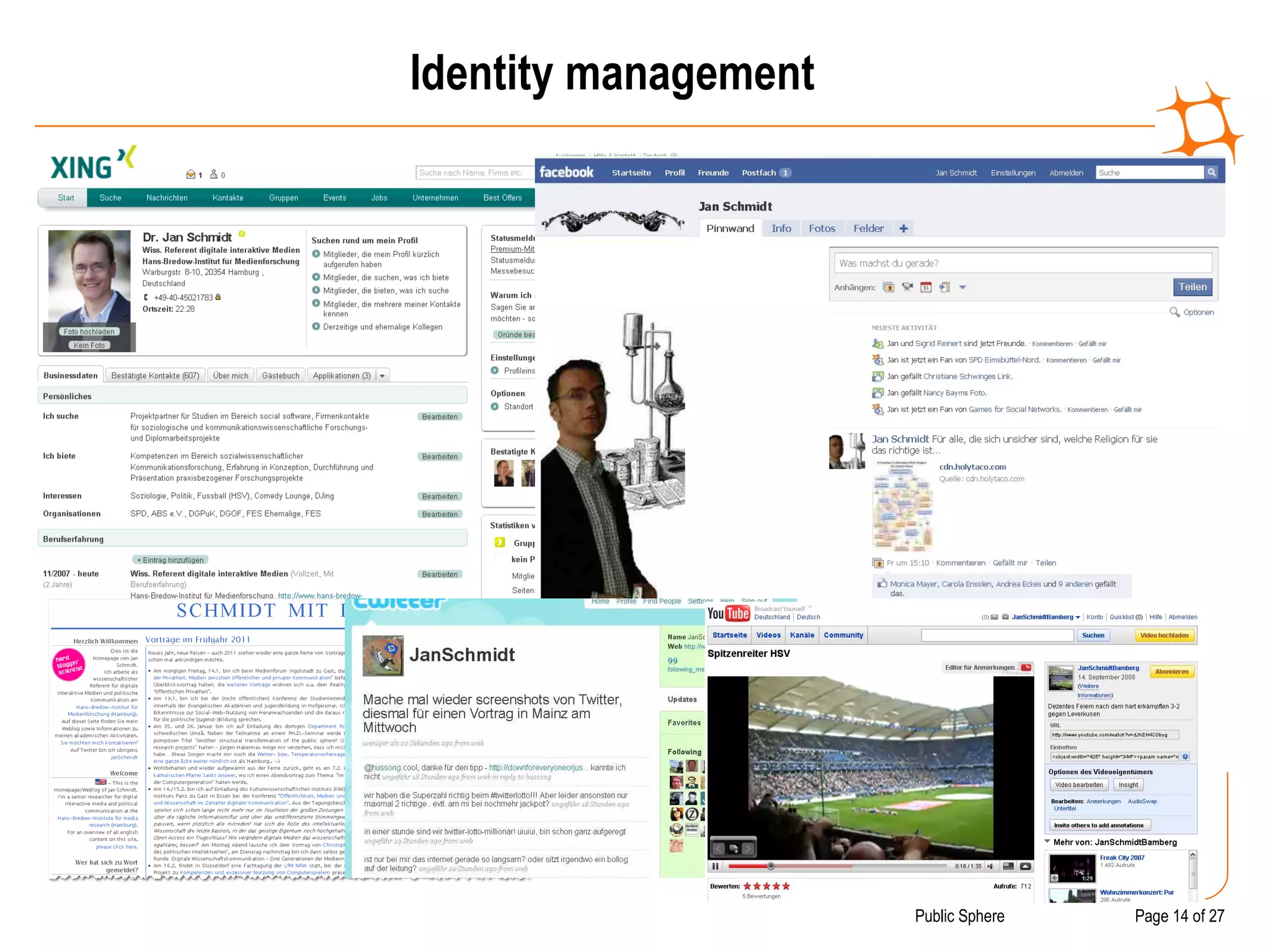
Identity management
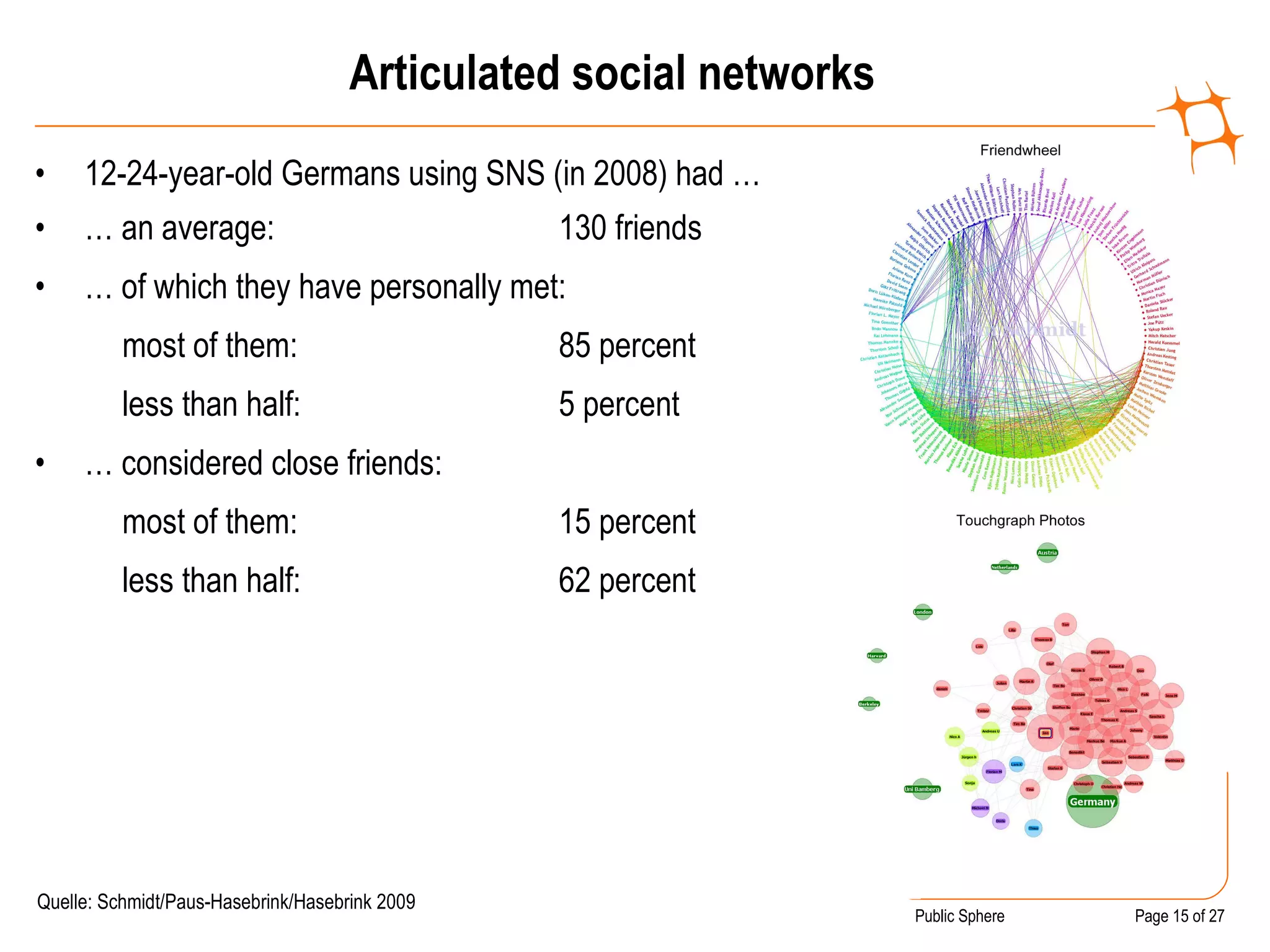
Articulated social networks 12-24-year-old Germans using SNS (in 2008) had … …  an average:   130 friends …  of which they have personally met: most of them: 85 percent less than half: 5 percent …  considered close friends: most of them: 15 percent less than half: 62 percent Quelle: Schmidt/Paus-Hasebrink/Hasebrink 2009
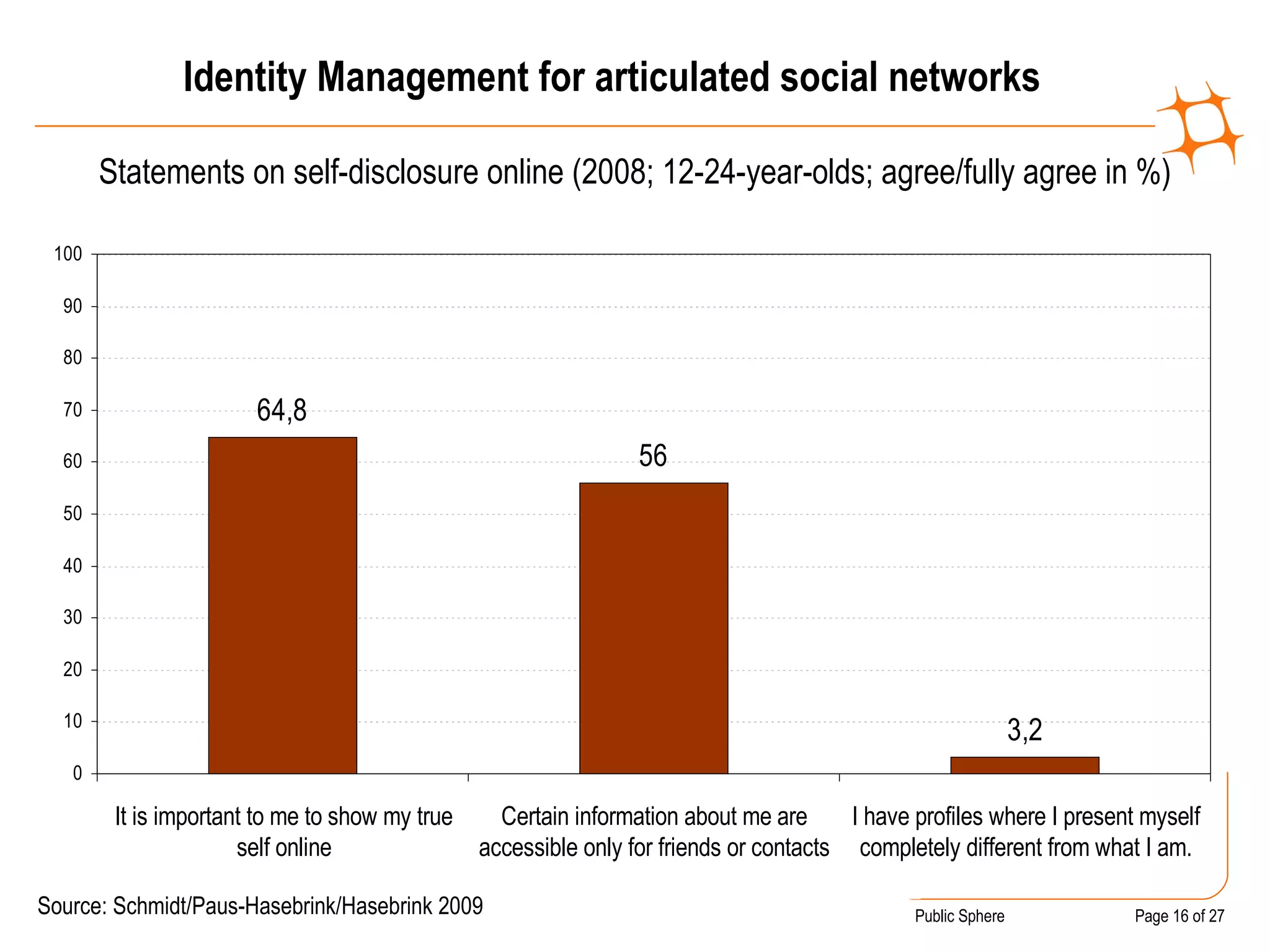
Identity Management for articulated social networks Statements on self-disclosure online (2008; 12-24-year-olds; agree/fully agree in %) Source: Schmidt/Paus-Hasebrink/Hasebrink 2009
Structure of personal publics Personal Publics emerge when and where users make available/filter information which is…  (a)  personally relevant to them ,  [instead of being selected according to  news factors / news values] (b)  directed to an (intended) audience of strong and weak ties , [instead of a disperse and unknown audience] (c)  presented to engage in conversation . [instead of to publicise]    Personal publics are public in the sense of „accessible“, but not necessarily in the sense „of general interest“
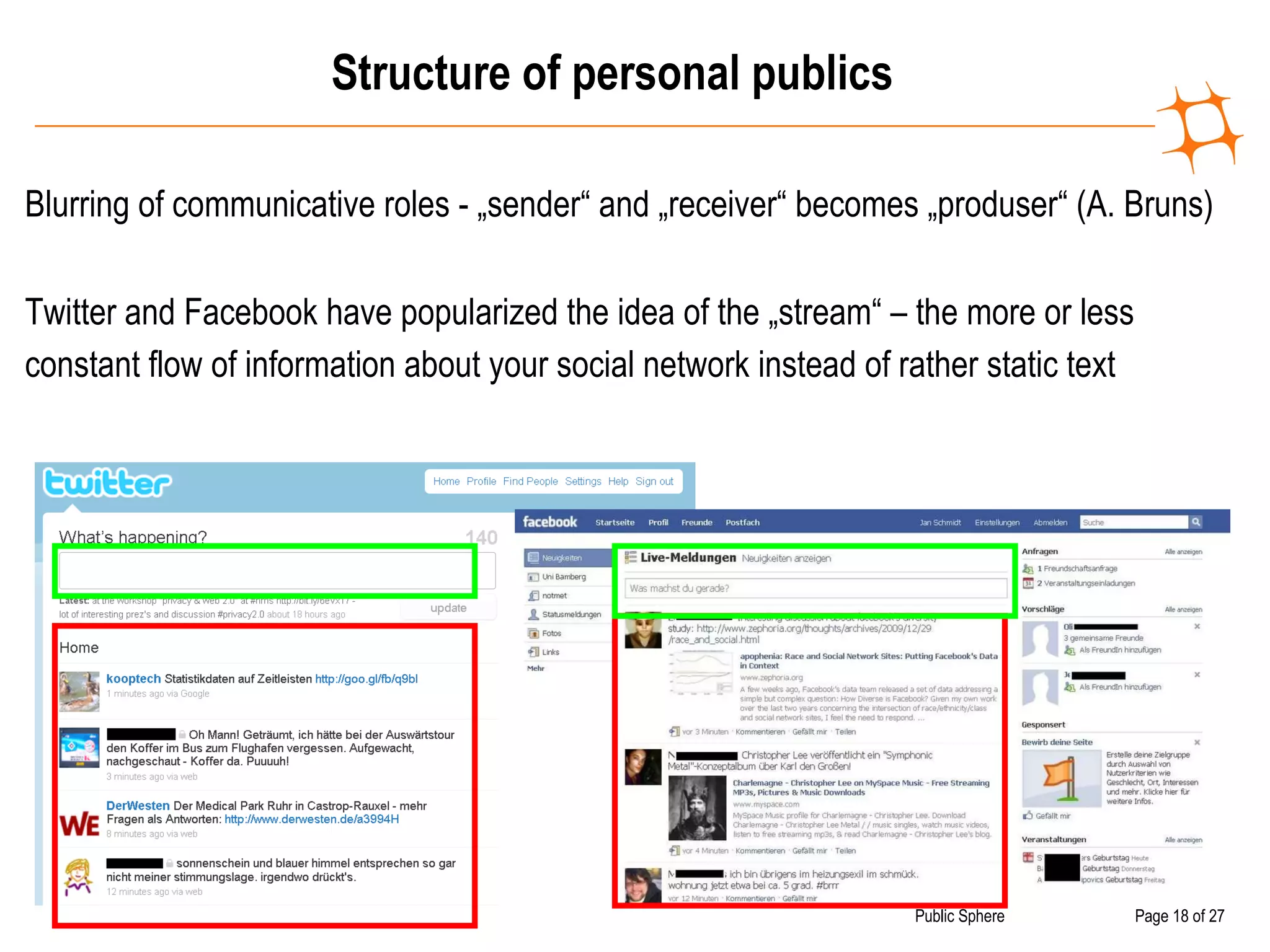
Structure of personal publics Blurring of communicative roles - „sender“ and „receiver“ becomes „produser“ (A. Bruns) Twitter and Facebook have popularized the idea of the „stream“ – the more or less constant flow of information about your social network instead of rather static text
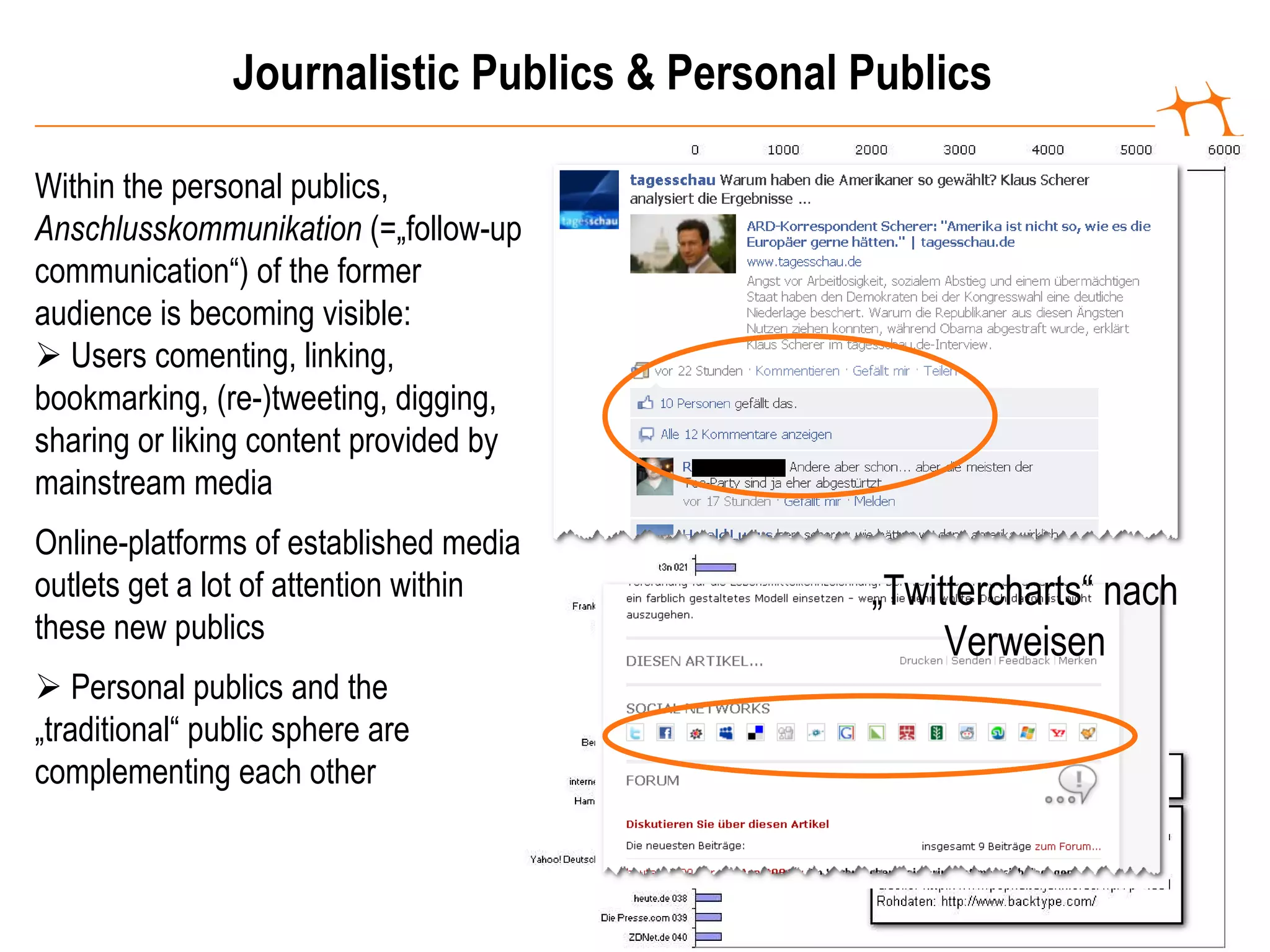
Journalistic Publics & Personal Publics Within the personal publics,  Anschlusskommunikation  (=„follow-up communication“) of the former audience is becoming visible:    Users comenting, linking, bookmarking, (re-)tweeting, digging, sharing or liking content provided by mainstream media Online-platforms of established media outlets get a lot of attention within these new publics    Personal publics and the „traditional“ public sphere are complementing each other „ Twittercharts“ nach Verweisen
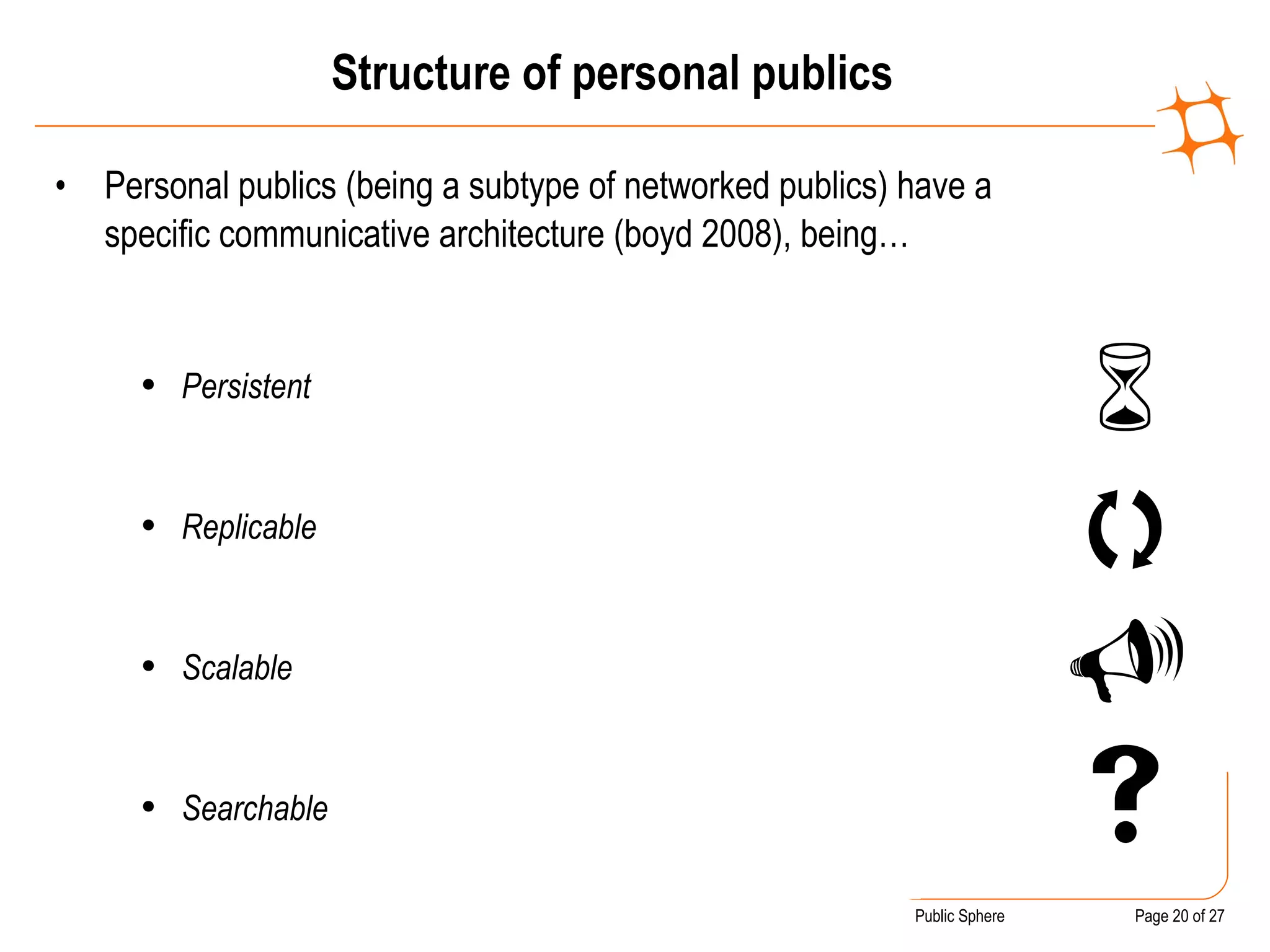
Structure of personal publics Personal publics (being a subtype of networked publics) have a specific communicative architecture (boyd 2008), being… Persistent Replicable Scalable Searchable    
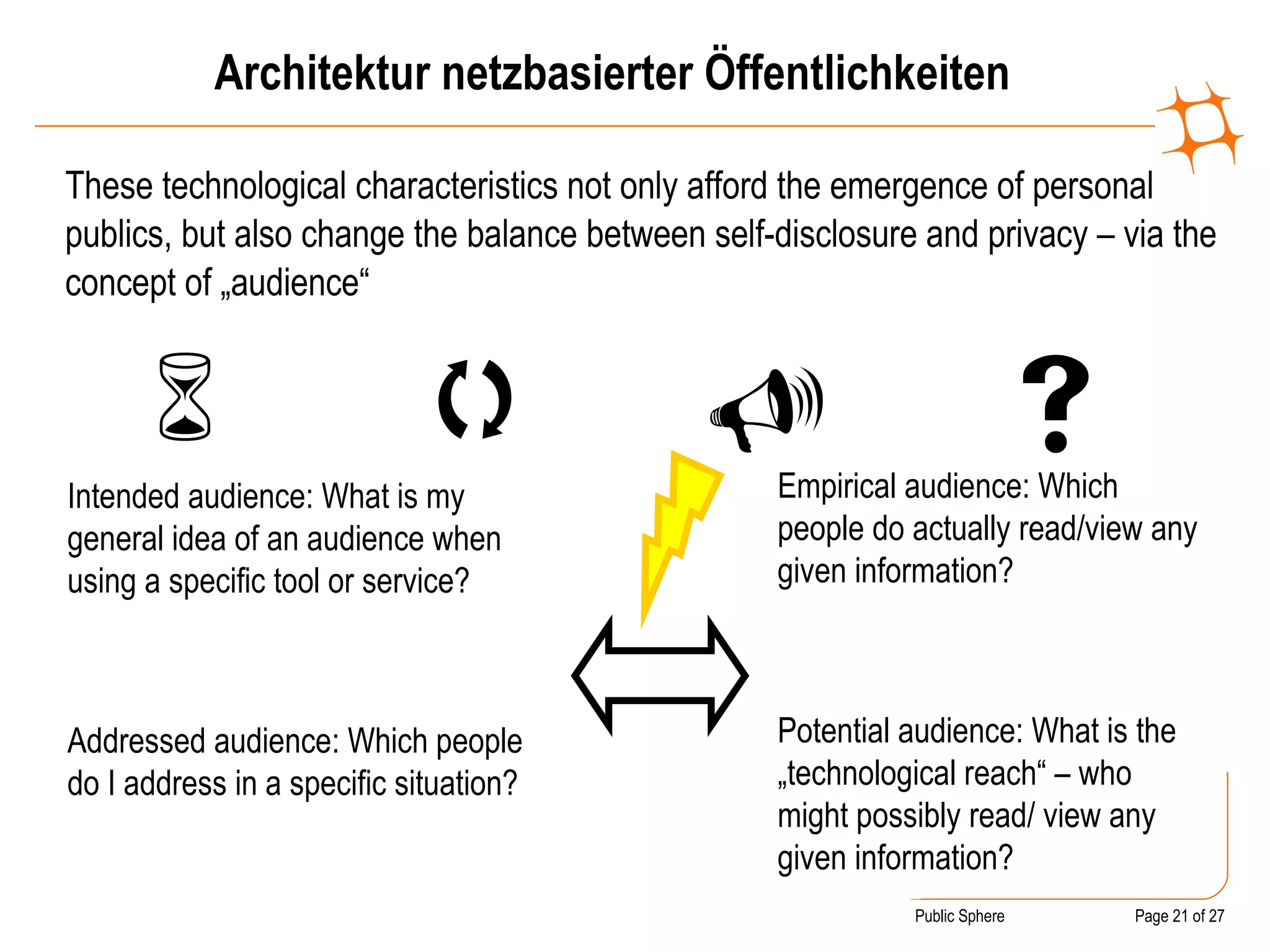
Architektur netzbasierter Öffentlichkeiten These technological characteristics not only afford the emergence of personal publics, but also change the balance between self-disclosure and privacy – via the concept of „audience“     Intended audience: What is my general idea of an audience when using a specific tool or service? Addressed audience: Which people do I address in a specific situation? Empirical audience: Which people do actually read/view any given information? Potential audience: What is the „technological reach“ – who might possibly read/ view any given information?
Agenda Introducing my background Structural transformation of the public sphere? Current research projects at the Hans-Bredow-Institute Personal publics Rediscovering audience Discussion
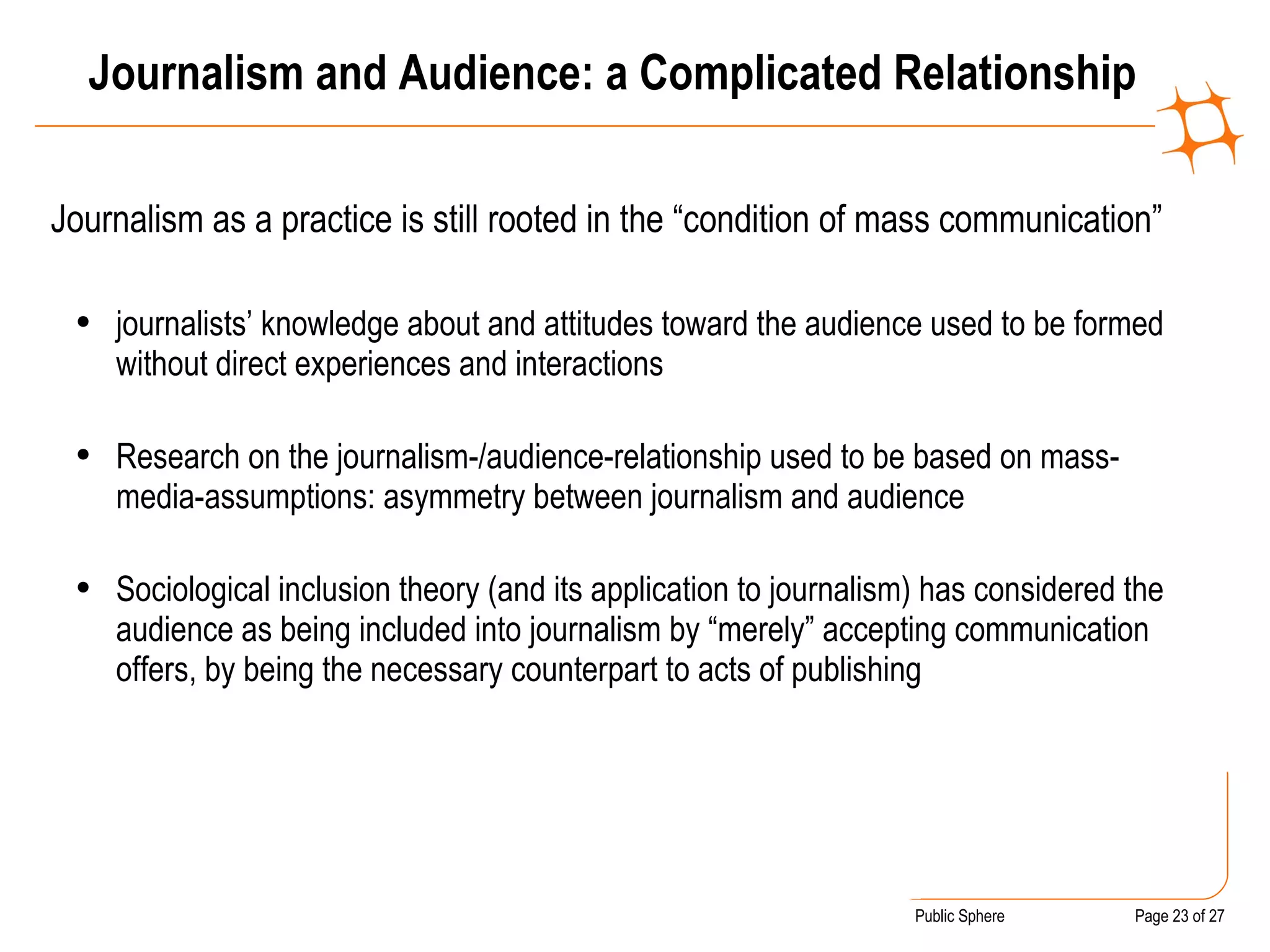
Journalism and Audience: a Complicated Relationship Journalism as a practice is still rooted in the “condition of mass communication” journalists’ knowledge about and attitudes toward the audience used to be formed without direct experiences and interactions Research on the journalism-/audience-relationship used to be based on mass-media-assumptions: asymmetry between journalism and audience Sociological inclusion theory (and its application to journalism) has considered the audience as being included into journalism by “merely” accepting communication offers, by being the necessary counterpart to acts of publishing
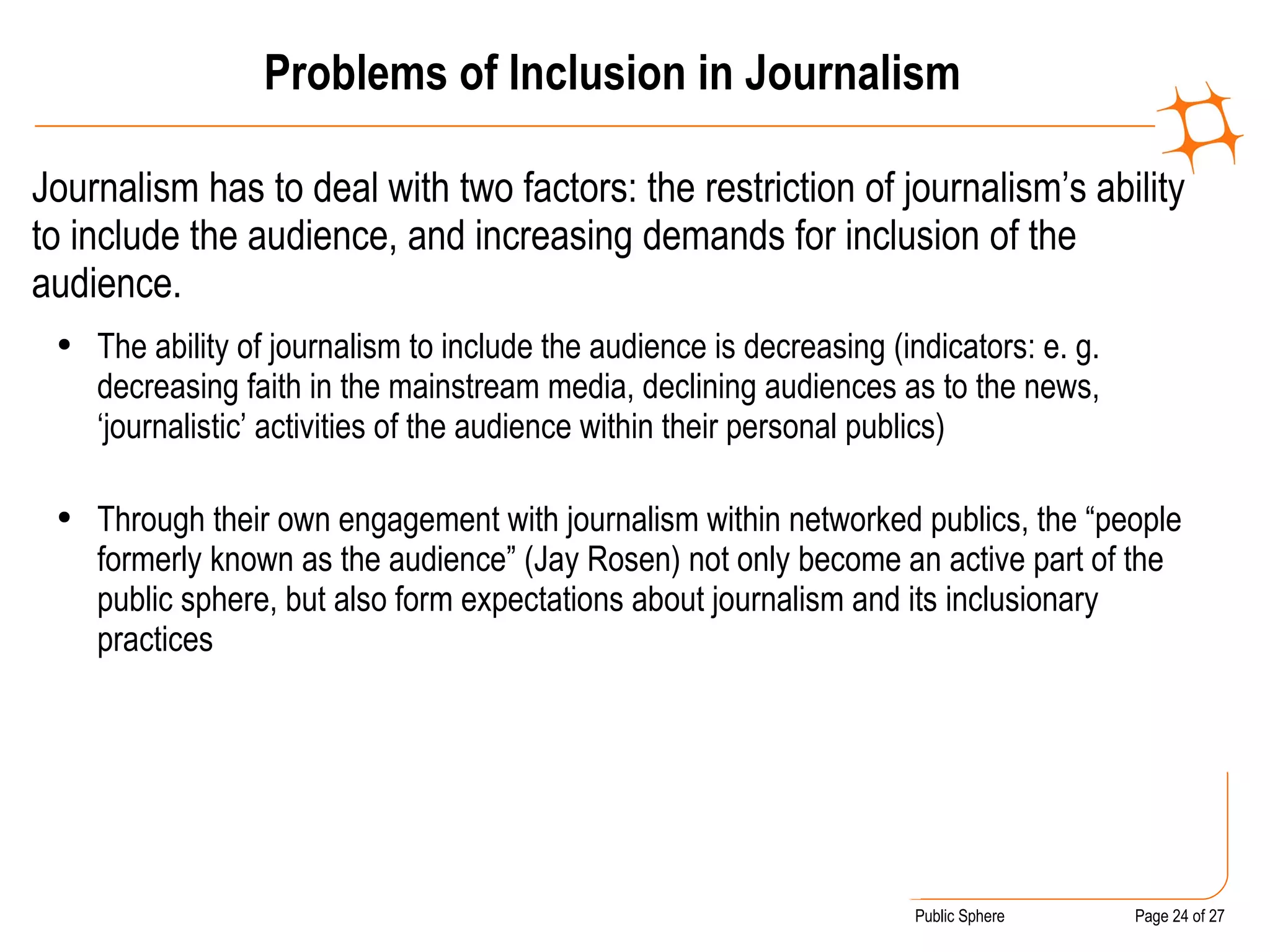
Problems of Inclusion in Journalism Journalism has to deal with two factors: the restriction of journalism’s ability to include the audience, and increasing demands for inclusion of the audience. The ability of journalism to include the audience is decreasing (indicators: e. g. decreasing faith in the mainstream media, declining audiences as to the news, ‘journalistic’ activities of the audience within their personal publics) Through their own engagement with journalism within networked publics, the “people formerly known as the audience” (Jay Rosen) not only become an active part of the public sphere, but also form expectations about journalism and its inclusionary practices
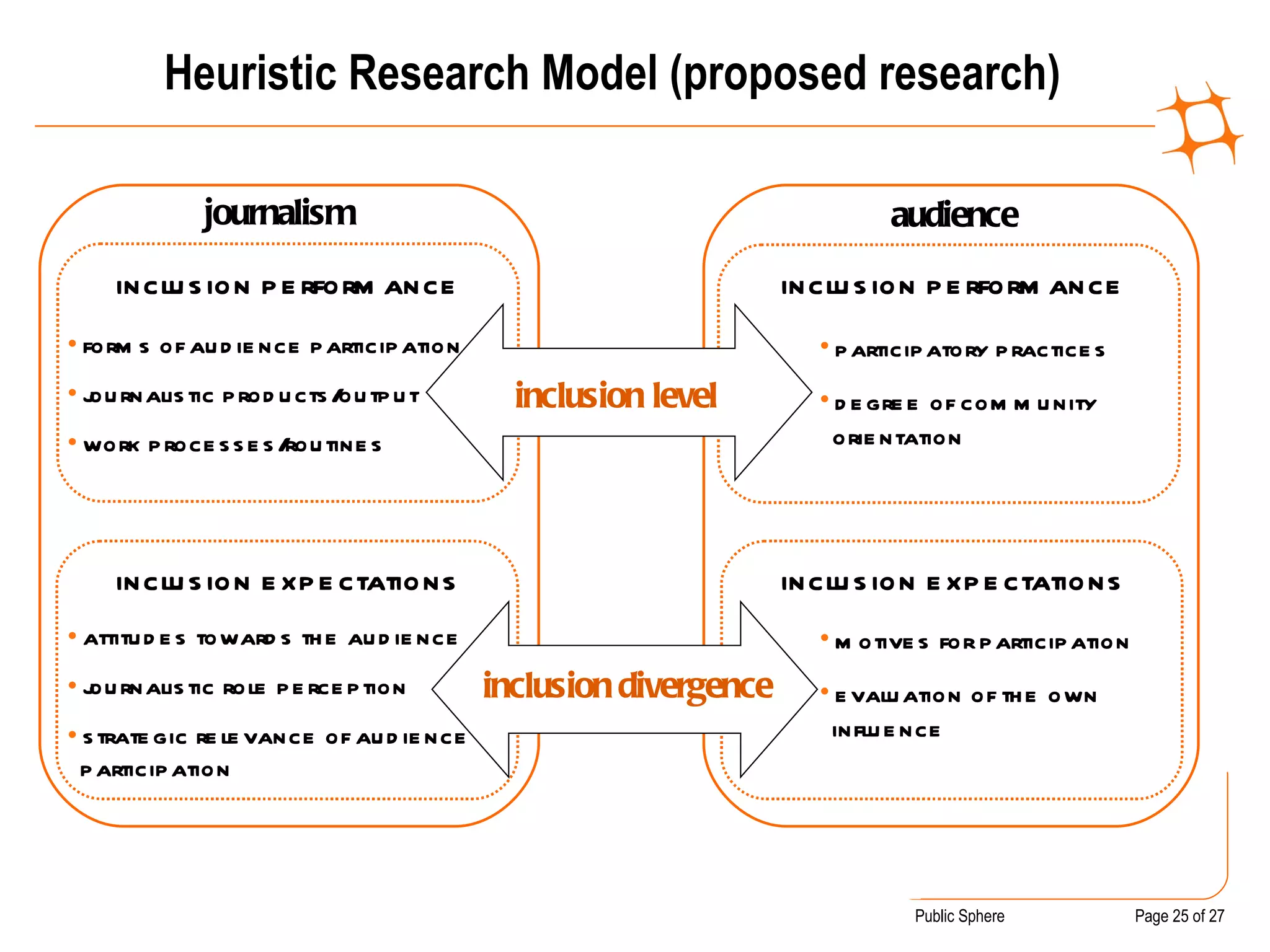
Heuristic Research Model (proposed research) audience inclusion   performance participatory   practices degree   of   community   orientation inclusion   expectations motives   for   participation evaluation   of   the   own   influence inclusion   performance forms   of   audience   participation journalistic   products/output work   processes/routines inclusion   expectations attitudes   towards   the   audience journalistic   role   perception strategic   relevance   of   audience   participation journalism inclusion   level inclusion   divergence
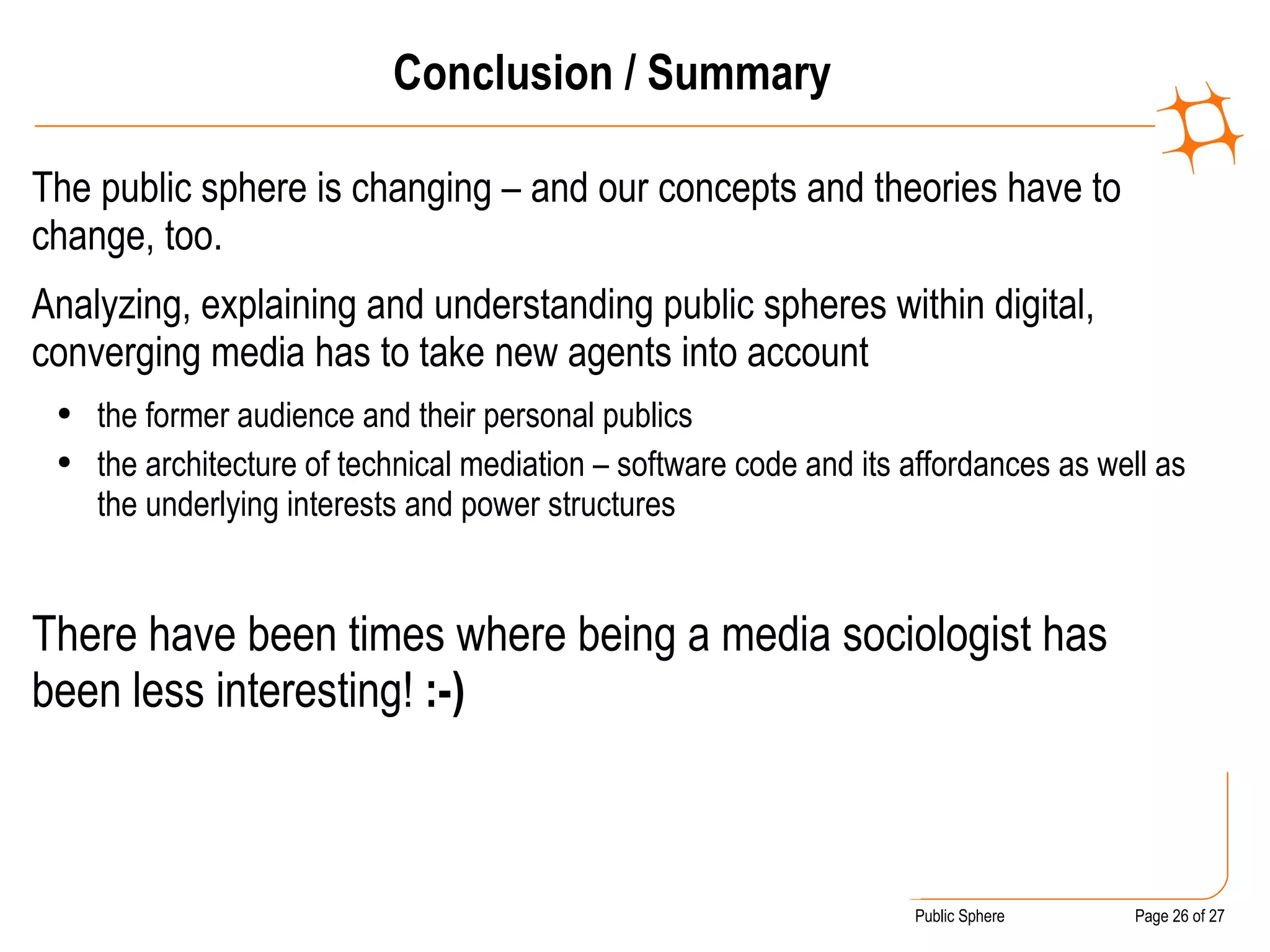
Conclusion / Summary The public sphere is changing – and our concepts and theories have to change, too. Analyzing, explaining and understanding public spheres within digital, converging media has to take new agents into account the former audience and their personal publics the architecture of technical mediation – software code and its affordances as well as the underlying interests and power structures There have been times where being a media sociologist has been less interesting!  :-)
Thank you! Dr. Jan-Hinrik Schmidt Hans-Bredow-Institut Warburgstr. 8-10, 20354 Hamburg [email_address] www.hans-bredow-institut.de www.schmidtmitdete.de www.dasneuenetz.de
Relevant Literature Benkler, Yochai (2006): The Wealth of Networks. How social production transforms markets and freedom.  New Haven/London. boyd, danah (2008): Taken out of context. American Teen Sociality in Networked Publics. Berkely. Online: http://www.danah.org/papers/TakenOutOfContext.pdf. Bruns, Axel (2008): Blogs, Wikipedia, Second Life, and beyond. From production to produsage. New York. Jenkins, Henry (2006): Convergence Culture. Where old and new media collide. New York. Neuberger, Christoph/Christian Nuernbergk/Melanie Rischke (Hg.) (2009): Journalismus im Internet. Profession – Partizipation – Technisierung. Wiesbaden.  Papacharissi, Zizi (2010): A private sphere. Democracy in a digital age. Cambridge. Schmidt, Jan (2009): Das neue Netz. Merkmale, Praktiken und Konsequenzen des Web 2.0. Konstanz. Schmidt, Jan/Ingrid Paus-Hasebrink/Uwe Hasebrink (Hrsg.) (2009): Heranwachsen mit dem Social Web. Berlin .

Transformation janschmidt umea_2011_print

  • 1.
    Another structural transformationof the public sphere? On recent challenges and current research projects Dr. Jan-Hinrik Schmidt Senior Researcher for digital interactive media and political communication Ume å , January 2011
  • 2.
    Agenda Introducing mybackground Structural transformation of the public sphere? Current research projects at the Hans-Bredow-Institute Personal public Rediscovering audience Discussion
  • 3.
  • 4.
    The Hans-Bredow-Institute Foundedin 1950 – leading independent media research institute in Germany, funded by City of Hamburg and various other public institutions (e.g. Federal Media Authorities) as well as by competitive research grants Named after Hans Bredow (1879-1959) – originally a broadcast technician; Commissioner for Broadcasting in the Ministry of Posts in the Weimar Republic; banned from work after the Nazis got into power; central figure in building public broadcasting system after 1945 Scope of Research: Focussing on the structure of mediated public communication - understanding the underlying determinants, assessing future opportunities and risks, and providing orientation for the actors involved Interdisciplinary perspective : combining social sciences and legal studies within various research programmes
  • 5.
    Research Programmes „Foundations of societal information“ – how does society keep itself informed? e.g. project on the media repertoires of the german population „ Types of public communication“ – how is the changing media system structured? e.g. study on „ Leitmedium Internet?“ for German Parliament „ Between reception, interaction, and production“ – how do users‘s roles change? e.g. study on adolescents and Web 2.0 „ Long-term media effects “ – are there any, and if yes: which and how? z.B. the role of television in forming images, attitudes & beliefs about the Holocaust
  • 6.
    Agenda Introducing mybackground Structural transformation of the public sphere? Current research projects at the Hans-Bredow-Institute Personal public Rediscovering audience Discussion
  • 7.
    Another structural transformationof the public sphere? CC-BY-SA-3.0, Wolfram Huke - http://commons.wikimedia.org/wiki/File:JuergenHabermas_crop2.jpg CC-BY-SA-3.0, Takk, http://commons.wikimedia.org/wiki/File:Televison_Hungarian_ORION_1957.jpg
  • 8.
    The context (inbrief) Basic trends contributing to structural changes in the public sphere today: The Technological Convergence / Digitization The Political-Economical Globalization, „marketization“ The Social Networked Individualism  Not only the social contexts, but also the internal structures of mediated spaces are changing Governing / Regulating mediated spaces Producing public spheres
  • 9.
    Governing mediated spacesGoverning / regulating convergent digital media / mediated spaces Law e.g. free speech; media concentration laws Social Norms e.g. news factors; personal authenticity; community standards Contracts e.g. personal data  service, transferring ownership rights Software Code e.g. default settings of visibility or filtering; aggregation, the „app“ model more universal more contextual ? Interplay of these factors
  • 10.
    Producing the PublicSphere Producing the Public Sphere in Digital Media Co-produced by professional, participatory & technical intermediation (Neuberger 2009) Changes within professional intermediation: Shifting balance between public and private media re-organization of journalistic practices in convergent media (e.g. newsrooms; transmedia news reporting) Growing importance of participatory intermediation lowered barriers for "making information public" (publishing - filtering – distributing) new entrants / new voices – but not per se democratic/inclusive/emancipatory Technical intermediation – the „hidden gatekeepers“ Algorithms and software code are providing deep structure of public sphere Only seemingly neutral – but designed with (implicit or explicit) interests and assumptions
  • 11.
    Agenda Introducing mybackground Structural transformation of the public sphere? Current research projects at the Hans-Bredow-Institute Personal publics Rediscovering audience Discussion
  • 12.
    Starting point: SocialWeb Practices Social Web lowers barriers for … www.flickr.com/photos/44029537@N00/12760664/ Identity Management (Presenting individual interests, opinions, experiences, skills, etc.) http://flickr.com/photos/mylesdgrant/495698908/ Relationship Management (Maintaining existing and building new relationships) http://www.flickr.com/photos/axels_bilder/1267008046/ Information Management (co-creating, filtering and re-distributing relevant information / knowledge / content)
  • 13.
    Identity management PersistentMyth: The Internet as „cyberspace“, where people leave their bodies behind to create new identites http://themiddleeastinterest.files.wordpress.com/2007/12/matrix.jpg
  • 14.
  • 15.
    Articulated social networks12-24-year-old Germans using SNS (in 2008) had … … an average: 130 friends … of which they have personally met: most of them: 85 percent less than half: 5 percent … considered close friends: most of them: 15 percent less than half: 62 percent Quelle: Schmidt/Paus-Hasebrink/Hasebrink 2009
  • 16.
    Identity Management forarticulated social networks Statements on self-disclosure online (2008; 12-24-year-olds; agree/fully agree in %) Source: Schmidt/Paus-Hasebrink/Hasebrink 2009
  • 17.
    Structure of personalpublics Personal Publics emerge when and where users make available/filter information which is… (a) personally relevant to them , [instead of being selected according to news factors / news values] (b) directed to an (intended) audience of strong and weak ties , [instead of a disperse and unknown audience] (c) presented to engage in conversation . [instead of to publicise]  Personal publics are public in the sense of „accessible“, but not necessarily in the sense „of general interest“
  • 18.
    Structure of personalpublics Blurring of communicative roles - „sender“ and „receiver“ becomes „produser“ (A. Bruns) Twitter and Facebook have popularized the idea of the „stream“ – the more or less constant flow of information about your social network instead of rather static text
  • 19.
    Journalistic Publics &Personal Publics Within the personal publics, Anschlusskommunikation (=„follow-up communication“) of the former audience is becoming visible:  Users comenting, linking, bookmarking, (re-)tweeting, digging, sharing or liking content provided by mainstream media Online-platforms of established media outlets get a lot of attention within these new publics  Personal publics and the „traditional“ public sphere are complementing each other „ Twittercharts“ nach Verweisen
  • 20.
    Structure of personalpublics Personal publics (being a subtype of networked publics) have a specific communicative architecture (boyd 2008), being… Persistent Replicable Scalable Searchable    
  • 21.
    Architektur netzbasierter ÖffentlichkeitenThese technological characteristics not only afford the emergence of personal publics, but also change the balance between self-disclosure and privacy – via the concept of „audience“     Intended audience: What is my general idea of an audience when using a specific tool or service? Addressed audience: Which people do I address in a specific situation? Empirical audience: Which people do actually read/view any given information? Potential audience: What is the „technological reach“ – who might possibly read/ view any given information?
  • 22.
    Agenda Introducing mybackground Structural transformation of the public sphere? Current research projects at the Hans-Bredow-Institute Personal publics Rediscovering audience Discussion
  • 23.
    Journalism and Audience:a Complicated Relationship Journalism as a practice is still rooted in the “condition of mass communication” journalists’ knowledge about and attitudes toward the audience used to be formed without direct experiences and interactions Research on the journalism-/audience-relationship used to be based on mass-media-assumptions: asymmetry between journalism and audience Sociological inclusion theory (and its application to journalism) has considered the audience as being included into journalism by “merely” accepting communication offers, by being the necessary counterpart to acts of publishing
  • 24.
    Problems of Inclusionin Journalism Journalism has to deal with two factors: the restriction of journalism’s ability to include the audience, and increasing demands for inclusion of the audience. The ability of journalism to include the audience is decreasing (indicators: e. g. decreasing faith in the mainstream media, declining audiences as to the news, ‘journalistic’ activities of the audience within their personal publics) Through their own engagement with journalism within networked publics, the “people formerly known as the audience” (Jay Rosen) not only become an active part of the public sphere, but also form expectations about journalism and its inclusionary practices
  • 25.
    Heuristic Research Model(proposed research) audience inclusion performance participatory practices degree of community orientation inclusion expectations motives for participation evaluation of the own influence inclusion performance forms of audience participation journalistic products/output work processes/routines inclusion expectations attitudes towards the audience journalistic role perception strategic relevance of audience participation journalism inclusion level inclusion divergence
  • 26.
    Conclusion / SummaryThe public sphere is changing – and our concepts and theories have to change, too. Analyzing, explaining and understanding public spheres within digital, converging media has to take new agents into account the former audience and their personal publics the architecture of technical mediation – software code and its affordances as well as the underlying interests and power structures There have been times where being a media sociologist has been less interesting! :-)
  • 27.
    Thank you! Dr.Jan-Hinrik Schmidt Hans-Bredow-Institut Warburgstr. 8-10, 20354 Hamburg [email_address] www.hans-bredow-institut.de www.schmidtmitdete.de www.dasneuenetz.de
  • 28.
    Relevant Literature Benkler,Yochai (2006): The Wealth of Networks. How social production transforms markets and freedom. New Haven/London. boyd, danah (2008): Taken out of context. American Teen Sociality in Networked Publics. Berkely. Online: http://www.danah.org/papers/TakenOutOfContext.pdf. Bruns, Axel (2008): Blogs, Wikipedia, Second Life, and beyond. From production to produsage. New York. Jenkins, Henry (2006): Convergence Culture. Where old and new media collide. New York. Neuberger, Christoph/Christian Nuernbergk/Melanie Rischke (Hg.) (2009): Journalismus im Internet. Profession – Partizipation – Technisierung. Wiesbaden. Papacharissi, Zizi (2010): A private sphere. Democracy in a digital age. Cambridge. Schmidt, Jan (2009): Das neue Netz. Merkmale, Praktiken und Konsequenzen des Web 2.0. Konstanz. Schmidt, Jan/Ingrid Paus-Hasebrink/Uwe Hasebrink (Hrsg.) (2009): Heranwachsen mit dem Social Web. Berlin .

Editor's Notes

  • #2 Notizen:
  • #24 One of the most commonly used metaphors with regard to the new forms of public communication is the changing nature of the sender receiver relationship – and this especially with regard to the relationship between journalism and its audience. This relationship was always complicated, and in a way it is paradoxical: On the one hand, journalism provides a public service and needs an audience. On the other hand, this audience only plays (or should one better say: used to play?) a subordinate role in everyday newsroom routines. In a lot of studies journalists have been criticized for being geared more to their colleagues than to their audience (e.g. Donsbach 1982). But almost all of the referring studies here, have been conducted under the conditions of mass communication. And previous journalism studies on the journalism-/audience-relationship are based on the assumption, that journalists’ attitudes towards their audience are unavoidably almost exclusive of direct experiences and interactions. So one can say that traditional journalism research and particular research on the journalism-/audience-relationship is based on mass medial assumptions . And these take an asymmetry between journalism and audience as a basis. Due to social media these circumstances have totally changed : Participation and interaction have become relevant sources that influence journalists’ perceptions of the audience (Domingo et. al. 2008; Thurman 2008). Nevertheless, the audience's role within journalism (and within journalism studies) has not been incorporated in detail, and with regard to the new conditions of (online) communication. The sociological theory of inclusion, in my opinion, has good prospects to bridge this gap:
  • #25 The Journalistic gatekeeper monopoly is based on the asymmetry between professional role and an audience role, which is (almost) restricted to selective use. But this asymmetry can no longer be sustained. And even though t raditional news organizations are still very important to their consumers, the ability to include the audience is decreasing : Traditional news media are losing audiences. What has been observed is a loss of coverage, acceptance and credibility. These trends affect particularly newspapers, and the younger age groups . This leads to the conclusion, that journalism has to deal with two factors : firstly, the restriction of journalism’s ability to include the audience, and secondly the increasing demands for inclusion of the audience. These observations were the starting points of a research project which I have conceptualized together with a colleague of mine at the Hans-Bredow-Institut, Jan Schmidt. Our key questions are :
  • #26 As we have seen so far the audience has played an inferior role within journalism research. Therefore we have chosen a perspective for the intended project, which combines communicator oriented research with audience research in the context of new forms of public communication. Here we differentiate between ‘inclusion performance’ and ‘inclusion expectations’ – each seen from the perspective of journalists and the audience/users. Inclusion performance (or inclusion service) of journalism contains different forms of audience participation, which are expressed in the journalistic products and output. All of require adapted work processes and newsrooms routines. Inclusion expectations of journalists are the basis for their attitudes towards the audience and the self-perception of their professional role. Also of importance here is the strategic relevance of audience participation and the priority it has in the newsrooms for economic and journalistic reasons. Inclusion performance, seen from the audience’s perspective stands for different practices of participation. They can have different degrees of community orientation depending on whether the user regards it as a individual act or as part of an aggregated expression of ‘the audience’. Inclusion expectations of users become manifest, on the one hand, as motives for participation, and on the other hand, as perceived possibilities having influence on the news. The comparison of the ‘inclusion performance’ of these two groups is interpreted as ‘inclusion level’ , and the degree of compliance between the ‘inclusion expectations’ of journalists and that of users is interpreted as ‘inclusion divergence’ . I have to admit that I’m not sure if these terms are felicitous translations from German into English – maybe we can discuss that later on. Against the background of this model we are planning to conduct four case studies in tv newsrooms and in their associated online newsrooms with the involvement of the respective users of their services. This model might also be useful to systematise existing studies in the field which often refer to only one of the elements differentiated here. As we have limited time I leave it at that for now . Let me finish with a brief conclusion : (I‘m really looking forward to the presentation of Karin Wahl-Jorgensen and her colleagues on Friday because they have already done on BBC what we are planning to do in our research.)