Training on Autoclave
By
Dhaval Surti
@Pharmatalks_group
What is An Autoclave?
• An autoclave is like a large pressure cooker; it operates
by using steam under pressure as the sterilizing agent.
High pressures enable steam to reach high
temperatures, thus increasing its heat content and
killing power.
• Autoclave and Steam Sterilizer words are used for same
equipment interchangeably
• Charles Chamberland invented first real steam
sterilizer in 1880.
• First steam sterilizer looked like pressure cooker and
also worked in same way.
How steam kills microorganism?
• Autoclave operates using steam under high pressure as
sterilizing agent.
• High pressures enables steam to reach high
temperature, thus increasing heat content and killing
power.
• Most of heating power of steam comes from its latent
heat of vaporization. This is the amount of heat
required to make water hot.
• It takes 80 calories to make 1 litre of water to boil, but
540 calories to convert that boiling water to steam
• Therefore steam at 100 C has almost seven times more
heat than boiling water
How steam kills microorganism?
• Steam is able to penetrate objects with cooler
temperatures because once the steam contacts a
cooler surface, it immediately condenses to water,
producing a concomitant 1870 fold decrease in
steam volume.
• This creates a negative pressure at the point of
condensation and draws more steam to the area.
• Condensations continues to so long as the
temperature of the condensing surface is less than
that of steam; once temperatures equilibrate, a
saturated steam environment is formed.
How steam kills microorganism?
• Moist heat is thought to kill microorganisms by
causing coagulation of essential proteins.
• When heat is used as sterilizing agent, the
vibratory motion of every molecule of a
microorganism is increased to levels that
induce cleavage of intramolecular hydrogen
bonds between proteins.
• Death is therefore caused by an accumulation
of irreversible damage to all metabolic
functions of the organism
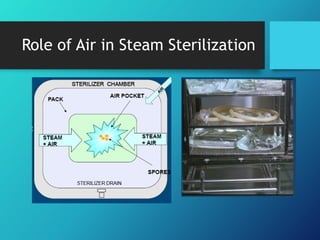
Role of Air in Steam Sterilization
• Air and steam do not mix readily.
• Air is heavier than steam.
• If items to be sterilized are wrapped too tightly
than entrapped air cannot escape forming cool
pockets inside packages preventing steam from
reaching sufficient temperature to kill all
microorganisms.
• Heat carrying capacity of air is much less than
steam
• Debris in drain strainer may form air layer which
preventing effective operation of steam sterilizer
Role of Air in Steam Sterilization
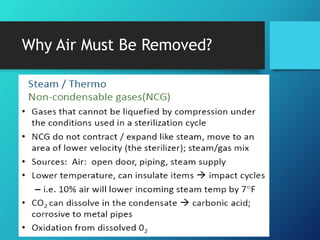
Why Air Must Be Removed?
• Air is enemy since the heat power is steam
• Air does not mix readily with steam and sinks
to the bottom of chamber
• Entrapped air pockets touches the surfaces,
impairing killing effect of steam
Why Air Must Be Removed?
Equilibration Time
• As per EN 285 2016, Equilibration time is
‘period which elapses between the attainment
of the sterilization temperature at the
reference measurement point and the
attainment of the sterilization temperature at
all points within the load’.
• Equilibration time 15 seconds for the
Autoclaves of size less than 800 L
• 30 seconds for the Autoclaves of size more
than 800 L
Usage of Autoclave
• Filling Assemblies includes filling needles and tubing
• Components for filling, filtration etc (vessels, containers,
glassware, sampling bottles)
• Garments
• Rubber stoppers, aluminium seals
• Filters, silicone tubing, gloves
• Documents and labels
• Components for environmental monitoring in aseptic areas
• Components for area sanitization like buckets, sponge mops,
wipes, sanitization bottles, etc
• Accessories like forceps, tools, clamps, bio-breathable papers
• And so on…
Regulatory Observations
• Inadequate control of autoclave sterilization
cycles
• Single door autoclaves instead of double door
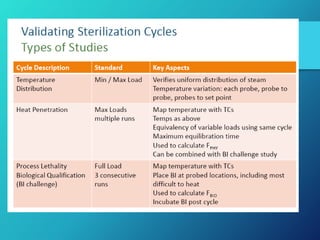
• The porous load steriliser data did not meet
current equilibration requirements
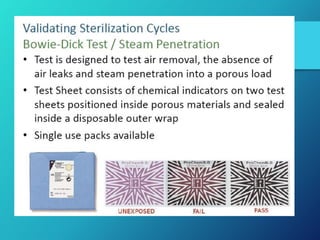
• Leak rate and air removal testing was not
frequent enough
• Sterilizer load patterns were not adequately
defined in SOP
Advantages of Steam
Sterilization
• It is preferred way of destroying
microorganism
• It is non-toxic
• Kills spores
• Inexpensive
• Cycles are fast
Disadvantages of Steam
Sterilization
• Steam can be hazardous certain pieces of
equipment
• If steam is not pure than it can get into very
small lumens and block them
• Pitting or discoloration of metal when come in
contact with steam that wasn’t pure
• Not suitable for moisture sensitive materials
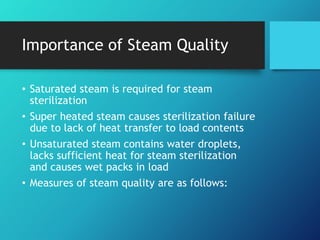
Importance of Steam Quality
• Saturated steam is required for steam
sterilization
• Super heated steam causes sterilization failure
due to lack of heat transfer to load contents
• Unsaturated steam contains water droplets,
lacks sufficient heat for steam sterilization
and causes wet packs in load
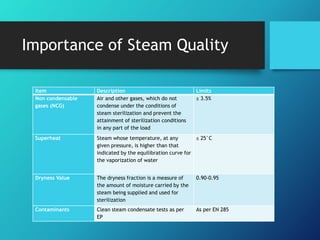
• Measures of steam quality are as follows:
Importance of Steam Quality
Item Description Limits
Non condensable
gases (NCG)
Air and other gases, which do not
condense under the conditions of
steam sterilization and prevent the
attainment of sterilization conditions
in any part of the load
≤ 3.5%
Superheat Steam whose temperature, at any
given pressure, is higher than that
indicated by the equilibration curve for
the vaporization of water
≤ 25°C
Dryness Value The dryness fraction is a measure of
the amount of moisture carried by the
steam being supplied and used for
sterilization
0.90-0.95
Contaminants Clean steam condensate tests as per
EP
As per EN 285
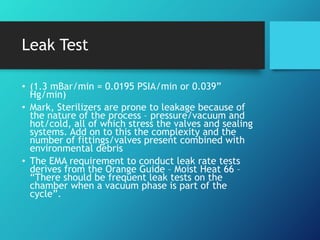
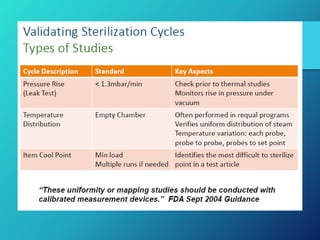
Leak Test
• (1.3 mBar/min = 0.0195 PSIA/min or 0.039”
Hg/min)
• Mark, Sterilizers are prone to leakage because of
the nature of the process – pressure/vacuum and
hot/cold, all of which stress the valves and sealing
systems. Add on to this the complexity and the
number of fittings/valves present combined with
environmental debris
• The EMA requirement to conduct leak rate tests
derives from the Orange Guide – Moist Heat 66 –
“There should be frequent leak tests on the
chamber when a vacuum phase is part of the
cycle”.
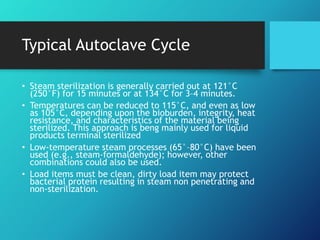
Typical Autoclave Cycle
• Steam sterilization is generally carried out at 121°C
(250°F) for 15 minutes or at 134°C for 3–4 minutes.
• Temperatures can be reduced to 115°C, and even as low
as 105°C, depending upon the bioburden, integrity, heat
resistance, and characteristics of the material being
sterilized. This approach is beng mainly used for liquid
products terminal sterilized
• Low-temperature steam processes (65°–80°C) have been
used (e.g., steam-formaldehyde); however, other
combinations could also be used.
• Load items must be clean, dirty load item may protect
bacterial protein resulting in steam non penetrating and
non-sterilization.
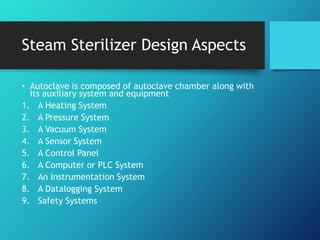
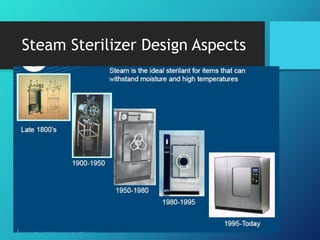
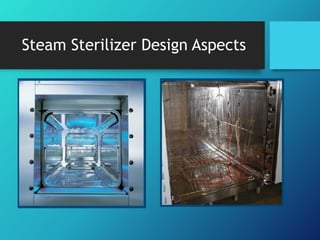
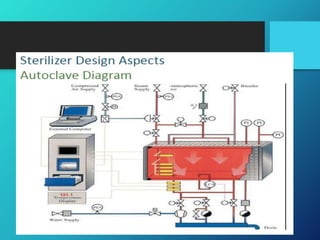
Steam Sterilizer Design Aspects
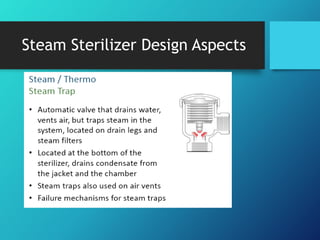
• Autoclave is composed of autoclave chamber along with
its auxiliary system and equipment
1. A Heating System
2. A Pressure System
3. A Vacuum System
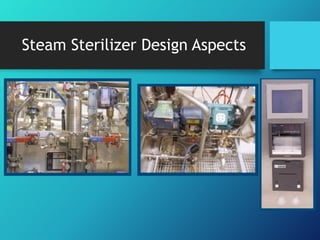
4. A Sensor System
5. A Control Panel
6. A Computer or PLC System
7. An Instrumentation System
8. A Datalogging System
9. Safety Systems
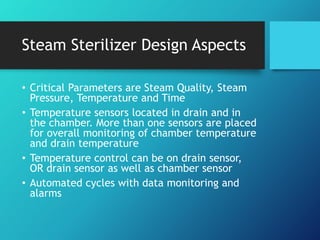
Steam Sterilizer Design Aspects
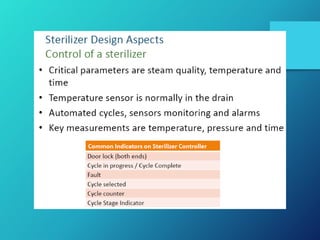
• Critical Parameters are Steam Quality, Steam
Pressure, Temperature and Time
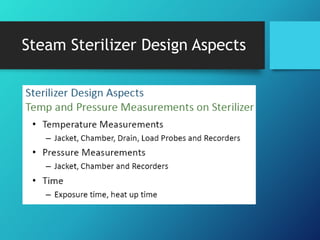
• Temperature sensors located in drain and in
the chamber. More than one sensors are placed
for overall monitoring of chamber temperature
and drain temperature
• Temperature control can be on drain sensor,
OR drain sensor as well as chamber sensor
• Automated cycles with data monitoring and
alarms
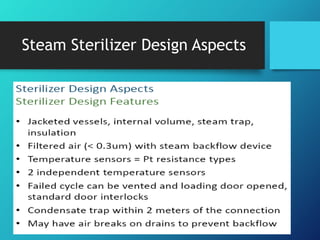
Steam Sterilizer Design Aspects
Mechanism of Sterilization
• Most of the heating power of steam comes
from its latent heat of vaporization. This is the
amount of heat required to convert boiling
water to steam.
• This amount of heat is large compared to that
required to make water hot. For example, it
takes 80 calories to make 1 liter of water boil,
but 540 calories to convert that boiling water
to steam. Therefore, steam at 100º C has
almost seven times more heat
Mechanism of Sterilization
• Steam is able to penetrate objects with cooler
temperatures because once the steam contacts a
cooler surface it immediately condenses to water,
producing a concomitant 1,870 fold decrease in
steam volume. This creates negative pressure at
the point of condensation and draws more steam
to the area. Condensations continues so long as the
temperature of the condensing surface is less than
that of steam. These properties ensure rapid
heating of surfaces, good penetration of dense
materials, and coagulation of proteins.
Why steam is so Effective?
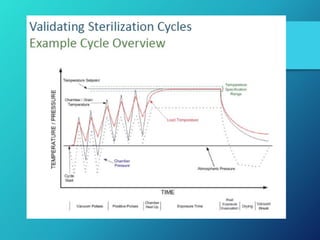
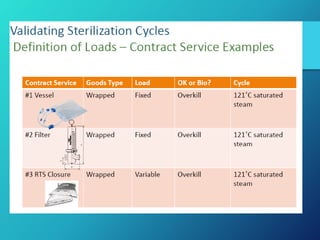
Validation of Sterilization Cycle
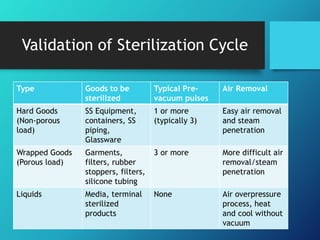
Type Goods to be
sterilized
Typical Pre-
vacuum pulses
Air Removal
Hard Goods
(Non-porous
load)
SS Equipment,
containers, SS
piping,
Glassware
1 or more
(typically 3)
Easy air removal
and steam
penetration
Wrapped Goods
(Porous load)
Garments,
filters, rubber
stoppers, filters,
silicone tubing
3 or more More difficult air
removal/steam
penetration
Liquids Media, terminal
sterilized
products
None Air overpressure
process, heat
and cool without
vacuum
Validation of Sterilization Cycle
Load items must be clean, dirty load item
may protect bacterial protein resulting in
Load items must be clean, dirty load item
may protect bacterial protein resulting in
Load items must be clean, dirty load item
may protect bacterial protein resulting in
Load items must be clean, dirty load item
may protect bacterial protein resulting in
Load items must be clean, dirty load item
may protect bacterial protein resulting in
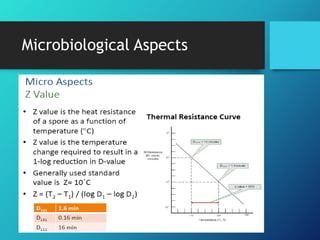
Microbiological Aspects
• Sterility Assurance Level
The probability of a single viable microorganism
being present on a sterilized unit is one in one
million after the item has undergone a
sterilization process; often called a six log
reduction
For potential products, desire a SAL of 106
Microbiological Aspects
Hope this is of some Help
•This is not all inclusive but
can help/direct to
understand more about
autoclave
•Thank You For Your Time
•DHAVAL SURTI
t.me/Pharmatalks

traning on autoclave for microbiologist.pdf

  • 1.
    Training on Autoclave By DhavalSurti @Pharmatalks_group
  • 2.
    What is AnAutoclave? • An autoclave is like a large pressure cooker; it operates by using steam under pressure as the sterilizing agent. High pressures enable steam to reach high temperatures, thus increasing its heat content and killing power. • Autoclave and Steam Sterilizer words are used for same equipment interchangeably • Charles Chamberland invented first real steam sterilizer in 1880. • First steam sterilizer looked like pressure cooker and also worked in same way.
  • 3.
    How steam killsmicroorganism? • Autoclave operates using steam under high pressure as sterilizing agent. • High pressures enables steam to reach high temperature, thus increasing heat content and killing power. • Most of heating power of steam comes from its latent heat of vaporization. This is the amount of heat required to make water hot. • It takes 80 calories to make 1 litre of water to boil, but 540 calories to convert that boiling water to steam • Therefore steam at 100 C has almost seven times more heat than boiling water
  • 4.
    How steam killsmicroorganism? • Steam is able to penetrate objects with cooler temperatures because once the steam contacts a cooler surface, it immediately condenses to water, producing a concomitant 1870 fold decrease in steam volume. • This creates a negative pressure at the point of condensation and draws more steam to the area. • Condensations continues to so long as the temperature of the condensing surface is less than that of steam; once temperatures equilibrate, a saturated steam environment is formed.
  • 5.
    How steam killsmicroorganism? • Moist heat is thought to kill microorganisms by causing coagulation of essential proteins. • When heat is used as sterilizing agent, the vibratory motion of every molecule of a microorganism is increased to levels that induce cleavage of intramolecular hydrogen bonds between proteins. • Death is therefore caused by an accumulation of irreversible damage to all metabolic functions of the organism
  • 6.
    Role of Airin Steam Sterilization • Air and steam do not mix readily. • Air is heavier than steam. • If items to be sterilized are wrapped too tightly than entrapped air cannot escape forming cool pockets inside packages preventing steam from reaching sufficient temperature to kill all microorganisms. • Heat carrying capacity of air is much less than steam • Debris in drain strainer may form air layer which preventing effective operation of steam sterilizer
  • 7.
    Role of Airin Steam Sterilization
  • 8.
    Why Air MustBe Removed? • Air is enemy since the heat power is steam • Air does not mix readily with steam and sinks to the bottom of chamber • Entrapped air pockets touches the surfaces, impairing killing effect of steam
  • 9.
    Why Air MustBe Removed?
  • 10.
    Equilibration Time • Asper EN 285 2016, Equilibration time is ‘period which elapses between the attainment of the sterilization temperature at the reference measurement point and the attainment of the sterilization temperature at all points within the load’. • Equilibration time 15 seconds for the Autoclaves of size less than 800 L • 30 seconds for the Autoclaves of size more than 800 L
  • 11.
    Usage of Autoclave •Filling Assemblies includes filling needles and tubing • Components for filling, filtration etc (vessels, containers, glassware, sampling bottles) • Garments • Rubber stoppers, aluminium seals • Filters, silicone tubing, gloves • Documents and labels • Components for environmental monitoring in aseptic areas • Components for area sanitization like buckets, sponge mops, wipes, sanitization bottles, etc • Accessories like forceps, tools, clamps, bio-breathable papers • And so on…
  • 12.
    Regulatory Observations • Inadequatecontrol of autoclave sterilization cycles • Single door autoclaves instead of double door • The porous load steriliser data did not meet current equilibration requirements • Leak rate and air removal testing was not frequent enough • Sterilizer load patterns were not adequately defined in SOP
  • 13.
    Advantages of Steam Sterilization •It is preferred way of destroying microorganism • It is non-toxic • Kills spores • Inexpensive • Cycles are fast
  • 14.
    Disadvantages of Steam Sterilization •Steam can be hazardous certain pieces of equipment • If steam is not pure than it can get into very small lumens and block them • Pitting or discoloration of metal when come in contact with steam that wasn’t pure • Not suitable for moisture sensitive materials
  • 15.
    Importance of SteamQuality • Saturated steam is required for steam sterilization • Super heated steam causes sterilization failure due to lack of heat transfer to load contents • Unsaturated steam contains water droplets, lacks sufficient heat for steam sterilization and causes wet packs in load • Measures of steam quality are as follows:
  • 16.
    Importance of SteamQuality Item Description Limits Non condensable gases (NCG) Air and other gases, which do not condense under the conditions of steam sterilization and prevent the attainment of sterilization conditions in any part of the load ≤ 3.5% Superheat Steam whose temperature, at any given pressure, is higher than that indicated by the equilibration curve for the vaporization of water ≤ 25°C Dryness Value The dryness fraction is a measure of the amount of moisture carried by the steam being supplied and used for sterilization 0.90-0.95 Contaminants Clean steam condensate tests as per EP As per EN 285
  • 17.
    Leak Test • (1.3mBar/min = 0.0195 PSIA/min or 0.039” Hg/min) • Mark, Sterilizers are prone to leakage because of the nature of the process – pressure/vacuum and hot/cold, all of which stress the valves and sealing systems. Add on to this the complexity and the number of fittings/valves present combined with environmental debris • The EMA requirement to conduct leak rate tests derives from the Orange Guide – Moist Heat 66 – “There should be frequent leak tests on the chamber when a vacuum phase is part of the cycle”.
  • 18.
    Typical Autoclave Cycle •Steam sterilization is generally carried out at 121°C (250°F) for 15 minutes or at 134°C for 3–4 minutes. • Temperatures can be reduced to 115°C, and even as low as 105°C, depending upon the bioburden, integrity, heat resistance, and characteristics of the material being sterilized. This approach is beng mainly used for liquid products terminal sterilized • Low-temperature steam processes (65°–80°C) have been used (e.g., steam-formaldehyde); however, other combinations could also be used. • Load items must be clean, dirty load item may protect bacterial protein resulting in steam non penetrating and non-sterilization.
  • 19.
    Steam Sterilizer DesignAspects • Autoclave is composed of autoclave chamber along with its auxiliary system and equipment 1. A Heating System 2. A Pressure System 3. A Vacuum System 4. A Sensor System 5. A Control Panel 6. A Computer or PLC System 7. An Instrumentation System 8. A Datalogging System 9. Safety Systems
  • 20.
  • 21.
  • 22.
  • 23.
  • 25.
    Steam Sterilizer DesignAspects • Critical Parameters are Steam Quality, Steam Pressure, Temperature and Time • Temperature sensors located in drain and in the chamber. More than one sensors are placed for overall monitoring of chamber temperature and drain temperature • Temperature control can be on drain sensor, OR drain sensor as well as chamber sensor • Automated cycles with data monitoring and alarms
  • 27.
  • 28.
  • 29.
  • 30.
    Mechanism of Sterilization •Most of the heating power of steam comes from its latent heat of vaporization. This is the amount of heat required to convert boiling water to steam. • This amount of heat is large compared to that required to make water hot. For example, it takes 80 calories to make 1 liter of water boil, but 540 calories to convert that boiling water to steam. Therefore, steam at 100º C has almost seven times more heat
  • 31.
    Mechanism of Sterilization •Steam is able to penetrate objects with cooler temperatures because once the steam contacts a cooler surface it immediately condenses to water, producing a concomitant 1,870 fold decrease in steam volume. This creates negative pressure at the point of condensation and draws more steam to the area. Condensations continues so long as the temperature of the condensing surface is less than that of steam. These properties ensure rapid heating of surfaces, good penetration of dense materials, and coagulation of proteins.
  • 32.
    Why steam isso Effective?
  • 33.
  • 34.
    Validation of SterilizationCycle Type Goods to be sterilized Typical Pre- vacuum pulses Air Removal Hard Goods (Non-porous load) SS Equipment, containers, SS piping, Glassware 1 or more (typically 3) Easy air removal and steam penetration Wrapped Goods (Porous load) Garments, filters, rubber stoppers, filters, silicone tubing 3 or more More difficult air removal/steam penetration Liquids Media, terminal sterilized products None Air overpressure process, heat and cool without vacuum
  • 35.
  • 43.
    Load items mustbe clean, dirty load item may protect bacterial protein resulting in Load items must be clean, dirty load item may protect bacterial protein resulting in Load items must be clean, dirty load item may protect bacterial protein resulting in Load items must be clean, dirty load item may protect bacterial protein resulting in Load items must be clean, dirty load item may protect bacterial protein resulting in
  • 44.
  • 45.
    Microbiological Aspects • SterilityAssurance Level The probability of a single viable microorganism being present on a sterilized unit is one in one million after the item has undergone a sterilization process; often called a six log reduction For potential products, desire a SAL of 106
  • 46.
  • 47.
  • 48.
  • 49.
  • 50.
  • 51.
  • 52.
  • 53.
    Hope this isof some Help •This is not all inclusive but can help/direct to understand more about autoclave •Thank You For Your Time •DHAVAL SURTI t.me/Pharmatalks