Chapter 7
TRAIT THEORIES:
ALLPORT, EYSENCK, CATTELL
QUESTIONS TO BE ADDRESSED
IN THIS CHAPTER
1. What are the main ways in which people differ
from each another in their thoughts, feelings,
and behavior? How many different personality
traits are needed to adequately describe these
individual differences?
2. Does every person have a unique set of
personality traits or is there a universal set of
traits that provides a taxonomy of individual
differences?
3. If people can be described in terms of traits,
how can we explain variability in behavior over
time and across situations?
TRAIT THEORY’S VIEW OF THE
PERSON
TRAIT = a consistent pattern of behavior, emotion,
and thought
•2 connotations:
1. Stability (traits describe regularity in behavior)
2. Distinctiveness (traits distinguish among individuals)
•Assumption - people possess psychological
qualities that endure over time and across
situations
•Building a personality theory on traits implies that
people are consistent regardless of experience
TRAIT THEORY’S VIEW OF THE
SCIENCE OF PERSONALITY
SCIENTIFIC FUNCTIONS SERVED BY TRAIT
CONSTRUCTS
•Description
•Traits summarize a person’s typical behavior,
emotion, and thought and, thus, what a person is
usually like
•Trait theories provide descriptive facts that must
be explained by other theories of personality
•Most trait theorists try to establish a framework
within which any and all persons can be described
•Trait theorists try to establish a personality
taxonomy = a way of classifying the traits being
studied
TRAIT THEORY’S VIEW OF THE
SCIENCE OF PERSONALITY
SCIENTIFIC FUNCTIONS SERVED BY TRAIT
CONSTRUCTS
•Prediction
•With traits, one should be able to predict
everyday behavior and aspects of personal
environments
•With traits, one can make predictions that
have practical value (e.g., predicting which
applicants are most appropriate for a job)
TRAIT THEORY’S VIEW OF THE
SCIENCE OF PERSONALITY
SCIENTIFIC FUNCTIONS SERVED BY TRAIT
CONSTRUCTS
•Explanation
•The most important challenge for a scientific theory; differs
from prediction
•One can predict without being able to explain and can
explain without being able to predict
•Some trait theorists use traits to describe and predict
•Others treat traits as if they can explain – inferring
biological factors that underlie traits
•Most trait theorists believe that inherited genetic factors
are the main determinant of individual differences in traits
(40-60%)
PERSPECTIVES SHARED BY
TRAIT THEORISTS
• People possess broad predispositions to
respond in certain ways
• People who have a strong tendency to respond
in certain ways are high on certain traits; people
who have less of a tendency to respond in
certain ways are low on certain traits
• There is a correlation between possession of a
certain trait and performance on trait-related
actions
• Traits can be organized hierarchically
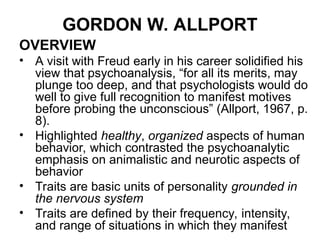
GORDON W. ALLPORT
OVERVIEW
• A visit with Freud early in his career solidified his
view that psychoanalysis, “for all its merits, may
plunge too deep, and that psychologists would do
well to give full recognition to manifest motives
before probing the unconscious” (Allport, 1967, p.
8).
• Highlighted healthy, organized aspects of human
behavior, which contrasted the psychoanalytic
emphasis on animalistic and neurotic aspects of
behavior
• Traits are basic units of personality grounded in
the nervous system
• Traits are defined by their frequency, intensity,
and range of situations in which they manifest
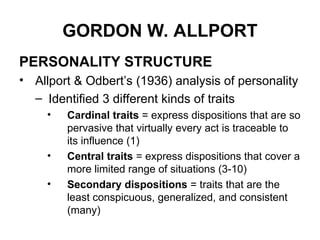
GORDON W. ALLPORT
PERSONALITY STRUCTURE
• Allport & Odbert’s (1936) analysis of personality
– Identified 3 different kinds of traits
• Cardinal traits = express dispositions that are so
pervasive that virtually every act is traceable to
its influence (1)
• Central traits = express dispositions that cover a
more limited range of situations (3-10)
• Secondary dispositions = traits that are the
least conspicuous, generalized, and consistent
(many)
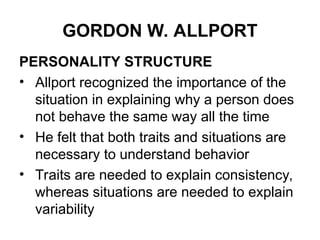
GORDON W. ALLPORT
PERSONALITY STRUCTURE
• Allport recognized the importance of the
situation in explaining why a person does
not behave the same way all the time
• He felt that both traits and situations are
necessary to understand behavior
• Traits are needed to explain consistency,
whereas situations are needed to explain
variability
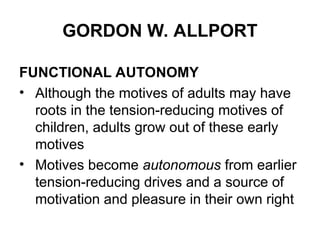
GORDON W. ALLPORT
FUNCTIONAL AUTONOMY
• Although the motives of adults may have
roots in the tension-reducing motives of
children, adults grow out of these early
motives
• Motives become autonomous from earlier
tension-reducing drives and a source of
motivation and pleasure in their own right
GORDON W. ALLPORT
IDIOGRAPHIC RESEARCH
• The idiographic approach adopts the in-
depth study of presumably unique
individuals as a way to learn about people
generally
• Contrasts with other trait theorists, who
generally adopt a nomothetic approach
in which large numbers of individuals are
described in terms of a common set of
traits
RAYMOND B. CATTELL
OVERVIEW
• Was a professor and director of the Laboratory
of Personality Assessment at the U of I for most
of his career
• Background in chemistry helped CATTELL to
recognize the importance of a taxonomy of
traits, much like the periodic table
• Viewed factor analysis as the tool for
discovering a set of basic “psychological
elements” (traits) that would form the foundation
of personality
RAYMOND B. CATTELL
FACTOR ANALSYIS = a statistical tool for
summarizing how a large number of
variables are related
• In a typical factor-analytic study, many
different measures are administered to many
respondents
• Some scores will be positively correlated with
one another; others negatively correlated
• These correlations might reflect the influence
of a more basic, underlying factor
RAYMOND B. CATTELL
• Factor analysis is the main way that trait
theorists identify the primary trait
dimensions of personality
• Factor analysis identifies patterns of
covariation in responses, yet does not
explain why these responses covary
• The researcher, using his or her
knowledge of psychology and related
fields, interprets the patterns of
covariation
RAYMOND B. CATTELL
STRUCTURE
• Surface traits = response tendencies
that can be observed in various situations
• Source traits = core internal
psychological structures that are the
underlying cause of the observed
intercorrelations among surface traits
RAYMOND B. CATTELL
STRUCTURE
• The factors that summarize the correlations
among surface traits are called source traits,
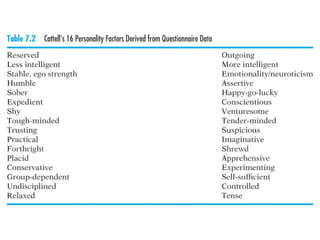
• CATTELL identified 16 source traits which he
grouped into 3 categories:
– Ability traits = traits that facilitate adaptive
functioning
– Temperament traits = traits that influence
emotions
– Dynamic traits = traits that direct motivation
RAYMOND B. CATTELL
SOURCES OF EVIDENCE: L-DATA,
Q DATA, AND OT-DATA
•L-data = life-record data
– Measures of behavior in everyday situations
(e.g., school performance)
– May be actual counts of behavior or ratings
based on observations
•Q-data = self-report or questionnaire data
RAYMOND B. CATTELL
SOURCES OF EVIDENCE: L-DATA,
Q DATA, AND OT-DATA
•OT-data = objective-test data
– Recording of behavior in situations where
participants are unaware of the relationship
between their responses and a certain trait
(e.g., experiment)
– The trait of assertiveness can be expressed
behaviorally, such as fast tempo in arm-
shoulder movement or fast speed of letter
comparisons
RAYMOND B. CATTELL
SOURCES OF EVIDENCE: L-DATA,
Q DATA, AND OT-DATA
• CATTELL’s Sixteen Personality Factor
Questionnaire (16 PF) was derived from
factor analyses of Q-data
• However, CATTELL was concerned with
possible self-deception in questionnaire
responses and the wisdom of psychiatric
patients’ self-ratings
• Later, he relied on OT-data in his factor-
analytic research
RAYMOND B. CATTELL
STABILITY AND VARIABILITY
• CATTELL did not view people as static
organisms who respond the same way in all
situations
• He highlighted two other determinants of action:
states and roles
– States = fluctuations in emotion (mood) that are
partly influenced by the immediate situation
– Roles = responses prescribed by interpersonal
relations in discrete sociocultural circumstances
• Traits, states, and roles interact in complex
ways to produce behavior in situations
HANS J. EYSENCK
OVERVIEW
• Eysenck’s three-factor theory was influenced by
− Factor analysis
− Psychologists who studied personality types (e.g., Jung)
− Experimental work on classical conditioning by Pavlov
• Eysenck believed that psychoanalysis failed to provide
reliable and valid measures of personality constructs
• Eysenck believed that sound measures of individual
differences were necessary to identify the biological
foundations of traits
• Eysenck recognized that without understanding the
biology of traits, trait explanations could be circular
HANS J. EYSENCK
STRUCTURE
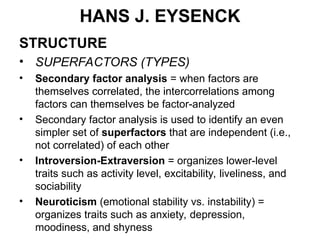
• SUPERFACTORS (TYPES)
• Secondary factor analysis = when factors are
themselves correlated, the intercorrelations among
factors can themselves be factor-analyzed
• Secondary factor analysis is used to identify an even
simpler set of superfactors that are independent (i.e.,
not correlated) of each other
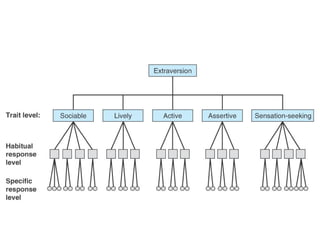
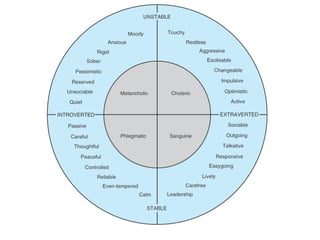
• Introversion-Extraversion = organizes lower-level
traits such as activity level, excitability, liveliness, and
sociability
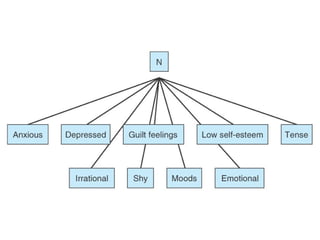
• Neuroticism (emotional stability vs. instability) =
organizes traits such as anxiety, depression,
moodiness, and shyness
HANS J. EYSENCK
STRUCTURE
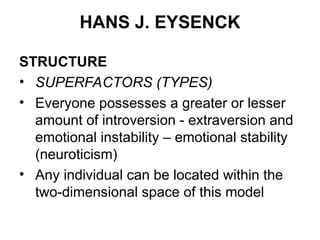
• SUPERFACTORS (TYPES)
• Everyone possesses a greater or lesser
amount of introversion - extraversion and
emotional instability – emotional stability
(neuroticism)
• Any individual can be located within the
two-dimensional space of this model
HANS J. EYSENCK
STRUCTURE
• SUPERFACTORS (TYPES)
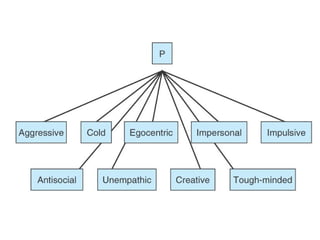
• Eysenck later added a third superfactor
• Psychoticism = abnormal qualities,
including aggressiveness, antisocial
tendencies, lack of empathy, and
idiosyncratic thinking
• Eysenck’s three factors are: PEN
HANS J. EYSENCK
MEASURING SUPERFACTORS
• Eysenck developed self-report items to
measure each factor
• The typical extravert will answer “Yes” to
– “Do other people think of you as very lively?”
– “Would you be unhappy if you could not see
lots of people most of the time?”
• The typical introvert will answer “Yes” to
– “Generally, do you prefer reading to meeting
people?”
– “Are you mostly quiet when you are with
people?”
HANS J. EYSENCK
MEASURING SUPERFACTORS
• Eysenck also devised objective indices
based on his belief in the biological basis
for individual differences in personality
– Lemon drop test - lemon juice is placed on a
participant’s tongue
– Introverts and extraverts differ in the amount
of saliva they produce in response to
stimulation
HANS J. EYSENCK
BIOLOGICAL BASIS OF PERSONALITY
• Individual differences in introversion-
extraversion reflect individual differences
in the neurophysiological functioning of
the cortex of the brain
– Introverts experience more cortical arousal
from events than do extraverts (e.g., intense
social stimuli overarouse introverts, leading
to socially inhibition and withdrawal
– Extraverts experience less cortical arousal
than introverts from the same stimulus (e.g.,
due to underarousal, extroverts seek and
create more lively social environments)
HANS J. EYSENCK
BIOLOGICAL BASIS OF PERSONALITY
• If traits have a biological basis, then
individual differences in introversion-
extraversion should be at least partly
hereditary
• Comparisons of identical with fraternal
twins show that heredity accounts for
some of the variations between
individuals in introversion-extraversion
HANS J. EYSENCK
BIOLOGICAL BASIS OF PERSONALITY
• Other evidence consistent with Eysenck’s
biological theorizing
– Individual differences in introversion-extraversion are
stable over time
– Introversion-extraversion is found cross-culturally
– Various indices of biological functioning correlate
with introversion-extraversion scores, including:
• Brain activity
• Heart rate
• Hormone level
• Sweat-gland activity
HANS J. EYSENCK
BIOLOGICAL BASIS OF PERSONALITY
• Still other evidence consistent with
Eysenck’s biological theorizing indicates
that introverts as compared to extraverts
– Are more sensitive to pain
– Become fatigued more easily
– Experience decrements in performance when
excited
– Tend to be more careful
HANS J. EYSENCK
I-E AND SOCIAL BEHAVIOR
• Campbell & Hawley (1982) investigated the
study habits introverts and extraverts
– More extraverts than introverts chose to
study in library locations where there was
external stimulation
– Extraverts took more study breaks than did
introverts
– Extraverts preferred higher noise levels and
more opportunities to socialize while studying
than did introverts
HANS J. EYSENCK
PSYCHOPATHOLOGY
• Psychological disorders can be related to
superfactors and to central nervous system
functioning associated with these superfactors
• A person develops neurotic symptoms because
the interaction of biological tendencies and
environmental experiences produce conditioned
emotional reactions to fear-producing stimuli
• A majority of neurotic patients tend to have high
Neuroticism and low Extraversion scores
• Criminals and antisocial people tend to be high
on Neuroticism, Extraversion, and Psychoticism
HANS J. EYSENCK
BEHAVIOR CHANGE
• Eysenck was optimistic about the
remediation of psychopathology
• Although people inherit genetic
predispositions, it is possible for them to
– Avoid traumatic situations
– Unlearn fear responses
– Learn adaptive social conduct

7107638.pptnnnnnnnñbbbvvvcfffccccccccxxc

  • 1.
  • 2.
    QUESTIONS TO BEADDRESSED IN THIS CHAPTER 1. What are the main ways in which people differ from each another in their thoughts, feelings, and behavior? How many different personality traits are needed to adequately describe these individual differences? 2. Does every person have a unique set of personality traits or is there a universal set of traits that provides a taxonomy of individual differences? 3. If people can be described in terms of traits, how can we explain variability in behavior over time and across situations?
  • 4.
    TRAIT THEORY’S VIEWOF THE PERSON TRAIT = a consistent pattern of behavior, emotion, and thought •2 connotations: 1. Stability (traits describe regularity in behavior) 2. Distinctiveness (traits distinguish among individuals) •Assumption - people possess psychological qualities that endure over time and across situations •Building a personality theory on traits implies that people are consistent regardless of experience
  • 5.
    TRAIT THEORY’S VIEWOF THE SCIENCE OF PERSONALITY SCIENTIFIC FUNCTIONS SERVED BY TRAIT CONSTRUCTS •Description •Traits summarize a person’s typical behavior, emotion, and thought and, thus, what a person is usually like •Trait theories provide descriptive facts that must be explained by other theories of personality •Most trait theorists try to establish a framework within which any and all persons can be described •Trait theorists try to establish a personality taxonomy = a way of classifying the traits being studied
  • 6.
    TRAIT THEORY’S VIEWOF THE SCIENCE OF PERSONALITY SCIENTIFIC FUNCTIONS SERVED BY TRAIT CONSTRUCTS •Prediction •With traits, one should be able to predict everyday behavior and aspects of personal environments •With traits, one can make predictions that have practical value (e.g., predicting which applicants are most appropriate for a job)
  • 7.
    TRAIT THEORY’S VIEWOF THE SCIENCE OF PERSONALITY SCIENTIFIC FUNCTIONS SERVED BY TRAIT CONSTRUCTS •Explanation •The most important challenge for a scientific theory; differs from prediction •One can predict without being able to explain and can explain without being able to predict •Some trait theorists use traits to describe and predict •Others treat traits as if they can explain – inferring biological factors that underlie traits •Most trait theorists believe that inherited genetic factors are the main determinant of individual differences in traits (40-60%)
  • 8.
    PERSPECTIVES SHARED BY TRAITTHEORISTS • People possess broad predispositions to respond in certain ways • People who have a strong tendency to respond in certain ways are high on certain traits; people who have less of a tendency to respond in certain ways are low on certain traits • There is a correlation between possession of a certain trait and performance on trait-related actions • Traits can be organized hierarchically
  • 9.
    GORDON W. ALLPORT OVERVIEW •A visit with Freud early in his career solidified his view that psychoanalysis, “for all its merits, may plunge too deep, and that psychologists would do well to give full recognition to manifest motives before probing the unconscious” (Allport, 1967, p. 8). • Highlighted healthy, organized aspects of human behavior, which contrasted the psychoanalytic emphasis on animalistic and neurotic aspects of behavior • Traits are basic units of personality grounded in the nervous system • Traits are defined by their frequency, intensity, and range of situations in which they manifest
  • 10.
    GORDON W. ALLPORT PERSONALITYSTRUCTURE • Allport & Odbert’s (1936) analysis of personality – Identified 3 different kinds of traits • Cardinal traits = express dispositions that are so pervasive that virtually every act is traceable to its influence (1) • Central traits = express dispositions that cover a more limited range of situations (3-10) • Secondary dispositions = traits that are the least conspicuous, generalized, and consistent (many)
  • 11.
    GORDON W. ALLPORT PERSONALITYSTRUCTURE • Allport recognized the importance of the situation in explaining why a person does not behave the same way all the time • He felt that both traits and situations are necessary to understand behavior • Traits are needed to explain consistency, whereas situations are needed to explain variability
  • 12.
    GORDON W. ALLPORT FUNCTIONALAUTONOMY • Although the motives of adults may have roots in the tension-reducing motives of children, adults grow out of these early motives • Motives become autonomous from earlier tension-reducing drives and a source of motivation and pleasure in their own right
  • 13.
    GORDON W. ALLPORT IDIOGRAPHICRESEARCH • The idiographic approach adopts the in- depth study of presumably unique individuals as a way to learn about people generally • Contrasts with other trait theorists, who generally adopt a nomothetic approach in which large numbers of individuals are described in terms of a common set of traits
  • 14.
    RAYMOND B. CATTELL OVERVIEW •Was a professor and director of the Laboratory of Personality Assessment at the U of I for most of his career • Background in chemistry helped CATTELL to recognize the importance of a taxonomy of traits, much like the periodic table • Viewed factor analysis as the tool for discovering a set of basic “psychological elements” (traits) that would form the foundation of personality
  • 15.
    RAYMOND B. CATTELL FACTORANALSYIS = a statistical tool for summarizing how a large number of variables are related • In a typical factor-analytic study, many different measures are administered to many respondents • Some scores will be positively correlated with one another; others negatively correlated • These correlations might reflect the influence of a more basic, underlying factor
  • 16.
    RAYMOND B. CATTELL •Factor analysis is the main way that trait theorists identify the primary trait dimensions of personality • Factor analysis identifies patterns of covariation in responses, yet does not explain why these responses covary • The researcher, using his or her knowledge of psychology and related fields, interprets the patterns of covariation
  • 17.
    RAYMOND B. CATTELL STRUCTURE •Surface traits = response tendencies that can be observed in various situations • Source traits = core internal psychological structures that are the underlying cause of the observed intercorrelations among surface traits
  • 18.
    RAYMOND B. CATTELL STRUCTURE •The factors that summarize the correlations among surface traits are called source traits, • CATTELL identified 16 source traits which he grouped into 3 categories: – Ability traits = traits that facilitate adaptive functioning – Temperament traits = traits that influence emotions – Dynamic traits = traits that direct motivation
  • 19.
    RAYMOND B. CATTELL SOURCESOF EVIDENCE: L-DATA, Q DATA, AND OT-DATA •L-data = life-record data – Measures of behavior in everyday situations (e.g., school performance) – May be actual counts of behavior or ratings based on observations •Q-data = self-report or questionnaire data
  • 20.
    RAYMOND B. CATTELL SOURCESOF EVIDENCE: L-DATA, Q DATA, AND OT-DATA •OT-data = objective-test data – Recording of behavior in situations where participants are unaware of the relationship between their responses and a certain trait (e.g., experiment) – The trait of assertiveness can be expressed behaviorally, such as fast tempo in arm- shoulder movement or fast speed of letter comparisons
  • 21.
    RAYMOND B. CATTELL SOURCESOF EVIDENCE: L-DATA, Q DATA, AND OT-DATA • CATTELL’s Sixteen Personality Factor Questionnaire (16 PF) was derived from factor analyses of Q-data • However, CATTELL was concerned with possible self-deception in questionnaire responses and the wisdom of psychiatric patients’ self-ratings • Later, he relied on OT-data in his factor- analytic research
  • 23.
    RAYMOND B. CATTELL STABILITYAND VARIABILITY • CATTELL did not view people as static organisms who respond the same way in all situations • He highlighted two other determinants of action: states and roles – States = fluctuations in emotion (mood) that are partly influenced by the immediate situation – Roles = responses prescribed by interpersonal relations in discrete sociocultural circumstances • Traits, states, and roles interact in complex ways to produce behavior in situations
  • 24.
    HANS J. EYSENCK OVERVIEW •Eysenck’s three-factor theory was influenced by − Factor analysis − Psychologists who studied personality types (e.g., Jung) − Experimental work on classical conditioning by Pavlov • Eysenck believed that psychoanalysis failed to provide reliable and valid measures of personality constructs • Eysenck believed that sound measures of individual differences were necessary to identify the biological foundations of traits • Eysenck recognized that without understanding the biology of traits, trait explanations could be circular
  • 25.
    HANS J. EYSENCK STRUCTURE •SUPERFACTORS (TYPES) • Secondary factor analysis = when factors are themselves correlated, the intercorrelations among factors can themselves be factor-analyzed • Secondary factor analysis is used to identify an even simpler set of superfactors that are independent (i.e., not correlated) of each other • Introversion-Extraversion = organizes lower-level traits such as activity level, excitability, liveliness, and sociability • Neuroticism (emotional stability vs. instability) = organizes traits such as anxiety, depression, moodiness, and shyness
  • 28.
    HANS J. EYSENCK STRUCTURE •SUPERFACTORS (TYPES) • Everyone possesses a greater or lesser amount of introversion - extraversion and emotional instability – emotional stability (neuroticism) • Any individual can be located within the two-dimensional space of this model
  • 30.
    HANS J. EYSENCK STRUCTURE •SUPERFACTORS (TYPES) • Eysenck later added a third superfactor • Psychoticism = abnormal qualities, including aggressiveness, antisocial tendencies, lack of empathy, and idiosyncratic thinking • Eysenck’s three factors are: PEN
  • 32.
    HANS J. EYSENCK MEASURINGSUPERFACTORS • Eysenck developed self-report items to measure each factor • The typical extravert will answer “Yes” to – “Do other people think of you as very lively?” – “Would you be unhappy if you could not see lots of people most of the time?” • The typical introvert will answer “Yes” to – “Generally, do you prefer reading to meeting people?” – “Are you mostly quiet when you are with people?”
  • 33.
    HANS J. EYSENCK MEASURINGSUPERFACTORS • Eysenck also devised objective indices based on his belief in the biological basis for individual differences in personality – Lemon drop test - lemon juice is placed on a participant’s tongue – Introverts and extraverts differ in the amount of saliva they produce in response to stimulation
  • 34.
    HANS J. EYSENCK BIOLOGICALBASIS OF PERSONALITY • Individual differences in introversion- extraversion reflect individual differences in the neurophysiological functioning of the cortex of the brain – Introverts experience more cortical arousal from events than do extraverts (e.g., intense social stimuli overarouse introverts, leading to socially inhibition and withdrawal – Extraverts experience less cortical arousal than introverts from the same stimulus (e.g., due to underarousal, extroverts seek and create more lively social environments)
  • 35.
    HANS J. EYSENCK BIOLOGICALBASIS OF PERSONALITY • If traits have a biological basis, then individual differences in introversion- extraversion should be at least partly hereditary • Comparisons of identical with fraternal twins show that heredity accounts for some of the variations between individuals in introversion-extraversion
  • 36.
    HANS J. EYSENCK BIOLOGICALBASIS OF PERSONALITY • Other evidence consistent with Eysenck’s biological theorizing – Individual differences in introversion-extraversion are stable over time – Introversion-extraversion is found cross-culturally – Various indices of biological functioning correlate with introversion-extraversion scores, including: • Brain activity • Heart rate • Hormone level • Sweat-gland activity
  • 37.
    HANS J. EYSENCK BIOLOGICALBASIS OF PERSONALITY • Still other evidence consistent with Eysenck’s biological theorizing indicates that introverts as compared to extraverts – Are more sensitive to pain – Become fatigued more easily – Experience decrements in performance when excited – Tend to be more careful
  • 38.
    HANS J. EYSENCK I-EAND SOCIAL BEHAVIOR • Campbell & Hawley (1982) investigated the study habits introverts and extraverts – More extraverts than introverts chose to study in library locations where there was external stimulation – Extraverts took more study breaks than did introverts – Extraverts preferred higher noise levels and more opportunities to socialize while studying than did introverts
  • 39.
    HANS J. EYSENCK PSYCHOPATHOLOGY •Psychological disorders can be related to superfactors and to central nervous system functioning associated with these superfactors • A person develops neurotic symptoms because the interaction of biological tendencies and environmental experiences produce conditioned emotional reactions to fear-producing stimuli • A majority of neurotic patients tend to have high Neuroticism and low Extraversion scores • Criminals and antisocial people tend to be high on Neuroticism, Extraversion, and Psychoticism
  • 40.
    HANS J. EYSENCK BEHAVIORCHANGE • Eysenck was optimistic about the remediation of psychopathology • Although people inherit genetic predispositions, it is possible for them to – Avoid traumatic situations – Unlearn fear responses – Learn adaptive social conduct