






JAIPURIA INSTITUTEOF MANAGEMENT
LUCKNOW
TRAINING PROGRAM @ PNB
SUBMITTED BY-
TASHEEN SHEIKH-JL13PGDM119
TULIKA CHOPRA-JL13PGDM120
VIDHI CHAUHAN-JL13PGDM123
SUBMITTED TO-
PROFPALLAVISRIVASTAVA
ii | P a g e
ACKNOWLEDGMENT
We take this opportunity to express our profound gratitude and deep regards to our guide
Professor Pallavi Srivastava for her exemplary guidance, monitoring and constant
encouragement throughout the course of this project. We also take this opportunity to express a
deep sense of gratitude to Senior Manager PNB JC Joshi,Retired GM PNB Vinod Kr Joel,
Deputy Director PNB Pramod Dixit for their cordial support, valuable information and guidance,
which helped us in completing this task through various stages.
We are obliged to staff members of Punjab National Bank for the valuable information provided
by them in their respective fields. We are grateful for their cooperation during the period of our
Project.
TASHEEN SHEIKH-JL13PGDM119
TULIKA CHOPRA-JL13PGDM120
VIDHI CHAUHAN-JL13PGDM123
Table of Contents
ACKNOWLEDGMENT.......................................................................................................................... ii
INTRODUCTION..................................................................................................................................4
COMPANY PROFILE .......................................................................................................................6
OBJECTIVE OF THE STUDY ...................................................................................................................8
TRAINING NEEDS ASSESSMENT OF PUNJAB NATIONAL BANK................................................................9
METHODOLOGY ...............................................................................................................................10
FEEDBACK FORM..............................................................................................................................11
PROGRAMS ANDPARTICIPANTS........................................................................................................12
DESIGN OF TRAINING PROGRAMME IN PNB.......................................................................................13
IMPLEMENTATION............................................................................................................................15
CONCLUSION....................................................................................................................................17
RECOMMENDATIONS .......................................................................................................................18
BIBLIOGRAPHY.................................................................................................................................19
4 | P a g e
INTRODUCTION
TRAINING AND DEVELOPMENT
After employees have been selected for various positions in an organization, training them for
the specific tasks to which they have been assigned assumes great importance. It is true in many
organizations that before an employee is fitted into a harmonious working relationship with other
employees, he is given adequate training. Training is the act of increasing the knowledge and
skills of an employee for performing a particular job. The major outcome of training is learning.
A trainee learns new habits, refined skills and useful knowledge during the training that helps
him improve performance. Training enables an employee to do his present job more efficiently
and prepare himself for a higher-level job. The essential features of training may be stated thus:
Increases knowledge and skills for doing a particular job; it bridges the gap between job needs
and employee skills, knowledge and behaviors
Focuses attention on the current job: it is job specific and addresses particular performance
deficits or problems
Concentrates on individual employees: changing what employees know, how they work, their
attitudes toward their work or their interactions with their co-workers or supervisors
Tends to be more narrowly focused and oriented toward short-term performance concerns.
5 | P a g e
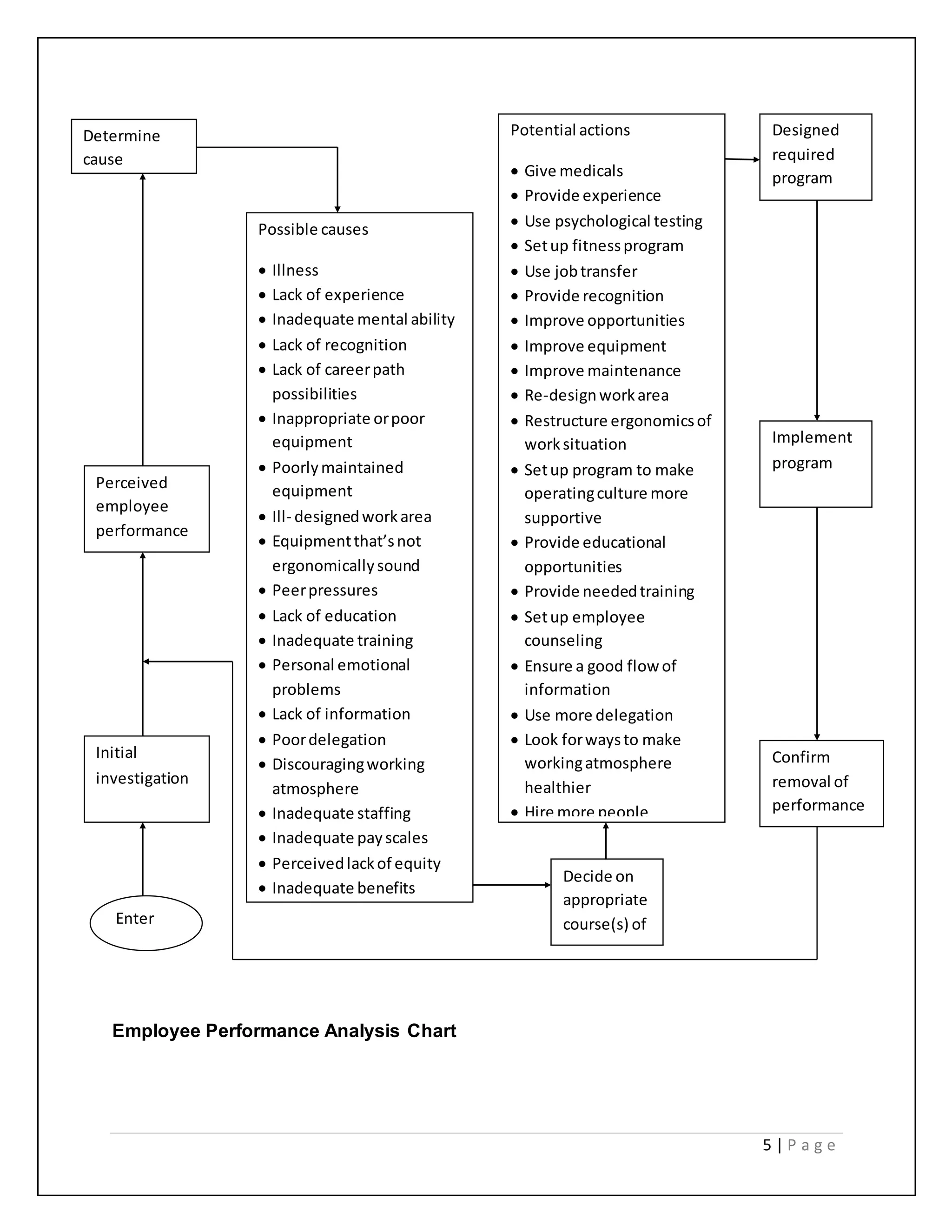
Employee Performance Analysis Chart
Determine
cause
Perceived
employee
performance
discrepancy
Initial
investigation
Enter
Possible causes
 Illness
 Lack of experience
 Inadequate mental ability
 Lack of recognition
 Lack of careerpath
possibilities
 Inappropriate orpoor
equipment
 Poorlymaintained
equipment
 Ill- designedworkarea
 Equipmentthat’snot
ergonomicallysound
 Peerpressures
 Lack of education
 Inadequate training
 Personal emotional
problems
 Lack of information
 Poordelegation
 Discouragingworking
atmosphere
 Inadequate staffing
 Inadequate payscales
 Perceivedlackof equity
 Inadequate benefits
 Poorphysical environment
 Conflictingdemands
 Unionrestrictions
 Legal restrictions
Etc.
Potential actions
 Give medicals
 Provide experience
 Use psychological testing
 Setup fitnessprogram
 Use jobtransfer
 Provide recognition
 Improve opportunities
 Improve equipment
 Improve maintenance
 Re-designworkarea
 Restructure ergonomicsof
worksituation
 Setup program to make
operatingculture more
supportive
 Provide educational
opportunities
 Provide neededtraining
 Setup employee
counseling
 Ensure a good flow of
information
 Use more delegation
 Look forwaysto make
workingatmosphere
healthier
 Hire more people
 Improve payscales
 Improve physical
environment
 Improve supervision
 Sort out demands
 Work withunions
 Improve legal aspects
Etc
Decide on
appropriate
course(s) of
action
Designed
required
program
Implement
program
Confirm
removal of
performance
discrepancy
6 | P a g e
COMPANY PROFILE
Punjab National Bank Established in 1895 at Lahore, undivided India, Punjab National
Bank (PNB) has the distinction of being the first bank to have been started solely with
Indian capital. During its existence of over one-hundred years, PNB has faced many
trials of strength including the trauma of partition of India in 1947 at the time of
independence. However, the bank not only withstood such adversities but established
itself firmly on the Indian subcontinent. The bank was nationalized in July 1969 along
with 13 other banks.
Punjab National Bank is serving over 3.5 crore customers through 4497 offices, largest
amongst Nationalized Banks. Amongst Top 1000 World Banks, PNB is ranked at 248th
place according to “The Banker” London. The Bank was recently ranked 38th amongst
top 500 companies by the leading financial daily, Economic Times. PNB’s attempts at
providing best customer service has earned it 9th place among India's Most Trusted top
50 service brands in Economic Times- A.C Nielson Survey.
PNB offers a wide variety of banking services which include:
o corporate and personal banking,
o industrial finance,
o agricultural finance,
o Financing of trade and international banking.
 Among the clients of the bank are multinational companies, Indian conglomerates,
medium and small industrial units, exporters and non-resident Indians. The large
presence and vast resource base have helped the bank to build strong links with trade and
industry.
 The bank provides finance to agriculture and allied activities and Small Scale Industries
(SSI). The bank has established 16 specialized branches to finance exclusively SSIs. The
bank is ranked 515 among the biggest banks in the world by Banker's Almanac (Jan
2000) London.
7 | P a g e
 Punjab National Bank has a strong banking relationship with 217 leading international
banks all over the world enhances its capabilities to handle transactions world-wide.
Besides, bank has Rupee Drawing Arrangements with exchange companies in the Gulf.
Bank is a member of the SWIFT and 75 branches of the bank are connected through its
computer-based terminal at Mumbai. The bank also maintains accounts in 13 currencies.
With its dealing rooms and well-trained dealers, the bank offers Forex dealing in India.
 Keeping with its tradition of excellence in customer service PNB has adopted a quality
movement Alliance with Quality. Under this as many as 364 offices of the bank have
been awarded the coveted ISO 9002 certification. The bank further planning to cover
more offices under this quality movement.
 Internet Banking services are available through all Branches of the Bank networked
under CBS. Providing 24 hours, 365 days banking right from the PC of the user, Internet
Banking offers world class banking facilities like anytime, anywhere access to account,
complete details of transactions, and statement of account, online information of deposits,
loans overdraft account etc. PNB has recently introduced Online Payment Facility for
railway reservation through IRCTC Payment Gateway Project and Online Utility Bill
Payment Services which allows Internet Banking account holders to pay their telephone,
mobile, electricity, insurance and other bills anytime from anywhere from their desktop.
 Another step taken by PNB in meeting the changing aspirations of its clientele is the
launch of its Debit card, which is also an A TM card. It enables the card holder to buy
goods and services at over 99270 merchant establishments across the country. Besides,
the card can be used to withdraw cash at more than 11000 A TMs, where the 'Maestro'
logo is displayed, apart from the PNB’s over 555 A TMs and tie up arrangements with
other Banks.
8 | P a g e
OBJECTIVE OF THE STUDY
The primary objective of our study at Punjab National Bank is to lay down the foundation of
training and development.
 Our another objective is to apply my learning in the area of Human Resources so that we
gain significant practical understand of the nature and importance of training and
development and identify the various inputs that should go into any programme.
 To know the effectiveness of the training programme conducted by the company.
 To know whether employees are aware about their responsibilities and authorities or not.
 To improve Organizational Climate and increase the morale of employees.
 To know whether the present training programme is conducted successfully or not.
 To know about the work culture of the organization and plan the training program.
9 | P a g e
TRAINING NEEDS ASSESSMENT OF PUNJAB NATIONAL BANK
 In order to assess there is a system of maintenance of inventory cards at regional as well
as zonal office level. While submitting their performance form, the officer staffs indicates
the Areas in which they need training as to improve their skills and perform the job
better. The appraising authority and the reviewing authority are required to take a note of
this feedback from the staff and the inventory cards are being maintained at
regional/zonal offices are required to be upgraded and keep up to date, keeping in view
the training need mentioned by the staff.
 For identifying the training needs, the branch manager should submit the information on
annual basis to the regional office on or before 31st December every year, the same
should be consolidated at regional office for the whole region and submitted to the zonal
office on or before 10th of January every year.
 The inventory cards keep a record of the training provided to an employee from time to
time and whenever decisions are taken for the nominations of the participants, these cards
are kept in view so as to provide the appropriate training to the employees keeping in
view his self-opinion.
 Zonal training coordinator frequently interacts with the principal/training manager of the
training center/college looking after the training requirements. Regional managers and
other senior officials visit the branches quarterly to make a point to interact with the staff
members and assessment of the training requirement is one of the areas, which are
discussed to bring all around improvement in the working of the branch.
Sometimes, the Bank conducts open sessions where the employees themselves state their
training needs on an informal basis and it is the controlling officer who thereby decides
whether the need is reasonable or not. The Performance Appraisal Report is also
occasionally used as a source to identify training needs of employees.
10 | P a g e
TNA at PNB:
 Employees working for more than 15years than the new recruits face issues with
operational issues based at the technological levels.
 Communication and skill gaps between the new joiners’ and the older ones which
leads to lack of healthy and friendly work place environment.
 Since, there is complete lack of employee engagement, the employees face a
monotonous schedule of work which makes them irritated and frustrated which
results in resistance to change.
 Due to this there is lack in customer orientation.
 Lack of knowledge current knowledge about the competitors.
 Restricted to the allotted work set up than taking any other responsibility for the
branch or the bank as the whole.
METHODOLOGY
Tools of Data collection
Data has been collected by the following means:
Primary Sources: It includesPersonal interviews were held with the officers with special focus on
the prevailing their views and suggestions.
Secondary Sources: secondary data collected with the help of books available in the library, and
Internet. Other published materials such as Training Interventions by Harry Barrington, Training
and development by P L Rao, Training and Analysis. Reference was also made to Bank’s web
site “www.Pnbindia.com”
11 | P a g e
FEEDBACK FORM
12 | P a g e
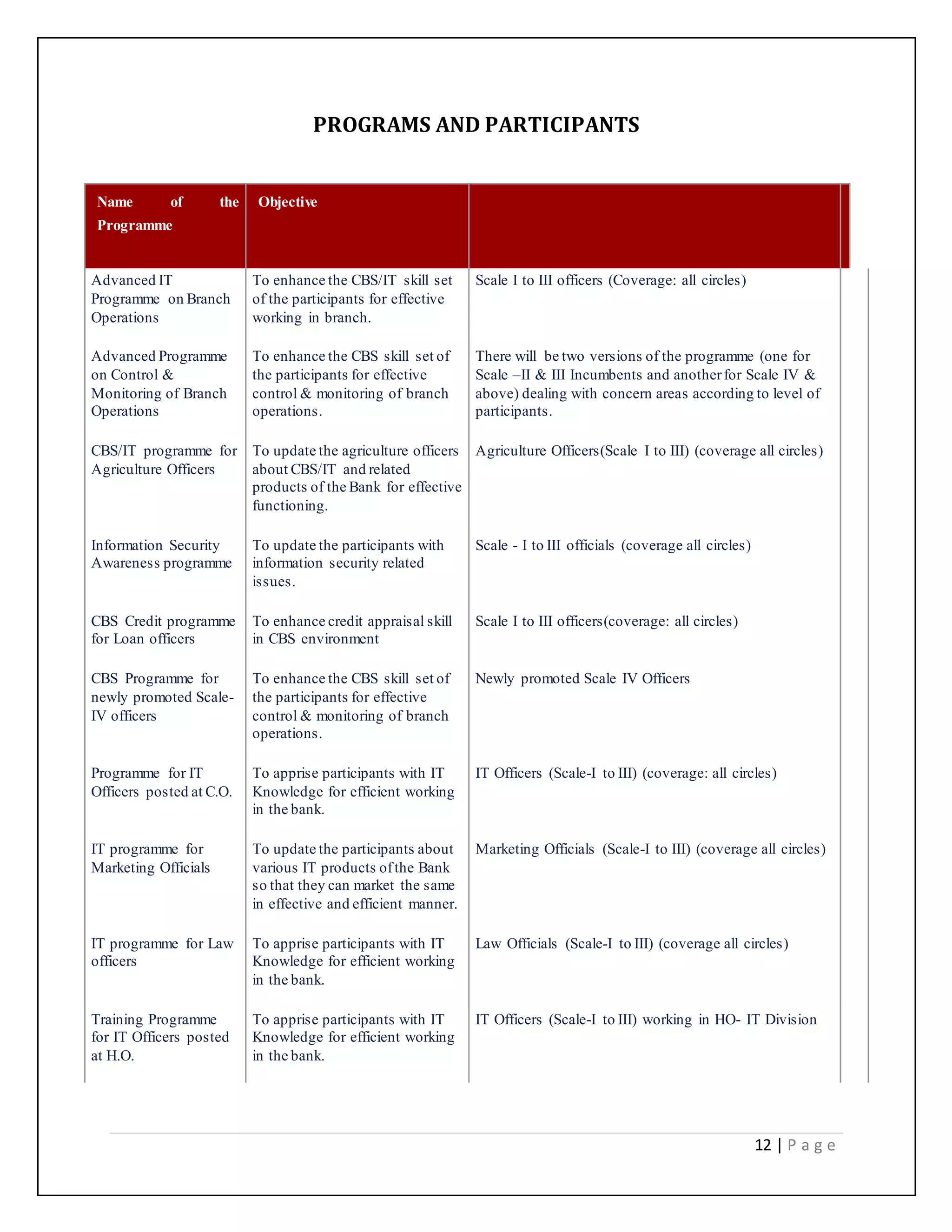
PROGRAMS AND PARTICIPANTS
Name of the
Programme
Objective
Advanced IT
Programme on Branch
Operations
To enhance the CBS/IT skill set
of the participants for effective
working in branch.
Scale I to III officers (Coverage: all circles)
Advanced Programme
on Control &
Monitoring of Branch
Operations
To enhance the CBS skill set of
the participants for effective
control & monitoring of branch
operations.
There will be two versions of the programme (one for
Scale –II & III Incumbents and anotherfor Scale IV &
above) dealing with concern areas according to level of
participants.
CBS/IT programme for
Agriculture Officers
To update the agriculture officers
about CBS/IT and related
products of the Bank for effective
functioning.
Agriculture Officers(Scale I to III) (coverage all circles)
Information Security
Awareness programme
To update the participants with
information security related
issues.
Scale - I to III officials (coverage all circles)
CBS Credit programme
for Loan officers
To enhance credit appraisal skill
in CBS environment
Scale I to III officers(coverage: all circles)
CBS Programme for
newly promoted Scale-
IV officers
To enhance the CBS skill set of
the participants for effective
control & monitoring of branch
operations.
Newly promoted Scale IV Officers
Programme for IT
Officers posted at C.O.
To apprise participants with IT
Knowledge for efficient working
in the bank.
IT Officers (Scale-I to III) (coverage: all circles)
IT programme for
Marketing Officials
To update the participants about
various IT products ofthe Bank
so that they can market the same
in effective and efficient manner.
Marketing Officials (Scale-I to III) (coverage all circles)
IT programme for Law
officers
To apprise participants with IT
Knowledge for efficient working
in the bank.
Law Officials (Scale-I to III) (coverage all circles)
Training Programme
for IT Officers posted
at H.O.
To apprise participants with IT
Knowledge for efficient working
in the bank.
IT Officers (Scale-I to III) working in HO- IT Division
13 | P a g e
Auditing and control
aspects in CBS
To equip the auditors with
various auditing and control tools
in CBS environment & efficient
analysis of MIS reports through
IT tools.
There will be two versions of the programme (one for
auditors up to Scale III and another for Scale IV auditors)
dealing with concern areas according to level of
participants.
Source:http://www.pnbiit.ac.in/
DESIGN OF TRAINING PROGRAMME IN PNB
The training system within the bank has been oriented so as to be responsive of the thrust areas
system being thrown up in the banking environment and create a pool of trained/skilled
personnel at various levels of hierarchy so as to efficiently manage the branches and provide
customer satisfying services. However, training at PNB is not mandatory for all employees but it
has been certainly felt that every employee should be trained at least once in 3 years.
The training programs implemented by the bank concentrate not only on providing conceptual
framework but also developing problem-solving skills with the aid of various pedagogical tools
so as to enable trainees to face the practical problems in the field emerging from time to time.
A conscious effort has been made not only to enrich the knowledge of the participants on the
present assignments but also to expose them to the development-taking place in the banking
environment so as to groom them in the future.
The training infrastructure has been oriented towards providing intensive training in tropical
areas like Credit, Foreign Exchange, Merchant banking & computers as well as short training in
the job specific and activity specific areas. The training forums serve as vital platform for the
senior executives to disseminate and explain the banks for credit policies, objectives and share
the views on our bank performance visa-versa the system.
The senior authorities take the opportunities to obtain the feedback from participants, which are
essential and integral to the process of management of any buoyant and vibrant system.
This two-way interaction helps the field staff to better appreciate even in the environment that is
challenging at the corporate level and also helps the corporate management to obtain effective
14 | P a g e
feedback, which facilitate formulation of strategies and policies for achievement of corporate
objectives.
Schedule of the program:
The programme coordinator while designing the programme schedule should notice
following points:
 The objective of the programme should be clearly spelt out. Not only it should be
mentioned in the programme schedule but it must be made clear to participants at the
beginning.
 The level of the participants, their existing knowledge, skills and experience should
be kept in mind before finalizing the programme schedule to know from what level of
knowledge the trainer should concentrate and carry the participants with him trill
every aspect of the subject is cleared.
 Training can be very interesting, enriching experience if the faculty provides variety,
mixing practical with theory sessions, quoting from personnel experiences and
allowing time for discussion and absorption.
 Adequate time should be available for doing justice to all the subjects.
 Flexibility in the design of the programme would ensure that participants do not have
to learn those aspects which they already know and whenever such situation is faced
by the faculty, either the level of discussion may be increased or subject may be
changed.
 An inbuilt feedback system to facilitate revision, if any, desired by the participants
during the course of the programmed may be planned and some cushion periods
should be provided.
 The programme coordinator should prepare brief synopsis of each topic to be covered
during the programme in case the standardized synopsis are not available and he may
revise or improve the standardize synopsis also in the light of latest developments and
requirements.
15 | P a g e
IMPLEMENTATION
After the training manager at the Zonal Training Center (ZTC) draws the draft of the training
plan as per the exigency. The draft is then sent to the Zonal Manger who in turn sends it to the
Head Office for approval. The draft is approved at the Training Manger's Conference held at the
Head Office and is finally sent to the Zonal Office for implementation. Sometimes, the
concerned departments are also consulted before making the plan. However, the training plan is
subject to changes according to the need of the hour.
Training plan and schedule.
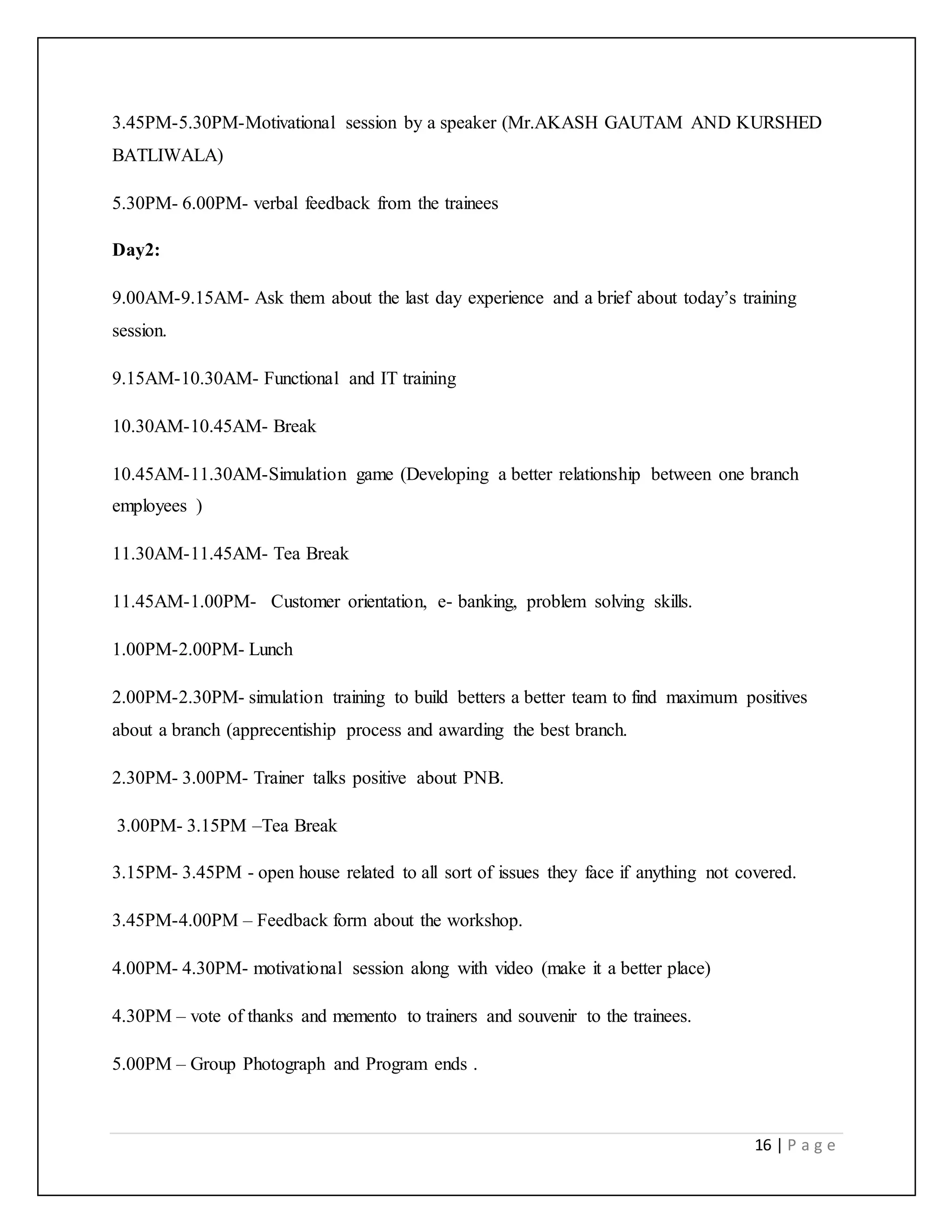
Program Agenda and schedule
Day1:
9.30AM- 9.40 AM – Lighting of lamp and Invocation
9.30AM- 10.00 AM-Welcome Address by Zonal Head and Country Head Traning Officer
10.00AM-10.15AM – Welcome address and introduction of the trainers along with distribution
of kits .
10.15AM-10.30AM- Introduce you to the maximum people in the hall informally (Ice breaking
session)
10.30AM-11.30AM-Informal Interaction between the trainers and the trainee knowing their
needs.
11.30AM- 11.45AM- Break/Tea
11.45AM- 1.00PM - Operational and technical training -1
1.00PM-2.00PM- Lunch
2.00PM-3.30PM-– Soft skills training based on employee internal relations.
3.30PM-3.45PM-Tea break
16 | P a g e
3.45PM-5.30PM-Motivational session by a speaker (Mr.AKASH GAUTAM AND KURSHED
BATLIWALA)
5.30PM- 6.00PM- verbal feedback from the trainees
Day2:
9.00AM-9.15AM- Ask them about the last day experience and a brief about today’s training
session.
9.15AM-10.30AM- Functional and IT training
10.30AM-10.45AM- Break
10.45AM-11.30AM-Simulation game (Developing a better relationship between one branch
employees )
11.30AM-11.45AM- Tea Break
11.45AM-1.00PM- Customer orientation, e- banking, problem solving skills.
1.00PM-2.00PM- Lunch
2.00PM-2.30PM- simulation training to build betters a better team to find maximum positives
about a branch (apprecentiship process and awarding the best branch.
2.30PM- 3.00PM- Trainer talks positive about PNB.
3.00PM- 3.15PM –Tea Break
3.15PM- 3.45PM - open house related to all sort of issues they face if anything not covered.
3.45PM-4.00PM – Feedback form about the workshop.
4.00PM- 4.30PM- motivational session along with video (make it a better place)
4.30PM – vote of thanks and memento to trainers and souvenir to the trainees.
5.00PM – Group Photograph and Program ends .
17 | P a g e
CONCLUSION
After going through the subsystem of HRD namely- Training and Development in Punjab
National Bank, we came to know that this subsystem is highly visible in the organization. All
Human resource development systems must have a strong foundation within the Organization as
an organization is made up of people & function through people, the resource- men, money,
material & machinery are collected coordinated & utilized through people, it is through the
combined efforts of people that material monetary resources are effectively utilized for the
attainment of organizational objectives. As time, passes people become experienced & skilled
which is not so with the other resources that generally depreciate as the time passes by. It is the
man only who with his ability to feel, think, conceive & grow can show his satisfaction or
dissatisfaction, resentment or acceptance for all types of related activities. It is the person at work
who is valued, not the machine, infrastructure or capital.
PNB, realizing the importance of the above fact, has given great emphasis on its Training &
development Activities). PNB come up with a Institute like at institute of informational
technology Punjab National Bank vibhuti khand Gomti Nagar Lucknow
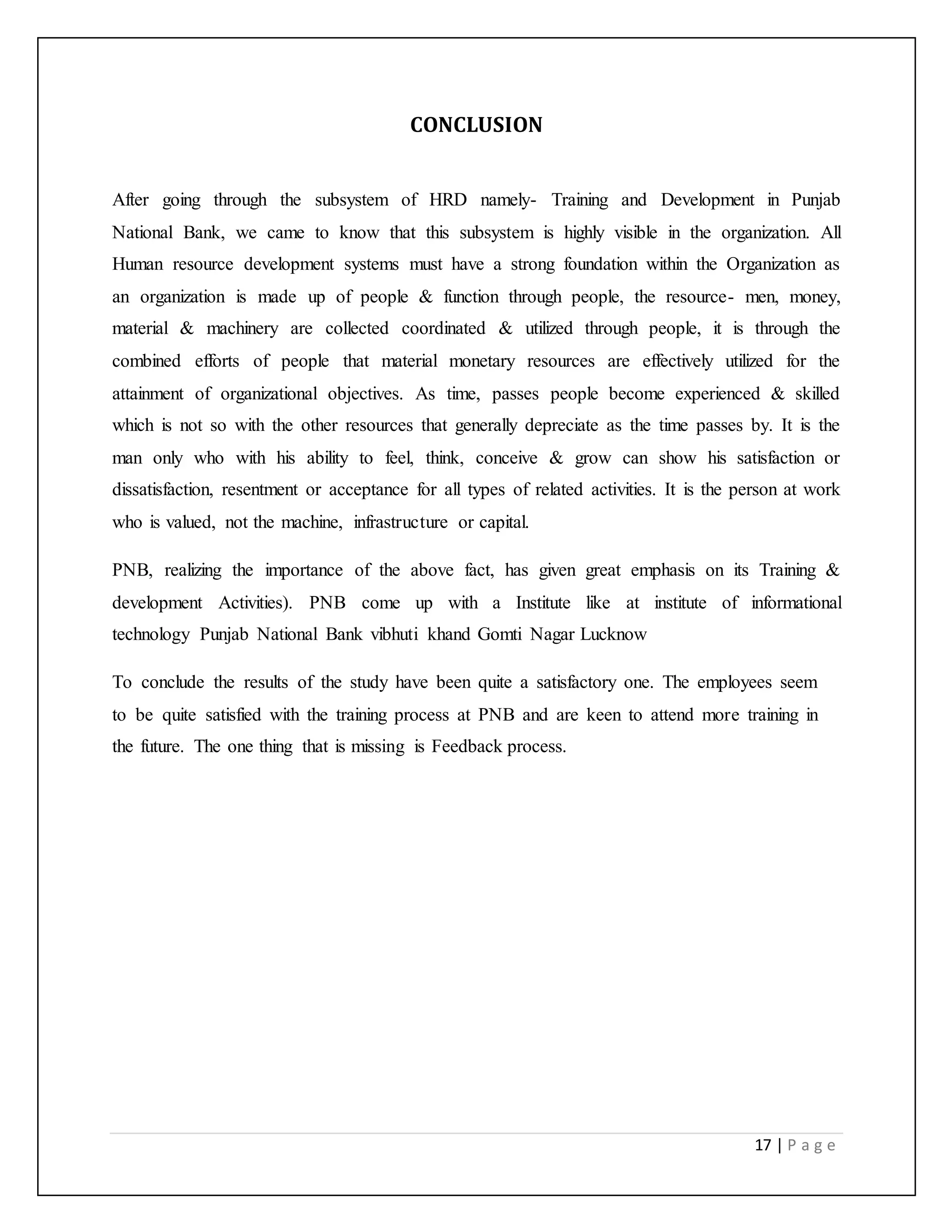
To conclude the results of the study have been quite a satisfactory one. The employees seem
to be quite satisfied with the training process at PNB and are keen to attend more training in
the future. The one thing that is missing is Feedback process.
18 | P a g e
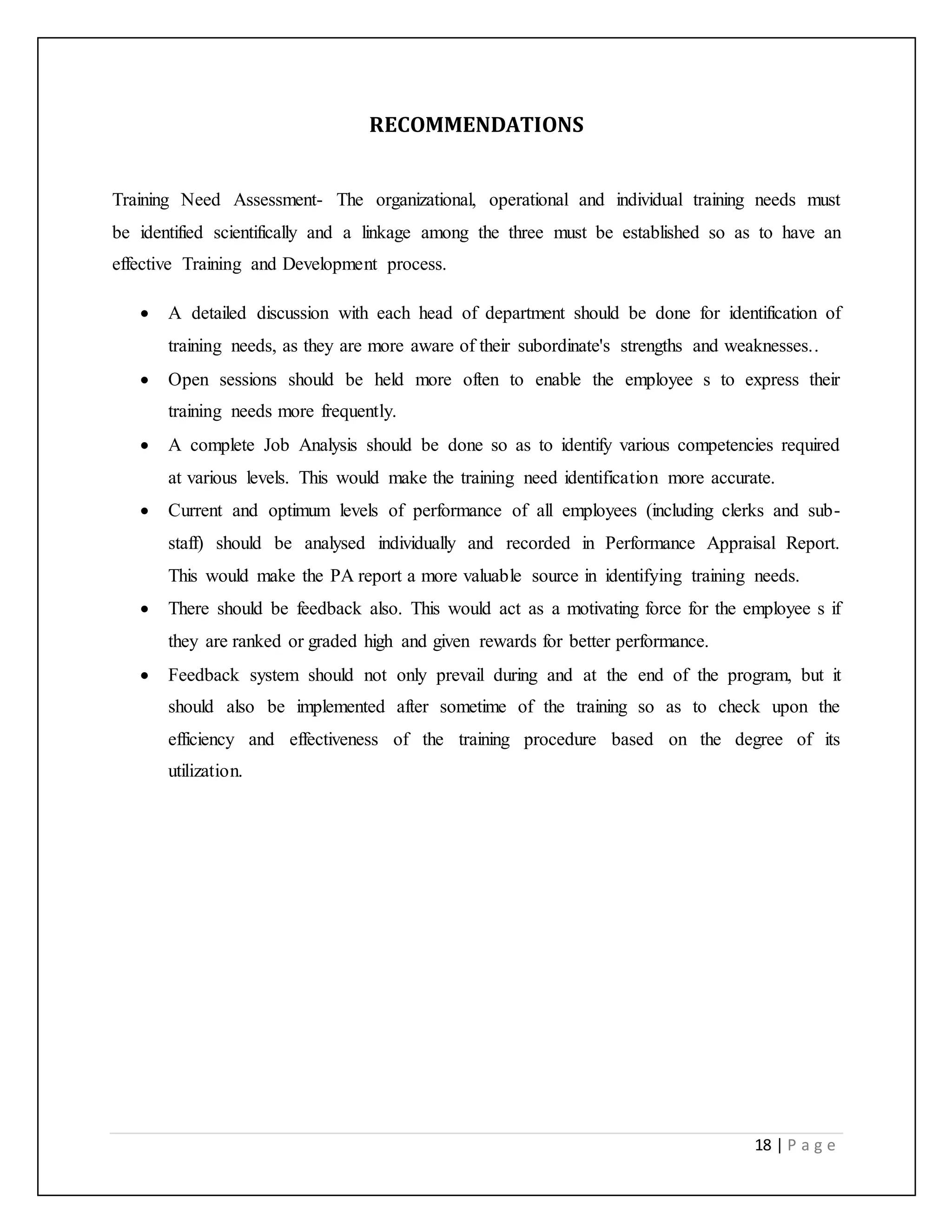
RECOMMENDATIONS
Training Need Assessment- The organizational, operational and individual training needs must
be identified scientifically and a linkage among the three must be established so as to have an
effective Training and Development process.
 A detailed discussion with each head of department should be done for identification of
training needs, as they are more aware of their subordinate's strengths and weaknesses..
 Open sessions should be held more often to enable the employee s to express their
training needs more frequently.
 A complete Job Analysis should be done so as to identify various competencies required
at various levels. This would make the training need identification more accurate.
 Current and optimum levels of performance of all employees (including clerks and sub-
staff) should be analysed individually and recorded in Performance Appraisal Report.
This would make the PA report a more valuable source in identifying training needs.
 There should be feedback also. This would act as a motivating force for the employee s if
they are ranked or graded high and given rewards for better performance.
 Feedback system should not only prevail during and at the end of the program, but it
should also be implemented after sometime of the training so as to check upon the
efficiency and effectiveness of the training procedure based on the degree of its
utilization.
19 | P a g e
BIBLIOGRAPHY
 Institute of Information technology PNB http://www.pnbiit.ac.in/
 PNB www.pnbindia.in/
 Training needs Analysis- Robyn Peterson
 Training and Development- P L Rao
 Training Interventions- Harry Barrington
 Senior Manager PNB JC Joshi- +91941870471
 Retired GM PNB Vinod Kr Joel
 Deputy Director PNB Pramod Dixit.

TRAINING @ PNB

  • 1.
    JAIPURIA INSTITUTEOF MANAGEMENT LUCKNOW TRAININGPROGRAM @ PNB SUBMITTED BY- TASHEEN SHEIKH-JL13PGDM119 TULIKA CHOPRA-JL13PGDM120 VIDHI CHAUHAN-JL13PGDM123 SUBMITTED TO- PROFPALLAVISRIVASTAVA
  • 2.
    ii | Pa g e ACKNOWLEDGMENT We take this opportunity to express our profound gratitude and deep regards to our guide Professor Pallavi Srivastava for her exemplary guidance, monitoring and constant encouragement throughout the course of this project. We also take this opportunity to express a deep sense of gratitude to Senior Manager PNB JC Joshi,Retired GM PNB Vinod Kr Joel, Deputy Director PNB Pramod Dixit for their cordial support, valuable information and guidance, which helped us in completing this task through various stages. We are obliged to staff members of Punjab National Bank for the valuable information provided by them in their respective fields. We are grateful for their cooperation during the period of our Project. TASHEEN SHEIKH-JL13PGDM119 TULIKA CHOPRA-JL13PGDM120 VIDHI CHAUHAN-JL13PGDM123
  • 3.
    Table of Contents ACKNOWLEDGMENT..........................................................................................................................ii INTRODUCTION..................................................................................................................................4 COMPANY PROFILE .......................................................................................................................6 OBJECTIVE OF THE STUDY ...................................................................................................................8 TRAINING NEEDS ASSESSMENT OF PUNJAB NATIONAL BANK................................................................9 METHODOLOGY ...............................................................................................................................10 FEEDBACK FORM..............................................................................................................................11 PROGRAMS ANDPARTICIPANTS........................................................................................................12 DESIGN OF TRAINING PROGRAMME IN PNB.......................................................................................13 IMPLEMENTATION............................................................................................................................15 CONCLUSION....................................................................................................................................17 RECOMMENDATIONS .......................................................................................................................18 BIBLIOGRAPHY.................................................................................................................................19
  • 4.
    4 | Pa g e INTRODUCTION TRAINING AND DEVELOPMENT After employees have been selected for various positions in an organization, training them for the specific tasks to which they have been assigned assumes great importance. It is true in many organizations that before an employee is fitted into a harmonious working relationship with other employees, he is given adequate training. Training is the act of increasing the knowledge and skills of an employee for performing a particular job. The major outcome of training is learning. A trainee learns new habits, refined skills and useful knowledge during the training that helps him improve performance. Training enables an employee to do his present job more efficiently and prepare himself for a higher-level job. The essential features of training may be stated thus: Increases knowledge and skills for doing a particular job; it bridges the gap between job needs and employee skills, knowledge and behaviors Focuses attention on the current job: it is job specific and addresses particular performance deficits or problems Concentrates on individual employees: changing what employees know, how they work, their attitudes toward their work or their interactions with their co-workers or supervisors Tends to be more narrowly focused and oriented toward short-term performance concerns.
  • 5.
    5 | Pa g e Employee Performance Analysis Chart Determine cause Perceived employee performance discrepancy Initial investigation Enter Possible causes  Illness  Lack of experience  Inadequate mental ability  Lack of recognition  Lack of careerpath possibilities  Inappropriate orpoor equipment  Poorlymaintained equipment  Ill- designedworkarea  Equipmentthat’snot ergonomicallysound  Peerpressures  Lack of education  Inadequate training  Personal emotional problems  Lack of information  Poordelegation  Discouragingworking atmosphere  Inadequate staffing  Inadequate payscales  Perceivedlackof equity  Inadequate benefits  Poorphysical environment  Conflictingdemands  Unionrestrictions  Legal restrictions Etc. Potential actions  Give medicals  Provide experience  Use psychological testing  Setup fitnessprogram  Use jobtransfer  Provide recognition  Improve opportunities  Improve equipment  Improve maintenance  Re-designworkarea  Restructure ergonomicsof worksituation  Setup program to make operatingculture more supportive  Provide educational opportunities  Provide neededtraining  Setup employee counseling  Ensure a good flow of information  Use more delegation  Look forwaysto make workingatmosphere healthier  Hire more people  Improve payscales  Improve physical environment  Improve supervision  Sort out demands  Work withunions  Improve legal aspects Etc Decide on appropriate course(s) of action Designed required program Implement program Confirm removal of performance discrepancy
  • 6.
    6 | Pa g e COMPANY PROFILE Punjab National Bank Established in 1895 at Lahore, undivided India, Punjab National Bank (PNB) has the distinction of being the first bank to have been started solely with Indian capital. During its existence of over one-hundred years, PNB has faced many trials of strength including the trauma of partition of India in 1947 at the time of independence. However, the bank not only withstood such adversities but established itself firmly on the Indian subcontinent. The bank was nationalized in July 1969 along with 13 other banks. Punjab National Bank is serving over 3.5 crore customers through 4497 offices, largest amongst Nationalized Banks. Amongst Top 1000 World Banks, PNB is ranked at 248th place according to “The Banker” London. The Bank was recently ranked 38th amongst top 500 companies by the leading financial daily, Economic Times. PNB’s attempts at providing best customer service has earned it 9th place among India's Most Trusted top 50 service brands in Economic Times- A.C Nielson Survey. PNB offers a wide variety of banking services which include: o corporate and personal banking, o industrial finance, o agricultural finance, o Financing of trade and international banking.  Among the clients of the bank are multinational companies, Indian conglomerates, medium and small industrial units, exporters and non-resident Indians. The large presence and vast resource base have helped the bank to build strong links with trade and industry.  The bank provides finance to agriculture and allied activities and Small Scale Industries (SSI). The bank has established 16 specialized branches to finance exclusively SSIs. The bank is ranked 515 among the biggest banks in the world by Banker's Almanac (Jan 2000) London.
  • 7.
    7 | Pa g e  Punjab National Bank has a strong banking relationship with 217 leading international banks all over the world enhances its capabilities to handle transactions world-wide. Besides, bank has Rupee Drawing Arrangements with exchange companies in the Gulf. Bank is a member of the SWIFT and 75 branches of the bank are connected through its computer-based terminal at Mumbai. The bank also maintains accounts in 13 currencies. With its dealing rooms and well-trained dealers, the bank offers Forex dealing in India.  Keeping with its tradition of excellence in customer service PNB has adopted a quality movement Alliance with Quality. Under this as many as 364 offices of the bank have been awarded the coveted ISO 9002 certification. The bank further planning to cover more offices under this quality movement.  Internet Banking services are available through all Branches of the Bank networked under CBS. Providing 24 hours, 365 days banking right from the PC of the user, Internet Banking offers world class banking facilities like anytime, anywhere access to account, complete details of transactions, and statement of account, online information of deposits, loans overdraft account etc. PNB has recently introduced Online Payment Facility for railway reservation through IRCTC Payment Gateway Project and Online Utility Bill Payment Services which allows Internet Banking account holders to pay their telephone, mobile, electricity, insurance and other bills anytime from anywhere from their desktop.  Another step taken by PNB in meeting the changing aspirations of its clientele is the launch of its Debit card, which is also an A TM card. It enables the card holder to buy goods and services at over 99270 merchant establishments across the country. Besides, the card can be used to withdraw cash at more than 11000 A TMs, where the 'Maestro' logo is displayed, apart from the PNB’s over 555 A TMs and tie up arrangements with other Banks.
  • 8.
    8 | Pa g e OBJECTIVE OF THE STUDY The primary objective of our study at Punjab National Bank is to lay down the foundation of training and development.  Our another objective is to apply my learning in the area of Human Resources so that we gain significant practical understand of the nature and importance of training and development and identify the various inputs that should go into any programme.  To know the effectiveness of the training programme conducted by the company.  To know whether employees are aware about their responsibilities and authorities or not.  To improve Organizational Climate and increase the morale of employees.  To know whether the present training programme is conducted successfully or not.  To know about the work culture of the organization and plan the training program.
  • 9.
    9 | Pa g e TRAINING NEEDS ASSESSMENT OF PUNJAB NATIONAL BANK  In order to assess there is a system of maintenance of inventory cards at regional as well as zonal office level. While submitting their performance form, the officer staffs indicates the Areas in which they need training as to improve their skills and perform the job better. The appraising authority and the reviewing authority are required to take a note of this feedback from the staff and the inventory cards are being maintained at regional/zonal offices are required to be upgraded and keep up to date, keeping in view the training need mentioned by the staff.  For identifying the training needs, the branch manager should submit the information on annual basis to the regional office on or before 31st December every year, the same should be consolidated at regional office for the whole region and submitted to the zonal office on or before 10th of January every year.  The inventory cards keep a record of the training provided to an employee from time to time and whenever decisions are taken for the nominations of the participants, these cards are kept in view so as to provide the appropriate training to the employees keeping in view his self-opinion.  Zonal training coordinator frequently interacts with the principal/training manager of the training center/college looking after the training requirements. Regional managers and other senior officials visit the branches quarterly to make a point to interact with the staff members and assessment of the training requirement is one of the areas, which are discussed to bring all around improvement in the working of the branch. Sometimes, the Bank conducts open sessions where the employees themselves state their training needs on an informal basis and it is the controlling officer who thereby decides whether the need is reasonable or not. The Performance Appraisal Report is also occasionally used as a source to identify training needs of employees.
  • 10.
    10 | Pa g e TNA at PNB:  Employees working for more than 15years than the new recruits face issues with operational issues based at the technological levels.  Communication and skill gaps between the new joiners’ and the older ones which leads to lack of healthy and friendly work place environment.  Since, there is complete lack of employee engagement, the employees face a monotonous schedule of work which makes them irritated and frustrated which results in resistance to change.  Due to this there is lack in customer orientation.  Lack of knowledge current knowledge about the competitors.  Restricted to the allotted work set up than taking any other responsibility for the branch or the bank as the whole. METHODOLOGY Tools of Data collection Data has been collected by the following means: Primary Sources: It includesPersonal interviews were held with the officers with special focus on the prevailing their views and suggestions. Secondary Sources: secondary data collected with the help of books available in the library, and Internet. Other published materials such as Training Interventions by Harry Barrington, Training and development by P L Rao, Training and Analysis. Reference was also made to Bank’s web site “www.Pnbindia.com”
  • 11.
    11 | Pa g e FEEDBACK FORM
  • 12.
    12 | Pa g e PROGRAMS AND PARTICIPANTS Name of the Programme Objective Advanced IT Programme on Branch Operations To enhance the CBS/IT skill set of the participants for effective working in branch. Scale I to III officers (Coverage: all circles) Advanced Programme on Control & Monitoring of Branch Operations To enhance the CBS skill set of the participants for effective control & monitoring of branch operations. There will be two versions of the programme (one for Scale –II & III Incumbents and anotherfor Scale IV & above) dealing with concern areas according to level of participants. CBS/IT programme for Agriculture Officers To update the agriculture officers about CBS/IT and related products of the Bank for effective functioning. Agriculture Officers(Scale I to III) (coverage all circles) Information Security Awareness programme To update the participants with information security related issues. Scale - I to III officials (coverage all circles) CBS Credit programme for Loan officers To enhance credit appraisal skill in CBS environment Scale I to III officers(coverage: all circles) CBS Programme for newly promoted Scale- IV officers To enhance the CBS skill set of the participants for effective control & monitoring of branch operations. Newly promoted Scale IV Officers Programme for IT Officers posted at C.O. To apprise participants with IT Knowledge for efficient working in the bank. IT Officers (Scale-I to III) (coverage: all circles) IT programme for Marketing Officials To update the participants about various IT products ofthe Bank so that they can market the same in effective and efficient manner. Marketing Officials (Scale-I to III) (coverage all circles) IT programme for Law officers To apprise participants with IT Knowledge for efficient working in the bank. Law Officials (Scale-I to III) (coverage all circles) Training Programme for IT Officers posted at H.O. To apprise participants with IT Knowledge for efficient working in the bank. IT Officers (Scale-I to III) working in HO- IT Division
  • 13.
    13 | Pa g e Auditing and control aspects in CBS To equip the auditors with various auditing and control tools in CBS environment & efficient analysis of MIS reports through IT tools. There will be two versions of the programme (one for auditors up to Scale III and another for Scale IV auditors) dealing with concern areas according to level of participants. Source:http://www.pnbiit.ac.in/ DESIGN OF TRAINING PROGRAMME IN PNB The training system within the bank has been oriented so as to be responsive of the thrust areas system being thrown up in the banking environment and create a pool of trained/skilled personnel at various levels of hierarchy so as to efficiently manage the branches and provide customer satisfying services. However, training at PNB is not mandatory for all employees but it has been certainly felt that every employee should be trained at least once in 3 years. The training programs implemented by the bank concentrate not only on providing conceptual framework but also developing problem-solving skills with the aid of various pedagogical tools so as to enable trainees to face the practical problems in the field emerging from time to time. A conscious effort has been made not only to enrich the knowledge of the participants on the present assignments but also to expose them to the development-taking place in the banking environment so as to groom them in the future. The training infrastructure has been oriented towards providing intensive training in tropical areas like Credit, Foreign Exchange, Merchant banking & computers as well as short training in the job specific and activity specific areas. The training forums serve as vital platform for the senior executives to disseminate and explain the banks for credit policies, objectives and share the views on our bank performance visa-versa the system. The senior authorities take the opportunities to obtain the feedback from participants, which are essential and integral to the process of management of any buoyant and vibrant system. This two-way interaction helps the field staff to better appreciate even in the environment that is challenging at the corporate level and also helps the corporate management to obtain effective
  • 14.
    14 | Pa g e feedback, which facilitate formulation of strategies and policies for achievement of corporate objectives. Schedule of the program: The programme coordinator while designing the programme schedule should notice following points:  The objective of the programme should be clearly spelt out. Not only it should be mentioned in the programme schedule but it must be made clear to participants at the beginning.  The level of the participants, their existing knowledge, skills and experience should be kept in mind before finalizing the programme schedule to know from what level of knowledge the trainer should concentrate and carry the participants with him trill every aspect of the subject is cleared.  Training can be very interesting, enriching experience if the faculty provides variety, mixing practical with theory sessions, quoting from personnel experiences and allowing time for discussion and absorption.  Adequate time should be available for doing justice to all the subjects.  Flexibility in the design of the programme would ensure that participants do not have to learn those aspects which they already know and whenever such situation is faced by the faculty, either the level of discussion may be increased or subject may be changed.  An inbuilt feedback system to facilitate revision, if any, desired by the participants during the course of the programmed may be planned and some cushion periods should be provided.  The programme coordinator should prepare brief synopsis of each topic to be covered during the programme in case the standardized synopsis are not available and he may revise or improve the standardize synopsis also in the light of latest developments and requirements.
  • 15.
    15 | Pa g e IMPLEMENTATION After the training manager at the Zonal Training Center (ZTC) draws the draft of the training plan as per the exigency. The draft is then sent to the Zonal Manger who in turn sends it to the Head Office for approval. The draft is approved at the Training Manger's Conference held at the Head Office and is finally sent to the Zonal Office for implementation. Sometimes, the concerned departments are also consulted before making the plan. However, the training plan is subject to changes according to the need of the hour. Training plan and schedule. Program Agenda and schedule Day1: 9.30AM- 9.40 AM – Lighting of lamp and Invocation 9.30AM- 10.00 AM-Welcome Address by Zonal Head and Country Head Traning Officer 10.00AM-10.15AM – Welcome address and introduction of the trainers along with distribution of kits . 10.15AM-10.30AM- Introduce you to the maximum people in the hall informally (Ice breaking session) 10.30AM-11.30AM-Informal Interaction between the trainers and the trainee knowing their needs. 11.30AM- 11.45AM- Break/Tea 11.45AM- 1.00PM - Operational and technical training -1 1.00PM-2.00PM- Lunch 2.00PM-3.30PM-– Soft skills training based on employee internal relations. 3.30PM-3.45PM-Tea break
  • 16.
    16 | Pa g e 3.45PM-5.30PM-Motivational session by a speaker (Mr.AKASH GAUTAM AND KURSHED BATLIWALA) 5.30PM- 6.00PM- verbal feedback from the trainees Day2: 9.00AM-9.15AM- Ask them about the last day experience and a brief about today’s training session. 9.15AM-10.30AM- Functional and IT training 10.30AM-10.45AM- Break 10.45AM-11.30AM-Simulation game (Developing a better relationship between one branch employees ) 11.30AM-11.45AM- Tea Break 11.45AM-1.00PM- Customer orientation, e- banking, problem solving skills. 1.00PM-2.00PM- Lunch 2.00PM-2.30PM- simulation training to build betters a better team to find maximum positives about a branch (apprecentiship process and awarding the best branch. 2.30PM- 3.00PM- Trainer talks positive about PNB. 3.00PM- 3.15PM –Tea Break 3.15PM- 3.45PM - open house related to all sort of issues they face if anything not covered. 3.45PM-4.00PM – Feedback form about the workshop. 4.00PM- 4.30PM- motivational session along with video (make it a better place) 4.30PM – vote of thanks and memento to trainers and souvenir to the trainees. 5.00PM – Group Photograph and Program ends .
  • 17.
    17 | Pa g e CONCLUSION After going through the subsystem of HRD namely- Training and Development in Punjab National Bank, we came to know that this subsystem is highly visible in the organization. All Human resource development systems must have a strong foundation within the Organization as an organization is made up of people & function through people, the resource- men, money, material & machinery are collected coordinated & utilized through people, it is through the combined efforts of people that material monetary resources are effectively utilized for the attainment of organizational objectives. As time, passes people become experienced & skilled which is not so with the other resources that generally depreciate as the time passes by. It is the man only who with his ability to feel, think, conceive & grow can show his satisfaction or dissatisfaction, resentment or acceptance for all types of related activities. It is the person at work who is valued, not the machine, infrastructure or capital. PNB, realizing the importance of the above fact, has given great emphasis on its Training & development Activities). PNB come up with a Institute like at institute of informational technology Punjab National Bank vibhuti khand Gomti Nagar Lucknow To conclude the results of the study have been quite a satisfactory one. The employees seem to be quite satisfied with the training process at PNB and are keen to attend more training in the future. The one thing that is missing is Feedback process.
  • 18.
    18 | Pa g e RECOMMENDATIONS Training Need Assessment- The organizational, operational and individual training needs must be identified scientifically and a linkage among the three must be established so as to have an effective Training and Development process.  A detailed discussion with each head of department should be done for identification of training needs, as they are more aware of their subordinate's strengths and weaknesses..  Open sessions should be held more often to enable the employee s to express their training needs more frequently.  A complete Job Analysis should be done so as to identify various competencies required at various levels. This would make the training need identification more accurate.  Current and optimum levels of performance of all employees (including clerks and sub- staff) should be analysed individually and recorded in Performance Appraisal Report. This would make the PA report a more valuable source in identifying training needs.  There should be feedback also. This would act as a motivating force for the employee s if they are ranked or graded high and given rewards for better performance.  Feedback system should not only prevail during and at the end of the program, but it should also be implemented after sometime of the training so as to check upon the efficiency and effectiveness of the training procedure based on the degree of its utilization.
  • 19.
    19 | Pa g e BIBLIOGRAPHY  Institute of Information technology PNB http://www.pnbiit.ac.in/  PNB www.pnbindia.in/  Training needs Analysis- Robyn Peterson  Training and Development- P L Rao  Training Interventions- Harry Barrington  Senior Manager PNB JC Joshi- +91941870471  Retired GM PNB Vinod Kr Joel  Deputy Director PNB Pramod Dixit.