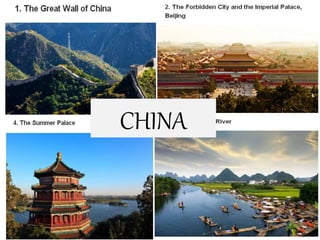
China
CHINA
OBJECTIVES
• Compare the major ethnic groups of
China
• Appraise the Festivals and Holidays of
Norway
• Explore the Chinese cuisine and Lifestyle
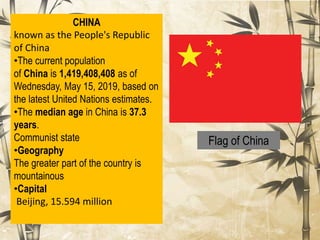
Flag of China
CHINA
known as the People's Republic
of China
•The current population
of China is 1,419,408,408 as of
Wednesday, May 15, 2019, based on
the latest United Nations estimates.
•The median age in China is 37.3
years.
Communist state
•Geography
The greater part of the country is
mountainous
•Capital
Beijing, 15.594 million
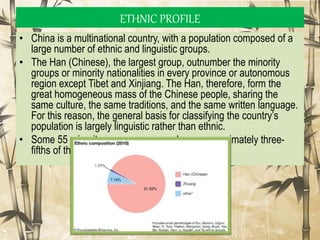
• China is a multinational country, with a population composed of a
large number of ethnic and linguistic groups.
• The Han (Chinese), the largest group, outnumber the minority
groups or minority nationalities in every province or autonomous
region except Tibet and Xinjiang. The Han, therefore, form the
great homogeneous mass of the Chinese people, sharing the
same culture, the same traditions, and the same written language.
For this reason, the general basis for classifying the country’s
population is largely linguistic rather than ethnic.
• Some 55 minority groups are spread over approximately three-
fifths of the country’s total area
ETHNIC PROFILE
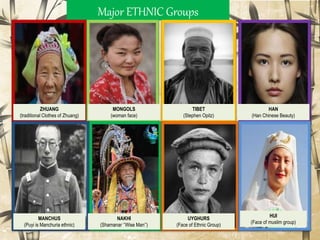
Major ETHNIC Groups
ZHUANG
(traditional Clothes of Zhuang)
MONGOLS
(woman face)
TIBET
(Stephen Opitz)
HAN
(Han Chinese Beauty)
MANCHUS
(Puyi is Manchuria ethnic)
NAKHI
(Shamanar ‘’Wise Man’’)
UYGHURS
(Face of Ethnic Group)
HUI
(Face of muslim group)
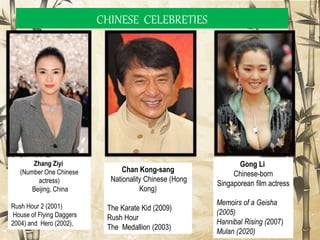
CHINESE CELEBRETIES
Zhang Ziyi
(Number One Chinese
actress)
Beijing, China
Rush Hour 2 (2001)
House of Flying Daggers
2004) and Hero (2002),
Chan Kong-sang
Nationality Chinese (Hong
Kong)
The Karate Kid (2009)
Rush Hour
The Medallion (2003)
Gong Li
Chinese-born
Singaporean film actress
Memoirs of a Geisha
(2005)
Hannibal Rising (2007)
Mulan (2020)
Chinese cuisine is an important part of Chinese culture, which includes cuisine originating from the
diverse regions of China, as well as from Chinese people in other parts of the world. Because of
the Chinese diaspora (oversease people who reside mainland of China) and historical power of the
country, Chinese cuisine has influenced many other cuisines in Asia, with modifications made to
cater to local palates. Chinese food staples such as rice, soy sauce, noodles, tea, and tofu, and
utensils such aschopsticks and the wok, can now be found worldwide.
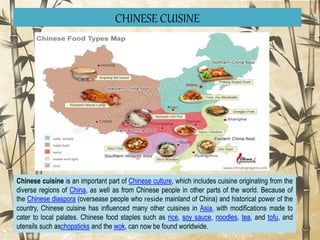
CHINESE CUISINE
Chinese cuisine is an important part of Chinese culture, which includes cuisine originating from the
diverse regions of China, as well as from Chinese people in other parts of the world. Because of
the Chinese diaspora (oversease people who reside mainland of China) and historical power of the
country, Chinese cuisine has influenced many other cuisines in Asia, with modifications made to
cater to local palates. Chinese food staples such as rice, soy sauce, noodles, tea, and tofu, and
utensils such aschopsticks and the wok, can now be found worldwide.
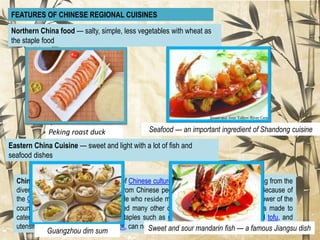
FEATURES OF CHINESE REGIONAL CUISINES
Northern China food — salty, simple, less vegetables with wheat as
the staple food
Peking roast duck Seafood — an important ingredient of Shandong cuisine
Eastern China Cuisine — sweet and light with a lot of fish and
seafood dishes
Guangzhou dim sum Sweet and sour mandarin fish — a famous Jiangsu dish
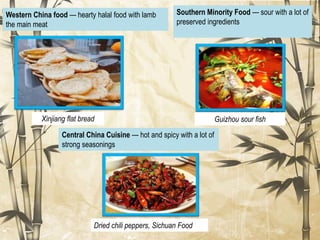
Western China food — hearty halal food with lamb
the main meat
Central China Cuisine — hot and spicy with a lot of
strong seasonings
Xinjiang flat bread
Dried chili peppers, Sichuan Food
Southern Minority Food — sour with a lot of
preserved ingredients
Guizhou sour fish
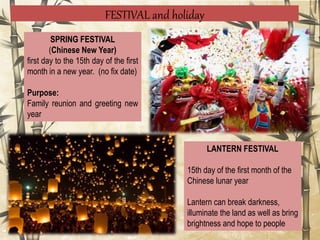
FESTIVAL and holiday
SPRING FESTIVAL
(Chinese New Year)
first day to the 15th day of the first
month in a new year. (no fix date)
Purpose:
Family reunion and greeting new
year
LANTERN FESTIVAL
15th day of the first month of the
Chinese lunar year
Lantern can break darkness,
illuminate the land as well as bring
brightness and hope to people
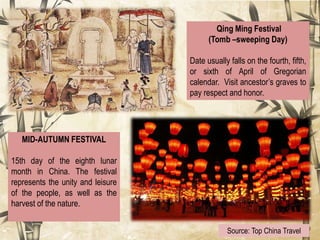
Qing Ming Festival
(Tomb –sweeping Day)
Date usually falls on the fourth, fifth,
or sixth of April of Gregorian
calendar. Visit ancestor’s graves to
pay respect and honor.
MID-AUTUMN FESTIVAL
15th day of the eighth lunar
month in China. The festival
represents the unity and leisure
of the people, as well as the
harvest of the nature.
Source: Top China Travel
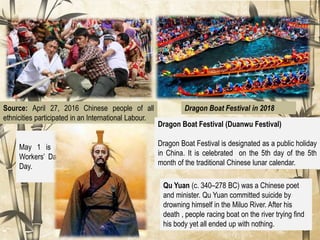
May 1 is MAY DAY International
Workers’ Day, also known as Labor
Day.
Source: April 27, 2016 Chinese people of all
ethnicities participated in an International Labour.
Dragon Boat Festival in 2018
Dragon Boat Festival (Duanwu Festival)
Dragon Boat Festival is designated as a public holiday
in China. It is celebrated on the 5th day of the 5th
month of the traditional Chinese lunar calendar.
Qu Yuan (c. 340–278 BC) was a Chinese poet
and minister. Qu Yuan committed suicide by
drowning himself in the Miluo River. After his
death , people racing boat on the river trying find
his body yet all ended up with nothing.
CHINESE LIFESTYLE
TRADITIONAL LIFESTYLE OF
CHINESE PEOPLE
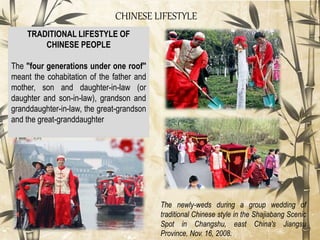
The "four generations under one roof"
meant the cohabitation of the father and
mother, son and daughter-in-law (or
daughter and son-in-law), grandson and
granddaughter-in-law, the great-grandson
and the great-granddaughter
The newly-weds during a group wedding of
traditional Chinese style in the Shajiabang Scenic
Spot in Changshu, east China's Jiangsu
Province, Nov. 16, 2008.
MODERNIZED LIFESTYLE OF CHINESE
PEOPLE
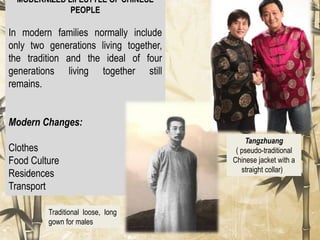
In modern families normally include
only two generations living together,
the tradition and the ideal of four
generations living together still
remains.
Modern Changes:
Clothes
Food Culture
Residences
Transport
Traditional loose, long
gown for males
Tangzhuang
( pseudo-traditional
Chinese jacket with a
straight collar)
An alleyway flanked by traditional
residences. (concrete)
Traditional Chinese
residential architecture
(wood)
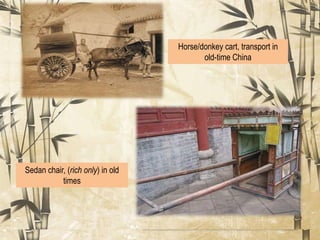
Horse/donkey cart, transport in
old-time China
Sedan chair, (rich only) in old
times
CHINESEETIQUETTE , Do’s and Don’ts
China is known as a state of etiquette and ceremonies. The traditional Chinese
etiquettes can let people to know about the daily life of Chinese in China. Also, it is necessary to
behave in a good manner, avoid ban manner and pay attention to the Chinese taboos when you
plan to have a visit or even stay in China for a long time.
GREETINGS
DO:
Do greet others by using a
handshake or a nod
Do address seniority. (Mr/Ms)
Do address the eldest or most
senior person first.
DON’TS:
Don’t offer too firm of a
handshake. (too firm is
aggression)
Don’t go straight for a hug.
Don’t address elders using ‘ni
hao’ (/nee haow/)
Greeting and Hand Gesture
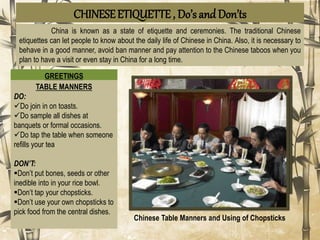
TABLE MANNERS
DO:
Do join in on toasts.
Do sample all dishes at
banquets or formal occasions.
Do tap the table when someone
refills your tea
DON’T:
Don’t put bones, seeds or other
inedible into in your rice bowl.
Don’t tap your chopsticks.
Don’t use your own chopsticks to
pick food from the central dishes.
Chinese Table Manners and Using of Chopsticks
GIVING AND RECEIVING GIFTS
DO:
Do Present and receive things
with both hands.
Do refuse a gift a number of
times before accepting it.
Do gift small items.
(appreciative)
DON’T:
Don’t be too eager to unwrap your
gift.
Don’t wrap gifts using black or
white wrapping paper.
Choose festive colors, such as red,
instead.
Don’t gift clocks or other
symbolic items. (related to the
number four are associated with
death in China)
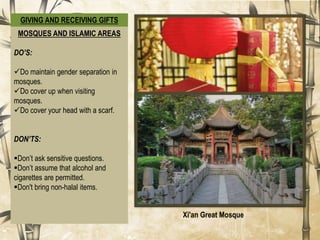
MOSQUES AND ISLAMIC AREAS
DO’S:
Do maintain gender separation in
mosques.
Do cover up when visiting
mosques.
Do cover your head with a scarf.
DON’TS:
Don’t ask sensitive questions.
Don’t assume that alcohol and
cigarettes are permitted.
Don't bring non-halal items.
Gifts
Xi'an Great Mosque
REFERENCES
SYNTHESIS
• I really appreciate the importance of having festivals
and holidays to them. Knowing their culture makes
me realize to value the culture and identity I have as
a Filipino. AS a future social studies teacher,
studying this kind of things expands my knowledge
and have better understanding regards to their
culture.

China

  • 1.
  • 2.
    OBJECTIVES • Compare themajor ethnic groups of China • Appraise the Festivals and Holidays of Norway • Explore the Chinese cuisine and Lifestyle
  • 3.
    Flag of China CHINA knownas the People's Republic of China •The current population of China is 1,419,408,408 as of Wednesday, May 15, 2019, based on the latest United Nations estimates. •The median age in China is 37.3 years. Communist state •Geography The greater part of the country is mountainous •Capital Beijing, 15.594 million
  • 4.
    • China isa multinational country, with a population composed of a large number of ethnic and linguistic groups. • The Han (Chinese), the largest group, outnumber the minority groups or minority nationalities in every province or autonomous region except Tibet and Xinjiang. The Han, therefore, form the great homogeneous mass of the Chinese people, sharing the same culture, the same traditions, and the same written language. For this reason, the general basis for classifying the country’s population is largely linguistic rather than ethnic. • Some 55 minority groups are spread over approximately three- fifths of the country’s total area ETHNIC PROFILE
  • 5.
    Major ETHNIC Groups ZHUANG (traditionalClothes of Zhuang) MONGOLS (woman face) TIBET (Stephen Opitz) HAN (Han Chinese Beauty) MANCHUS (Puyi is Manchuria ethnic) NAKHI (Shamanar ‘’Wise Man’’) UYGHURS (Face of Ethnic Group) HUI (Face of muslim group)
  • 6.
    CHINESE CELEBRETIES Zhang Ziyi (NumberOne Chinese actress) Beijing, China Rush Hour 2 (2001) House of Flying Daggers 2004) and Hero (2002), Chan Kong-sang Nationality Chinese (Hong Kong) The Karate Kid (2009) Rush Hour The Medallion (2003) Gong Li Chinese-born Singaporean film actress Memoirs of a Geisha (2005) Hannibal Rising (2007) Mulan (2020)
  • 7.
    Chinese cuisine isan important part of Chinese culture, which includes cuisine originating from the diverse regions of China, as well as from Chinese people in other parts of the world. Because of the Chinese diaspora (oversease people who reside mainland of China) and historical power of the country, Chinese cuisine has influenced many other cuisines in Asia, with modifications made to cater to local palates. Chinese food staples such as rice, soy sauce, noodles, tea, and tofu, and utensils such aschopsticks and the wok, can now be found worldwide. CHINESE CUISINE
  • 8.
    Chinese cuisine isan important part of Chinese culture, which includes cuisine originating from the diverse regions of China, as well as from Chinese people in other parts of the world. Because of the Chinese diaspora (oversease people who reside mainland of China) and historical power of the country, Chinese cuisine has influenced many other cuisines in Asia, with modifications made to cater to local palates. Chinese food staples such as rice, soy sauce, noodles, tea, and tofu, and utensils such aschopsticks and the wok, can now be found worldwide. FEATURES OF CHINESE REGIONAL CUISINES Northern China food — salty, simple, less vegetables with wheat as the staple food Peking roast duck Seafood — an important ingredient of Shandong cuisine Eastern China Cuisine — sweet and light with a lot of fish and seafood dishes Guangzhou dim sum Sweet and sour mandarin fish — a famous Jiangsu dish
  • 9.
    Western China food— hearty halal food with lamb the main meat Central China Cuisine — hot and spicy with a lot of strong seasonings Xinjiang flat bread Dried chili peppers, Sichuan Food Southern Minority Food — sour with a lot of preserved ingredients Guizhou sour fish
  • 10.
    FESTIVAL and holiday SPRINGFESTIVAL (Chinese New Year) first day to the 15th day of the first month in a new year. (no fix date) Purpose: Family reunion and greeting new year LANTERN FESTIVAL 15th day of the first month of the Chinese lunar year Lantern can break darkness, illuminate the land as well as bring brightness and hope to people
  • 11.
    Qing Ming Festival (Tomb–sweeping Day) Date usually falls on the fourth, fifth, or sixth of April of Gregorian calendar. Visit ancestor’s graves to pay respect and honor. MID-AUTUMN FESTIVAL 15th day of the eighth lunar month in China. The festival represents the unity and leisure of the people, as well as the harvest of the nature. Source: Top China Travel
  • 12.
    May 1 isMAY DAY International Workers’ Day, also known as Labor Day. Source: April 27, 2016 Chinese people of all ethnicities participated in an International Labour. Dragon Boat Festival in 2018 Dragon Boat Festival (Duanwu Festival) Dragon Boat Festival is designated as a public holiday in China. It is celebrated on the 5th day of the 5th month of the traditional Chinese lunar calendar. Qu Yuan (c. 340–278 BC) was a Chinese poet and minister. Qu Yuan committed suicide by drowning himself in the Miluo River. After his death , people racing boat on the river trying find his body yet all ended up with nothing.
  • 13.
    CHINESE LIFESTYLE TRADITIONAL LIFESTYLEOF CHINESE PEOPLE The "four generations under one roof" meant the cohabitation of the father and mother, son and daughter-in-law (or daughter and son-in-law), grandson and granddaughter-in-law, the great-grandson and the great-granddaughter The newly-weds during a group wedding of traditional Chinese style in the Shajiabang Scenic Spot in Changshu, east China's Jiangsu Province, Nov. 16, 2008.
  • 14.
    MODERNIZED LIFESTYLE OFCHINESE PEOPLE In modern families normally include only two generations living together, the tradition and the ideal of four generations living together still remains. Modern Changes: Clothes Food Culture Residences Transport Traditional loose, long gown for males Tangzhuang ( pseudo-traditional Chinese jacket with a straight collar)
  • 15.
    An alleyway flankedby traditional residences. (concrete) Traditional Chinese residential architecture (wood) Horse/donkey cart, transport in old-time China Sedan chair, (rich only) in old times
  • 16.
    CHINESEETIQUETTE , Do’sand Don’ts China is known as a state of etiquette and ceremonies. The traditional Chinese etiquettes can let people to know about the daily life of Chinese in China. Also, it is necessary to behave in a good manner, avoid ban manner and pay attention to the Chinese taboos when you plan to have a visit or even stay in China for a long time. GREETINGS DO: Do greet others by using a handshake or a nod Do address seniority. (Mr/Ms) Do address the eldest or most senior person first. DON’TS: Don’t offer too firm of a handshake. (too firm is aggression) Don’t go straight for a hug. Don’t address elders using ‘ni hao’ (/nee haow/) Greeting and Hand Gesture TABLE MANNERS DO: Do join in on toasts. Do sample all dishes at banquets or formal occasions. Do tap the table when someone refills your tea DON’T: Don’t put bones, seeds or other inedible into in your rice bowl. Don’t tap your chopsticks. Don’t use your own chopsticks to pick food from the central dishes. Chinese Table Manners and Using of Chopsticks
  • 17.
    GIVING AND RECEIVINGGIFTS DO: Do Present and receive things with both hands. Do refuse a gift a number of times before accepting it. Do gift small items. (appreciative) DON’T: Don’t be too eager to unwrap your gift. Don’t wrap gifts using black or white wrapping paper. Choose festive colors, such as red, instead. Don’t gift clocks or other symbolic items. (related to the number four are associated with death in China) MOSQUES AND ISLAMIC AREAS DO’S: Do maintain gender separation in mosques. Do cover up when visiting mosques. Do cover your head with a scarf. DON’TS: Don’t ask sensitive questions. Don’t assume that alcohol and cigarettes are permitted. Don't bring non-halal items. Gifts Xi'an Great Mosque
  • 18.
  • 19.
    SYNTHESIS • I reallyappreciate the importance of having festivals and holidays to them. Knowing their culture makes me realize to value the culture and identity I have as a Filipino. AS a future social studies teacher, studying this kind of things expands my knowledge and have better understanding regards to their culture.

Editor's Notes

  • #11 MID- AUTUMN FESTIVAL On this day, the moon is believed to be the brightest and biggest in the whole year. The festival represents the unity and leisure of the people, as well as the harvest of the nature. Things To do On the Mid-Autumn Day Worshipping the Moon Eating Moon cake Guessing Lantern Riddles  Qing Ming Festival (Tomb –sweeping Day) Date usually falls on the fourth, fifth, or sixth of April of Gregorian calendar.  people visit their ancestors' graves, pay respects to the dead and hold memorial ceremonies in honor of their ancestors. This is one of many ways to express their filial love.
  • #13 May Day, or Labor Day, is a public holiday in many countries worldwide. It usually occurs around May 1, but the date varies across countries. It is associated with the start of spring as well as the celebration of workers.
  • #14 TRADITIONAL LIFESTYLE OF CHINESE PEOPLE In traditional Chinese culture, the family is the basic unit of society, while individuals are only one part of the family. The idea of tracing back ancestry is still the most powerful centripetal force of the Chinese nation. The harmony and stability of families and clans are the assurance of peace and the advancement of society.