



TRAINING DESIGN PROCESS
This is a multi-step process!
• Current state
This is a multi-step process!
• Current state
• Future desired state
This is a multi-step process!
• Current state
• Future desired state
• Current system requirements
This is a multi-step process!
• Current state
• Future desired state
• Current system requirements
• Audience roles and requirements…
This is a multi-step process!
• Current state
• Future desired state
• Current system requirements
• Audience roles and requirements…
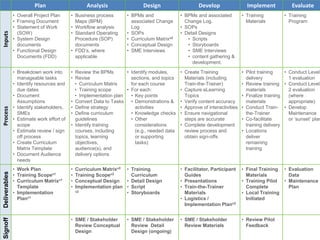
Here’s a complicated grid of the entire process ->
Plan Analysis Design Develop Implement EvaluateInputs
• Overall Project Plan
• Framing Document
• Statement of Work
(SOW)
• System Design
documents
• Functional Design
Documents (FDD)
• Business process
Maps (BPM)
• Workflow analysis
• Standard Operating
Procedure (SOP)
documents
• FDD’s, where
applicable
• BPMs and
associated Change
Log
• SOPs
• Curriculum Matrixv2
• Conceptual Design
• SME Interviews
• BPMs and associated
Change Log.
• SOPs
• Detail Designs
• Scripts
• Storyboards
• SME Interviews
• content gathering &
development.
• Training
Materials
• Training
Program
Process
• Breakdown work into
manageable tasks
• Identify resources and
due dates
• Document
Assumptions
• Identify stakeholders,
SMEs
• Estimate work effort of
scope
• Estimate review / sign
off process
• Create Curriculum
Matrix Template
• Document Audience
needs
• Review the BPMs
• Revise
• Curriculum Matrix
• Training scope
• Implementation plan
• Convert Data to Tasks
• Define strategy
• Define curriculum
guidelines
• Identify training
courses, including
topics, learning
objectives,
audience(s), and
delivery options
• Identify modules,
sections, and topics
for each course
• For each:
• Key points
• Demonstrations &
activities
• Knowledge checks
• Other
considerations
(e.g., needed data
or supporting
tasks)
• Create Training
Materials (including
Train-the-Trainer)
• Capture eLearning
Topics
• Verify content accuracy
• Approve of interactivities
• Ensure navigational
steps are accurate
• Complete development
review process and
obtain sign-offs
• Pilot training
delivery
• Review training
materials
• Finalize training
materials
• Conduct Train-
the-Trainer
• Co-facilitate
training delivery
• Locations
deliver
remaining
training
• Conduct Level
1 evaluation
• Conduct Level
2 evaluation
(where
appropriate)
• Develop
Maintenance
or ‘sunset’ plan
Deliverables
• Work Plan
• Training Scopev1
• Curriculum Matrixv1
Template
• Implementation
Planv1
• Curriculum Matrixv2
• Training Scopev2
• Conceptual Design
• Implementation plan
v2
• Training
Curriculum
• Detail Design
• Script
• Storyboards
• Facilitator, Participant
Guides
• Presentations
• Train-the-Trainer
Materials
• Logistics /
Implementation Planv2
• Final Training
Materials
• Training Pilot
Complete
• Local Training
Initiated
• Evaluation
Data
• Maintenance
Plan
Signoff
• SME / Stakeholder
Review Conceptual
Design
• SME / Stakeholder
Review Detail
Design (ongoing)
• SME / Stakeholder
Review Materials
• Review Pilot
Feedback
Plan Analysis Design Develop Implement EvaluateInputs
• Overall Project Plan
• Framing Document
• Statement of Work
(SOW)
• System Design
documents
• Functional Design
Documents (FDD)
• Business process
Maps (BPM)
• Workflow analysis
• Standard Operating
Procedure (SOP)
documents
• FDD’s, where
applicable
• BPMs and
associated Change
Log
• SOPs
• Curriculum Matrixv2
• Conceptual Design
• SME Interviews
• BPMs and associated
Change Log.
• SOPs
• Detail Designs
• Scripts
• Storyboards
• SME Interviews
• content gathering &
development.
• Training
Materials
• Training
Program
Process
• Breakdown work into
manageable tasks
• Identify resources and
due dates
• Document
Assumptions
• Identify stakeholders,
SMEs
• Estimate work effort of
scope
• Estimate review / sign
off process
• Create Curriculum
Matrix Template
• Document Audience
needs
• Review the BPMs
• Revise
• Curriculum Matrix
• Training scope
• Implementation plan
• Convert Data to Tasks
• Define strategy
• Define curriculum
guidelines
• Identify training
courses, including
topics, learning
objectives,
audience(s), and
delivery options
• Identify modules,
sections, and topics
for each course
• For each:
• Key points
• Demonstrations &
activities
• Knowledge checks
• Other
considerations
(e.g., needed data
or supporting
tasks)
• Create Training
Materials (including
Train-the-Trainer)
• Capture eLearning
Topics
• Verify content accuracy
• Approve of interactivities
• Ensure navigational
steps are accurate
• Complete development
review process and
obtain sign-offs
• Pilot training
delivery
• Review training
materials
• Finalize training
materials
• Conduct Train-
the-Trainer
• Co-facilitate
training delivery
• Locations
deliver
remaining
training
• Conduct Level
1 evaluation
• Conduct Level
2 evaluation
(where
appropriate)
• Develop
Maintenance
or ‘sunset’ plan
Deliverables
• Work Plan
• Training Scopev1
• Curriculum Matrixv1
Template
• Implementation
Planv1
• Curriculum Matrixv2
• Training Scopev2
• Conceptual Design
• Implementation plan
v2
• Training
Curriculum
• Detail Design
• Script
• Storyboards
• Facilitator, Participant
Guides
• Presentations
• Train-the-Trainer
Materials
• Logistics /
Implementation Planv2
• Final Training
Materials
• Training Pilot
Complete
• Local Training
Initiated
• Evaluation
Data
• Maintenance
Plan
Signoff
• SME / Stakeholder
Review Conceptual
Design
• SME / Stakeholder
Review Detail
Design (ongoing)
• SME / Stakeholder
Review Materials
• Review Pilot
Feedback
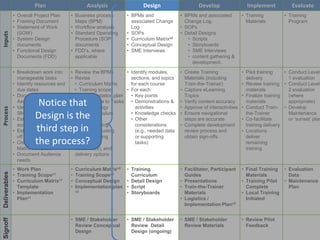
Notice that
Design is the
third step in
the process?
Plan Analysis Design Develop Implement EvaluateInputs
• Overall Project Plan
• Framing Document
• Statement of Work
(SOW)
• System Design
documents
• Functional Design
Documents (FDD)
• Business process
Maps (BPM)
• Workflow analysis
• Standard Operating
Procedure (SOP)
documents
• FDD’s, where
applicable
• BPMs and
associated Change
Log
• SOPs
• Curriculum Matrixv2
• Conceptual Design
• SME Interviews
• BPMs and associated
Change Log.
• SOPs
• Detail Designs
• Scripts
• Storyboards
• SME Interviews
• content gathering &
development.
• Training
Materials
• Training
Program
Process
• Breakdown work into
manageable tasks
• Identify resources and
due dates
• Document
Assumptions
• Identify stakeholders,
SMEs
• Estimate work effort of
scope
• Estimate review / sign
off process
• Create Curriculum
Matrix Template
• Document Audience
needs
• Review the BPMs
• Revise
• Curriculum Matrix
• Training scope
• Implementation plan
• Convert Data to Tasks
• Define strategy
• Define curriculum
guidelines
• Identify training
courses, including
topics, learning
objectives,
audience(s), and
delivery options
• Identify modules,
sections, and topics
for each course
• For each:
• Key points
• Demonstrations &
activities
• Knowledge checks
• Other
considerations
(e.g., needed data
or supporting
tasks)
• Create Training
Materials (including
Train-the-Trainer)
• Capture eLearning
Topics
• Verify content accuracy
• Approve of interactivities
• Ensure navigational
steps are accurate
• Complete development
review process and
obtain sign-offs
• Pilot training
delivery
• Review training
materials
• Finalize training
materials
• Conduct Train-
the-Trainer
• Co-facilitate
training delivery
• Locations
deliver
remaining
training
• Conduct Level
1 evaluation
• Conduct Level
2 evaluation
(where
appropriate)
• Develop
Maintenance
or ‘sunset’ plan
Deliverables
• Work Plan
• Training Scopev1
• Curriculum Matrixv1
Template
• Implementation
Planv1
• Curriculum Matrixv2
• Training Scopev2
• Conceptual Design
• Implementation plan
v2
• Training
Curriculum
• Detail Design
• Script
• Storyboards
• Facilitator, Participant
Guides
• Presentations
• Train-the-Trainer
Materials
• Logistics /
Implementation Planv2
• Final Training
Materials
• Training Pilot
Complete
• Local Training
Initiated
• Evaluation
Data
• Maintenance
Plan
Signoff
• SME / Stakeholder
Review Conceptual
Design
• SME / Stakeholder
Review Detail
Design (ongoing)
• SME / Stakeholder
Review Materials
• Review Pilot
Feedback
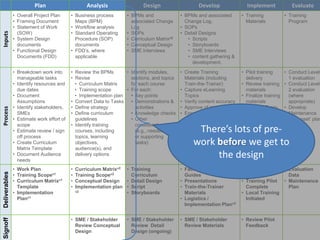
There’s lots of pre-
work before we get to
the design
Plan Analysis Design Develop Implement EvaluateInputs
• Overall Project Plan
• Framing Document
• Statement of Work
(SOW)
• System Design
documents
• Functional Design
Documents (FDD)
• Business process
Maps (BPM)
• Workflow analysis
• Standard Operating
Procedure (SOP)
documents
• FDD’s, where
applicable
• BPMs and
associated Change
Log
• SOPs
• Curriculum Matrixv2
• Conceptual Design
• SME Interviews
• BPMs and associated
Change Log.
• SOPs
• Detail Designs
• Scripts
• Storyboards
• SME Interviews
• content gathering &
development.
• Training
Materials
• Training
Program
Process
• Breakdown work into
manageable tasks
• Identify resources and
due dates
• Document
Assumptions
• Identify stakeholders,
SMEs
• Estimate work effort of
scope
• Estimate review / sign
off process
• Create Curriculum
Matrix Template
• Document Audience
needs
• Review the BPMs
• Revise
• Curriculum Matrix
• Training scope
• Implementation plan
• Convert Data to Tasks
• Define strategy
• Define curriculum
guidelines
• Identify training
courses, including
topics, learning
objectives,
audience(s), and
delivery options
• Identify modules,
sections, and topics
for each course
• For each:
• Key points
• Demonstrations &
activities
• Knowledge checks
• Other
considerations
(e.g., needed data
or supporting
tasks)
• Create Training
Materials (including
Train-the-Trainer)
• Capture eLearning
Topics
• Verify content accuracy
• Approve of interactivities
• Ensure navigational
steps are accurate
• Complete development
review process and
obtain sign-offs
• Pilot training
delivery
• Review training
materials
• Finalize training
materials
• Conduct Train-
the-Trainer
• Co-facilitate
training delivery
• Locations
deliver
remaining
training
• Conduct Level
1 evaluation
• Conduct Level
2 evaluation
(where
appropriate)
• Develop
Maintenance
or ‘sunset’ plan
Deliverables
• Work Plan
• Training Scopev1
• Curriculum Matrixv1
Template
• Implementation
Planv1
• Curriculum Matrixv2
• Training Scopev2
• Conceptual Design
• Implementation plan
v2
• Training
Curriculum
• Detail Design
• Script
• Storyboards
• Facilitator, Participant
Guides
• Presentations
• Train-the-Trainer
Materials
• Logistics /
Implementation Planv2
• Final Training
Materials
• Training Pilot
Complete
• Local Training
Initiated
• Evaluation
Data
• Maintenance
Plan
Signoff
• SME / Stakeholder
Review Conceptual
Design
• SME / Stakeholder
Review Detail
Design (ongoing)
• SME / Stakeholder
Review Materials
• Review Pilot
Feedback
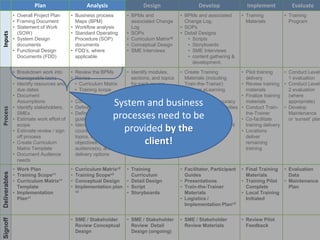
System and business
processes need to be
provided by the
client!
Plan Analysis Design Develop Implement EvaluateInputs
• Overall Project Plan
• Framing Document
• Statement of Work
(SOW)
• System Design
documents
• Functional Design
Documents (FDD)
• Business process
Maps (BPM)
• Workflow analysis
• Standard Operating
Procedure (SOP)
documents
• FDD’s, where
applicable
• BPMs and
associated Change
Log
• SOPs
• Curriculum Matrixv2
• Conceptual Design
• SME Interviews
• BPMs and associated
Change Log.
• SOPs
• Detail Designs
• Scripts
• Storyboards
• SME Interviews
• content gathering &
development.
• Training
Materials
• Training
Program
Process
• Breakdown work into
manageable tasks
• Identify resources and
due dates
• Document
Assumptions
• Identify stakeholders,
SMEs
• Estimate work effort of
scope
• Estimate review / sign
off process
• Create Curriculum
Matrix Template
• Document Audience
needs
• Review the BPMs
• Revise
• Curriculum Matrix
• Training scope
• Implementation plan
• Convert Data to Tasks
• Define strategy
• Define curriculum
guidelines
• Identify training
courses, including
topics, learning
objectives,
audience(s), and
delivery options
• Identify modules,
sections, and topics
for each course
• For each:
• Key points
• Demonstrations &
activities
• Knowledge checks
• Other
considerations
(e.g., needed data
or supporting
tasks)
• Create Training
Materials (including
Train-the-Trainer)
• Capture eLearning
Topics
• Verify content accuracy
• Approve of interactivities
• Ensure navigational
steps are accurate
• Complete development
review process and
obtain sign-offs
• Pilot training
delivery
• Review training
materials
• Finalize training
materials
• Conduct Train-
the-Trainer
• Co-facilitate
training delivery
• Locations
deliver
remaining
training
• Conduct Level
1 evaluation
• Conduct Level
2 evaluation
(where
appropriate)
• Develop
Maintenance
or ‘sunset’ plan
Deliverables
• Work Plan
• Training Scopev1
• Curriculum Matrixv1
Template
• Implementation
Planv1
• Curriculum Matrixv2
• Training Scopev2
• Conceptual Design
• Implementation plan
v2
• Training
Curriculum
• Detail Design
• Script
• Storyboards
• Facilitator, Participant
Guides
• Presentations
• Train-the-Trainer
Materials
• Logistics /
Implementation Planv2
• Final Training
Materials
• Training Pilot
Complete
• Local Training
Initiated
• Evaluation
Data
• Maintenance
Plan
Signoff
• SME / Stakeholder
Review Conceptual
Design
• SME / Stakeholder
Review Detail
Design (ongoing)
• SME / Stakeholder
Review Materials
• Review Pilot
Feedback
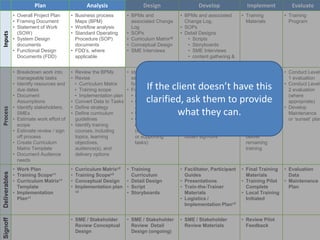
If the client doesn’t have this
clarified, ask them to provide
what they can.
Plan Analysis Design Develop Implement EvaluateInputs
• Overall Project Plan
• Framing Document
• Statement of Work
(SOW)
• System Design
documents
• Functional Design
Documents (FDD)
• Business process
Maps (BPM)
• Workflow analysis
• Standard Operating
Procedure (SOP)
documents
• FDD’s, where
applicable
• BPMs and
associated Change
Log
• SOPs
• Curriculum Matrixv2
• Conceptual Design
• SME Interviews
• BPMs and associated
Change Log.
• SOPs
• Detail Designs
• Scripts
• Storyboards
• SME Interviews
• content gathering &
development.
• Training
Materials
• Training
Program
Process
• Breakdown work into
manageable tasks
• Identify resources and
due dates
• Document
Assumptions
• Identify stakeholders,
SMEs
• Estimate work effort of
scope
• Estimate review / sign
off process
• Create Curriculum
Matrix Template
• Document Audience
needs
• Review the BPMs
• Revise
• Curriculum Matrix
• Training scope
• Implementation plan
• Convert Data to Tasks
• Define strategy
• Define curriculum
guidelines
• Identify training
courses, including
topics, learning
objectives,
audience(s), and
delivery options
• Identify modules,
sections, and topics
for each course
• For each:
• Key points
• Demonstrations &
activities
• Knowledge checks
• Other
considerations
(e.g., needed data
or supporting
tasks)
• Create Training
Materials (including
Train-the-Trainer)
• Capture eLearning
Topics
• Verify content accuracy
• Approve of interactivities
• Ensure navigational
steps are accurate
• Complete development
review process and
obtain sign-offs
• Pilot training
delivery
• Review training
materials
• Finalize training
materials
• Conduct Train-
the-Trainer
• Co-facilitate
training delivery
• Locations
deliver
remaining
training
• Conduct Level
1 evaluation
• Conduct Level
2 evaluation
(where
appropriate)
• Develop
Maintenance
or ‘sunset’ plan
Deliverables
• Work Plan
• Training Scopev1
• Curriculum Matrixv1
Template
• Implementation
Planv1
• Curriculum Matrixv2
• Training Scopev2
• Conceptual Design
• Implementation plan
v2
• Training
Curriculum
• Detail Design
• Script
• Storyboards
• Facilitator, Participant
Guides
• Presentations
• Train-the-Trainer
Materials
• Logistics /
Implementation Planv2
• Final Training
Materials
• Training Pilot
Complete
• Local Training
Initiated
• Evaluation
Data
• Maintenance
Plan
Signoff
• SME / Stakeholder
Review Conceptual
Design
• SME / Stakeholder
Review Detail
Design (ongoing)
• SME / Stakeholder
Review Materials
• Review Pilot
Feedback
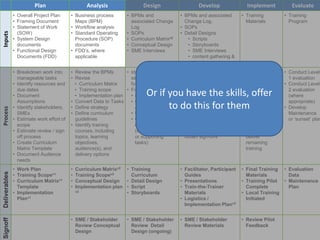
Or if you have the skills, offer
to do this for them
Analysis will divine what you need to train to, if you need to train at all
ANALYSIS CAN BE DONE QUICKLY BY
SKILLED PROFESSIONALS
Besides, If you don’t know what needs training,
HOW DO YOU GO ABOUT BUILDING IT?
Besides, If you don’t know what needs training,
Want to know more?
ZULEKA (AT) GMAIL (DOT) COM
Want to know more?
ZULEKA (AT) GMAIL (DOT) COM
TWITTER @KIRA_GREER
Want to know more?

Training Design Process

  • 1.
  • 2.
    This is amulti-step process!
  • 3.
    This is amulti-step process! • Current state
  • 4.
    This is amulti-step process! • Current state • Future desired state
  • 5.
    This is amulti-step process! • Current state • Future desired state • Current system requirements
  • 6.
    This is amulti-step process! • Current state • Future desired state • Current system requirements • Audience roles and requirements…
  • 7.
    This is amulti-step process! • Current state • Future desired state • Current system requirements • Audience roles and requirements… Here’s a complicated grid of the entire process ->
  • 8.
    Plan Analysis DesignDevelop Implement EvaluateInputs • Overall Project Plan • Framing Document • Statement of Work (SOW) • System Design documents • Functional Design Documents (FDD) • Business process Maps (BPM) • Workflow analysis • Standard Operating Procedure (SOP) documents • FDD’s, where applicable • BPMs and associated Change Log • SOPs • Curriculum Matrixv2 • Conceptual Design • SME Interviews • BPMs and associated Change Log. • SOPs • Detail Designs • Scripts • Storyboards • SME Interviews • content gathering & development. • Training Materials • Training Program Process • Breakdown work into manageable tasks • Identify resources and due dates • Document Assumptions • Identify stakeholders, SMEs • Estimate work effort of scope • Estimate review / sign off process • Create Curriculum Matrix Template • Document Audience needs • Review the BPMs • Revise • Curriculum Matrix • Training scope • Implementation plan • Convert Data to Tasks • Define strategy • Define curriculum guidelines • Identify training courses, including topics, learning objectives, audience(s), and delivery options • Identify modules, sections, and topics for each course • For each: • Key points • Demonstrations & activities • Knowledge checks • Other considerations (e.g., needed data or supporting tasks) • Create Training Materials (including Train-the-Trainer) • Capture eLearning Topics • Verify content accuracy • Approve of interactivities • Ensure navigational steps are accurate • Complete development review process and obtain sign-offs • Pilot training delivery • Review training materials • Finalize training materials • Conduct Train- the-Trainer • Co-facilitate training delivery • Locations deliver remaining training • Conduct Level 1 evaluation • Conduct Level 2 evaluation (where appropriate) • Develop Maintenance or ‘sunset’ plan Deliverables • Work Plan • Training Scopev1 • Curriculum Matrixv1 Template • Implementation Planv1 • Curriculum Matrixv2 • Training Scopev2 • Conceptual Design • Implementation plan v2 • Training Curriculum • Detail Design • Script • Storyboards • Facilitator, Participant Guides • Presentations • Train-the-Trainer Materials • Logistics / Implementation Planv2 • Final Training Materials • Training Pilot Complete • Local Training Initiated • Evaluation Data • Maintenance Plan Signoff • SME / Stakeholder Review Conceptual Design • SME / Stakeholder Review Detail Design (ongoing) • SME / Stakeholder Review Materials • Review Pilot Feedback
  • 9.
    Plan Analysis DesignDevelop Implement EvaluateInputs • Overall Project Plan • Framing Document • Statement of Work (SOW) • System Design documents • Functional Design Documents (FDD) • Business process Maps (BPM) • Workflow analysis • Standard Operating Procedure (SOP) documents • FDD’s, where applicable • BPMs and associated Change Log • SOPs • Curriculum Matrixv2 • Conceptual Design • SME Interviews • BPMs and associated Change Log. • SOPs • Detail Designs • Scripts • Storyboards • SME Interviews • content gathering & development. • Training Materials • Training Program Process • Breakdown work into manageable tasks • Identify resources and due dates • Document Assumptions • Identify stakeholders, SMEs • Estimate work effort of scope • Estimate review / sign off process • Create Curriculum Matrix Template • Document Audience needs • Review the BPMs • Revise • Curriculum Matrix • Training scope • Implementation plan • Convert Data to Tasks • Define strategy • Define curriculum guidelines • Identify training courses, including topics, learning objectives, audience(s), and delivery options • Identify modules, sections, and topics for each course • For each: • Key points • Demonstrations & activities • Knowledge checks • Other considerations (e.g., needed data or supporting tasks) • Create Training Materials (including Train-the-Trainer) • Capture eLearning Topics • Verify content accuracy • Approve of interactivities • Ensure navigational steps are accurate • Complete development review process and obtain sign-offs • Pilot training delivery • Review training materials • Finalize training materials • Conduct Train- the-Trainer • Co-facilitate training delivery • Locations deliver remaining training • Conduct Level 1 evaluation • Conduct Level 2 evaluation (where appropriate) • Develop Maintenance or ‘sunset’ plan Deliverables • Work Plan • Training Scopev1 • Curriculum Matrixv1 Template • Implementation Planv1 • Curriculum Matrixv2 • Training Scopev2 • Conceptual Design • Implementation plan v2 • Training Curriculum • Detail Design • Script • Storyboards • Facilitator, Participant Guides • Presentations • Train-the-Trainer Materials • Logistics / Implementation Planv2 • Final Training Materials • Training Pilot Complete • Local Training Initiated • Evaluation Data • Maintenance Plan Signoff • SME / Stakeholder Review Conceptual Design • SME / Stakeholder Review Detail Design (ongoing) • SME / Stakeholder Review Materials • Review Pilot Feedback Notice that Design is the third step in the process?
  • 10.
    Plan Analysis DesignDevelop Implement EvaluateInputs • Overall Project Plan • Framing Document • Statement of Work (SOW) • System Design documents • Functional Design Documents (FDD) • Business process Maps (BPM) • Workflow analysis • Standard Operating Procedure (SOP) documents • FDD’s, where applicable • BPMs and associated Change Log • SOPs • Curriculum Matrixv2 • Conceptual Design • SME Interviews • BPMs and associated Change Log. • SOPs • Detail Designs • Scripts • Storyboards • SME Interviews • content gathering & development. • Training Materials • Training Program Process • Breakdown work into manageable tasks • Identify resources and due dates • Document Assumptions • Identify stakeholders, SMEs • Estimate work effort of scope • Estimate review / sign off process • Create Curriculum Matrix Template • Document Audience needs • Review the BPMs • Revise • Curriculum Matrix • Training scope • Implementation plan • Convert Data to Tasks • Define strategy • Define curriculum guidelines • Identify training courses, including topics, learning objectives, audience(s), and delivery options • Identify modules, sections, and topics for each course • For each: • Key points • Demonstrations & activities • Knowledge checks • Other considerations (e.g., needed data or supporting tasks) • Create Training Materials (including Train-the-Trainer) • Capture eLearning Topics • Verify content accuracy • Approve of interactivities • Ensure navigational steps are accurate • Complete development review process and obtain sign-offs • Pilot training delivery • Review training materials • Finalize training materials • Conduct Train- the-Trainer • Co-facilitate training delivery • Locations deliver remaining training • Conduct Level 1 evaluation • Conduct Level 2 evaluation (where appropriate) • Develop Maintenance or ‘sunset’ plan Deliverables • Work Plan • Training Scopev1 • Curriculum Matrixv1 Template • Implementation Planv1 • Curriculum Matrixv2 • Training Scopev2 • Conceptual Design • Implementation plan v2 • Training Curriculum • Detail Design • Script • Storyboards • Facilitator, Participant Guides • Presentations • Train-the-Trainer Materials • Logistics / Implementation Planv2 • Final Training Materials • Training Pilot Complete • Local Training Initiated • Evaluation Data • Maintenance Plan Signoff • SME / Stakeholder Review Conceptual Design • SME / Stakeholder Review Detail Design (ongoing) • SME / Stakeholder Review Materials • Review Pilot Feedback There’s lots of pre- work before we get to the design
  • 11.
    Plan Analysis DesignDevelop Implement EvaluateInputs • Overall Project Plan • Framing Document • Statement of Work (SOW) • System Design documents • Functional Design Documents (FDD) • Business process Maps (BPM) • Workflow analysis • Standard Operating Procedure (SOP) documents • FDD’s, where applicable • BPMs and associated Change Log • SOPs • Curriculum Matrixv2 • Conceptual Design • SME Interviews • BPMs and associated Change Log. • SOPs • Detail Designs • Scripts • Storyboards • SME Interviews • content gathering & development. • Training Materials • Training Program Process • Breakdown work into manageable tasks • Identify resources and due dates • Document Assumptions • Identify stakeholders, SMEs • Estimate work effort of scope • Estimate review / sign off process • Create Curriculum Matrix Template • Document Audience needs • Review the BPMs • Revise • Curriculum Matrix • Training scope • Implementation plan • Convert Data to Tasks • Define strategy • Define curriculum guidelines • Identify training courses, including topics, learning objectives, audience(s), and delivery options • Identify modules, sections, and topics for each course • For each: • Key points • Demonstrations & activities • Knowledge checks • Other considerations (e.g., needed data or supporting tasks) • Create Training Materials (including Train-the-Trainer) • Capture eLearning Topics • Verify content accuracy • Approve of interactivities • Ensure navigational steps are accurate • Complete development review process and obtain sign-offs • Pilot training delivery • Review training materials • Finalize training materials • Conduct Train- the-Trainer • Co-facilitate training delivery • Locations deliver remaining training • Conduct Level 1 evaluation • Conduct Level 2 evaluation (where appropriate) • Develop Maintenance or ‘sunset’ plan Deliverables • Work Plan • Training Scopev1 • Curriculum Matrixv1 Template • Implementation Planv1 • Curriculum Matrixv2 • Training Scopev2 • Conceptual Design • Implementation plan v2 • Training Curriculum • Detail Design • Script • Storyboards • Facilitator, Participant Guides • Presentations • Train-the-Trainer Materials • Logistics / Implementation Planv2 • Final Training Materials • Training Pilot Complete • Local Training Initiated • Evaluation Data • Maintenance Plan Signoff • SME / Stakeholder Review Conceptual Design • SME / Stakeholder Review Detail Design (ongoing) • SME / Stakeholder Review Materials • Review Pilot Feedback System and business processes need to be provided by the client!
  • 12.
    Plan Analysis DesignDevelop Implement EvaluateInputs • Overall Project Plan • Framing Document • Statement of Work (SOW) • System Design documents • Functional Design Documents (FDD) • Business process Maps (BPM) • Workflow analysis • Standard Operating Procedure (SOP) documents • FDD’s, where applicable • BPMs and associated Change Log • SOPs • Curriculum Matrixv2 • Conceptual Design • SME Interviews • BPMs and associated Change Log. • SOPs • Detail Designs • Scripts • Storyboards • SME Interviews • content gathering & development. • Training Materials • Training Program Process • Breakdown work into manageable tasks • Identify resources and due dates • Document Assumptions • Identify stakeholders, SMEs • Estimate work effort of scope • Estimate review / sign off process • Create Curriculum Matrix Template • Document Audience needs • Review the BPMs • Revise • Curriculum Matrix • Training scope • Implementation plan • Convert Data to Tasks • Define strategy • Define curriculum guidelines • Identify training courses, including topics, learning objectives, audience(s), and delivery options • Identify modules, sections, and topics for each course • For each: • Key points • Demonstrations & activities • Knowledge checks • Other considerations (e.g., needed data or supporting tasks) • Create Training Materials (including Train-the-Trainer) • Capture eLearning Topics • Verify content accuracy • Approve of interactivities • Ensure navigational steps are accurate • Complete development review process and obtain sign-offs • Pilot training delivery • Review training materials • Finalize training materials • Conduct Train- the-Trainer • Co-facilitate training delivery • Locations deliver remaining training • Conduct Level 1 evaluation • Conduct Level 2 evaluation (where appropriate) • Develop Maintenance or ‘sunset’ plan Deliverables • Work Plan • Training Scopev1 • Curriculum Matrixv1 Template • Implementation Planv1 • Curriculum Matrixv2 • Training Scopev2 • Conceptual Design • Implementation plan v2 • Training Curriculum • Detail Design • Script • Storyboards • Facilitator, Participant Guides • Presentations • Train-the-Trainer Materials • Logistics / Implementation Planv2 • Final Training Materials • Training Pilot Complete • Local Training Initiated • Evaluation Data • Maintenance Plan Signoff • SME / Stakeholder Review Conceptual Design • SME / Stakeholder Review Detail Design (ongoing) • SME / Stakeholder Review Materials • Review Pilot Feedback If the client doesn’t have this clarified, ask them to provide what they can.
  • 13.
    Plan Analysis DesignDevelop Implement EvaluateInputs • Overall Project Plan • Framing Document • Statement of Work (SOW) • System Design documents • Functional Design Documents (FDD) • Business process Maps (BPM) • Workflow analysis • Standard Operating Procedure (SOP) documents • FDD’s, where applicable • BPMs and associated Change Log • SOPs • Curriculum Matrixv2 • Conceptual Design • SME Interviews • BPMs and associated Change Log. • SOPs • Detail Designs • Scripts • Storyboards • SME Interviews • content gathering & development. • Training Materials • Training Program Process • Breakdown work into manageable tasks • Identify resources and due dates • Document Assumptions • Identify stakeholders, SMEs • Estimate work effort of scope • Estimate review / sign off process • Create Curriculum Matrix Template • Document Audience needs • Review the BPMs • Revise • Curriculum Matrix • Training scope • Implementation plan • Convert Data to Tasks • Define strategy • Define curriculum guidelines • Identify training courses, including topics, learning objectives, audience(s), and delivery options • Identify modules, sections, and topics for each course • For each: • Key points • Demonstrations & activities • Knowledge checks • Other considerations (e.g., needed data or supporting tasks) • Create Training Materials (including Train-the-Trainer) • Capture eLearning Topics • Verify content accuracy • Approve of interactivities • Ensure navigational steps are accurate • Complete development review process and obtain sign-offs • Pilot training delivery • Review training materials • Finalize training materials • Conduct Train- the-Trainer • Co-facilitate training delivery • Locations deliver remaining training • Conduct Level 1 evaluation • Conduct Level 2 evaluation (where appropriate) • Develop Maintenance or ‘sunset’ plan Deliverables • Work Plan • Training Scopev1 • Curriculum Matrixv1 Template • Implementation Planv1 • Curriculum Matrixv2 • Training Scopev2 • Conceptual Design • Implementation plan v2 • Training Curriculum • Detail Design • Script • Storyboards • Facilitator, Participant Guides • Presentations • Train-the-Trainer Materials • Logistics / Implementation Planv2 • Final Training Materials • Training Pilot Complete • Local Training Initiated • Evaluation Data • Maintenance Plan Signoff • SME / Stakeholder Review Conceptual Design • SME / Stakeholder Review Detail Design (ongoing) • SME / Stakeholder Review Materials • Review Pilot Feedback Or if you have the skills, offer to do this for them
  • 14.
    Analysis will divinewhat you need to train to, if you need to train at all
  • 15.
    ANALYSIS CAN BEDONE QUICKLY BY SKILLED PROFESSIONALS
  • 16.
    Besides, If youdon’t know what needs training,
  • 17.
    HOW DO YOUGO ABOUT BUILDING IT? Besides, If you don’t know what needs training,
  • 18.
  • 19.
    ZULEKA (AT) GMAIL(DOT) COM Want to know more?
  • 20.
    ZULEKA (AT) GMAIL(DOT) COM TWITTER @KIRA_GREER Want to know more?