iconsultica
TRAINING


                    www.iconsultica.com
         Management ..Consulting . .Development . Training
         Management Consulting Development . Training
I. Context
A. Context: Global Workforce Trends


 We are entering an age where the dominant society is a knowledge society. Knowledge
 will be the key resource and knowledge workers will dominate the workforce.

 This transition from an industrial based economy and society is changing not only the
 way we work, communicate and live, but also the way we are governed and the way that
 the public service will be expected to deliver programs and provide services.

 Knowledge is different from every other historical means of production. It becomes
 obsolete rapidly. It travels more effortlessly than money. It cannot be inherited. It must
 be acquired at the individual level and each person starts with the same level of
 ignorance. In a knowledge society, a person's and the organization's ability to acquire
 and share knowledge is their most important competency.

 Public service work is predominantly knowledge work and employees of government are
 predominantly knowledge workers. In such a knowledge-based environment, one of the
 most important investments a government can make is investment in its employees - its
 human capital. In an era of a contracted and increasingly competitive and highly mobile
 labor market, sustained investment in human capital will be necessary to attract and
 retain the required talent and to provide high quality public services in an efficient way.


 The Public Service Context

 Reports concluded that the public service continues to face challenges such as
 globalization measures and the increased need for knowledge-based workers that
 impedes the performance of the public service. Training and development in the public
 service concluded that it was timely for government to change its thinking about training
 and development in the public service and to treat employee development not as a
 luxury, but rather as a necessary investment. The report found that human capital is at
 risk and that training and development, as currently managed, is not being applied in a
 strategic way. Current tendencies call on government to "maintain the human capital of
 public service, its capacity to create good policy advice, and its ability to deliver top
 quality services efficiently" saying that this was urgently needed, now more than ever
 before, given current pressures on the public service.


iconsultica TRAINING              www.iconsultica.com
                       Management ..Consulting . .Development . Training
                       Management Consulting Development . Training
These issues have contributed to employee perceptions that government values training
and development. Employees surveyed have been consistent in expressing their concerns
about the lack of access to training and development opportunities.
A related issue is the perception that managers in the public service lack the necessary
skills to lead and motivate the workforce.


This initiative is designed to perfectly meet the public service professional needs and it
contains six goals:

"     Effective people strategy
"     Proactive and visionary leadership
"     Performance focused workplace
"     Learning and innovative organization
"     Flexible and motivating work environment
"     Progressive employer - employee relations


This document sets out the primary strategy for the creation of a learning and innovative
organization within the public service. One of the component strategies is the creation of
a management development program that will support the goal of "proactive and
visionary leadership." Investment in learning is a key measure of renewal and
development of the public service.


iconsultica TRAINING              www.iconsultica.com
                       Management ..Consulting . .Development . Training
                       Management Consulting Development . Training
The Business Case for Investment in Learning

 The dynamic role and public expectations of government as well as the new emphasis on
 integrated and cross-ministry policy design and service delivery have changed public
 sector management and operations with profound long term consequences. These
 factors are generating pressures to invest in learning, both at the organizational and the
 individual levels, in order to be more accountable for results in a decentralized
 environment, make more effective use of technology, modernize the management of
 people, lead public and private partnerships and leverage the scarce resources of
 government for better service to citizens.

  • Learning investments in achieving these objectives in the public service are direct
    investments in the strategic priorities of the British Columbia government.

  • Empirical studies in both public and private sector organizations have shown that
    learning investments produce substantial economic returns to organizations
    through reduced costs, increased efficiencies and other direct and indirect benefits
    that improve the performance and competitiveness of the organization.
  • Return on Investment -Empirical evidence showing strong ROI on learning
    investments has motivated some organizations to intensify these investments.

  • Service Improvement - Many service organizations invest in learning because
    measured improvements in service have been shown to contribute to "brand"
    reputation, client satisfaction and, eventually, to competitive advantage.

  • Catalyst for Change - In fast moving and competitive environments, complacency
    and rigidity are fatal. Learning promotes perspective and innovation and is a key
    driver of change, starting with changed mindsets that are often the hidden block to
    successful organizational development and timely adaptation.
  • Innovation and Creativity - Knowledge being "the new commodity", the ability to
    create and adapt it has become a key to organizational strength and performance.
    Individual and organizational learning are now business imperatives in government
    and the private sector.


iconsultica TRAINING              www.iconsultica.com
                       Management ..Consulting . .Development . Training
                       Management Consulting Development . Training
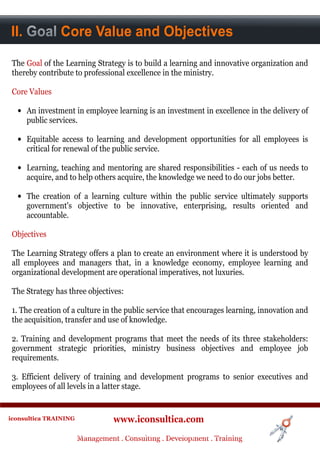
II.Context Core Value and Objectives
A. Goal


 The Goal of the Learning Strategy is to build a learning and innovative organization and
 thereby contribute to professional excellence in the ministry.

 Core Values

  • An investment in employee learning is an investment in excellence in the delivery of
    public services.

  • Equitable access to learning and development opportunities for all employees is
    critical for renewal of the public service.

  • Learning, teaching and mentoring are shared responsibilities - each of us needs to
    acquire, and to help others acquire, the knowledge we need to do our jobs better.

  • The creation of a learning culture within the public service ultimately supports
    government's objective to be innovative, enterprising, results oriented and
    accountable.

 Objectives

 The Learning Strategy offers a plan to create an environment where it is understood by
 all employees and managers that, in a knowledge economy, employee learning and
 organizational development are operational imperatives, not luxuries.

 The Strategy has three objectives:

 1. The creation of a culture in the public service that encourages learning, innovation and
 the acquisition, transfer and use of knowledge.

 2. Training and development programs that meet the needs of its three stakeholders:
 government strategic priorities, ministry business objectives and employee job
 requirements.

 3. Efficient delivery of training and development programs to senior executives and
 employees of all levels in a latter stage.


iconsultica TRAINING              www.iconsultica.com
                       Management ..Consulting . .Development . Training
                       Management Consulting Development . Training
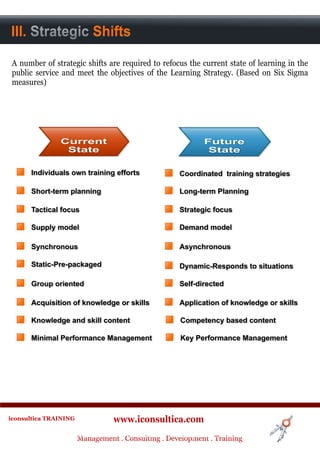
III. Strategic Shifts
A. Context


 A number of strategic shifts are required to refocus the current state of learning in the
 public service and meet the objectives of the Learning Strategy. (Based on Six Sigma
 measures)


iconsultica TRAINING              www.iconsultica.com
                       Management ..Consulting . .Development . Training
                       Management Consulting Development . Training
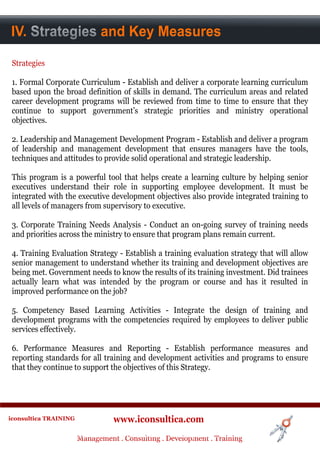
IV. Strategies and Key Measures
A. Context


 Strategies

 1. Formal Corporate Curriculum - Establish and deliver a corporate learning curriculum
 based upon the broad definition of skills in demand. The curriculum areas and related
 career development programs will be reviewed from time to time to ensure that they
 continue to support government’s strategic priorities and ministry operational
 objectives.

 2. Leadership and Management Development Program - Establish and deliver a program
 of leadership and management development that ensures managers have the tools,
 techniques and attitudes to provide solid operational and strategic leadership.

 This program is a powerful tool that helps create a learning culture by helping senior
 executives understand their role in supporting employee development. It must be
 integrated with the executive development objectives also provide integrated training to
 all levels of managers from supervisory to executive.

 3. Corporate Training Needs Analysis - Conduct an on-going survey of training needs
 and priorities across the ministry to ensure that program plans remain current.

 4. Training Evaluation Strategy - Establish a training evaluation strategy that will allow
 senior management to understand whether its training and development objectives are
 being met. Government needs to know the results of its training investment. Did trainees
 actually learn what was intended by the program or course and has it resulted in
 improved performance on the job?

 5. Competency Based Learning Activities - Integrate the design of training and
 development programs with the competencies required by employees to deliver public
 services effectively.

 6. Performance Measures and Reporting - Establish performance measures and
 reporting standards for all training and development activities and programs to ensure
 that they continue to support the objectives of this Strategy.


iconsultica TRAINING              www.iconsultica.com
                       Management ..Consulting . .Development . Training
                       Management Consulting Development . Training
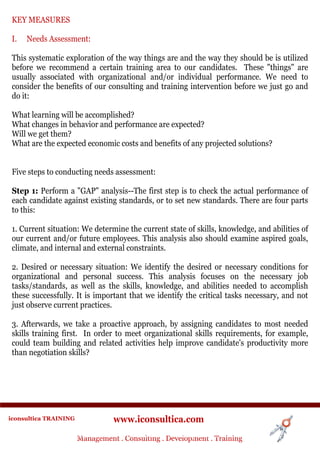
KEY MEASURES

 I.   Needs Assessment:

 This systematic exploration of the way things are and the way they should be is utilized
 before we recommend a certain training area to our candidates. These "things" are
 usually associated with organizational and/or individual performance. We need to
 consider the benefits of our consulting and training intervention before we just go and
 do it:

 What learning will be accomplished?
 What changes in behavior and performance are expected?
 Will we get them?
 What are the expected economic costs and benefits of any projected solutions?


 Five steps to conducting needs assessment:

 Step 1: Perform a "GAP" analysis--The first step is to check the actual performance of
 each candidate against existing standards, or to set new standards. There are four parts
 to this:

 1. Current situation: We determine the current state of skills, knowledge, and abilities of
 our current and/or future employees. This analysis also should examine aspired goals,
 climate, and internal and external constraints.

 2. Desired or necessary situation: We identify the desired or necessary conditions for
 organizational and personal success. This analysis focuses on the necessary job
 tasks/standards, as well as the skills, knowledge, and abilities needed to accomplish
 these successfully. It is important that we identify the critical tasks necessary, and not
 just observe current practices.

 3. Afterwards, we take a proactive approach, by assigning candidates to most needed
 skills training first. In order to meet organizational skills requirements, for example,
 could team building and related activities help improve candidate's productivity more
 than negotiation skills?


iconsultica TRAINING              www.iconsultica.com
                       Management ..Consulting . .Development . Training
                       Management Consulting Development . Training
4. Are there internal or external forces dictating that training and/or organization
 development will take place? Are there policies or management decisions which might
 dictate the implementation of some program? Are there governmental mandates to
 which we must comply?


 Step 2: Identify priorities--The first step should have produced a large list of needs for
 training and development, career development, organization development, and/or other
 interventions. Now we examine these in view of their importance to our organizational
 goals, realities, and constraints. We must determine if the identified needs are real, if
 they are worth addressing, and specify their importance and urgency in view of
 Candidate's organizational needs and requirements

 Step 3: Identify causes of performance problems and opportunities
 Now that we have prioritized and focused on critical organizational and personal needs,
 we next identify specific problem areas and opportunities.
 We ask two questions for every identified need:

 Are Candidates doing their jobs effectively?
 Do they know how to do their jobs?

 Step 4: Identify possible solutions and opportunities
 Multiple methods of Needs Assessment are used, to get a true picture, It is important to
 get a complete picture from many sources and viewpoints. Candidates fill out a
 combination of questionnaires, consultation sessions with persons in key positions,
 and/or with specific knowledge review of relevant literature, interviews, focus groups,
 tests, records & report studies work samples.

 Step 5: Kick Start-Candidates are emerged into training programs that best correspond
 to their professional needs based on entire needs analysis.


iconsultica TRAINING              www.iconsultica.com
                       Management ..Consulting . .Development . Training
                       Management Consulting Development . Training
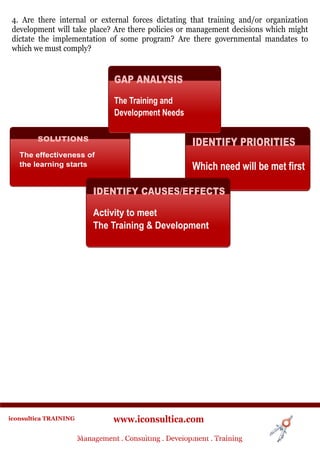
4. Are there internal or external forces dictating that training and/or organization
 development will take place? Are there policies or management decisions which might
 dictate the implementation of some program? Are there governmental mandates to
 which we must comply?


                                 GAP ANALYSIS
                                 The Training and
                                 Development Needs

        SOLUTIONS
                                                        IDENTIFY PRIORITIES
   The effectiveness of
   the learning starts                                  Which need will be met first

                           IDENTIFY CAUSES/EFFECTS

                           Activity to meet
                           The Training & Development


iconsultica TRAINING              www.iconsultica.com
                       Management ..Consulting . .Development . Training
                       Management Consulting Development . Training
2.   Quantitative Evaluation:

 Typically, when we evaluate our work, we look for validity, accuracy and reliability in our
 evaluations. We also look for evaluation approaches that are practical and relevant.
 Quantitative Evaluation methods are highly accurate and effective, that's why we use
 them extensively before, during and after training and development activities. We
 consider the following basic suggestions:

 Before the Implementation Phase

 1. We examine if selected training and development methods really result in the
 candidate's learning the knowledge and skills needed to perform the task or carry out the
 role? We also answer whether other candidates used the methods and been successful?

 2. We consider applying the methods to highly skilled candidates then test their
 impressions of the methods.

 3. Methods must conform to the candidate's preferences and learning styles. Thus, we
 suggest that candidates briefly review the methods, e.g., documentation, Data shows, etc.


 During Implementation of Training

 1. We ask the Candidates how they're doing. Do they understand what's being said?

 2. Periodical short test are conducted to have the candidates explain the main points of
 what was just described to them.

 3. We explore whether candidates are enthusiastically taking part in the activities. Is he
 or she coming late and leaving early?

 After Completion of the Training

 1. We design a test before and after the training and development, and compare the
 results.
 2. We interview Candidates before and after, and compare results.
 3. We observe Candidates perform the task or conduct the role.
 4. An expert evaluator from inside or outside the Ministry will be assigned to evaluate
 the learner's knowledge and skills.


iconsultica TRAINING              www.iconsultica.com
                       Management ..Consulting . .Development . Training
                       Management Consulting Development . Training
Methods for collecting information about evaluation

 1. Case Study-an in-depth examination of each candidate as an individual case. We
 rely on multiple sources of information to provide as complete a picture as possible on
 each and every participant and groups working at the same department.

 2. Interviews-we collect information by talking with and listening to participants. Two
 models are conducted here: first, tightly structured, like surveys. Second, free-flowing
 and conversational.

 3. Observation-its important for us to see and assess our participants by keeping a
 track record of their conduct.

 4. Group assessment-- collecting evaluation information about participants through the
 use of group processes such as nominal group technique, focus group, brainstorming and
 forums.

 5. Expert review--examination by a review committee, panel of experts or peers.
 6. Portfolio review--an on-going and careful analysis of each participant's materials,
 including samples of work, presentations, and the scope of program or activity being
 evaluated.

 7. Testimonial--taking in account participants responses and reactions.

 8. Test-use of established standards to assess knowledge, skills, and performance.

 9. Document analysis--use of content analysis and other techniques to analyze and
 summarize printed material and existing information.
 10. Creative expression--use of art forms to facilitate powerful tools for participants to
 present their ideas and feelings through drama, music and art.


iconsultica TRAINING              www.iconsultica.com
                       Management ..Consulting . .Development . Training
                       Management Consulting Development . Training
iconsultica
TRAINING


      Leadership
     Development
         Management . Consulting . Development . Training
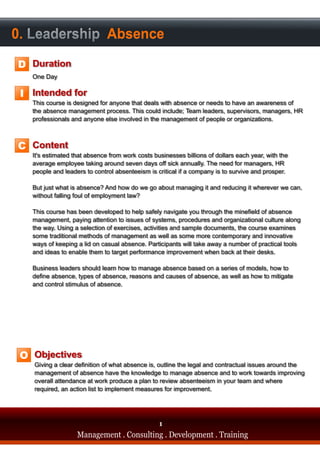
0. Leadership Absence
D

 I


C


 O


                                      1
         Management . Consulting . Development . Training
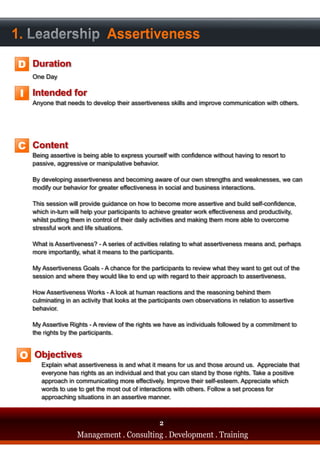
1. Leadership Assertiveness
D

 I


C


 O


                                      2
         Management . Consulting . Development . Training
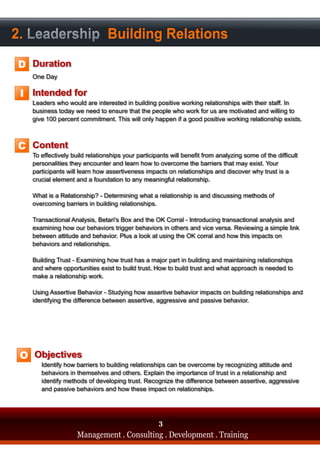
2. Leadership Building Relations
D

 I


C


 O


                                      3
         Management . Consulting . Development . Training
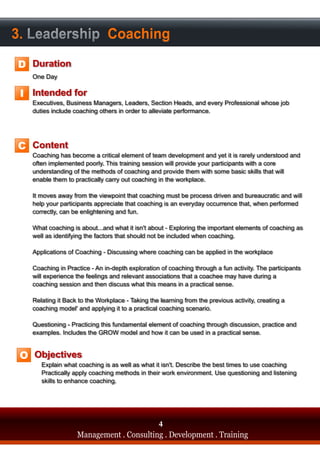
3. Leadership Coaching
D

 I


C


 O


                                      4
         Management . Consulting . Development . Training
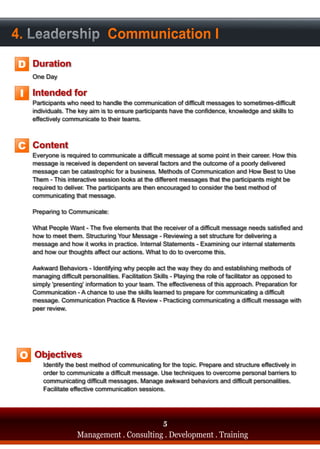
4. Leadership Communication I
D

 I


C


 O


                                       5
         Management . Consulting . Development . Training
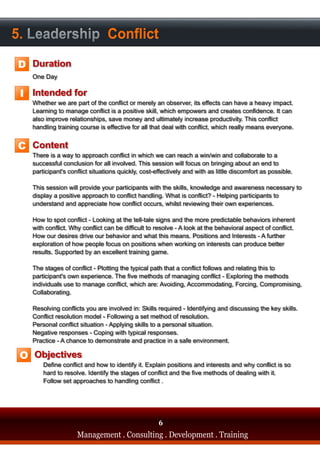
5. Leadership Conflict
D

 I


C


 O


                                      6
         Management . Consulting . Development . Training
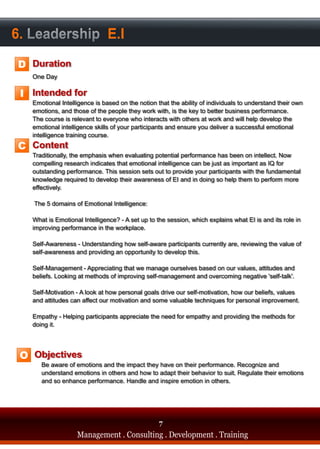
6. Leadership E.I
D

 I


C


 O


                                      7
         Management . Consulting . Development . Training
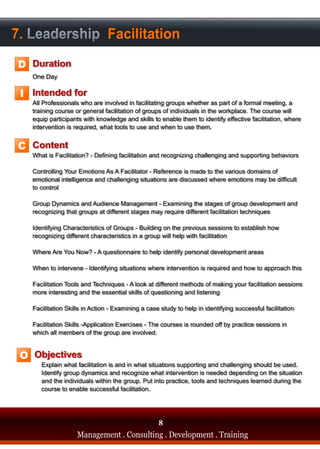
7. Leadership Facilitation
 D

 I


 C


 O


                                       8
          Management . Consulting . Development . Training
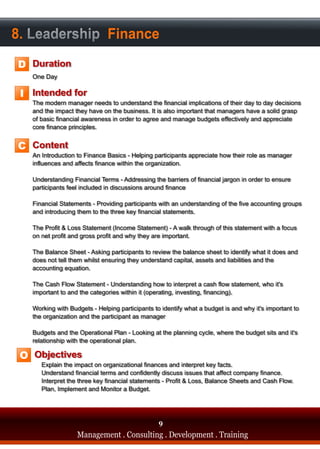
8. Leadership Finance
D

 I


C


 O


                                      9
         Management . Consulting . Development . Training
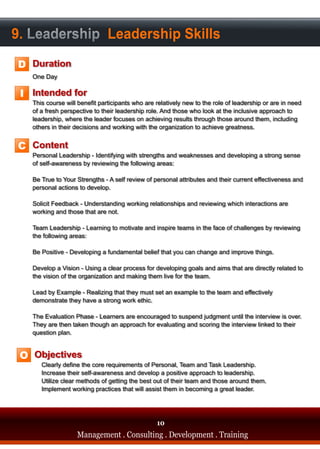
9. Leadership Leadership Skills
D

 I


C


 O


                                     10
         Management . Consulting . Development . Training
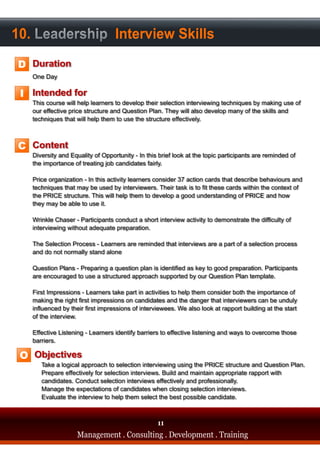
10. Leadership Interview Skills
 D

 I


 C


 O


                                      11
          Management . Consulting . Development . Training
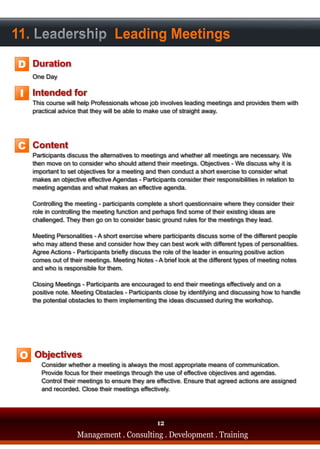
11. Leadership Leading Meetings
D

 I


C


 O


                                     12
         Management . Consulting . Development . Training
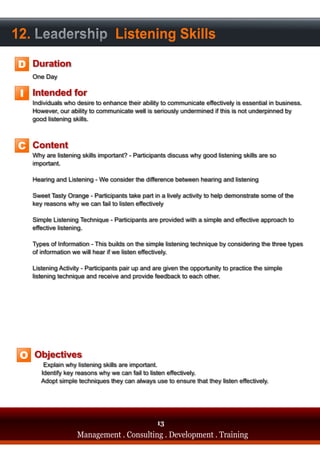
12. Leadership Listening Skills
 D

 I


 C


 O


                                     13
         Management . Consulting . Development . Training
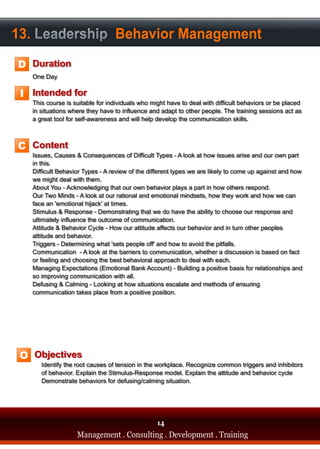
13. Leadership Behavior Management
D

 I


C


 O


                                    14
        Management . Consulting . Development . Training
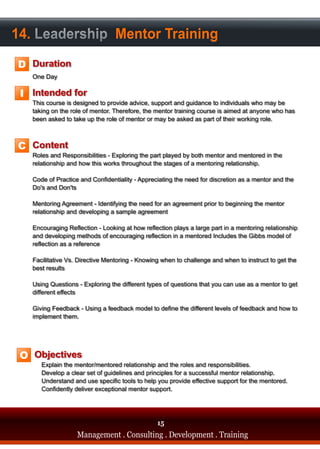
14. Leadership Mentor Training
D

 I


C


 O


                                     15
         Management . Consulting . Development . Training
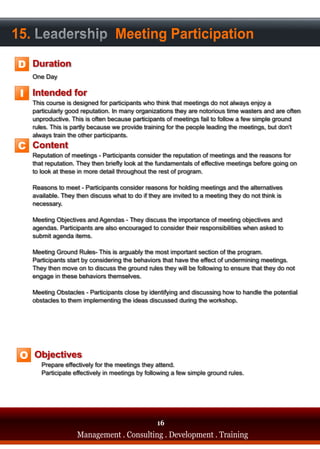
15. Leadership Meeting Participation
D

 I


C


 O


                                     16
         Management . Consulting . Development . Training
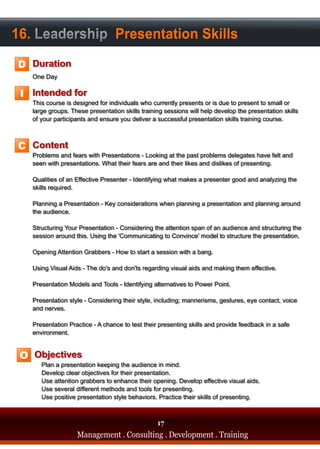
16. Leadership Presentation Skills
D

 I


C


 O


                                     17
         Management . Consulting . Development . Training
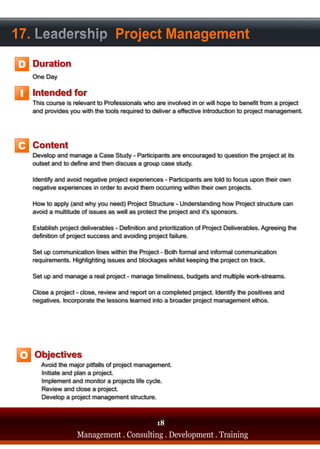
17. Leadership Project Management
D

 I


C


 O


                                     18
         Management . Consulting . Development . Training
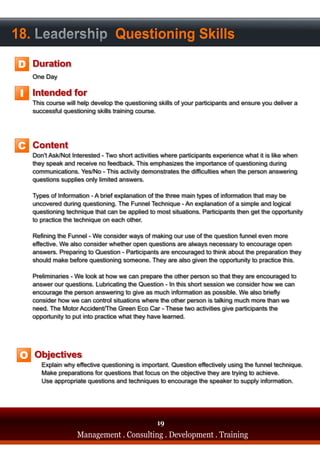
18. Leadership Questioning Skills
D

 I


C


 O


                                     19
         Management . Consulting . Development . Training
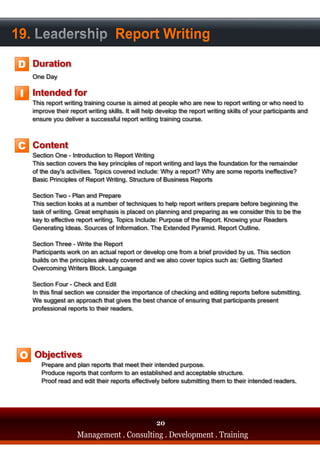
19. Leadership Report Writing
D

 I


C


 O


                                     20
         Management . Consulting . Development . Training
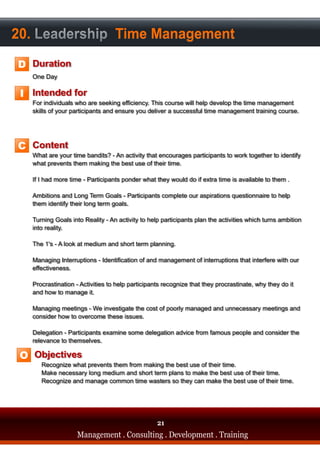
20. Leadership Time Management
D

 I


C


 O


                                    21
        Management . Consulting . Development . Training
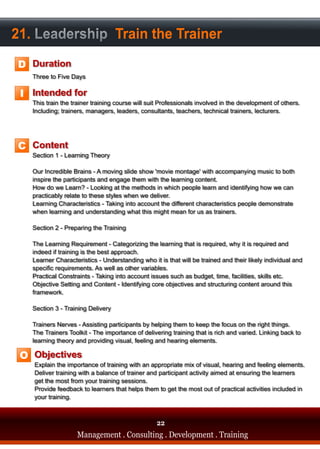
21. Leadership Train the Trainer
 D

 I


 C


 O


                                     22
         Management . Consulting . Development . Training
iconsultica
TRAINING


      Business
    Development
                    www.iconsultica.com
         Management .. Consulting ..Development . .Training
         Management Consulting Development Training
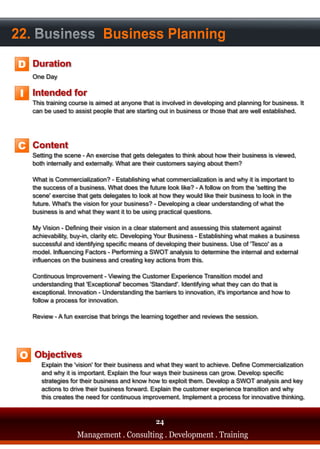
22. Business Business Planning
  D

   I


  C


   O


                                          24
www.iconsultica.com                      24
                  Management .. Consulting . .Development . . Training
                  Management Consulting Development Training
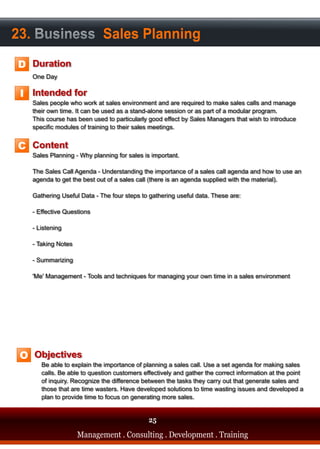
23. Business Sales Planning
  D

   I


  C


   O


                                       25
www.iconsultica.com                     25
                  Management .. Consulting . .Development . . Training
                  Management Consulting Development Training
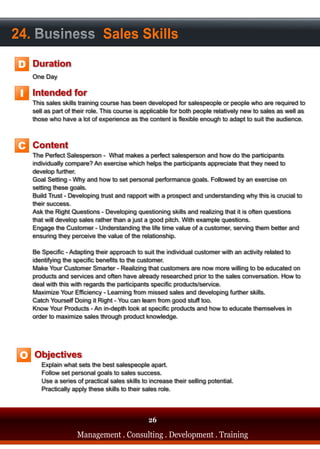
24. Business Sales Skills
  D

   I


  C


   O


                                       26
www.iconsultica.com                     26
                  Management .. Consulting . .Development . . Training
                  Management Consulting Development Training
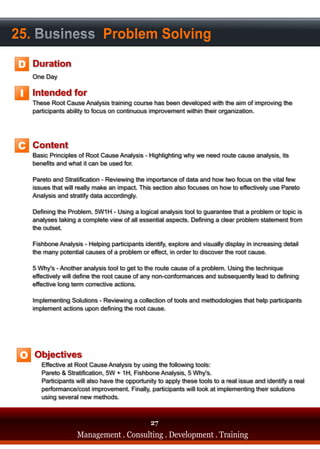
25. Business Problem Solving
  D

   I


  C


   O


                                        27
www.iconsultica.com                      27
                  Management .. Consulting . .Development . . Training
                  Management Consulting Development Training
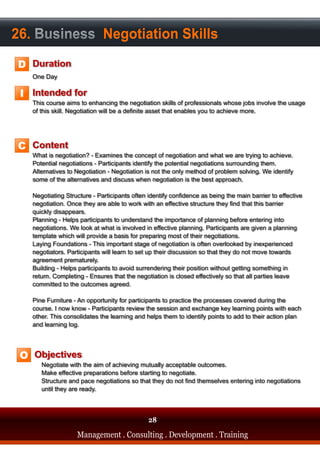
26. Business Negotiation Skills
D

 I


C


 O


                            28

         Management . Consulting . Development . Training
iconsultica
TRAINING


        www.iconsultica.com


         Management ..Consulting . .Development . Training
         Management Consulting Development . Training

Training catalog

  • 1.
    iconsultica TRAINING www.iconsultica.com Management ..Consulting . .Development . Training Management Consulting Development . Training
  • 2.
    I. Context A. Context:Global Workforce Trends We are entering an age where the dominant society is a knowledge society. Knowledge will be the key resource and knowledge workers will dominate the workforce. This transition from an industrial based economy and society is changing not only the way we work, communicate and live, but also the way we are governed and the way that the public service will be expected to deliver programs and provide services. Knowledge is different from every other historical means of production. It becomes obsolete rapidly. It travels more effortlessly than money. It cannot be inherited. It must be acquired at the individual level and each person starts with the same level of ignorance. In a knowledge society, a person's and the organization's ability to acquire and share knowledge is their most important competency. Public service work is predominantly knowledge work and employees of government are predominantly knowledge workers. In such a knowledge-based environment, one of the most important investments a government can make is investment in its employees - its human capital. In an era of a contracted and increasingly competitive and highly mobile labor market, sustained investment in human capital will be necessary to attract and retain the required talent and to provide high quality public services in an efficient way. The Public Service Context Reports concluded that the public service continues to face challenges such as globalization measures and the increased need for knowledge-based workers that impedes the performance of the public service. Training and development in the public service concluded that it was timely for government to change its thinking about training and development in the public service and to treat employee development not as a luxury, but rather as a necessary investment. The report found that human capital is at risk and that training and development, as currently managed, is not being applied in a strategic way. Current tendencies call on government to "maintain the human capital of public service, its capacity to create good policy advice, and its ability to deliver top quality services efficiently" saying that this was urgently needed, now more than ever before, given current pressures on the public service. iconsultica TRAINING www.iconsultica.com Management ..Consulting . .Development . Training Management Consulting Development . Training
  • 3.
    These issues havecontributed to employee perceptions that government values training and development. Employees surveyed have been consistent in expressing their concerns about the lack of access to training and development opportunities. A related issue is the perception that managers in the public service lack the necessary skills to lead and motivate the workforce. This initiative is designed to perfectly meet the public service professional needs and it contains six goals: " Effective people strategy " Proactive and visionary leadership " Performance focused workplace " Learning and innovative organization " Flexible and motivating work environment " Progressive employer - employee relations This document sets out the primary strategy for the creation of a learning and innovative organization within the public service. One of the component strategies is the creation of a management development program that will support the goal of "proactive and visionary leadership." Investment in learning is a key measure of renewal and development of the public service. iconsultica TRAINING www.iconsultica.com Management ..Consulting . .Development . Training Management Consulting Development . Training
  • 4.
    The Business Casefor Investment in Learning The dynamic role and public expectations of government as well as the new emphasis on integrated and cross-ministry policy design and service delivery have changed public sector management and operations with profound long term consequences. These factors are generating pressures to invest in learning, both at the organizational and the individual levels, in order to be more accountable for results in a decentralized environment, make more effective use of technology, modernize the management of people, lead public and private partnerships and leverage the scarce resources of government for better service to citizens. • Learning investments in achieving these objectives in the public service are direct investments in the strategic priorities of the British Columbia government. • Empirical studies in both public and private sector organizations have shown that learning investments produce substantial economic returns to organizations through reduced costs, increased efficiencies and other direct and indirect benefits that improve the performance and competitiveness of the organization. • Return on Investment -Empirical evidence showing strong ROI on learning investments has motivated some organizations to intensify these investments. • Service Improvement - Many service organizations invest in learning because measured improvements in service have been shown to contribute to "brand" reputation, client satisfaction and, eventually, to competitive advantage. • Catalyst for Change - In fast moving and competitive environments, complacency and rigidity are fatal. Learning promotes perspective and innovation and is a key driver of change, starting with changed mindsets that are often the hidden block to successful organizational development and timely adaptation. • Innovation and Creativity - Knowledge being "the new commodity", the ability to create and adapt it has become a key to organizational strength and performance. Individual and organizational learning are now business imperatives in government and the private sector. iconsultica TRAINING www.iconsultica.com Management ..Consulting . .Development . Training Management Consulting Development . Training
  • 5.
    II.Context Core Valueand Objectives A. Goal The Goal of the Learning Strategy is to build a learning and innovative organization and thereby contribute to professional excellence in the ministry. Core Values • An investment in employee learning is an investment in excellence in the delivery of public services. • Equitable access to learning and development opportunities for all employees is critical for renewal of the public service. • Learning, teaching and mentoring are shared responsibilities - each of us needs to acquire, and to help others acquire, the knowledge we need to do our jobs better. • The creation of a learning culture within the public service ultimately supports government's objective to be innovative, enterprising, results oriented and accountable. Objectives The Learning Strategy offers a plan to create an environment where it is understood by all employees and managers that, in a knowledge economy, employee learning and organizational development are operational imperatives, not luxuries. The Strategy has three objectives: 1. The creation of a culture in the public service that encourages learning, innovation and the acquisition, transfer and use of knowledge. 2. Training and development programs that meet the needs of its three stakeholders: government strategic priorities, ministry business objectives and employee job requirements. 3. Efficient delivery of training and development programs to senior executives and employees of all levels in a latter stage. iconsultica TRAINING www.iconsultica.com Management ..Consulting . .Development . Training Management Consulting Development . Training
  • 6.
    III. Strategic Shifts A.Context A number of strategic shifts are required to refocus the current state of learning in the public service and meet the objectives of the Learning Strategy. (Based on Six Sigma measures) iconsultica TRAINING www.iconsultica.com Management ..Consulting . .Development . Training Management Consulting Development . Training
  • 7.
    IV. Strategies andKey Measures A. Context Strategies 1. Formal Corporate Curriculum - Establish and deliver a corporate learning curriculum based upon the broad definition of skills in demand. The curriculum areas and related career development programs will be reviewed from time to time to ensure that they continue to support government’s strategic priorities and ministry operational objectives. 2. Leadership and Management Development Program - Establish and deliver a program of leadership and management development that ensures managers have the tools, techniques and attitudes to provide solid operational and strategic leadership. This program is a powerful tool that helps create a learning culture by helping senior executives understand their role in supporting employee development. It must be integrated with the executive development objectives also provide integrated training to all levels of managers from supervisory to executive. 3. Corporate Training Needs Analysis - Conduct an on-going survey of training needs and priorities across the ministry to ensure that program plans remain current. 4. Training Evaluation Strategy - Establish a training evaluation strategy that will allow senior management to understand whether its training and development objectives are being met. Government needs to know the results of its training investment. Did trainees actually learn what was intended by the program or course and has it resulted in improved performance on the job? 5. Competency Based Learning Activities - Integrate the design of training and development programs with the competencies required by employees to deliver public services effectively. 6. Performance Measures and Reporting - Establish performance measures and reporting standards for all training and development activities and programs to ensure that they continue to support the objectives of this Strategy. iconsultica TRAINING www.iconsultica.com Management ..Consulting . .Development . Training Management Consulting Development . Training
  • 8.
    KEY MEASURES I. Needs Assessment: This systematic exploration of the way things are and the way they should be is utilized before we recommend a certain training area to our candidates. These "things" are usually associated with organizational and/or individual performance. We need to consider the benefits of our consulting and training intervention before we just go and do it: What learning will be accomplished? What changes in behavior and performance are expected? Will we get them? What are the expected economic costs and benefits of any projected solutions? Five steps to conducting needs assessment: Step 1: Perform a "GAP" analysis--The first step is to check the actual performance of each candidate against existing standards, or to set new standards. There are four parts to this: 1. Current situation: We determine the current state of skills, knowledge, and abilities of our current and/or future employees. This analysis also should examine aspired goals, climate, and internal and external constraints. 2. Desired or necessary situation: We identify the desired or necessary conditions for organizational and personal success. This analysis focuses on the necessary job tasks/standards, as well as the skills, knowledge, and abilities needed to accomplish these successfully. It is important that we identify the critical tasks necessary, and not just observe current practices. 3. Afterwards, we take a proactive approach, by assigning candidates to most needed skills training first. In order to meet organizational skills requirements, for example, could team building and related activities help improve candidate's productivity more than negotiation skills? iconsultica TRAINING www.iconsultica.com Management ..Consulting . .Development . Training Management Consulting Development . Training
  • 9.
    4. Are thereinternal or external forces dictating that training and/or organization development will take place? Are there policies or management decisions which might dictate the implementation of some program? Are there governmental mandates to which we must comply? Step 2: Identify priorities--The first step should have produced a large list of needs for training and development, career development, organization development, and/or other interventions. Now we examine these in view of their importance to our organizational goals, realities, and constraints. We must determine if the identified needs are real, if they are worth addressing, and specify their importance and urgency in view of Candidate's organizational needs and requirements Step 3: Identify causes of performance problems and opportunities Now that we have prioritized and focused on critical organizational and personal needs, we next identify specific problem areas and opportunities. We ask two questions for every identified need: Are Candidates doing their jobs effectively? Do they know how to do their jobs? Step 4: Identify possible solutions and opportunities Multiple methods of Needs Assessment are used, to get a true picture, It is important to get a complete picture from many sources and viewpoints. Candidates fill out a combination of questionnaires, consultation sessions with persons in key positions, and/or with specific knowledge review of relevant literature, interviews, focus groups, tests, records & report studies work samples. Step 5: Kick Start-Candidates are emerged into training programs that best correspond to their professional needs based on entire needs analysis. iconsultica TRAINING www.iconsultica.com Management ..Consulting . .Development . Training Management Consulting Development . Training
  • 10.
    4. Are thereinternal or external forces dictating that training and/or organization development will take place? Are there policies or management decisions which might dictate the implementation of some program? Are there governmental mandates to which we must comply? GAP ANALYSIS The Training and Development Needs SOLUTIONS IDENTIFY PRIORITIES The effectiveness of the learning starts Which need will be met first IDENTIFY CAUSES/EFFECTS Activity to meet The Training & Development iconsultica TRAINING www.iconsultica.com Management ..Consulting . .Development . Training Management Consulting Development . Training
  • 11.
    2. Quantitative Evaluation: Typically, when we evaluate our work, we look for validity, accuracy and reliability in our evaluations. We also look for evaluation approaches that are practical and relevant. Quantitative Evaluation methods are highly accurate and effective, that's why we use them extensively before, during and after training and development activities. We consider the following basic suggestions: Before the Implementation Phase 1. We examine if selected training and development methods really result in the candidate's learning the knowledge and skills needed to perform the task or carry out the role? We also answer whether other candidates used the methods and been successful? 2. We consider applying the methods to highly skilled candidates then test their impressions of the methods. 3. Methods must conform to the candidate's preferences and learning styles. Thus, we suggest that candidates briefly review the methods, e.g., documentation, Data shows, etc. During Implementation of Training 1. We ask the Candidates how they're doing. Do they understand what's being said? 2. Periodical short test are conducted to have the candidates explain the main points of what was just described to them. 3. We explore whether candidates are enthusiastically taking part in the activities. Is he or she coming late and leaving early? After Completion of the Training 1. We design a test before and after the training and development, and compare the results. 2. We interview Candidates before and after, and compare results. 3. We observe Candidates perform the task or conduct the role. 4. An expert evaluator from inside or outside the Ministry will be assigned to evaluate the learner's knowledge and skills. iconsultica TRAINING www.iconsultica.com Management ..Consulting . .Development . Training Management Consulting Development . Training
  • 12.
    Methods for collectinginformation about evaluation 1. Case Study-an in-depth examination of each candidate as an individual case. We rely on multiple sources of information to provide as complete a picture as possible on each and every participant and groups working at the same department. 2. Interviews-we collect information by talking with and listening to participants. Two models are conducted here: first, tightly structured, like surveys. Second, free-flowing and conversational. 3. Observation-its important for us to see and assess our participants by keeping a track record of their conduct. 4. Group assessment-- collecting evaluation information about participants through the use of group processes such as nominal group technique, focus group, brainstorming and forums. 5. Expert review--examination by a review committee, panel of experts or peers. 6. Portfolio review--an on-going and careful analysis of each participant's materials, including samples of work, presentations, and the scope of program or activity being evaluated. 7. Testimonial--taking in account participants responses and reactions. 8. Test-use of established standards to assess knowledge, skills, and performance. 9. Document analysis--use of content analysis and other techniques to analyze and summarize printed material and existing information. 10. Creative expression--use of art forms to facilitate powerful tools for participants to present their ideas and feelings through drama, music and art. iconsultica TRAINING www.iconsultica.com Management ..Consulting . .Development . Training Management Consulting Development . Training
  • 13.
    iconsultica TRAINING Leadership Development Management . Consulting . Development . Training
  • 14.
    0. Leadership Absence D I C O 1 Management . Consulting . Development . Training
  • 15.
    1. Leadership Assertiveness D I C O 2 Management . Consulting . Development . Training
  • 16.
    2. Leadership BuildingRelations D I C O 3 Management . Consulting . Development . Training
  • 17.
    3. Leadership Coaching D I C O 4 Management . Consulting . Development . Training
  • 18.
    4. Leadership CommunicationI D I C O 5 Management . Consulting . Development . Training
  • 19.
    5. Leadership Conflict D I C O 6 Management . Consulting . Development . Training
  • 20.
    6. Leadership E.I D I C O 7 Management . Consulting . Development . Training
  • 21.
    7. Leadership Facilitation D I C O 8 Management . Consulting . Development . Training
  • 22.
    8. Leadership Finance D I C O 9 Management . Consulting . Development . Training
  • 23.
    9. Leadership LeadershipSkills D I C O 10 Management . Consulting . Development . Training
  • 24.
    10. Leadership InterviewSkills D I C O 11 Management . Consulting . Development . Training
  • 25.
    11. Leadership LeadingMeetings D I C O 12 Management . Consulting . Development . Training
  • 26.
    12. Leadership ListeningSkills D I C O 13 Management . Consulting . Development . Training
  • 27.
    13. Leadership BehaviorManagement D I C O 14 Management . Consulting . Development . Training
  • 28.
    14. Leadership MentorTraining D I C O 15 Management . Consulting . Development . Training
  • 29.
    15. Leadership MeetingParticipation D I C O 16 Management . Consulting . Development . Training
  • 30.
    16. Leadership PresentationSkills D I C O 17 Management . Consulting . Development . Training
  • 31.
    17. Leadership ProjectManagement D I C O 18 Management . Consulting . Development . Training
  • 32.
    18. Leadership QuestioningSkills D I C O 19 Management . Consulting . Development . Training
  • 33.
    19. Leadership ReportWriting D I C O 20 Management . Consulting . Development . Training
  • 34.
    20. Leadership TimeManagement D I C O 21 Management . Consulting . Development . Training
  • 35.
    21. Leadership Trainthe Trainer D I C O 22 Management . Consulting . Development . Training
  • 36.
    iconsultica TRAINING Business Development www.iconsultica.com Management .. Consulting ..Development . .Training Management Consulting Development Training
  • 37.
    22. Business BusinessPlanning D I C O 24 www.iconsultica.com 24 Management .. Consulting . .Development . . Training Management Consulting Development Training
  • 38.
    23. Business SalesPlanning D I C O 25 www.iconsultica.com 25 Management .. Consulting . .Development . . Training Management Consulting Development Training
  • 39.
    24. Business SalesSkills D I C O 26 www.iconsultica.com 26 Management .. Consulting . .Development . . Training Management Consulting Development Training
  • 40.
    25. Business ProblemSolving D I C O 27 www.iconsultica.com 27 Management .. Consulting . .Development . . Training Management Consulting Development Training
  • 41.
    26. Business NegotiationSkills D I C O 28 Management . Consulting . Development . Training
  • 42.
    iconsultica TRAINING www.iconsultica.com Management ..Consulting . .Development . Training Management Consulting Development . Training