Traffic Signal Management System using Data Warehouse & data mining.pptx
1.
Click to editMaster title style
1
Traffic Signal Management System
using Data Warehouse & Data
Mining
G R O U P N O - 6 5
2.
Click to editMaster title style
2 2
Introduction
Wh at is a Tr a f f ic Si gn a l M a n a g em e n t S y st e m ?
ensures smooth vehicle flow
reduces congestion
enhances safety
Wh y D at a Ware h ou se & D a t a M in in g ?
Stores historical traffic data.
Identifies traffic patterns using data mining
techniques.
Helps in adaptive traffic control and decision-making.
3.
Click to editMaster title style
3 3
Importance of Data in Traffic Signal
Management
Tr a f f i c m a n a g e m e n t re l i e s o n re a l - t i m e a n d h i s t o r i c a l d a t a .
D a t a s o u rc e s i n c l u d e :
CCTV cameras
Sensors & IoT devices
GPS and mobile tracking
Weather reports
Accident & congestion reports
4.
Click to editMaster title style
4 4
Data Warehouse in Traffic Management
Definition: A centralized repository for structured traffic data.
How It Works?
Collects data from multiple sources (sensors, GPS, reports).
Stores data for long-term analysis.
Supports decision-making for better traffic control.
Components:
ETL (Extract, Transform, Load)
Data Marts (e.g., Accident Data Mart, Traffic Flow Data
Mart)
OLAP (Online Analytical Processing)
5.
Click to editMaster title style
5 5
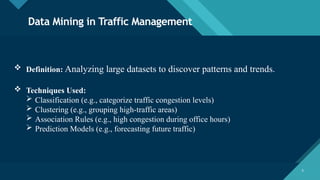
Data Mining in Traffic Management
Definition: Analyzing large datasets to discover patterns and trends.
Techniques Used:
Classification (e.g., categorize traffic congestion levels)
Clustering (e.g., grouping high-traffic areas)
Association Rules (e.g., high congestion during office hours)
Prediction Models (e.g., forecasting future traffic)
6.
Click to editMaster title style
6 6
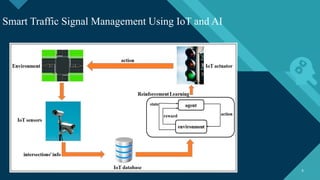
Smart Traffic Signal Management Using IoT and AI
7.
Click to editMaster title style
7 7
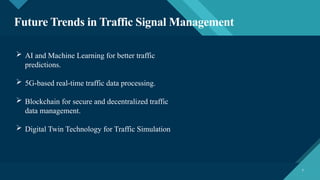
Future Trends in Traffic Signal Management
AI and Machine Learning for better traffic
predictions.
5G-based real-time traffic data processing.
Blockchain for secure and decentralized traffic
data management.
Digital Twin Technology for Traffic Simulation
8.
Click to editMaster title style
8 8
Conclusion
Data Warehouse and Data Mining play a crucial
role in optimizing traffic signals.
Advanced technologies help reduce congestion
and improve road safety.
Future smart city projects will heavily rely on
data-driven traffic management.



![[DSC Europe 25] Slobodan Dolinic - Smart and Intelligent Green Region.pptx](https://cdn.slidesharecdn.com/ss_thumbnails/0bribinjsp6ghwtvsvor-2-sigre-slobodan-dolinic-260115093812-c9c10e90-thumbnail.jpg?width=640&height=640&fit=bounds)


![[DSC Europe 25] Elena Menshikova - AI-Powered Operational Excellence: Revolut...](https://cdn.slidesharecdn.com/ss_thumbnails/es6nholbqy3zaao2c2yd-2-elena-menshikova-data-ai-in-decision-making-260115093812-4fba8b38-thumbnail.jpg?width=640&height=640&fit=bounds)
![[DSC Europe 25] Bojan Djuricic - Predictive Design Process.pdf](https://cdn.slidesharecdn.com/ss_thumbnails/5awdrbedqdek3gqu2ezy-4-the-predictive-design-bojan-djuricic-260120105856-6c399e9b-thumbnail.jpg?width=640&height=640&fit=bounds)


