V isualist’s s
                            Workshop
                               A Traditional Approach
                               and Serial Vision


                               EXCERPT FROM THE VISUALISTS
                               WORKSHOP BY STEVE STANNARD


TRADITIONAL VISUALIZATION                                      STEVE STANNARD’s                1
    Professional WorkshoP                                     SALiENT GROUP
                                                             Visualists Landscape Architects
                                                                          Artists
The TradiTional approach

 WHAT IS A TRADITIONAL APPROACH?

 Architectural visualization is generally concerned with seeing into
 the future. It is most often environmentally based, focusing on the
 sites and the relationship of man-made and natural elements sur-
 rounding them, both existing and proposed.

 Nearly all architectural, engineering, or planning projects are visu-
 alized at some point in the design process. What varies is the ap-
 proach. Many designers use visualization as a sales tool when they
 have a resolved design, producing a drawing that reflects a final
 product. Most often this type of illustration is purely digital, as all
 the information needed is thought through and computerized.

 Alternately, some choose a visualization approach that is more de-
 sign oriented, one that takes place during the design process and
 can start from the moment an idea is hatched. I call this the tradi-
 tional approach. By definition, it is deliberately using sketches as
 a primary design tool. The tools used can be digital but more often
 the visualist uses traditional tools or a combination of both. In prac-
 tice, it is the essential practice of design drawing.

 Through the years the traditional approach to drawing has proven
 to be invaluable for ease of use, immediacy, ability to engage, and
 inherent charm. It is used most effectively early in design projects,
 during the time when initial ideas are formed, when decisions as
 to function and character are made. Used properly, traditional il-
 lustration techniques offer an economy, flexibility, and insight
 that cannot be matched easily with most digital visualization tech-
 niques.


             TRADITIONAL VISUALIZATION                                       STEVE STANNARD’s                2
                 Professional WorkshoP                                      SALiENT GROUP
                                                                           Visualists Landscape Architects
                                                                                        Artists
The TradiTional approach
Serial Vision

The traditional approach, because of it’s design value and speed, is often
used early in a project. Rather than render a likeness of a building, your
task will be to help weave together the elements of a site environment-
trees, buildings, water, traffic, people- until drama is released.

To make this often complicated task simpler, it helps to think in terms
of relationships. Consider this: a building standing alone in a field is
experienced as a work of architecture. Bring several buildings together
and something different happens. Your audience begins to consider sizes
and shapes against one another. All the elements start to work with each
other, developing an emotional response based on their relationship with
each other.

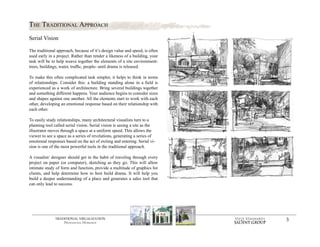
To easily study relationships, many architectural visualists turn to a
planning tool called serial vision. Serial vision is seeing a site as the
illustrator moves through a space at a uniform speed. This allows the
viewer to see a space as a series of revelations, generating a series of
emotional responses based on the act of exiting and entering. Serial vi-
sion is one of the most powerful tools in the traditional approach.

A visualist/ designer should get in the habit of traveling through every
project on paper (or computer), sketching as they go. This will allow
intimate study of form and function, provide a multitude of graphics for
clients, and help determine how to best build drama. It will help you
build a deeper understanding of a place and generates a sales tool that
can only lead to success.


               TRADITIONAL VISUALIZATION                                       STEVE STANNARD’s                3
                   Professional WorkshoP                                      SALiENT GROUP
                                                                             Visualists Landscape Architects
                                                                                          Artists
The TradiTional approach

                                                                           Serial ViSion createS anticipation through manipulation
                                                                           of exiSting and emerging ViewS. within thiS action fallS
                                                                                    the idea of place and the idea of content.


                                                                            place iS concerned with the poSition of our body in the
                                                                           enVironment and iS inStinctiVe. in illuStration, aS in na-
                                                                             ture, where one StandS produceS a range of emotionS
                                                                           that reSult from the phySical experienceS of encloSure and
                                                                           expoSure. think of thiS in termS of here and there. when
                                                                              you create a here, you automatically create a there.

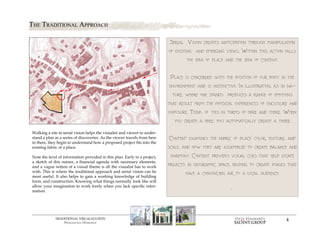
Walking a site in serial vision helps the visualist and viewer to under-
stand a plan as a series of discoveries. As the viewer travels from here    content examineS the fabric of place’ color, texture, and
to there, they begin to understand how a proposed project fits into the
existing fabric of a place.                                                Scale, and how they are aSSembled to create balance and
Note the level of information provided in this plan. Early in a project,    harmony. content proVideS ViSual cueS that help locate
a sketch of this nature, a financial agenda with necessary elements,
and a vague notion of a visual theme is all the visualist has to work
                                                                           projectS in geographic Space, helping to create imageS that
with. This is where the traditional approach and serial vision can be              haVe a conVincing air to a local audience.
most useful. It also helps to gain a working knowledge of building
form, and construction. Knowing what things normally look like will
allow your imagination to work freely when you lack specific infor-
mation.


             TRADITIONAL VISUALIZATION                                                                    STEVE STANNARD’s                4
                 Professional WorkshoP                                                                   SALiENT GROUP
                                                                                                        Visualists Landscape Architects
                                                                                                                     Artists
The TradiTional approach
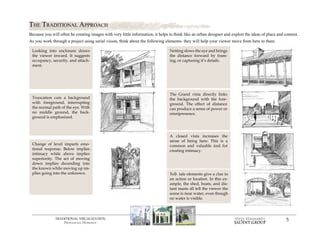
Because you will often be creating images with very little information, it helps to think like an urban designer and exploit the ideas of place and content.
As you work through a project using serial vision, think about the following elements- they will help your viewer move from here to there.

 Looking into enclosure draws                                                    Netting slows the eye and brings
 the viewer inward. It suggests                                                  the distance forward by fram-
 occupancy, security, and attach-                                                ing, or capturing it’s details.
 ment.


                                                                                 The Grand vista directly links
 Truncation cuts a background                                                    the background with the fore-
 with foreground, interrupting                                                   ground. The effect of distance
 the normal path of the eye. With                                                can produce a sense of power or
 no middle ground, the back-                                                     omnipresence.
 ground is emphasized.


                                                                                 A closed vista increases the
                                                                                 sense of being here. This is a
 Change of level imparts emo-                                                    common and valuable tool for
 tional response. Below implies                                                  creating intimacy.
 intimacy while above implies
 superiority. The act of moving
 down implies decending into
 the known while moving up im-
 plies going into the unknown.                                                   Tell- tale elements give a clue to
                                                                                 an action or location. In this ex-
                                                                                 ample, the shed, boats, and dis-
                                                                                 tant masts all tell the viewer the
                                                                                 scene is near water, even though
                                                                                 no water is visible.


               TRADITIONAL VISUALIZATION                                                                                STEVE STANNARD’s                5
                   Professional WorkshoP                                                                               SALiENT GROUP
                                                                                                                      Visualists Landscape Architects
                                                                                                                                   Artists
The TradiTional approach
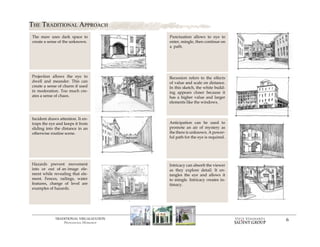
The maw uses dark space to               Punctuation allows to eye to
create a sense of the unknown.           enter, mingle, then continue on
                                         a path.


Projection allows the eye to             Recession refers to the effects
dwell and meander. This can              of value and scale on distance.
create a sense of charm if used          In this sketch, the white build-
in moderation. Too much cre-             ing appears closer because it
ates a sense of chaos.                   has a higher value and larger
                                         elements like the windows.


Incident draws attention. It en-
traps the eye and keeps it from          Anticipation can be used to
sliding into the distance in an          promote an air of mystery as
otherwise routine scene.                 the there is unknown. A power-
                                         ful path for the eye is required.


Hazards prevent movement                 Intricacy can absorb the viewer
into or out of an image ele-             as they explore detail. It en-
ment while revealing that ele-           tangles the eye and allows it
ment. Fences, railings, water            to mingle. Intricacy creates in-
features, change of level are            timacy.
examples of hazards.


             TRADITIONAL VISUALIZATION                                         STEVE STANNARD’s                6
                 Professional WorkshoP                                        SALiENT GROUP
                                                                             Visualists Landscape Architects
                                                                                          Artists

Traditional Serial Vision Excerpt

  • 1.
    V isualist’s s Workshop A Traditional Approach and Serial Vision EXCERPT FROM THE VISUALISTS WORKSHOP BY STEVE STANNARD TRADITIONAL VISUALIZATION STEVE STANNARD’s 1 Professional WorkshoP SALiENT GROUP Visualists Landscape Architects Artists
  • 2.
    The TradiTional approach WHAT IS A TRADITIONAL APPROACH? Architectural visualization is generally concerned with seeing into the future. It is most often environmentally based, focusing on the sites and the relationship of man-made and natural elements sur- rounding them, both existing and proposed. Nearly all architectural, engineering, or planning projects are visu- alized at some point in the design process. What varies is the ap- proach. Many designers use visualization as a sales tool when they have a resolved design, producing a drawing that reflects a final product. Most often this type of illustration is purely digital, as all the information needed is thought through and computerized. Alternately, some choose a visualization approach that is more de- sign oriented, one that takes place during the design process and can start from the moment an idea is hatched. I call this the tradi- tional approach. By definition, it is deliberately using sketches as a primary design tool. The tools used can be digital but more often the visualist uses traditional tools or a combination of both. In prac- tice, it is the essential practice of design drawing. Through the years the traditional approach to drawing has proven to be invaluable for ease of use, immediacy, ability to engage, and inherent charm. It is used most effectively early in design projects, during the time when initial ideas are formed, when decisions as to function and character are made. Used properly, traditional il- lustration techniques offer an economy, flexibility, and insight that cannot be matched easily with most digital visualization tech- niques. TRADITIONAL VISUALIZATION STEVE STANNARD’s 2 Professional WorkshoP SALiENT GROUP Visualists Landscape Architects Artists
  • 3.
    The TradiTional approach SerialVision The traditional approach, because of it’s design value and speed, is often used early in a project. Rather than render a likeness of a building, your task will be to help weave together the elements of a site environment- trees, buildings, water, traffic, people- until drama is released. To make this often complicated task simpler, it helps to think in terms of relationships. Consider this: a building standing alone in a field is experienced as a work of architecture. Bring several buildings together and something different happens. Your audience begins to consider sizes and shapes against one another. All the elements start to work with each other, developing an emotional response based on their relationship with each other. To easily study relationships, many architectural visualists turn to a planning tool called serial vision. Serial vision is seeing a site as the illustrator moves through a space at a uniform speed. This allows the viewer to see a space as a series of revelations, generating a series of emotional responses based on the act of exiting and entering. Serial vi- sion is one of the most powerful tools in the traditional approach. A visualist/ designer should get in the habit of traveling through every project on paper (or computer), sketching as they go. This will allow intimate study of form and function, provide a multitude of graphics for clients, and help determine how to best build drama. It will help you build a deeper understanding of a place and generates a sales tool that can only lead to success. TRADITIONAL VISUALIZATION STEVE STANNARD’s 3 Professional WorkshoP SALiENT GROUP Visualists Landscape Architects Artists
  • 4.
    The TradiTional approach Serial ViSion createS anticipation through manipulation of exiSting and emerging ViewS. within thiS action fallS the idea of place and the idea of content. place iS concerned with the poSition of our body in the enVironment and iS inStinctiVe. in illuStration, aS in na- ture, where one StandS produceS a range of emotionS that reSult from the phySical experienceS of encloSure and expoSure. think of thiS in termS of here and there. when you create a here, you automatically create a there. Walking a site in serial vision helps the visualist and viewer to under- stand a plan as a series of discoveries. As the viewer travels from here content examineS the fabric of place’ color, texture, and to there, they begin to understand how a proposed project fits into the existing fabric of a place. Scale, and how they are aSSembled to create balance and Note the level of information provided in this plan. Early in a project, harmony. content proVideS ViSual cueS that help locate a sketch of this nature, a financial agenda with necessary elements, and a vague notion of a visual theme is all the visualist has to work projectS in geographic Space, helping to create imageS that with. This is where the traditional approach and serial vision can be haVe a conVincing air to a local audience. most useful. It also helps to gain a working knowledge of building form, and construction. Knowing what things normally look like will allow your imagination to work freely when you lack specific infor- mation. TRADITIONAL VISUALIZATION STEVE STANNARD’s 4 Professional WorkshoP SALiENT GROUP Visualists Landscape Architects Artists
  • 5.
    The TradiTional approach Becauseyou will often be creating images with very little information, it helps to think like an urban designer and exploit the ideas of place and content. As you work through a project using serial vision, think about the following elements- they will help your viewer move from here to there. Looking into enclosure draws Netting slows the eye and brings the viewer inward. It suggests the distance forward by fram- occupancy, security, and attach- ing, or capturing it’s details. ment. The Grand vista directly links Truncation cuts a background the background with the fore- with foreground, interrupting ground. The effect of distance the normal path of the eye. With can produce a sense of power or no middle ground, the back- omnipresence. ground is emphasized. A closed vista increases the sense of being here. This is a Change of level imparts emo- common and valuable tool for tional response. Below implies creating intimacy. intimacy while above implies superiority. The act of moving down implies decending into the known while moving up im- plies going into the unknown. Tell- tale elements give a clue to an action or location. In this ex- ample, the shed, boats, and dis- tant masts all tell the viewer the scene is near water, even though no water is visible. TRADITIONAL VISUALIZATION STEVE STANNARD’s 5 Professional WorkshoP SALiENT GROUP Visualists Landscape Architects Artists
  • 6.
    The TradiTional approach Themaw uses dark space to Punctuation allows to eye to create a sense of the unknown. enter, mingle, then continue on a path. Projection allows the eye to Recession refers to the effects dwell and meander. This can of value and scale on distance. create a sense of charm if used In this sketch, the white build- in moderation. Too much cre- ing appears closer because it ates a sense of chaos. has a higher value and larger elements like the windows. Incident draws attention. It en- traps the eye and keeps it from Anticipation can be used to sliding into the distance in an promote an air of mystery as otherwise routine scene. the there is unknown. A power- ful path for the eye is required. Hazards prevent movement Intricacy can absorb the viewer into or out of an image ele- as they explore detail. It en- ment while revealing that ele- tangles the eye and allows it ment. Fences, railings, water to mingle. Intricacy creates in- features, change of level are timacy. examples of hazards. TRADITIONAL VISUALIZATION STEVE STANNARD’s 6 Professional WorkshoP SALiENT GROUP Visualists Landscape Architects Artists