 The traditional Macedonian songs under the musical idioms of mainland Greece but are
highly heterogeneous due to the various influences from both the neighboring nations and of
the refugees-who conceded region and morphology of the space. In general, the Macedonian
music rhythms and lyrical themes Macedonian is the necessary intermediary link between the
traditional music of Epirus and Thessaly (secondary and Central Greece and the
Peloponnese) with the musical tradition of Thrace and Istanbul (and minor in northwest Asia
Minor), without which the study, analysis and investigation of the evolution of traditional
Greek song forever, it becomes very difficult. [citation pending]
 So in the mountains and in the south we find kinship relationships and border-according to
the continental or Thessalian songs, and great is the historical tradition and thieves songs.
Urban areas (Pieria, Veria, Kozani, Siatista, Florina, Kastoria, etc.) have strong local
characteristics. Naoussa is also known for the events of the carnival (Boules). The region,
which was a port of communication with Asia Minor and Constantinople, like most coastal
areas, have been influenced by the East while retaining elements landlubber music.
 The topics are broad and cover all the events of human life. Great variety is also made use of
musical instruments.
 Separate chapter in the rich history of music holds Thessaloniki, as one of the biggest ports in
the Mediterranean, has embraced many traditions thus create a unique music history.
The combination of covered and
disclosed holes enabling it to export
a massive sound, over three octaves,
depending on the capabilities of the
organist. There is a wide range of
clarinets, separated according to
their tonality. The most common is
the clarinet in B ♭, which has the
typical form and dimensions of the
instrument as it is widely known.
Those with the sharpest sound
playing in La ♭, ♭ and Mi Re. By
mid tone there clarinets in C, Si ♭,
Shi natural and LA. In most low
tone and bass are bass clarinets in E
♭ and Si ♭, which differ in their
form than usual, featuring longer
and bell. There is also a metal
clarinet in G, very common in
Turkey.
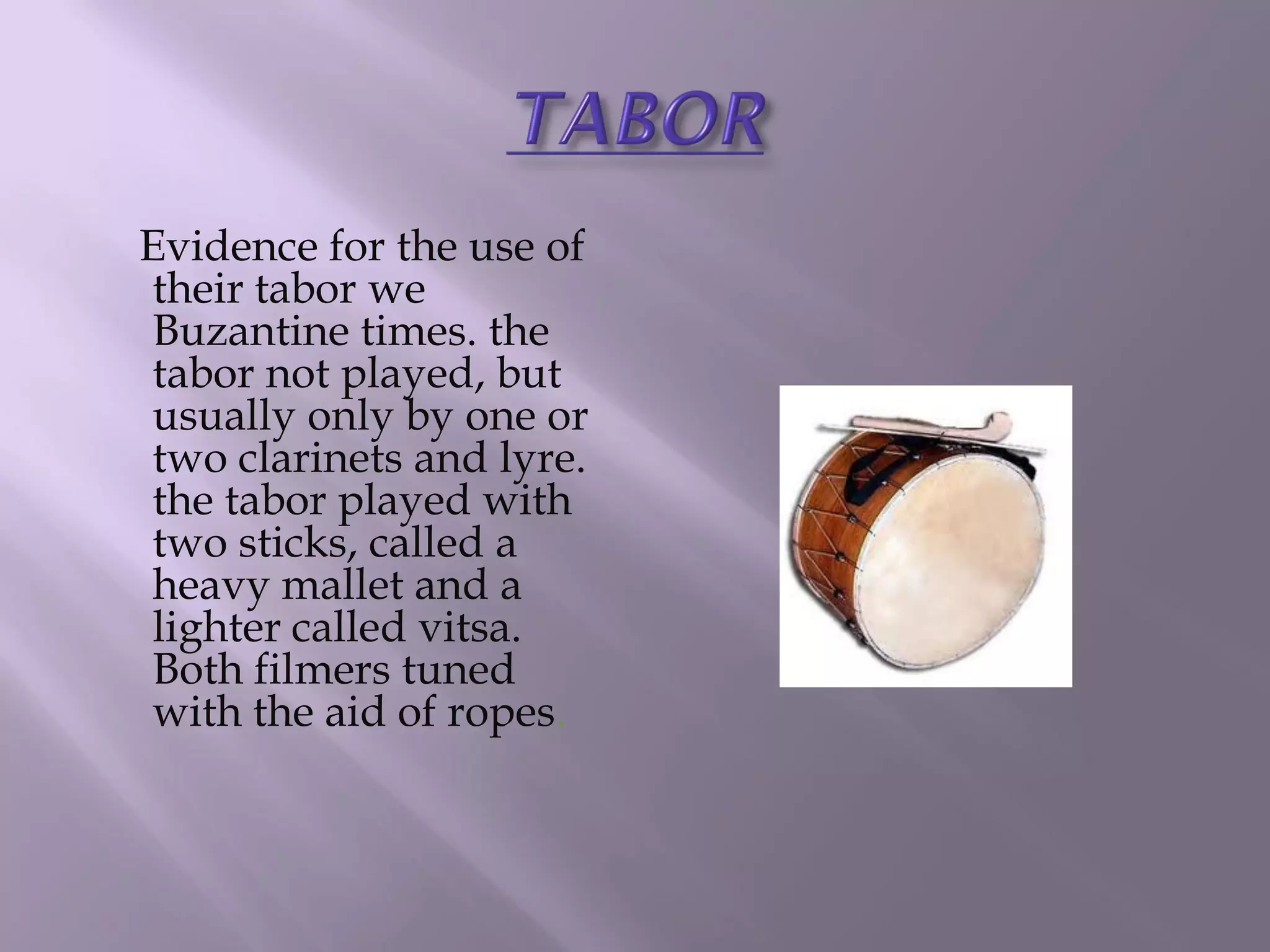
Evidence for the use of
their tabor we
Buzantine times. the
tabor not played, but
usually only by one or
two clarinets and lyre.
the tabor played with
two sticks, called a
heavy mallet and a
lighter called vitsa.
Both filmers tuned
with the aid of ropes.
The bagpipe Bagpipe or
touloumi or vessel is a kind of
bagpipe, that kind of
traditional musical wind
instrument, consisting of a bag
and wooden part. The bagpipe
is a traditional musical
instrument throughout Europe,
North Africa and the Middle
East. The bagpipe consists of a
bag, mouthpiece and audio
production department. The
latter is composed of two
separate glottidofonous
lumens. The one with short
holes, produces the melody
and the other, without long
holes, producing a phoneme
that holds its equal.
Url for traditional songs
http://www.youtube.com/watch?v=saTKkLcy9w
M
http://www.youtube.com/watch?v=7Hh43Lyo9u
c
http://www.youtube.com/watch?v=NuKDduOiif
E
http://www.youtube.com/watch?v=cyuxSWga6X
Q
http://www.youtube.com/watch?v=28NMCdyqQ
eY

Traditional music macedonian (1)

  • 1.
     The traditionalMacedonian songs under the musical idioms of mainland Greece but are highly heterogeneous due to the various influences from both the neighboring nations and of the refugees-who conceded region and morphology of the space. In general, the Macedonian music rhythms and lyrical themes Macedonian is the necessary intermediary link between the traditional music of Epirus and Thessaly (secondary and Central Greece and the Peloponnese) with the musical tradition of Thrace and Istanbul (and minor in northwest Asia Minor), without which the study, analysis and investigation of the evolution of traditional Greek song forever, it becomes very difficult. [citation pending]  So in the mountains and in the south we find kinship relationships and border-according to the continental or Thessalian songs, and great is the historical tradition and thieves songs. Urban areas (Pieria, Veria, Kozani, Siatista, Florina, Kastoria, etc.) have strong local characteristics. Naoussa is also known for the events of the carnival (Boules). The region, which was a port of communication with Asia Minor and Constantinople, like most coastal areas, have been influenced by the East while retaining elements landlubber music.  The topics are broad and cover all the events of human life. Great variety is also made use of musical instruments.  Separate chapter in the rich history of music holds Thessaloniki, as one of the biggest ports in the Mediterranean, has embraced many traditions thus create a unique music history.
  • 2.
    The combination ofcovered and disclosed holes enabling it to export a massive sound, over three octaves, depending on the capabilities of the organist. There is a wide range of clarinets, separated according to their tonality. The most common is the clarinet in B ♭, which has the typical form and dimensions of the instrument as it is widely known. Those with the sharpest sound playing in La ♭, ♭ and Mi Re. By mid tone there clarinets in C, Si ♭, Shi natural and LA. In most low tone and bass are bass clarinets in E ♭ and Si ♭, which differ in their form than usual, featuring longer and bell. There is also a metal clarinet in G, very common in Turkey.
  • 3.
    Evidence for theuse of their tabor we Buzantine times. the tabor not played, but usually only by one or two clarinets and lyre. the tabor played with two sticks, called a heavy mallet and a lighter called vitsa. Both filmers tuned with the aid of ropes.
  • 4.
    The bagpipe Bagpipeor touloumi or vessel is a kind of bagpipe, that kind of traditional musical wind instrument, consisting of a bag and wooden part. The bagpipe is a traditional musical instrument throughout Europe, North Africa and the Middle East. The bagpipe consists of a bag, mouthpiece and audio production department. The latter is composed of two separate glottidofonous lumens. The one with short holes, produces the melody and the other, without long holes, producing a phoneme that holds its equal.
  • 5.
    Url for traditionalsongs http://www.youtube.com/watch?v=saTKkLcy9w M http://www.youtube.com/watch?v=7Hh43Lyo9u c http://www.youtube.com/watch?v=NuKDduOiif E http://www.youtube.com/watch?v=cyuxSWga6X Q http://www.youtube.com/watch?v=28NMCdyqQ eY