More Related Content


Similar to Traders or Commodity Finance Banks Part VIII-


Traders or Commodity Finance Banks Part VIII-
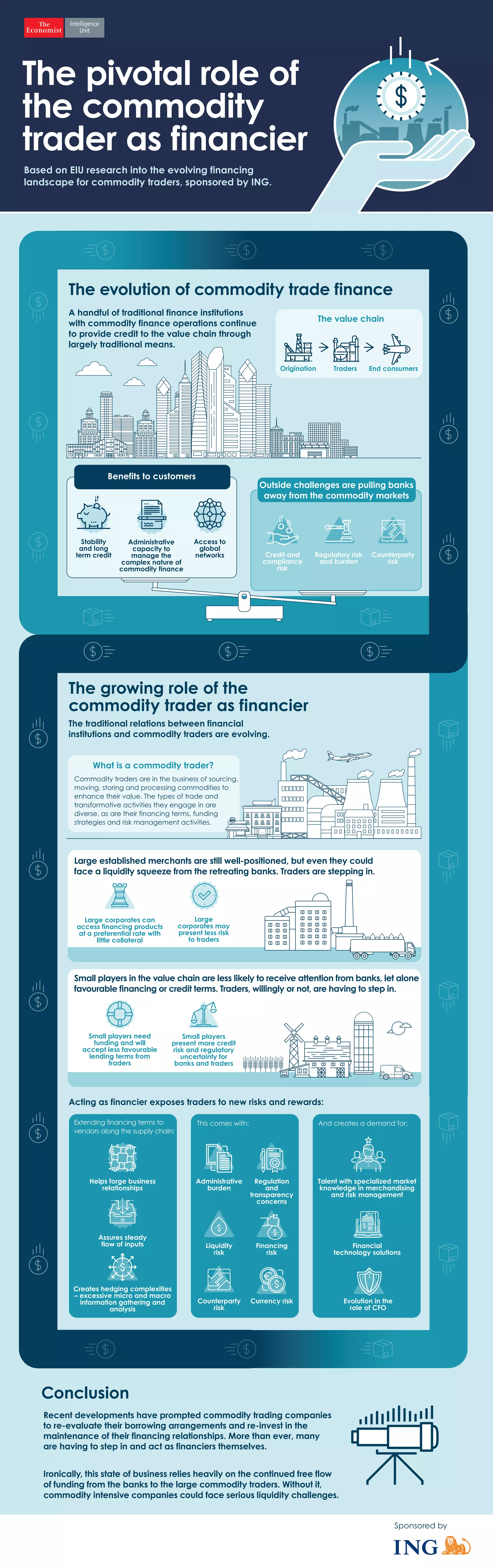
- 1. Recent developments haveprompted commodity trading companies to re-evaluate their borrowing arrangements and re-invest in the maintenance of their financing relationships. More than ever, many are having to step in and act as financiers themselves. Ironically, this state of business relies heavily on the continued free flow of funding from the banks to the large commodity traders. Without it, commodity intensive companies could face serious liquidity challenges. The pivotal role of the commodity trader as financier Based on EIU research into the evolving financing landscape for commodity traders, sponsored by ING. The growing role of the commodity trader as financier Conclusion The traditional relations between financial institutions and commodity traders are evolving. Sponsored by Helps forge business relationships Administrative burden Assures steady flow of inputs Extending financing terms to vendors along the supply chain: This comes with: Talent with specialized market knowledge in merchandising and risk management Regulation and transparency concerns And creates a demand for: Large corporates may present less risk to traders Large corporates can access financing products at a preferential rate with little collateral Stability and long term credit Credit and compliance risk Administrative capacity to manage the complex nature of commodity finance Counterparty risk Access to global networks Regulatory risk and burden Benefits to customers Outside challenges are pulling banks away from the commodity markets The evolution of commodity trade finance A handful of traditional finance institutions with commodity finance operations continue to provide credit to the value chain through largely traditional means. The value chain What is a commodity trader? Origination Traders End consumers Commodity traders are in the business of sourcing, moving, storing and processing commodities to enhance their value. The types of trade and transformative activities they engage in are diverse, as are their financing terms, funding strategies and risk management activities. Large established merchants are still well-positioned, but even they could face a liquidity squeeze from the retreating banks. Traders are stepping in. Small players in the value chain are less likely to receive attention from banks, let alone favourable financing or credit terms. Traders, willingly or not, are having to step in. Acting as financier exposes traders to new risks and rewards: Small players need funding and will accept less favourable lending terms from traders Small players present more credit risk and regulatory uncertainty for banks and traders Financing risk Liquidity risk Counterparty risk Currency risk Creates hedging complexities – excessive micro and macro information gathering and analysis Financial technology solutions Evolution in the role of CFO