HEALTH INFORMATION TECHNOLOGY
LEADERSHIP EXCELLENCE:
TONY FANELLI
“The task of the leader is to get
Platforms that Enhance Physician and
Patient Experiences through Connected
Communities of Health Interoperability
“The task
"Aspire to Inspire before you Expire."
~Unknown
re before you Expire." ~Unknown "Aspire to
Inspire before you Expire." ~Unknown
My Motto:
The Path To Success
WORK HARD
IN SILENCE,
LET SUCCESS
MAKE THE
NOISE!
2 of 10
The Patient Comes First:
Commitment to the “Voice of the Customer”
“A customer is the most important visitor on our
premises; he is not dependent on us. We are
dependent on him. He is not an interruption to our
work. He is the purpose of it. He is not an outsider in
our business. He is part of it. We are not doing him a
favor by serving him. He is doing us a favor by giving
us the opportunity to do so.”
~Mahatma Gandhi
3 of 10
My Career by the Numbers:
Track Record & Experience
• 20+ years in vertically integrated networks: primary care physician, specialty physician, IDN &
acute/post-acute hospital sales – Abbott Diagnostics, SBCL/Quest Diagnostics, Florida Hospital &
Florida Drug Screens.
• 20+ years of developing demo data bases; conducting internal and external client training; and
spearheading process improvements per the “Voice of the Customer” – Abbott Diagnostics,
SBCL/Quest Diagnostics, Florida Drug Screens, LLC & Niagara Falls Memorial Medical Center.
• 20+ years in primary care & specialty physician EMR sales – SBCL TORO and Quest Diagnostics
CARE360 EHR / PM / RCM. Initiated PMS and LIS interfaces and bridges.
• 5+ years in IDN, hospital, primary care & specialty physician EMR/EHR operations – Florida Hospital
(SYSTOC) and NFMMC (PracticePartner, Shared Medical Systems, eClinicalWorks).
Progressive Career with Stellar Performance & Recognition:
 Quest Florida Business Unit Top DSM Customer Satisfaction and Response Awards - 2004.
 Quest Florida Business Unit Top DSM Award - 2003.
 Quest Florida Business Unit DSM Coaching & Mentoring Award - 2003.
 Quest Florida Business Unit Top DSM Awards - 2nd & 3rd Quarters - 2003.
 Quest Special Recognition Stock Option for #5 National District - 2002.
 SBCL National ABM Presidents Club Award – 1998.
 SBCL National ABM Vice President’s Award – 1998.
 SBCL National TSM President's Club Award - 1993.
 SBCL National TSM Vice President’s Award – 1993.
 SBCL National TSM Vice President's Award - 1992.
 Abbott Diagnostics Top Boston Region ASPS Award - 1987.
 Abbott Diagnostics DSS & ASPS "6th Man" Awards - 1984, 1985 & 1986.
 Abbott Diagnostics President's Club Award (#1 DSS National Ranking) - 1986.
 Abbott Diagnostics Senior Sales DSS Award - 1985.
4 of 10
Five Step Pipeline Model:
Build a Robust & Sustainable Pipeline
• PROSPECT & ENGAGE: Identify prospects, diagram organizational
chart, qualify prospects, secure appointments, and maximize the pipeline.
Never be more than one step from your clients – both internal & external.
• DIFFERENTIATE & ENTICE: Teach for differentiation; offer unique
perspectives and drive two-way communication. Align yourself with early
adopters and thought leaders.
• BUILD VALUE: Tailor for resonance through value-based & disruptive
solutions; identify stakeholder value & economic drivers. Permeate account,
present solutions, define opportunity costs & gain technical wins.
• CONFIRM & CLOSE: Take control; inspire emotion & build consensus;
is comfortable discussing money and drives stakeholders to act (can tactfully
challenge and pressure the customer). Develops constructive tension.
• MAKE REFERENCEABLE: Deliver value, make referenceable and
discover new needs. Leverage current clients and deliver patient-centric,
knowledge-based solutions according to the “Voice of the Customer.”
5 of 10
Knowing Your Audience’s Needs:
Primary Care Physician Front-Office Staff
Issues with eCW and most EMRs based on my view from the inside:
• Initially register patients through Cerner (HIS) and have to
re-register through eCW.
• Fax Inbox chart indexing is extremely cumbersome and
time-consuming vs. printing records and scanning to chart.
• Extremely user-unfriendly in most pre-registration and post-
registration tasks due to multiple and redundant data entry
prompts.
• Double charting issues regarding breast cancer and
diabetes screening – non-flow sheet protocols do not
automatically populate patient chart and have to be
manually entered.
6 of 10
Knowing Your Audience’s Needs:
PCP EHR Administrator
Issues with eCW and most EMRs based on my view from the inside:
Users:
• Correct data entry
• Correct use
• Proper security
• Proper use
Timely Updates to Software:
• Bug fixes
• Data base updates – RXs, Tests
Interfaces with Lab and Imaging Results:
• Duplicate test results
• Duplicate orders
• Non-joining results
• Bad tracking
Reporting:
• Garbage-in, Garbage-out
Cerner (HIS):
• Will not create a new encounter for billing based on out coming appointment patient information (ADT)
messages from eCW, causing double registration.
7 of 10
Knowing Your Audience’s Needs:
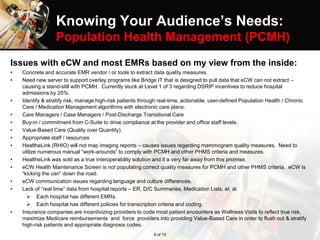
Population Health Management (PCMH)
Issues with eCW and most EMRs based on my view from the inside:
• Concrete and accurate EMR vendor / or tools to extract data quality measures.
• Need new server to support overlay programs like Bridge IT that is designed to pull data that eCW can not extract –
causing a stand-still with PCMH. Currently stuck at Level 1 of 3 regarding DSRIP incentives to reduce hospital
admissions by 25%.
• Identify & stratify risk; manage high-risk patients through real-time, actionable, user-defined Population Health / Chronic
Care / Medication Management algorithms with electronic care plans.
• Care Managers / Case Managers / Post-Discharge Transitional Care
• Buy-in / commitment from C-Suite to drive compliance at the provider and office staff levels.
• Value-Based Care (Quality over Quantity).
• Appropriate staff / resources
• HealtheLink (RHIO) will not map imaging reports – causes issues regarding mammogram quality measures. Need to
utilize numerous manual “work-arounds” to comply with PCMH and other PHMS criteria and measures.
• HealtheLink was sold as a true interoperability solution and it a very far away from this promise.
• eCW Health Maintenance Screen is not populating correct quality measures for PCMH and other PHMS criteria. eCW is
“kicking the can” down the road.
• eCW communication issues regarding language and culture differences.
• Lack of “real time” data from hospital reports – ER, D/C Summaries, Medication Lists, et. al.
 Each hospital has different EMRs.
 Each hospital has different policies for transcription criteria and coding.
• Insurance companies are incentivizing providers to code most patient encounters as Wellness Visits to reflect true risk,
maximize Medicare reimbursements and force providers into providing Value-Based Care in order to flush out & stratify
high-risk patients and appropriate diagnosis codes.
8 of 10
Knowing Your Audience’s Needs:
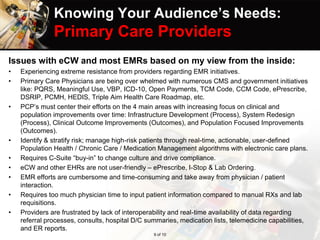
Primary Care Providers
Issues with eCW and most EMRs based on my view from the inside:
• Experiencing extreme resistance from providers regarding EMR initiatives.
• Primary Care Physicians are being over whelmed with numerous CMS and government initiatives
like: PQRS, Meaningful Use, VBP, ICD-10, Open Payments, TCM Code, CCM Code, ePrescribe,
DSRIP, PCMH, HEDIS, Triple Aim Health Care Roadmap, etc.
• PCP’s must center their efforts on the 4 main areas with increasing focus on clinical and
population improvements over time: Infrastructure Development (Process), System Redesign
(Process), Clinical Outcome Improvements (Outcomes), and Population Focused Improvements
(Outcomes).
• Identify & stratify risk; manage high-risk patients through real-time, actionable, user-defined
Population Health / Chronic Care / Medication Management algorithms with electronic care plans.
• Requires C-Suite “buy-in” to change culture and drive compliance.
• eCW and other EHRs are not user-friendly – ePrescribe, I-Stop & Lab Ordering.
• EMR efforts are cumbersome and time-consuming and take away from physician / patient
interaction.
• Requires too much physician time to input patient information compared to manual RXs and lab
requisitions.
• Providers are frustrated by lack of interoperability and real-time availability of data regarding
referral processes, consults, hospital D/C summaries, medication lists, telemedicine capabilities,
and ER reports.
9 of 10
Knowing Your Audience’s Needs:
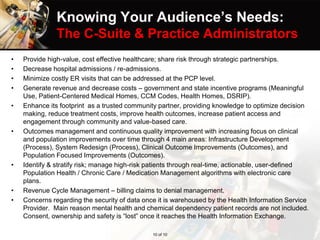
The C-Suite & Practice Administrators
• Provide high-value, cost effective healthcare; share risk through strategic partnerships.
• Decrease hospital admissions / re-admissions.
• Minimize costly ER visits that can be addressed at the PCP level.
• Generate revenue and decrease costs – government and state incentive programs (Meaningful
Use, Patient-Centered Medical Homes, CCM Codes, Health Homes, DSRIP).
• Enhance its footprint as a trusted community partner, providing knowledge to optimize decision
making, reduce treatment costs, improve health outcomes, increase patient access and
engagement through community and value-based care.
• Outcomes management and continuous quality improvement with increasing focus on clinical
and population improvements over time through 4 main areas: Infrastructure Development
(Process), System Redesign (Process), Clinical Outcome Improvements (Outcomes), and
Population Focused Improvements (Outcomes).
• Identify & stratify risk; manage high-risk patients through real-time, actionable, user-defined
Population Health / Chronic Care / Medication Management algorithms with electronic care
plans.
• Revenue Cycle Management – billing claims to denial management.
• Concerns regarding the security of data once it is warehoused by the Health Information Service
Provider. Main reason mental health and chemical dependency patient records are not included.
Consent, ownership and safety is “lost” once it reaches the Health Information Exchange.
10 of 10

HIT_2016

  • 1.
    HEALTH INFORMATION TECHNOLOGY LEADERSHIPEXCELLENCE: TONY FANELLI “The task of the leader is to get Platforms that Enhance Physician and Patient Experiences through Connected Communities of Health Interoperability “The task "Aspire to Inspire before you Expire." ~Unknown re before you Expire." ~Unknown "Aspire to Inspire before you Expire." ~Unknown
  • 2.
    My Motto: The PathTo Success WORK HARD IN SILENCE, LET SUCCESS MAKE THE NOISE! 2 of 10
  • 3.
    The Patient ComesFirst: Commitment to the “Voice of the Customer” “A customer is the most important visitor on our premises; he is not dependent on us. We are dependent on him. He is not an interruption to our work. He is the purpose of it. He is not an outsider in our business. He is part of it. We are not doing him a favor by serving him. He is doing us a favor by giving us the opportunity to do so.” ~Mahatma Gandhi 3 of 10
  • 4.
    My Career bythe Numbers: Track Record & Experience • 20+ years in vertically integrated networks: primary care physician, specialty physician, IDN & acute/post-acute hospital sales – Abbott Diagnostics, SBCL/Quest Diagnostics, Florida Hospital & Florida Drug Screens. • 20+ years of developing demo data bases; conducting internal and external client training; and spearheading process improvements per the “Voice of the Customer” – Abbott Diagnostics, SBCL/Quest Diagnostics, Florida Drug Screens, LLC & Niagara Falls Memorial Medical Center. • 20+ years in primary care & specialty physician EMR sales – SBCL TORO and Quest Diagnostics CARE360 EHR / PM / RCM. Initiated PMS and LIS interfaces and bridges. • 5+ years in IDN, hospital, primary care & specialty physician EMR/EHR operations – Florida Hospital (SYSTOC) and NFMMC (PracticePartner, Shared Medical Systems, eClinicalWorks). Progressive Career with Stellar Performance & Recognition:  Quest Florida Business Unit Top DSM Customer Satisfaction and Response Awards - 2004.  Quest Florida Business Unit Top DSM Award - 2003.  Quest Florida Business Unit DSM Coaching & Mentoring Award - 2003.  Quest Florida Business Unit Top DSM Awards - 2nd & 3rd Quarters - 2003.  Quest Special Recognition Stock Option for #5 National District - 2002.  SBCL National ABM Presidents Club Award – 1998.  SBCL National ABM Vice President’s Award – 1998.  SBCL National TSM President's Club Award - 1993.  SBCL National TSM Vice President’s Award – 1993.  SBCL National TSM Vice President's Award - 1992.  Abbott Diagnostics Top Boston Region ASPS Award - 1987.  Abbott Diagnostics DSS & ASPS "6th Man" Awards - 1984, 1985 & 1986.  Abbott Diagnostics President's Club Award (#1 DSS National Ranking) - 1986.  Abbott Diagnostics Senior Sales DSS Award - 1985. 4 of 10
  • 5.
    Five Step PipelineModel: Build a Robust & Sustainable Pipeline • PROSPECT & ENGAGE: Identify prospects, diagram organizational chart, qualify prospects, secure appointments, and maximize the pipeline. Never be more than one step from your clients – both internal & external. • DIFFERENTIATE & ENTICE: Teach for differentiation; offer unique perspectives and drive two-way communication. Align yourself with early adopters and thought leaders. • BUILD VALUE: Tailor for resonance through value-based & disruptive solutions; identify stakeholder value & economic drivers. Permeate account, present solutions, define opportunity costs & gain technical wins. • CONFIRM & CLOSE: Take control; inspire emotion & build consensus; is comfortable discussing money and drives stakeholders to act (can tactfully challenge and pressure the customer). Develops constructive tension. • MAKE REFERENCEABLE: Deliver value, make referenceable and discover new needs. Leverage current clients and deliver patient-centric, knowledge-based solutions according to the “Voice of the Customer.” 5 of 10
  • 6.
    Knowing Your Audience’sNeeds: Primary Care Physician Front-Office Staff Issues with eCW and most EMRs based on my view from the inside: • Initially register patients through Cerner (HIS) and have to re-register through eCW. • Fax Inbox chart indexing is extremely cumbersome and time-consuming vs. printing records and scanning to chart. • Extremely user-unfriendly in most pre-registration and post- registration tasks due to multiple and redundant data entry prompts. • Double charting issues regarding breast cancer and diabetes screening – non-flow sheet protocols do not automatically populate patient chart and have to be manually entered. 6 of 10
  • 7.
    Knowing Your Audience’sNeeds: PCP EHR Administrator Issues with eCW and most EMRs based on my view from the inside: Users: • Correct data entry • Correct use • Proper security • Proper use Timely Updates to Software: • Bug fixes • Data base updates – RXs, Tests Interfaces with Lab and Imaging Results: • Duplicate test results • Duplicate orders • Non-joining results • Bad tracking Reporting: • Garbage-in, Garbage-out Cerner (HIS): • Will not create a new encounter for billing based on out coming appointment patient information (ADT) messages from eCW, causing double registration. 7 of 10
  • 8.
    Knowing Your Audience’sNeeds: Population Health Management (PCMH) Issues with eCW and most EMRs based on my view from the inside: • Concrete and accurate EMR vendor / or tools to extract data quality measures. • Need new server to support overlay programs like Bridge IT that is designed to pull data that eCW can not extract – causing a stand-still with PCMH. Currently stuck at Level 1 of 3 regarding DSRIP incentives to reduce hospital admissions by 25%. • Identify & stratify risk; manage high-risk patients through real-time, actionable, user-defined Population Health / Chronic Care / Medication Management algorithms with electronic care plans. • Care Managers / Case Managers / Post-Discharge Transitional Care • Buy-in / commitment from C-Suite to drive compliance at the provider and office staff levels. • Value-Based Care (Quality over Quantity). • Appropriate staff / resources • HealtheLink (RHIO) will not map imaging reports – causes issues regarding mammogram quality measures. Need to utilize numerous manual “work-arounds” to comply with PCMH and other PHMS criteria and measures. • HealtheLink was sold as a true interoperability solution and it a very far away from this promise. • eCW Health Maintenance Screen is not populating correct quality measures for PCMH and other PHMS criteria. eCW is “kicking the can” down the road. • eCW communication issues regarding language and culture differences. • Lack of “real time” data from hospital reports – ER, D/C Summaries, Medication Lists, et. al.  Each hospital has different EMRs.  Each hospital has different policies for transcription criteria and coding. • Insurance companies are incentivizing providers to code most patient encounters as Wellness Visits to reflect true risk, maximize Medicare reimbursements and force providers into providing Value-Based Care in order to flush out & stratify high-risk patients and appropriate diagnosis codes. 8 of 10
  • 9.
    Knowing Your Audience’sNeeds: Primary Care Providers Issues with eCW and most EMRs based on my view from the inside: • Experiencing extreme resistance from providers regarding EMR initiatives. • Primary Care Physicians are being over whelmed with numerous CMS and government initiatives like: PQRS, Meaningful Use, VBP, ICD-10, Open Payments, TCM Code, CCM Code, ePrescribe, DSRIP, PCMH, HEDIS, Triple Aim Health Care Roadmap, etc. • PCP’s must center their efforts on the 4 main areas with increasing focus on clinical and population improvements over time: Infrastructure Development (Process), System Redesign (Process), Clinical Outcome Improvements (Outcomes), and Population Focused Improvements (Outcomes). • Identify & stratify risk; manage high-risk patients through real-time, actionable, user-defined Population Health / Chronic Care / Medication Management algorithms with electronic care plans. • Requires C-Suite “buy-in” to change culture and drive compliance. • eCW and other EHRs are not user-friendly – ePrescribe, I-Stop & Lab Ordering. • EMR efforts are cumbersome and time-consuming and take away from physician / patient interaction. • Requires too much physician time to input patient information compared to manual RXs and lab requisitions. • Providers are frustrated by lack of interoperability and real-time availability of data regarding referral processes, consults, hospital D/C summaries, medication lists, telemedicine capabilities, and ER reports. 9 of 10
  • 10.
    Knowing Your Audience’sNeeds: The C-Suite & Practice Administrators • Provide high-value, cost effective healthcare; share risk through strategic partnerships. • Decrease hospital admissions / re-admissions. • Minimize costly ER visits that can be addressed at the PCP level. • Generate revenue and decrease costs – government and state incentive programs (Meaningful Use, Patient-Centered Medical Homes, CCM Codes, Health Homes, DSRIP). • Enhance its footprint as a trusted community partner, providing knowledge to optimize decision making, reduce treatment costs, improve health outcomes, increase patient access and engagement through community and value-based care. • Outcomes management and continuous quality improvement with increasing focus on clinical and population improvements over time through 4 main areas: Infrastructure Development (Process), System Redesign (Process), Clinical Outcome Improvements (Outcomes), and Population Focused Improvements (Outcomes). • Identify & stratify risk; manage high-risk patients through real-time, actionable, user-defined Population Health / Chronic Care / Medication Management algorithms with electronic care plans. • Revenue Cycle Management – billing claims to denial management. • Concerns regarding the security of data once it is warehoused by the Health Information Service Provider. Main reason mental health and chemical dependency patient records are not included. Consent, ownership and safety is “lost” once it reaches the Health Information Exchange. 10 of 10