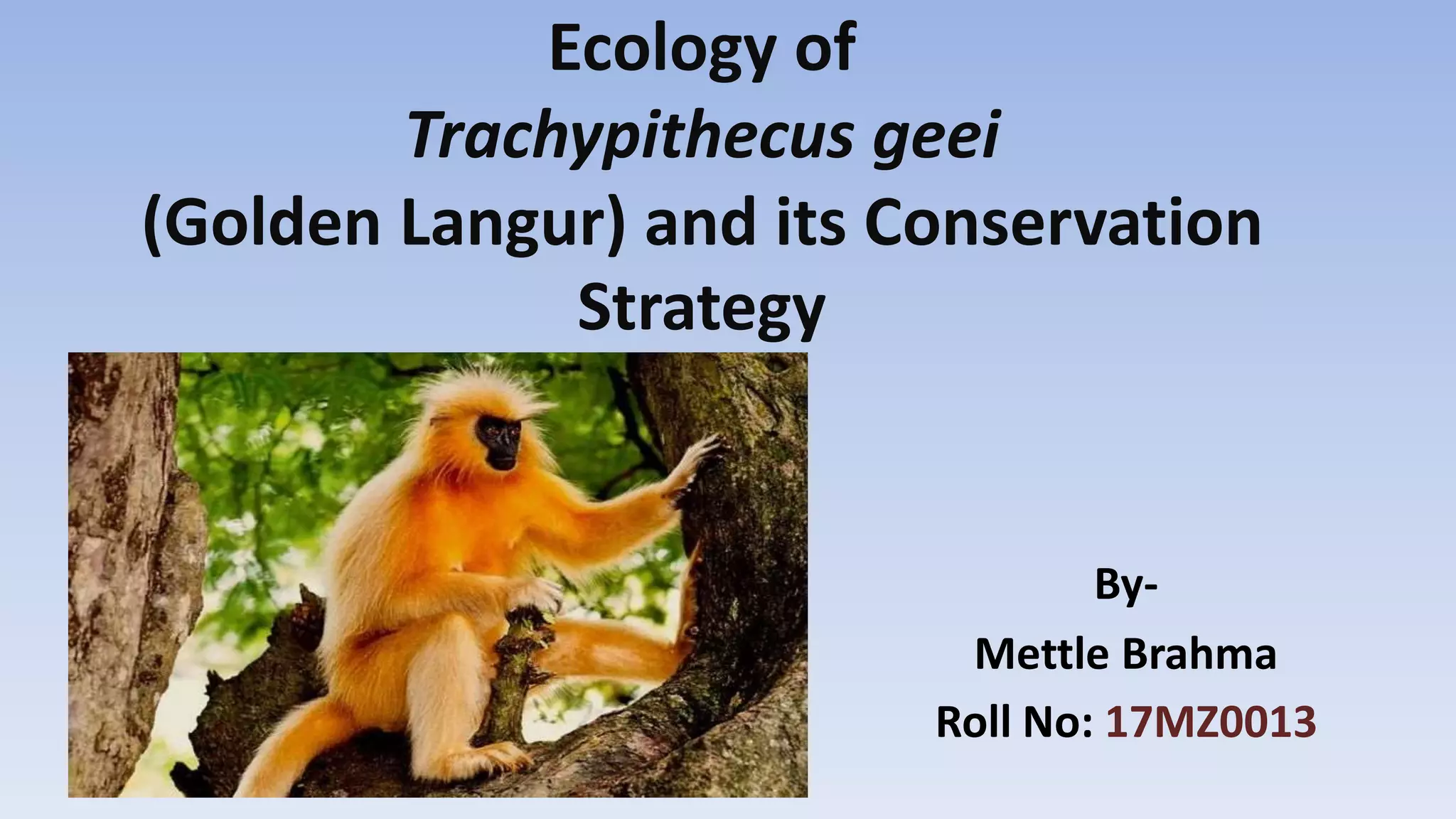
Ecology of
Trachypithecus geei
(Golden Langur) and its Conservation
Strategy
By-
Mettle Brahma
Roll No: 17MZ0013
Introduction
• The golden Langur is one of the rarest
primates of south Asia.
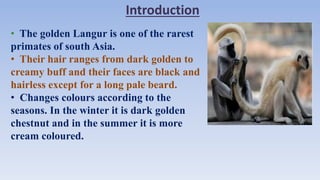
• Their hair ranges from dark golden to
creamy buff and their faces are black and
hairless except for a long pale beard.
• Changes colours according to the
seasons. In the winter it is dark golden
chestnut and in the summer it is more
cream coloured.
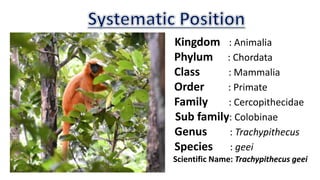
Kingdom : Animalia
Phylum : Chordata
Class : Mammalia
Order : Primate
Family : Cercopithecidae
Sub family: Colobinae
Genus : Trachypithecus
Species : geei
Scientific Name: Trachypithecus geei
Discovery of Golden Langur
• E.P. Gee discovered golden langur in 1954.
• It was first introduced through the book “THE
WILD LIFE OF INDIA”
• In 2003, they were considered endangered by the
IUCN Red list, it is listed in Appendix 1 on the
CITES website.
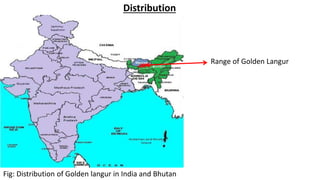
Fig: Distribution of Golden langur in India and Bhutan
Distribution
Range of Golden Langur
Distribution In India
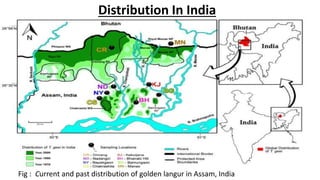
Fig : Current and past distribution of golden langur in Assam, India
Habitat Range
• It is found only in small pocket of forests of north-western Assam,
India and south central Bhutan at the indo Bhutan border.
• It is distributes in India between the rivers Manas in the east,
Sankosh in the west and Brahmaputra in the south.
• Range Elevation: May occur, 0 to 3000m
• Habitat range: Temperate, tropical; terrestrial
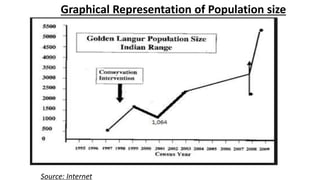
• Population Status: About 3000 species were recorded in between
the year 2011. Recently no census is carried out, but last data
recorded was about 2,500 species in India.
Graphical Representation of Population size
Size
Source: Internet
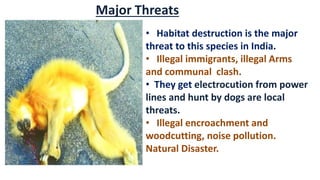
Major Threats
• Habitat destruction is the major
threat to this species in India.
• Illegal immigrants, illegal Arms
and communal clash.
• They get electrocution from power
lines and hunt by dogs are local
threats.
• Illegal encroachment and
woodcutting, noise pollution.
Natural Disaster.
Food habitat
• It is leaf-eating, arboreal, canopy- dwelling langur endemic to India and
Bhutan. They mostly feed on Cryptocoryne retrospiralis.
• Due to the large amounts of leafy material that the golden langurs consume,
they have a sacculated stomach, which is a common characteristic in the
subfamily Colobinae.
• They are recently seen consuming insects in extreme condition.
• It was found to have a diet consisting of 74% leaves, 9% fruits, and 5% flowers.
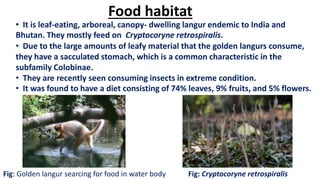
Fig: Golden langur searcing for food in water body Fig: Cryptocoryne retrospiralis
Daily Activity
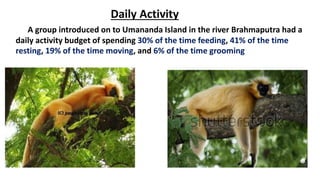
A group introduced on to Umananda Island in the river Brahmaputra had a
daily activity budget of spending 30% of the time feeding, 41% of the time
resting, 19% of the time moving, and 6% of the time grooming
Reproduction
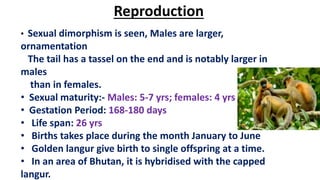
• Sexual dimorphism is seen, Males are larger,
ornamentation
The tail has a tassel on the end and is notably larger in
males
than in females.
• Sexual maturity:- Males: 5-7 yrs; females: 4 yrs
• Gestation Period: 168-180 days
• Life span: 26 yrs
• Births takes place during the month January to June
• Golden langur give birth to single offspring at a time.
• In an area of Bhutan, it is hybridised with the capped
langur.
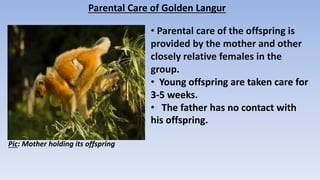
Parental Care of Golden Langur
• Parental care of the offspring is
provided by the mother and other
closely relative females in the
group.
• Young offspring are taken care for
3-5 weeks.
• The father has no contact with
his offspring.
Pic: Mother holding its offspring
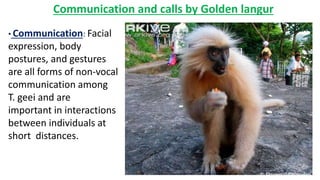
Communication and calls by Golden langur
• Communication: Facial
expression, body
postures, and gestures
are all forms of non-vocal
communication among
T. geei and are
important in interactions
between individuals at
short distances.
Alarm Calls by Golden Langurs
• Calls: Three types of Calls are emitted by Golden langurs for
defence
1. Alarm Call: Males emits sound with closed mouth in low
pitch vocalization -’Nauk-Nauk....’
2. Barking Alarm Call: Adult Males emits sound with open
mouth with high pitch- aeke-ke-aeke-ke.
3. Infant Speech: This sounds are produced by infants, when
they feel they are in danger. --geckers
Conservation Status
• IUCN Red List: Endangered(2008)
• CITES Listing: Appendix 1(2011)
• Wildlife Protection Act: Schedule 1
• Protected Areas: Manas National Park; Chakrashila Wildlife
Sanctuary; Ripu-Chirang reserve forests, Peacock Island
• The Golden Langur Conservation Project (1998):The project
worked with regional N.G.O. and government agencies using
the following tools to effect conservation contagion:
1) community meetings and involving villages in forest
committees and “Self Help Groups” for economic development;
2) formal seminars and celebratory events for the creation
of the Manas Biosphere Reserve.
Ecological benefits
• The spreading the seeds of plants
and fruits they digested to different
locations.
• Golden Langur species is an icon
for the people of Assam and
Bhutan.
• The Golden Langur draws many
tourists and environmentalists
curious to learn about this
wondrous creature.
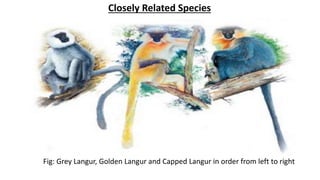
Closely Related Species
Fig: Grey Langur, Golden Langur and Capped Langur in order from left to right
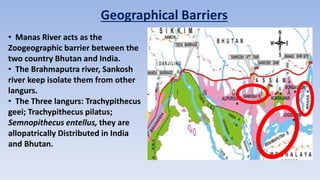
Geographical Barriers
• Manas River acts as the
Zoogeographic barrier between the
two country Bhutan and India.
• The Brahmaputra river, Sankosh
river keep isolate them from other
langurs.
• The Three langurs: Trachypithecus
geei; Trachypithecus pilatus;
Semnopithecus entellus, they are
allopatrically Distributed in India
and Bhutan.
Choudhury, A. (1988a). Priority ratings for conservation of Indian primates. Oryx 22(2), 89-94.
Choudhury, A.U. (1988b). Conservation in Manas Tiger Reserve. Tiger paper 15(2), 23-27.
Choudhury, A.U. (1990). Primates in Bhutan. Oryx, 24, 125.
Choudhury, A.U. (1992). Golden Langur-distribution confusion. Oryx, 26 (3), 172-173.
Gee, E.P. (1964). The Wild Life of India. Harper Collins, London: Fontana. 224pp.
Ghosh, A.K., & Biswas, S. (1976). A note on ecology of the Golden Langur (Presbytis geei
Khajuria). Journal of Bombay Natural History Society 72(4), 524-528.
Gupta, A.K. (2000). Primates of Tripura. Forest Department, Government of Tripura, Agartala.
40pp
Mukherjee, R.P., and Southwick, C.H. (1996-97). Present Status of the Golden Langur in
Assam, India. Asian Primates 6(3 &4), 1-4.
Raj, M. (2012). Wildlife Ecology and Management. Assam Book Depot, 146-152.
Trachypithecus geei (Golden Langur) and its Conservation Strategy

Trachypithecus geei (Golden Langur) and its Conservation Strategy

  • 1.
    Ecology of Trachypithecus geei (GoldenLangur) and its Conservation Strategy By- Mettle Brahma Roll No: 17MZ0013
  • 2.
    Introduction • The goldenLangur is one of the rarest primates of south Asia. • Their hair ranges from dark golden to creamy buff and their faces are black and hairless except for a long pale beard. • Changes colours according to the seasons. In the winter it is dark golden chestnut and in the summer it is more cream coloured.
  • 3.
    Kingdom : Animalia Phylum: Chordata Class : Mammalia Order : Primate Family : Cercopithecidae Sub family: Colobinae Genus : Trachypithecus Species : geei Scientific Name: Trachypithecus geei
  • 4.
    Discovery of GoldenLangur • E.P. Gee discovered golden langur in 1954. • It was first introduced through the book “THE WILD LIFE OF INDIA” • In 2003, they were considered endangered by the IUCN Red list, it is listed in Appendix 1 on the CITES website.
  • 5.
    Fig: Distribution ofGolden langur in India and Bhutan Distribution Range of Golden Langur
  • 6.
    Distribution In India Fig: Current and past distribution of golden langur in Assam, India
  • 7.
    Habitat Range • Itis found only in small pocket of forests of north-western Assam, India and south central Bhutan at the indo Bhutan border. • It is distributes in India between the rivers Manas in the east, Sankosh in the west and Brahmaputra in the south. • Range Elevation: May occur, 0 to 3000m • Habitat range: Temperate, tropical; terrestrial • Population Status: About 3000 species were recorded in between the year 2011. Recently no census is carried out, but last data recorded was about 2,500 species in India.
  • 8.
    Graphical Representation ofPopulation size Size Source: Internet
  • 9.
    Major Threats • Habitatdestruction is the major threat to this species in India. • Illegal immigrants, illegal Arms and communal clash. • They get electrocution from power lines and hunt by dogs are local threats. • Illegal encroachment and woodcutting, noise pollution. Natural Disaster.
  • 10.
    Food habitat • Itis leaf-eating, arboreal, canopy- dwelling langur endemic to India and Bhutan. They mostly feed on Cryptocoryne retrospiralis. • Due to the large amounts of leafy material that the golden langurs consume, they have a sacculated stomach, which is a common characteristic in the subfamily Colobinae. • They are recently seen consuming insects in extreme condition. • It was found to have a diet consisting of 74% leaves, 9% fruits, and 5% flowers. Fig: Golden langur searcing for food in water body Fig: Cryptocoryne retrospiralis
  • 11.
    Daily Activity A groupintroduced on to Umananda Island in the river Brahmaputra had a daily activity budget of spending 30% of the time feeding, 41% of the time resting, 19% of the time moving, and 6% of the time grooming
  • 12.
    Reproduction • Sexual dimorphismis seen, Males are larger, ornamentation The tail has a tassel on the end and is notably larger in males than in females. • Sexual maturity:- Males: 5-7 yrs; females: 4 yrs • Gestation Period: 168-180 days • Life span: 26 yrs • Births takes place during the month January to June • Golden langur give birth to single offspring at a time. • In an area of Bhutan, it is hybridised with the capped langur.
  • 13.
    Parental Care ofGolden Langur • Parental care of the offspring is provided by the mother and other closely relative females in the group. • Young offspring are taken care for 3-5 weeks. • The father has no contact with his offspring. Pic: Mother holding its offspring
  • 14.
    Communication and callsby Golden langur • Communication: Facial expression, body postures, and gestures are all forms of non-vocal communication among T. geei and are important in interactions between individuals at short distances.
  • 15.
    Alarm Calls byGolden Langurs • Calls: Three types of Calls are emitted by Golden langurs for defence 1. Alarm Call: Males emits sound with closed mouth in low pitch vocalization -’Nauk-Nauk....’ 2. Barking Alarm Call: Adult Males emits sound with open mouth with high pitch- aeke-ke-aeke-ke. 3. Infant Speech: This sounds are produced by infants, when they feel they are in danger. --geckers
  • 16.
    Conservation Status • IUCNRed List: Endangered(2008) • CITES Listing: Appendix 1(2011) • Wildlife Protection Act: Schedule 1 • Protected Areas: Manas National Park; Chakrashila Wildlife Sanctuary; Ripu-Chirang reserve forests, Peacock Island • The Golden Langur Conservation Project (1998):The project worked with regional N.G.O. and government agencies using the following tools to effect conservation contagion: 1) community meetings and involving villages in forest committees and “Self Help Groups” for economic development; 2) formal seminars and celebratory events for the creation of the Manas Biosphere Reserve.
  • 17.
    Ecological benefits • Thespreading the seeds of plants and fruits they digested to different locations. • Golden Langur species is an icon for the people of Assam and Bhutan. • The Golden Langur draws many tourists and environmentalists curious to learn about this wondrous creature.
  • 18.
    Closely Related Species Fig:Grey Langur, Golden Langur and Capped Langur in order from left to right
  • 19.
    Geographical Barriers • ManasRiver acts as the Zoogeographic barrier between the two country Bhutan and India. • The Brahmaputra river, Sankosh river keep isolate them from other langurs. • The Three langurs: Trachypithecus geei; Trachypithecus pilatus; Semnopithecus entellus, they are allopatrically Distributed in India and Bhutan.
  • 20.
    Choudhury, A. (1988a).Priority ratings for conservation of Indian primates. Oryx 22(2), 89-94. Choudhury, A.U. (1988b). Conservation in Manas Tiger Reserve. Tiger paper 15(2), 23-27. Choudhury, A.U. (1990). Primates in Bhutan. Oryx, 24, 125. Choudhury, A.U. (1992). Golden Langur-distribution confusion. Oryx, 26 (3), 172-173. Gee, E.P. (1964). The Wild Life of India. Harper Collins, London: Fontana. 224pp. Ghosh, A.K., & Biswas, S. (1976). A note on ecology of the Golden Langur (Presbytis geei Khajuria). Journal of Bombay Natural History Society 72(4), 524-528. Gupta, A.K. (2000). Primates of Tripura. Forest Department, Government of Tripura, Agartala. 40pp Mukherjee, R.P., and Southwick, C.H. (1996-97). Present Status of the Golden Langur in Assam, India. Asian Primates 6(3 &4), 1-4. Raj, M. (2012). Wildlife Ecology and Management. Assam Book Depot, 146-152.