Project part-financed by the European Union
Sustainability Standards for New
Homes in the UK: the Code for
Sustainable Homes
Kate Aspinall
Project part-financed by the European Union
Quick, non-technical tour of the Code
• Registered Social Landlords (RSLs) in the UK
• Brief description of how sustainability standards for housebuilding
have evolved in the UK
• The Code for Sustainable Homes
o Structure and key aspects
o How it applies to RSLs and to other constructors
o Examples
Project part-financed by the European Union
The Role of Registered Social Landlords (RSLs)
• Main providers of publicly funded homes in the UK.
• Development part-funded by government grants - £8.4 billion in
2008 -11 programme - 155,000 homes per year. Funding goes to
RSLs, local authorities and approved private developers.
• Must meet conditions for receiving public subsidy (Social Housing
Grant) including financial probity and standards of management as
well as quality of design and sustainability.
• Progressive increase in standards expected, always in excess of
Building Regulations and the private sector.
Project part-financed by the European Union
Evolution of Sustainability Standards
• Building Regulations - set basic standards for all aspects of
construction includind energy efficiency - mandatory for all
construction. Baseline on which other standards are built.
• EcoHomes certification scheme - newbuild
– Part of BREEAM certification programme
– Voluntary for private housebuilders
– Became mandatory for RSLs, progressively higher ratings required
– Applied to the whole development, not individual homes
• EcoHomes XB for refurbishment projects
– Voluntary
• CSH - national standard for the sustainable design and construction
of new homes from April 2007.
Project part-financed by the European Union
Code for Sustainable Homes – Scope
• Introduced April 2007
• From May 2008, mandatory for all new homes to have a CSH rating.
• Ratings included in the Home Information Pack on sale of property.
• Private developers can opt for a “nil-rating” – don’t even have to
achieve the lowest level of the Code.
• Introduces minimum levels of performance in nine key areas
• Mandatory and optional elements make it flexible
• Scoring system at six levels
• Assessed at design stage and post-construction
Project part-financed by the European Union
Key Performance Issues
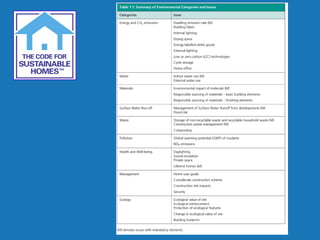
Each homes is awarded credits in respect of:
• Energy and CO2 Emissions
• Water
• Materials used
• Surface water management
• Waste management
• Pollution
• Health and Wellbeing
• Management
• Ecology
Project part-financed by the European Union
Scoring System
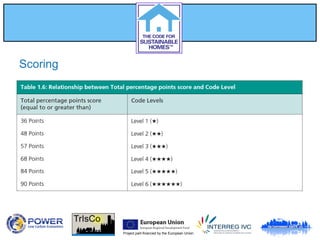
• Six levels, each achieved by meeting:
o the mandatory standard appropriate for that level, AND
o a proportion of the “flexible” standards
• Each level represents a progressive improvement on the baseline of
Building Regulations – including Level 1.
• Level 3 – currently required for RSL projects.
• Level 4 – current “exemplary performance”.
• Level 5 – represents 100% reduction in CO2 emissions
• Level 6 is the “Zero Carbon” home
• The home is scored against each category to arrive at a % score to
establish overall rating.
Project part-financed by the European Union
Mandatory elements
• In order to attain every level a minimum performance MUST be achieved in:
• CO2 emission rates
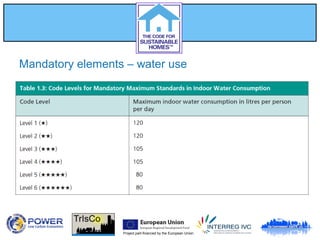
• Indoor water use
• Materials
• Waste
• Surface water run-off
• To attain Level 2 – 6, progressively higher minimum standards in:
• CO2 emission rates
• Indoor water use.
• To attain Level 6, the home must also meet Lifetime Homes standards.
Project part-financed by the European Union
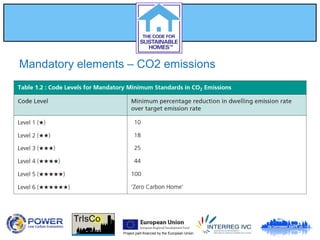
Mandatory elements – CO2 emissions
Project part-financed by the European Union
Mandatory elements – water use
Project part-financed by the European Union
“Flexible” elements
• Beyond the mandatory elements, developers can gain credits from
the other elements to achieve the overall score.
• Choice in how to achieve the Level rating they are seeking.
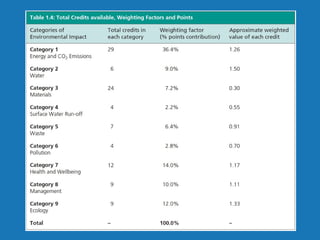
• Not all elements are equal – environmental weighting factor is
applied to each category to emphasise those elements that are
seen as more environmentally significant.
Project part-financed by the European Union
The
• Main
Project part-financed by the European Union
Scoring
• Have the four mandatory categories been achieved?
If they have not all been met then the home is zero rated, regardless
of scores achieved for other elements.
• Have the minimum scores been achieved to gain the mandatory
credits for CO2 and water use for the Level sought?
Rating determined by the lowest score, so both are needed to meet
the requirements for a higher Level.
• Have the credits from mandatory and flexible elements achieved the
totals necessary to achieve the Level sought?
Project part-financed by the European Union
Scoring
Project part-financed by the European Union
Assessment
• Carried out by approved CSH Assessor
• Programme of assessor training licenced by the BRE
• Assessment must be by use of the approved calculation tool
• Submitted to the BRE
• Approval/certificate issued
Project part-financed by the European Union
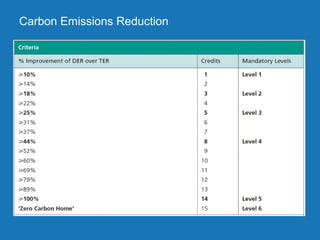
Carbon Emissions
• By far the most important element – 15 credits available
• Heaviest weighting
• Building Regulations establish a Target Emissions Rate (TER)*
• Home is assessed for its Dwelling Emissions Rate (DER)*
• Percentage improvement of DER compared with TER establishes
the credit achieved.
* kg of CO2 per m2
per annum arising from energy use for heating, hot water and lighting
Project part-financed by the European Union
Carbon Emissions Reduction
Project part-financed by the European Union
How the Code applies to RSLs
• Publicly subsidised, so always expected to lead the private sector
on standards.
• All schemes funded after April 2007 to achieve Level 3 or higher.
• Additional grant for higher scoring schemes.
• From April 2010 need to achieve Level 4.
Project part-financed by the European Union
The Zero Carbon Home
CSH Definition:
Government intention is for all new homes built to be Zero Carbon by
2016
“Where net carbon dioxide emissions resulting from ALL
energy used in the dwelling are zero or better.
This includes the energy consumed in the operation of the
space heating/cooling and hot-water systems, ventilation,
all internal lighting cooking and all electrical appliances.”
Project part-financed by the European Union
Examples
• RSLs – Level 3 now being met for all schemes
• Both schemes we are visiting meet Level 3 in different ways, using
different construction methods.
• Later phases of the West of Waterlooville site will have to meet
Level 4 – how?
• Costs of meeting the higher standard varies according to RSL’s own
requirements and the demands of the location, planning
requirements and so on.
Project part-financed by the European Union
The
• The
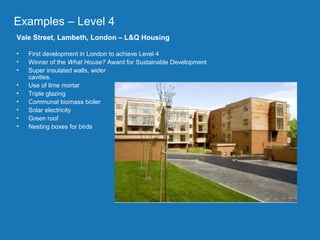
Examples – Level 4
Vale Street, Lambeth, London – L&Q Housing
• First development in London to achieve Level 4
• Winner of the What House? Award for Sustainable Development
• Super insulated walls, wider
cavities.
• Use of lime mortar
• Triple glazing
• Communal biomass boiler
• Solar electricity
• Green roof
• Nesting boxes for birds
Project part-financed by the European Union
The
• The
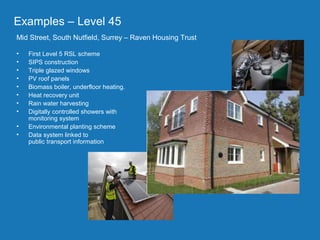
Examples – Level 45
Mid Street, South Nutfield, Surrey – Raven Housing Trust
• First Level 5 RSL scheme
• SIPS construction
• Triple glazed windows
• PV roof panels
• Biomass boiler, underfloor heating.
• Heat recovery unit
• Rain water harvesting
• Digitally controlled showers with
monitoring system
• Environmental planting scheme
• Data system linked to
public transport information
Project part-financed by the European Union
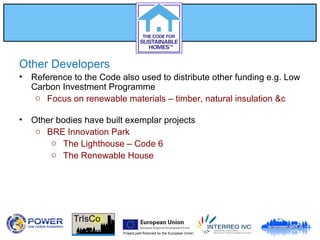
Other Developers
• Reference to the Code also used to distribute other funding e.g. Low
Carbon Investment Programme
o Focus on renewable materials – timber, natural insulation &c
• Other bodies have built exemplar projects
o BRE Innovation Park
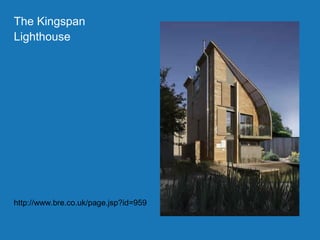
o The Lighthouse – Code 6
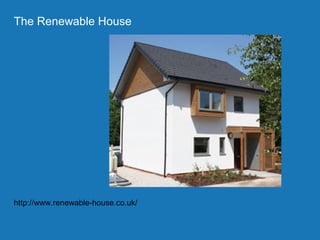
o The Renewable House
Project part-financed by the European Union
The
• The
The Kingspan
Lighthouse
http://www.bre.co.uk/page.jsp?id=959
Project part-financed by the European Union
The
• The
The Renewable House
http://www.renewable-house.co.uk/
Project part-financed by the European Union
Further information:
Code for Sustainable Homes
http://www.communities.gov.uk/planningandbuilding/buildingregulations/legislation/codesustainable/
Building Regulations: Energy efficiency requirements for new dwellings - a forward look
at what standards may be in 2010 and 2013
www.communities.gov.uk/publications/planningandbuilding/energyefficiencynewdwellings
BREEAM Code for Sustainable Homes information
http://www.breeam.org/page.jsp?id=86
Building Regulations Part L
http://www.planningportal.gov.uk/england/professionals/buildingregs/technicalguidance/bcconsfppartl/
bcconsfppartlappdoc/bcconsfppartl1aappdoc
DCLG Sustainable Development Action Plan
http://www.communities.gov.uk/publications/corporate/sustainabledevelopment2007-08

TrIsCo UK Study Tour: Code for Sustainable Homes

  • 1.
    Project part-financed bythe European Union Sustainability Standards for New Homes in the UK: the Code for Sustainable Homes Kate Aspinall
  • 2.
    Project part-financed bythe European Union Quick, non-technical tour of the Code • Registered Social Landlords (RSLs) in the UK • Brief description of how sustainability standards for housebuilding have evolved in the UK • The Code for Sustainable Homes o Structure and key aspects o How it applies to RSLs and to other constructors o Examples
  • 3.
    Project part-financed bythe European Union The Role of Registered Social Landlords (RSLs) • Main providers of publicly funded homes in the UK. • Development part-funded by government grants - £8.4 billion in 2008 -11 programme - 155,000 homes per year. Funding goes to RSLs, local authorities and approved private developers. • Must meet conditions for receiving public subsidy (Social Housing Grant) including financial probity and standards of management as well as quality of design and sustainability. • Progressive increase in standards expected, always in excess of Building Regulations and the private sector.
  • 4.
    Project part-financed bythe European Union Evolution of Sustainability Standards • Building Regulations - set basic standards for all aspects of construction includind energy efficiency - mandatory for all construction. Baseline on which other standards are built. • EcoHomes certification scheme - newbuild – Part of BREEAM certification programme – Voluntary for private housebuilders – Became mandatory for RSLs, progressively higher ratings required – Applied to the whole development, not individual homes • EcoHomes XB for refurbishment projects – Voluntary • CSH - national standard for the sustainable design and construction of new homes from April 2007.
  • 5.
    Project part-financed bythe European Union Code for Sustainable Homes – Scope • Introduced April 2007 • From May 2008, mandatory for all new homes to have a CSH rating. • Ratings included in the Home Information Pack on sale of property. • Private developers can opt for a “nil-rating” – don’t even have to achieve the lowest level of the Code. • Introduces minimum levels of performance in nine key areas • Mandatory and optional elements make it flexible • Scoring system at six levels • Assessed at design stage and post-construction
  • 6.
    Project part-financed bythe European Union Key Performance Issues Each homes is awarded credits in respect of: • Energy and CO2 Emissions • Water • Materials used • Surface water management • Waste management • Pollution • Health and Wellbeing • Management • Ecology
  • 7.
    Project part-financed bythe European Union Scoring System • Six levels, each achieved by meeting: o the mandatory standard appropriate for that level, AND o a proportion of the “flexible” standards • Each level represents a progressive improvement on the baseline of Building Regulations – including Level 1. • Level 3 – currently required for RSL projects. • Level 4 – current “exemplary performance”. • Level 5 – represents 100% reduction in CO2 emissions • Level 6 is the “Zero Carbon” home • The home is scored against each category to arrive at a % score to establish overall rating.
  • 8.
    Project part-financed bythe European Union Mandatory elements • In order to attain every level a minimum performance MUST be achieved in: • CO2 emission rates • Indoor water use • Materials • Waste • Surface water run-off • To attain Level 2 – 6, progressively higher minimum standards in: • CO2 emission rates • Indoor water use. • To attain Level 6, the home must also meet Lifetime Homes standards.
  • 9.
    Project part-financed bythe European Union
  • 10.
    Project part-financed bythe European Union Mandatory elements – CO2 emissions
  • 11.
    Project part-financed bythe European Union Mandatory elements – water use
  • 12.
    Project part-financed bythe European Union “Flexible” elements • Beyond the mandatory elements, developers can gain credits from the other elements to achieve the overall score. • Choice in how to achieve the Level rating they are seeking. • Not all elements are equal – environmental weighting factor is applied to each category to emphasise those elements that are seen as more environmentally significant.
  • 13.
    Project part-financed bythe European Union The • Main
  • 14.
    Project part-financed bythe European Union Scoring • Have the four mandatory categories been achieved? If they have not all been met then the home is zero rated, regardless of scores achieved for other elements. • Have the minimum scores been achieved to gain the mandatory credits for CO2 and water use for the Level sought? Rating determined by the lowest score, so both are needed to meet the requirements for a higher Level. • Have the credits from mandatory and flexible elements achieved the totals necessary to achieve the Level sought?
  • 15.
    Project part-financed bythe European Union Scoring
  • 16.
    Project part-financed bythe European Union Assessment • Carried out by approved CSH Assessor • Programme of assessor training licenced by the BRE • Assessment must be by use of the approved calculation tool • Submitted to the BRE • Approval/certificate issued
  • 17.
    Project part-financed bythe European Union Carbon Emissions • By far the most important element – 15 credits available • Heaviest weighting • Building Regulations establish a Target Emissions Rate (TER)* • Home is assessed for its Dwelling Emissions Rate (DER)* • Percentage improvement of DER compared with TER establishes the credit achieved. * kg of CO2 per m2 per annum arising from energy use for heating, hot water and lighting
  • 18.
    Project part-financed bythe European Union Carbon Emissions Reduction
  • 19.
    Project part-financed bythe European Union How the Code applies to RSLs • Publicly subsidised, so always expected to lead the private sector on standards. • All schemes funded after April 2007 to achieve Level 3 or higher. • Additional grant for higher scoring schemes. • From April 2010 need to achieve Level 4.
  • 20.
    Project part-financed bythe European Union The Zero Carbon Home CSH Definition: Government intention is for all new homes built to be Zero Carbon by 2016 “Where net carbon dioxide emissions resulting from ALL energy used in the dwelling are zero or better. This includes the energy consumed in the operation of the space heating/cooling and hot-water systems, ventilation, all internal lighting cooking and all electrical appliances.”
  • 21.
    Project part-financed bythe European Union Examples • RSLs – Level 3 now being met for all schemes • Both schemes we are visiting meet Level 3 in different ways, using different construction methods. • Later phases of the West of Waterlooville site will have to meet Level 4 – how? • Costs of meeting the higher standard varies according to RSL’s own requirements and the demands of the location, planning requirements and so on.
  • 22.
    Project part-financed bythe European Union The • The Examples – Level 4 Vale Street, Lambeth, London – L&Q Housing • First development in London to achieve Level 4 • Winner of the What House? Award for Sustainable Development • Super insulated walls, wider cavities. • Use of lime mortar • Triple glazing • Communal biomass boiler • Solar electricity • Green roof • Nesting boxes for birds
  • 23.
    Project part-financed bythe European Union The • The Examples – Level 45 Mid Street, South Nutfield, Surrey – Raven Housing Trust • First Level 5 RSL scheme • SIPS construction • Triple glazed windows • PV roof panels • Biomass boiler, underfloor heating. • Heat recovery unit • Rain water harvesting • Digitally controlled showers with monitoring system • Environmental planting scheme • Data system linked to public transport information
  • 24.
    Project part-financed bythe European Union Other Developers • Reference to the Code also used to distribute other funding e.g. Low Carbon Investment Programme o Focus on renewable materials – timber, natural insulation &c • Other bodies have built exemplar projects o BRE Innovation Park o The Lighthouse – Code 6 o The Renewable House
  • 25.
    Project part-financed bythe European Union The • The The Kingspan Lighthouse http://www.bre.co.uk/page.jsp?id=959
  • 26.
    Project part-financed bythe European Union The • The The Renewable House http://www.renewable-house.co.uk/
  • 27.
    Project part-financed bythe European Union Further information: Code for Sustainable Homes http://www.communities.gov.uk/planningandbuilding/buildingregulations/legislation/codesustainable/ Building Regulations: Energy efficiency requirements for new dwellings - a forward look at what standards may be in 2010 and 2013 www.communities.gov.uk/publications/planningandbuilding/energyefficiencynewdwellings BREEAM Code for Sustainable Homes information http://www.breeam.org/page.jsp?id=86 Building Regulations Part L http://www.planningportal.gov.uk/england/professionals/buildingregs/technicalguidance/bcconsfppartl/ bcconsfppartlappdoc/bcconsfppartl1aappdoc DCLG Sustainable Development Action Plan http://www.communities.gov.uk/publications/corporate/sustainabledevelopment2007-08