COOKERY NC II
TRAINING
REGULATIONS
TOURISM SECTOR
(HOTEL AND RESTAURANT)
TECHNICAL EDUCATION AND SKILLS DEVELOPMENT AUTHORITY
East Service Road, South Superhighway, Taguig City, Metro Manila
TABLE OF CONTENTS
TOURISM SECTOR
(HOTEL AND RESTAURANT)
COOKERY NC II
Page No.
SECTION 1 BARTENDING NC II QUALIFICATION 1
SECTION 2 COMPETENCY STANDARDS
• Basic Competencies 2 -
17
• Common Competencies 18 -
36
• Core Competencies 37 -
76
SECTION 3 TRAINING ARRANGEMENTS
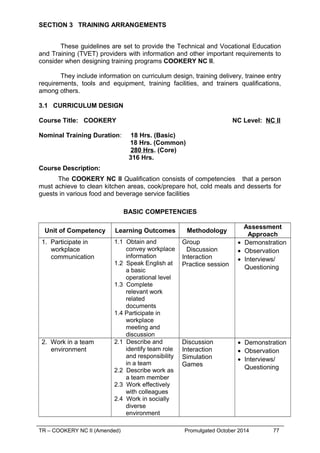
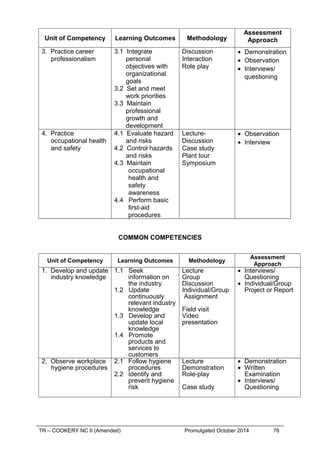
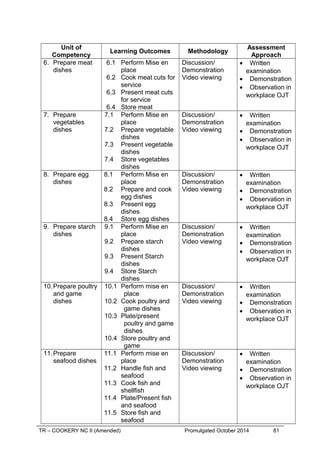
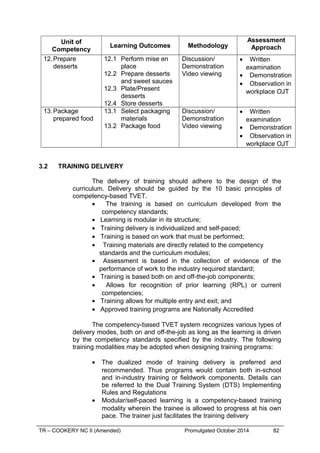
3.1 Curriculum Design 77 - 82
3.2 Training Delivery 82 -
83
3.3 Trainee Entry Requirements 84
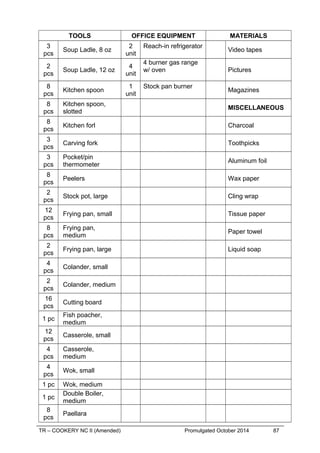
3.4 List of Tools, Equipment and Materials 84 - 87
3.5 Training Facilities 87
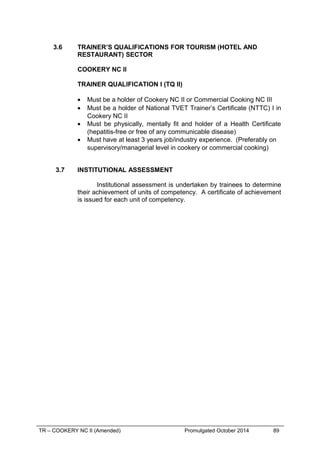
3.6 Trainer’s Qualifications 88
3.7 Institutional Assessment 88
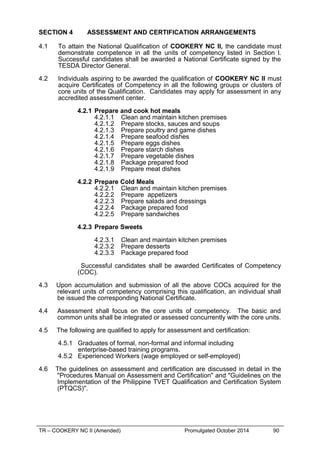
SECTION 4 ASSESSMENT AND
CERTIFICATION ARRANGEMENTS 89
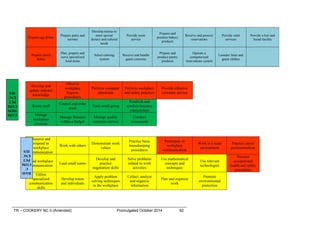
COMPETENCY MAP 90 - 91
ACKNOWLEDGEMENTS 92 - 93
TRAINING REGULATIONS FOR
COOKERY NC II
SECTION 1 COOKERY NC II QUALIFICATION
The COOKERY NC II Qualification consists of competencies that a person
must achieve to clean kitchen areas, prepare hot, cold meals and desserts for guests
in various food and beverage service facilities
This Qualification is packaged from the competency map of the Tourism
Sector (Hotel and Restaurant) as shown in Annex A.
The Units of Competency comprising this Qualification include the following:
CODE NO. BASIC COMPETENCIES
500311105 Participate in workplace communication
500311106 Work in a team environment
500311107 Practice career professionalism
500311108 Practice occupational health and safety procedures
CODE NO. COMMON COMPETENCIES
TRS311201 Develop and update industry knowledge
TRS311202 Observe workplace hygiene procedures
TRS311203 Perform computer operations
TRS311204 Perform workplace and safety practices
TRS311205 Provide effective customer service
A person who has achieved this Qualification is competent to be
employed in any of the following positions in the Garde Manger, Pastry or in
the Hot Kitchen Section as:
 Cook or Commis
 Assistant Cook
TR – COOKERY NC II (Amended) Promulgated October 2014 1
CODE NO. CORE COMPETENCIES
TRS512328 Clean and maintain kitchen premises
TRS512331 Prepare stocks, sauces and soups
TRS512381 Prepare appetizers
TRS512382 Prepare salads and dressing
TRS512330 Prepare sandwiches
TRS512383 Prepare meat dishes
TRS512384 Prepare vegetables dishes
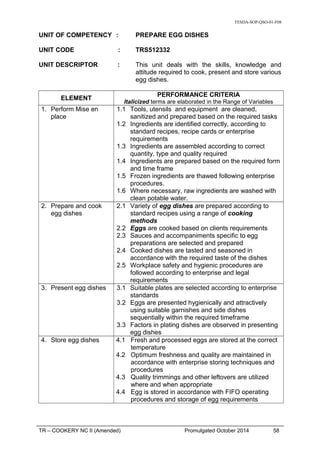
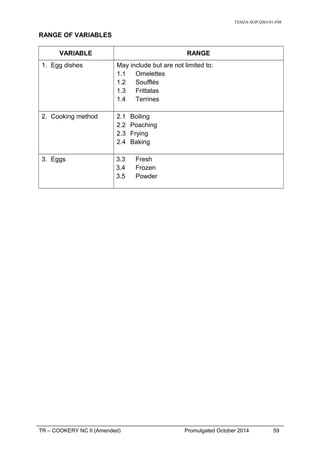
TRS512385 Prepare egg dishes
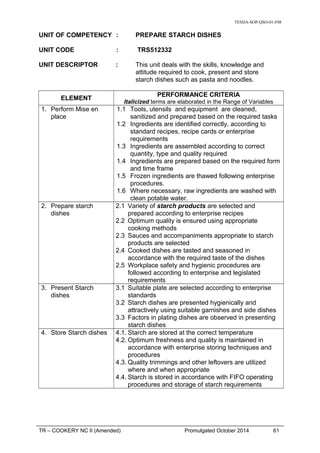
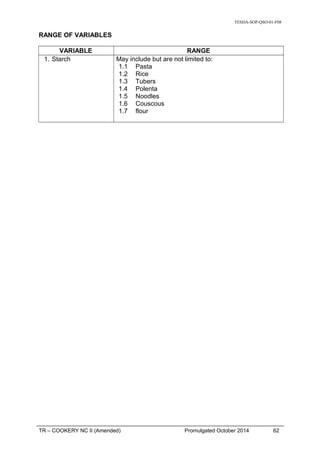
TRS512386 Prepare starch dishes
TRS512333 Prepare poultry and game dish(es
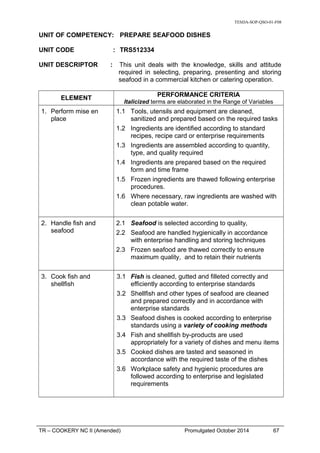
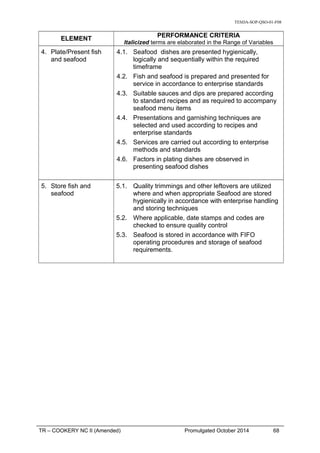
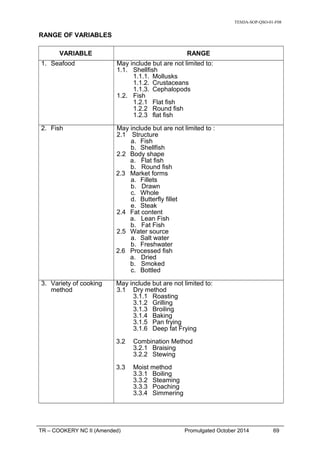
TRS512334 Prepare seafood dishes
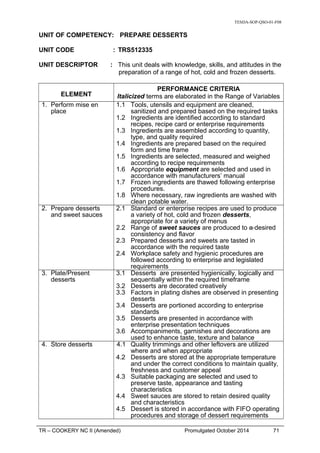
TRS512335 Prepare desserts
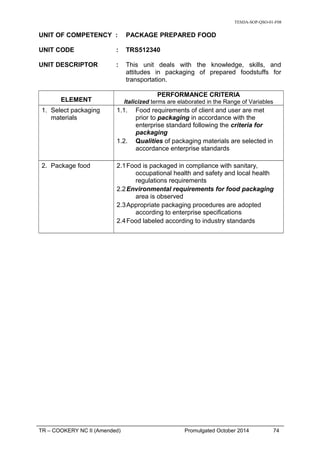
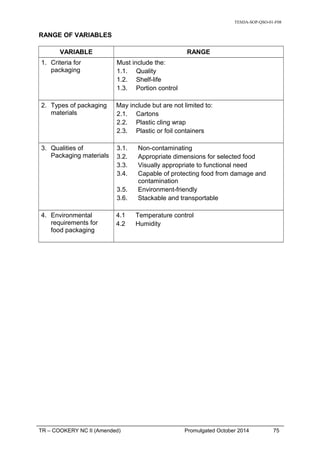
TRS512340 Package prepared food
SECTION 2 COMPETENCY STANDARDS
This section gives the details of the contents of the basic, common and core
units of competency required in COOKERY NC II.
BASIC COMPETENCIES
UNIT OF COMPETENCY : PARTICIPATE IN WORKPLACE COMMUNICATION
UNIT CODE : 500311105
UNIT DESCRIPTOR : This unit covers the knowledge, skills and attitudes
required to gather, interpret and convey information in
response to workplace requirements.
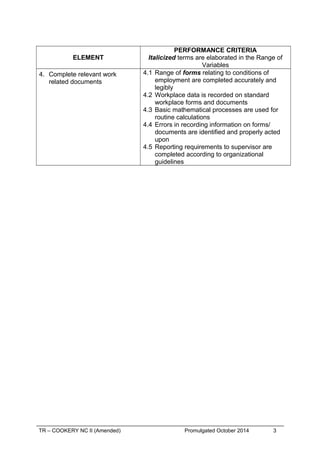
ELEMENT
PERFORMANCE CRITERIA
Italicized terms are elaborated in the Range of
Variables
1. Obtain and convey workplace
information
1.1 Specific and relevant information is accessed
from appropriate sources
1.2 Effective questioning , active listening and
speaking skills are used to gather and convey
information
1.3 Appropriate medium is used to transfer
information and ideas
1.4 Appropriate non- verbal communication is
used
1.5 Appropriate lines of communication with
supervisors and colleagues are identified and
followed
1.6 Defined workplace procedures for the location
and storage of information are used
1.7 Personal interaction is carried out clearly and
concisely
2. Speak English at a
basic operational level
2.1 Simple conversations on familiar topics with
work colleagues is participated
2.2 Simple verbal instructions or requests are
responded to
2.3 Simple requests are made
2.4 Routine procedures are described
2.5 Likes, dislikes and preferences are expressed
2.6 Different forms of expression in English is
identified
3. Participate in workplace
meetings and discussions
3.1 Team meetings are attended on time
3.2 Own opinions are clearly expressed and those
of others are listened to without interruption
3.3 Meeting inputs are consistent with the meeting
purpose and established protocols
3.4 Workplace interactions are conducted in a
courteous manner
3.5 Questions about simple routine workplace
procedures and maters concerning working
conditions of employment are asked and
responded to
3.6 Meetings outcomes are interpreted and
implemented
TR – COOKERY NC II (Amended) Promulgated October 2014 2
ELEMENT
PERFORMANCE CRITERIA
Italicized terms are elaborated in the Range of
Variables
4. Complete relevant work
related documents
4.1 Range of forms relating to conditions of
employment are completed accurately and
legibly
4.2 Workplace data is recorded on standard
workplace forms and documents
4.3 Basic mathematical processes are used for
routine calculations
4.4 Errors in recording information on forms/
documents are identified and properly acted
upon
4.5 Reporting requirements to supervisor are
completed according to organizational
guidelines
TR – COOKERY NC II (Amended) Promulgated October 2014 3
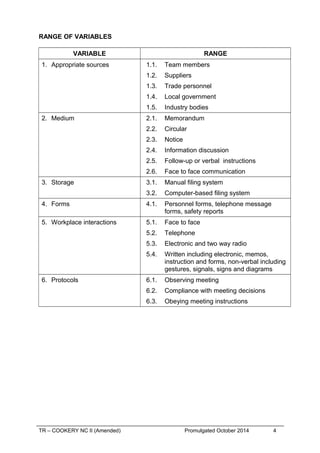
RANGE OF VARIABLES
VARIABLE RANGE
1. Appropriate sources 1.1. Team members
1.2. Suppliers
1.3. Trade personnel
1.4. Local government
1.5. Industry bodies
2. Medium 2.1. Memorandum
2.2. Circular
2.3. Notice
2.4. Information discussion
2.5. Follow-up or verbal instructions
2.6. Face to face communication
3. Storage 3.1. Manual filing system
3.2. Computer-based filing system
4. Forms 4.1. Personnel forms, telephone message
forms, safety reports
5. Workplace interactions 5.1. Face to face
5.2. Telephone
5.3. Electronic and two way radio
5.4. Written including electronic, memos,
instruction and forms, non-verbal including
gestures, signals, signs and diagrams
6. Protocols 6.1. Observing meeting
6.2. Compliance with meeting decisions
6.3. Obeying meeting instructions
TR – COOKERY NC II (Amended) Promulgated October 2014 4
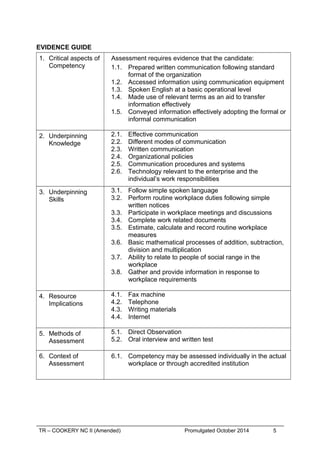
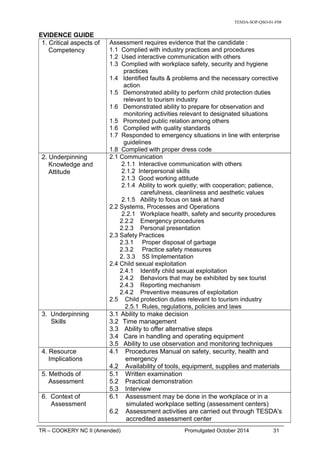
EVIDENCE GUIDE
1. Critical aspects of
Competency
Assessment requires evidence that the candidate:
1.1. Prepared written communication following standard
format of the organization
1.2. Accessed information using communication equipment
1.3. Spoken English at a basic operational level
1.4. Made use of relevant terms as an aid to transfer
information effectively
1.5. Conveyed information effectively adopting the formal or
informal communication
2. Underpinning
Knowledge
2.1. Effective communication
2.2. Different modes of communication
2.3. Written communication
2.4. Organizational policies
2.5. Communication procedures and systems
2.6. Technology relevant to the enterprise and the
individual’s work responsibilities
3. Underpinning
Skills
3.1. Follow simple spoken language
3.2. Perform routine workplace duties following simple
written notices
3.3. Participate in workplace meetings and discussions
3.4. Complete work related documents
3.5. Estimate, calculate and record routine workplace
measures
3.6. Basic mathematical processes of addition, subtraction,
division and multiplication
3.7. Ability to relate to people of social range in the
workplace
3.8. Gather and provide information in response to
workplace requirements
4. Resource
Implications
4.1. Fax machine
4.2. Telephone
4.3. Writing materials
4.4. Internet
5. Methods of
Assessment
5.1. Direct Observation
5.2. Oral interview and written test
6. Context of
Assessment
6.1. Competency may be assessed individually in the actual
workplace or through accredited institution
TR – COOKERY NC II (Amended) Promulgated October 2014 5
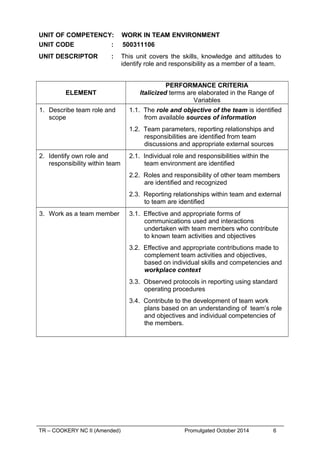
UNIT OF COMPETENCY: WORK IN TEAM ENVIRONMENT
UNIT CODE : 500311106
UNIT DESCRIPTOR : This unit covers the skills, knowledge and attitudes to
identify role and responsibility as a member of a team.
ELEMENT
PERFORMANCE CRITERIA
Italicized terms are elaborated in the Range of
Variables
1. Describe team role and
scope
1.1. The role and objective of the team is identified
from available sources of information
1.2. Team parameters, reporting relationships and
responsibilities are identified from team
discussions and appropriate external sources
2. Identify own role and
responsibility within team
2.1. Individual role and responsibilities within the
team environment are identified
2.2. Roles and responsibility of other team members
are identified and recognized
2.3. Reporting relationships within team and external
to team are identified
3. Work as a team member 3.1. Effective and appropriate forms of
communications used and interactions
undertaken with team members who contribute
to known team activities and objectives
3.2. Effective and appropriate contributions made to
complement team activities and objectives,
based on individual skills and competencies and
workplace context
3.3. Observed protocols in reporting using standard
operating procedures
3.4. Contribute to the development of team work
plans based on an understanding of team’s role
and objectives and individual competencies of
the members.
TR – COOKERY NC II (Amended) Promulgated October 2014 6
ELEMENT
PERFORMANCE CRITERIA
Italicized terms are elaborated in the Range of
Variables
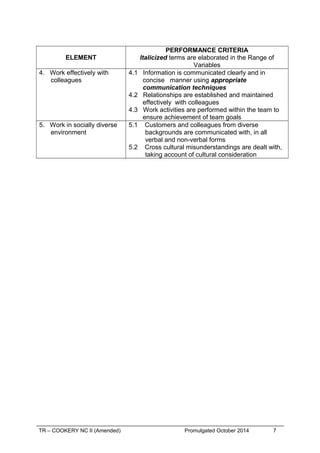
4. Work effectively with
colleagues
4.1 Information is communicated clearly and in
concise manner using appropriate
communication techniques
4.2 Relationships are established and maintained
effectively with colleagues
4.3 Work activities are performed within the team to
ensure achievement of team goals
5. Work in socially diverse
environment
5.1 Customers and colleagues from diverse
backgrounds are communicated with, in all
verbal and non-verbal forms
5.2 Cross cultural misunderstandings are dealt with,
taking account of cultural consideration
TR – COOKERY NC II (Amended) Promulgated October 2014 7
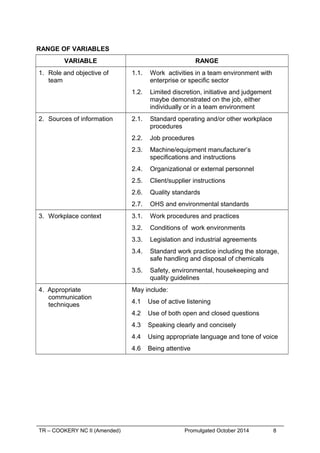
RANGE OF VARIABLES
VARIABLE RANGE
1. Role and objective of
team
1.1. Work activities in a team environment with
enterprise or specific sector
1.2. Limited discretion, initiative and judgement
maybe demonstrated on the job, either
individually or in a team environment
2. Sources of information 2.1. Standard operating and/or other workplace
procedures
2.2. Job procedures
2.3. Machine/equipment manufacturer’s
specifications and instructions
2.4. Organizational or external personnel
2.5. Client/supplier instructions
2.6. Quality standards
2.7. OHS and environmental standards
3. Workplace context 3.1. Work procedures and practices
3.2. Conditions of work environments
3.3. Legislation and industrial agreements
3.4. Standard work practice including the storage,
safe handling and disposal of chemicals
3.5. Safety, environmental, housekeeping and
quality guidelines
4. Appropriate
communication
techniques
May include:
4.1 Use of active listening
4.2 Use of both open and closed questions
4.3 Speaking clearly and concisely
4.4 Using appropriate language and tone of voice
4.6 Being attentive
TR – COOKERY NC II (Amended) Promulgated October 2014 8
EVIDENCE GUIDE
1. Critical aspects of
competency
Assessment requires evidence that the candidate:
1.1. Operated in a team to complete workplace activity
1.2. Worked effectively with others
1.3. Worked in socially diverse environment
1.4. Conveyed information in written or oral form
1.5. Selected and used appropriate workplace language
1.6. Followed designated work plan for the job
1.7. Reported outcomes
2. Underpinning
Knowledge
2.1. Communication process
2.2. Team structure
2.3. Team roles
2.4. Group planning and decision making
2.5. Specific diversity issues
3. Underpinning
Skills
3.1. Communicate appropriately, consistent with the culture
of the workplace
4. Resource
Implications
The following resources MUST be provided:
4.1. Access to relevant workplace or appropriately
simulated environment where assessment can take
place
4.2. Materials relevant to the proposed activity or tasks
5. Methods of
Assessment
Competency may be assessed through:
5.1. Observation of the individual member in relation to the
work activities of the group
5.2. Observation of simulation and or role play involving the
participation of individual member to the attainment of
organizational goal
5.3. Case studies and scenarios as a basis for discussion of
issues and strategies in teamwork
6. Context for
Assessment
6.1. Competency may be assessed in workplace or in a
simulated workplace setting
6.2. Assessment shall be observed while task are being
undertaken whether individually or in group
TR – COOKERY NC II (Amended) Promulgated October 2014 9
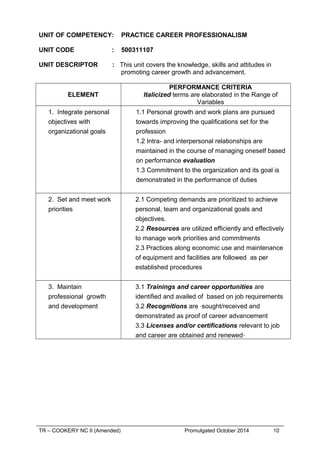
UNIT OF COMPETENCY: PRACTICE CAREER PROFESSIONALISM
UNIT CODE : 500311107
UNIT DESCRIPTOR : This unit covers the knowledge, skills and attitudes in
promoting career growth and advancement.
ELEMENT
PERFORMANCE CRITERIA
Italicized terms are elaborated in the Range of
Variables
1. Integrate personal
objectives with
organizational goals
1.1 Personal growth and work plans are pursued
towards improving the qualifications set for the
profession
1.2 Intra- and interpersonal relationships are
maintained in the course of managing oneself based
on performance evaluation
1.3 Commitment to the organization and its goal is
demonstrated in the performance of duties
2. Set and meet work
priorities
2.1 Competing demands are prioritized to achieve
personal, team and organizational goals and
objectives.
2.2 Resources are utilized efficiently and effectively
to manage work priorities and commitments
2.3 Practices along economic use and maintenance
of equipment and facilities are followed as per
established procedures
3. Maintain
professional growth
and development
3.1 Trainings and career opportunities are
identified and availed of based on job requirements
3.2 Recognitions are sought/received and
demonstrated as proof of career advancement
3.3 Licenses and/or certifications relevant to job
and career are obtained and renewed
TR – COOKERY NC II (Amended) Promulgated October 2014 10
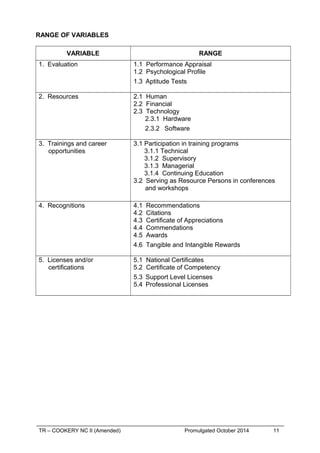
RANGE OF VARIABLES
VARIABLE RANGE
1. Evaluation 1.1 Performance Appraisal
1.2 Psychological Profile
1.3 Aptitude Tests
2. Resources 2.1 Human
2.2 Financial
2.3 Technology
2.3.1 Hardware
2.3.2 Software
3. Trainings and career
opportunities
3.1 Participation in training programs
3.1.1 Technical
3.1.2 Supervisory
3.1.3 Managerial
3.1.4 Continuing Education
3.2 Serving as Resource Persons in conferences
and workshops
4. Recognitions 4.1 Recommendations
4.2 Citations
4.3 Certificate of Appreciations
4.4 Commendations
4.5 Awards
4.6 Tangible and Intangible Rewards
5. Licenses and/or
certifications
5.1 National Certificates
5.2 Certificate of Competency
5.3 Support Level Licenses
5.4 Professional Licenses
TR – COOKERY NC II (Amended) Promulgated October 2014 11
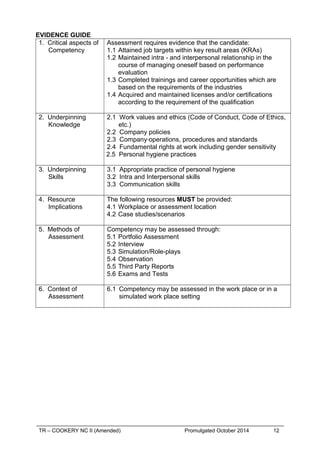
EVIDENCE GUIDE
1. Critical aspects of
Competency
Assessment requires evidence that the candidate:
1.1 Attained job targets within key result areas (KRAs)
1.2 Maintained intra - and interpersonal relationship in the
course of managing oneself based on performance
evaluation
1.3 Completed trainings and career opportunities which are
based on the requirements of the industries
1.4 Acquired and maintained licenses and/or certifications
according to the requirement of the qualification
2. Underpinning
Knowledge
2.1 Work values and ethics (Code of Conduct, Code of Ethics,
etc.)
2.2 Company policies
2.3 Company operations, procedures and standards
2.4 Fundamental rights at work including gender sensitivity
2.5 Personal hygiene practices
3. Underpinning
Skills
3.1 Appropriate practice of personal hygiene
3.2 Intra and Interpersonal skills
3.3 Communication skills
4. Resource
Implications
The following resources MUST be provided:
4.1 Workplace or assessment location
4.2 Case studies/scenarios
5. Methods of
Assessment
Competency may be assessed through:
5.1 Portfolio Assessment
5.2 Interview
5.3 Simulation/Role-plays
5.4 Observation
5.5 Third Party Reports
5.6 Exams and Tests
6. Context of
Assessment
6.1 Competency may be assessed in the work place or in a
simulated work place setting
TR – COOKERY NC II (Amended) Promulgated October 2014 12
TR – COOKERY NC II (Amended) Promulgated October 2014 13
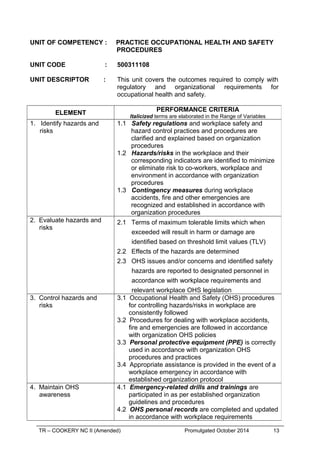
UNIT OF COMPETENCY : PRACTICE OCCUPATIONAL HEALTH AND SAFETY
PROCEDURES
UNIT CODE : 500311108
UNIT DESCRIPTOR : This unit covers the outcomes required to comply with
regulatory and organizational requirements for
occupational health and safety.
ELEMENT
PERFORMANCE CRITERIA
Italicized terms are elaborated in the Range of Variables
1. Identify hazards and
risks
1.1 Safety regulations and workplace safety and
hazard control practices and procedures are
clarified and explained based on organization
procedures
1.2 Hazards/risks in the workplace and their
corresponding indicators are identified to minimize
or eliminate risk to co-workers, workplace and
environment in accordance with organization
procedures
1.3 Contingency measures during workplace
accidents, fire and other emergencies are
recognized and established in accordance with
organization procedures
2. Evaluate hazards and
risks
2.1 Terms of maximum tolerable limits which when
exceeded will result in harm or damage are
identified based on threshold limit values (TLV)
2.2 Effects of the hazards are determined
2.3 OHS issues and/or concerns and identified safety
hazards are reported to designated personnel in
accordance with workplace requirements and
relevant workplace OHS legislation
3. Control hazards and
risks
3.1 Occupational Health and Safety (OHS) procedures
for controlling hazards/risks in workplace are
consistently followed
3.2 Procedures for dealing with workplace accidents,
fire and emergencies are followed in accordance
with organization OHS policies
3.3 Personal protective equipment (PPE) is correctly
used in accordance with organization OHS
procedures and practices
3.4 Appropriate assistance is provided in the event of a
workplace emergency in accordance with
established organization protocol
4. Maintain OHS
awareness
4.1 Emergency-related drills and trainings are
participated in as per established organization
guidelines and procedures
4.2 OHS personal records are completed and updated
in accordance with workplace requirements
TR – COOKERY NC II (Amended) Promulgated October 2014 14
ELEMENT
PERFORMANCE CRITERIA
Italicized terms are elaborated in the Range of Variables
5. Perform basic first-aid
procedures
5.1 Situation is assessed in accordance with accepted
practice
5.2 Basic first-aid techniques is applied in accordance
with established first-aid procedures and
enterprise policy
5.3 Details of the incident is communicated in a timely
manner according to enterprise policy
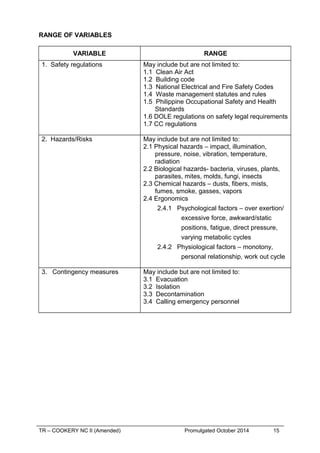
RANGE OF VARIABLES
VARIABLE RANGE
1. Safety regulations May include but are not limited to:
1.1 Clean Air Act
1.2 Building code
1.3 National Electrical and Fire Safety Codes
1.4 Waste management statutes and rules
1.5 Philippine Occupational Safety and Health
Standards
1.6 DOLE regulations on safety legal requirements
1.7 CC regulations
2. Hazards/Risks May include but are not limited to:
2.1 Physical hazards – impact, illumination,
pressure, noise, vibration, temperature,
radiation
2.2 Biological hazards- bacteria, viruses, plants,
parasites, mites, molds, fungi, insects
2.3 Chemical hazards – dusts, fibers, mists,
fumes, smoke, gasses, vapors
2.4 Ergonomics
2.4.1 Psychological factors – over exertion/
excessive force, awkward/static
positions, fatigue, direct pressure,
varying metabolic cycles
2.4.2 Physiological factors – monotony,
personal relationship, work out cycle
3. Contingency measures May include but are not limited to:
3.1 Evacuation
3.2 Isolation
3.3 Decontamination
3.4 Calling emergency personnel
TR – COOKERY NC II (Amended) Promulgated October 2014 15
VARIABLE RANGE
4. PPE May include but are not limited to:
4.1 Mask
4.2 Gloves
4.3 Goggles
4.4 Hair Net/cap/bonnet
4.5 Face mask/shield
4.6 Ear muffs
4.7 Apron/Gown/coverall/jump suit
4.8 Anti-static suits
5. Emergency-related drills and
training
5.1 Fire drill
5.2 Earthquake drill
5.3 Basic life support/CPR
5.4 First aid
5.5 Spillage control
5.6 Decontamination of chemical and toxic
5.7 Disaster preparedness/management
6. OHS personal records 6.1 Medical/Health records
6.2 Incident reports
6.3 Accident reports
6.4 OHS-related training completed
TR – COOKERY NC II (Amended) Promulgated October 2014 16
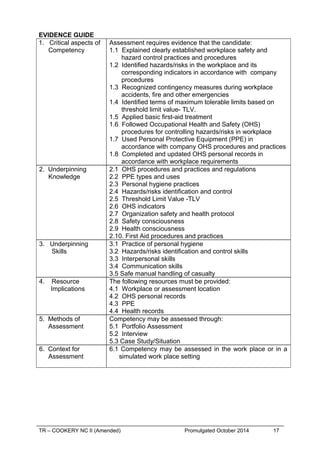
EVIDENCE GUIDE
1. Critical aspects of
Competency
Assessment requires evidence that the candidate:
1.1 Explained clearly established workplace safety and
hazard control practices and procedures
1.2 Identified hazards/risks in the workplace and its
corresponding indicators in accordance with company
procedures
1.3 Recognized contingency measures during workplace
accidents, fire and other emergencies
1.4 Identified terms of maximum tolerable limits based on
threshold limit value- TLV.
1.5 Applied basic first-aid treatment
1.6 Followed Occupational Health and Safety (OHS)
procedures for controlling hazards/risks in workplace
1.7 Used Personal Protective Equipment (PPE) in
accordance with company OHS procedures and practices
1.8 Completed and updated OHS personal records in
accordance with workplace requirements
2. Underpinning
Knowledge
2.1 OHS procedures and practices and regulations
2.2 PPE types and uses
2.3 Personal hygiene practices
2.4 Hazards/risks identification and control
2.5 Threshold Limit Value -TLV
2.6 OHS indicators
2.7 Organization safety and health protocol
2.8 Safety consciousness
2.9 Health consciousness
2.10. First Aid procedures and practices
3. Underpinning
Skills
3.1 Practice of personal hygiene
3.2 Hazards/risks identification and control skills
3.3 Interpersonal skills
3.4 Communication skills
3.5 Safe manual handling of casualty
4. Resource
Implications
The following resources must be provided:
4.1 Workplace or assessment location
4.2 OHS personal records
4.3 PPE
4.4 Health records
5. Methods of
Assessment
Competency may be assessed through:
5.1 Portfolio Assessment
5.2 Interview
5.3 Case Study/Situation
6. Context for
Assessment
6.1 Competency may be assessed in the work place or in a
simulated work place setting
TR – COOKERY NC II (Amended) Promulgated October 2014 17
TESDA-SOP-QSO-01-F08
COMMON COMPETENCIES
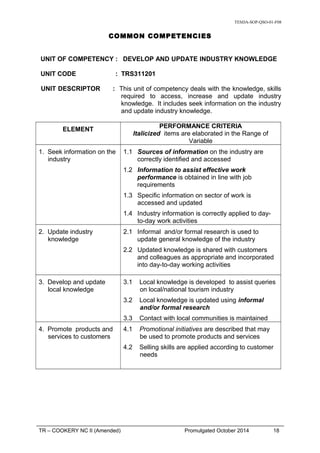
UNIT OF COMPETENCY : DEVELOP AND UPDATE INDUSTRY KNOWLEDGE
UNIT CODE : TRS311201
UNIT DESCRIPTOR : This unit of competency deals with the knowledge, skills
required to access, increase and update industry
knowledge. It includes seek information on the industry
and update industry knowledge.
ELEMENT
PERFORMANCE CRITERIA
Italicized items are elaborated in the Range of
Variable
1. Seek information on the
industry
1.1 Sources of information on the industry are
correctly identified and accessed
1.2 Information to assist effective work
performance is obtained in line with job
requirements
1.3 Specific information on sector of work is
accessed and updated
1.4 Industry information is correctly applied to day-
to-day work activities
2. Update industry
knowledge
2.1 Informal and/or formal research is used to
update general knowledge of the industry
2.2 Updated knowledge is shared with customers
and colleagues as appropriate and incorporated
into day-to-day working activities
3. Develop and update
local knowledge
3.1 Local knowledge is developed to assist queries
on local/national tourism industry
3.2 Local knowledge is updated using informal
and/or formal research
3.3 Contact with local communities is maintained
4. Promote products and
services to customers
4.1 Promotional initiatives are described that may
be used to promote products and services
4.2 Selling skills are applied according to customer
needs
TR – COOKERY NC II (Amended) Promulgated October 2014 18
TESDA-SOP-QSO-01-F08
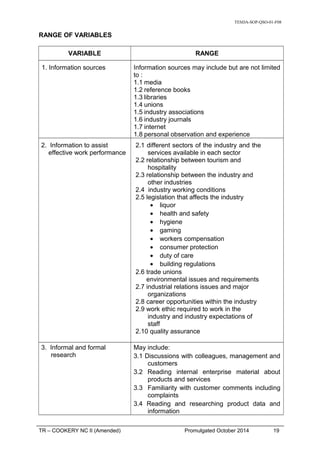
RANGE OF VARIABLES
VARIABLE RANGE
1. Information sources Information sources may include but are not limited
to :
1.1 media
1.2 reference books
1.3 libraries
1.4 unions
1.5 industry associations
1.6 industry journals
1.7 internet
1.8 personal observation and experience
2. Information to assist
effective work performance
2.1 different sectors of the industry and the
services available in each sector
2.2 relationship between tourism and
hospitality
2.3 relationship between the industry and
other industries
2.4 industry working conditions
2.5 legislation that affects the industry
• liquor
• health and safety
• hygiene
• gaming
• workers compensation
• consumer protection
• duty of care
• building regulations
2.6 trade unions
environmental issues and requirements
2.7 industrial relations issues and major
organizations
2.8 career opportunities within the industry
2.9 work ethic required to work in the
industry and industry expectations of
staff
2.10 quality assurance
3. Informal and formal
research
May include:
3.1 Discussions with colleagues, management and
customers
3.2 Reading internal enterprise material about
products and services
3.3 Familiarity with customer comments including
complaints
3.4 Reading and researching product data and
information
TR – COOKERY NC II (Amended) Promulgated October 2014 19
TESDA-SOP-QSO-01-F08
VARIABLE RANGE
3.5 Conducting internal testing to determine
quality and differentials
3.6 General media research
3.7 Developing and analyzing responses to
questionnaires
3.8 Reading surveys and ratings
4. Promotional initiatives May include:
4.1 Media campaigns
4.2 Internal promotions, including static displays,
demonstrations, tastings, videos,
competitions, packages, events
TR – COOKERY NC II (Amended) Promulgated October 2014 20
TESDA-SOP-QSO-01-F08
EVIDENCE GUIDE
1. Critical aspects of
Competency
Assessment requires evidence that the candidate/ trainee:
1.1 Knew key sources of information on the industry
1.2 Updated industry knowledge
1.3 Accessed and used industry information
1.4 Developed and updated local knowledge
1.5 Promoted products and services
2. Underpinning
Skills
2.1 Time management
2.2 Ready skills needed to access industry information
2.3 Basic competency skills needed to access the internet
3. Underpinning
Knowledge
3.1 Overview of quality assurance in the industry
3.2 Role of individual staff members
3.3 Industry information sources
4. Resource
Implications
4.1 Sources of information on the industry
4.2 Industry knowledge
5. Methods of
Assessment
5.1 Interview/questions
5.2 Practical demonstration
5.3 Portfolio of industry information related to trainee’s work
6. Context for
Assessment
6.1 Assessment may be done in the workplace or in a
simulated workplace setting (assessment centers)
6.2 Assessment activities are carried out through TESDA's
accredited assessment center
TR – COOKERY NC II (Amended) Promulgated October 2014 21
TESDA-SOP-QSO-01-F08
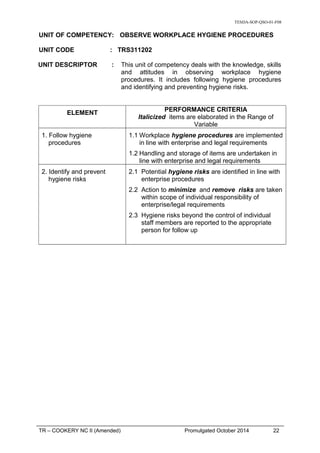
UNIT OF COMPETENCY: OBSERVE WORKPLACE HYGIENE PROCEDURES
UNIT CODE : TRS311202
UNIT DESCRIPTOR : This unit of competency deals with the knowledge, skills
and attitudes in observing workplace hygiene
procedures. It includes following hygiene procedures
and identifying and preventing hygiene risks.
ELEMENT
PERFORMANCE CRITERIA
Italicized items are elaborated in the Range of
Variable
1. Follow hygiene
procedures
1.1 Workplace hygiene procedures are implemented
in line with enterprise and legal requirements
1.2 Handling and storage of items are undertaken in
line with enterprise and legal requirements
2. Identify and prevent
hygiene risks
2.1 Potential hygiene risks are identified in line with
enterprise procedures
2.2 Action to minimize and remove risks are taken
within scope of individual responsibility of
enterprise/legal requirements
2.3 Hygiene risks beyond the control of individual
staff members are reported to the appropriate
person for follow up
TR – COOKERY NC II (Amended) Promulgated October 2014 22
TESDA-SOP-QSO-01-F08
RANGE OF VARIABLES
VARIABLE RANGE
1. Hygiene procedures Hygiene procedures may include :
1.1 safe and hygienic handling of food and
beverage
1.2 regular hand washing
1.3 correct food storage
1.4 appropriate and clean clothing
1.5 avoidance of cross-contamination
1.6 safe handling disposal of linen and laundry
1.7 appropriate handling and disposal of garbage
1.8 cleaning and sanitizing procedures
1.9 personal hygiene
2. Hygiene risk 2.1 bacterial and other contamination arising from
poor handling of food
2.2 inappropriate storage of foods
2.3 storage at incorrect temperatures
2.4 foods left uncovered
2.5 poor personal hygiene practices
2.6 poor work practices
2.6.1 cleaning
2.6.2 housekeeping
2.6.3 food handling
2.6.4 vermin
2.6.5 airborne dust
2.7 cross-contamination through cleaning
inappropriate cleaning practices
2.8 inappropriate handling of potentially infectious
linen
2.9 contaminated wastes such as blood and body
secretions
2.10 disposal of garbage and contaminated or
potentially contaminated wastes
3. Minimizing or removing risk 3.1 auditing staff skills and providing training
3.2 ensuring policies and procedures are followed
strictly
3.3 audits or incidents with follow up actions
TR – COOKERY NC II (Amended) Promulgated October 2014 23
TESDA-SOP-QSO-01-F08
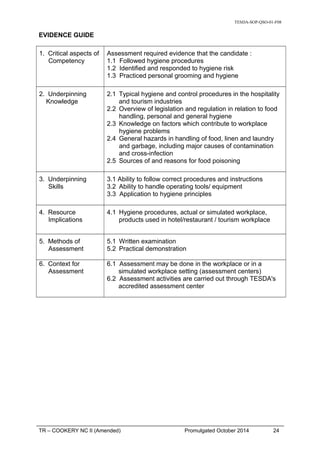
EVIDENCE GUIDE
1. Critical aspects of
Competency
Assessment required evidence that the candidate :
1.1 Followed hygiene procedures
1.2 Identified and responded to hygiene risk
1.3 Practiced personal grooming and hygiene
2. Underpinning
Knowledge
2.1 Typical hygiene and control procedures in the hospitality
and tourism industries
2.2 Overview of legislation and regulation in relation to food
handling, personal and general hygiene
2.3 Knowledge on factors which contribute to workplace
hygiene problems
2.4 General hazards in handling of food, linen and laundry
and garbage, including major causes of contamination
and cross-infection
2.5 Sources of and reasons for food poisoning
3. Underpinning
Skills
3.1 Ability to follow correct procedures and instructions
3.2 Ability to handle operating tools/ equipment
3.3 Application to hygiene principles
4. Resource
Implications
4.1 Hygiene procedures, actual or simulated workplace,
products used in hotel/restaurant / tourism workplace
5. Methods of
Assessment
5.1 Written examination
5.2 Practical demonstration
6. Context for
Assessment
6.1 Assessment may be done in the workplace or in a
simulated workplace setting (assessment centers)
6.2 Assessment activities are carried out through TESDA's
accredited assessment center
TR – COOKERY NC II (Amended) Promulgated October 2014 24
TESDA-SOP-QSO-01-F08
UNIT OF COMPETENCY: PERFORM COMPUTER OPERATIONS
UNIT CODE : TRS311203
UNIT DESCRIPTOR : This unit covers the knowledge, skills and attitudes and
values needed to perform computer operations which
includes inputting, accessing, producing and transferring
data using the appropriate hardware and software
ELEMENT PERFORMANCE CRITERIA
Italicized terms are elaborated in the Range of Variables
1. Plan and prepare for
task to be undertaken
1.1. Requirements of task are determined
1.2. Appropriate hardware and software is selected
according to task assigned and required outcome
1.3. Task is planned to ensure OH & S guidelines and
procedures are followed
2. Input data into computer 2.1. Data are entered into the computer using
appropriate program/application in accordance with
company procedures
2.2. Accuracy of information is checked and information
is saved in accordance with standard operating
procedures
2.3. Inputted data are stored in storage media according
to requirements
2.4. Work is performed within ergonomic guidelines
3. Access information
using computer
3.1. Correct program/application is selected based on
job requirements
3.2. Program/application containing the information
required is accessed according to company
procedures
3.3. Desktop icons are correctly selected, opened and
closed for navigation purposes
3.4. Keyboard techniques are carried out in line with OH
& S requirements for safe use of keyboards
4. Produce/output data
using computer system
4.1. Entered data are processed using appropriate
software commands
4.2. Data are printed out as required using computer
hardware/peripheral devices in accordance with
standard operating procedures
4.3. Files and data are transferred between compatible
systems using computer software, hardware/
peripheral devices in accordance with standard
operating procedures
5. Maintain computer
equipment and systems
5.1. Systems for cleaning, minor maintenance and
replacement of consumables are implemented
5.2. Procedures for ensuring security of data, including
regular back-ups and virus checks are implemented
in accordance with standard operating procedures
5.3. Basic file maintenance procedures are implemented
in line with the standard operating procedures
5.4. Document systems are maintained
TR – COOKERY NC II (Amended) Promulgated October 2014 25
TESDA-SOP-QSO-01-F08
RANGE OF VARIABLES
VARIABLE RANGE
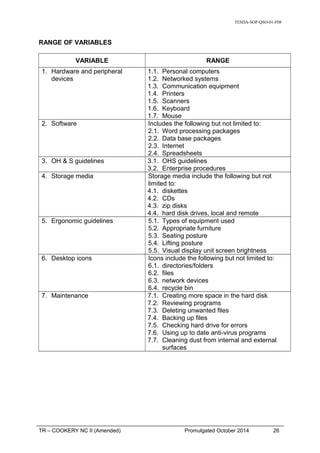
1. Hardware and peripheral
devices
1.1. Personal computers
1.2. Networked systems
1.3. Communication equipment
1.4. Printers
1.5. Scanners
1.6. Keyboard
1.7. Mouse
2. Software Includes the following but not limited to:
2.1. Word processing packages
2.2. Data base packages
2.3. Internet
2.4. Spreadsheets
3. OH & S guidelines 3.1. OHS guidelines
3.2. Enterprise procedures
4. Storage media Storage media include the following but not
limited to:
4.1. diskettes
4.2. CDs
4.3. zip disks
4.4. hard disk drives, local and remote
5. Ergonomic guidelines 5.1. Types of equipment used
5.2. Appropriate furniture
5.3. Seating posture
5.4. Lifting posture
5.5. Visual display unit screen brightness
6. Desktop icons Icons include the following but not limited to:
6.1. directories/folders
6.2. files
6.3. network devices
6.4. recycle bin
7. Maintenance 7.1. Creating more space in the hard disk
7.2. Reviewing programs
7.3. Deleting unwanted files
7.4. Backing up files
7.5. Checking hard drive for errors
7.6. Using up to date anti-virus programs
7.7. Cleaning dust from internal and external
surfaces
TR – COOKERY NC II (Amended) Promulgated October 2014 26
TESDA-SOP-QSO-01-F08
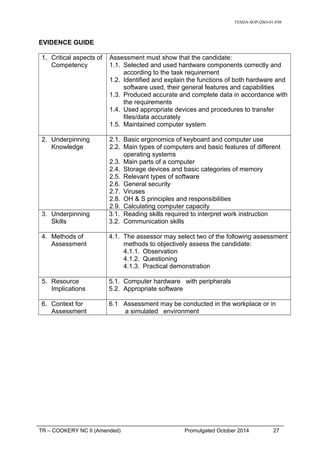
EVIDENCE GUIDE
1. Critical aspects of
Competency
Assessment must show that the candidate:
1.1. Selected and used hardware components correctly and
according to the task requirement
1.2. Identified and explain the functions of both hardware and
software used, their general features and capabilities
1.3. Produced accurate and complete data in accordance with
the requirements
1.4. Used appropriate devices and procedures to transfer
files/data accurately
1.5. Maintained computer system
2. Underpinning
Knowledge
2.1. Basic ergonomics of keyboard and computer use
2.2. Main types of computers and basic features of different
operating systems
2.3. Main parts of a computer
2.4. Storage devices and basic categories of memory
2.5. Relevant types of software
2.6. General security
2.7. Viruses
2.8. OH & S principles and responsibilities
2.9. Calculating computer capacity
3. Underpinning
Skills
3.1. Reading skills required to interpret work instruction
3.2. Communication skills
4. Methods of
Assessment
4.1. The assessor may select two of the following assessment
methods to objectively assess the candidate:
4.1.1. Observation
4.1.2. Questioning
4.1.3. Practical demonstration
5. Resource
Implications
5.1. Computer hardware with peripherals
5.2. Appropriate software
6. Context for
Assessment
6.1 Assessment may be conducted in the workplace or in
a simulated environment
TR – COOKERY NC II (Amended) Promulgated October 2014 27
TESDA-SOP-QSO-01-F08
UNIT OF COMPETENCY: PERFORM WORKPLACE AND SAFETY PRACTICES
UNIT CODE : TRS311204
UNIT DESCRIPTOR : This unit of competency deals with the knowledge, skills
and attitudes in following health, safety and security
practices. It includes dealing with emergency situations
and maintaining safe personal presentation standards.
ELEMENT
PERFORMANCE CRITERIA
Italicized items are elaborated on the Range of
Variables
1. Follow workplace
procedures for health,
safety and security practices
1.1 Correct health, safety and security
procedures are followed in line with legislation,
regulations and enterprise procedures
1.2 Breaches of health, safety and security
procedures are identified and reported in line
with enterprise procedure
1.3 Suspicious behavior or unusual occurrence are
reported in line with enterprise procedure
2. Perform child protection
duties relevant to the
tourism industry
2.1 Issue of sexual exploitation of children by tourist
is identified
2.2 National, regional and international actions are
described to prevent the sexual exploitation of
children by tourists
2.3 Actions that can be taken in the workplace are
described to protect children from sexual
exploitation by tourists
3. Observe and monitor people 3.1 Areas and people who require observation and
monitoring is prepared
3.2 Observation and monitoring activities are
implemented
3.3 Apprehension of offenders are determined
3.4 Offenders are arrested according to enterprise
procedures
3.5 Administrative responsibilities are fulfilled
4. Deal with emergency
situations
4.1 Emergency and potential emergency situations
are recognized and appropriate action are taken
within individual’s scope of responsibility
4.2 Emergency procedures are followed in line with
enterprise procedures
4.3 Assistance is sought from colleagues to resolve
or respond to emergency situations
4.4 Details of emergency situations are reported in
line with enterprise procedures
TR – COOKERY NC II (Amended) Promulgated October 2014 28
TESDA-SOP-QSO-01-F08
ELEMENT
PERFORMANCE CRITERIA
Italicized items are elaborated on the Range of
Variables
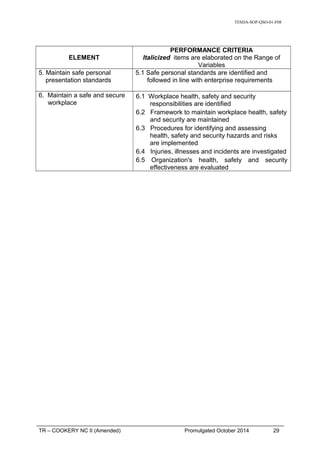
5. Maintain safe personal
presentation standards
5.1 Safe personal standards are identified and
followed in line with enterprise requirements
6. Maintain a safe and secure
workplace
6.1 Workplace health, safety and security
responsibilities are identified
6.2 Framework to maintain workplace health, safety
and security are maintained
6.3 Procedures for identifying and assessing
health, safety and security hazards and risks
are implemented
6.4 Injuries, illnesses and incidents are investigated
6.5 Organization's health, safety and security
effectiveness are evaluated
TR – COOKERY NC II (Amended) Promulgated October 2014 29
TESDA-SOP-QSO-01-F08
RANGE OF VARIABLES
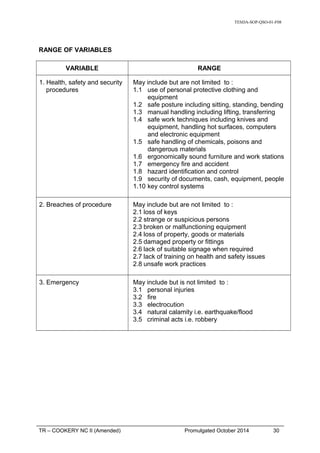
VARIABLE RANGE
1. Health, safety and security
procedures
May include but are not limited to :
1.1 use of personal protective clothing and
equipment
1.2 safe posture including sitting, standing, bending
1.3 manual handling including lifting, transferring
1.4 safe work techniques including knives and
equipment, handling hot surfaces, computers
and electronic equipment
1.5 safe handling of chemicals, poisons and
dangerous materials
1.6 ergonomically sound furniture and work stations
1.7 emergency fire and accident
1.8 hazard identification and control
1.9 security of documents, cash, equipment, people
1.10 key control systems
2. Breaches of procedure May include but are not limited to :
2.1 loss of keys
2.2 strange or suspicious persons
2.3 broken or malfunctioning equipment
2.4 loss of property, goods or materials
2.5 damaged property or fittings
2.6 lack of suitable signage when required
2.7 lack of training on health and safety issues
2.8 unsafe work practices
3. Emergency May include but is not limited to :
3.1 personal injuries
3.2 fire
3.3 electrocution
3.4 natural calamity i.e. earthquake/flood
3.5 criminal acts i.e. robbery
TR – COOKERY NC II (Amended) Promulgated October 2014 30
TESDA-SOP-QSO-01-F08
EVIDENCE GUIDE
1. Critical aspects of
Competency
Assessment requires evidence that the candidate :
1.1 Complied with industry practices and procedures
1.2 Used interactive communication with others
1.3 Complied with workplace safety, security and hygiene
practices
1.4 Identified faults & problems and the necessary corrective
action
1.5 Demonstrated ability to perform child protection duties
relevant to tourism industry
1.6 Demonstrated ability to prepare for observation and
monitoring activities relevant to designated situations
1.5 Promoted public relation among others
1.6 Complied with quality standards
1.7 Responded to emergency situations in line with enterprise
guidelines
1.8 Complied with proper dress code
2. Underpinning
Knowledge and
Attitude
2.1 Communication
2.1.1 Interactive communication with others
2.1.2 Interpersonal skills
2.1.3 Good working attitude
2.1.4 Ability to work quietly; with cooperation; patience,
carefulness, cleanliness and aesthetic values
2.1.5 Ability to focus on task at hand
2.2 Systems, Processes and Operations
2.2.1 Workplace health, safety and security procedures
2.2.2 Emergency procedures
2.2.3 Personal presentation
2.3 Safety Practices
2.3.1 Proper disposal of garbage
2.3.2 Practice safety measures
2. 3.3 5S Implementation
2.4 Child sexual exploitation
2.4.1 Identify child sexual exploitation
2.4.2 Behaviors that may be exhibited by sex tourist
2.4.3 Reporting mechanism
2.4.2 Preventive measures of exploitation
2.5 Child protection duties relevant to tourism industry
2.5.1 Rules, regulations, policies and laws
3. Underpinning
Skills
3.1 Ability to make decision
3.2 Time management
3.3 Ability to offer alternative steps
3.4 Care in handling and operating equipment
3.5 Ability to use observation and monitoring techniques
4. Resource
Implications
4.1 Procedures Manual on safety, security, health and
emergency
4.2 Availability of tools, equipment, supplies and materials
5. Methods of
Assessment
5.1 Written examination
5.2 Practical demonstration
5.3 Interview
6. Context of
Assessment
6.1 Assessment may be done in the workplace or in a
simulated workplace setting (assessment centers)
6.2 Assessment activities are carried out through TESDA's
accredited assessment center
TR – COOKERY NC II (Amended) Promulgated October 2014 31
TESDA-SOP-QSO-01-F08
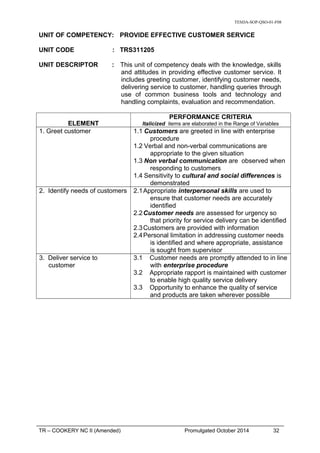
UNIT OF COMPETENCY: PROVIDE EFFECTIVE CUSTOMER SERVICE
UNIT CODE : TRS311205
UNIT DESCRIPTOR : This unit of competency deals with the knowledge, skills
and attitudes in providing effective customer service. It
includes greeting customer, identifying customer needs,
delivering service to customer, handling queries through
use of common business tools and technology and
handling complaints, evaluation and recommendation.
ELEMENT
PERFORMANCE CRITERIA
Italicized items are elaborated in the Range of Variables
1. Greet customer 1.1 Customers are greeted in line with enterprise
procedure
1.2 Verbal and non-verbal communications are
appropriate to the given situation
1.3 Non verbal communication are observed when
responding to customers
1.4 Sensitivity to cultural and social differences is
demonstrated
2. Identify needs of customers 2.1Appropriate interpersonal skills are used to
ensure that customer needs are accurately
identified
2.2Customer needs are assessed for urgency so
that priority for service delivery can be identified
2.3Customers are provided with information
2.4Personal limitation in addressing customer needs
is identified and where appropriate, assistance
is sought from supervisor
3. Deliver service to
customer
3.1 Customer needs are promptly attended to in line
with enterprise procedure
3.2 Appropriate rapport is maintained with customer
to enable high quality service delivery
3.3 Opportunity to enhance the quality of service
and products are taken wherever possible
TR – COOKERY NC II (Amended) Promulgated October 2014 32
TESDA-SOP-QSO-01-F08
ELEMENT
PERFORMANCE CRITERIA
Italicized items are elaborated in the Range of Variables
4. Handle queries through use
of common business tools
and technology
4.1 Common business tools and technology are
used efficiently to determine customer
requirements
4.2 Queries/ information are recorded in line with
enterprise procedure
4.3 Queries are acted upon promptly and correctly in
line with enterprise procedure
5. Handle complaints/conflict
situations, evaluation and
recommendations
5.1 Guests are greeted with a smile and eye-to-eye
contact
5.2 Responsibility for resolving the complaint is
taken within limit of responsibility and according
to enterprise policy
5.3 Nature and details of complaint are established
and agreed with the customer
5.4 Threats to personal safety are identified and
managed to personal safety of customers or
colleagues and appropriate assistance is
organized
5.5 Appropriate action is taken to resolve the
complaint to the customers satisfaction wherever
possible
5.6 Conflict situations are resolved within scope of
individual responsibility by applying effective
communication skills and according to enterprise
policy
TR – COOKERY NC II (Amended) Promulgated October 2014 33
TESDA-SOP-QSO-01-F08
RANGE OF VARIABLES
VARIABLE RANGE
1. Customer May include:
1.1 internal
1.2 external
2. Non-verbal
communication
May include:
2.1 body language
2.2 dress and accessories
2.3 gestures and mannerisms
2.4 voice tonality and volume
2.5 use of space
2.6 culturally specific communication customs and
practices
3. Cultural and social
differences
May include:
3.1 modes of greeting, farewell and conversation
3.2 body language/ use of body gestures
3.3 formality of language
4. Interpersonal skills May include:
4.1 interactive communication
4.2 public relation
4.3 good working attitude
4.4 sincerity
4.5 pleasant disposition
4.6 effective communication skills
5. Customer and
colleagues needs
May include:
5.1 those with a disability
5.2 those with special cultural or language needs
5.3 unaccompanied children
5.4 parents with young children
5.5 pregnant women
5.6 single women
6. Enterprise procedure May include:
6.1 modes of greeting and farewell
6.2 addressing the person by name
6.3 time-lapse before a response
6.4 style manual requirements
6.5 standard letters and format
7. Business tools and
technology
May include:
7.1 telephone
7.2 fax machine
7.3 computer equipment
7.4 internet, email
TR – COOKERY NC II (Amended) Promulgated October 2014 34
TESDA-SOP-QSO-01-F08
VARIABLE RANGE
8. Complaint May include:
8.1 level of service
8.2 product standards
8.3 processes
8.4 information given
8.5 charges and fees
9. Threats to personal
safety
May include:
9.1 violent customers
9.2 drug and alcohol affected customers
9.3 customers fighting amongst themselves
TR – COOKERY NC II (Amended) Promulgated October 2014 35
TESDA-SOP-QSO-01-F08
EVIDENCE GUIDE
1. Critical aspects of
Competency
Assessment requires evidence that the candidate :
1.1 Complied with industry practices and procedures
1.2 Used interactive communication with others
1.3 Complied with occupational, health and safety practices
1.4 Promoted public relation among others
1.5 Complied with service manual standards
1.6 Demonstrated familiarity with company facilities, products
and services
1.7 Applied company rules and standards
1.8 Applied telephone ethics
1.9 Applied correct procedure in using telephone, fax
machine, internet
1.10 Handled customer complaints within limit of individual
responsibility
2. Underpinning
Knowledge and
Attitude
2.1 Communication
2.1.1 Interactive communication with others
2.1.2 Interpersonal skills/ social graces with
sincerity
2.2 Safety Practices
2.2.1 Safe work practices
2.2.2 Personal hygiene
2.3 Attitude
2.3.1 Attentive, patient and cordial
2.3.2 Eye-to-eye contact
2.3.3 Maintain teamwork and cooperation
2.4 Theory
2.4.1 Selling/upselling techniques
2.4.2 Interview techniques
2.4.3 Conflict resolution
2.4.4 Communication process
2.4.5 Communication barriers
3. Underpinning
Skills
3.1 Effective communication skills
3.2 Non-verbal communication - body language
3.3 Good time management
3.4 Ability to work calmly and unobtrusively effectively
3.5 Ability to handle telephone inquiries and
conversations
3.6 Correct procedure in handling telephone inquiries
3.7 Proper way of handling complaints
4. Resource
Implications
May include:
4.1 Availability of telephone, fax machine, internet, etc.
4.2 Availability of data on projects and services; tariff and
rates, promotional activities in place etc.
4.3 Availability of office supplies
5. Methods of
Assessment
5.1 Written examination
5.2 Practical demonstration
6. Context for
Assessment
6.1 Assessment may be done in the workplace or in a
simulated workplace setting (assessment centers)
6.2 Assessment activities are carried out through TESDA's
accredited assessment center
TR – COOKERY NC II (Amended) Promulgated October 2014 36
TESDA-SOP-QSO-01-F08
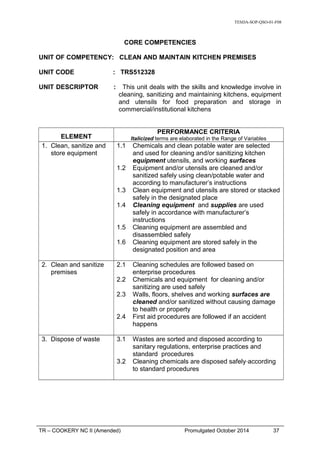
CORE COMPETENCIES
UNIT OF COMPETENCY: CLEAN AND MAINTAIN KITCHEN PREMISES
UNIT CODE : TRS512328
UNIT DESCRIPTOR : This unit deals with the skills and knowledge involve in
cleaning, sanitizing and maintaining kitchens, equipment
and utensils for food preparation and storage in
commercial/institutional kitchens
ELEMENT
PERFORMANCE CRITERIA
Italicized terms are elaborated in the Range of Variables
1. Clean, sanitize and
store equipment
1.1 Chemicals and clean potable water are selected
and used for cleaning and/or sanitizing kitchen
equipment utensils, and working surfaces
1.2 Equipment and/or utensils are cleaned and/or
sanitized safely using clean/potable water and
according to manufacturer’s instructions
1.3 Clean equipment and utensils are stored or stacked
safely in the designated place
1.4 Cleaning equipment and supplies are used
safely in accordance with manufacturer’s
instructions
1.5 Cleaning equipment are assembled and
disassembled safely
1.6 Cleaning equipment are stored safely in the
designated position and area
2. Clean and sanitize
premises
2.1 Cleaning schedules are followed based on
enterprise procedures
2.2 Chemicals and equipment for cleaning and/or
sanitizing are used safely
2.3 Walls, floors, shelves and working surfaces are
cleaned and/or sanitized without causing damage
to health or property
2.4 First aid procedures are followed if an accident
happens
3. Dispose of waste 3.1 Wastes are sorted and disposed according to
sanitary regulations, enterprise practices and
standard procedures
3.2 Cleaning chemicals are disposed safely according
to standard procedures
TR – COOKERY NC II (Amended) Promulgated October 2014 37
TESDA-SOP-QSO-01-F08
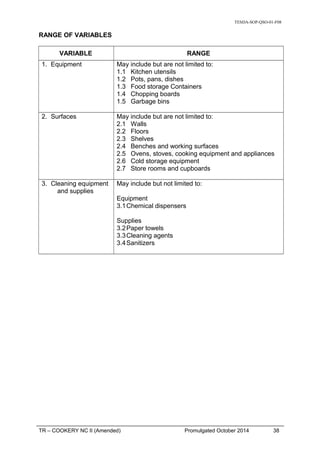
RANGE OF VARIABLES
VARIABLE RANGE
1. Equipment May include but are not limited to:
1.1 Kitchen utensils
1.2 Pots, pans, dishes
1.3 Food storage Containers
1.4 Chopping boards
1.5 Garbage bins
2. Surfaces May include but are not limited to:
2.1 Walls
2.2 Floors
2.3 Shelves
2.4 Benches and working surfaces
2.5 Ovens, stoves, cooking equipment and appliances
2.6 Cold storage equipment
2.7 Store rooms and cupboards
3. Cleaning equipment
and supplies
May include but not limited to:
Equipment
3.1Chemical dispensers
Supplies
3.2Paper towels
3.3Cleaning agents
3.4Sanitizers
TR – COOKERY NC II (Amended) Promulgated October 2014 38
TESDA-SOP-QSO-01-F08
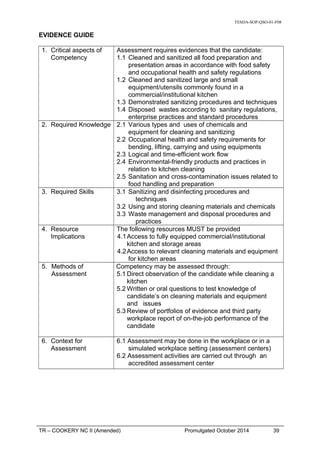
EVIDENCE GUIDE
1. Critical aspects of
Competency
Assessment requires evidences that the candidate:
1.1 Cleaned and sanitized all food preparation and
presentation areas in accordance with food safety
and occupational health and safety regulations
1.2 Cleaned and sanitized large and small
equipment/utensils commonly found in a
commercial/institutional kitchen
1.3 Demonstrated sanitizing procedures and techniques
1.4 Disposed wastes according to sanitary regulations,
enterprise practices and standard procedures
2. Required Knowledge 2.1 Various types and uses of chemicals and
equipment for cleaning and sanitizing
2.2 Occupational health and safety requirements for
bending, lifting, carrying and using equipments
2.3 Logical and time-efficient work flow
2.4 Environmental-friendly products and practices in
relation to kitchen cleaning
2.5 Sanitation and cross-contamination issues related to
food handling and preparation
3. Required Skills 3.1 Sanitizing and disinfecting procedures and
techniques
3.2 Using and storing cleaning materials and chemicals
3.3 Waste management and disposal procedures and
practices
4. Resource
Implications
The following resources MUST be provided
4.1Access to fully equipped commercial/institutional
kitchen and storage areas
4.2Access to relevant cleaning materials and equipment
for kitchen areas
5. Methods of
Assessment
Competency may be assessed through:
5.1 Direct observation of the candidate while cleaning a
kitchen
5.2 Written or oral questions to test knowledge of
candidate’s on cleaning materials and equipment
and issues
5.3 Review of portfolios of evidence and third party
workplace report of on-the-job performance of the
candidate
6. Context for
Assessment
6.1 Assessment may be done in the workplace or in a
simulated workplace setting (assessment centers)
6.2 Assessment activities are carried out through an
accredited assessment center
TR – COOKERY NC II (Amended) Promulgated October 2014 39
TESDA-SOP-QSO-01-F08
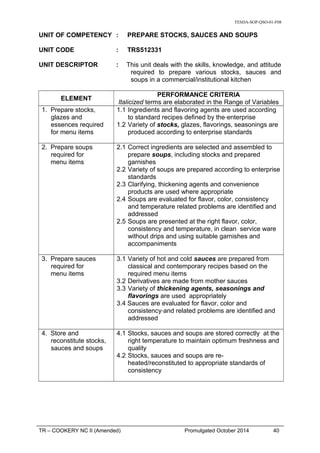
UNIT OF COMPETENCY : PREPARE STOCKS, SAUCES AND SOUPS
UNIT CODE : TRS512331
UNIT DESCRIPTOR : This unit deals with the skills, knowledge, and attitude
required to prepare various stocks, sauces and
soups in a commercial/institutional kitchen
ELEMENT
PERFORMANCE CRITERIA
Italicized terms are elaborated in the Range of Variables
1. Prepare stocks,
glazes and
essences required
for menu items
1.1 Ingredients and flavoring agents are used according
to standard recipes defined by the enterprise
1.2 Variety of stocks, glazes, flavorings, seasonings are
produced according to enterprise standards
2. Prepare soups
required for
menu items
2.1 Correct ingredients are selected and assembled to
prepare soups, including stocks and prepared
garnishes
2.2 Variety of soups are prepared according to enterprise
standards
2.3 Clarifying, thickening agents and convenience
products are used where appropriate
2.4 Soups are evaluated for flavor, color, consistency
and temperature related problems are identified and
addressed
2.5 Soups are presented at the right flavor, color,
consistency and temperature, in clean service ware
without drips and using suitable garnishes and
accompaniments
3. Prepare sauces
required for
menu items
3.1 Variety of hot and cold sauces are prepared from
classical and contemporary recipes based on the
required menu items
3.2 Derivatives are made from mother sauces
3.3 Variety of thickening agents, seasonings and
flavorings are used appropriately
3.4 Sauces are evaluated for flavor, color and
consistency and related problems are identified and
addressed
4. Store and
reconstitute stocks,
sauces and soups
4.1 Stocks, sauces and soups are stored correctly at the
right temperature to maintain optimum freshness and
quality
4.2 Stocks, sauces and soups are re-
heated/reconstituted to appropriate standards of
consistency
TR – COOKERY NC II (Amended) Promulgated October 2014 40
TESDA-SOP-QSO-01-F08
RANGE OF VARIABLES
VARIABLE RANGE
1. Stocks May include but are not limited to:
1.1 Beef stock- Brown/ White
1.2 Chicken stock -Brown/ White
1.3 Fish/seafood stock
1.4 Vegetable stock
2. Soups May include but are not limited to:
2.1 Clear
2.1.1. Consommé
2.1.2. Bouillon
2.2 Thick
2.2.1. Cream
2.2.2. Puree
2.2.3. Chowder
2.2.4. Bisque
2.3 Specialty soups
2.3.1. National/regional soups
3. Sauces May include but are not limited to:
3.1 Béchamel
3.2 Veloute
3.3 Espagnole
3.4 Hollandaise
3.5 Tomato
4. Thickening agents May include but are not limited to:
4.1 Fat and flour
4.1.1. Roux
4.1.2. Beurre manie
4.2 Starch - water
4.2.1. Slurry/white wash
4.2.2. Starch - water
4.3 Liaison
5. Seasonings and
flavorings
May include but are not limited to:
5.1 Bases
5.2 Bouillon cubes or powders
5.3 Flavor enhancers
5.4 Instant sauces
TR – COOKERY NC II (Amended) Promulgated October 2014 41
TESDA-SOP-QSO-01-F08
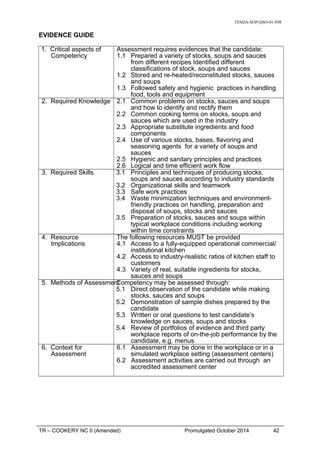
EVIDENCE GUIDE
1. Critical aspects of
Competency
Assessment requires evidences that the candidate:
1.1 Prepared a variety of stocks, soups and sauces
from different recipes Identified different
classifications of stock, soups and sauces
1.2 Stored and re-heated/reconstituted stocks, sauces
and soups
1.3 Followed safety and hygienic practices in handling
food, tools and equipment
2. Required Knowledge 2.1 Common problems on stocks, sauces and soups
and how to identify and rectify them
2.2 Common cooking terms on stocks, soups and
sauces which are used in the industry
2.3 Appropriate substitute ingredients and food
components
2.4 Use of various stocks, bases, flavoring and
seasoning agents for a variety of soups and
sauces
2.5 Hygienic and sanitary principles and practices
2.6 Logical and time efficient work flow
3. Required Skills 3.1 Principles and techniques of producing stocks,
soups and sauces according to industry standards
3.2 Organizational skills and teamwork
3.3 Safe work practices
3.4 Waste minimization techniques and environment-
friendly practices on handling, preparation and
disposal of soups, stocks and sauces
3.5 Preparation of stocks, sauces and soups within
typical workplace conditions including working
within time constraints
4. Resource
Implications
The following resources MUST be provided
4.1 Access to a fully-equipped operational commercial/
institutional kitchen
4.2 Access to industry-realistic ratios of kitchen staff to
customers
4.3 Variety of real, suitable ingredients for stocks,
sauces and soups
5. Methods of AssessmentCompetency may be assessed through:
5.1 Direct observation of the candidate while making
stocks, sauces and soups
5.2 Demonstration of sample dishes prepared by the
candidate
5.3 Written or oral questions to test candidate’s
knowledge on sauces, soups and stocks
5.4 Review of portfolios of evidence and third party
workplace reports of on-the-job performance by the
candidate, e.g. menus
6. Context for
Assessment
6.1 Assessment may be done in the workplace or in a
simulated workplace setting (assessment centers)
6.2 Assessment activities are carried out through an
accredited assessment center
TR – COOKERY NC II (Amended) Promulgated October 2014 42
TESDA-SOP-QSO-01-F08
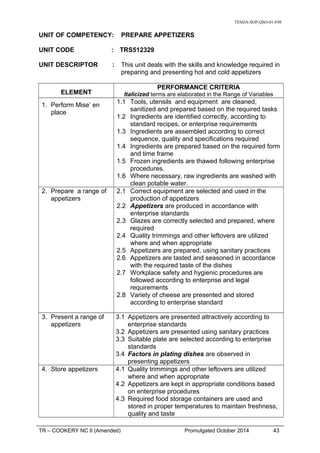
UNIT OF COMPETENCY: PREPARE APPETIZERS
UNIT CODE : TRS512329
UNIT DESCRIPTOR : This unit deals with the skills and knowledge required in
preparing and presenting hot and cold appetizers
ELEMENT
PERFORMANCE CRITERIA
Italicized terms are elaborated in the Range of Variables
1. Perform Mise’ en
place
1.1 Tools, utensils and equipment are cleaned,
sanitized and prepared based on the required tasks
1.2 Ingredients are identified correctly, according to
standard recipes, or enterprise requirements
1.3 Ingredients are assembled according to correct
sequence, quality and specifications required
1.4 Ingredients are prepared based on the required form
and time frame
1.5 Frozen ingredients are thawed following enterprise
procedures.
1.6 Where necessary, raw ingredients are washed with
clean potable water.
2. Prepare a range of
appetizers
2.1 Correct equipment are selected and used in the
production of appetizers
2.2 Appetizers are produced in accordance with
enterprise standards
2.3 Glazes are correctly selected and prepared, where
required
2.4 Quality trimmings and other leftovers are utilized
where and when appropriate
2.5 Appetizers are prepared, using sanitary practices
2.6 Appetizers are tasted and seasoned in accordance
with the required taste of the dishes
2.7 Workplace safety and hygienic procedures are
followed according to enterprise and legal
requirements
2.8 Variety of cheese are presented and stored
according to enterprise standard
3. Present a range of
appetizers
3.1 Appetizers are presented attractively according to
enterprise standards
3.2 Appetizers are presented using sanitary practices
3.3 Suitable plate are selected according to enterprise
standards
3.4 Factors in plating dishes are observed in
presenting appetizers
4. Store appetizers 4.1 Quality trimmings and other leftovers are utilized
where and when appropriate
4.2 Appetizers are kept in appropriate conditions based
on enterprise procedures
4.3 Required food storage containers are used and
stored in proper temperatures to maintain freshness,
quality and taste
TR – COOKERY NC II (Amended) Promulgated October 2014 43
TESDA-SOP-QSO-01-F08
RANGE OF VARIABLES
VARIABLE RANGE
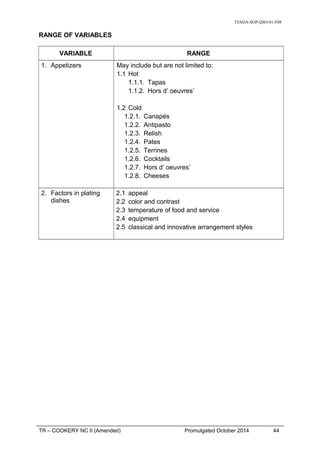
1. Appetizers May include but are not limited to:
1.1 Hot
1.1.1. Tapas
1.1.2. Hors d’ oeuvres’
1.2 Cold
1.2.1. Canapés
1.2.2. Antipasto
1.2.3. Relish
1.2.4. Pates
1.2.5. Terrines
1.2.6. Cocktails
1.2.7. Hors d’ oeuvres’
1.2.8. Cheeses
2. Factors in plating
dishes
2.1 appeal
2.2 color and contrast
2.3 temperature of food and service
2.4 equipment
2.5 classical and innovative arrangement styles
TR – COOKERY NC II (Amended) Promulgated October 2014 44
TESDA-SOP-QSO-01-F08
EVIDENCE GUIDE
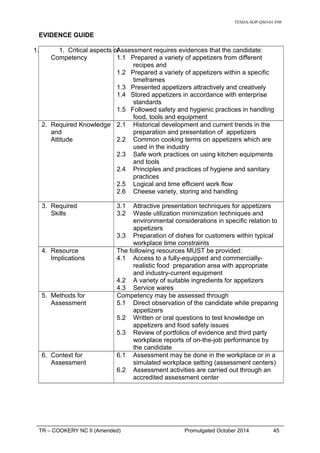
1. 1. Critical aspects of
Competency
Assessment requires evidences that the candidate:
1.1 Prepared a variety of appetizers from different
recipes and
1.2 Prepared a variety of appetizers within a specific
timeframes
1.3 Presented appetizers attractively and creatively
1.4 Stored appetizers in accordance with enterprise
standards
1.5 Followed safety and hygienic practices in handling
food, tools and equipment
2. Required Knowledge
and
Attitude
2.1 Historical development and current trends in the
preparation and presentation of appetizers
2.2 Common cooking terms on appetizers which are
used in the industry
2.3 Safe work practices on using kitchen equipments
and tools
2.4 Principles and practices of hygiene and sanitary
practices
2.5 Logical and time efficient work flow
2.6 Cheese variety, storing and handling
3. Required
Skills
3.1 Attractive presentation techniques for appetizers
3.2 Waste utilization minimization techniques and
environmental considerations in specific relation to
appetizers
3.3 Preparation of dishes for customers within typical
workplace time constraints
4. Resource
Implications
The following resources MUST be provided:
4.1 Access to a fully-equipped and commercially-
realistic food preparation area with appropriate
and industry-current equipment
4.2 A variety of suitable ingredients for appetizers
4.3 Service wares
5. Methods for
Assessment
Competency may be assessed through
5.1 Direct observation of the candidate while preparing
appetizers
5.2 Written or oral questions to test knowledge on
appetizers and food safety issues
5.3 Review of portfolios of evidence and third party
workplace reports of on-the-job performance by
the candidate
6. Context for
Assessment
6.1 Assessment may be done in the workplace or in a
simulated workplace setting (assessment centers)
6.2 Assessment activities are carried out through an
accredited assessment center
TR – COOKERY NC II (Amended) Promulgated October 2014 45
TESDA-SOP-QSO-01-F08
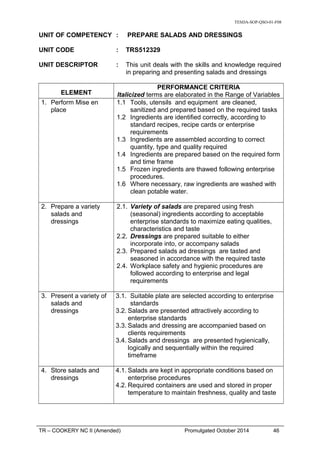
UNIT OF COMPETENCY : PREPARE SALADS AND DRESSINGS
UNIT CODE : TRS512329
UNIT DESCRIPTOR : This unit deals with the skills and knowledge required
in preparing and presenting salads and dressings
ELEMENT
PERFORMANCE CRITERIA
Italicized terms are elaborated in the Range of Variables
1. Perform Mise en
place
1.1 Tools, utensils and equipment are cleaned,
sanitized and prepared based on the required tasks
1.2 Ingredients are identified correctly, according to
standard recipes, recipe cards or enterprise
requirements
1.3 Ingredients are assembled according to correct
quantity, type and quality required
1.4 Ingredients are prepared based on the required form
and time frame
1.5 Frozen ingredients are thawed following enterprise
procedures.
1.6 Where necessary, raw ingredients are washed with
clean potable water.
2. Prepare a variety
salads and
dressings
2.1. Variety of salads are prepared using fresh
(seasonal) ingredients according to acceptable
enterprise standards to maximize eating qualities,
characteristics and taste
2.2. Dressings are prepared suitable to either
incorporate into, or accompany salads
2.3. Prepared salads ad dressings are tasted and
seasoned in accordance with the required taste
2.4. Workplace safety and hygienic procedures are
followed according to enterprise and legal
requirements
3. Present a variety of
salads and
dressings
3.1. Suitable plate are selected according to enterprise
standards
3.2. Salads are presented attractively according to
enterprise standards
3.3. Salads and dressing are accompanied based on
clients requirements
3.4. Salads and dressings are presented hygienically,
logically and sequentially within the required
timeframe
4. Store salads and
dressings
4.1. Salads are kept in appropriate conditions based on
enterprise procedures
4.2. Required containers are used and stored in proper
temperature to maintain freshness, quality and taste
TR – COOKERY NC II (Amended) Promulgated October 2014 46
TESDA-SOP-QSO-01-F08
RANGE OF VARIABLES
1. Variety of Salads May include but are not limited to:
1.1. Leafy
1.2. Non-leafy
1.3. Protein
1.4. Combination
1.5. Congealed
1.6. Fruit
1.7. Cooked
2. Dressings May include but are not limited to:
2.1 Temporary emulsions
2.2 Permanent emulsions
TR – COOKERY NC II (Amended) Promulgated October 2014 47
TESDA-SOP-QSO-01-F08
EVIDENCE GUIDE
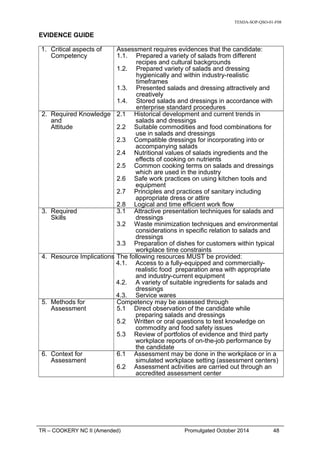
1. Critical aspects of
Competency
Assessment requires evidences that the candidate:
1.1. Prepared a variety of salads from different
recipes and cultural backgrounds
1.2. Prepared variety of salads and dressing
hygienically and within industry-realistic
timeframes
1.3. Presented salads and dressing attractively and
creatively
1.4. Stored salads and dressings in accordance with
enterprise standard procedures
2. Required Knowledge
and
Attitude
2.1 Historical development and current trends in
salads and dressings
2.2 Suitable commodities and food combinations for
use in salads and dressings
2.3 Compatible dressings for incorporating into or
accompanying salads
2.4 Nutritional values of salads ingredients and the
effects of cooking on nutrients
2.5 Common cooking terms on salads and dressings
which are used in the industry
2.6 Safe work practices on using kitchen tools and
equipment
2.7 Principles and practices of sanitary including
appropriate dress or attire
2.8 Logical and time efficient work flow
3. Required
Skills
3.1 Attractive presentation techniques for salads and
dressings
3.2 Waste minimization techniques and environmental
considerations in specific relation to salads and
dressings
3.3 Preparation of dishes for customers within typical
workplace time constraints
4. Resource Implications The following resources MUST be provided:
4.1. Access to a fully-equipped and commercially-
realistic food preparation area with appropriate
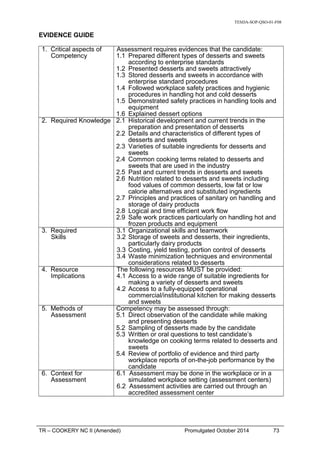
and industry-current equipment
4.2. A variety of suitable ingredients for salads and
dressings
4.3. Service wares
5. Methods for
Assessment
Competency may be assessed through
5.1 Direct observation of the candidate while
preparing salads and dressings
5.2 Written or oral questions to test knowledge on
commodity and food safety issues
5.3 Review of portfolios of evidence and third party
workplace reports of on-the-job performance by
the candidate
6. Context for
Assessment
6.1 Assessment may be done in the workplace or in a
simulated workplace setting (assessment centers)
6.2 Assessment activities are carried out through an
accredited assessment center
TR – COOKERY NC II (Amended) Promulgated October 2014 48
TESDA-SOP-QSO-01-F08
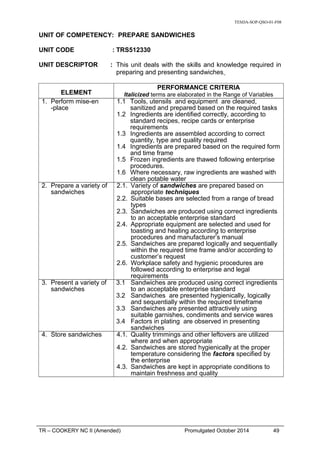
UNIT OF COMPETENCY: PREPARE SANDWICHES
UNIT CODE : TRS512330
UNIT DESCRIPTOR : This unit deals with the skills and knowledge required in
preparing and presenting sandwiches
ELEMENT
PERFORMANCE CRITERIA
Italicized terms are elaborated in the Range of Variables
1. Perform mise-en
-place
1.1 Tools, utensils and equipment are cleaned,
sanitized and prepared based on the required tasks
1.2 Ingredients are identified correctly, according to
standard recipes, recipe cards or enterprise
requirements
1.3 Ingredients are assembled according to correct
quantity, type and quality required
1.4 Ingredients are prepared based on the required form
and time frame
1.5 Frozen ingredients are thawed following enterprise
procedures.
1.6 Where necessary, raw ingredients are washed with
clean potable water
2. Prepare a variety of
sandwiches
2.1. Variety of sandwiches are prepared based on
appropriate techniques
2.2. Suitable bases are selected from a range of bread
types
2.3. Sandwiches are produced using correct ingredients
to an acceptable enterprise standard
2.4. Appropriate equipment are selected and used for
toasting and heating according to enterprise
procedures and manufacturer’s manual
2.5. Sandwiches are prepared logically and sequentially
within the required time frame and/or according to
customer’s request
2.6. Workplace safety and hygienic procedures are
followed according to enterprise and legal
requirements
3. Present a variety of
sandwiches
3.1 Sandwiches are produced using correct ingredients
to an acceptable enterprise standard
3.2 Sandwiches are presented hygienically, logically
and sequentially within the required timeframe
3.3 Sandwiches are presented attractively using
suitable garnishes, condiments and service wares
3.4 Factors in plating are observed in presenting
sandwiches
4. Store sandwiches 4.1. Quality trimmings and other leftovers are utilized
where and when appropriate
4.2. Sandwiches are stored hygienically at the proper
temperature considering the factors specified by
the enterprise
4.3. Sandwiches are kept in appropriate conditions to
maintain freshness and quality
TR – COOKERY NC II (Amended) Promulgated October 2014 49
TESDA-SOP-QSO-01-F08
RANGE OF VARIABLES
VARIABLE RANGE
1. Sandwiches May include but are not limited to:
1.1 Regular
1.2 Baked
1.3 Grilled
1.4 Fried
1.5 Open faced
1.6 Specialty
1.7 Multi-decker Wraps
1.8 Pinwheel, domino or checkerboard sandwiches
2. Techniques May include but are not limited to:
2.1 Garnishing
2.2 Spreading
2.3 Layering
2.4 Piping
2.5 Portioning
2.6 Molding
2.7 Cutting
3. Factors to consider
in storage of
sandwiches
May include but are not limited to:
3.1 Ingredients of a sandwich
3.2 temperature
3.3 packaging
TR – COOKERY NC II (Amended) Promulgated October 2014 50
TESDA-SOP-QSO-01-F08
EVIDENCE GUIDE
1. Critical aspects of
Competency
Assessment requires evidences that the candidate:
1.1 Prepared different types of sandwiches using
different types of breads and ingredients and
preparation techniques
1.2 Prepared a certain quantity of sandwiches
hygienically and within industry-realistic timeframes
1.3 Presented sandwiches attractively using suitable
garnishes, condiments and service wares
1.4 Stored sandwiches in accordance with enterprise
standard procedures
2. Required Knowledge 2.1 Suitable breads, fillings, and ingredients
2.2 Appropriate food combinations for sandwiches
2.3 Common cooking terms related to sandwiches that
are used in the industry
2.4 Principles and practices of sanitary, including dress
standards
2.5 Basic food information on special dietary needs and
customer
2.6 Past and current trends in sandwich preparation
2.7 Hygienic food handling practices
2.8 Safe work practices on cutting
2.9 Logical and time-efficient work flow
2.10 Portion control for sandwiches
3. Required Skills 3.1 Creative sandwich presentation techniques
3.2 Suitable storage techniques to maintain optimum
quality of ingredients
3.3 Organizational skills and teamwork
3.4 Waste minimization techniques
3.5 Preparation of multiple types of sandwiches under
time constraints
4. Resource Implications The following resources MUST be provided:
4.1 Access to a fully-equipped commercially-realistic
food preparation area for sandwich production
4.2 Real ingredients for sandwiches and service wares
5. Methods of AssessmentCompetency may be assessed through :
5.1 Direct observation of the candidate while making
sandwiches and preparing fillings
5.2 Written and oral questions to test candidate’s
knowledge on appropriate food combinations for
sandwiches and hygienic food handling
requirements
5.3 Review of portfolios of evidence and third party
workplace reports of on-the-job performance by the
candidate
6. Context for
Assessment
6.1 Assessment may be done in the workplace or in a
simulated workplace setting (assessment centers)
6.2 Assessment activities are carried out in an
accredited assessment center
TR – COOKERY NC II (Amended) Promulgated October 2014 51
TESDA-SOP-QSO-01-F08
UNIT OF COMPETENCY : PREPARE MEAT DISHES
UNIT CODE : TRS512338
UNIT DESCRIPTOR : This unit deals with the knowledge, skills and attitude
in selecting, preparing, cooking and storing meats.
ELEMENT
PERFORMANCE CRITERIA
Italicized terms are elaborated in the Range of Variables
1. Perform Mise en
place
1.1 Tools, utensils and equipment are cleaned,
sanitized and prepared based on the required tasks
1.2 Ingredients are identified correctly, according to
standard recipes, recipe cards or enterprise
requirements
1.3 Ingredients are assembled according to correct
quantity, type and quality required
1.4 Ingredients are prepared based on the required form
and time frame
1.5 Frozen ingredients are thawed following enterprise
procedures.
1.6 Where necessary, raw ingredients are washed with
clean potable water.
2. Cook meat cuts for
service
2.1. Appropriate cooking methods are identified and
used for cooking
2.2. A variety of portioned meat cuts are cooked in
accordance to standard recipe specifications
2.3. A variety of offal dishes are cooked according to
standard recipes
2.4. Meats are carved using the appropriate tools and
techniques
2.5. Ingredients are adjusted to meet special requests of
customers
2.6. Cooked dishes are tasted and seasoned in
accordance with the required taste of the dishes
2.7. Workplace safety and hygienic procedures are
followed according to enterprise and legal
requirements
3. Present meat cuts
for service
3.1 Meat dishes are presented attractively according to
classical, cultural and enterprise standards
3.2 Meat dishes are presented hygienically, logically and
sequentially within the required timeframe
3.3 Suitable plate are selected according to enterprise
standards
3.4 Factors in plating dishes are observed in presenting
meat dishes
4. Store meat 4.1 Quality trimmings and other leftovers are utilized
where and when appropriate
4.2 Fresh and cryovac-packed meat are stored correctly
according to health regulations
4.3 Required containers are used and stored in proper
temperature to maintain freshness, quality and taste
4.4 Meat is stored in accordance with FIFO operating
procedures and storage of meat requirements
TR – COOKERY NC II (Amended) Promulgated October 2014 52
TESDA-SOP-QSO-01-F08
RANGE OF VARIABLES
VARIABLE RANGE
1. Tools, utensils and
equipment
May include but are not limited to:
1.1. Various kitchen knives
1.2. Meat mallet
1.3. Meat hooks
1.4. Larding needles
1.5. Knife sharpening and honing equipments
1.6. Food slicers and processors
1.7. Meat thermometer
1.8. Weighing scales
1.9. Kitchen twines
2. Cooking method May include but are not limited to:
2.1. Dry method
2.1.1. Roasting
2.1.2. Grilling
2.1.3. Broiling
2.1.4. Baking
2.1.5. Pan frying
2.1.6. Deep fat Frying
2.2. Combination Method
2.2.1. Braising
2.2.2. Stewing
2.3. Moist method
2.3.1. Boiling
2.3.2. Steaming
2.3.3. Poaching
2.3.4. Simmering
3. Dishes 3.1 Offal
3.2 Meat
TR – COOKERY NC II (Amended) Promulgated October 2014 53
TESDA-SOP-QSO-01-F08
EVIDENCE GUIDE
1. Critical aspects of
Competency
Assessment requires evidences that the candidate:
1.1 Applied safe and accurate cutting techniques
1.2 Observed hygienic handling and storing of meat
1.3 Prepared a range of meat dishes to enterprise
standards
1.4 Performed Mise en place
1.5 Cooked variety of meat dishes
1.6 Presented variety of meat dishes
1.7 Followed workplace safety practices and hygienic
procedures in preparing meat dishes
1.8 Followed safety practices in handling tools and
equipment
2. Required Knowledge 2.1 Different classifications of meats
2.2 Historical development and current trends in the
preparation and presentation of meat
2.3 Classification of culinary methods
2.4 Characteristics of meats including type, cut, quality
and fat content
2.5 Characteristics of different meat cuts including
primary, secondary and portioned cuts
2.6 Appropriate trade names and cooking terms in
accordance with standard meat cuts
2.7 Principles and practices of storing, freezing and aging
of meats
2.8 Nutrition content and food values of meat
2.9 Cooking terms related to handling and storage of
meat commonly used in the enterprise and industry
2.10 Uses and characteristics of various knives and
equipment
2.11 Safe work practices on using kitchen equipments and
tools
2.12 Logical and time efficient work flow
3 3. Required Skills 3.1 Appropriate preparation and culinary methods for
various cuts and types of meat
3.2 Cutting techniques of ingredients
3.3 Knife care and maintenance
3.4 Organizational skills and teamwork
3.5 Principles and practices of hygienic handling and
storage of meat
3.6 Waste minimization techniques and environment-
friendly disposal
4. Resource Implications The following resources MUST be provided
4.1 Use of a wide range of meat cuts and products.
4.2 Fully-equipped, operational, commercial/intuitional
kitchen (including industry- modern equipment/tools)
4.3 Various type of meat and ingredients
4.4 Service wares
5. Methods of
Assessment
Competency may be assessed through:
5.1 Direct observation of the candidate while preparing
and cooking meat
5.2 Interview the candidate the type of culinary method
that he/she is performing
5.3 Review of portfolios of evidence and third party
workplace reports of on-the-job performance by the
candidate
6. Context for
Assessment
6.1 Assessment may be done in the workplace or in a
simulated workplace setting (assessment centers)
6.2 Assessment activities are carried out through an
accredited assessment center
TR – COOKERY NC II (Amended) Promulgated October 2014 54
TESDA-SOP-QSO-01-F08
UNIT OF COMPETENCY : PREPARE VEGETABLES DISHES
UNIT CODE : TRS512332
UNIT DESCRIPTOR : This unit deals with the skills, knowledge and
attitude required in cooking, presenting and storing
various vegetables dishes.
ELEMENT
PERFORMANCE CRITERIA
Italicized terms are elaborated in the Range of Variables
1. Perform Mise en
place
1.1 Tools, utensils and equipment are cleaned,
sanitized and prepared based on the required tasks
1.2 Ingredients are identified correctly, according to
standard recipes, recipe cards or enterprise
requirements
1.3 Ingredients are assembled according to correct
quantity, type and quality required
1.4 Ingredients are prepared based on the required form
and time frame
1.5 Frozen ingredients are thawed following enterprise
procedures.
1.6 Where necessary, raw ingredients are washed with
clean potable water.
2. Prepare vegetable
dishes
2.1. Vegetables are selected according to, quality
2.2. Vegetables accompaniments are selected to
complement and enhance menu items
2.3. Variety of vegetables dishes are prepared following
appropriate Cooking methods to preserve optimum
quality and nutrition
2.4. Suitable sauces and accompaniments are selected
and served with vegetables
2.5. Cooked dishes are tasted and seasoned in
accordance with the required taste of the dishes
2.6. Workplace safety and hygienic procedures are
followed according to enterprise and legal
requirements
3. Present vegetable
dishes
3.1 Vegetables are uniformly cut and attractively
presented
3.2 Suitable plate are selected according to enterprise
standards
3.3 Factors in plating dishes are observed in presenting
poultry and game dishes
3.4 Vegetables dishes are presented hygienically,
logically and sequentially within the required
timeframe
4. Store vegetables
dishes
4.1 Quality trimmings and other leftovers are utilized
where and when appropriate
4.2 Vegetables are stored at the correct temperature
4.3 Optimum freshness and quality is maintained in
accordance with enterprise storing techniques and
procedure
4.4 Vegetable is stored in accordance with FIFO
operating procedures and storage of vegetable
requirements
TR – COOKERY NC II (Amended) Promulgated October 2014 55
TESDA-SOP-QSO-01-F08
RANGE OF VARIABLES
VARIABLE RANGE
1. Vegetables May include but are not limited to:
1.1 Fresh
1.2 Frozen
1.3 Canned
1.4 Dried
1.5 Bottled
2. Cooking Method May include but are not limited to:
2.1 Dry method
2.1.1 Roasting
2.1.2 Grilling
2.1.3 Broiling
2.1.4 Baking
2.1.5 Pan frying
2.1.6 Deep fat Frying
2.2 Combination Method
2.2.1 Braising
2.2.2 Stewing
2.3 Moist method
2.3.1 Boiling
2.3.2 Steaming
2.3.3 Poaching
2.3.4 Simmering
TR – COOKERY NC II (Amended) Promulgated October 2014 56
TESDA-SOP-QSO-01-F08
EVIDENCE GUIDE
1. Critical aspects of
Competency
Assessment requires evidences that the candidate:
1.1 Performed mise en place
1.2 Prepared a variety of vegetable dishes
1.3 Presented variety of vegetable dishes with
appropriate service wares and garnishes
1.4 Stored vegetable dishes in accordance with
enterprise standard procedures
1.5 Followed workplace safety practices and hygienic
procedures
1.6 Followed safety practices in handling tools and
equipment
1.7 Determined/Explained different classifications of
vegetables
2. Required Knowledge 2.1 Varieties and characteristics of vegetables
2.2 Past and current trends in culinary uses and dishes
of vegetables
2.3 Nutrition related to vegetables, in particular the food
values of commodities and the effects of cooking on
the nutritional value of food
2.4 Common cooking terms related to vegetables
dishes that are used in the industry
2.5 Safe work practices on using tools and equipment
2.6 Principles and practices of sanitary related to use of
raw ingredients
2.7 Logical and time efficient work flow
3. Required Skills 3.1 Cutting and presentation techniques of vegetables
3.2 Organizational skills and teamwork
3.3 Waste minimization techniques and environmental
considerations in specific relation to vegetables
4. Resource
Implications
The following resources MUST be provided:
4.1 Access to a fully-equipped operational
commercial/institutional kitchen (including industry-
current equipment)
4.2 Real/Relevant ingredients and service wares
5. Methods of AssessmentCompetency may be assessed through :
5.1 Direct observation of the candidate while preparing
dishes
5.2 Portfolio Report like sampling of dishes cooked by
the candidate
5.3 Written or oral questions to test candidate’s
knowledge on appropriate cooking methods for
various commodities and safety issues
5.4 Review of portfolios of evidence and third party
workplace reports of on-the-job performance by the
candidate
6. Context for
Assessment
6.1 Assessment may be done in the workplace or in a
simulated workplace setting (assessment centers)
6.2 Assessment activities are carried out through an
accredited assessment center
TR – COOKERY NC II (Amended) Promulgated October 2014 57
TESDA-SOP-QSO-01-F08
UNIT OF COMPETENCY : PREPARE EGG DISHES
UNIT CODE : TRS512332
UNIT DESCRIPTOR : This unit deals with the skills, knowledge and
attitude required to cook, present and store various
egg dishes.
ELEMENT
PERFORMANCE CRITERIA
Italicized terms are elaborated in the Range of Variables
1. Perform Mise en
place
1.1 Tools, utensils and equipment are cleaned,
sanitized and prepared based on the required tasks
1.2 Ingredients are identified correctly, according to
standard recipes, recipe cards or enterprise
requirements
1.3 Ingredients are assembled according to correct
quantity, type and quality required
1.4 Ingredients are prepared based on the required form
and time frame
1.5 Frozen ingredients are thawed following enterprise
procedures.
1.6 Where necessary, raw ingredients are washed with
clean potable water.
2. Prepare and cook
egg dishes
2.1 Variety of egg dishes are prepared according to
standard recipes using a range of cooking
methods
2.2 Eggs are cooked based on clients requirements
2.3 Sauces and accompaniments specific to egg
preparations are selected and prepared
2.4 Cooked dishes are tasted and seasoned in
accordance with the required taste of the dishes
2.5 Workplace safety and hygienic procedures are
followed according to enterprise and legal
requirements
3. Present egg dishes 3.1 Suitable plates are selected according to enterprise
standards
3.2 Eggs are presented hygienically and attractively
using suitable garnishes and side dishes
sequentially within the required timeframe
3.3 Factors in plating dishes are observed in presenting
egg dishes
4. Store egg dishes 4.1 Fresh and processed eggs are stored at the correct
temperature
4.2 Optimum freshness and quality are maintained in
accordance with enterprise storing techniques and
procedures
4.3 Quality trimmings and other leftovers are utilized
where and when appropriate
4.4 Egg is stored in accordance with FIFO operating
procedures and storage of egg requirements
TR – COOKERY NC II (Amended) Promulgated October 2014 58
TESDA-SOP-QSO-01-F08
RANGE OF VARIABLES
VARIABLE RANGE
1. Egg dishes May include but are not limited to:
1.1 Omelettes
1.2 Soufflés
1.3 Frittatas
1.4 Terrines
2. Cooking method 2.1 Boiling
2.2 Poaching
2.3 Frying
2.4 Baking
3. Eggs 3.3 Fresh
3.4 Frozen
3.5 Powder
TR – COOKERY NC II (Amended) Promulgated October 2014 59
TESDA-SOP-QSO-01-F08
EVIDENCE GUIDE
1. Critical aspects of
Competency
Assessment requires evidences that the candidate:
1.1 Prepared a variety of dishes eggs
1.2 Presented a variety of egg dishes using appropriate
service wares and garnishes
1.3 Followed workplace safety practices and hygienic
procedures in preparing egg dishes
1.4 Followed safety practices in handling tools and
equipment
1.5 Determined/Explained different classifications of
eggs
2. Required Knowledge 2.1 Varieties and characteristics of eggs
2.2 Historical development and current trends in the
preparation and presentation of egg
2.3 Past and current trends in culinary uses and dishes
of eggs
2.4 Nutrition related to eggs in particular the food values
of commodities and the effects of cooking on the
nutritional value of food
2.5 Common cooking terms related to egg dishes and
culinary uses that are used in the industry
2.6 Safe work practices on using tools and equipment
2.7 Principles and practices of sanitary related to use of
raw ingredients
2.8 Logical and time efficient work flow
3. Required Skills 3.1 Presentation techniques of eggs
3.2 Organizational skills and teamwork
3.3 Waste minimization techniques and environmental
considerations in specific relation to eggs
4. Resource
Implications
The following resources MUST be provided:
4.1 Access to a fully-equipped operational
commercial/institutional kitchen (including industry-
modern equipment)
4.2 Eggs
4.3 Real/Relevant ingredients
4.3 Service ware
5. Methods of
Assessment
Competency may be assessed through :
5.1 Direct observation of the candidate while preparing
dishes
5.2 Portfolio Report like sampling of dishes cooked by
the candidate
5.3 Written or oral questions to test candidate’s
knowledge on appropriate cooking methods for
various commodities and safety issues
5.4 Review of portfolios of evidence and third party
workplace reports of on-the-job performance by the
candidate
6. Context for
Assessment
6.1 Assessment may be done in the workplace or in a
simulated workplace setting (assessment centers)
6.2 Assessment activities are carried out through an
accredited assessment center
TR – COOKERY NC II (Amended) Promulgated October 2014 60
TESDA-SOP-QSO-01-F08
UNIT OF COMPETENCY : PREPARE STARCH DISHES
UNIT CODE : TRS512332
UNIT DESCRIPTOR : This unit deals with the skills, knowledge and
attitude required to cook, present and store
starch dishes such as pasta and noodles.
ELEMENT
PERFORMANCE CRITERIA
Italicized terms are elaborated in the Range of Variables
1. Perform Mise en
place
1.1 Tools, utensils and equipment are cleaned,
sanitized and prepared based on the required tasks
1.2 Ingredients are identified correctly, according to
standard recipes, recipe cards or enterprise
requirements
1.3 Ingredients are assembled according to correct
quantity, type and quality required
1.4 Ingredients are prepared based on the required form
and time frame
1.5 Frozen ingredients are thawed following enterprise
procedures.
1.6 Where necessary, raw ingredients are washed with
clean potable water.
2. Prepare starch
dishes
2.1 Variety of starch products are selected and
prepared according to enterprise recipes
2.2 Optimum quality is ensured using appropriate
cooking methods
2.3 Sauces and accompaniments appropriate to starch
products are selected
2.4 Cooked dishes are tasted and seasoned in
accordance with the required taste of the dishes
2.5 Workplace safety and hygienic procedures are
followed according to enterprise and legislated
requirements
3. Present Starch
dishes
3.1 Suitable plate are selected according to enterprise
standards
3.2 Starch dishes are presented hygienically and
attractively using suitable garnishes and side dishes
3.3 Factors in plating dishes are observed in presenting
starch dishes
4. Store Starch dishes 4.1. Starch are stored at the correct temperature
4.2. Optimum freshness and quality is maintained in
accordance with enterprise storing techniques and
procedures
4.3. Quality trimmings and other leftovers are utilized
where and when appropriate
4.4. Starch is stored in accordance with FIFO operating
procedures and storage of starch requirements
TR – COOKERY NC II (Amended) Promulgated October 2014 61
TESDA-SOP-QSO-01-F08
RANGE OF VARIABLES
VARIABLE RANGE
1. Starch May include but are not limited to:
1.1 Pasta
1.2 Rice
1.3 Tubers
1.4 Polenta
1.5 Noodles
1.6 Couscous
1.7 flour
TR – COOKERY NC II (Amended) Promulgated October 2014 62
TESDA-SOP-QSO-01-F08
EVIDENCE GUIDE
1. Critical aspects of
Competency
Assessment requires evidences that the candidate:
1.1 Prepared a variety of dishes using starch
products
1.2 Presented starch dishes in appropriate service
wares
1.3 Prepared appropriate sauces for the prepared
starch dishes
1.4 Stored starch dishes
1.5 Followed workplace safety practices and hygienic
procedures in preparing variety of starch dishes
1.6 Demonstrated safety practices in handling tools
and equipment
1.7 Determined/Explained different classifications of
starch products
2. Required Knowledge 2.1 Historical development and current trends in the
preparation and presentation of starch dishes
2.2 Varieties and characteristics of starch foods
2.3 Past and current trends in culinary uses and dishes
starch foods
2.4 Nutrition related to starch dishes in particular the
food values of commodities and the effects of
cooking on the nutritional value of food
2.5 Common cooking terms related to starch dishes that
are used in the industry
2.6 Safe work practices on using tools and equipment
2.7 Principles and practices of sanitary related to use of
raw ingredients
2.8 Logical and time efficient work flow
3. Required Skills 3.1 Presentation techniques of starch dishes
3.2 Organizational skills and teamwork
3.3 Waste minimization techniques and environmental
considerations in specific relation to starch dishes
4. Resource
Implications
The following resources MUST be provided:
4.1 Access to a fully-equipped operational
commercial/institutional kitchen (including industry-
current equipment)
4.2 Real/Relevant ingredients
4.3 Service ware
5. Methods of
Assessment
Competency may be assessed through :
5.1 Direct observation of the candidate while preparing
dishes
5.2 Written or oral questions to test candidate’s
knowledge on appropriate cooking methods for
various commodities and safety issues
5.4 Review of portfolios of evidence and third party
workplace reports of on-the-job performance by the
candidate
6. Context for
Assessment
6.1 Assessment may be done in the workplace or in a
simulated workplace setting (assessment centers)
6.2 Assessment activities are carried out through an
accredited assessment center
TR – COOKERY NC II (Amended) Promulgated October 2014 63
TESDA-SOP-QSO-01-F08
UNIT OF COMPETENCY : PREPARE POULTRY AND GAME DISHES
UNIT CODE : TRS512333
UNIT DESCRIPTOR : This unit deals with the knowledge, skills and
attitude required in selecting, preparing, cooking,
plating/presenting and storing poultry and game.
ELEMENT
PERFORMANCE CRITERIA
Italicized terms are elaborated in the Range of Variables
1. Perform mise en
place
1.1 Tools, utensils and equipment are cleaned,
sanitized and prepared based on the required tasks
1.2 Ingredients are identified according to standard
recipes, recipe card or enterprise requirements
1.3 Ingredients are assembled according to quantity,
type, and quality required
1.4 Ingredients are prepared based on the required form
and time frame
1.5 Poultry and game are prepared based on its
enterprise poultry and game preparation
techniques
1.6 Frozen poultry and game are thawed in accordance
with enterprise thawing procedures
1.7 Frozen ingredients are thawed following enterprise
procedures.
1.8 Where necessary, raw ingredients are washed with
clean potable water.
2. Cook poultry and
game dishes
2.1 Poultry and game are handled efficiently and
hygienically to minimize risk of food spoilage and
cross-contamination
2.2 Poultry and game dishes are cooked according to
enterprise standard recipes and appropriate
Cooking methods
2.3 Cooked dishes are tasted and seasoned in
accordance with the required taste of the dishes
3. Plate/present
poultry and game
dishes
3.1 Service wares are selected in accordance with type
of poultry and game dishes
3.2 Poultry and game is plated/presented using suitable
sauces, garnishes and accompaniments
3.3 Poultry dishes are presented hygienically, logically
and sequentially within the required timeframe
3.4 Factors in plating dishes are observed in
presenting poultry and game dishes..
4. Store poultry and
game
4.1 Poultry and game are stored ensuring storage
conditions and optimal temperature are maintained
4.2 Quality trimmings and other leftovers are utilized
where and when appropriate
TR – COOKERY NC II (Amended) Promulgated October 2014 64
TESDA-SOP-QSO-01-F08
RANGE OF VARIABLES
VARIABLE RANGE
1. Poultry or game May include but are not limited to :
1.1 Chicken, turkey, duck, goose
1.2 Pheasant, quail, pigeon, guinea fowl, wild duck
1.3 Rabbit, hare
1.4 Boar, goat
2. Poultry preparation
techniques
May include but are not limited to:
2.1 De-boning
2.2 Stuffing
2.3 Filleting
2.4 Rolling and trussing
2.5 Larding
2.6 Marinating
3. Cooking methods for
poultry and game
May include but are not limited to:
3.1 Dry method
3.1.1 Roasting
3.1.2 Grilling
3.1.3 Broiling
3.1.4 Baking
3.1.5 Pan frying
3.1.6 Deep fat Frying
3.2 Combination Method
3.2.1 Braising
3.2.2 Stewing
3.3 Moist method
3.3.1 Boiling
3.3.2 Steaming
3.3.3 Poaching
3.3.4 Simmering
4. Factors to consider
in plating dishes
4.1 appeal
4.2 color and contrast
4.3 temperature of food and service
4.4 equipment
4.5 classical and innovative arrangement styles
5. Ways of presenting
poultry and game
dishes
5.1 Carve
5.2 Portions
5.3 Whole
TR – COOKERY NC II (Amended) Promulgated October 2014 65
TESDA-SOP-QSO-01-F08
EVIDENCE GUIDE
1. Critical aspects of
Competency
Assessment requires evidences that the candidate:
1.1 Understood the different classifications of poultry
and game
1.2 Demonstrated particular storage and handling
practices related to poultry and game
1.3 Prepared a variety of poultry and game dishes
according to enterprise standards
1.4 Cooked and presented or plated poultry and game
dishes according to enterprise standards
1.5 Followed safety practices in handling tools and
equipment
2. Required Knowledge 2.1 Classification of varieties of poultry and game items
2.2 Quality criteria for poultry and game
2.3 Appropriate cookery methods for poultry and game
dishes
2.4 Past and current trends in poultry and game dishes
2.5 Nutrition related to poultry and game, including food
values and any specific issues like salmonella
contaminations, etc.
2.6 Common cooking terms related to poultry and game
which are used in the industry
2.7 Safe work practices, particularly in relation to cutting
2.8 Logical and time efficient work flow
3. Required Skills 3.1 Organizational skills and teamwork
3.2 Principles and practices of sanitary specifically
cross-contamination
3.3 Techniques on minimizing wastes and environment-
friendly practices on handling and preparation of
poultry and game
4. Resource
Implications
The following resources MUST be provided:
4.1 Access to a fully-equipped operational
commercial/institutional kitchen (including industry-
modern equipment)
4.2 Real/Required ingredients
4.3 Poultry and game
4.4 Service wares
5. Methods of
Assessment
Competency may be assessed through :
5.1 Direct observation of the candidate while handling
and cooking game and poultry
5.2 Sampling of dishes cooked by the candidate
5.3 Written or oral questions to test candidate’s
knowledge on issues involved in cooking game,
food safety and appropriate cookery methods for
poultry and game
5.4 Review of portfolios of evidence and third party
workplace reports of on-the-job performance by the
candidate
6. Context for
Assessment
6.1 Assessment may be done in the workplace or in a
simulated workplace setting (assessment centers)
6.2 Assessment activities are carried out through an
accredited assessment center
TR – COOKERY NC II (Amended) Promulgated October 2014 66
TESDA-SOP-QSO-01-F08
UNIT OF COMPETENCY: PREPARE SEAFOOD DISHES
UNIT CODE : TRS512334
UNIT DESCRIPTOR : This unit deals with the knowledge, skills and attitude
required in selecting, preparing, presenting and storing
seafood in a commercial kitchen or catering operation.
ELEMENT
PERFORMANCE CRITERIA
Italicized terms are elaborated in the Range of Variables
1. Perform mise en
place
1.1 Tools, utensils and equipment are cleaned,
sanitized and prepared based on the required tasks
1.2 Ingredients are identified according to standard
recipes, recipe card or enterprise requirements
1.3 Ingredients are assembled according to quantity,
type, and quality required
1.4 Ingredients are prepared based on the required
form and time frame
1.5 Frozen ingredients are thawed following enterprise
procedures.
1.6 Where necessary, raw ingredients are washed with
clean potable water.
2. Handle fish and
seafood
2.1 Seafood is selected according to quality,
2.2 Seafood are handled hygienically in accordance
with enterprise handling and storing techniques
2.3 Frozen seafood are thawed correctly to ensure
maximum quality, and to retain their nutrients
3. Cook fish and
shellfish
3.1 Fish is cleaned, gutted and filleted correctly and
efficiently according to enterprise standards
3.2 Shellfish and other types of seafood are cleaned
and prepared correctly and in accordance with
enterprise standards
3.3 Seafood dishes is cooked according to enterprise
standards using a variety of cooking methods
3.4 Fish and shellfish by-products are used
appropriately for a variety of dishes and menu items
3.5 Cooked dishes are tasted and seasoned in
accordance with the required taste of the dishes
3.6 Workplace safety and hygienic procedures are
followed according to enterprise and legislated
requirements
TR – COOKERY NC II (Amended) Promulgated October 2014 67
TESDA-SOP-QSO-01-F08
ELEMENT
PERFORMANCE CRITERIA
Italicized terms are elaborated in the Range of Variables
4. Plate/Present fish
and seafood
4.1. Seafood dishes are presented hygienically,
logically and sequentially within the required
timeframe
4.2. Fish and seafood is prepared and presented for
service in accordance to enterprise standards
4.3. Suitable sauces and dips are prepared according
to standard recipes and as required to accompany
seafood menu items
4.4. Presentations and garnishing techniques are
selected and used according to recipes and
enterprise standards
4.5. Services are carried out according to enterprise
methods and standards
4.6. Factors in plating dishes are observed in
presenting seafood dishes
5. Store fish and
seafood
5.1. Quality trimmings and other leftovers are utilized
where and when appropriate Seafood are stored
hygienically in accordance with enterprise handling
and storing techniques
5.2. Where applicable, date stamps and codes are
checked to ensure quality control
5.3. Seafood is stored in accordance with FIFO
operating procedures and storage of seafood
requirements.
TR – COOKERY NC II (Amended) Promulgated October 2014 68
TESDA-SOP-QSO-01-F08
RANGE OF VARIABLES
VARIABLE RANGE
1. Seafood May include but are not limited to:
1.1. Shellfish
1.1.1. Mollusks
1.1.2. Crustaceans
1.1.3. Cephalopods
1.2. Fish
1.2.1 Flat fish
1.2.2 Round fish
1.2.3 flat fish
2. Fish May include but are not limited to :
2.1 Structure
a. Fish
b. Shellfish
2.2 Body shape
a. Flat fish
b. Round fish
2.3 Market forms
a. Fillets
b. Drawn
c. Whole
d. Butterfly fillet
e. Steak
2.4 Fat content
a. Lean Fish
b. Fat Fish
2.5 Water source
a. Salt water
b. Freshwater
2.6 Processed fish
a. Dried
b. Smoked
c. Bottled
3. Variety of cooking
method
May include but are not limited to:
3.1 Dry method
3.1.1 Roasting
3.1.2 Grilling
3.1.3 Broiling
3.1.4 Baking
3.1.5 Pan frying
3.1.6 Deep fat Frying
3.2 Combination Method
3.2.1 Braising
3.2.2 Stewing
3.3 Moist method
3.3.1 Boiling
3.3.2 Steaming
3.3.3 Poaching
3.3.4 Simmering
TR – COOKERY NC II (Amended) Promulgated October 2014 69
TESDA-SOP-QSO-01-F08
EVIDENCE GUIDE
1. Critical aspects of
Competency
Assessment requires evidences that the candidate:
1.1 Explained the different classifications of seafood
1.2 Demonstrated storing and handling issues related to
seafood
1.3 Cooked and plated/presented a range of seafood
dishes according to enterprise standards
1.4 Stored seafood hygienically and in accordance with
enterprise standard procedures
1.5 Demonstrated safety practices in handling tools and
equipment
2. Required Knowledge 2.1 Historical development and current trends in the
preparation and presentation of seafood
2.2 Classification and varieties of fish and shellfish
2.3 Criteria for judging the quality of fresh seafood
2.4 Storage requirements for seafood
2.5 Nutrition related to seafood, particularly the
nutritional value of seafood
2.6 Specific dietary issues including allergies and
intolerances
2.7 Common cooking terms related to seafood that are
used in the industry
2.8 Principles and practices of sanitary specifically on
handling and storage of seafood
2.9 Safe work practices, particularly on using sharp
knives
3. Required Skills 3.1 Appropriate cookery methods for fish and shellfish
3.2 Cutting and presentation techniques, particularly on
fish and crustaceans
3.3 Costing, yield testing and portion control for seafood
3.4 Waste minimization techniques and environmental
considerations in relation to seafood
4. Resource
Implications
The following resources MUST be provided:
4.1 Access to a fully-equipped operational
commercial/institutional kitchen (including industry-
current equipment)
4.2 Real/Relevant ingredients
4.3 Seafood
4.4 Service wares
5. Methods of
Assessment
Competency may be assessed through :
5.1 Direct observation of the candidate while preparing
and cooking fish and seafood
5.2 Written or oral questions to test candidate’s
knowledge on storage issues related to fish and
seafood
5.3 Review of portfolios of evidence and third party
workplace reports of on-the-job performance by the
candidate
6. Context for
Assessment
6.1 Assessment may be done in the workplace or in a
simulated workplace setting (assessment centers)
6.2 Assessment activities are carried out through an
accredited assessment center
TR – COOKERY NC II (Amended) Promulgated October 2014 70
TESDA-SOP-QSO-01-F08
UNIT OF COMPETENCY: PREPARE DESSERTS
UNIT CODE : TRS512335
UNIT DESCRIPTOR : This unit deals with knowledge, skills, and attitudes in the
preparation of a range of hot, cold and frozen desserts.
ELEMENT
PERFORMANCE CRITERIA
Italicized terms are elaborated in the Range of Variables
1. Perform mise en
place
1.1 Tools, utensils and equipment are cleaned,
sanitized and prepared based on the required tasks
1.2 Ingredients are identified according to standard
recipes, recipe card or enterprise requirements
1.3 Ingredients are assembled according to quantity,
type, and quality required
1.4 Ingredients are prepared based on the required
form and time frame
1.5 Ingredients are selected, measured and weighed
according to recipe requirements
1.6 Appropriate equipment are selected and used in
accordance with manufacturers’ manual
1.7 Frozen ingredients are thawed following enterprise
procedures.
1.8 Where necessary, raw ingredients are washed with
clean potable water.
2. Prepare desserts
and sweet sauces
2.1 Standard or enterprise recipes are used to produce
a variety of hot, cold and frozen desserts,
appropriate for a variety of menus
2.2 Range of sweet sauces are produced to a desired
consistency and flavor
2.3 Prepared desserts and sweets are tasted in
accordance with the required taste
2.4 Workplace safety and hygienic procedures are
followed according to enterprise and legislated
requirements
3. Plate/Present
desserts
3.1 Desserts are presented hygienically, logically and
sequentially within the required timeframe
3.2 Desserts are decorated creatively
3.3 Factors in plating dishes are observed in presenting
desserts
3.4 Desserts are portioned according to enterprise
standards
3.5 Desserts are presented in accordance with
enterprise presentation techniques
3.6 Accompaniments, garnishes and decorations are
used to enhance taste, texture and balance
4. Store desserts 4.1 Quality trimmings and other leftovers are utilized
where and when appropriate
4.2 Desserts are stored at the appropriate temperature
and under the correct conditions to maintain quality,
freshness and customer appeal
4.3 Suitable packaging are selected and used to
preserve taste, appearance and tasting
characteristics
4.4 Sweet sauces are stored to retain desired quality
and characteristics
4.5 Dessert is stored in accordance with FIFO operating
procedures and storage of dessert requirements
TR – COOKERY NC II (Amended) Promulgated October 2014 71
TESDA-SOP-QSO-01-F08
RANGE OF VARIABLES
VARIABLE RANGE
1. Equipment for
making desserts
May include but are not limited to:
1.1 Blenders
1.2 Ice-cream machines
1.3 Ice shavers
1.4 Juicers
1.5 Mixers
1.6 Ovens
1.7 Chillers and freezers
1.8 Steamer
1.9 Weighing scales
1.10 Cooking equipment
2. Desserts May include but are not limited to:
2.1 Pudding, pies, tarts, flans, fritters
2.2 Custard, creams
2.3 Prepared fruit
2.4 Mousse
2.5 Repes,
2.6 Sorbet, ice cream, parfait,
2.7 Quick bread
2.8 Cookies
3. Sweet sauces May include but are not limited to:
3.1 Sugar syrups
3.2 Fruit syrups
3.3 Fruit purees, sauces and coulis
3.4 Chocolate-based sauces
3.5 Custards and crèmes
3.7 Flavored butters and creams
4. Suitable thickening
agents for sweet
sauces
May include but are not limited to:
4.1 Corn starch, arrowroot, potato starch
4.2 Modified starch
4.3 Liason
4.4 Gelatin
TR – COOKERY NC II (Amended) Promulgated October 2014 72
TESDA-SOP-QSO-01-F08
EVIDENCE GUIDE
1. Critical aspects of
Competency
Assessment requires evidences that the candidate:
1.1 Prepared different types of desserts and sweets
according to enterprise standards
1.2 Presented desserts and sweets attractively
1.3 Stored desserts and sweets in accordance with
enterprise standard procedures
1.4 Followed workplace safety practices and hygienic
procedures in handling hot and cold desserts
1.5 Demonstrated safety practices in handling tools and
equipment
1.6 Explained dessert options
2. Required Knowledge 2.1 Historical development and current trends in the
preparation and presentation of desserts
2.2 Details and characteristics of different types of
desserts and sweets
2.3 Varieties of suitable ingredients for desserts and
sweets
2.4 Common cooking terms related to desserts and
sweets that are used in the industry
2.5 Past and current trends in desserts and sweets
2.6 Nutrition related to desserts and sweets including
food values of common desserts, low fat or low
calorie alternatives and substituted ingredients
2.7 Principles and practices of sanitary on handling and
storage of dairy products
2.8 Logical and time efficient work flow
2.9 Safe work practices particularly on handling hot and
frozen products and equipment
3. Required
Skills
3.1 Organizational skills and teamwork
3.2 Storage of sweets and desserts, their ingredients,
particularly dairy products
3.3 Costing, yield testing, portion control of desserts
3.4 Waste minimization techniques and environmental
considerations related to desserts
4. Resource
Implications
The following resources MUST be provided:
4.1 Access to a wide range of suitable ingredients for
making a variety of desserts and sweets
4.2 Access to a fully-equipped operational
commercial/institutional kitchen for making desserts
and sweets
5. Methods of
Assessment
Competency may be assessed through:
5.1 Direct observation of the candidate while making
and presenting desserts
5.2 Sampling of desserts made by the candidate
5.3 Written or oral questions to test candidate’s
knowledge on cooking terms related to desserts and
sweets
5.4 Review of portfolio of evidence and third party
workplace reports of on-the-job performance by the
candidate
6. Context for
Assessment
6.1 Assessment may be done in the workplace or in a
simulated workplace setting (assessment centers)
6.2 Assessment activities are carried out through an
accredited assessment center
TR – COOKERY NC II (Amended) Promulgated October 2014 73
TESDA-SOP-QSO-01-F08
UNIT OF COMPETENCY : PACKAGE PREPARED FOOD
UNIT CODE : TRS512340
UNIT DESCRIPTOR : This unit deals with the knowledge, skills, and
attitudes in packaging of prepared foodstuffs for
transportation.
ELEMENT
PERFORMANCE CRITERIA
Italicized terms are elaborated in the Range of Variables
1. Select packaging
materials
1.1. Food requirements of client and user are met
prior to packaging in accordance with the
enterprise standard following the criteria for
packaging
1.2. Qualities of packaging materials are selected in
accordance enterprise standards
2. Package food 2.1Food is packaged in compliance with sanitary,
occupational health and safety and local health
regulations requirements
2.2Environmental requirements for food packaging
area is observed
2.3Appropriate packaging procedures are adopted
according to enterprise specifications
2.4Food labeled according to industry standards
TR – COOKERY NC II (Amended) Promulgated October 2014 74
TESDA-SOP-QSO-01-F08
RANGE OF VARIABLES
VARIABLE RANGE
1. Criteria for
packaging
Must include the:
1.1. Quality
1.2. Shelf-life
1.3. Portion control
2. Types of packaging
materials
May include but are not limited to:
2.1. Cartons
2.2. Plastic cling wrap
2.3. Plastic or foil containers
3. Qualities of
Packaging materials
3.1. Non-contaminating
3.2. Appropriate dimensions for selected food
3.3. Visually appropriate to functional need
3.4. Capable of protecting food from damage and
contamination
3.5. Environment-friendly
3.6. Stackable and transportable
4. Environmental
requirements for
food packaging
4.1 Temperature control
4.2 Humidity
TR – COOKERY NC II (Amended) Promulgated October 2014 75
TESDA-SOP-QSO-01-F08
EVIDENCE GUIDE
1. Critical aspects of
Competency
Assessment requires evidences that the candidate:
1.1 Performed safe packaging of food within food
safety requirements and regulations
1.2 Selected and used suitable packaging materials
and methods for a different food item types
1.3 Demonstrated hygienic practices and food safety
regulations in storing and transporting package
foods
2. Required Knowledge
and Attitude
2.1 Safe work practices on packaging, dealing with hot
surfaces, lifting and bending.
2.2 The characteristics and uses of different packaging
materials
2.3 Portion control practices and principles
2.4 Functional design requirements for food packaging
areas
2.5 Hygienic practices and food safety regulations,
particularly on storage and transporting of food,
including:
2.5.1 HACCP Principles applied to off-site catering
2.5.2 Local health regulations pertaining on food
production and packaging
2.5.3 Current Philippine regulations
3. Required Skills 3.1 Storing and transporting of food
3.2 Packaging techniques
4. Resource
Implications
The following resources MUST be provided:
4.1 Access to a range of appropriate packaging
materials, catering equipment
4.2 Real food items
5. Methods of AssessmentCompetency may be assessed through:
5.1 Direct observation of the candidate while packaging
foods
5.2 Written or oral questions to test candidate’s
knowledge on packaging types and methods for
different types of food, hygienic practices in
packaging, maintaining food quality and nutritional
value
5.3 Review of portfolios of evidence and third party
workplace reports of on-the-job performance by the
candidate
6. Context for
Assessment
6.1 Assessment may be done in the workplace or in a
simulated workplace setting (assessment centers)
6.2 Assessment activities are carried out through an
accredited assessment center
TR – COOKERY NC II (Amended) Promulgated October 2014 76
SECTION 3 TRAINING ARRANGEMENTS
These guidelines are set to provide the Technical and Vocational Education
and Training (TVET) providers with information and other important requirements to
consider when designing training programs COOKERY NC II.
They include information on curriculum design, training delivery, trainee entry
requirements, tools and equipment, training facilities, and trainers qualifications,
among others.
3.1 CURRICULUM DESIGN
Course Title: COOKERY NC Level: NC II
Nominal Training Duration: 18 Hrs. (Basic)
18 Hrs. (Common)
280 Hrs. (Core)
316 Hrs.
Course Description:
The COOKERY NC II Qualification consists of competencies that a person
must achieve to clean kitchen areas, cook/prepare hot, cold meals and desserts for
guests in various food and beverage service facilities
BASIC COMPETENCIES
Unit of Competency Learning Outcomes Methodology
Assessment
Approach
1. Participate in
workplace
communication
1.1 Obtain and
convey workplace
information
1.2 Speak English at
a basic
operational level
1.3 Complete
relevant work
related
documents
1.4 Participate in
workplace
meeting and
discussion
Group
Discussion
Interaction
Practice session
• Demonstration
• Observation
• Interviews/
Questioning
2. Work in a team
environment
2.1 Describe and
identify team role
and responsibility
in a team
2.2 Describe work as
a team member
2.3 Work effectively
with colleagues
2.4 Work in socially
diverse
environment
Discussion
Interaction
Simulation
Games
• Demonstration
• Observation
• Interviews/
Questioning
TR – COOKERY NC II (Amended) Promulgated October 2014 77
Unit of Competency Learning Outcomes Methodology
Assessment
Approach
3. Practice career
professionalism
3.1 Integrate
personal
objectives with
organizational
goals
3.2 Set and meet
work priorities
3.3 Maintain
professional
growth and
development
Discussion
Interaction
Role play
• Demonstration
• Observation
• Interviews/
questioning
4. Practice
occupational health
and safety
4.1 Evaluate hazard
and risks
4.2 Control hazards
and risks
4.3 Maintain
occupational
health and
safety
awareness
4.4 Perform basic
first-aid
procedures
Lecture-
Discussion
Case study
Plant tour
Symposium
• Observation
• Interview
COMMON COMPETENCIES
Unit of Competency Learning Outcomes Methodology
Assessment
Approach
1. Develop and update
industry knowledge
1.1 Seek
information on
the industry
1.2 Update
continuously
relevant industry
knowledge
1.3 Develop and
update local
knowledge
1.4 Promote
products and
services to
customers
Lecture
Group
Discussion
Individual/Group
Assignment
Field visit
Video
presentation
• Interviews/
Questioning
• Individual/Group
Project or Report
2. Observe workplace
hygiene procedures
2.1 Follow hygiene
procedures
2.2 Identify and
prevent hygiene
risk
Lecture
Demonstration
Role-play
Case study
• Demonstration
• Written
Examination
• Interviews/
Questioning
TR – COOKERY NC II (Amended) Promulgated October 2014 78
Unit of Competency Learning Outcomes Methodology
Assessment
Approach
3. Perform computer
operations
3.1 Plan and prepare
task to be
undertaken
3.2 Input data into a
computer
3.3 Assess
information using
computer
3.4 Produce/ output
data using
computer system
3.5 Maintain
computer system
Lecture
Group
Discussion
Tutorial or self-
pace
Demonstration
Practice session
• Interviews/
Questioning
• Practical
Demonstration
• Observation
4. Perform workplace
and safety practices
4.1 Practice
workplace
procedures for
health, safety and
security practices
4.2 Perform child
protection duties
relevant to the
tourism industry
4.3 Observe and
monitor people
4.4 Deal with
emergency
situations
4.5 Maintain safe
personal
presentation
standards
4.6 Maintain a safe
and secure
workplace
Lecture
Demonstration
Role-play
Simulation
• Demonstration
• Interviews/
Questioning
• Written
Examination
5. Provide effective
customer service
5.1 Greet customers
5.2 Identify customer
5.3 Deliver service to
customer
5.6 Handle queries
through use of
common business
tools and
technology
5.5 Handle
complaints/
conflict situations,
evaluation and
recommendations
Lecture
Demonstration
Role-play
Simulation
• Demonstration
• Interviews/
Questioning
• Observation
TR – COOKERY NC II (Amended) Promulgated October 2014 79
CORE COMPETENCIES
Unit of
Competency
Learning Outcomes Methodology
Assessment
Approach
1. Clean and
maintain
kitchen
premises
1.1 Clean, sanitize and
store equipment
1.2 Clean and sanitize
premises
1.3 Dispose of waste
Discussion/
Demonstration
Video viewing
• Written
Examination
• Demonstration
• Observation in
workplace OJT
2. Prepare stocks,
sauces and
soups
2.1 Prepare stocks,
glazes and
essences required
for menu items
2.2 Prepare soups
required for menu
items
2.3 Prepare sauces
required for menu
items
2.4 Store and
reconstitute
stocks, sauces and
soups
Discussion/
Demonstration
Video viewing
• Written
examination
• Demonstration
• Observation in
workplace OJT
3. Prepare
appetizers
3.1 Perform Mise’ en
place
3.2 Prepare a range
of appetizers
3.3 Present a range of
appetizers
3.4 Store appetizers
Discussion/
Demonstration
Video viewing
• Written
examination
• Demonstration
• Observation in
workplace OJT
4. Prepare salads
and dressings
4.1 Perform Mise en
place
4.2 Prepare a variety
salads and
dressings
4.3 Present a variety
of salads and
dressings
4.4 Store salads and
dressings
Discussion/
Demonstration
Video viewing
• Written
examination
• Demonstration
• Observation in
workplace OJT
5. Prepare
sandwiches
5.1 Perform Mise en
place
5.2 Prepare a variety
of sandwiches
5.3 Present a variety
of sandwiches
5.4 Store sandwiches
Discussion/
Demonstration
Video viewing
• Written
examination
• Demonstration
• Observation in
workplace OJT
TR – COOKERY NC II (Amended) Promulgated October 2014 80
Unit of
Competency
Learning Outcomes Methodology
Assessment
Approach
6. Prepare meat
dishes
6.1 Perform Mise en
place
6.2 Cook meat cuts for
service
6.3 Present meat cuts
for service
6.4 Store meat
Discussion/
Demonstration
Video viewing
• Written
examination
• Demonstration
• Observation in
workplace OJT
7. Prepare
vegetables
dishes
7.1 Perform Mise en
place
7.2 Prepare vegetable
dishes
7.3 Present vegetable
dishes
7.4 Store vegetables
dishes
Discussion/
Demonstration
Video viewing
• Written
examination
• Demonstration
• Observation in
workplace OJT
8. Prepare egg
dishes
8.1 Perform Mise en
place
8.2 Prepare and cook
egg dishes
8.3 Present egg
dishes
8.4 Store egg dishes
Discussion/
Demonstration
Video viewing
• Written
examination
• Demonstration
• Observation in
workplace OJT
9. Prepare starch
dishes
9.1 Perform Mise en
place
9.2 Prepare starch
dishes
9.3 Present Starch
dishes
9.4 Store Starch
dishes
Discussion/
Demonstration
Video viewing
• Written
examination
• Demonstration
• Observation in
workplace OJT
10.Prepare poultry
and game
dishes
10.1 Perform mise en
place
10.2 Cook poultry and
game dishes
10.3 Plate/present
poultry and game
dishes
10.4 Store poultry and
game
Discussion/
Demonstration
Video viewing
• Written
examination
• Demonstration
• Observation in
workplace OJT
11.Prepare
seafood dishes
11.1 Perform mise en
place
11.2 Handle fish and
seafood
11.3 Cook fish and
shellfish
11.4 Plate/Present fish
and seafood
11.5 Store fish and
seafood
Discussion/
Demonstration
Video viewing
• Written
examination
• Demonstration
• Observation in
workplace OJT
TR – COOKERY NC II (Amended) Promulgated October 2014 81
Unit of
Competency
Learning Outcomes Methodology
Assessment
Approach
12.Prepare
desserts
12.1 Perform mise en
place
12.2 Prepare desserts
and sweet sauces
12.3 Plate/Present
desserts
12.4 Store desserts
Discussion/
Demonstration
Video viewing
• Written
examination
• Demonstration
• Observation in
workplace OJT
13.Package
prepared food
13.1 Select packaging
materials
13.2 Package food
Discussion/
Demonstration
Video viewing
• Written
examination
• Demonstration
• Observation in
workplace OJT
3.2 TRAINING DELIVERY
The delivery of training should adhere to the design of the
curriculum. Delivery should be guided by the 10 basic principles of
competency-based TVET.
• The training is based on curriculum developed from the
competency standards;
• Learning is modular in its structure;
• Training delivery is individualized and self-paced;
• Training is based on work that must be performed;
• Training materials are directly related to the competency
standards and the curriculum modules;
• Assessment is based in the collection of evidence of the
performance of work to the industry required standard;
• Training is based both on and off-the-job components;
• Allows for recognition of prior learning (RPL) or current
competencies;
• Training allows for multiple entry and exit; and
• Approved training programs are Nationally Accredited
The competency-based TVET system recognizes various types of
delivery modes, both on and off-the-job as long as the learning is driven
by the competency standards specified by the industry. The following
training modalities may be adopted when designing training programs:
• The dualized mode of training delivery is preferred and
recommended. Thus programs would contain both in-school
and in-industry training or fieldwork components. Details can
be referred to the Dual Training System (DTS) Implementing
Rules and Regulations
• Modular/self-paced learning is a competency-based training
modality wherein the trainee is allowed to progress at his own
pace. The trainer just facilitates the training delivery
TR – COOKERY NC II (Amended) Promulgated October 2014 82
• Peer teaching/mentoring is a training modality wherein fast
learners are given the opportunity to assist the slow learners
• Supervised industry training or on-the-job training is an
approach in training designed to enhance the knowledge and
skills of the trainee through actual experience in the workplace
to acquire specific competencies prescribed in the training
regulations
• Distance learning is a formal education process in which
majority of the instruction occurs when the students and
instructor are not in the same place. Distance learning may
employ correspondence study, audio, video or computer
technologies
3.3 TRAINEE ENTRY REQUIREMENTS
Trainees or students wishing to gain entry into this course
should possess the following requirements:
• can communicate both in oral and written;
• physically and mentally fit;
• with good moral character; and
• can perform basic mathematical computation
This list does not include specific institutional requirements such
as educational attainment, appropriate work experience, and
others that may be required of the trainees by the school or training
center delivering the TVET program.
3.4 LIST OF TOOLS AND EQUIPMENT
COOKERY – NC II
Recommended list of tools, equipment and materials for the training of a maximum
of 25 trainees for COOKERY NC II are as follows:
TOOLS OFFICE EQUIPMENT MATERIALS
QTY QTY QTY MEAT
10
pcs
Chef’s knife
1unit Electric fan Beef
8
pcs
Boning knife 3 unit
First aid cabinet
Pork
4
pcs
Oysters knife 1 unit
Filing cabinet 3
Layers compartment
Lamb/mutton
2
pcs
Cleaver knife 1 unit TV Veal
8
pcs
Tenderizer,
medium,small
2 unit Video player POULTRY
TR – COOKERY NC II (Amended) Promulgated October 2014 83
8
pcs
Skimmer, fine 1 unit Fire extinguisher Chicken
TR – COOKERY NC II (Amended) Promulgated October 2014 84
TOOLS OFFICE EQUIPMENT MATERIALS
8
pcs
Wire skimmer,
small
1
unit
Emergency light Duck
8
pcs
Skimmers, spider 1 pc
directional signage/s
for each rooms Turkey
8
pcs
Strainer,small,fine
1
unit
air condition Pigeon, etc.
8
pcs
Siever,small
1
unit
telephones SEAFOOD
8
pcs
Strainer,medium
fine
3
unit
computers with
internet connection Fish
8
pcs
Turner,3” x 6”
1
unit
Fax machine Shellfish
8
pcs
Spatula
2
unit
LCD
Crustacean
8
pcs
Wooden spoon
LABORATORY
EQUIPMENTS
PERISHABLES
8
pcs
Parisienne spoon
1
unit
Air conditioner Vegetables
8
pcs
Zester
2
unit
Fire extinguisher
Fruits
8
pcs
Piping bag
1
unit
Emergency light
Dairy products
8
pcs
Pastry tubes
1
unit
Combination of
broiler and griddle -
small
Processed food
3
pcs
Strainer
Chinois,small
3
unit
Exhaust hood
DRY GOODS
(GROCERIES)
2
pcs
Strainer Chinois,
medium
1
unit
Dish washing
machine (optional
Sauces
4
pcs
Funnel, small
1
unit
Blender machine
Spices and herbs
4
pcs
Funnel, medium
1
unit
Pressure cooker
medium
Salamander, griller
Seasoning
6
sets
Measuring spoon
8
unit
Braising pan -
medium Canned fruits
10
pcs
Tongs, 8 inches
1
unit
Meat slicer - small
Canned vegetables
8
pcs
Tongs, 12 inches
1
unit
Meat chopper
machine Noodles
TR – COOKERY NC II (Amended) Promulgated October 2014 85
TOOLS OFFICE EQUIPMENT MATERIALS
8
sets
Measuring cup
8
unit
Preparation table
with sink & shelves
(approx. 45x28’’)
Pasta
4
pcs
Measuring urn
1
unit
Bain Marie – table
w/4 compartments Rice
2
pcs
Ice cream scoop
2
unit
Working s/s table
(fabricated) Flour
2
unit
Condiment cabinet
Sugar
10
pcs
Cheese Cloth
1
unit
Washing sink tables
w/3 compartments Beans
24
pcs
Serving spoon
1
unit
Soak sink, optional
FACILITIES
4
sets
Pepper and salt
mill
8
unit
Utility shelving Workshop
2
unit
Weighing scale, 5
kgs
2
unit
Stainless steel rack
(5 shelves
Laboratory
4
unit
Weighing scale,
1000 grams
1
unit
Utility cart
Audio-visual room
8
pcs
Apple corer
4
pcs
Floor mops
Lecture room
8
pcs
Wire whisk,small
2
unit
Mop Squeezer Storage/stock room
8
pcs
Wire whisk,
medium
4
pcs
Broom (tambo)
Research
room/Library
2
pcs
Wire whisk, heavy
duty
4
pcs
Dust pan REFERENCES
1 pc Can opener
4
unit
Garbage bin (4
gals.) Books
8
pcs
Kitchen scissors
8
pcs
Liquid soap
dispenser Manuals
8
pcs
Soup Ladle, 3 oz
4
pcs
Paper towel
dispenser Charts
8
pcs
Soup Ladle, 6 oz
1
unit
Reach-in freezer
CD’s
TR – COOKERY NC II (Amended) Promulgated October 2014 86
TOOLS OFFICE EQUIPMENT MATERIALS
3
pcs
Soup Ladle, 8 oz
2
unit
Reach-in refrigerator
Video tapes
2
pcs
Soup Ladle, 12 oz
4
unit
4 burner gas range
w/ oven Pictures
8
pcs
Kitchen spoon
1
unit
Stock pan burner
Magazines
8
pcs
Kitchen spoon,
slotted
MISCELLANEOUS
8
pcs
Kitchen forl Charcoal
3
pcs
Carving fork Toothpicks
3
pcs
Pocket/pin
thermometer
Aluminum foil
8
pcs
Peelers Wax paper
2
pcs
Stock pot, large Cling wrap
12
pcs
Frying pan, small Tissue paper
8
pcs
Frying pan,
medium
Paper towel
2
pcs
Frying pan, large Liquid soap
4
pcs
Colander, small
2
pcs
Colander, medium
16
pcs
Cutting board
1 pc
Fish poacher,
medium
12
pcs
Casserole, small
4
pcs
Casserole,
medium
4
pcs
Wok, small
1 pc Wok, medium
1 pc
Double Boiler,
medium
8
pcs
Paellara
TR – COOKERY NC II (Amended) Promulgated October 2014 87
TOOLS OFFICE EQUIPMENT MATERIALS
12
pcs
Glass rack
12
pcs
Soup cup rack
12
pcs
Plate rack
8
pcs
Baking tray, small
12
pcs
Utility
tray,stainless
4
pcs
Roasting pan
NOTE: Implementation of the training program can be made possible through a
MOA between the Training school and Industry for the use of the facilities.
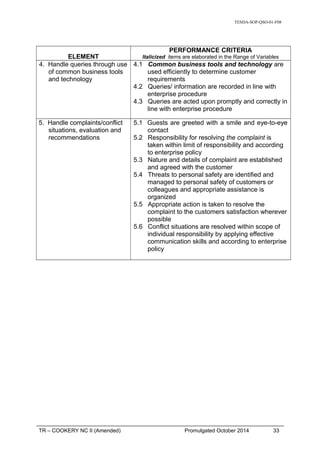
This is in response to the school limitation on the high cost of equipment.
3.5 TRAINING FACILITIES
Based on a class intake of 25 students/trainees.
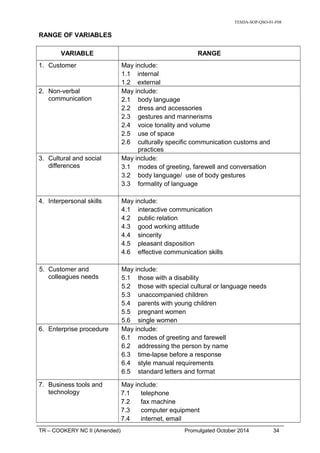
Space Requirement Size in Meters Area in Sq.
Meters
Total Area in Sq.
Meters
Student/Trainee
Working Space
1 x 1 m. 1 sq. m. 25 sq. m
Lecture/Demo Room (8 x 5 m.)x2
(40sq.m.)x2
(40 sq. m).x2
Laboratory 8 x 5 m. 40 sq. m. 40 sq. m.
Learning Resource
Center
3 x 5 m. 15 sq. m. 15 sq. m.
Facilities/Equipment/
Circulation Area
36 sq. m.
Total workshop area: 156 sq. m. +40sq.m.
TR – COOKERY NC II (Amended) Promulgated October 2014 88
3.6 TRAINER’S QUALIFICATIONS FOR TOURISM (HOTEL AND
RESTAURANT) SECTOR
COOKERY NC II
TRAINER QUALIFICATION I (TQ II)
• Must be a holder of Cookery NC II or Commercial Cooking NC III
• Must be a holder of National TVET Trainer’s Certificate (NTTC) I in
Cookery NC II
• Must be physically, mentally fit and holder of a Health Certificate
(hepatitis-free or free of any communicable disease)
• Must have at least 3 years job/industry experience. (Preferably on
supervisory/managerial level in cookery or commercial cooking)
3.7 INSTITUTIONAL ASSESSMENT
Institutional assessment is undertaken by trainees to determine
their achievement of units of competency. A certificate of achievement
is issued for each unit of competency.
TR – COOKERY NC II (Amended) Promulgated October 2014 89
SECTION 4 ASSESSMENT AND CERTIFICATION ARRANGEMENTS
4.1 To attain the National Qualification of COOKERY NC II, the candidate must
demonstrate competence in all the units of competency listed in Section l.
Successful candidates shall be awarded a National Certificate signed by the
TESDA Director General.
4.2 Individuals aspiring to be awarded the qualification of COOKERY NC II must
acquire Certificates of Competency in all the following groups or clusters of
core units of the Qualification. Candidates may apply for assessment in any
accredited assessment center.
4.2.1 Prepare and cook hot meals
4.2.1.1 Clean and maintain kitchen premises
4.2.1.2 Prepare stocks, sauces and soups
4.2.1.3 Prepare poultry and game dishes
4.2.1.4 Prepare seafood dishes
4.2.1.5 Prepare eggs dishes
4.2.1.6 Prepare starch dishes
4.2.1.7 Prepare vegetable dishes
4.2.1.8 Package prepared food
4.2.1.9 Prepare meat dishes
4.2.2 Prepare Cold Meals
4.2.2.1 Clean and maintain kitchen premises
4.2.2.2 Prepare appetizers
4.2.2.3 Prepare salads and dressings
4.2.2.4 Package prepared food
4.2.2.5 Prepare sandwiches
4.2.3 Prepare Sweets
4.2.3.1 Clean and maintain kitchen premises
4.2.3.2 Prepare desserts
4.2.3.3 Package prepared food
Successful candidates shall be awarded Certificates of Competency
(COC).
4.3 Upon accumulation and submission of all the above COCs acquired for the
relevant units of competency comprising this qualification, an individual shall
be issued the corresponding National Certificate.
4.4 Assessment shall focus on the core units of competency. The basic and
common units shall be integrated or assessed concurrently with the core units.
4.5 The following are qualified to apply for assessment and certification:
4.5.1 Graduates of formal, non-formal and informal including
enterprise-based training programs.
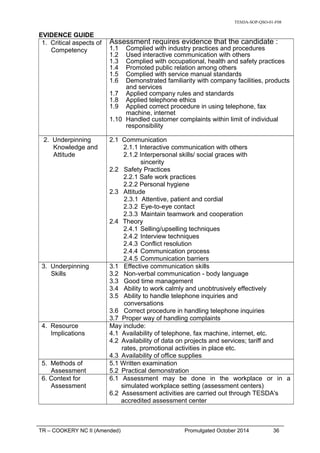
4.5.2 Experienced Workers (wage employed or self-employed)
4.6 The guidelines on assessment and certification are discussed in detail in the
"Procedures Manual on Assessment and Certification" and "Guidelines on the
Implementation of the Philippine TVET Qualification and Certification System
(PTQCS)".
TR – COOKERY NC II (Amended) Promulgated October 2014 90
Clean and maintain
kitchen premises
Prepare poultry and
game dishes
Select, prepare and
serve specialty
cuisine’s
Manage facilities
associated with
commercial catering
contracts
Direct and lead
service team in the
dining
area/restaurant
Prepare and present
gateaux, tortes and
cakes
Provide
accommodation
reception services
Plan and schedule
routine
maintenance, repairs
and modifications
Prepare stocks,
sauces and soups
Prepare seafood
dishes
Monitor catering
revenue and costs
Plan the catering for
an event or function
Oversee dining
area operations
Prepare and display
petits fours
Conduct night
audit
Contribute to the
implementation of
emergency
procedures
Prepare appetizers Prepare desserts
Establish and
maintain quality
control
Design menus to
meet market needs
Oversee banquet
and/or catering
function
Present desserts
Provide club
reception services
Observe and
monitor people
Prepare salads and
dressings
Package prepared
food
Apply cook-chill-
freeze production
process
Develop a food
safety program
Operate a food
outlet
Clean bar areas
Provide porter
services
Escort, carry and
store valuable items
Prepare
sandwiches
Plan and prepare
food for ala carte
and buffets
Prepare foods
according to
dietary and cultural
needs
Prepare the dining
room/restaurant area
for service
Prepare tenders for
catering contracts
Operate bar
Provide
housekeeping
services to guests
Manage physical
assets
Prepare meat
dishes
Plan and control
menu-based
catering
Transport and store
food in a safe and
hygienic manner
Provide preliminary
dining
room/restaurant
service procedures
Develop a food
safety program
Prepare and mix
cocktails and non-
alcoholic
concoctions and hot
drinks
Prepare rooms for
guests
Manage stock
purchases and
inventory
Prepare vegetable
dishes
Organize bulk
cooking operations
Apply catering
control principles
Prepare food and
beverage service to
guests
Plan coffee shop
layout, menu and
storage (Coffee
Shop)
Provide wine
service
Clean premises
Provide for the
safety of Very
Important Persons
(VIP)
TR – COOKERY NC II (Amended) Promulgated October 2014 91
COR
E
COM
PET
ENC
IES
COMPETENCY MAP - TOURISM Sector
(Hotel and Restaurant)
COOKERY NC II
Prepare egg dishes
Prepare pates and
terrines
Develop menus to
meet special
dietary and cultural
needs
Provide room
service
Prepare and
produce bakery
products
Receive and process
reservations
Provide valet
services
Provide a lost and
found facility
Prepare starch
dishes
Plan, prepare and
serve specialized
food items
Select catering
system
Receive and handle
guest concerns
Prepare and
produce pastry
products
Operate a
computerized
reservations system
Launder linen and
guest clothes
Develop and
update industry
knowledge
Observe
workplace
hygiene
procedures
Perform computer
operations
Perform workplace
and safety practices
Provide effective
customer service
Roster staff
Control and order
stock
Train small group
Establish and
conduct business
relationships
Manage
workplace
diversity
Manage finances
within a budget
Manage quality
customer service
Conduct
assessment
Receive and
respond to
workplace
communication
Work with others
Demonstrate work
values
Practice basic
housekeeping
procedures
Participate in
workplace
communication
Work in a team
environment
Practice career
professionalism
Lead workplace
communication
Lead small teams
Develop and
practice
negotiation skills
Solve problems
related to work
activities
Use mathematical
concepts and
techniques
Use relevant
technologies
Practice
occupational
health and safety
procedures
Utilize
specialized
communication
skills
Develop teams
and individuals
Apply problem
solving techniques
in the workplace
Collect, analyze
and organize
information
Plan and organize
work
Promote
environmental
protection
TR – COOKERY NC II (Amended) Promulgated October 2014 92
COM
MON
COM
PET
ENC
IES
BASI
C
COM
PET
ENC
IES
ACKNOWLEDGEMENTS
The Technical Education and Skills Development Authority (TESDA) wishes to
extend thanks and appreciation to the many representatives of business, industry,
academe and government agencies who donated their time and expertise to the
development and validation of these Training Regulations.
INDUSTRY EXPERTS
MA. CHRISTINA G. AQUINO CHRISTOPHER A. BAUTISTA
CHED Technical Panel Member for Member, COHREP
Tourism/ Department Head
Immediate Past President Instituto Culinario, OB Montessori
Council of Hotel and Restaurant Greenhills, San Juan City
Educators of the Philippines (COHREP)
Lyceum of the Philippines University (LPU)
Intramuros, Manila
ASEAN Master Assessor
MITCHELL A. BORJA CHITO O. FLORES
Member, COHREP Member, HRCAP
Dean/Director Executive Chef
Food and Beverage/Catering City Garden Suite Hotel
University of Batangas 1153 A. Mabini St., Ermita, Manila
Batangas City
ROBERTO P. FRANCISCO MANUEL N. NARIO
President Member, HRCAP
Hotel and Restaurant Chefs’ Sous Chef
Association of the Philippines (HRCAP) New World Hotel, Makati City/
Center for Advanced Training in Manila Hotel
Food and Beverage Services, Inc. Esperanza cor. Makati Ave.
CATFABS) Makati City
TESDA, Taguig City
JOSE GABRIEL E. PRATS ANGELO CHUBBY S. TIMBAN
Member Member, HRCAP
Hotel and Restaurant Association Executive Chef
of the Philippines (HRAP) City Garden Makati Hotel
Program Director Durban St., Makati Ave.
The Culinary Institute of Aristocrat Makati City
432 San Andres St. cor Del Pilar
Malate, Manila
ASEAN Master Assessor
JESUS L. CUYCO JULIE ANN F. MENDOZA
Chef Consultant and Culinary Instructor Quality Assurance Officer/Chef/Instructor
Most Institute School of Culinary Arts Lyceum of the Philippines University (LPU)
ASEAN Master Trainer ASEAN Master Assessor
ELENA C. RIVERA
Culinary Arts Instructor
Center for Asian Culinary Studies
ASEAN Master Assessor
TR – COOKERY NC II (Amended) Promulgated October 2014 93
The Participants in the Validation of this Training Regulation
The Members of the TESDA Board and Secretariat
The MANAGEMENT and Staff of the TESDA Secretariat
• Qualifications and Standards Office (QSO)
TR – COOKERY NC II (Amended) Promulgated October 2014 94

Tr cookery nc ii

  • 1.
    COOKERY NC II TRAINING REGULATIONS TOURISMSECTOR (HOTEL AND RESTAURANT) TECHNICAL EDUCATION AND SKILLS DEVELOPMENT AUTHORITY East Service Road, South Superhighway, Taguig City, Metro Manila
  • 2.
    TABLE OF CONTENTS TOURISMSECTOR (HOTEL AND RESTAURANT) COOKERY NC II Page No. SECTION 1 BARTENDING NC II QUALIFICATION 1 SECTION 2 COMPETENCY STANDARDS • Basic Competencies 2 - 17 • Common Competencies 18 - 36 • Core Competencies 37 - 76 SECTION 3 TRAINING ARRANGEMENTS 3.1 Curriculum Design 77 - 82 3.2 Training Delivery 82 - 83 3.3 Trainee Entry Requirements 84 3.4 List of Tools, Equipment and Materials 84 - 87 3.5 Training Facilities 87 3.6 Trainer’s Qualifications 88 3.7 Institutional Assessment 88 SECTION 4 ASSESSMENT AND CERTIFICATION ARRANGEMENTS 89 COMPETENCY MAP 90 - 91 ACKNOWLEDGEMENTS 92 - 93
  • 3.
    TRAINING REGULATIONS FOR COOKERYNC II SECTION 1 COOKERY NC II QUALIFICATION The COOKERY NC II Qualification consists of competencies that a person must achieve to clean kitchen areas, prepare hot, cold meals and desserts for guests in various food and beverage service facilities This Qualification is packaged from the competency map of the Tourism Sector (Hotel and Restaurant) as shown in Annex A. The Units of Competency comprising this Qualification include the following: CODE NO. BASIC COMPETENCIES 500311105 Participate in workplace communication 500311106 Work in a team environment 500311107 Practice career professionalism 500311108 Practice occupational health and safety procedures CODE NO. COMMON COMPETENCIES TRS311201 Develop and update industry knowledge TRS311202 Observe workplace hygiene procedures TRS311203 Perform computer operations TRS311204 Perform workplace and safety practices TRS311205 Provide effective customer service A person who has achieved this Qualification is competent to be employed in any of the following positions in the Garde Manger, Pastry or in the Hot Kitchen Section as:  Cook or Commis  Assistant Cook TR – COOKERY NC II (Amended) Promulgated October 2014 1 CODE NO. CORE COMPETENCIES TRS512328 Clean and maintain kitchen premises TRS512331 Prepare stocks, sauces and soups TRS512381 Prepare appetizers TRS512382 Prepare salads and dressing TRS512330 Prepare sandwiches TRS512383 Prepare meat dishes TRS512384 Prepare vegetables dishes TRS512385 Prepare egg dishes TRS512386 Prepare starch dishes TRS512333 Prepare poultry and game dish(es TRS512334 Prepare seafood dishes TRS512335 Prepare desserts TRS512340 Package prepared food
  • 4.
    SECTION 2 COMPETENCYSTANDARDS This section gives the details of the contents of the basic, common and core units of competency required in COOKERY NC II. BASIC COMPETENCIES UNIT OF COMPETENCY : PARTICIPATE IN WORKPLACE COMMUNICATION UNIT CODE : 500311105 UNIT DESCRIPTOR : This unit covers the knowledge, skills and attitudes required to gather, interpret and convey information in response to workplace requirements. ELEMENT PERFORMANCE CRITERIA Italicized terms are elaborated in the Range of Variables 1. Obtain and convey workplace information 1.1 Specific and relevant information is accessed from appropriate sources 1.2 Effective questioning , active listening and speaking skills are used to gather and convey information 1.3 Appropriate medium is used to transfer information and ideas 1.4 Appropriate non- verbal communication is used 1.5 Appropriate lines of communication with supervisors and colleagues are identified and followed 1.6 Defined workplace procedures for the location and storage of information are used 1.7 Personal interaction is carried out clearly and concisely 2. Speak English at a basic operational level 2.1 Simple conversations on familiar topics with work colleagues is participated 2.2 Simple verbal instructions or requests are responded to 2.3 Simple requests are made 2.4 Routine procedures are described 2.5 Likes, dislikes and preferences are expressed 2.6 Different forms of expression in English is identified 3. Participate in workplace meetings and discussions 3.1 Team meetings are attended on time 3.2 Own opinions are clearly expressed and those of others are listened to without interruption 3.3 Meeting inputs are consistent with the meeting purpose and established protocols 3.4 Workplace interactions are conducted in a courteous manner 3.5 Questions about simple routine workplace procedures and maters concerning working conditions of employment are asked and responded to 3.6 Meetings outcomes are interpreted and implemented TR – COOKERY NC II (Amended) Promulgated October 2014 2
  • 5.
    ELEMENT PERFORMANCE CRITERIA Italicized termsare elaborated in the Range of Variables 4. Complete relevant work related documents 4.1 Range of forms relating to conditions of employment are completed accurately and legibly 4.2 Workplace data is recorded on standard workplace forms and documents 4.3 Basic mathematical processes are used for routine calculations 4.4 Errors in recording information on forms/ documents are identified and properly acted upon 4.5 Reporting requirements to supervisor are completed according to organizational guidelines TR – COOKERY NC II (Amended) Promulgated October 2014 3
  • 6.
    RANGE OF VARIABLES VARIABLERANGE 1. Appropriate sources 1.1. Team members 1.2. Suppliers 1.3. Trade personnel 1.4. Local government 1.5. Industry bodies 2. Medium 2.1. Memorandum 2.2. Circular 2.3. Notice 2.4. Information discussion 2.5. Follow-up or verbal instructions 2.6. Face to face communication 3. Storage 3.1. Manual filing system 3.2. Computer-based filing system 4. Forms 4.1. Personnel forms, telephone message forms, safety reports 5. Workplace interactions 5.1. Face to face 5.2. Telephone 5.3. Electronic and two way radio 5.4. Written including electronic, memos, instruction and forms, non-verbal including gestures, signals, signs and diagrams 6. Protocols 6.1. Observing meeting 6.2. Compliance with meeting decisions 6.3. Obeying meeting instructions TR – COOKERY NC II (Amended) Promulgated October 2014 4
  • 7.
    EVIDENCE GUIDE 1. Criticalaspects of Competency Assessment requires evidence that the candidate: 1.1. Prepared written communication following standard format of the organization 1.2. Accessed information using communication equipment 1.3. Spoken English at a basic operational level 1.4. Made use of relevant terms as an aid to transfer information effectively 1.5. Conveyed information effectively adopting the formal or informal communication 2. Underpinning Knowledge 2.1. Effective communication 2.2. Different modes of communication 2.3. Written communication 2.4. Organizational policies 2.5. Communication procedures and systems 2.6. Technology relevant to the enterprise and the individual’s work responsibilities 3. Underpinning Skills 3.1. Follow simple spoken language 3.2. Perform routine workplace duties following simple written notices 3.3. Participate in workplace meetings and discussions 3.4. Complete work related documents 3.5. Estimate, calculate and record routine workplace measures 3.6. Basic mathematical processes of addition, subtraction, division and multiplication 3.7. Ability to relate to people of social range in the workplace 3.8. Gather and provide information in response to workplace requirements 4. Resource Implications 4.1. Fax machine 4.2. Telephone 4.3. Writing materials 4.4. Internet 5. Methods of Assessment 5.1. Direct Observation 5.2. Oral interview and written test 6. Context of Assessment 6.1. Competency may be assessed individually in the actual workplace or through accredited institution TR – COOKERY NC II (Amended) Promulgated October 2014 5
  • 8.
    UNIT OF COMPETENCY:WORK IN TEAM ENVIRONMENT UNIT CODE : 500311106 UNIT DESCRIPTOR : This unit covers the skills, knowledge and attitudes to identify role and responsibility as a member of a team. ELEMENT PERFORMANCE CRITERIA Italicized terms are elaborated in the Range of Variables 1. Describe team role and scope 1.1. The role and objective of the team is identified from available sources of information 1.2. Team parameters, reporting relationships and responsibilities are identified from team discussions and appropriate external sources 2. Identify own role and responsibility within team 2.1. Individual role and responsibilities within the team environment are identified 2.2. Roles and responsibility of other team members are identified and recognized 2.3. Reporting relationships within team and external to team are identified 3. Work as a team member 3.1. Effective and appropriate forms of communications used and interactions undertaken with team members who contribute to known team activities and objectives 3.2. Effective and appropriate contributions made to complement team activities and objectives, based on individual skills and competencies and workplace context 3.3. Observed protocols in reporting using standard operating procedures 3.4. Contribute to the development of team work plans based on an understanding of team’s role and objectives and individual competencies of the members. TR – COOKERY NC II (Amended) Promulgated October 2014 6
  • 9.
    ELEMENT PERFORMANCE CRITERIA Italicized termsare elaborated in the Range of Variables 4. Work effectively with colleagues 4.1 Information is communicated clearly and in concise manner using appropriate communication techniques 4.2 Relationships are established and maintained effectively with colleagues 4.3 Work activities are performed within the team to ensure achievement of team goals 5. Work in socially diverse environment 5.1 Customers and colleagues from diverse backgrounds are communicated with, in all verbal and non-verbal forms 5.2 Cross cultural misunderstandings are dealt with, taking account of cultural consideration TR – COOKERY NC II (Amended) Promulgated October 2014 7
  • 10.
    RANGE OF VARIABLES VARIABLERANGE 1. Role and objective of team 1.1. Work activities in a team environment with enterprise or specific sector 1.2. Limited discretion, initiative and judgement maybe demonstrated on the job, either individually or in a team environment 2. Sources of information 2.1. Standard operating and/or other workplace procedures 2.2. Job procedures 2.3. Machine/equipment manufacturer’s specifications and instructions 2.4. Organizational or external personnel 2.5. Client/supplier instructions 2.6. Quality standards 2.7. OHS and environmental standards 3. Workplace context 3.1. Work procedures and practices 3.2. Conditions of work environments 3.3. Legislation and industrial agreements 3.4. Standard work practice including the storage, safe handling and disposal of chemicals 3.5. Safety, environmental, housekeeping and quality guidelines 4. Appropriate communication techniques May include: 4.1 Use of active listening 4.2 Use of both open and closed questions 4.3 Speaking clearly and concisely 4.4 Using appropriate language and tone of voice 4.6 Being attentive TR – COOKERY NC II (Amended) Promulgated October 2014 8
  • 11.
    EVIDENCE GUIDE 1. Criticalaspects of competency Assessment requires evidence that the candidate: 1.1. Operated in a team to complete workplace activity 1.2. Worked effectively with others 1.3. Worked in socially diverse environment 1.4. Conveyed information in written or oral form 1.5. Selected and used appropriate workplace language 1.6. Followed designated work plan for the job 1.7. Reported outcomes 2. Underpinning Knowledge 2.1. Communication process 2.2. Team structure 2.3. Team roles 2.4. Group planning and decision making 2.5. Specific diversity issues 3. Underpinning Skills 3.1. Communicate appropriately, consistent with the culture of the workplace 4. Resource Implications The following resources MUST be provided: 4.1. Access to relevant workplace or appropriately simulated environment where assessment can take place 4.2. Materials relevant to the proposed activity or tasks 5. Methods of Assessment Competency may be assessed through: 5.1. Observation of the individual member in relation to the work activities of the group 5.2. Observation of simulation and or role play involving the participation of individual member to the attainment of organizational goal 5.3. Case studies and scenarios as a basis for discussion of issues and strategies in teamwork 6. Context for Assessment 6.1. Competency may be assessed in workplace or in a simulated workplace setting 6.2. Assessment shall be observed while task are being undertaken whether individually or in group TR – COOKERY NC II (Amended) Promulgated October 2014 9
  • 12.
    UNIT OF COMPETENCY:PRACTICE CAREER PROFESSIONALISM UNIT CODE : 500311107 UNIT DESCRIPTOR : This unit covers the knowledge, skills and attitudes in promoting career growth and advancement. ELEMENT PERFORMANCE CRITERIA Italicized terms are elaborated in the Range of Variables 1. Integrate personal objectives with organizational goals 1.1 Personal growth and work plans are pursued towards improving the qualifications set for the profession 1.2 Intra- and interpersonal relationships are maintained in the course of managing oneself based on performance evaluation 1.3 Commitment to the organization and its goal is demonstrated in the performance of duties 2. Set and meet work priorities 2.1 Competing demands are prioritized to achieve personal, team and organizational goals and objectives. 2.2 Resources are utilized efficiently and effectively to manage work priorities and commitments 2.3 Practices along economic use and maintenance of equipment and facilities are followed as per established procedures 3. Maintain professional growth and development 3.1 Trainings and career opportunities are identified and availed of based on job requirements 3.2 Recognitions are sought/received and demonstrated as proof of career advancement 3.3 Licenses and/or certifications relevant to job and career are obtained and renewed TR – COOKERY NC II (Amended) Promulgated October 2014 10
  • 13.
    RANGE OF VARIABLES VARIABLERANGE 1. Evaluation 1.1 Performance Appraisal 1.2 Psychological Profile 1.3 Aptitude Tests 2. Resources 2.1 Human 2.2 Financial 2.3 Technology 2.3.1 Hardware 2.3.2 Software 3. Trainings and career opportunities 3.1 Participation in training programs 3.1.1 Technical 3.1.2 Supervisory 3.1.3 Managerial 3.1.4 Continuing Education 3.2 Serving as Resource Persons in conferences and workshops 4. Recognitions 4.1 Recommendations 4.2 Citations 4.3 Certificate of Appreciations 4.4 Commendations 4.5 Awards 4.6 Tangible and Intangible Rewards 5. Licenses and/or certifications 5.1 National Certificates 5.2 Certificate of Competency 5.3 Support Level Licenses 5.4 Professional Licenses TR – COOKERY NC II (Amended) Promulgated October 2014 11
  • 14.
    EVIDENCE GUIDE 1. Criticalaspects of Competency Assessment requires evidence that the candidate: 1.1 Attained job targets within key result areas (KRAs) 1.2 Maintained intra - and interpersonal relationship in the course of managing oneself based on performance evaluation 1.3 Completed trainings and career opportunities which are based on the requirements of the industries 1.4 Acquired and maintained licenses and/or certifications according to the requirement of the qualification 2. Underpinning Knowledge 2.1 Work values and ethics (Code of Conduct, Code of Ethics, etc.) 2.2 Company policies 2.3 Company operations, procedures and standards 2.4 Fundamental rights at work including gender sensitivity 2.5 Personal hygiene practices 3. Underpinning Skills 3.1 Appropriate practice of personal hygiene 3.2 Intra and Interpersonal skills 3.3 Communication skills 4. Resource Implications The following resources MUST be provided: 4.1 Workplace or assessment location 4.2 Case studies/scenarios 5. Methods of Assessment Competency may be assessed through: 5.1 Portfolio Assessment 5.2 Interview 5.3 Simulation/Role-plays 5.4 Observation 5.5 Third Party Reports 5.6 Exams and Tests 6. Context of Assessment 6.1 Competency may be assessed in the work place or in a simulated work place setting TR – COOKERY NC II (Amended) Promulgated October 2014 12
  • 15.
    TR – COOKERYNC II (Amended) Promulgated October 2014 13 UNIT OF COMPETENCY : PRACTICE OCCUPATIONAL HEALTH AND SAFETY PROCEDURES UNIT CODE : 500311108 UNIT DESCRIPTOR : This unit covers the outcomes required to comply with regulatory and organizational requirements for occupational health and safety. ELEMENT PERFORMANCE CRITERIA Italicized terms are elaborated in the Range of Variables 1. Identify hazards and risks 1.1 Safety regulations and workplace safety and hazard control practices and procedures are clarified and explained based on organization procedures 1.2 Hazards/risks in the workplace and their corresponding indicators are identified to minimize or eliminate risk to co-workers, workplace and environment in accordance with organization procedures 1.3 Contingency measures during workplace accidents, fire and other emergencies are recognized and established in accordance with organization procedures 2. Evaluate hazards and risks 2.1 Terms of maximum tolerable limits which when exceeded will result in harm or damage are identified based on threshold limit values (TLV) 2.2 Effects of the hazards are determined 2.3 OHS issues and/or concerns and identified safety hazards are reported to designated personnel in accordance with workplace requirements and relevant workplace OHS legislation 3. Control hazards and risks 3.1 Occupational Health and Safety (OHS) procedures for controlling hazards/risks in workplace are consistently followed 3.2 Procedures for dealing with workplace accidents, fire and emergencies are followed in accordance with organization OHS policies 3.3 Personal protective equipment (PPE) is correctly used in accordance with organization OHS procedures and practices 3.4 Appropriate assistance is provided in the event of a workplace emergency in accordance with established organization protocol 4. Maintain OHS awareness 4.1 Emergency-related drills and trainings are participated in as per established organization guidelines and procedures 4.2 OHS personal records are completed and updated in accordance with workplace requirements
  • 16.
    TR – COOKERYNC II (Amended) Promulgated October 2014 14 ELEMENT PERFORMANCE CRITERIA Italicized terms are elaborated in the Range of Variables 5. Perform basic first-aid procedures 5.1 Situation is assessed in accordance with accepted practice 5.2 Basic first-aid techniques is applied in accordance with established first-aid procedures and enterprise policy 5.3 Details of the incident is communicated in a timely manner according to enterprise policy
  • 17.
    RANGE OF VARIABLES VARIABLERANGE 1. Safety regulations May include but are not limited to: 1.1 Clean Air Act 1.2 Building code 1.3 National Electrical and Fire Safety Codes 1.4 Waste management statutes and rules 1.5 Philippine Occupational Safety and Health Standards 1.6 DOLE regulations on safety legal requirements 1.7 CC regulations 2. Hazards/Risks May include but are not limited to: 2.1 Physical hazards – impact, illumination, pressure, noise, vibration, temperature, radiation 2.2 Biological hazards- bacteria, viruses, plants, parasites, mites, molds, fungi, insects 2.3 Chemical hazards – dusts, fibers, mists, fumes, smoke, gasses, vapors 2.4 Ergonomics 2.4.1 Psychological factors – over exertion/ excessive force, awkward/static positions, fatigue, direct pressure, varying metabolic cycles 2.4.2 Physiological factors – monotony, personal relationship, work out cycle 3. Contingency measures May include but are not limited to: 3.1 Evacuation 3.2 Isolation 3.3 Decontamination 3.4 Calling emergency personnel TR – COOKERY NC II (Amended) Promulgated October 2014 15
  • 18.
    VARIABLE RANGE 4. PPEMay include but are not limited to: 4.1 Mask 4.2 Gloves 4.3 Goggles 4.4 Hair Net/cap/bonnet 4.5 Face mask/shield 4.6 Ear muffs 4.7 Apron/Gown/coverall/jump suit 4.8 Anti-static suits 5. Emergency-related drills and training 5.1 Fire drill 5.2 Earthquake drill 5.3 Basic life support/CPR 5.4 First aid 5.5 Spillage control 5.6 Decontamination of chemical and toxic 5.7 Disaster preparedness/management 6. OHS personal records 6.1 Medical/Health records 6.2 Incident reports 6.3 Accident reports 6.4 OHS-related training completed TR – COOKERY NC II (Amended) Promulgated October 2014 16
  • 19.
    EVIDENCE GUIDE 1. Criticalaspects of Competency Assessment requires evidence that the candidate: 1.1 Explained clearly established workplace safety and hazard control practices and procedures 1.2 Identified hazards/risks in the workplace and its corresponding indicators in accordance with company procedures 1.3 Recognized contingency measures during workplace accidents, fire and other emergencies 1.4 Identified terms of maximum tolerable limits based on threshold limit value- TLV. 1.5 Applied basic first-aid treatment 1.6 Followed Occupational Health and Safety (OHS) procedures for controlling hazards/risks in workplace 1.7 Used Personal Protective Equipment (PPE) in accordance with company OHS procedures and practices 1.8 Completed and updated OHS personal records in accordance with workplace requirements 2. Underpinning Knowledge 2.1 OHS procedures and practices and regulations 2.2 PPE types and uses 2.3 Personal hygiene practices 2.4 Hazards/risks identification and control 2.5 Threshold Limit Value -TLV 2.6 OHS indicators 2.7 Organization safety and health protocol 2.8 Safety consciousness 2.9 Health consciousness 2.10. First Aid procedures and practices 3. Underpinning Skills 3.1 Practice of personal hygiene 3.2 Hazards/risks identification and control skills 3.3 Interpersonal skills 3.4 Communication skills 3.5 Safe manual handling of casualty 4. Resource Implications The following resources must be provided: 4.1 Workplace or assessment location 4.2 OHS personal records 4.3 PPE 4.4 Health records 5. Methods of Assessment Competency may be assessed through: 5.1 Portfolio Assessment 5.2 Interview 5.3 Case Study/Situation 6. Context for Assessment 6.1 Competency may be assessed in the work place or in a simulated work place setting TR – COOKERY NC II (Amended) Promulgated October 2014 17
  • 20.
    TESDA-SOP-QSO-01-F08 COMMON COMPETENCIES UNIT OFCOMPETENCY : DEVELOP AND UPDATE INDUSTRY KNOWLEDGE UNIT CODE : TRS311201 UNIT DESCRIPTOR : This unit of competency deals with the knowledge, skills required to access, increase and update industry knowledge. It includes seek information on the industry and update industry knowledge. ELEMENT PERFORMANCE CRITERIA Italicized items are elaborated in the Range of Variable 1. Seek information on the industry 1.1 Sources of information on the industry are correctly identified and accessed 1.2 Information to assist effective work performance is obtained in line with job requirements 1.3 Specific information on sector of work is accessed and updated 1.4 Industry information is correctly applied to day- to-day work activities 2. Update industry knowledge 2.1 Informal and/or formal research is used to update general knowledge of the industry 2.2 Updated knowledge is shared with customers and colleagues as appropriate and incorporated into day-to-day working activities 3. Develop and update local knowledge 3.1 Local knowledge is developed to assist queries on local/national tourism industry 3.2 Local knowledge is updated using informal and/or formal research 3.3 Contact with local communities is maintained 4. Promote products and services to customers 4.1 Promotional initiatives are described that may be used to promote products and services 4.2 Selling skills are applied according to customer needs TR – COOKERY NC II (Amended) Promulgated October 2014 18
  • 21.
    TESDA-SOP-QSO-01-F08 RANGE OF VARIABLES VARIABLERANGE 1. Information sources Information sources may include but are not limited to : 1.1 media 1.2 reference books 1.3 libraries 1.4 unions 1.5 industry associations 1.6 industry journals 1.7 internet 1.8 personal observation and experience 2. Information to assist effective work performance 2.1 different sectors of the industry and the services available in each sector 2.2 relationship between tourism and hospitality 2.3 relationship between the industry and other industries 2.4 industry working conditions 2.5 legislation that affects the industry • liquor • health and safety • hygiene • gaming • workers compensation • consumer protection • duty of care • building regulations 2.6 trade unions environmental issues and requirements 2.7 industrial relations issues and major organizations 2.8 career opportunities within the industry 2.9 work ethic required to work in the industry and industry expectations of staff 2.10 quality assurance 3. Informal and formal research May include: 3.1 Discussions with colleagues, management and customers 3.2 Reading internal enterprise material about products and services 3.3 Familiarity with customer comments including complaints 3.4 Reading and researching product data and information TR – COOKERY NC II (Amended) Promulgated October 2014 19
  • 22.
    TESDA-SOP-QSO-01-F08 VARIABLE RANGE 3.5 Conductinginternal testing to determine quality and differentials 3.6 General media research 3.7 Developing and analyzing responses to questionnaires 3.8 Reading surveys and ratings 4. Promotional initiatives May include: 4.1 Media campaigns 4.2 Internal promotions, including static displays, demonstrations, tastings, videos, competitions, packages, events TR – COOKERY NC II (Amended) Promulgated October 2014 20
  • 23.
    TESDA-SOP-QSO-01-F08 EVIDENCE GUIDE 1. Criticalaspects of Competency Assessment requires evidence that the candidate/ trainee: 1.1 Knew key sources of information on the industry 1.2 Updated industry knowledge 1.3 Accessed and used industry information 1.4 Developed and updated local knowledge 1.5 Promoted products and services 2. Underpinning Skills 2.1 Time management 2.2 Ready skills needed to access industry information 2.3 Basic competency skills needed to access the internet 3. Underpinning Knowledge 3.1 Overview of quality assurance in the industry 3.2 Role of individual staff members 3.3 Industry information sources 4. Resource Implications 4.1 Sources of information on the industry 4.2 Industry knowledge 5. Methods of Assessment 5.1 Interview/questions 5.2 Practical demonstration 5.3 Portfolio of industry information related to trainee’s work 6. Context for Assessment 6.1 Assessment may be done in the workplace or in a simulated workplace setting (assessment centers) 6.2 Assessment activities are carried out through TESDA's accredited assessment center TR – COOKERY NC II (Amended) Promulgated October 2014 21
  • 24.
    TESDA-SOP-QSO-01-F08 UNIT OF COMPETENCY:OBSERVE WORKPLACE HYGIENE PROCEDURES UNIT CODE : TRS311202 UNIT DESCRIPTOR : This unit of competency deals with the knowledge, skills and attitudes in observing workplace hygiene procedures. It includes following hygiene procedures and identifying and preventing hygiene risks. ELEMENT PERFORMANCE CRITERIA Italicized items are elaborated in the Range of Variable 1. Follow hygiene procedures 1.1 Workplace hygiene procedures are implemented in line with enterprise and legal requirements 1.2 Handling and storage of items are undertaken in line with enterprise and legal requirements 2. Identify and prevent hygiene risks 2.1 Potential hygiene risks are identified in line with enterprise procedures 2.2 Action to minimize and remove risks are taken within scope of individual responsibility of enterprise/legal requirements 2.3 Hygiene risks beyond the control of individual staff members are reported to the appropriate person for follow up TR – COOKERY NC II (Amended) Promulgated October 2014 22
  • 25.
    TESDA-SOP-QSO-01-F08 RANGE OF VARIABLES VARIABLERANGE 1. Hygiene procedures Hygiene procedures may include : 1.1 safe and hygienic handling of food and beverage 1.2 regular hand washing 1.3 correct food storage 1.4 appropriate and clean clothing 1.5 avoidance of cross-contamination 1.6 safe handling disposal of linen and laundry 1.7 appropriate handling and disposal of garbage 1.8 cleaning and sanitizing procedures 1.9 personal hygiene 2. Hygiene risk 2.1 bacterial and other contamination arising from poor handling of food 2.2 inappropriate storage of foods 2.3 storage at incorrect temperatures 2.4 foods left uncovered 2.5 poor personal hygiene practices 2.6 poor work practices 2.6.1 cleaning 2.6.2 housekeeping 2.6.3 food handling 2.6.4 vermin 2.6.5 airborne dust 2.7 cross-contamination through cleaning inappropriate cleaning practices 2.8 inappropriate handling of potentially infectious linen 2.9 contaminated wastes such as blood and body secretions 2.10 disposal of garbage and contaminated or potentially contaminated wastes 3. Minimizing or removing risk 3.1 auditing staff skills and providing training 3.2 ensuring policies and procedures are followed strictly 3.3 audits or incidents with follow up actions TR – COOKERY NC II (Amended) Promulgated October 2014 23
  • 26.
    TESDA-SOP-QSO-01-F08 EVIDENCE GUIDE 1. Criticalaspects of Competency Assessment required evidence that the candidate : 1.1 Followed hygiene procedures 1.2 Identified and responded to hygiene risk 1.3 Practiced personal grooming and hygiene 2. Underpinning Knowledge 2.1 Typical hygiene and control procedures in the hospitality and tourism industries 2.2 Overview of legislation and regulation in relation to food handling, personal and general hygiene 2.3 Knowledge on factors which contribute to workplace hygiene problems 2.4 General hazards in handling of food, linen and laundry and garbage, including major causes of contamination and cross-infection 2.5 Sources of and reasons for food poisoning 3. Underpinning Skills 3.1 Ability to follow correct procedures and instructions 3.2 Ability to handle operating tools/ equipment 3.3 Application to hygiene principles 4. Resource Implications 4.1 Hygiene procedures, actual or simulated workplace, products used in hotel/restaurant / tourism workplace 5. Methods of Assessment 5.1 Written examination 5.2 Practical demonstration 6. Context for Assessment 6.1 Assessment may be done in the workplace or in a simulated workplace setting (assessment centers) 6.2 Assessment activities are carried out through TESDA's accredited assessment center TR – COOKERY NC II (Amended) Promulgated October 2014 24
  • 27.
    TESDA-SOP-QSO-01-F08 UNIT OF COMPETENCY:PERFORM COMPUTER OPERATIONS UNIT CODE : TRS311203 UNIT DESCRIPTOR : This unit covers the knowledge, skills and attitudes and values needed to perform computer operations which includes inputting, accessing, producing and transferring data using the appropriate hardware and software ELEMENT PERFORMANCE CRITERIA Italicized terms are elaborated in the Range of Variables 1. Plan and prepare for task to be undertaken 1.1. Requirements of task are determined 1.2. Appropriate hardware and software is selected according to task assigned and required outcome 1.3. Task is planned to ensure OH & S guidelines and procedures are followed 2. Input data into computer 2.1. Data are entered into the computer using appropriate program/application in accordance with company procedures 2.2. Accuracy of information is checked and information is saved in accordance with standard operating procedures 2.3. Inputted data are stored in storage media according to requirements 2.4. Work is performed within ergonomic guidelines 3. Access information using computer 3.1. Correct program/application is selected based on job requirements 3.2. Program/application containing the information required is accessed according to company procedures 3.3. Desktop icons are correctly selected, opened and closed for navigation purposes 3.4. Keyboard techniques are carried out in line with OH & S requirements for safe use of keyboards 4. Produce/output data using computer system 4.1. Entered data are processed using appropriate software commands 4.2. Data are printed out as required using computer hardware/peripheral devices in accordance with standard operating procedures 4.3. Files and data are transferred between compatible systems using computer software, hardware/ peripheral devices in accordance with standard operating procedures 5. Maintain computer equipment and systems 5.1. Systems for cleaning, minor maintenance and replacement of consumables are implemented 5.2. Procedures for ensuring security of data, including regular back-ups and virus checks are implemented in accordance with standard operating procedures 5.3. Basic file maintenance procedures are implemented in line with the standard operating procedures 5.4. Document systems are maintained TR – COOKERY NC II (Amended) Promulgated October 2014 25
  • 28.
    TESDA-SOP-QSO-01-F08 RANGE OF VARIABLES VARIABLERANGE 1. Hardware and peripheral devices 1.1. Personal computers 1.2. Networked systems 1.3. Communication equipment 1.4. Printers 1.5. Scanners 1.6. Keyboard 1.7. Mouse 2. Software Includes the following but not limited to: 2.1. Word processing packages 2.2. Data base packages 2.3. Internet 2.4. Spreadsheets 3. OH & S guidelines 3.1. OHS guidelines 3.2. Enterprise procedures 4. Storage media Storage media include the following but not limited to: 4.1. diskettes 4.2. CDs 4.3. zip disks 4.4. hard disk drives, local and remote 5. Ergonomic guidelines 5.1. Types of equipment used 5.2. Appropriate furniture 5.3. Seating posture 5.4. Lifting posture 5.5. Visual display unit screen brightness 6. Desktop icons Icons include the following but not limited to: 6.1. directories/folders 6.2. files 6.3. network devices 6.4. recycle bin 7. Maintenance 7.1. Creating more space in the hard disk 7.2. Reviewing programs 7.3. Deleting unwanted files 7.4. Backing up files 7.5. Checking hard drive for errors 7.6. Using up to date anti-virus programs 7.7. Cleaning dust from internal and external surfaces TR – COOKERY NC II (Amended) Promulgated October 2014 26
  • 29.
    TESDA-SOP-QSO-01-F08 EVIDENCE GUIDE 1. Criticalaspects of Competency Assessment must show that the candidate: 1.1. Selected and used hardware components correctly and according to the task requirement 1.2. Identified and explain the functions of both hardware and software used, their general features and capabilities 1.3. Produced accurate and complete data in accordance with the requirements 1.4. Used appropriate devices and procedures to transfer files/data accurately 1.5. Maintained computer system 2. Underpinning Knowledge 2.1. Basic ergonomics of keyboard and computer use 2.2. Main types of computers and basic features of different operating systems 2.3. Main parts of a computer 2.4. Storage devices and basic categories of memory 2.5. Relevant types of software 2.6. General security 2.7. Viruses 2.8. OH & S principles and responsibilities 2.9. Calculating computer capacity 3. Underpinning Skills 3.1. Reading skills required to interpret work instruction 3.2. Communication skills 4. Methods of Assessment 4.1. The assessor may select two of the following assessment methods to objectively assess the candidate: 4.1.1. Observation 4.1.2. Questioning 4.1.3. Practical demonstration 5. Resource Implications 5.1. Computer hardware with peripherals 5.2. Appropriate software 6. Context for Assessment 6.1 Assessment may be conducted in the workplace or in a simulated environment TR – COOKERY NC II (Amended) Promulgated October 2014 27
  • 30.
    TESDA-SOP-QSO-01-F08 UNIT OF COMPETENCY:PERFORM WORKPLACE AND SAFETY PRACTICES UNIT CODE : TRS311204 UNIT DESCRIPTOR : This unit of competency deals with the knowledge, skills and attitudes in following health, safety and security practices. It includes dealing with emergency situations and maintaining safe personal presentation standards. ELEMENT PERFORMANCE CRITERIA Italicized items are elaborated on the Range of Variables 1. Follow workplace procedures for health, safety and security practices 1.1 Correct health, safety and security procedures are followed in line with legislation, regulations and enterprise procedures 1.2 Breaches of health, safety and security procedures are identified and reported in line with enterprise procedure 1.3 Suspicious behavior or unusual occurrence are reported in line with enterprise procedure 2. Perform child protection duties relevant to the tourism industry 2.1 Issue of sexual exploitation of children by tourist is identified 2.2 National, regional and international actions are described to prevent the sexual exploitation of children by tourists 2.3 Actions that can be taken in the workplace are described to protect children from sexual exploitation by tourists 3. Observe and monitor people 3.1 Areas and people who require observation and monitoring is prepared 3.2 Observation and monitoring activities are implemented 3.3 Apprehension of offenders are determined 3.4 Offenders are arrested according to enterprise procedures 3.5 Administrative responsibilities are fulfilled 4. Deal with emergency situations 4.1 Emergency and potential emergency situations are recognized and appropriate action are taken within individual’s scope of responsibility 4.2 Emergency procedures are followed in line with enterprise procedures 4.3 Assistance is sought from colleagues to resolve or respond to emergency situations 4.4 Details of emergency situations are reported in line with enterprise procedures TR – COOKERY NC II (Amended) Promulgated October 2014 28
  • 31.
    TESDA-SOP-QSO-01-F08 ELEMENT PERFORMANCE CRITERIA Italicized itemsare elaborated on the Range of Variables 5. Maintain safe personal presentation standards 5.1 Safe personal standards are identified and followed in line with enterprise requirements 6. Maintain a safe and secure workplace 6.1 Workplace health, safety and security responsibilities are identified 6.2 Framework to maintain workplace health, safety and security are maintained 6.3 Procedures for identifying and assessing health, safety and security hazards and risks are implemented 6.4 Injuries, illnesses and incidents are investigated 6.5 Organization's health, safety and security effectiveness are evaluated TR – COOKERY NC II (Amended) Promulgated October 2014 29
  • 32.
    TESDA-SOP-QSO-01-F08 RANGE OF VARIABLES VARIABLERANGE 1. Health, safety and security procedures May include but are not limited to : 1.1 use of personal protective clothing and equipment 1.2 safe posture including sitting, standing, bending 1.3 manual handling including lifting, transferring 1.4 safe work techniques including knives and equipment, handling hot surfaces, computers and electronic equipment 1.5 safe handling of chemicals, poisons and dangerous materials 1.6 ergonomically sound furniture and work stations 1.7 emergency fire and accident 1.8 hazard identification and control 1.9 security of documents, cash, equipment, people 1.10 key control systems 2. Breaches of procedure May include but are not limited to : 2.1 loss of keys 2.2 strange or suspicious persons 2.3 broken or malfunctioning equipment 2.4 loss of property, goods or materials 2.5 damaged property or fittings 2.6 lack of suitable signage when required 2.7 lack of training on health and safety issues 2.8 unsafe work practices 3. Emergency May include but is not limited to : 3.1 personal injuries 3.2 fire 3.3 electrocution 3.4 natural calamity i.e. earthquake/flood 3.5 criminal acts i.e. robbery TR – COOKERY NC II (Amended) Promulgated October 2014 30
  • 33.
    TESDA-SOP-QSO-01-F08 EVIDENCE GUIDE 1. Criticalaspects of Competency Assessment requires evidence that the candidate : 1.1 Complied with industry practices and procedures 1.2 Used interactive communication with others 1.3 Complied with workplace safety, security and hygiene practices 1.4 Identified faults & problems and the necessary corrective action 1.5 Demonstrated ability to perform child protection duties relevant to tourism industry 1.6 Demonstrated ability to prepare for observation and monitoring activities relevant to designated situations 1.5 Promoted public relation among others 1.6 Complied with quality standards 1.7 Responded to emergency situations in line with enterprise guidelines 1.8 Complied with proper dress code 2. Underpinning Knowledge and Attitude 2.1 Communication 2.1.1 Interactive communication with others 2.1.2 Interpersonal skills 2.1.3 Good working attitude 2.1.4 Ability to work quietly; with cooperation; patience, carefulness, cleanliness and aesthetic values 2.1.5 Ability to focus on task at hand 2.2 Systems, Processes and Operations 2.2.1 Workplace health, safety and security procedures 2.2.2 Emergency procedures 2.2.3 Personal presentation 2.3 Safety Practices 2.3.1 Proper disposal of garbage 2.3.2 Practice safety measures 2. 3.3 5S Implementation 2.4 Child sexual exploitation 2.4.1 Identify child sexual exploitation 2.4.2 Behaviors that may be exhibited by sex tourist 2.4.3 Reporting mechanism 2.4.2 Preventive measures of exploitation 2.5 Child protection duties relevant to tourism industry 2.5.1 Rules, regulations, policies and laws 3. Underpinning Skills 3.1 Ability to make decision 3.2 Time management 3.3 Ability to offer alternative steps 3.4 Care in handling and operating equipment 3.5 Ability to use observation and monitoring techniques 4. Resource Implications 4.1 Procedures Manual on safety, security, health and emergency 4.2 Availability of tools, equipment, supplies and materials 5. Methods of Assessment 5.1 Written examination 5.2 Practical demonstration 5.3 Interview 6. Context of Assessment 6.1 Assessment may be done in the workplace or in a simulated workplace setting (assessment centers) 6.2 Assessment activities are carried out through TESDA's accredited assessment center TR – COOKERY NC II (Amended) Promulgated October 2014 31
  • 34.
    TESDA-SOP-QSO-01-F08 UNIT OF COMPETENCY:PROVIDE EFFECTIVE CUSTOMER SERVICE UNIT CODE : TRS311205 UNIT DESCRIPTOR : This unit of competency deals with the knowledge, skills and attitudes in providing effective customer service. It includes greeting customer, identifying customer needs, delivering service to customer, handling queries through use of common business tools and technology and handling complaints, evaluation and recommendation. ELEMENT PERFORMANCE CRITERIA Italicized items are elaborated in the Range of Variables 1. Greet customer 1.1 Customers are greeted in line with enterprise procedure 1.2 Verbal and non-verbal communications are appropriate to the given situation 1.3 Non verbal communication are observed when responding to customers 1.4 Sensitivity to cultural and social differences is demonstrated 2. Identify needs of customers 2.1Appropriate interpersonal skills are used to ensure that customer needs are accurately identified 2.2Customer needs are assessed for urgency so that priority for service delivery can be identified 2.3Customers are provided with information 2.4Personal limitation in addressing customer needs is identified and where appropriate, assistance is sought from supervisor 3. Deliver service to customer 3.1 Customer needs are promptly attended to in line with enterprise procedure 3.2 Appropriate rapport is maintained with customer to enable high quality service delivery 3.3 Opportunity to enhance the quality of service and products are taken wherever possible TR – COOKERY NC II (Amended) Promulgated October 2014 32
  • 35.
    TESDA-SOP-QSO-01-F08 ELEMENT PERFORMANCE CRITERIA Italicized itemsare elaborated in the Range of Variables 4. Handle queries through use of common business tools and technology 4.1 Common business tools and technology are used efficiently to determine customer requirements 4.2 Queries/ information are recorded in line with enterprise procedure 4.3 Queries are acted upon promptly and correctly in line with enterprise procedure 5. Handle complaints/conflict situations, evaluation and recommendations 5.1 Guests are greeted with a smile and eye-to-eye contact 5.2 Responsibility for resolving the complaint is taken within limit of responsibility and according to enterprise policy 5.3 Nature and details of complaint are established and agreed with the customer 5.4 Threats to personal safety are identified and managed to personal safety of customers or colleagues and appropriate assistance is organized 5.5 Appropriate action is taken to resolve the complaint to the customers satisfaction wherever possible 5.6 Conflict situations are resolved within scope of individual responsibility by applying effective communication skills and according to enterprise policy TR – COOKERY NC II (Amended) Promulgated October 2014 33
  • 36.
    TESDA-SOP-QSO-01-F08 RANGE OF VARIABLES VARIABLERANGE 1. Customer May include: 1.1 internal 1.2 external 2. Non-verbal communication May include: 2.1 body language 2.2 dress and accessories 2.3 gestures and mannerisms 2.4 voice tonality and volume 2.5 use of space 2.6 culturally specific communication customs and practices 3. Cultural and social differences May include: 3.1 modes of greeting, farewell and conversation 3.2 body language/ use of body gestures 3.3 formality of language 4. Interpersonal skills May include: 4.1 interactive communication 4.2 public relation 4.3 good working attitude 4.4 sincerity 4.5 pleasant disposition 4.6 effective communication skills 5. Customer and colleagues needs May include: 5.1 those with a disability 5.2 those with special cultural or language needs 5.3 unaccompanied children 5.4 parents with young children 5.5 pregnant women 5.6 single women 6. Enterprise procedure May include: 6.1 modes of greeting and farewell 6.2 addressing the person by name 6.3 time-lapse before a response 6.4 style manual requirements 6.5 standard letters and format 7. Business tools and technology May include: 7.1 telephone 7.2 fax machine 7.3 computer equipment 7.4 internet, email TR – COOKERY NC II (Amended) Promulgated October 2014 34
  • 37.
    TESDA-SOP-QSO-01-F08 VARIABLE RANGE 8. ComplaintMay include: 8.1 level of service 8.2 product standards 8.3 processes 8.4 information given 8.5 charges and fees 9. Threats to personal safety May include: 9.1 violent customers 9.2 drug and alcohol affected customers 9.3 customers fighting amongst themselves TR – COOKERY NC II (Amended) Promulgated October 2014 35
  • 38.
    TESDA-SOP-QSO-01-F08 EVIDENCE GUIDE 1. Criticalaspects of Competency Assessment requires evidence that the candidate : 1.1 Complied with industry practices and procedures 1.2 Used interactive communication with others 1.3 Complied with occupational, health and safety practices 1.4 Promoted public relation among others 1.5 Complied with service manual standards 1.6 Demonstrated familiarity with company facilities, products and services 1.7 Applied company rules and standards 1.8 Applied telephone ethics 1.9 Applied correct procedure in using telephone, fax machine, internet 1.10 Handled customer complaints within limit of individual responsibility 2. Underpinning Knowledge and Attitude 2.1 Communication 2.1.1 Interactive communication with others 2.1.2 Interpersonal skills/ social graces with sincerity 2.2 Safety Practices 2.2.1 Safe work practices 2.2.2 Personal hygiene 2.3 Attitude 2.3.1 Attentive, patient and cordial 2.3.2 Eye-to-eye contact 2.3.3 Maintain teamwork and cooperation 2.4 Theory 2.4.1 Selling/upselling techniques 2.4.2 Interview techniques 2.4.3 Conflict resolution 2.4.4 Communication process 2.4.5 Communication barriers 3. Underpinning Skills 3.1 Effective communication skills 3.2 Non-verbal communication - body language 3.3 Good time management 3.4 Ability to work calmly and unobtrusively effectively 3.5 Ability to handle telephone inquiries and conversations 3.6 Correct procedure in handling telephone inquiries 3.7 Proper way of handling complaints 4. Resource Implications May include: 4.1 Availability of telephone, fax machine, internet, etc. 4.2 Availability of data on projects and services; tariff and rates, promotional activities in place etc. 4.3 Availability of office supplies 5. Methods of Assessment 5.1 Written examination 5.2 Practical demonstration 6. Context for Assessment 6.1 Assessment may be done in the workplace or in a simulated workplace setting (assessment centers) 6.2 Assessment activities are carried out through TESDA's accredited assessment center TR – COOKERY NC II (Amended) Promulgated October 2014 36
  • 39.
    TESDA-SOP-QSO-01-F08 CORE COMPETENCIES UNIT OFCOMPETENCY: CLEAN AND MAINTAIN KITCHEN PREMISES UNIT CODE : TRS512328 UNIT DESCRIPTOR : This unit deals with the skills and knowledge involve in cleaning, sanitizing and maintaining kitchens, equipment and utensils for food preparation and storage in commercial/institutional kitchens ELEMENT PERFORMANCE CRITERIA Italicized terms are elaborated in the Range of Variables 1. Clean, sanitize and store equipment 1.1 Chemicals and clean potable water are selected and used for cleaning and/or sanitizing kitchen equipment utensils, and working surfaces 1.2 Equipment and/or utensils are cleaned and/or sanitized safely using clean/potable water and according to manufacturer’s instructions 1.3 Clean equipment and utensils are stored or stacked safely in the designated place 1.4 Cleaning equipment and supplies are used safely in accordance with manufacturer’s instructions 1.5 Cleaning equipment are assembled and disassembled safely 1.6 Cleaning equipment are stored safely in the designated position and area 2. Clean and sanitize premises 2.1 Cleaning schedules are followed based on enterprise procedures 2.2 Chemicals and equipment for cleaning and/or sanitizing are used safely 2.3 Walls, floors, shelves and working surfaces are cleaned and/or sanitized without causing damage to health or property 2.4 First aid procedures are followed if an accident happens 3. Dispose of waste 3.1 Wastes are sorted and disposed according to sanitary regulations, enterprise practices and standard procedures 3.2 Cleaning chemicals are disposed safely according to standard procedures TR – COOKERY NC II (Amended) Promulgated October 2014 37
  • 40.
    TESDA-SOP-QSO-01-F08 RANGE OF VARIABLES VARIABLERANGE 1. Equipment May include but are not limited to: 1.1 Kitchen utensils 1.2 Pots, pans, dishes 1.3 Food storage Containers 1.4 Chopping boards 1.5 Garbage bins 2. Surfaces May include but are not limited to: 2.1 Walls 2.2 Floors 2.3 Shelves 2.4 Benches and working surfaces 2.5 Ovens, stoves, cooking equipment and appliances 2.6 Cold storage equipment 2.7 Store rooms and cupboards 3. Cleaning equipment and supplies May include but not limited to: Equipment 3.1Chemical dispensers Supplies 3.2Paper towels 3.3Cleaning agents 3.4Sanitizers TR – COOKERY NC II (Amended) Promulgated October 2014 38
  • 41.
    TESDA-SOP-QSO-01-F08 EVIDENCE GUIDE 1. Criticalaspects of Competency Assessment requires evidences that the candidate: 1.1 Cleaned and sanitized all food preparation and presentation areas in accordance with food safety and occupational health and safety regulations 1.2 Cleaned and sanitized large and small equipment/utensils commonly found in a commercial/institutional kitchen 1.3 Demonstrated sanitizing procedures and techniques 1.4 Disposed wastes according to sanitary regulations, enterprise practices and standard procedures 2. Required Knowledge 2.1 Various types and uses of chemicals and equipment for cleaning and sanitizing 2.2 Occupational health and safety requirements for bending, lifting, carrying and using equipments 2.3 Logical and time-efficient work flow 2.4 Environmental-friendly products and practices in relation to kitchen cleaning 2.5 Sanitation and cross-contamination issues related to food handling and preparation 3. Required Skills 3.1 Sanitizing and disinfecting procedures and techniques 3.2 Using and storing cleaning materials and chemicals 3.3 Waste management and disposal procedures and practices 4. Resource Implications The following resources MUST be provided 4.1Access to fully equipped commercial/institutional kitchen and storage areas 4.2Access to relevant cleaning materials and equipment for kitchen areas 5. Methods of Assessment Competency may be assessed through: 5.1 Direct observation of the candidate while cleaning a kitchen 5.2 Written or oral questions to test knowledge of candidate’s on cleaning materials and equipment and issues 5.3 Review of portfolios of evidence and third party workplace report of on-the-job performance of the candidate 6. Context for Assessment 6.1 Assessment may be done in the workplace or in a simulated workplace setting (assessment centers) 6.2 Assessment activities are carried out through an accredited assessment center TR – COOKERY NC II (Amended) Promulgated October 2014 39
  • 42.
    TESDA-SOP-QSO-01-F08 UNIT OF COMPETENCY: PREPARE STOCKS, SAUCES AND SOUPS UNIT CODE : TRS512331 UNIT DESCRIPTOR : This unit deals with the skills, knowledge, and attitude required to prepare various stocks, sauces and soups in a commercial/institutional kitchen ELEMENT PERFORMANCE CRITERIA Italicized terms are elaborated in the Range of Variables 1. Prepare stocks, glazes and essences required for menu items 1.1 Ingredients and flavoring agents are used according to standard recipes defined by the enterprise 1.2 Variety of stocks, glazes, flavorings, seasonings are produced according to enterprise standards 2. Prepare soups required for menu items 2.1 Correct ingredients are selected and assembled to prepare soups, including stocks and prepared garnishes 2.2 Variety of soups are prepared according to enterprise standards 2.3 Clarifying, thickening agents and convenience products are used where appropriate 2.4 Soups are evaluated for flavor, color, consistency and temperature related problems are identified and addressed 2.5 Soups are presented at the right flavor, color, consistency and temperature, in clean service ware without drips and using suitable garnishes and accompaniments 3. Prepare sauces required for menu items 3.1 Variety of hot and cold sauces are prepared from classical and contemporary recipes based on the required menu items 3.2 Derivatives are made from mother sauces 3.3 Variety of thickening agents, seasonings and flavorings are used appropriately 3.4 Sauces are evaluated for flavor, color and consistency and related problems are identified and addressed 4. Store and reconstitute stocks, sauces and soups 4.1 Stocks, sauces and soups are stored correctly at the right temperature to maintain optimum freshness and quality 4.2 Stocks, sauces and soups are re- heated/reconstituted to appropriate standards of consistency TR – COOKERY NC II (Amended) Promulgated October 2014 40
  • 43.
    TESDA-SOP-QSO-01-F08 RANGE OF VARIABLES VARIABLERANGE 1. Stocks May include but are not limited to: 1.1 Beef stock- Brown/ White 1.2 Chicken stock -Brown/ White 1.3 Fish/seafood stock 1.4 Vegetable stock 2. Soups May include but are not limited to: 2.1 Clear 2.1.1. Consommé 2.1.2. Bouillon 2.2 Thick 2.2.1. Cream 2.2.2. Puree 2.2.3. Chowder 2.2.4. Bisque 2.3 Specialty soups 2.3.1. National/regional soups 3. Sauces May include but are not limited to: 3.1 Béchamel 3.2 Veloute 3.3 Espagnole 3.4 Hollandaise 3.5 Tomato 4. Thickening agents May include but are not limited to: 4.1 Fat and flour 4.1.1. Roux 4.1.2. Beurre manie 4.2 Starch - water 4.2.1. Slurry/white wash 4.2.2. Starch - water 4.3 Liaison 5. Seasonings and flavorings May include but are not limited to: 5.1 Bases 5.2 Bouillon cubes or powders 5.3 Flavor enhancers 5.4 Instant sauces TR – COOKERY NC II (Amended) Promulgated October 2014 41
  • 44.
    TESDA-SOP-QSO-01-F08 EVIDENCE GUIDE 1. Criticalaspects of Competency Assessment requires evidences that the candidate: 1.1 Prepared a variety of stocks, soups and sauces from different recipes Identified different classifications of stock, soups and sauces 1.2 Stored and re-heated/reconstituted stocks, sauces and soups 1.3 Followed safety and hygienic practices in handling food, tools and equipment 2. Required Knowledge 2.1 Common problems on stocks, sauces and soups and how to identify and rectify them 2.2 Common cooking terms on stocks, soups and sauces which are used in the industry 2.3 Appropriate substitute ingredients and food components 2.4 Use of various stocks, bases, flavoring and seasoning agents for a variety of soups and sauces 2.5 Hygienic and sanitary principles and practices 2.6 Logical and time efficient work flow 3. Required Skills 3.1 Principles and techniques of producing stocks, soups and sauces according to industry standards 3.2 Organizational skills and teamwork 3.3 Safe work practices 3.4 Waste minimization techniques and environment- friendly practices on handling, preparation and disposal of soups, stocks and sauces 3.5 Preparation of stocks, sauces and soups within typical workplace conditions including working within time constraints 4. Resource Implications The following resources MUST be provided 4.1 Access to a fully-equipped operational commercial/ institutional kitchen 4.2 Access to industry-realistic ratios of kitchen staff to customers 4.3 Variety of real, suitable ingredients for stocks, sauces and soups 5. Methods of AssessmentCompetency may be assessed through: 5.1 Direct observation of the candidate while making stocks, sauces and soups 5.2 Demonstration of sample dishes prepared by the candidate 5.3 Written or oral questions to test candidate’s knowledge on sauces, soups and stocks 5.4 Review of portfolios of evidence and third party workplace reports of on-the-job performance by the candidate, e.g. menus 6. Context for Assessment 6.1 Assessment may be done in the workplace or in a simulated workplace setting (assessment centers) 6.2 Assessment activities are carried out through an accredited assessment center TR – COOKERY NC II (Amended) Promulgated October 2014 42
  • 45.
    TESDA-SOP-QSO-01-F08 UNIT OF COMPETENCY:PREPARE APPETIZERS UNIT CODE : TRS512329 UNIT DESCRIPTOR : This unit deals with the skills and knowledge required in preparing and presenting hot and cold appetizers ELEMENT PERFORMANCE CRITERIA Italicized terms are elaborated in the Range of Variables 1. Perform Mise’ en place 1.1 Tools, utensils and equipment are cleaned, sanitized and prepared based on the required tasks 1.2 Ingredients are identified correctly, according to standard recipes, or enterprise requirements 1.3 Ingredients are assembled according to correct sequence, quality and specifications required 1.4 Ingredients are prepared based on the required form and time frame 1.5 Frozen ingredients are thawed following enterprise procedures. 1.6 Where necessary, raw ingredients are washed with clean potable water. 2. Prepare a range of appetizers 2.1 Correct equipment are selected and used in the production of appetizers 2.2 Appetizers are produced in accordance with enterprise standards 2.3 Glazes are correctly selected and prepared, where required 2.4 Quality trimmings and other leftovers are utilized where and when appropriate 2.5 Appetizers are prepared, using sanitary practices 2.6 Appetizers are tasted and seasoned in accordance with the required taste of the dishes 2.7 Workplace safety and hygienic procedures are followed according to enterprise and legal requirements 2.8 Variety of cheese are presented and stored according to enterprise standard 3. Present a range of appetizers 3.1 Appetizers are presented attractively according to enterprise standards 3.2 Appetizers are presented using sanitary practices 3.3 Suitable plate are selected according to enterprise standards 3.4 Factors in plating dishes are observed in presenting appetizers 4. Store appetizers 4.1 Quality trimmings and other leftovers are utilized where and when appropriate 4.2 Appetizers are kept in appropriate conditions based on enterprise procedures 4.3 Required food storage containers are used and stored in proper temperatures to maintain freshness, quality and taste TR – COOKERY NC II (Amended) Promulgated October 2014 43
  • 46.
    TESDA-SOP-QSO-01-F08 RANGE OF VARIABLES VARIABLERANGE 1. Appetizers May include but are not limited to: 1.1 Hot 1.1.1. Tapas 1.1.2. Hors d’ oeuvres’ 1.2 Cold 1.2.1. Canapés 1.2.2. Antipasto 1.2.3. Relish 1.2.4. Pates 1.2.5. Terrines 1.2.6. Cocktails 1.2.7. Hors d’ oeuvres’ 1.2.8. Cheeses 2. Factors in plating dishes 2.1 appeal 2.2 color and contrast 2.3 temperature of food and service 2.4 equipment 2.5 classical and innovative arrangement styles TR – COOKERY NC II (Amended) Promulgated October 2014 44
  • 47.
    TESDA-SOP-QSO-01-F08 EVIDENCE GUIDE 1. 1.Critical aspects of Competency Assessment requires evidences that the candidate: 1.1 Prepared a variety of appetizers from different recipes and 1.2 Prepared a variety of appetizers within a specific timeframes 1.3 Presented appetizers attractively and creatively 1.4 Stored appetizers in accordance with enterprise standards 1.5 Followed safety and hygienic practices in handling food, tools and equipment 2. Required Knowledge and Attitude 2.1 Historical development and current trends in the preparation and presentation of appetizers 2.2 Common cooking terms on appetizers which are used in the industry 2.3 Safe work practices on using kitchen equipments and tools 2.4 Principles and practices of hygiene and sanitary practices 2.5 Logical and time efficient work flow 2.6 Cheese variety, storing and handling 3. Required Skills 3.1 Attractive presentation techniques for appetizers 3.2 Waste utilization minimization techniques and environmental considerations in specific relation to appetizers 3.3 Preparation of dishes for customers within typical workplace time constraints 4. Resource Implications The following resources MUST be provided: 4.1 Access to a fully-equipped and commercially- realistic food preparation area with appropriate and industry-current equipment 4.2 A variety of suitable ingredients for appetizers 4.3 Service wares 5. Methods for Assessment Competency may be assessed through 5.1 Direct observation of the candidate while preparing appetizers 5.2 Written or oral questions to test knowledge on appetizers and food safety issues 5.3 Review of portfolios of evidence and third party workplace reports of on-the-job performance by the candidate 6. Context for Assessment 6.1 Assessment may be done in the workplace or in a simulated workplace setting (assessment centers) 6.2 Assessment activities are carried out through an accredited assessment center TR – COOKERY NC II (Amended) Promulgated October 2014 45
  • 48.
    TESDA-SOP-QSO-01-F08 UNIT OF COMPETENCY: PREPARE SALADS AND DRESSINGS UNIT CODE : TRS512329 UNIT DESCRIPTOR : This unit deals with the skills and knowledge required in preparing and presenting salads and dressings ELEMENT PERFORMANCE CRITERIA Italicized terms are elaborated in the Range of Variables 1. Perform Mise en place 1.1 Tools, utensils and equipment are cleaned, sanitized and prepared based on the required tasks 1.2 Ingredients are identified correctly, according to standard recipes, recipe cards or enterprise requirements 1.3 Ingredients are assembled according to correct quantity, type and quality required 1.4 Ingredients are prepared based on the required form and time frame 1.5 Frozen ingredients are thawed following enterprise procedures. 1.6 Where necessary, raw ingredients are washed with clean potable water. 2. Prepare a variety salads and dressings 2.1. Variety of salads are prepared using fresh (seasonal) ingredients according to acceptable enterprise standards to maximize eating qualities, characteristics and taste 2.2. Dressings are prepared suitable to either incorporate into, or accompany salads 2.3. Prepared salads ad dressings are tasted and seasoned in accordance with the required taste 2.4. Workplace safety and hygienic procedures are followed according to enterprise and legal requirements 3. Present a variety of salads and dressings 3.1. Suitable plate are selected according to enterprise standards 3.2. Salads are presented attractively according to enterprise standards 3.3. Salads and dressing are accompanied based on clients requirements 3.4. Salads and dressings are presented hygienically, logically and sequentially within the required timeframe 4. Store salads and dressings 4.1. Salads are kept in appropriate conditions based on enterprise procedures 4.2. Required containers are used and stored in proper temperature to maintain freshness, quality and taste TR – COOKERY NC II (Amended) Promulgated October 2014 46
  • 49.
    TESDA-SOP-QSO-01-F08 RANGE OF VARIABLES 1.Variety of Salads May include but are not limited to: 1.1. Leafy 1.2. Non-leafy 1.3. Protein 1.4. Combination 1.5. Congealed 1.6. Fruit 1.7. Cooked 2. Dressings May include but are not limited to: 2.1 Temporary emulsions 2.2 Permanent emulsions TR – COOKERY NC II (Amended) Promulgated October 2014 47
  • 50.
    TESDA-SOP-QSO-01-F08 EVIDENCE GUIDE 1. Criticalaspects of Competency Assessment requires evidences that the candidate: 1.1. Prepared a variety of salads from different recipes and cultural backgrounds 1.2. Prepared variety of salads and dressing hygienically and within industry-realistic timeframes 1.3. Presented salads and dressing attractively and creatively 1.4. Stored salads and dressings in accordance with enterprise standard procedures 2. Required Knowledge and Attitude 2.1 Historical development and current trends in salads and dressings 2.2 Suitable commodities and food combinations for use in salads and dressings 2.3 Compatible dressings for incorporating into or accompanying salads 2.4 Nutritional values of salads ingredients and the effects of cooking on nutrients 2.5 Common cooking terms on salads and dressings which are used in the industry 2.6 Safe work practices on using kitchen tools and equipment 2.7 Principles and practices of sanitary including appropriate dress or attire 2.8 Logical and time efficient work flow 3. Required Skills 3.1 Attractive presentation techniques for salads and dressings 3.2 Waste minimization techniques and environmental considerations in specific relation to salads and dressings 3.3 Preparation of dishes for customers within typical workplace time constraints 4. Resource Implications The following resources MUST be provided: 4.1. Access to a fully-equipped and commercially- realistic food preparation area with appropriate and industry-current equipment 4.2. A variety of suitable ingredients for salads and dressings 4.3. Service wares 5. Methods for Assessment Competency may be assessed through 5.1 Direct observation of the candidate while preparing salads and dressings 5.2 Written or oral questions to test knowledge on commodity and food safety issues 5.3 Review of portfolios of evidence and third party workplace reports of on-the-job performance by the candidate 6. Context for Assessment 6.1 Assessment may be done in the workplace or in a simulated workplace setting (assessment centers) 6.2 Assessment activities are carried out through an accredited assessment center TR – COOKERY NC II (Amended) Promulgated October 2014 48
  • 51.
    TESDA-SOP-QSO-01-F08 UNIT OF COMPETENCY:PREPARE SANDWICHES UNIT CODE : TRS512330 UNIT DESCRIPTOR : This unit deals with the skills and knowledge required in preparing and presenting sandwiches ELEMENT PERFORMANCE CRITERIA Italicized terms are elaborated in the Range of Variables 1. Perform mise-en -place 1.1 Tools, utensils and equipment are cleaned, sanitized and prepared based on the required tasks 1.2 Ingredients are identified correctly, according to standard recipes, recipe cards or enterprise requirements 1.3 Ingredients are assembled according to correct quantity, type and quality required 1.4 Ingredients are prepared based on the required form and time frame 1.5 Frozen ingredients are thawed following enterprise procedures. 1.6 Where necessary, raw ingredients are washed with clean potable water 2. Prepare a variety of sandwiches 2.1. Variety of sandwiches are prepared based on appropriate techniques 2.2. Suitable bases are selected from a range of bread types 2.3. Sandwiches are produced using correct ingredients to an acceptable enterprise standard 2.4. Appropriate equipment are selected and used for toasting and heating according to enterprise procedures and manufacturer’s manual 2.5. Sandwiches are prepared logically and sequentially within the required time frame and/or according to customer’s request 2.6. Workplace safety and hygienic procedures are followed according to enterprise and legal requirements 3. Present a variety of sandwiches 3.1 Sandwiches are produced using correct ingredients to an acceptable enterprise standard 3.2 Sandwiches are presented hygienically, logically and sequentially within the required timeframe 3.3 Sandwiches are presented attractively using suitable garnishes, condiments and service wares 3.4 Factors in plating are observed in presenting sandwiches 4. Store sandwiches 4.1. Quality trimmings and other leftovers are utilized where and when appropriate 4.2. Sandwiches are stored hygienically at the proper temperature considering the factors specified by the enterprise 4.3. Sandwiches are kept in appropriate conditions to maintain freshness and quality TR – COOKERY NC II (Amended) Promulgated October 2014 49
  • 52.
    TESDA-SOP-QSO-01-F08 RANGE OF VARIABLES VARIABLERANGE 1. Sandwiches May include but are not limited to: 1.1 Regular 1.2 Baked 1.3 Grilled 1.4 Fried 1.5 Open faced 1.6 Specialty 1.7 Multi-decker Wraps 1.8 Pinwheel, domino or checkerboard sandwiches 2. Techniques May include but are not limited to: 2.1 Garnishing 2.2 Spreading 2.3 Layering 2.4 Piping 2.5 Portioning 2.6 Molding 2.7 Cutting 3. Factors to consider in storage of sandwiches May include but are not limited to: 3.1 Ingredients of a sandwich 3.2 temperature 3.3 packaging TR – COOKERY NC II (Amended) Promulgated October 2014 50
  • 53.
    TESDA-SOP-QSO-01-F08 EVIDENCE GUIDE 1. Criticalaspects of Competency Assessment requires evidences that the candidate: 1.1 Prepared different types of sandwiches using different types of breads and ingredients and preparation techniques 1.2 Prepared a certain quantity of sandwiches hygienically and within industry-realistic timeframes 1.3 Presented sandwiches attractively using suitable garnishes, condiments and service wares 1.4 Stored sandwiches in accordance with enterprise standard procedures 2. Required Knowledge 2.1 Suitable breads, fillings, and ingredients 2.2 Appropriate food combinations for sandwiches 2.3 Common cooking terms related to sandwiches that are used in the industry 2.4 Principles and practices of sanitary, including dress standards 2.5 Basic food information on special dietary needs and customer 2.6 Past and current trends in sandwich preparation 2.7 Hygienic food handling practices 2.8 Safe work practices on cutting 2.9 Logical and time-efficient work flow 2.10 Portion control for sandwiches 3. Required Skills 3.1 Creative sandwich presentation techniques 3.2 Suitable storage techniques to maintain optimum quality of ingredients 3.3 Organizational skills and teamwork 3.4 Waste minimization techniques 3.5 Preparation of multiple types of sandwiches under time constraints 4. Resource Implications The following resources MUST be provided: 4.1 Access to a fully-equipped commercially-realistic food preparation area for sandwich production 4.2 Real ingredients for sandwiches and service wares 5. Methods of AssessmentCompetency may be assessed through : 5.1 Direct observation of the candidate while making sandwiches and preparing fillings 5.2 Written and oral questions to test candidate’s knowledge on appropriate food combinations for sandwiches and hygienic food handling requirements 5.3 Review of portfolios of evidence and third party workplace reports of on-the-job performance by the candidate 6. Context for Assessment 6.1 Assessment may be done in the workplace or in a simulated workplace setting (assessment centers) 6.2 Assessment activities are carried out in an accredited assessment center TR – COOKERY NC II (Amended) Promulgated October 2014 51
  • 54.
    TESDA-SOP-QSO-01-F08 UNIT OF COMPETENCY: PREPARE MEAT DISHES UNIT CODE : TRS512338 UNIT DESCRIPTOR : This unit deals with the knowledge, skills and attitude in selecting, preparing, cooking and storing meats. ELEMENT PERFORMANCE CRITERIA Italicized terms are elaborated in the Range of Variables 1. Perform Mise en place 1.1 Tools, utensils and equipment are cleaned, sanitized and prepared based on the required tasks 1.2 Ingredients are identified correctly, according to standard recipes, recipe cards or enterprise requirements 1.3 Ingredients are assembled according to correct quantity, type and quality required 1.4 Ingredients are prepared based on the required form and time frame 1.5 Frozen ingredients are thawed following enterprise procedures. 1.6 Where necessary, raw ingredients are washed with clean potable water. 2. Cook meat cuts for service 2.1. Appropriate cooking methods are identified and used for cooking 2.2. A variety of portioned meat cuts are cooked in accordance to standard recipe specifications 2.3. A variety of offal dishes are cooked according to standard recipes 2.4. Meats are carved using the appropriate tools and techniques 2.5. Ingredients are adjusted to meet special requests of customers 2.6. Cooked dishes are tasted and seasoned in accordance with the required taste of the dishes 2.7. Workplace safety and hygienic procedures are followed according to enterprise and legal requirements 3. Present meat cuts for service 3.1 Meat dishes are presented attractively according to classical, cultural and enterprise standards 3.2 Meat dishes are presented hygienically, logically and sequentially within the required timeframe 3.3 Suitable plate are selected according to enterprise standards 3.4 Factors in plating dishes are observed in presenting meat dishes 4. Store meat 4.1 Quality trimmings and other leftovers are utilized where and when appropriate 4.2 Fresh and cryovac-packed meat are stored correctly according to health regulations 4.3 Required containers are used and stored in proper temperature to maintain freshness, quality and taste 4.4 Meat is stored in accordance with FIFO operating procedures and storage of meat requirements TR – COOKERY NC II (Amended) Promulgated October 2014 52
  • 55.
    TESDA-SOP-QSO-01-F08 RANGE OF VARIABLES VARIABLERANGE 1. Tools, utensils and equipment May include but are not limited to: 1.1. Various kitchen knives 1.2. Meat mallet 1.3. Meat hooks 1.4. Larding needles 1.5. Knife sharpening and honing equipments 1.6. Food slicers and processors 1.7. Meat thermometer 1.8. Weighing scales 1.9. Kitchen twines 2. Cooking method May include but are not limited to: 2.1. Dry method 2.1.1. Roasting 2.1.2. Grilling 2.1.3. Broiling 2.1.4. Baking 2.1.5. Pan frying 2.1.6. Deep fat Frying 2.2. Combination Method 2.2.1. Braising 2.2.2. Stewing 2.3. Moist method 2.3.1. Boiling 2.3.2. Steaming 2.3.3. Poaching 2.3.4. Simmering 3. Dishes 3.1 Offal 3.2 Meat TR – COOKERY NC II (Amended) Promulgated October 2014 53
  • 56.
    TESDA-SOP-QSO-01-F08 EVIDENCE GUIDE 1. Criticalaspects of Competency Assessment requires evidences that the candidate: 1.1 Applied safe and accurate cutting techniques 1.2 Observed hygienic handling and storing of meat 1.3 Prepared a range of meat dishes to enterprise standards 1.4 Performed Mise en place 1.5 Cooked variety of meat dishes 1.6 Presented variety of meat dishes 1.7 Followed workplace safety practices and hygienic procedures in preparing meat dishes 1.8 Followed safety practices in handling tools and equipment 2. Required Knowledge 2.1 Different classifications of meats 2.2 Historical development and current trends in the preparation and presentation of meat 2.3 Classification of culinary methods 2.4 Characteristics of meats including type, cut, quality and fat content 2.5 Characteristics of different meat cuts including primary, secondary and portioned cuts 2.6 Appropriate trade names and cooking terms in accordance with standard meat cuts 2.7 Principles and practices of storing, freezing and aging of meats 2.8 Nutrition content and food values of meat 2.9 Cooking terms related to handling and storage of meat commonly used in the enterprise and industry 2.10 Uses and characteristics of various knives and equipment 2.11 Safe work practices on using kitchen equipments and tools 2.12 Logical and time efficient work flow 3 3. Required Skills 3.1 Appropriate preparation and culinary methods for various cuts and types of meat 3.2 Cutting techniques of ingredients 3.3 Knife care and maintenance 3.4 Organizational skills and teamwork 3.5 Principles and practices of hygienic handling and storage of meat 3.6 Waste minimization techniques and environment- friendly disposal 4. Resource Implications The following resources MUST be provided 4.1 Use of a wide range of meat cuts and products. 4.2 Fully-equipped, operational, commercial/intuitional kitchen (including industry- modern equipment/tools) 4.3 Various type of meat and ingredients 4.4 Service wares 5. Methods of Assessment Competency may be assessed through: 5.1 Direct observation of the candidate while preparing and cooking meat 5.2 Interview the candidate the type of culinary method that he/she is performing 5.3 Review of portfolios of evidence and third party workplace reports of on-the-job performance by the candidate 6. Context for Assessment 6.1 Assessment may be done in the workplace or in a simulated workplace setting (assessment centers) 6.2 Assessment activities are carried out through an accredited assessment center TR – COOKERY NC II (Amended) Promulgated October 2014 54
  • 57.
    TESDA-SOP-QSO-01-F08 UNIT OF COMPETENCY: PREPARE VEGETABLES DISHES UNIT CODE : TRS512332 UNIT DESCRIPTOR : This unit deals with the skills, knowledge and attitude required in cooking, presenting and storing various vegetables dishes. ELEMENT PERFORMANCE CRITERIA Italicized terms are elaborated in the Range of Variables 1. Perform Mise en place 1.1 Tools, utensils and equipment are cleaned, sanitized and prepared based on the required tasks 1.2 Ingredients are identified correctly, according to standard recipes, recipe cards or enterprise requirements 1.3 Ingredients are assembled according to correct quantity, type and quality required 1.4 Ingredients are prepared based on the required form and time frame 1.5 Frozen ingredients are thawed following enterprise procedures. 1.6 Where necessary, raw ingredients are washed with clean potable water. 2. Prepare vegetable dishes 2.1. Vegetables are selected according to, quality 2.2. Vegetables accompaniments are selected to complement and enhance menu items 2.3. Variety of vegetables dishes are prepared following appropriate Cooking methods to preserve optimum quality and nutrition 2.4. Suitable sauces and accompaniments are selected and served with vegetables 2.5. Cooked dishes are tasted and seasoned in accordance with the required taste of the dishes 2.6. Workplace safety and hygienic procedures are followed according to enterprise and legal requirements 3. Present vegetable dishes 3.1 Vegetables are uniformly cut and attractively presented 3.2 Suitable plate are selected according to enterprise standards 3.3 Factors in plating dishes are observed in presenting poultry and game dishes 3.4 Vegetables dishes are presented hygienically, logically and sequentially within the required timeframe 4. Store vegetables dishes 4.1 Quality trimmings and other leftovers are utilized where and when appropriate 4.2 Vegetables are stored at the correct temperature 4.3 Optimum freshness and quality is maintained in accordance with enterprise storing techniques and procedure 4.4 Vegetable is stored in accordance with FIFO operating procedures and storage of vegetable requirements TR – COOKERY NC II (Amended) Promulgated October 2014 55
  • 58.
    TESDA-SOP-QSO-01-F08 RANGE OF VARIABLES VARIABLERANGE 1. Vegetables May include but are not limited to: 1.1 Fresh 1.2 Frozen 1.3 Canned 1.4 Dried 1.5 Bottled 2. Cooking Method May include but are not limited to: 2.1 Dry method 2.1.1 Roasting 2.1.2 Grilling 2.1.3 Broiling 2.1.4 Baking 2.1.5 Pan frying 2.1.6 Deep fat Frying 2.2 Combination Method 2.2.1 Braising 2.2.2 Stewing 2.3 Moist method 2.3.1 Boiling 2.3.2 Steaming 2.3.3 Poaching 2.3.4 Simmering TR – COOKERY NC II (Amended) Promulgated October 2014 56
  • 59.
    TESDA-SOP-QSO-01-F08 EVIDENCE GUIDE 1. Criticalaspects of Competency Assessment requires evidences that the candidate: 1.1 Performed mise en place 1.2 Prepared a variety of vegetable dishes 1.3 Presented variety of vegetable dishes with appropriate service wares and garnishes 1.4 Stored vegetable dishes in accordance with enterprise standard procedures 1.5 Followed workplace safety practices and hygienic procedures 1.6 Followed safety practices in handling tools and equipment 1.7 Determined/Explained different classifications of vegetables 2. Required Knowledge 2.1 Varieties and characteristics of vegetables 2.2 Past and current trends in culinary uses and dishes of vegetables 2.3 Nutrition related to vegetables, in particular the food values of commodities and the effects of cooking on the nutritional value of food 2.4 Common cooking terms related to vegetables dishes that are used in the industry 2.5 Safe work practices on using tools and equipment 2.6 Principles and practices of sanitary related to use of raw ingredients 2.7 Logical and time efficient work flow 3. Required Skills 3.1 Cutting and presentation techniques of vegetables 3.2 Organizational skills and teamwork 3.3 Waste minimization techniques and environmental considerations in specific relation to vegetables 4. Resource Implications The following resources MUST be provided: 4.1 Access to a fully-equipped operational commercial/institutional kitchen (including industry- current equipment) 4.2 Real/Relevant ingredients and service wares 5. Methods of AssessmentCompetency may be assessed through : 5.1 Direct observation of the candidate while preparing dishes 5.2 Portfolio Report like sampling of dishes cooked by the candidate 5.3 Written or oral questions to test candidate’s knowledge on appropriate cooking methods for various commodities and safety issues 5.4 Review of portfolios of evidence and third party workplace reports of on-the-job performance by the candidate 6. Context for Assessment 6.1 Assessment may be done in the workplace or in a simulated workplace setting (assessment centers) 6.2 Assessment activities are carried out through an accredited assessment center TR – COOKERY NC II (Amended) Promulgated October 2014 57
  • 60.
    TESDA-SOP-QSO-01-F08 UNIT OF COMPETENCY: PREPARE EGG DISHES UNIT CODE : TRS512332 UNIT DESCRIPTOR : This unit deals with the skills, knowledge and attitude required to cook, present and store various egg dishes. ELEMENT PERFORMANCE CRITERIA Italicized terms are elaborated in the Range of Variables 1. Perform Mise en place 1.1 Tools, utensils and equipment are cleaned, sanitized and prepared based on the required tasks 1.2 Ingredients are identified correctly, according to standard recipes, recipe cards or enterprise requirements 1.3 Ingredients are assembled according to correct quantity, type and quality required 1.4 Ingredients are prepared based on the required form and time frame 1.5 Frozen ingredients are thawed following enterprise procedures. 1.6 Where necessary, raw ingredients are washed with clean potable water. 2. Prepare and cook egg dishes 2.1 Variety of egg dishes are prepared according to standard recipes using a range of cooking methods 2.2 Eggs are cooked based on clients requirements 2.3 Sauces and accompaniments specific to egg preparations are selected and prepared 2.4 Cooked dishes are tasted and seasoned in accordance with the required taste of the dishes 2.5 Workplace safety and hygienic procedures are followed according to enterprise and legal requirements 3. Present egg dishes 3.1 Suitable plates are selected according to enterprise standards 3.2 Eggs are presented hygienically and attractively using suitable garnishes and side dishes sequentially within the required timeframe 3.3 Factors in plating dishes are observed in presenting egg dishes 4. Store egg dishes 4.1 Fresh and processed eggs are stored at the correct temperature 4.2 Optimum freshness and quality are maintained in accordance with enterprise storing techniques and procedures 4.3 Quality trimmings and other leftovers are utilized where and when appropriate 4.4 Egg is stored in accordance with FIFO operating procedures and storage of egg requirements TR – COOKERY NC II (Amended) Promulgated October 2014 58
  • 61.
    TESDA-SOP-QSO-01-F08 RANGE OF VARIABLES VARIABLERANGE 1. Egg dishes May include but are not limited to: 1.1 Omelettes 1.2 Soufflés 1.3 Frittatas 1.4 Terrines 2. Cooking method 2.1 Boiling 2.2 Poaching 2.3 Frying 2.4 Baking 3. Eggs 3.3 Fresh 3.4 Frozen 3.5 Powder TR – COOKERY NC II (Amended) Promulgated October 2014 59
  • 62.
    TESDA-SOP-QSO-01-F08 EVIDENCE GUIDE 1. Criticalaspects of Competency Assessment requires evidences that the candidate: 1.1 Prepared a variety of dishes eggs 1.2 Presented a variety of egg dishes using appropriate service wares and garnishes 1.3 Followed workplace safety practices and hygienic procedures in preparing egg dishes 1.4 Followed safety practices in handling tools and equipment 1.5 Determined/Explained different classifications of eggs 2. Required Knowledge 2.1 Varieties and characteristics of eggs 2.2 Historical development and current trends in the preparation and presentation of egg 2.3 Past and current trends in culinary uses and dishes of eggs 2.4 Nutrition related to eggs in particular the food values of commodities and the effects of cooking on the nutritional value of food 2.5 Common cooking terms related to egg dishes and culinary uses that are used in the industry 2.6 Safe work practices on using tools and equipment 2.7 Principles and practices of sanitary related to use of raw ingredients 2.8 Logical and time efficient work flow 3. Required Skills 3.1 Presentation techniques of eggs 3.2 Organizational skills and teamwork 3.3 Waste minimization techniques and environmental considerations in specific relation to eggs 4. Resource Implications The following resources MUST be provided: 4.1 Access to a fully-equipped operational commercial/institutional kitchen (including industry- modern equipment) 4.2 Eggs 4.3 Real/Relevant ingredients 4.3 Service ware 5. Methods of Assessment Competency may be assessed through : 5.1 Direct observation of the candidate while preparing dishes 5.2 Portfolio Report like sampling of dishes cooked by the candidate 5.3 Written or oral questions to test candidate’s knowledge on appropriate cooking methods for various commodities and safety issues 5.4 Review of portfolios of evidence and third party workplace reports of on-the-job performance by the candidate 6. Context for Assessment 6.1 Assessment may be done in the workplace or in a simulated workplace setting (assessment centers) 6.2 Assessment activities are carried out through an accredited assessment center TR – COOKERY NC II (Amended) Promulgated October 2014 60
  • 63.
    TESDA-SOP-QSO-01-F08 UNIT OF COMPETENCY: PREPARE STARCH DISHES UNIT CODE : TRS512332 UNIT DESCRIPTOR : This unit deals with the skills, knowledge and attitude required to cook, present and store starch dishes such as pasta and noodles. ELEMENT PERFORMANCE CRITERIA Italicized terms are elaborated in the Range of Variables 1. Perform Mise en place 1.1 Tools, utensils and equipment are cleaned, sanitized and prepared based on the required tasks 1.2 Ingredients are identified correctly, according to standard recipes, recipe cards or enterprise requirements 1.3 Ingredients are assembled according to correct quantity, type and quality required 1.4 Ingredients are prepared based on the required form and time frame 1.5 Frozen ingredients are thawed following enterprise procedures. 1.6 Where necessary, raw ingredients are washed with clean potable water. 2. Prepare starch dishes 2.1 Variety of starch products are selected and prepared according to enterprise recipes 2.2 Optimum quality is ensured using appropriate cooking methods 2.3 Sauces and accompaniments appropriate to starch products are selected 2.4 Cooked dishes are tasted and seasoned in accordance with the required taste of the dishes 2.5 Workplace safety and hygienic procedures are followed according to enterprise and legislated requirements 3. Present Starch dishes 3.1 Suitable plate are selected according to enterprise standards 3.2 Starch dishes are presented hygienically and attractively using suitable garnishes and side dishes 3.3 Factors in plating dishes are observed in presenting starch dishes 4. Store Starch dishes 4.1. Starch are stored at the correct temperature 4.2. Optimum freshness and quality is maintained in accordance with enterprise storing techniques and procedures 4.3. Quality trimmings and other leftovers are utilized where and when appropriate 4.4. Starch is stored in accordance with FIFO operating procedures and storage of starch requirements TR – COOKERY NC II (Amended) Promulgated October 2014 61
  • 64.
    TESDA-SOP-QSO-01-F08 RANGE OF VARIABLES VARIABLERANGE 1. Starch May include but are not limited to: 1.1 Pasta 1.2 Rice 1.3 Tubers 1.4 Polenta 1.5 Noodles 1.6 Couscous 1.7 flour TR – COOKERY NC II (Amended) Promulgated October 2014 62
  • 65.
    TESDA-SOP-QSO-01-F08 EVIDENCE GUIDE 1. Criticalaspects of Competency Assessment requires evidences that the candidate: 1.1 Prepared a variety of dishes using starch products 1.2 Presented starch dishes in appropriate service wares 1.3 Prepared appropriate sauces for the prepared starch dishes 1.4 Stored starch dishes 1.5 Followed workplace safety practices and hygienic procedures in preparing variety of starch dishes 1.6 Demonstrated safety practices in handling tools and equipment 1.7 Determined/Explained different classifications of starch products 2. Required Knowledge 2.1 Historical development and current trends in the preparation and presentation of starch dishes 2.2 Varieties and characteristics of starch foods 2.3 Past and current trends in culinary uses and dishes starch foods 2.4 Nutrition related to starch dishes in particular the food values of commodities and the effects of cooking on the nutritional value of food 2.5 Common cooking terms related to starch dishes that are used in the industry 2.6 Safe work practices on using tools and equipment 2.7 Principles and practices of sanitary related to use of raw ingredients 2.8 Logical and time efficient work flow 3. Required Skills 3.1 Presentation techniques of starch dishes 3.2 Organizational skills and teamwork 3.3 Waste minimization techniques and environmental considerations in specific relation to starch dishes 4. Resource Implications The following resources MUST be provided: 4.1 Access to a fully-equipped operational commercial/institutional kitchen (including industry- current equipment) 4.2 Real/Relevant ingredients 4.3 Service ware 5. Methods of Assessment Competency may be assessed through : 5.1 Direct observation of the candidate while preparing dishes 5.2 Written or oral questions to test candidate’s knowledge on appropriate cooking methods for various commodities and safety issues 5.4 Review of portfolios of evidence and third party workplace reports of on-the-job performance by the candidate 6. Context for Assessment 6.1 Assessment may be done in the workplace or in a simulated workplace setting (assessment centers) 6.2 Assessment activities are carried out through an accredited assessment center TR – COOKERY NC II (Amended) Promulgated October 2014 63
  • 66.
    TESDA-SOP-QSO-01-F08 UNIT OF COMPETENCY: PREPARE POULTRY AND GAME DISHES UNIT CODE : TRS512333 UNIT DESCRIPTOR : This unit deals with the knowledge, skills and attitude required in selecting, preparing, cooking, plating/presenting and storing poultry and game. ELEMENT PERFORMANCE CRITERIA Italicized terms are elaborated in the Range of Variables 1. Perform mise en place 1.1 Tools, utensils and equipment are cleaned, sanitized and prepared based on the required tasks 1.2 Ingredients are identified according to standard recipes, recipe card or enterprise requirements 1.3 Ingredients are assembled according to quantity, type, and quality required 1.4 Ingredients are prepared based on the required form and time frame 1.5 Poultry and game are prepared based on its enterprise poultry and game preparation techniques 1.6 Frozen poultry and game are thawed in accordance with enterprise thawing procedures 1.7 Frozen ingredients are thawed following enterprise procedures. 1.8 Where necessary, raw ingredients are washed with clean potable water. 2. Cook poultry and game dishes 2.1 Poultry and game are handled efficiently and hygienically to minimize risk of food spoilage and cross-contamination 2.2 Poultry and game dishes are cooked according to enterprise standard recipes and appropriate Cooking methods 2.3 Cooked dishes are tasted and seasoned in accordance with the required taste of the dishes 3. Plate/present poultry and game dishes 3.1 Service wares are selected in accordance with type of poultry and game dishes 3.2 Poultry and game is plated/presented using suitable sauces, garnishes and accompaniments 3.3 Poultry dishes are presented hygienically, logically and sequentially within the required timeframe 3.4 Factors in plating dishes are observed in presenting poultry and game dishes.. 4. Store poultry and game 4.1 Poultry and game are stored ensuring storage conditions and optimal temperature are maintained 4.2 Quality trimmings and other leftovers are utilized where and when appropriate TR – COOKERY NC II (Amended) Promulgated October 2014 64
  • 67.
    TESDA-SOP-QSO-01-F08 RANGE OF VARIABLES VARIABLERANGE 1. Poultry or game May include but are not limited to : 1.1 Chicken, turkey, duck, goose 1.2 Pheasant, quail, pigeon, guinea fowl, wild duck 1.3 Rabbit, hare 1.4 Boar, goat 2. Poultry preparation techniques May include but are not limited to: 2.1 De-boning 2.2 Stuffing 2.3 Filleting 2.4 Rolling and trussing 2.5 Larding 2.6 Marinating 3. Cooking methods for poultry and game May include but are not limited to: 3.1 Dry method 3.1.1 Roasting 3.1.2 Grilling 3.1.3 Broiling 3.1.4 Baking 3.1.5 Pan frying 3.1.6 Deep fat Frying 3.2 Combination Method 3.2.1 Braising 3.2.2 Stewing 3.3 Moist method 3.3.1 Boiling 3.3.2 Steaming 3.3.3 Poaching 3.3.4 Simmering 4. Factors to consider in plating dishes 4.1 appeal 4.2 color and contrast 4.3 temperature of food and service 4.4 equipment 4.5 classical and innovative arrangement styles 5. Ways of presenting poultry and game dishes 5.1 Carve 5.2 Portions 5.3 Whole TR – COOKERY NC II (Amended) Promulgated October 2014 65
  • 68.
    TESDA-SOP-QSO-01-F08 EVIDENCE GUIDE 1. Criticalaspects of Competency Assessment requires evidences that the candidate: 1.1 Understood the different classifications of poultry and game 1.2 Demonstrated particular storage and handling practices related to poultry and game 1.3 Prepared a variety of poultry and game dishes according to enterprise standards 1.4 Cooked and presented or plated poultry and game dishes according to enterprise standards 1.5 Followed safety practices in handling tools and equipment 2. Required Knowledge 2.1 Classification of varieties of poultry and game items 2.2 Quality criteria for poultry and game 2.3 Appropriate cookery methods for poultry and game dishes 2.4 Past and current trends in poultry and game dishes 2.5 Nutrition related to poultry and game, including food values and any specific issues like salmonella contaminations, etc. 2.6 Common cooking terms related to poultry and game which are used in the industry 2.7 Safe work practices, particularly in relation to cutting 2.8 Logical and time efficient work flow 3. Required Skills 3.1 Organizational skills and teamwork 3.2 Principles and practices of sanitary specifically cross-contamination 3.3 Techniques on minimizing wastes and environment- friendly practices on handling and preparation of poultry and game 4. Resource Implications The following resources MUST be provided: 4.1 Access to a fully-equipped operational commercial/institutional kitchen (including industry- modern equipment) 4.2 Real/Required ingredients 4.3 Poultry and game 4.4 Service wares 5. Methods of Assessment Competency may be assessed through : 5.1 Direct observation of the candidate while handling and cooking game and poultry 5.2 Sampling of dishes cooked by the candidate 5.3 Written or oral questions to test candidate’s knowledge on issues involved in cooking game, food safety and appropriate cookery methods for poultry and game 5.4 Review of portfolios of evidence and third party workplace reports of on-the-job performance by the candidate 6. Context for Assessment 6.1 Assessment may be done in the workplace or in a simulated workplace setting (assessment centers) 6.2 Assessment activities are carried out through an accredited assessment center TR – COOKERY NC II (Amended) Promulgated October 2014 66
  • 69.
    TESDA-SOP-QSO-01-F08 UNIT OF COMPETENCY:PREPARE SEAFOOD DISHES UNIT CODE : TRS512334 UNIT DESCRIPTOR : This unit deals with the knowledge, skills and attitude required in selecting, preparing, presenting and storing seafood in a commercial kitchen or catering operation. ELEMENT PERFORMANCE CRITERIA Italicized terms are elaborated in the Range of Variables 1. Perform mise en place 1.1 Tools, utensils and equipment are cleaned, sanitized and prepared based on the required tasks 1.2 Ingredients are identified according to standard recipes, recipe card or enterprise requirements 1.3 Ingredients are assembled according to quantity, type, and quality required 1.4 Ingredients are prepared based on the required form and time frame 1.5 Frozen ingredients are thawed following enterprise procedures. 1.6 Where necessary, raw ingredients are washed with clean potable water. 2. Handle fish and seafood 2.1 Seafood is selected according to quality, 2.2 Seafood are handled hygienically in accordance with enterprise handling and storing techniques 2.3 Frozen seafood are thawed correctly to ensure maximum quality, and to retain their nutrients 3. Cook fish and shellfish 3.1 Fish is cleaned, gutted and filleted correctly and efficiently according to enterprise standards 3.2 Shellfish and other types of seafood are cleaned and prepared correctly and in accordance with enterprise standards 3.3 Seafood dishes is cooked according to enterprise standards using a variety of cooking methods 3.4 Fish and shellfish by-products are used appropriately for a variety of dishes and menu items 3.5 Cooked dishes are tasted and seasoned in accordance with the required taste of the dishes 3.6 Workplace safety and hygienic procedures are followed according to enterprise and legislated requirements TR – COOKERY NC II (Amended) Promulgated October 2014 67
  • 70.
    TESDA-SOP-QSO-01-F08 ELEMENT PERFORMANCE CRITERIA Italicized termsare elaborated in the Range of Variables 4. Plate/Present fish and seafood 4.1. Seafood dishes are presented hygienically, logically and sequentially within the required timeframe 4.2. Fish and seafood is prepared and presented for service in accordance to enterprise standards 4.3. Suitable sauces and dips are prepared according to standard recipes and as required to accompany seafood menu items 4.4. Presentations and garnishing techniques are selected and used according to recipes and enterprise standards 4.5. Services are carried out according to enterprise methods and standards 4.6. Factors in plating dishes are observed in presenting seafood dishes 5. Store fish and seafood 5.1. Quality trimmings and other leftovers are utilized where and when appropriate Seafood are stored hygienically in accordance with enterprise handling and storing techniques 5.2. Where applicable, date stamps and codes are checked to ensure quality control 5.3. Seafood is stored in accordance with FIFO operating procedures and storage of seafood requirements. TR – COOKERY NC II (Amended) Promulgated October 2014 68
  • 71.
    TESDA-SOP-QSO-01-F08 RANGE OF VARIABLES VARIABLERANGE 1. Seafood May include but are not limited to: 1.1. Shellfish 1.1.1. Mollusks 1.1.2. Crustaceans 1.1.3. Cephalopods 1.2. Fish 1.2.1 Flat fish 1.2.2 Round fish 1.2.3 flat fish 2. Fish May include but are not limited to : 2.1 Structure a. Fish b. Shellfish 2.2 Body shape a. Flat fish b. Round fish 2.3 Market forms a. Fillets b. Drawn c. Whole d. Butterfly fillet e. Steak 2.4 Fat content a. Lean Fish b. Fat Fish 2.5 Water source a. Salt water b. Freshwater 2.6 Processed fish a. Dried b. Smoked c. Bottled 3. Variety of cooking method May include but are not limited to: 3.1 Dry method 3.1.1 Roasting 3.1.2 Grilling 3.1.3 Broiling 3.1.4 Baking 3.1.5 Pan frying 3.1.6 Deep fat Frying 3.2 Combination Method 3.2.1 Braising 3.2.2 Stewing 3.3 Moist method 3.3.1 Boiling 3.3.2 Steaming 3.3.3 Poaching 3.3.4 Simmering TR – COOKERY NC II (Amended) Promulgated October 2014 69
  • 72.
    TESDA-SOP-QSO-01-F08 EVIDENCE GUIDE 1. Criticalaspects of Competency Assessment requires evidences that the candidate: 1.1 Explained the different classifications of seafood 1.2 Demonstrated storing and handling issues related to seafood 1.3 Cooked and plated/presented a range of seafood dishes according to enterprise standards 1.4 Stored seafood hygienically and in accordance with enterprise standard procedures 1.5 Demonstrated safety practices in handling tools and equipment 2. Required Knowledge 2.1 Historical development and current trends in the preparation and presentation of seafood 2.2 Classification and varieties of fish and shellfish 2.3 Criteria for judging the quality of fresh seafood 2.4 Storage requirements for seafood 2.5 Nutrition related to seafood, particularly the nutritional value of seafood 2.6 Specific dietary issues including allergies and intolerances 2.7 Common cooking terms related to seafood that are used in the industry 2.8 Principles and practices of sanitary specifically on handling and storage of seafood 2.9 Safe work practices, particularly on using sharp knives 3. Required Skills 3.1 Appropriate cookery methods for fish and shellfish 3.2 Cutting and presentation techniques, particularly on fish and crustaceans 3.3 Costing, yield testing and portion control for seafood 3.4 Waste minimization techniques and environmental considerations in relation to seafood 4. Resource Implications The following resources MUST be provided: 4.1 Access to a fully-equipped operational commercial/institutional kitchen (including industry- current equipment) 4.2 Real/Relevant ingredients 4.3 Seafood 4.4 Service wares 5. Methods of Assessment Competency may be assessed through : 5.1 Direct observation of the candidate while preparing and cooking fish and seafood 5.2 Written or oral questions to test candidate’s knowledge on storage issues related to fish and seafood 5.3 Review of portfolios of evidence and third party workplace reports of on-the-job performance by the candidate 6. Context for Assessment 6.1 Assessment may be done in the workplace or in a simulated workplace setting (assessment centers) 6.2 Assessment activities are carried out through an accredited assessment center TR – COOKERY NC II (Amended) Promulgated October 2014 70
  • 73.
    TESDA-SOP-QSO-01-F08 UNIT OF COMPETENCY:PREPARE DESSERTS UNIT CODE : TRS512335 UNIT DESCRIPTOR : This unit deals with knowledge, skills, and attitudes in the preparation of a range of hot, cold and frozen desserts. ELEMENT PERFORMANCE CRITERIA Italicized terms are elaborated in the Range of Variables 1. Perform mise en place 1.1 Tools, utensils and equipment are cleaned, sanitized and prepared based on the required tasks 1.2 Ingredients are identified according to standard recipes, recipe card or enterprise requirements 1.3 Ingredients are assembled according to quantity, type, and quality required 1.4 Ingredients are prepared based on the required form and time frame 1.5 Ingredients are selected, measured and weighed according to recipe requirements 1.6 Appropriate equipment are selected and used in accordance with manufacturers’ manual 1.7 Frozen ingredients are thawed following enterprise procedures. 1.8 Where necessary, raw ingredients are washed with clean potable water. 2. Prepare desserts and sweet sauces 2.1 Standard or enterprise recipes are used to produce a variety of hot, cold and frozen desserts, appropriate for a variety of menus 2.2 Range of sweet sauces are produced to a desired consistency and flavor 2.3 Prepared desserts and sweets are tasted in accordance with the required taste 2.4 Workplace safety and hygienic procedures are followed according to enterprise and legislated requirements 3. Plate/Present desserts 3.1 Desserts are presented hygienically, logically and sequentially within the required timeframe 3.2 Desserts are decorated creatively 3.3 Factors in plating dishes are observed in presenting desserts 3.4 Desserts are portioned according to enterprise standards 3.5 Desserts are presented in accordance with enterprise presentation techniques 3.6 Accompaniments, garnishes and decorations are used to enhance taste, texture and balance 4. Store desserts 4.1 Quality trimmings and other leftovers are utilized where and when appropriate 4.2 Desserts are stored at the appropriate temperature and under the correct conditions to maintain quality, freshness and customer appeal 4.3 Suitable packaging are selected and used to preserve taste, appearance and tasting characteristics 4.4 Sweet sauces are stored to retain desired quality and characteristics 4.5 Dessert is stored in accordance with FIFO operating procedures and storage of dessert requirements TR – COOKERY NC II (Amended) Promulgated October 2014 71
  • 74.
    TESDA-SOP-QSO-01-F08 RANGE OF VARIABLES VARIABLERANGE 1. Equipment for making desserts May include but are not limited to: 1.1 Blenders 1.2 Ice-cream machines 1.3 Ice shavers 1.4 Juicers 1.5 Mixers 1.6 Ovens 1.7 Chillers and freezers 1.8 Steamer 1.9 Weighing scales 1.10 Cooking equipment 2. Desserts May include but are not limited to: 2.1 Pudding, pies, tarts, flans, fritters 2.2 Custard, creams 2.3 Prepared fruit 2.4 Mousse 2.5 Repes, 2.6 Sorbet, ice cream, parfait, 2.7 Quick bread 2.8 Cookies 3. Sweet sauces May include but are not limited to: 3.1 Sugar syrups 3.2 Fruit syrups 3.3 Fruit purees, sauces and coulis 3.4 Chocolate-based sauces 3.5 Custards and crèmes 3.7 Flavored butters and creams 4. Suitable thickening agents for sweet sauces May include but are not limited to: 4.1 Corn starch, arrowroot, potato starch 4.2 Modified starch 4.3 Liason 4.4 Gelatin TR – COOKERY NC II (Amended) Promulgated October 2014 72
  • 75.
    TESDA-SOP-QSO-01-F08 EVIDENCE GUIDE 1. Criticalaspects of Competency Assessment requires evidences that the candidate: 1.1 Prepared different types of desserts and sweets according to enterprise standards 1.2 Presented desserts and sweets attractively 1.3 Stored desserts and sweets in accordance with enterprise standard procedures 1.4 Followed workplace safety practices and hygienic procedures in handling hot and cold desserts 1.5 Demonstrated safety practices in handling tools and equipment 1.6 Explained dessert options 2. Required Knowledge 2.1 Historical development and current trends in the preparation and presentation of desserts 2.2 Details and characteristics of different types of desserts and sweets 2.3 Varieties of suitable ingredients for desserts and sweets 2.4 Common cooking terms related to desserts and sweets that are used in the industry 2.5 Past and current trends in desserts and sweets 2.6 Nutrition related to desserts and sweets including food values of common desserts, low fat or low calorie alternatives and substituted ingredients 2.7 Principles and practices of sanitary on handling and storage of dairy products 2.8 Logical and time efficient work flow 2.9 Safe work practices particularly on handling hot and frozen products and equipment 3. Required Skills 3.1 Organizational skills and teamwork 3.2 Storage of sweets and desserts, their ingredients, particularly dairy products 3.3 Costing, yield testing, portion control of desserts 3.4 Waste minimization techniques and environmental considerations related to desserts 4. Resource Implications The following resources MUST be provided: 4.1 Access to a wide range of suitable ingredients for making a variety of desserts and sweets 4.2 Access to a fully-equipped operational commercial/institutional kitchen for making desserts and sweets 5. Methods of Assessment Competency may be assessed through: 5.1 Direct observation of the candidate while making and presenting desserts 5.2 Sampling of desserts made by the candidate 5.3 Written or oral questions to test candidate’s knowledge on cooking terms related to desserts and sweets 5.4 Review of portfolio of evidence and third party workplace reports of on-the-job performance by the candidate 6. Context for Assessment 6.1 Assessment may be done in the workplace or in a simulated workplace setting (assessment centers) 6.2 Assessment activities are carried out through an accredited assessment center TR – COOKERY NC II (Amended) Promulgated October 2014 73
  • 76.
    TESDA-SOP-QSO-01-F08 UNIT OF COMPETENCY: PACKAGE PREPARED FOOD UNIT CODE : TRS512340 UNIT DESCRIPTOR : This unit deals with the knowledge, skills, and attitudes in packaging of prepared foodstuffs for transportation. ELEMENT PERFORMANCE CRITERIA Italicized terms are elaborated in the Range of Variables 1. Select packaging materials 1.1. Food requirements of client and user are met prior to packaging in accordance with the enterprise standard following the criteria for packaging 1.2. Qualities of packaging materials are selected in accordance enterprise standards 2. Package food 2.1Food is packaged in compliance with sanitary, occupational health and safety and local health regulations requirements 2.2Environmental requirements for food packaging area is observed 2.3Appropriate packaging procedures are adopted according to enterprise specifications 2.4Food labeled according to industry standards TR – COOKERY NC II (Amended) Promulgated October 2014 74
  • 77.
    TESDA-SOP-QSO-01-F08 RANGE OF VARIABLES VARIABLERANGE 1. Criteria for packaging Must include the: 1.1. Quality 1.2. Shelf-life 1.3. Portion control 2. Types of packaging materials May include but are not limited to: 2.1. Cartons 2.2. Plastic cling wrap 2.3. Plastic or foil containers 3. Qualities of Packaging materials 3.1. Non-contaminating 3.2. Appropriate dimensions for selected food 3.3. Visually appropriate to functional need 3.4. Capable of protecting food from damage and contamination 3.5. Environment-friendly 3.6. Stackable and transportable 4. Environmental requirements for food packaging 4.1 Temperature control 4.2 Humidity TR – COOKERY NC II (Amended) Promulgated October 2014 75
  • 78.
    TESDA-SOP-QSO-01-F08 EVIDENCE GUIDE 1. Criticalaspects of Competency Assessment requires evidences that the candidate: 1.1 Performed safe packaging of food within food safety requirements and regulations 1.2 Selected and used suitable packaging materials and methods for a different food item types 1.3 Demonstrated hygienic practices and food safety regulations in storing and transporting package foods 2. Required Knowledge and Attitude 2.1 Safe work practices on packaging, dealing with hot surfaces, lifting and bending. 2.2 The characteristics and uses of different packaging materials 2.3 Portion control practices and principles 2.4 Functional design requirements for food packaging areas 2.5 Hygienic practices and food safety regulations, particularly on storage and transporting of food, including: 2.5.1 HACCP Principles applied to off-site catering 2.5.2 Local health regulations pertaining on food production and packaging 2.5.3 Current Philippine regulations 3. Required Skills 3.1 Storing and transporting of food 3.2 Packaging techniques 4. Resource Implications The following resources MUST be provided: 4.1 Access to a range of appropriate packaging materials, catering equipment 4.2 Real food items 5. Methods of AssessmentCompetency may be assessed through: 5.1 Direct observation of the candidate while packaging foods 5.2 Written or oral questions to test candidate’s knowledge on packaging types and methods for different types of food, hygienic practices in packaging, maintaining food quality and nutritional value 5.3 Review of portfolios of evidence and third party workplace reports of on-the-job performance by the candidate 6. Context for Assessment 6.1 Assessment may be done in the workplace or in a simulated workplace setting (assessment centers) 6.2 Assessment activities are carried out through an accredited assessment center TR – COOKERY NC II (Amended) Promulgated October 2014 76
  • 79.
    SECTION 3 TRAININGARRANGEMENTS These guidelines are set to provide the Technical and Vocational Education and Training (TVET) providers with information and other important requirements to consider when designing training programs COOKERY NC II. They include information on curriculum design, training delivery, trainee entry requirements, tools and equipment, training facilities, and trainers qualifications, among others. 3.1 CURRICULUM DESIGN Course Title: COOKERY NC Level: NC II Nominal Training Duration: 18 Hrs. (Basic) 18 Hrs. (Common) 280 Hrs. (Core) 316 Hrs. Course Description: The COOKERY NC II Qualification consists of competencies that a person must achieve to clean kitchen areas, cook/prepare hot, cold meals and desserts for guests in various food and beverage service facilities BASIC COMPETENCIES Unit of Competency Learning Outcomes Methodology Assessment Approach 1. Participate in workplace communication 1.1 Obtain and convey workplace information 1.2 Speak English at a basic operational level 1.3 Complete relevant work related documents 1.4 Participate in workplace meeting and discussion Group Discussion Interaction Practice session • Demonstration • Observation • Interviews/ Questioning 2. Work in a team environment 2.1 Describe and identify team role and responsibility in a team 2.2 Describe work as a team member 2.3 Work effectively with colleagues 2.4 Work in socially diverse environment Discussion Interaction Simulation Games • Demonstration • Observation • Interviews/ Questioning TR – COOKERY NC II (Amended) Promulgated October 2014 77
  • 80.
    Unit of CompetencyLearning Outcomes Methodology Assessment Approach 3. Practice career professionalism 3.1 Integrate personal objectives with organizational goals 3.2 Set and meet work priorities 3.3 Maintain professional growth and development Discussion Interaction Role play • Demonstration • Observation • Interviews/ questioning 4. Practice occupational health and safety 4.1 Evaluate hazard and risks 4.2 Control hazards and risks 4.3 Maintain occupational health and safety awareness 4.4 Perform basic first-aid procedures Lecture- Discussion Case study Plant tour Symposium • Observation • Interview COMMON COMPETENCIES Unit of Competency Learning Outcomes Methodology Assessment Approach 1. Develop and update industry knowledge 1.1 Seek information on the industry 1.2 Update continuously relevant industry knowledge 1.3 Develop and update local knowledge 1.4 Promote products and services to customers Lecture Group Discussion Individual/Group Assignment Field visit Video presentation • Interviews/ Questioning • Individual/Group Project or Report 2. Observe workplace hygiene procedures 2.1 Follow hygiene procedures 2.2 Identify and prevent hygiene risk Lecture Demonstration Role-play Case study • Demonstration • Written Examination • Interviews/ Questioning TR – COOKERY NC II (Amended) Promulgated October 2014 78
  • 81.
    Unit of CompetencyLearning Outcomes Methodology Assessment Approach 3. Perform computer operations 3.1 Plan and prepare task to be undertaken 3.2 Input data into a computer 3.3 Assess information using computer 3.4 Produce/ output data using computer system 3.5 Maintain computer system Lecture Group Discussion Tutorial or self- pace Demonstration Practice session • Interviews/ Questioning • Practical Demonstration • Observation 4. Perform workplace and safety practices 4.1 Practice workplace procedures for health, safety and security practices 4.2 Perform child protection duties relevant to the tourism industry 4.3 Observe and monitor people 4.4 Deal with emergency situations 4.5 Maintain safe personal presentation standards 4.6 Maintain a safe and secure workplace Lecture Demonstration Role-play Simulation • Demonstration • Interviews/ Questioning • Written Examination 5. Provide effective customer service 5.1 Greet customers 5.2 Identify customer 5.3 Deliver service to customer 5.6 Handle queries through use of common business tools and technology 5.5 Handle complaints/ conflict situations, evaluation and recommendations Lecture Demonstration Role-play Simulation • Demonstration • Interviews/ Questioning • Observation TR – COOKERY NC II (Amended) Promulgated October 2014 79
  • 82.
    CORE COMPETENCIES Unit of Competency LearningOutcomes Methodology Assessment Approach 1. Clean and maintain kitchen premises 1.1 Clean, sanitize and store equipment 1.2 Clean and sanitize premises 1.3 Dispose of waste Discussion/ Demonstration Video viewing • Written Examination • Demonstration • Observation in workplace OJT 2. Prepare stocks, sauces and soups 2.1 Prepare stocks, glazes and essences required for menu items 2.2 Prepare soups required for menu items 2.3 Prepare sauces required for menu items 2.4 Store and reconstitute stocks, sauces and soups Discussion/ Demonstration Video viewing • Written examination • Demonstration • Observation in workplace OJT 3. Prepare appetizers 3.1 Perform Mise’ en place 3.2 Prepare a range of appetizers 3.3 Present a range of appetizers 3.4 Store appetizers Discussion/ Demonstration Video viewing • Written examination • Demonstration • Observation in workplace OJT 4. Prepare salads and dressings 4.1 Perform Mise en place 4.2 Prepare a variety salads and dressings 4.3 Present a variety of salads and dressings 4.4 Store salads and dressings Discussion/ Demonstration Video viewing • Written examination • Demonstration • Observation in workplace OJT 5. Prepare sandwiches 5.1 Perform Mise en place 5.2 Prepare a variety of sandwiches 5.3 Present a variety of sandwiches 5.4 Store sandwiches Discussion/ Demonstration Video viewing • Written examination • Demonstration • Observation in workplace OJT TR – COOKERY NC II (Amended) Promulgated October 2014 80
  • 83.
    Unit of Competency Learning OutcomesMethodology Assessment Approach 6. Prepare meat dishes 6.1 Perform Mise en place 6.2 Cook meat cuts for service 6.3 Present meat cuts for service 6.4 Store meat Discussion/ Demonstration Video viewing • Written examination • Demonstration • Observation in workplace OJT 7. Prepare vegetables dishes 7.1 Perform Mise en place 7.2 Prepare vegetable dishes 7.3 Present vegetable dishes 7.4 Store vegetables dishes Discussion/ Demonstration Video viewing • Written examination • Demonstration • Observation in workplace OJT 8. Prepare egg dishes 8.1 Perform Mise en place 8.2 Prepare and cook egg dishes 8.3 Present egg dishes 8.4 Store egg dishes Discussion/ Demonstration Video viewing • Written examination • Demonstration • Observation in workplace OJT 9. Prepare starch dishes 9.1 Perform Mise en place 9.2 Prepare starch dishes 9.3 Present Starch dishes 9.4 Store Starch dishes Discussion/ Demonstration Video viewing • Written examination • Demonstration • Observation in workplace OJT 10.Prepare poultry and game dishes 10.1 Perform mise en place 10.2 Cook poultry and game dishes 10.3 Plate/present poultry and game dishes 10.4 Store poultry and game Discussion/ Demonstration Video viewing • Written examination • Demonstration • Observation in workplace OJT 11.Prepare seafood dishes 11.1 Perform mise en place 11.2 Handle fish and seafood 11.3 Cook fish and shellfish 11.4 Plate/Present fish and seafood 11.5 Store fish and seafood Discussion/ Demonstration Video viewing • Written examination • Demonstration • Observation in workplace OJT TR – COOKERY NC II (Amended) Promulgated October 2014 81
  • 84.
    Unit of Competency Learning OutcomesMethodology Assessment Approach 12.Prepare desserts 12.1 Perform mise en place 12.2 Prepare desserts and sweet sauces 12.3 Plate/Present desserts 12.4 Store desserts Discussion/ Demonstration Video viewing • Written examination • Demonstration • Observation in workplace OJT 13.Package prepared food 13.1 Select packaging materials 13.2 Package food Discussion/ Demonstration Video viewing • Written examination • Demonstration • Observation in workplace OJT 3.2 TRAINING DELIVERY The delivery of training should adhere to the design of the curriculum. Delivery should be guided by the 10 basic principles of competency-based TVET. • The training is based on curriculum developed from the competency standards; • Learning is modular in its structure; • Training delivery is individualized and self-paced; • Training is based on work that must be performed; • Training materials are directly related to the competency standards and the curriculum modules; • Assessment is based in the collection of evidence of the performance of work to the industry required standard; • Training is based both on and off-the-job components; • Allows for recognition of prior learning (RPL) or current competencies; • Training allows for multiple entry and exit; and • Approved training programs are Nationally Accredited The competency-based TVET system recognizes various types of delivery modes, both on and off-the-job as long as the learning is driven by the competency standards specified by the industry. The following training modalities may be adopted when designing training programs: • The dualized mode of training delivery is preferred and recommended. Thus programs would contain both in-school and in-industry training or fieldwork components. Details can be referred to the Dual Training System (DTS) Implementing Rules and Regulations • Modular/self-paced learning is a competency-based training modality wherein the trainee is allowed to progress at his own pace. The trainer just facilitates the training delivery TR – COOKERY NC II (Amended) Promulgated October 2014 82
  • 85.
    • Peer teaching/mentoringis a training modality wherein fast learners are given the opportunity to assist the slow learners • Supervised industry training or on-the-job training is an approach in training designed to enhance the knowledge and skills of the trainee through actual experience in the workplace to acquire specific competencies prescribed in the training regulations • Distance learning is a formal education process in which majority of the instruction occurs when the students and instructor are not in the same place. Distance learning may employ correspondence study, audio, video or computer technologies 3.3 TRAINEE ENTRY REQUIREMENTS Trainees or students wishing to gain entry into this course should possess the following requirements: • can communicate both in oral and written; • physically and mentally fit; • with good moral character; and • can perform basic mathematical computation This list does not include specific institutional requirements such as educational attainment, appropriate work experience, and others that may be required of the trainees by the school or training center delivering the TVET program. 3.4 LIST OF TOOLS AND EQUIPMENT COOKERY – NC II Recommended list of tools, equipment and materials for the training of a maximum of 25 trainees for COOKERY NC II are as follows: TOOLS OFFICE EQUIPMENT MATERIALS QTY QTY QTY MEAT 10 pcs Chef’s knife 1unit Electric fan Beef 8 pcs Boning knife 3 unit First aid cabinet Pork 4 pcs Oysters knife 1 unit Filing cabinet 3 Layers compartment Lamb/mutton 2 pcs Cleaver knife 1 unit TV Veal 8 pcs Tenderizer, medium,small 2 unit Video player POULTRY TR – COOKERY NC II (Amended) Promulgated October 2014 83
  • 86.
    8 pcs Skimmer, fine 1unit Fire extinguisher Chicken TR – COOKERY NC II (Amended) Promulgated October 2014 84
  • 87.
    TOOLS OFFICE EQUIPMENTMATERIALS 8 pcs Wire skimmer, small 1 unit Emergency light Duck 8 pcs Skimmers, spider 1 pc directional signage/s for each rooms Turkey 8 pcs Strainer,small,fine 1 unit air condition Pigeon, etc. 8 pcs Siever,small 1 unit telephones SEAFOOD 8 pcs Strainer,medium fine 3 unit computers with internet connection Fish 8 pcs Turner,3” x 6” 1 unit Fax machine Shellfish 8 pcs Spatula 2 unit LCD Crustacean 8 pcs Wooden spoon LABORATORY EQUIPMENTS PERISHABLES 8 pcs Parisienne spoon 1 unit Air conditioner Vegetables 8 pcs Zester 2 unit Fire extinguisher Fruits 8 pcs Piping bag 1 unit Emergency light Dairy products 8 pcs Pastry tubes 1 unit Combination of broiler and griddle - small Processed food 3 pcs Strainer Chinois,small 3 unit Exhaust hood DRY GOODS (GROCERIES) 2 pcs Strainer Chinois, medium 1 unit Dish washing machine (optional Sauces 4 pcs Funnel, small 1 unit Blender machine Spices and herbs 4 pcs Funnel, medium 1 unit Pressure cooker medium Salamander, griller Seasoning 6 sets Measuring spoon 8 unit Braising pan - medium Canned fruits 10 pcs Tongs, 8 inches 1 unit Meat slicer - small Canned vegetables 8 pcs Tongs, 12 inches 1 unit Meat chopper machine Noodles TR – COOKERY NC II (Amended) Promulgated October 2014 85
  • 88.
    TOOLS OFFICE EQUIPMENTMATERIALS 8 sets Measuring cup 8 unit Preparation table with sink & shelves (approx. 45x28’’) Pasta 4 pcs Measuring urn 1 unit Bain Marie – table w/4 compartments Rice 2 pcs Ice cream scoop 2 unit Working s/s table (fabricated) Flour 2 unit Condiment cabinet Sugar 10 pcs Cheese Cloth 1 unit Washing sink tables w/3 compartments Beans 24 pcs Serving spoon 1 unit Soak sink, optional FACILITIES 4 sets Pepper and salt mill 8 unit Utility shelving Workshop 2 unit Weighing scale, 5 kgs 2 unit Stainless steel rack (5 shelves Laboratory 4 unit Weighing scale, 1000 grams 1 unit Utility cart Audio-visual room 8 pcs Apple corer 4 pcs Floor mops Lecture room 8 pcs Wire whisk,small 2 unit Mop Squeezer Storage/stock room 8 pcs Wire whisk, medium 4 pcs Broom (tambo) Research room/Library 2 pcs Wire whisk, heavy duty 4 pcs Dust pan REFERENCES 1 pc Can opener 4 unit Garbage bin (4 gals.) Books 8 pcs Kitchen scissors 8 pcs Liquid soap dispenser Manuals 8 pcs Soup Ladle, 3 oz 4 pcs Paper towel dispenser Charts 8 pcs Soup Ladle, 6 oz 1 unit Reach-in freezer CD’s TR – COOKERY NC II (Amended) Promulgated October 2014 86
  • 89.
    TOOLS OFFICE EQUIPMENTMATERIALS 3 pcs Soup Ladle, 8 oz 2 unit Reach-in refrigerator Video tapes 2 pcs Soup Ladle, 12 oz 4 unit 4 burner gas range w/ oven Pictures 8 pcs Kitchen spoon 1 unit Stock pan burner Magazines 8 pcs Kitchen spoon, slotted MISCELLANEOUS 8 pcs Kitchen forl Charcoal 3 pcs Carving fork Toothpicks 3 pcs Pocket/pin thermometer Aluminum foil 8 pcs Peelers Wax paper 2 pcs Stock pot, large Cling wrap 12 pcs Frying pan, small Tissue paper 8 pcs Frying pan, medium Paper towel 2 pcs Frying pan, large Liquid soap 4 pcs Colander, small 2 pcs Colander, medium 16 pcs Cutting board 1 pc Fish poacher, medium 12 pcs Casserole, small 4 pcs Casserole, medium 4 pcs Wok, small 1 pc Wok, medium 1 pc Double Boiler, medium 8 pcs Paellara TR – COOKERY NC II (Amended) Promulgated October 2014 87
  • 90.
    TOOLS OFFICE EQUIPMENTMATERIALS 12 pcs Glass rack 12 pcs Soup cup rack 12 pcs Plate rack 8 pcs Baking tray, small 12 pcs Utility tray,stainless 4 pcs Roasting pan NOTE: Implementation of the training program can be made possible through a MOA between the Training school and Industry for the use of the facilities. This is in response to the school limitation on the high cost of equipment. 3.5 TRAINING FACILITIES Based on a class intake of 25 students/trainees. Space Requirement Size in Meters Area in Sq. Meters Total Area in Sq. Meters Student/Trainee Working Space 1 x 1 m. 1 sq. m. 25 sq. m Lecture/Demo Room (8 x 5 m.)x2 (40sq.m.)x2 (40 sq. m).x2 Laboratory 8 x 5 m. 40 sq. m. 40 sq. m. Learning Resource Center 3 x 5 m. 15 sq. m. 15 sq. m. Facilities/Equipment/ Circulation Area 36 sq. m. Total workshop area: 156 sq. m. +40sq.m. TR – COOKERY NC II (Amended) Promulgated October 2014 88
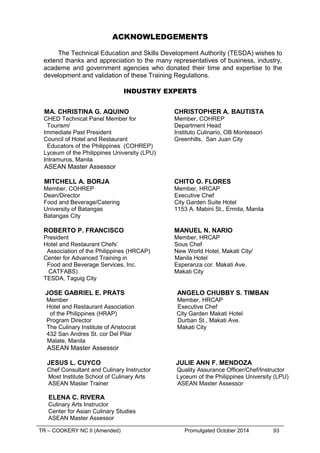
  • 91.
    3.6 TRAINER’S QUALIFICATIONSFOR TOURISM (HOTEL AND RESTAURANT) SECTOR COOKERY NC II TRAINER QUALIFICATION I (TQ II) • Must be a holder of Cookery NC II or Commercial Cooking NC III • Must be a holder of National TVET Trainer’s Certificate (NTTC) I in Cookery NC II • Must be physically, mentally fit and holder of a Health Certificate (hepatitis-free or free of any communicable disease) • Must have at least 3 years job/industry experience. (Preferably on supervisory/managerial level in cookery or commercial cooking) 3.7 INSTITUTIONAL ASSESSMENT Institutional assessment is undertaken by trainees to determine their achievement of units of competency. A certificate of achievement is issued for each unit of competency. TR – COOKERY NC II (Amended) Promulgated October 2014 89
  • 92.
    SECTION 4 ASSESSMENTAND CERTIFICATION ARRANGEMENTS 4.1 To attain the National Qualification of COOKERY NC II, the candidate must demonstrate competence in all the units of competency listed in Section l. Successful candidates shall be awarded a National Certificate signed by the TESDA Director General. 4.2 Individuals aspiring to be awarded the qualification of COOKERY NC II must acquire Certificates of Competency in all the following groups or clusters of core units of the Qualification. Candidates may apply for assessment in any accredited assessment center. 4.2.1 Prepare and cook hot meals 4.2.1.1 Clean and maintain kitchen premises 4.2.1.2 Prepare stocks, sauces and soups 4.2.1.3 Prepare poultry and game dishes 4.2.1.4 Prepare seafood dishes 4.2.1.5 Prepare eggs dishes 4.2.1.6 Prepare starch dishes 4.2.1.7 Prepare vegetable dishes 4.2.1.8 Package prepared food 4.2.1.9 Prepare meat dishes 4.2.2 Prepare Cold Meals 4.2.2.1 Clean and maintain kitchen premises 4.2.2.2 Prepare appetizers 4.2.2.3 Prepare salads and dressings 4.2.2.4 Package prepared food 4.2.2.5 Prepare sandwiches 4.2.3 Prepare Sweets 4.2.3.1 Clean and maintain kitchen premises 4.2.3.2 Prepare desserts 4.2.3.3 Package prepared food Successful candidates shall be awarded Certificates of Competency (COC). 4.3 Upon accumulation and submission of all the above COCs acquired for the relevant units of competency comprising this qualification, an individual shall be issued the corresponding National Certificate. 4.4 Assessment shall focus on the core units of competency. The basic and common units shall be integrated or assessed concurrently with the core units. 4.5 The following are qualified to apply for assessment and certification: 4.5.1 Graduates of formal, non-formal and informal including enterprise-based training programs. 4.5.2 Experienced Workers (wage employed or self-employed) 4.6 The guidelines on assessment and certification are discussed in detail in the "Procedures Manual on Assessment and Certification" and "Guidelines on the Implementation of the Philippine TVET Qualification and Certification System (PTQCS)". TR – COOKERY NC II (Amended) Promulgated October 2014 90
  • 93.
    Clean and maintain kitchenpremises Prepare poultry and game dishes Select, prepare and serve specialty cuisine’s Manage facilities associated with commercial catering contracts Direct and lead service team in the dining area/restaurant Prepare and present gateaux, tortes and cakes Provide accommodation reception services Plan and schedule routine maintenance, repairs and modifications Prepare stocks, sauces and soups Prepare seafood dishes Monitor catering revenue and costs Plan the catering for an event or function Oversee dining area operations Prepare and display petits fours Conduct night audit Contribute to the implementation of emergency procedures Prepare appetizers Prepare desserts Establish and maintain quality control Design menus to meet market needs Oversee banquet and/or catering function Present desserts Provide club reception services Observe and monitor people Prepare salads and dressings Package prepared food Apply cook-chill- freeze production process Develop a food safety program Operate a food outlet Clean bar areas Provide porter services Escort, carry and store valuable items Prepare sandwiches Plan and prepare food for ala carte and buffets Prepare foods according to dietary and cultural needs Prepare the dining room/restaurant area for service Prepare tenders for catering contracts Operate bar Provide housekeeping services to guests Manage physical assets Prepare meat dishes Plan and control menu-based catering Transport and store food in a safe and hygienic manner Provide preliminary dining room/restaurant service procedures Develop a food safety program Prepare and mix cocktails and non- alcoholic concoctions and hot drinks Prepare rooms for guests Manage stock purchases and inventory Prepare vegetable dishes Organize bulk cooking operations Apply catering control principles Prepare food and beverage service to guests Plan coffee shop layout, menu and storage (Coffee Shop) Provide wine service Clean premises Provide for the safety of Very Important Persons (VIP) TR – COOKERY NC II (Amended) Promulgated October 2014 91 COR E COM PET ENC IES COMPETENCY MAP - TOURISM Sector (Hotel and Restaurant) COOKERY NC II
  • 94.
    Prepare egg dishes Preparepates and terrines Develop menus to meet special dietary and cultural needs Provide room service Prepare and produce bakery products Receive and process reservations Provide valet services Provide a lost and found facility Prepare starch dishes Plan, prepare and serve specialized food items Select catering system Receive and handle guest concerns Prepare and produce pastry products Operate a computerized reservations system Launder linen and guest clothes Develop and update industry knowledge Observe workplace hygiene procedures Perform computer operations Perform workplace and safety practices Provide effective customer service Roster staff Control and order stock Train small group Establish and conduct business relationships Manage workplace diversity Manage finances within a budget Manage quality customer service Conduct assessment Receive and respond to workplace communication Work with others Demonstrate work values Practice basic housekeeping procedures Participate in workplace communication Work in a team environment Practice career professionalism Lead workplace communication Lead small teams Develop and practice negotiation skills Solve problems related to work activities Use mathematical concepts and techniques Use relevant technologies Practice occupational health and safety procedures Utilize specialized communication skills Develop teams and individuals Apply problem solving techniques in the workplace Collect, analyze and organize information Plan and organize work Promote environmental protection TR – COOKERY NC II (Amended) Promulgated October 2014 92 COM MON COM PET ENC IES BASI C COM PET ENC IES
  • 95.
    ACKNOWLEDGEMENTS The Technical Educationand Skills Development Authority (TESDA) wishes to extend thanks and appreciation to the many representatives of business, industry, academe and government agencies who donated their time and expertise to the development and validation of these Training Regulations. INDUSTRY EXPERTS MA. CHRISTINA G. AQUINO CHRISTOPHER A. BAUTISTA CHED Technical Panel Member for Member, COHREP Tourism/ Department Head Immediate Past President Instituto Culinario, OB Montessori Council of Hotel and Restaurant Greenhills, San Juan City Educators of the Philippines (COHREP) Lyceum of the Philippines University (LPU) Intramuros, Manila ASEAN Master Assessor MITCHELL A. BORJA CHITO O. FLORES Member, COHREP Member, HRCAP Dean/Director Executive Chef Food and Beverage/Catering City Garden Suite Hotel University of Batangas 1153 A. Mabini St., Ermita, Manila Batangas City ROBERTO P. FRANCISCO MANUEL N. NARIO President Member, HRCAP Hotel and Restaurant Chefs’ Sous Chef Association of the Philippines (HRCAP) New World Hotel, Makati City/ Center for Advanced Training in Manila Hotel Food and Beverage Services, Inc. Esperanza cor. Makati Ave. CATFABS) Makati City TESDA, Taguig City JOSE GABRIEL E. PRATS ANGELO CHUBBY S. TIMBAN Member Member, HRCAP Hotel and Restaurant Association Executive Chef of the Philippines (HRAP) City Garden Makati Hotel Program Director Durban St., Makati Ave. The Culinary Institute of Aristocrat Makati City 432 San Andres St. cor Del Pilar Malate, Manila ASEAN Master Assessor JESUS L. CUYCO JULIE ANN F. MENDOZA Chef Consultant and Culinary Instructor Quality Assurance Officer/Chef/Instructor Most Institute School of Culinary Arts Lyceum of the Philippines University (LPU) ASEAN Master Trainer ASEAN Master Assessor ELENA C. RIVERA Culinary Arts Instructor Center for Asian Culinary Studies ASEAN Master Assessor TR – COOKERY NC II (Amended) Promulgated October 2014 93
  • 96.
    The Participants inthe Validation of this Training Regulation The Members of the TESDA Board and Secretariat The MANAGEMENT and Staff of the TESDA Secretariat • Qualifications and Standards Office (QSO) TR – COOKERY NC II (Amended) Promulgated October 2014 94