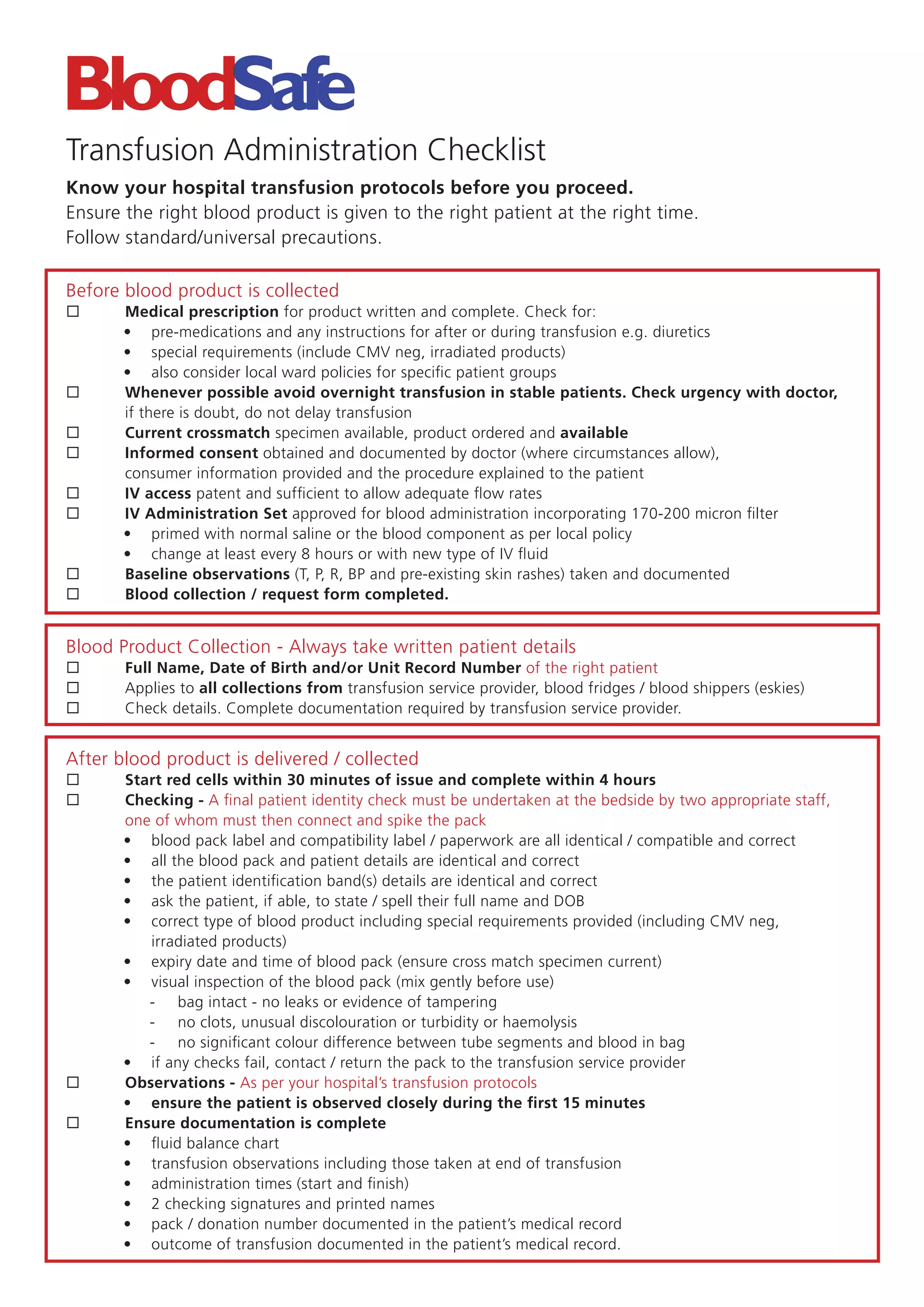
Transfusion Administration Checklist
Know your hospital transfusion protocols before you proceed.
Ensure the right blood product is given to the right patient at the right time.
Follow standard/universal precautions.

Before blood product is collected
       Medical prescription for product written and complete. Check for:
       • pre-medications and any instructions for after or during transfusion e.g. diuretics
       • special requirements (include CMV neg, irradiated products)
       • also consider local ward policies for specific patient groups
       Whenever possible avoid overnight transfusion in stable patients. Check urgency with doctor,
       if there is doubt, do not delay transfusion
       Current crossmatch specimen available, product ordered and available
       Informed consent obtained and documented by doctor (where circumstances allow),
       consumer information provided and the procedure explained to the patient
       IV access patent and sufficient to allow adequate flow rates
       IV Administration Set approved for blood administration incorporating 170-200 micron filter
       • primed with normal saline or the blood component as per local policy
       • change at least every 8 hours or with new type of IV fluid
       Baseline observations (T, P, R, BP and pre-existing skin rashes) taken and documented
       Blood collection / request form completed.


Blood Product Collection - Always take written patient details
       Full Name, Date of Birth and/or Unit Record Number of the right patient
       Applies to all collections from transfusion service provider, blood fridges / blood shippers (eskies)
       Check details. Complete documentation required by transfusion service provider.


After blood product is delivered / collected
       Start red cells within 30 minutes of issue and complete within 4 hours
       Checking - A final patient identity check must be undertaken at the bedside by two appropriate staff,
       one of whom must then connect and spike the pack
       • blood pack label and compatibility label / paperwork are all identical / compatible and correct
       • all the blood pack and patient details are identical and correct
       • the patient identification band(s) details are identical and correct
       • ask the patient, if able, to state / spell their full name and DOB
       • correct type of blood product including special requirements provided (including CMV neg,
          irradiated products)
       • expiry date and time of blood pack (ensure cross match specimen current)
       • visual inspection of the blood pack (mix gently before use)
          - bag intact - no leaks or evidence of tampering
          - no clots, unusual discolouration or turbidity or haemolysis
          - no significant colour difference between tube segments and blood in bag
       • if any checks fail, contact / return the pack to the transfusion service provider
       Observations - As per your hospital’s transfusion protocols
       • ensure the patient is observed closely during the first 15 minutes
       Ensure documentation is complete
       • fluid balance chart
       • transfusion observations including those taken at end of transfusion
       • administration times (start and finish)
       • 2 checking signatures and printed names
       • pack / donation number documented in the patient’s medical record
       • outcome of transfusion documented in the patient’s medical record.
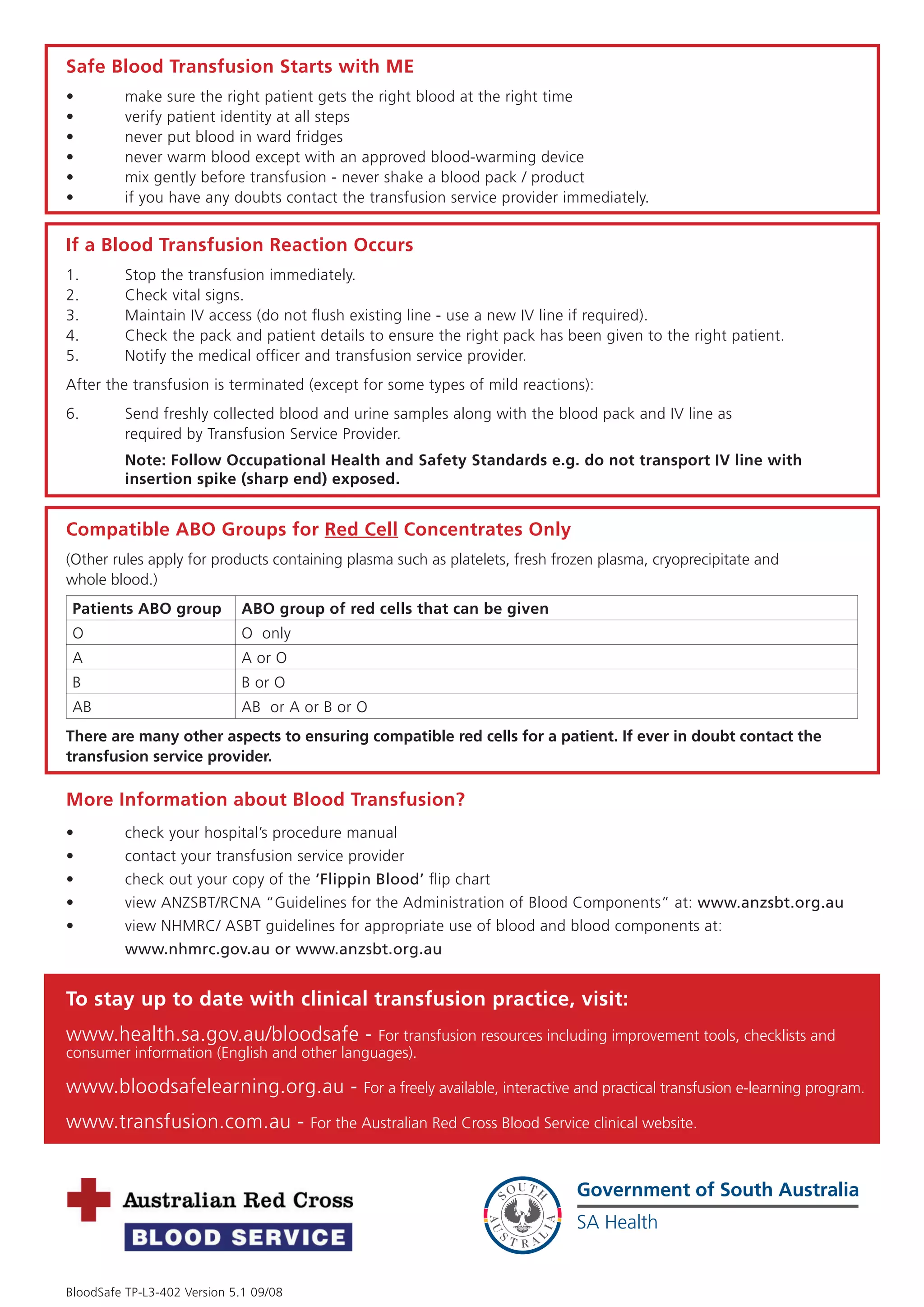
Safe Blood Transfusion Starts with ME
•         make sure the right patient gets the right blood at the right time
•         verify patient identity at all steps
•         never put blood in ward fridges
•         never warm blood except with an approved blood-warming device
•         mix gently before transfusion - never shake a blood pack / product
•         if you have any doubts contact the transfusion service provider immediately.


If a Blood Transfusion Reaction Occurs
1.        Stop the transfusion immediately.
2.        Check vital signs.
3.        Maintain IV access (do not flush existing line - use a new IV line if required).
4.        Check the pack and patient details to ensure the right pack has been given to the right patient.
5.        Notify the medical officer and transfusion service provider.
After the transfusion is terminated (except for some types of mild reactions):
6.        Send freshly collected blood and urine samples along with the blood pack and IV line as
          required by Transfusion Service Provider.
          Note: Follow Occupational Health and Safety Standards e.g. do not transport IV line with
          insertion spike (sharp end) exposed.


Compatible ABO Groups for Red Cell Concentrates Only
(Other rules apply for products containing plasma such as platelets, fresh frozen plasma, cryoprecipitate and
whole blood.)
 Patients ABO group          ABO group of red cells that can be given
 O                           O only
 A                           A or O
 B                           B or O
 AB                          AB or A or B or O
There are many other aspects to ensuring compatible red cells for a patient. If ever in doubt contact the
transfusion service provider.

More Information about Blood Transfusion?
•         check your hospital’s procedure manual
•         contact your transfusion service provider
•         check out your copy of the ‘Flippin Blood’ flip chart
•         view ANZSBT/RCNA “Guidelines for the Administration of Blood Components” at: www.anzsbt.org.au
•         view NHMRC/ ASBT guidelines for appropriate use of blood and blood components at:
          www.nhmrc.gov.au or www.anzsbt.org.au


To stay up to date with clinical transfusion practice, visit:
www.health.sa.gov.au/bloodsafe -             For transfusion resources including improvement tools, checklists and
consumer information (English and other languages).

www.bloodsafelearning.org.au -                  For a freely available, interactive and practical transfusion e-learning program.

www.transfusion.com.au -                For the Australian Red Cross Blood Service clinical website.


BloodSafe TP-L3-402 Version 5.1 09/08

Tp l3-402 nursing admin checklist 5 1 (1)

  • 1.
    Transfusion Administration Checklist Knowyour hospital transfusion protocols before you proceed. Ensure the right blood product is given to the right patient at the right time. Follow standard/universal precautions. Before blood product is collected Medical prescription for product written and complete. Check for: • pre-medications and any instructions for after or during transfusion e.g. diuretics • special requirements (include CMV neg, irradiated products) • also consider local ward policies for specific patient groups Whenever possible avoid overnight transfusion in stable patients. Check urgency with doctor, if there is doubt, do not delay transfusion Current crossmatch specimen available, product ordered and available Informed consent obtained and documented by doctor (where circumstances allow), consumer information provided and the procedure explained to the patient IV access patent and sufficient to allow adequate flow rates IV Administration Set approved for blood administration incorporating 170-200 micron filter • primed with normal saline or the blood component as per local policy • change at least every 8 hours or with new type of IV fluid Baseline observations (T, P, R, BP and pre-existing skin rashes) taken and documented Blood collection / request form completed. Blood Product Collection - Always take written patient details Full Name, Date of Birth and/or Unit Record Number of the right patient Applies to all collections from transfusion service provider, blood fridges / blood shippers (eskies) Check details. Complete documentation required by transfusion service provider. After blood product is delivered / collected Start red cells within 30 minutes of issue and complete within 4 hours Checking - A final patient identity check must be undertaken at the bedside by two appropriate staff, one of whom must then connect and spike the pack • blood pack label and compatibility label / paperwork are all identical / compatible and correct • all the blood pack and patient details are identical and correct • the patient identification band(s) details are identical and correct • ask the patient, if able, to state / spell their full name and DOB • correct type of blood product including special requirements provided (including CMV neg, irradiated products) • expiry date and time of blood pack (ensure cross match specimen current) • visual inspection of the blood pack (mix gently before use) - bag intact - no leaks or evidence of tampering - no clots, unusual discolouration or turbidity or haemolysis - no significant colour difference between tube segments and blood in bag • if any checks fail, contact / return the pack to the transfusion service provider Observations - As per your hospital’s transfusion protocols • ensure the patient is observed closely during the first 15 minutes Ensure documentation is complete • fluid balance chart • transfusion observations including those taken at end of transfusion • administration times (start and finish) • 2 checking signatures and printed names • pack / donation number documented in the patient’s medical record • outcome of transfusion documented in the patient’s medical record.
  • 2.
    Safe Blood TransfusionStarts with ME • make sure the right patient gets the right blood at the right time • verify patient identity at all steps • never put blood in ward fridges • never warm blood except with an approved blood-warming device • mix gently before transfusion - never shake a blood pack / product • if you have any doubts contact the transfusion service provider immediately. If a Blood Transfusion Reaction Occurs 1. Stop the transfusion immediately. 2. Check vital signs. 3. Maintain IV access (do not flush existing line - use a new IV line if required). 4. Check the pack and patient details to ensure the right pack has been given to the right patient. 5. Notify the medical officer and transfusion service provider. After the transfusion is terminated (except for some types of mild reactions): 6. Send freshly collected blood and urine samples along with the blood pack and IV line as required by Transfusion Service Provider. Note: Follow Occupational Health and Safety Standards e.g. do not transport IV line with insertion spike (sharp end) exposed. Compatible ABO Groups for Red Cell Concentrates Only (Other rules apply for products containing plasma such as platelets, fresh frozen plasma, cryoprecipitate and whole blood.) Patients ABO group ABO group of red cells that can be given O O only A A or O B B or O AB AB or A or B or O There are many other aspects to ensuring compatible red cells for a patient. If ever in doubt contact the transfusion service provider. More Information about Blood Transfusion? • check your hospital’s procedure manual • contact your transfusion service provider • check out your copy of the ‘Flippin Blood’ flip chart • view ANZSBT/RCNA “Guidelines for the Administration of Blood Components” at: www.anzsbt.org.au • view NHMRC/ ASBT guidelines for appropriate use of blood and blood components at: www.nhmrc.gov.au or www.anzsbt.org.au To stay up to date with clinical transfusion practice, visit: www.health.sa.gov.au/bloodsafe - For transfusion resources including improvement tools, checklists and consumer information (English and other languages). www.bloodsafelearning.org.au - For a freely available, interactive and practical transfusion e-learning program. www.transfusion.com.au - For the Australian Red Cross Blood Service clinical website. BloodSafe TP-L3-402 Version 5.1 09/08