RSD 9 Relating Systems Thinking and Design – 9th Symposium, Oct 16th, 2020
National Institute of Design Ahmedabad, India
Theme: Systemic Design for Well-Being
Methodology, philosophy and theory of systemic design
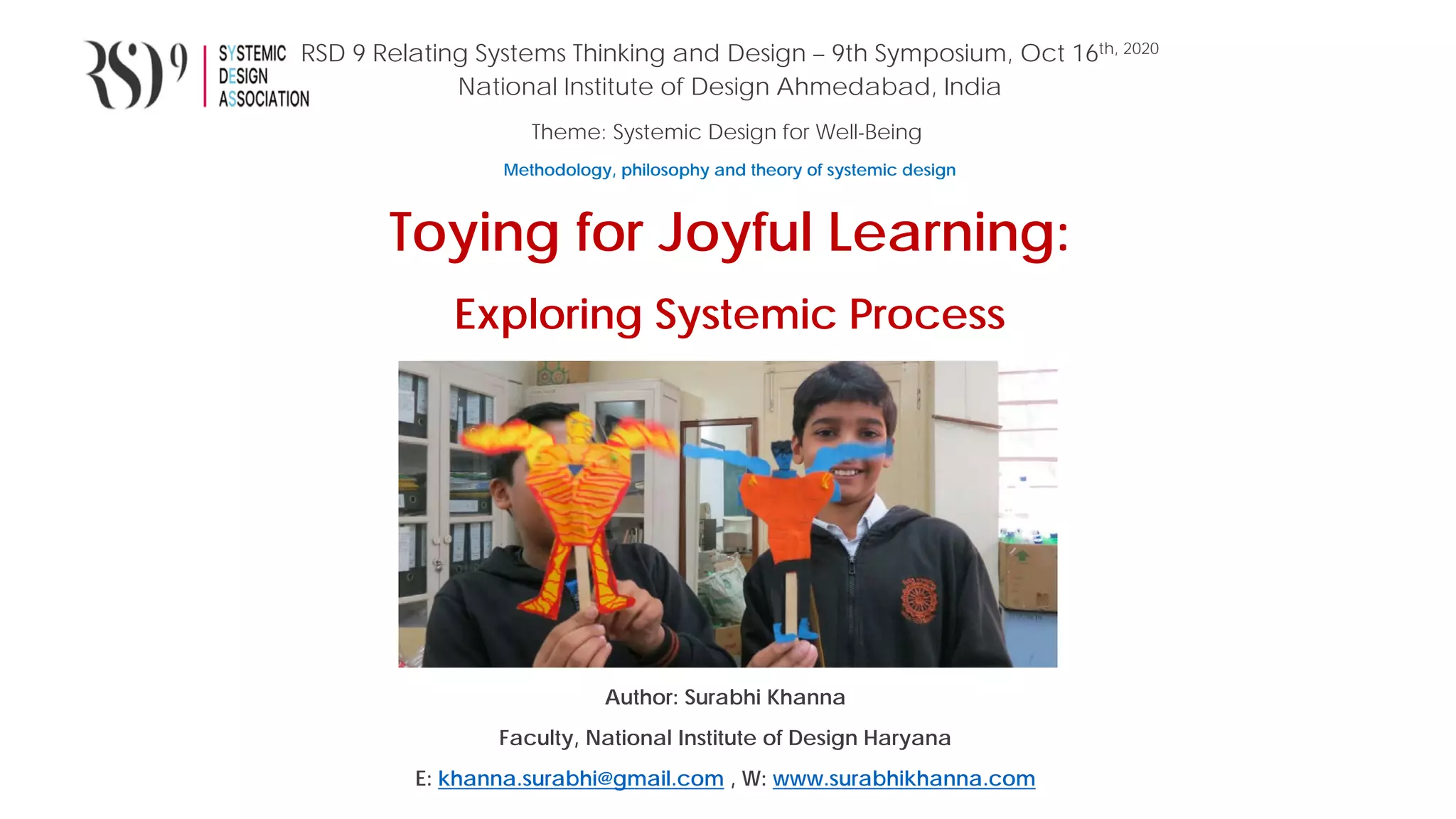
Toying for Joyful Learning:
Exploring Systemic Process
Author: Surabhi Khanna
Faculty, National Institute of Design Haryana
E: khanna.surabhi@gmail.com , W: www.surabhikhanna.com
“The best thing a child can do with a toy is to break it,
the next best thing is to make it;
even better is to create it.”
Source: Khanna S. (2018), Timeless Toys & Tales: A Design Process in Education. 8th International Toy Research Association
World Conference, International Toy Research Association (ITRA), Paris, France. hal-02081014
c Surabhi Khanna “Toying for Joyful Learning: Exploring Systemic Process”, October 2020
Various Indian folk toys unknowingly provide such
wisdom. The approach of design process and system
thinking is ingrained in design courses. The approach
of systemic process is used in a specific direction.
Since 2011, the author has been conducting
workshops on toys and games as a resource for joyful
learning. The focus is on learning from heritage-
based toys and games.
c Surabhi Khanna “Toying for Joyful Learning: Exploring Systemic Process”, October 2020
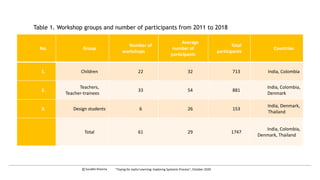
No. Group
Number of
workshops
Average
number of
participants
Total
participants
Countries
1. Children 22 32 713 India, Colombia
2.
Teachers,
Teacher-trainees
33 54 881
India, Colombia,
Denmark
3. Design students 6 26 153
India, Denmark,
Thailand
Total 61 29 1747
India, Colombia,
Denmark, Thailand
Table 1. Workshop groups and number of participants from 2011 to 2018
c Surabhi Khanna “Toying for Joyful Learning: Exploring Systemic Process”, October 2020
Understanding toys and stories associated with them,
seemed to have a good starting point with Indigenous
toys or folk toys. It is interesting to note that many toys
were short-lived and yet the play value is timeless.
Dynamic folk toys are by nature short-lived, mostly
due to the use of eco-friendly material. This in a way
is positive as children engage with the toy as long as it
interests them. (Khanna, Wolf, Ravishankar and
Sundram, 2018).
c Surabhi Khanna “Toying for Joyful Learning: Exploring Systemic Process”, October 2020
Toys and tales are symbiotic in nature. Toys enhance
skills, tales enable communication; together they form
an amalgamation of creativity and a special design
process. This is explained further through an example
of “String-Pulled Puppet”
c Surabhi Khanna “Toying for Joyful Learning: Exploring Systemic Process”, October 2020
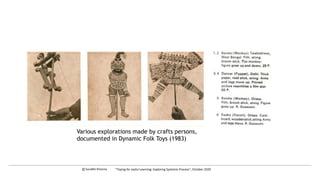
Various explorations made by crafts persons,
documented in Dynamic Folk Toys (1983)
c Surabhi Khanna “Toying for Joyful Learning: Exploring Systemic Process”, October 2020
Design education has courses like design process, design concepts and concerns,
systems thinking, design projects. These provide a strong base for design process through
practice-based approach.
The idea of the workshop sessions with students, teachers, teacher-trainee, professionals
like psychologists, educators, child development specialists, is to introduce learning from
toys and games and this brings in design process.
Participants are encouraged to create new ideas based on existing knowledge. The
experience of known to unknown to known is explored. So why did we use toys and
games to experience design process?
Toys and games are accessible and related to everyone since childhood. This brings a
natural bond to product and process. The power of making and playing is immense. The
medium of toy design facilitates the ability to create and express. This has been leading
to developing a systemic approach.
c Surabhi Khanna “Toying for Joyful Learning: Exploring Systemic Process”, October 2020
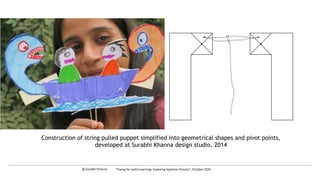
Construction of string pulled puppet simplified into geometrical shapes and pivot points,
developed at Surabhi Khanna design studio, 2014
c Surabhi Khanna “Toying for Joyful Learning: Exploring Systemic Process”, October 2020
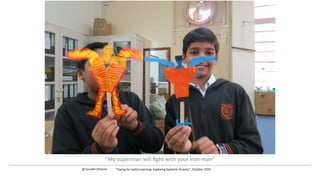
“My superman will fight with your iron-man”
c Surabhi Khanna “Toying for Joyful Learning: Exploring Systemic Process”, October 2020
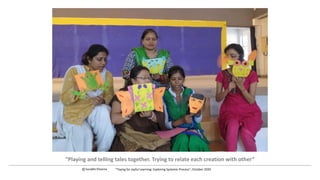
“Playing and telling tales together. Trying to relate each creation with other”
c Surabhi Khanna “Toying for Joyful Learning: Exploring Systemic Process”, October 2020
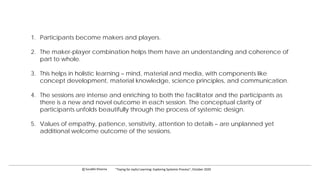
1. Participants become makers and players.
2. The maker-player combination helps them have an understanding and coherence of
part to whole.
3. This helps in holistic learning – mind, material and media, with components like
concept development, material knowledge, science principles, and communication.
4. The sessions are intense and enriching to both the facilitator and the participants as
there is a new and novel outcome in each session. The conceptual clarity of
participants unfolds beautifully through the process of systemic design.
5. Values of empathy, patience, sensitivity, attention to details – are unplanned yet
additional welcome outcome of the sessions.
c Surabhi Khanna “Toying for Joyful Learning: Exploring Systemic Process”, October 2020
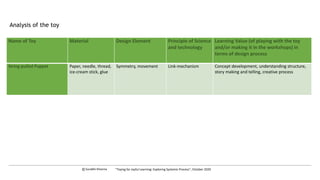
Analysis of the toy
Name of Toy Material Design Element Principle of Science
and technology
Learning Value (of playing with the toy
and/or making it in the workshops) in
terms of design process
String-pulled Puppet Paper, needle, thread,
ice-cream stick, glue
Symmetry, movement Link-mechanism Concept development, understanding structure,
story making and telling, creative process
c Surabhi Khanna “Toying for Joyful Learning: Exploring Systemic Process”, October 2020
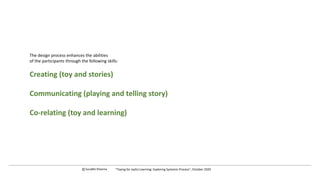
The design process enhances the abilities
of the participants through the following skills:
Creating (toy and stories)
Communicating (playing and telling story)
Co-relating (toy and learning)
c Surabhi Khanna “Toying for Joyful Learning: Exploring Systemic Process”, October 2020
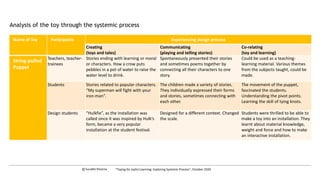
Name of Toy Participants Experiencing design process
Creating
(toys and tales)
Communicating
(playing and telling stories)
Co-relating
(toy and learning)
String-pulled
Puppet
Teachers, teacher-
trainees
Stories ending with learning or moral
or characters. How a crow puts
pebbles in a pot of water to raise the
water level to drink.
Spontaneously presented their stories
and sometimes poems together by
connecting all their characters to one
story.
Could be used as a teaching-
learning material. Various themes
from the subjects taught, could be
made.
Students Stories related to popular characters.
“My superman will fight with your
iron-man”.
The children made a variety of stories.
They individually expressed their forms
and stories, sometimes connecting with
each other.
The movement of the puppet,
fascinated the students.
Understanding the pivot points.
Learning the skill of tying knots.
Design students “Hulkfie”, as the installation was
called since it was inspired by Hulk’s
form, became a very popular
installation at the student festival.
Designed for a different context. Changed
the scale.
Students were thrilled to be able to
make a toy into an installation. They
learnt about material knowledge,
weight and force and how to make
an interactive installation.
Analysis of the toy through the systemic process
c Surabhi Khanna “Toying for Joyful Learning: Exploring Systemic Process”, October 2020
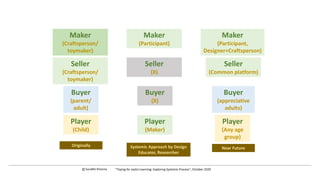
Maker
(Craftsperson/
toymaker)
Buyer
(parent/
adult)
Player
(Child)
Maker
(Participant)
Buyer
(X)
Player
(Maker)
Originally Systemic Approach by Design
Educator, Researcher
Near Future
Maker
(Participant,
Designer+Craftsperson)
Seller
(Craftsperson/
toymaker)
Seller
(X)
Seller
(Common platform)
Player
(Any age
group)
Buyer
(appreciative
adults)
c Surabhi Khanna “Toying for Joyful Learning: Exploring Systemic Process”, October 2020
Reflections and Indications
from the workshops has given the following insights:
•The workshops provide a heuristic approach to learning.
•There is potential of play and learning in indigenous toys which is experienced through
the workshop sessions.
•The idea of One to Many is effective as there is an opportunity to create many ideas,
staring from one idea.
•Interaction between participants prevails.
•Children get deeply involved in the process of creating and playing.
•One of the best ways to document play ideas and make it with today’s context through
stories and themes. This may be way to revive or innovate heritage.
• The design explorations also are cultural resource for learning.
• Framework using such a systemic approach for designing and developing new ideas.
This is aimed to be useful for children and teachers for learning, as well as design
community.
c Surabhi Khanna “Toying for Joyful Learning: Exploring Systemic Process”, October 2020
REFERENCES
• Gupta, A (1993) Toy Treasures, Eklavya, Bhopal, India, www.arvindguptatoys.com
• K.B. (2013, October 6) : Toying with ideas. The Hindu. Available at
http://www.thehindu.com/features/metroplus/toying-with-ideas/article5207102.ece [Accessed June 29,
2014]
• Khanna, S. (1983) Dynamic Folk Toys. Indian Toys based on the application of simple principles of science &
technology, The Development Commissioner for Handicrafts, New Delhi, India, www.sudarshankhanna.com
• Khanna, S. (1992) Joy of Making Indian Toys, National Book Trust, New Delhi, India,
www.sudarshankhanna.com
• Khanna, S., Wolf G. and Ravishankar A. (1999) Toys and Tales with everyday materials, Tara Publishing,
Chennai, India.
• Khanna S., Wolf G., Ravishankar A. and Sundram P. (2018) Toys and Play with everyday materials, Tara
Publishing, Chennai, India.
• Webpage of www.surabhikhana.com
• Khanna S. (2018), Timeless Toys & Tales: A Design Process in Education. 8th International Toy Research
Association World Conference, International Toy Research Association (ITRA), Paris, France. hal-02081014
c Surabhi Khanna “Toying for Joyful Learning: Exploring Systemic Process”, October 2020
RSD 9 Relating Systems Thinking and Design – 9th Symposium, Oct 16th, 2020
National Institute of Design Ahmedabad, India
Theme: Systemic Design for Well-Being
Methodology, philosophy and theory of systemic design
Toying for Joyful Learning:
Exploring Systemic Process
Author: Surabhi Khanna
Faculty, National Institute of Design Haryana
E: khanna.surabhi@gmail.com , W: www.surabhikhanna.com

Toying for Joyful Learning: Exploring systemic process

  • 1.
    RSD 9 RelatingSystems Thinking and Design – 9th Symposium, Oct 16th, 2020 National Institute of Design Ahmedabad, India Theme: Systemic Design for Well-Being Methodology, philosophy and theory of systemic design Toying for Joyful Learning: Exploring Systemic Process Author: Surabhi Khanna Faculty, National Institute of Design Haryana E: khanna.surabhi@gmail.com , W: www.surabhikhanna.com
  • 2.
    “The best thinga child can do with a toy is to break it, the next best thing is to make it; even better is to create it.” Source: Khanna S. (2018), Timeless Toys & Tales: A Design Process in Education. 8th International Toy Research Association World Conference, International Toy Research Association (ITRA), Paris, France. hal-02081014 c Surabhi Khanna “Toying for Joyful Learning: Exploring Systemic Process”, October 2020
  • 3.
    Various Indian folktoys unknowingly provide such wisdom. The approach of design process and system thinking is ingrained in design courses. The approach of systemic process is used in a specific direction. Since 2011, the author has been conducting workshops on toys and games as a resource for joyful learning. The focus is on learning from heritage- based toys and games. c Surabhi Khanna “Toying for Joyful Learning: Exploring Systemic Process”, October 2020
  • 4.
    No. Group Number of workshops Average numberof participants Total participants Countries 1. Children 22 32 713 India, Colombia 2. Teachers, Teacher-trainees 33 54 881 India, Colombia, Denmark 3. Design students 6 26 153 India, Denmark, Thailand Total 61 29 1747 India, Colombia, Denmark, Thailand Table 1. Workshop groups and number of participants from 2011 to 2018 c Surabhi Khanna “Toying for Joyful Learning: Exploring Systemic Process”, October 2020
  • 5.
    Understanding toys andstories associated with them, seemed to have a good starting point with Indigenous toys or folk toys. It is interesting to note that many toys were short-lived and yet the play value is timeless. Dynamic folk toys are by nature short-lived, mostly due to the use of eco-friendly material. This in a way is positive as children engage with the toy as long as it interests them. (Khanna, Wolf, Ravishankar and Sundram, 2018). c Surabhi Khanna “Toying for Joyful Learning: Exploring Systemic Process”, October 2020
  • 6.
    Toys and talesare symbiotic in nature. Toys enhance skills, tales enable communication; together they form an amalgamation of creativity and a special design process. This is explained further through an example of “String-Pulled Puppet” c Surabhi Khanna “Toying for Joyful Learning: Exploring Systemic Process”, October 2020
  • 7.
    Various explorations madeby crafts persons, documented in Dynamic Folk Toys (1983) c Surabhi Khanna “Toying for Joyful Learning: Exploring Systemic Process”, October 2020
  • 8.
    Design education hascourses like design process, design concepts and concerns, systems thinking, design projects. These provide a strong base for design process through practice-based approach. The idea of the workshop sessions with students, teachers, teacher-trainee, professionals like psychologists, educators, child development specialists, is to introduce learning from toys and games and this brings in design process. Participants are encouraged to create new ideas based on existing knowledge. The experience of known to unknown to known is explored. So why did we use toys and games to experience design process? Toys and games are accessible and related to everyone since childhood. This brings a natural bond to product and process. The power of making and playing is immense. The medium of toy design facilitates the ability to create and express. This has been leading to developing a systemic approach. c Surabhi Khanna “Toying for Joyful Learning: Exploring Systemic Process”, October 2020
  • 9.
    Construction of stringpulled puppet simplified into geometrical shapes and pivot points, developed at Surabhi Khanna design studio, 2014 c Surabhi Khanna “Toying for Joyful Learning: Exploring Systemic Process”, October 2020
  • 10.
    “My superman willfight with your iron-man” c Surabhi Khanna “Toying for Joyful Learning: Exploring Systemic Process”, October 2020
  • 11.
    “Playing and tellingtales together. Trying to relate each creation with other” c Surabhi Khanna “Toying for Joyful Learning: Exploring Systemic Process”, October 2020
  • 12.
    1. Participants becomemakers and players. 2. The maker-player combination helps them have an understanding and coherence of part to whole. 3. This helps in holistic learning – mind, material and media, with components like concept development, material knowledge, science principles, and communication. 4. The sessions are intense and enriching to both the facilitator and the participants as there is a new and novel outcome in each session. The conceptual clarity of participants unfolds beautifully through the process of systemic design. 5. Values of empathy, patience, sensitivity, attention to details – are unplanned yet additional welcome outcome of the sessions. c Surabhi Khanna “Toying for Joyful Learning: Exploring Systemic Process”, October 2020
  • 13.
    Analysis of thetoy Name of Toy Material Design Element Principle of Science and technology Learning Value (of playing with the toy and/or making it in the workshops) in terms of design process String-pulled Puppet Paper, needle, thread, ice-cream stick, glue Symmetry, movement Link-mechanism Concept development, understanding structure, story making and telling, creative process c Surabhi Khanna “Toying for Joyful Learning: Exploring Systemic Process”, October 2020
  • 14.
    The design processenhances the abilities of the participants through the following skills: Creating (toy and stories) Communicating (playing and telling story) Co-relating (toy and learning) c Surabhi Khanna “Toying for Joyful Learning: Exploring Systemic Process”, October 2020
  • 15.
    Name of ToyParticipants Experiencing design process Creating (toys and tales) Communicating (playing and telling stories) Co-relating (toy and learning) String-pulled Puppet Teachers, teacher- trainees Stories ending with learning or moral or characters. How a crow puts pebbles in a pot of water to raise the water level to drink. Spontaneously presented their stories and sometimes poems together by connecting all their characters to one story. Could be used as a teaching- learning material. Various themes from the subjects taught, could be made. Students Stories related to popular characters. “My superman will fight with your iron-man”. The children made a variety of stories. They individually expressed their forms and stories, sometimes connecting with each other. The movement of the puppet, fascinated the students. Understanding the pivot points. Learning the skill of tying knots. Design students “Hulkfie”, as the installation was called since it was inspired by Hulk’s form, became a very popular installation at the student festival. Designed for a different context. Changed the scale. Students were thrilled to be able to make a toy into an installation. They learnt about material knowledge, weight and force and how to make an interactive installation. Analysis of the toy through the systemic process c Surabhi Khanna “Toying for Joyful Learning: Exploring Systemic Process”, October 2020
  • 16.
    Maker (Craftsperson/ toymaker) Buyer (parent/ adult) Player (Child) Maker (Participant) Buyer (X) Player (Maker) Originally Systemic Approachby Design Educator, Researcher Near Future Maker (Participant, Designer+Craftsperson) Seller (Craftsperson/ toymaker) Seller (X) Seller (Common platform) Player (Any age group) Buyer (appreciative adults) c Surabhi Khanna “Toying for Joyful Learning: Exploring Systemic Process”, October 2020
  • 17.
    Reflections and Indications fromthe workshops has given the following insights: •The workshops provide a heuristic approach to learning. •There is potential of play and learning in indigenous toys which is experienced through the workshop sessions. •The idea of One to Many is effective as there is an opportunity to create many ideas, staring from one idea. •Interaction between participants prevails. •Children get deeply involved in the process of creating and playing. •One of the best ways to document play ideas and make it with today’s context through stories and themes. This may be way to revive or innovate heritage. • The design explorations also are cultural resource for learning. • Framework using such a systemic approach for designing and developing new ideas. This is aimed to be useful for children and teachers for learning, as well as design community. c Surabhi Khanna “Toying for Joyful Learning: Exploring Systemic Process”, October 2020
  • 18.
    REFERENCES • Gupta, A(1993) Toy Treasures, Eklavya, Bhopal, India, www.arvindguptatoys.com • K.B. (2013, October 6) : Toying with ideas. The Hindu. Available at http://www.thehindu.com/features/metroplus/toying-with-ideas/article5207102.ece [Accessed June 29, 2014] • Khanna, S. (1983) Dynamic Folk Toys. Indian Toys based on the application of simple principles of science & technology, The Development Commissioner for Handicrafts, New Delhi, India, www.sudarshankhanna.com • Khanna, S. (1992) Joy of Making Indian Toys, National Book Trust, New Delhi, India, www.sudarshankhanna.com • Khanna, S., Wolf G. and Ravishankar A. (1999) Toys and Tales with everyday materials, Tara Publishing, Chennai, India. • Khanna S., Wolf G., Ravishankar A. and Sundram P. (2018) Toys and Play with everyday materials, Tara Publishing, Chennai, India. • Webpage of www.surabhikhana.com • Khanna S. (2018), Timeless Toys & Tales: A Design Process in Education. 8th International Toy Research Association World Conference, International Toy Research Association (ITRA), Paris, France. hal-02081014 c Surabhi Khanna “Toying for Joyful Learning: Exploring Systemic Process”, October 2020
  • 19.
    RSD 9 RelatingSystems Thinking and Design – 9th Symposium, Oct 16th, 2020 National Institute of Design Ahmedabad, India Theme: Systemic Design for Well-Being Methodology, philosophy and theory of systemic design Toying for Joyful Learning: Exploring Systemic Process Author: Surabhi Khanna Faculty, National Institute of Design Haryana E: khanna.surabhi@gmail.com , W: www.surabhikhanna.com