Acknowledgments
1. Abstract
2. Scope of project
3. Project Objective
4. Understanding the System
4.1 Organisation structure of municipal schools
4.2 Departments
5. Research
5.1 Selection of sub - system
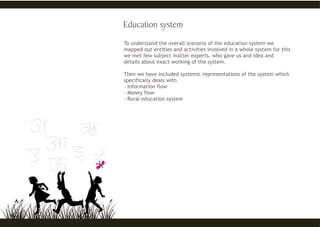
5.2 Introduction - Anganwadi
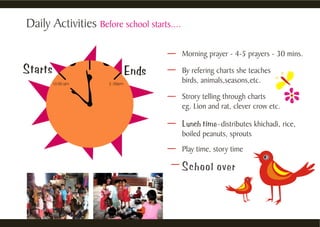
5.3 Activities and teaching pattern
6. User study
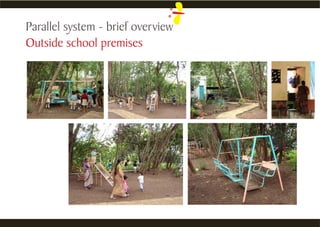
7. Parallel system - Kinder garten
8. Synopsis- Problem identification
9. Design opportunities
10.Design parameters
11.Design brief
12.Idea sketching
13.Desin direction (redefined design brief)
14.Concept selection
15.Detailing
15.1 - Dimensions
15.2 - Colour pallet
15.2 - Functions
15.4 - Graphics
16. Concept (in details)
17. Technology availability
18. Final prototype
I would like to express my gratitude to my guide, Mrs. Shetall
Natuu and Mr. Vikram Mitra for all their guidance in this learning
experience with the project. I would also thank Mr. Kiran Sabnis and
Pramod Sadolikar sir for their help to understand the scope of the
project.
Furthermore, I wish to express my gratitude to thank teachers of
the school and special thanks to all the pre- primary children
Most sincere thanks to the workshop staff for their co-operation and
guidance in the model making stage.
I would like to thank my friends, especially Devina, Malvika,
Bageshree, Nikhil and Gaurav for their understanding, patience and
motivation at every stage through the project
The project aims at studying a system of Municipal schools which
are situated at rural sector. We came across the news of teaching
methods in rural areas and the availability of resources for them.
This actually triggered the project idea.
After this we started to acquire some more information and
problems faced by rural school children. This topic is very vast in
nature as it is been handled by many people, NGOs and social
activists for betterment of rural school education. There are many
directions within this system.
There are scarcity of resources, teachers in core villages, teaching
learning materials, and students' attendance and retention level in
class because lack of interest, time, and awareness as well as
poverty.
This is our major challenge n a group to understand problems and
provide solutions on different directions.
The scope of this design project covers the improvement for
teaching methods of pre - primary students
This would involve studying organizational structure, existing
teaching methods, studying the context, contextual enquiry and user
behavior .Which will help to provide better solution to the existing
flaws in the subsystem.
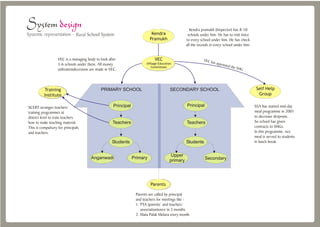
The main objective of this project is to study the system of rural
municipal schools as well as the hierarchy in the educational system,
entities, then the selecting sub-system and understanding it in detail
to provide solutions to the observed problem areas.
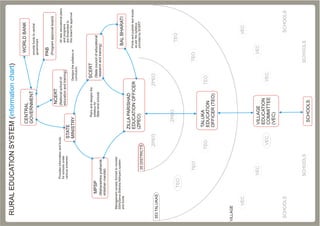
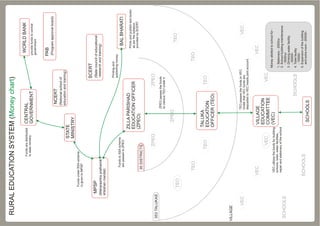
To understand the overall scenario of the education system we
mapped out entities and activities involved in a whole system for this
we met few subject matter experts. who gave us and idea and
details about exact working of the system.
Then we have included systemic representations of the system which
specifically deals with
- Information flow
- Money flow
- Rural education system
Pre primary class is the very beginning of the school and formal
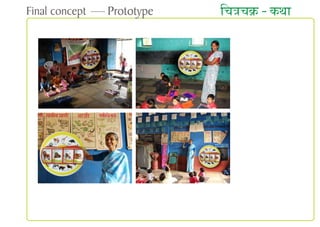
educational training. I think the fundamental understanding happens
from this stage. Students' age group starts from 3 - 6 and then they
are ready for their primary classes. So before primary its very
important and vital beginning portion in all students life.
During this study I came across many people who say that they still
remember their nursery teacher. So we can imagine the kind of
enjoyment, learning and bonding was there. Children's' mind in this
stage is very fragile and they are very much observant about things
around them. They try to build vocabulary of words, images etc.
which helps them building up fantasy. Fantasy and stories are big
parts of this stage of learning.
So I found this sub system of Anganwadi (courtyard play center)
interesting to build some basic learning aids and adding some more
fun element.
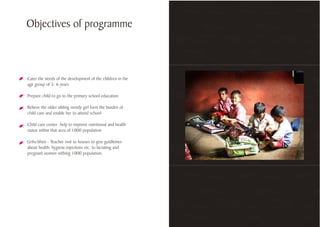
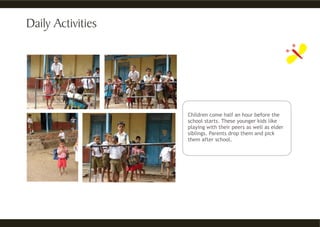
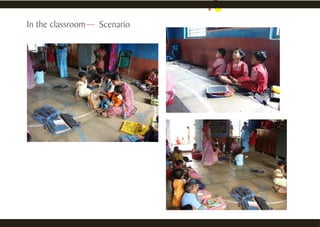
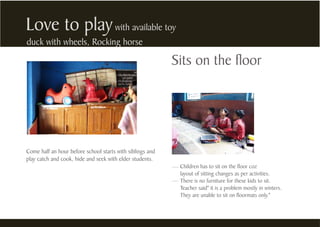
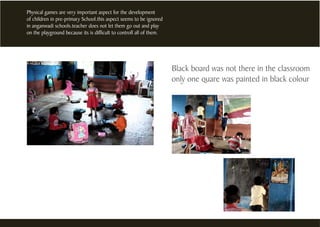
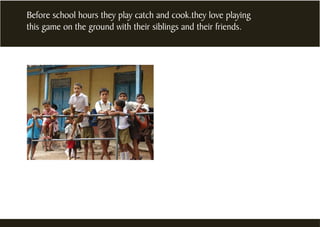
Children come half an hour before the
school starts. These younger kids like
playing with their peers as well as elder
siblings. Parents drop them and pick
them after school.
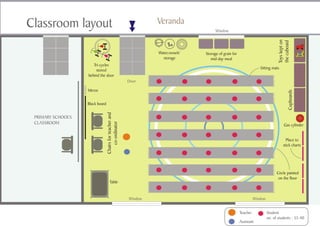
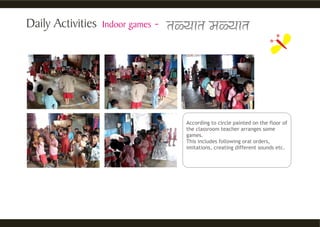
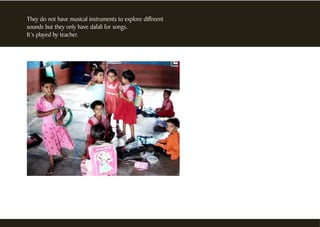
According to circle painted on the floor of
the classroom teacher arranges some
games.
This includes following oral orders,
imitations, creating different sounds etc.
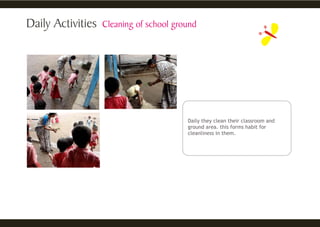
Daily they clean their classroom and
ground area. this forms habit for
cleanliness in them.
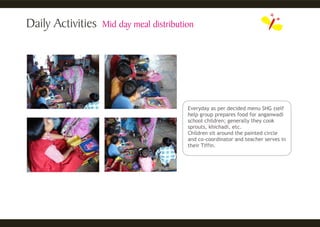
Everyday as per decided menu SHG (self
help group prepares food for anganwadi
school children; generally they cook
sprouts, khichadi, etc.
Children sit around the painted circle
and co-coordinator and teacher serves in
their Tiffin.
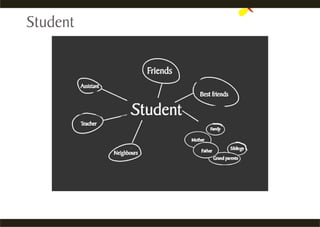
Teacher
Students
29
Play and learn
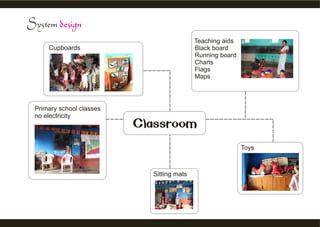
Low cost
Non- electric
Easy to manufacture
Made with local available materials
Simple to assemble
Modifiable
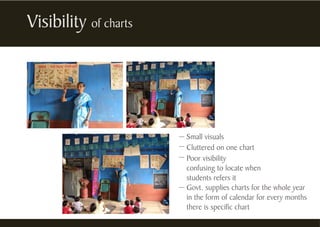
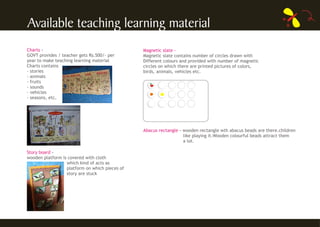
Charts -
.
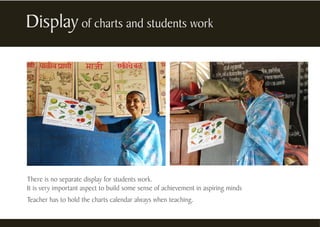
GOVT provides / teacher gets Rs.500/- per
year to make teaching learning material
Charts contains
- stories
- animals
- fruits
- sounds
- vehicles
- seasons, etc
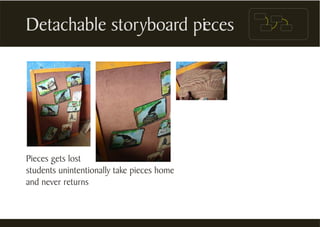
Story board -
wooden platform is covered with cloth
which kind of acts as
platform on which pieces of
story are stuck
Magnetic slate -
Magnetic slate contains number of circles drawn with
Different colours and provided with number of magnetic
circles on which there are printed pictures of colors,
birds, animals, vehicles etc.
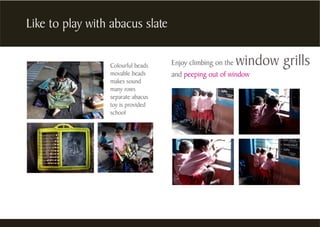
Abacus rectangle - wooden rectangle wth abacus beads are there.children
like playing it.Wooden colourful beads attract them
a lot.
Design a sequential story telling board or device
which can be used by students and teachers both.
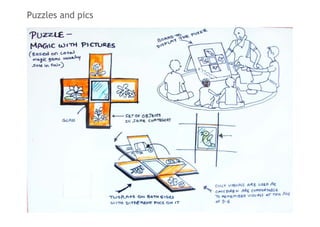
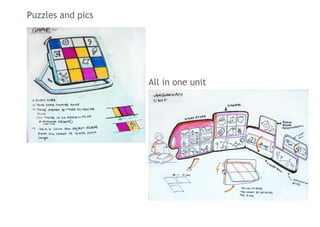
Puzzles and pics
Puzzles and pics
All in one unit
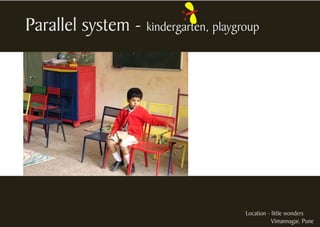
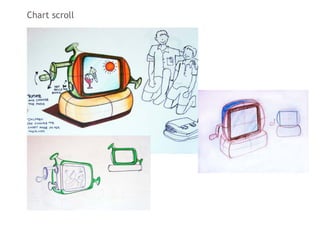
Chart scroll
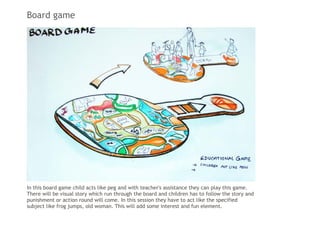
Board game
In this board game child acts like peg and with teacher's assistance they can play this game.
There will be visual story which run through the board and children has to follow the story and
punishment or action round will come. In this session they have to act like the specified
subject like frog jumps, old woman. This will add some interest and fun element.
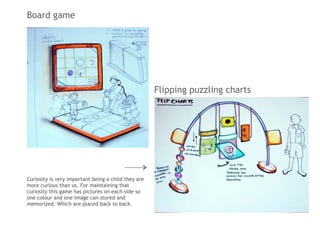
Flipping puzzling charts
Board game
Curiosity is very important being a child they are
more curious than us. For maintaining that
curiosity this game has pictures on each side so
one colour and one image can stored and
memorized. Which are placed back to back.
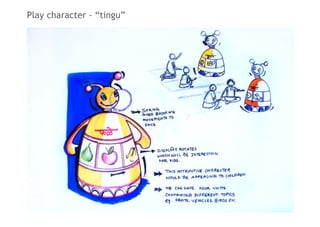
Play character - “tingu”
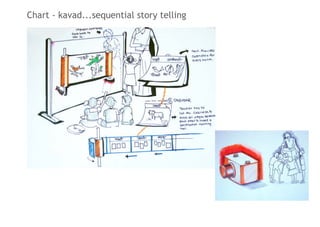
Chart - kavad...sequential story telling
Design brief -
Design a chart displaying system which also
includes the sequential story telling session.
Making the whole learning activity fun and learn base.
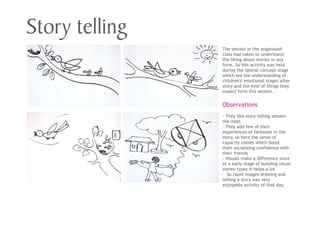
The session in the anganwadi
class had taken to understand
the liking about stories in any
form. So this activity was held
during the lateral concept stage
which led the understanding of
children's' emotional stages after
story and the kind of things they
expect form this session.
They like story telling session
the most.
They add few of their
experiences or fantasies in the
story, so here the sense of
capacity comes which boost
their socializing confidence with
their friends
Visuals make a difference since
at a early stage of building visual
stereo types it helps a lot
So rapid images drawing and
telling a story was very
enjoyable activity of that day.
Observations
-
-
-
-
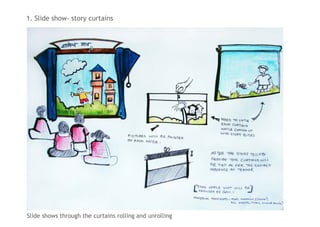
Slide shows through the curtains rolling and unrolling
1. Slide show- story curtains
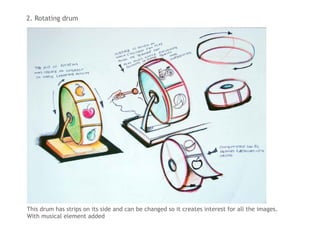
2. Rotating drum
This drum has strips on its side and can be changed so it creates interest for all the images.
With musical element added
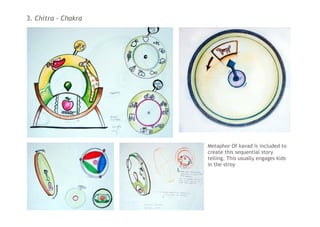
Metaphor Of kavad is included to
create this sequential story
telling. This usually engages kids
in the stroy
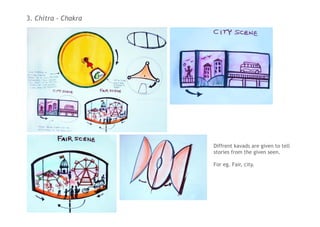
3. Chitra - Chakra
Diffrent kavads are given to tell
stories from the given seen.
For eg. Fair, city.
3. Chitra - Chakra
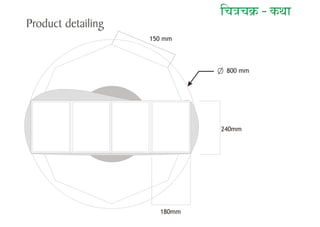
800 mm
180mm
240mm
150 mm
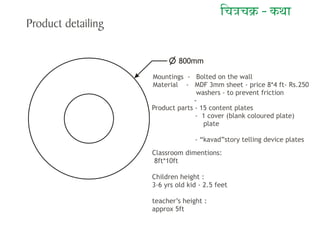
800mm
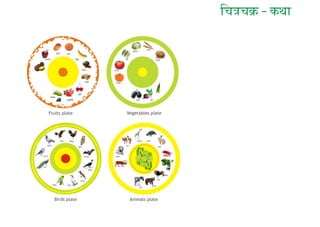
Graphics
Fruits plate Vegetables plate
Birds plate Animals plate
¨ÉÒ®SÉÒ
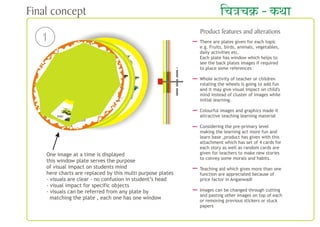
One image at a time is displayed
this window plate serves the purpose
of visual impact on students mind
here charts are replaced by this multi purpose plates
- visuals are clear - no confusion in student’s head
- visual impact for specific objects
- visuals can be referred from any plate by
matching the plate , each one has one window
1 There are plates given for each topic
e.g. Fruits, birds, animals, vegetables,
daily activities etc.
Each plate has window which helps to
see the back plates images if required
to place some references
Whole activity of teacher or children
rotating the wheels is going to add fun
and it may give visual impact on child's
mind instead of cluster of images while
initial learning.
Colourful images and graphics made it
attractive teaching learning material
Considering the pre-primary level
making the learning act more fun and
learn base ,product has given with this
attachment which has set of 4 cards for
each story as well as random cards are
given for teachers to make new stories
to convey some morals and habits.
Teaching aid which gives more than one
function are appreciated because of
price factor in Anganwadi
Images can be changed through cutting
and pasting other images on top of each
or removing previous stickers or stuck
papers
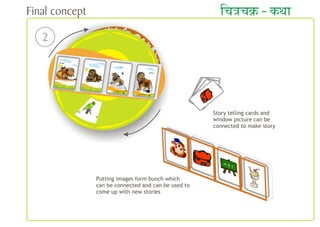
Putting images form bunch which
can be connected and can be used to
come up with new stories
Story telling cards and
window picture can be
connected to make story
2
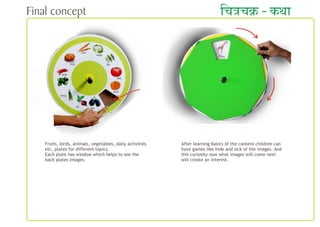
Fruits, birds, animals, vegetables, daily activities
etc. plates for different topics.
Each plate has window which helps to see the
back plates images.
After learning basics of the content children can
have games like hide and sick of the images. And
this curiosity now what images will come next
will create an interest.
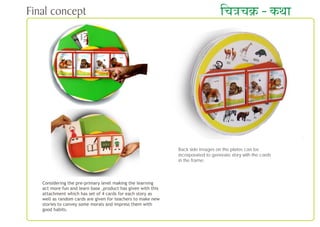
Considering the pre-primary level making the learning
act more fun and learn base ,product has given with this
attachment which has set of 4 cards for each story as
well as random cards are given for teachers to make new
stories to convey some morals and impress them with
good habits.
Back side images on the plates can be
incorporated to generate story with the cards
in the frame.
System design project by Vrushali Kulkarni

System design project by Vrushali Kulkarni

  • 3.
    Acknowledgments 1. Abstract 2. Scopeof project 3. Project Objective 4. Understanding the System 4.1 Organisation structure of municipal schools 4.2 Departments 5. Research 5.1 Selection of sub - system 5.2 Introduction - Anganwadi 5.3 Activities and teaching pattern 6. User study 7. Parallel system - Kinder garten 8. Synopsis- Problem identification 9. Design opportunities 10.Design parameters 11.Design brief 12.Idea sketching 13.Desin direction (redefined design brief) 14.Concept selection 15.Detailing 15.1 - Dimensions 15.2 - Colour pallet 15.2 - Functions 15.4 - Graphics 16. Concept (in details) 17. Technology availability 18. Final prototype
  • 4.
    I would liketo express my gratitude to my guide, Mrs. Shetall Natuu and Mr. Vikram Mitra for all their guidance in this learning experience with the project. I would also thank Mr. Kiran Sabnis and Pramod Sadolikar sir for their help to understand the scope of the project. Furthermore, I wish to express my gratitude to thank teachers of the school and special thanks to all the pre- primary children Most sincere thanks to the workshop staff for their co-operation and guidance in the model making stage. I would like to thank my friends, especially Devina, Malvika, Bageshree, Nikhil and Gaurav for their understanding, patience and motivation at every stage through the project
  • 5.
    The project aimsat studying a system of Municipal schools which are situated at rural sector. We came across the news of teaching methods in rural areas and the availability of resources for them. This actually triggered the project idea. After this we started to acquire some more information and problems faced by rural school children. This topic is very vast in nature as it is been handled by many people, NGOs and social activists for betterment of rural school education. There are many directions within this system. There are scarcity of resources, teachers in core villages, teaching learning materials, and students' attendance and retention level in class because lack of interest, time, and awareness as well as poverty. This is our major challenge n a group to understand problems and provide solutions on different directions.
  • 6.
    The scope ofthis design project covers the improvement for teaching methods of pre - primary students This would involve studying organizational structure, existing teaching methods, studying the context, contextual enquiry and user behavior .Which will help to provide better solution to the existing flaws in the subsystem. The main objective of this project is to study the system of rural municipal schools as well as the hierarchy in the educational system, entities, then the selecting sub-system and understanding it in detail to provide solutions to the observed problem areas.
  • 9.
    To understand theoverall scenario of the education system we mapped out entities and activities involved in a whole system for this we met few subject matter experts. who gave us and idea and details about exact working of the system. Then we have included systemic representations of the system which specifically deals with - Information flow - Money flow - Rural education system
  • 17.
    Pre primary classis the very beginning of the school and formal educational training. I think the fundamental understanding happens from this stage. Students' age group starts from 3 - 6 and then they are ready for their primary classes. So before primary its very important and vital beginning portion in all students life. During this study I came across many people who say that they still remember their nursery teacher. So we can imagine the kind of enjoyment, learning and bonding was there. Children's' mind in this stage is very fragile and they are very much observant about things around them. They try to build vocabulary of words, images etc. which helps them building up fantasy. Fantasy and stories are big parts of this stage of learning. So I found this sub system of Anganwadi (courtyard play center) interesting to build some basic learning aids and adding some more fun element.
  • 25.
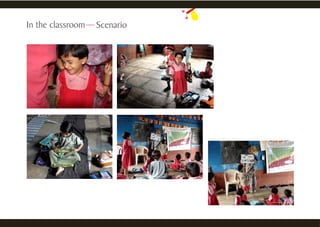
    Children come halfan hour before the school starts. These younger kids like playing with their peers as well as elder siblings. Parents drop them and pick them after school.
  • 26.
    According to circlepainted on the floor of the classroom teacher arranges some games. This includes following oral orders, imitations, creating different sounds etc.
  • 27.
    Daily they cleantheir classroom and ground area. this forms habit for cleanliness in them.
  • 28.
    Everyday as perdecided menu SHG (self help group prepares food for anganwadi school children; generally they cook sprouts, khichadi, etc. Children sit around the painted circle and co-coordinator and teacher serves in their Tiffin.
  • 29.
  • 35.
  • 52.
    Play and learn Lowcost Non- electric Easy to manufacture Made with local available materials Simple to assemble Modifiable
  • 53.
    Charts - . GOVT provides/ teacher gets Rs.500/- per year to make teaching learning material Charts contains - stories - animals - fruits - sounds - vehicles - seasons, etc Story board - wooden platform is covered with cloth which kind of acts as platform on which pieces of story are stuck Magnetic slate - Magnetic slate contains number of circles drawn with Different colours and provided with number of magnetic circles on which there are printed pictures of colors, birds, animals, vehicles etc. Abacus rectangle - wooden rectangle wth abacus beads are there.children like playing it.Wooden colourful beads attract them a lot.
  • 54.
    Design a sequentialstory telling board or device which can be used by students and teachers both.
  • 56.
  • 57.
  • 58.
  • 59.
    Board game In thisboard game child acts like peg and with teacher's assistance they can play this game. There will be visual story which run through the board and children has to follow the story and punishment or action round will come. In this session they have to act like the specified subject like frog jumps, old woman. This will add some interest and fun element.
  • 60.
    Flipping puzzling charts Boardgame Curiosity is very important being a child they are more curious than us. For maintaining that curiosity this game has pictures on each side so one colour and one image can stored and memorized. Which are placed back to back.
  • 61.
    Play character -“tingu”
  • 62.
  • 63.
    Design brief - Designa chart displaying system which also includes the sequential story telling session. Making the whole learning activity fun and learn base.
  • 65.
    The session inthe anganwadi class had taken to understand the liking about stories in any form. So this activity was held during the lateral concept stage which led the understanding of children's' emotional stages after story and the kind of things they expect form this session. They like story telling session the most. They add few of their experiences or fantasies in the story, so here the sense of capacity comes which boost their socializing confidence with their friends Visuals make a difference since at a early stage of building visual stereo types it helps a lot So rapid images drawing and telling a story was very enjoyable activity of that day. Observations - - - -
  • 66.
    Slide shows throughthe curtains rolling and unrolling 1. Slide show- story curtains
  • 67.
    2. Rotating drum Thisdrum has strips on its side and can be changed so it creates interest for all the images. With musical element added
  • 69.
    Metaphor Of kavadis included to create this sequential story telling. This usually engages kids in the stroy 3. Chitra - Chakra
  • 70.
    Diffrent kavads aregiven to tell stories from the given seen. For eg. Fair, city. 3. Chitra - Chakra
  • 71.
  • 72.
  • 73.
  • 74.
    Fruits plate Vegetablesplate Birds plate Animals plate ¨ÉÒ®SÉÒ
  • 75.
    One image ata time is displayed this window plate serves the purpose of visual impact on students mind here charts are replaced by this multi purpose plates - visuals are clear - no confusion in student’s head - visual impact for specific objects - visuals can be referred from any plate by matching the plate , each one has one window 1 There are plates given for each topic e.g. Fruits, birds, animals, vegetables, daily activities etc. Each plate has window which helps to see the back plates images if required to place some references Whole activity of teacher or children rotating the wheels is going to add fun and it may give visual impact on child's mind instead of cluster of images while initial learning. Colourful images and graphics made it attractive teaching learning material Considering the pre-primary level making the learning act more fun and learn base ,product has given with this attachment which has set of 4 cards for each story as well as random cards are given for teachers to make new stories to convey some morals and habits. Teaching aid which gives more than one function are appreciated because of price factor in Anganwadi Images can be changed through cutting and pasting other images on top of each or removing previous stickers or stuck papers
  • 76.
    Putting images formbunch which can be connected and can be used to come up with new stories Story telling cards and window picture can be connected to make story 2
  • 77.
    Fruits, birds, animals,vegetables, daily activities etc. plates for different topics. Each plate has window which helps to see the back plates images. After learning basics of the content children can have games like hide and sick of the images. And this curiosity now what images will come next will create an interest.
  • 78.
    Considering the pre-primarylevel making the learning act more fun and learn base ,product has given with this attachment which has set of 4 cards for each story as well as random cards are given for teachers to make new stories to convey some morals and impress them with good habits. Back side images on the plates can be incorporated to generate story with the cards in the frame.