Toward Structured Simulation of 
Enterprise Models 
Suman Roychoudhury, Sagar Sunkle, 
Hemant Rathod, and Vinay Kulkarni 
Tata Research Development and Design Center, 
Pune, India.
Motivation 
• Enterprise Architecture (EA) Models- 
– Holistic 
– Descriptive; capture who in enterprise do what and how across 
business, application, infrastructure layers 
– Static; do not describe the dynamic behavior an enterprise exhibits 
over time. 
• System Dynamics (SD) Models- 
– Useful for analysis of aggregates- 
– Pertinent to EA models at higher level of abstraction than business 
process models 
• Use case- Business as usual improvement 
– Simulation models derived from EA models could be used to study 
dynamic behavior of modeled enterprise 
– EA models are large; difficult to obtain simulation models by hand
EA (ArchiMate) MetaModels 
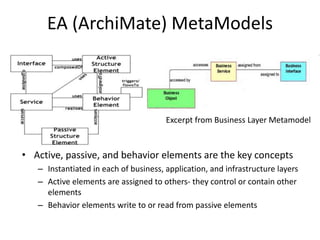
Excerpt from Business Layer Metamodel 
• Active, passive, and behavior elements are the key concepts 
– Instantiated in each of business, application, and infrastructure layers 
– Active elements are assigned to others- they control or contain other 
elements 
– Behavior elements write to or read from passive elements
System Dynamics Models 
InFlow 
OutFlow 
Stock 
Feedback 
Adapted From:http://www.naturalthinker.net/ 
• Stocks, flows and converters [variables/feedback] are the 
key concepts 
– Flows add up to or remove from stocks 
– Converters affect the flows 
– Stocks, flows, and converters can be grouped into modules
EA and SD Concepts 
EA Elements SD Elements Both Signify ArchiMate Examples 
Behavior 
Converters 
Behavior BusinessProcess, 
Elements 
and Flows 
ApplicationFunction 
Passive 
Structure 
Elements 
Stocks Passive nature; State; both 
change based on [causal] 
relations with other entities 
BusinessDataObject, 
ApplicationDataObject 
Active 
Structure 
Elements 
Modules Active nature; often contain 
or control rest of the 
entities 
BusinessActor, 
ApplicationComponent 
• EA Behavior elements could be realized as SD converters or 
flows 
– Which is more apt? Converters cannot directly influence behavior of the stocks; esp. if EA 
behavior element was related with a passive structure entity it must be flow rather than a 
converter 
– What if a EA behavior entity is related to both passive and active structure entities? 
• Requires elaborating relations between SD elements
Need for SD Metamodel 
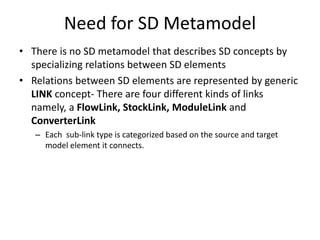
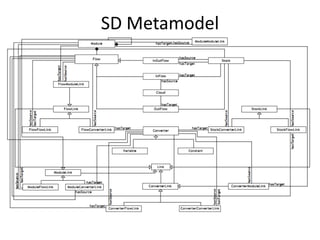
• There is no SD metamodel that describes SD concepts by 
specializing relations between SD elements 
• Relations between SD elements are represented by generic 
LINK concept- There are four different kinds of links 
namely, a FlowLink, StockLink, ModuleLink and 
ConverterLink 
– Each sub-link type is categorized based on the source and target 
model element it connects.
SD Metamodel
Specializing SD Element Links 
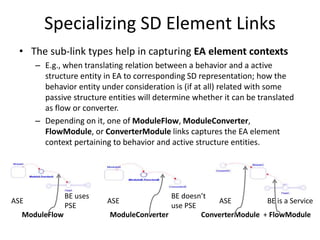
• The sub-link types help in capturing EA element contexts 
– E.g., when translating relation between a behavior and a active 
structure entity in EA to corresponding SD representation; how the 
behavior entity under consideration is (if at all) related with some 
passive structure entities will determine whether it can be translated 
as flow or converter. 
– Depending on it, one of ModuleFlow, ModuleConverter, 
FlowModule, or ConverterModule links captures the EA element 
context pertaining to behavior and active structure entities. 
ASE 
BE uses 
PSE 
BE doesn’t 
use PSE 
ASE ASE BE is a Service 
ModuleFlow ModuleConverter ConverterModule + FlowModule
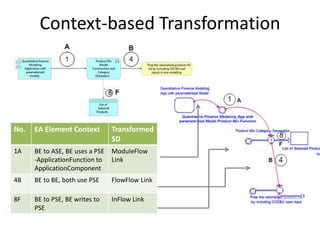
Context-based Transformation 
No. EA Element Context Transformed 
SD 
1A BE to ASE, BE uses a PSE 
-ApplicationFunction to 
ApplicationComponent 
ModuleFlow 
Link 
4B BE to BE, both use PSE FlowFlow Link 
8F BE to PSE, BE writes to 
PSE 
InFlow Link
Validation? 
• Merits 
– EA models of any size can be transformed- 
• A large EA model in its entirety or selective elements alone 
– Once SD model is available, simulation expert can discuss with 
domain expert about changing quantities now represented as 
stocks and flows 
– Context-based transformation based on metamodel relations 
enables traceability, but-
Yet to do- I 
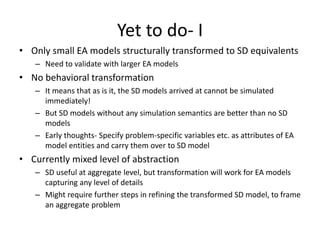
• Only small EA models structurally transformed to SD equivalents 
– Need to validate with larger EA models 
• No behavioral transformation 
– It means that as is it, the SD models arrived at cannot be simulated 
immediately! 
– But SD models without any simulation semantics are better than no SD 
models 
– Early thoughts- Specify problem-specific variables etc. as attributes of EA 
model entities and carry them over to SD model 
• Currently mixed level of abstraction 
– SD useful at aggregate level, but transformation will work for EA models 
capturing any level of details 
– Might require further steps in refining the transformed SD model, to frame 
an aggregate problem
Yet to do- II 
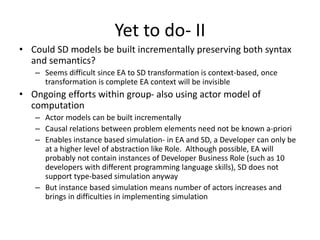
• Could SD models be built incrementally preserving both syntax 
and semantics? 
– Seems difficult since EA to SD transformation is context-based, once 
transformation is complete EA context will be invisible 
• Ongoing efforts within group- also using actor model of 
computation 
– Actor models can be built incrementally 
– Causal relations between problem elements need not be known a-priori 
– Enables instance based simulation- in EA and SD, a Developer can only be 
at a higher level of abstraction like Role. Although possible, EA will 
probably not contain instances of Developer Business Role (such as 10 
developers with different programming language skills), SD does not 
support type-based simulation anyway 
– But instance based simulation means number of actors increases and 
brings in difficulties in implementing simulation
Questions? 
I can be reached at sagar.sunkle@tcs.com

Toward Structured Simulation of Enterprise Models

  • 1.
    Toward Structured Simulationof Enterprise Models Suman Roychoudhury, Sagar Sunkle, Hemant Rathod, and Vinay Kulkarni Tata Research Development and Design Center, Pune, India.
  • 2.
    Motivation • EnterpriseArchitecture (EA) Models- – Holistic – Descriptive; capture who in enterprise do what and how across business, application, infrastructure layers – Static; do not describe the dynamic behavior an enterprise exhibits over time. • System Dynamics (SD) Models- – Useful for analysis of aggregates- – Pertinent to EA models at higher level of abstraction than business process models • Use case- Business as usual improvement – Simulation models derived from EA models could be used to study dynamic behavior of modeled enterprise – EA models are large; difficult to obtain simulation models by hand
  • 3.
    EA (ArchiMate) MetaModels Excerpt from Business Layer Metamodel • Active, passive, and behavior elements are the key concepts – Instantiated in each of business, application, and infrastructure layers – Active elements are assigned to others- they control or contain other elements – Behavior elements write to or read from passive elements
  • 4.
    System Dynamics Models InFlow OutFlow Stock Feedback Adapted From:http://www.naturalthinker.net/ • Stocks, flows and converters [variables/feedback] are the key concepts – Flows add up to or remove from stocks – Converters affect the flows – Stocks, flows, and converters can be grouped into modules
  • 5.
    EA and SDConcepts EA Elements SD Elements Both Signify ArchiMate Examples Behavior Converters Behavior BusinessProcess, Elements and Flows ApplicationFunction Passive Structure Elements Stocks Passive nature; State; both change based on [causal] relations with other entities BusinessDataObject, ApplicationDataObject Active Structure Elements Modules Active nature; often contain or control rest of the entities BusinessActor, ApplicationComponent • EA Behavior elements could be realized as SD converters or flows – Which is more apt? Converters cannot directly influence behavior of the stocks; esp. if EA behavior element was related with a passive structure entity it must be flow rather than a converter – What if a EA behavior entity is related to both passive and active structure entities? • Requires elaborating relations between SD elements
  • 6.
    Need for SDMetamodel • There is no SD metamodel that describes SD concepts by specializing relations between SD elements • Relations between SD elements are represented by generic LINK concept- There are four different kinds of links namely, a FlowLink, StockLink, ModuleLink and ConverterLink – Each sub-link type is categorized based on the source and target model element it connects.
  • 7.
  • 8.
    Specializing SD ElementLinks • The sub-link types help in capturing EA element contexts – E.g., when translating relation between a behavior and a active structure entity in EA to corresponding SD representation; how the behavior entity under consideration is (if at all) related with some passive structure entities will determine whether it can be translated as flow or converter. – Depending on it, one of ModuleFlow, ModuleConverter, FlowModule, or ConverterModule links captures the EA element context pertaining to behavior and active structure entities. ASE BE uses PSE BE doesn’t use PSE ASE ASE BE is a Service ModuleFlow ModuleConverter ConverterModule + FlowModule
  • 9.
    Context-based Transformation No.EA Element Context Transformed SD 1A BE to ASE, BE uses a PSE -ApplicationFunction to ApplicationComponent ModuleFlow Link 4B BE to BE, both use PSE FlowFlow Link 8F BE to PSE, BE writes to PSE InFlow Link
  • 10.
    Validation? • Merits – EA models of any size can be transformed- • A large EA model in its entirety or selective elements alone – Once SD model is available, simulation expert can discuss with domain expert about changing quantities now represented as stocks and flows – Context-based transformation based on metamodel relations enables traceability, but-
  • 11.
    Yet to do-I • Only small EA models structurally transformed to SD equivalents – Need to validate with larger EA models • No behavioral transformation – It means that as is it, the SD models arrived at cannot be simulated immediately! – But SD models without any simulation semantics are better than no SD models – Early thoughts- Specify problem-specific variables etc. as attributes of EA model entities and carry them over to SD model • Currently mixed level of abstraction – SD useful at aggregate level, but transformation will work for EA models capturing any level of details – Might require further steps in refining the transformed SD model, to frame an aggregate problem
  • 12.
    Yet to do-II • Could SD models be built incrementally preserving both syntax and semantics? – Seems difficult since EA to SD transformation is context-based, once transformation is complete EA context will be invisible • Ongoing efforts within group- also using actor model of computation – Actor models can be built incrementally – Causal relations between problem elements need not be known a-priori – Enables instance based simulation- in EA and SD, a Developer can only be at a higher level of abstraction like Role. Although possible, EA will probably not contain instances of Developer Business Role (such as 10 developers with different programming language skills), SD does not support type-based simulation anyway – But instance based simulation means number of actors increases and brings in difficulties in implementing simulation
  • 13.
    Questions? I canbe reached at sagar.sunkle@tcs.com