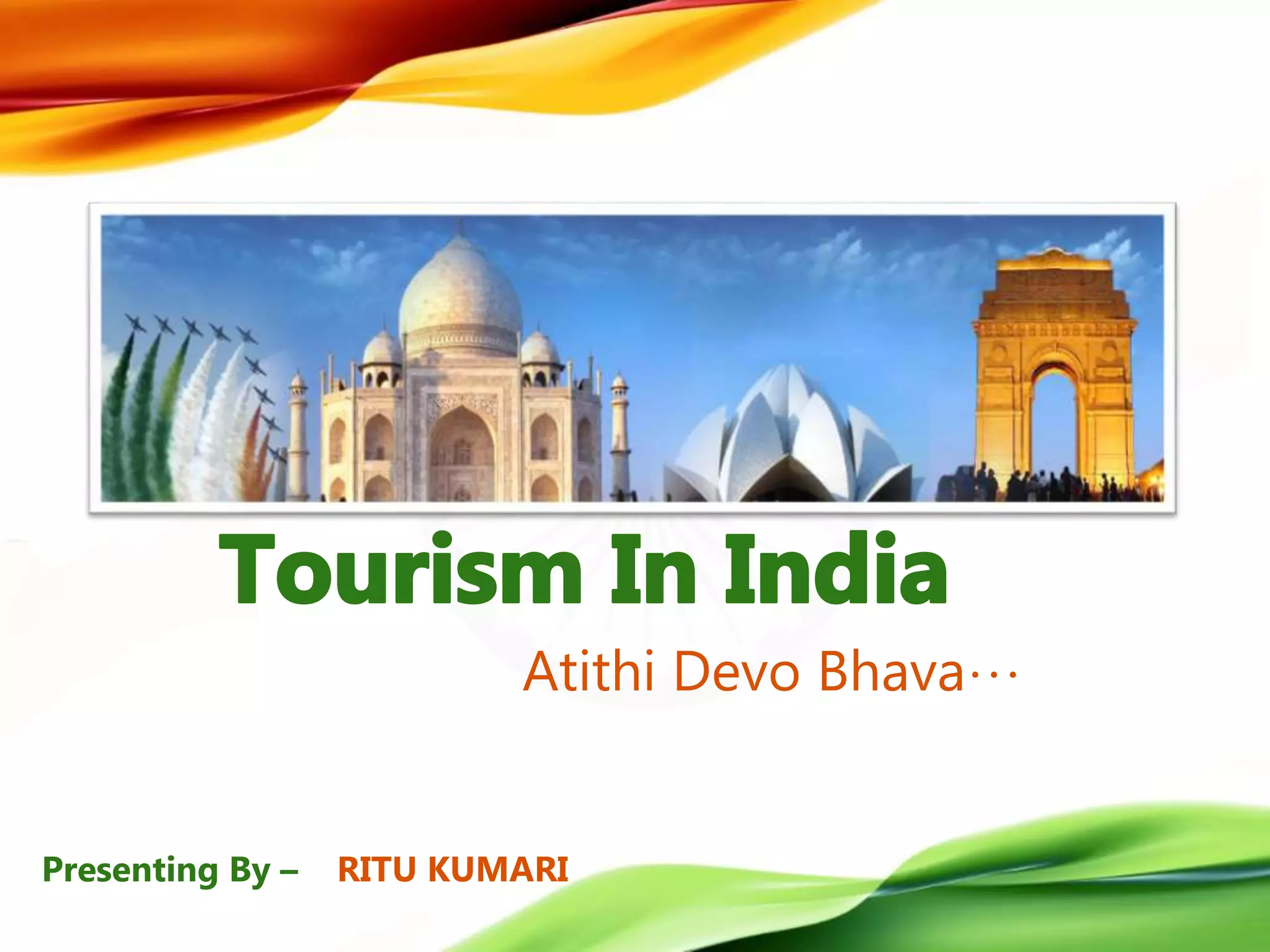
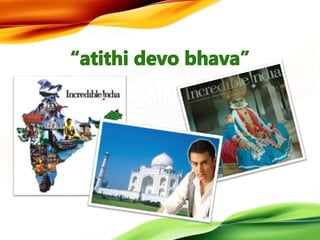
Atithi Devo Bhava…
Presenting By – RITU KUMARI
• Tourism is the travel for recreational (fun),
leisure (rest), family or business purposes,
usually of a limited duration.
The World Tourism Organization defines tourists as people
“traveling to and staying in places outside their usual
environment for not more than one consecutive year for leisure,
business and other purposes”.
• India as a tourism destination is the toast of the world
at the moment.
• Conde Nast ranked India amongst the top 10 tourist
destinations.
• Travel and tourism industry is the second highest
foreign exchange earner for India.
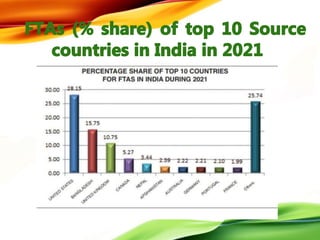
The number of FTAs in India during:
• 2019: 10.93million
• 2020: 2.74 million
• 2021: 1.52 million
• FTAs in March, 2022 were 3,42,308 with a positive growth
rate of 177.9% as compared to 1,23,179 in March, 2021.
• FTAs during the period January- March, 2022 were 7,84,750
as compared to 3,06,641 in March, 2021 registering a positive
growth of 155.9%.
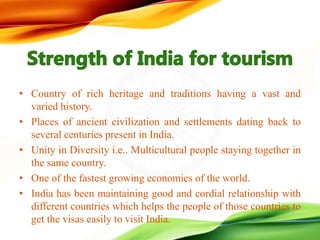
• Country of rich heritage and traditions having a vast and
varied history.
• Places of ancient civilization and settlements dating back to
several centuries present in India.
• Unity in Diversity i.e.. Multicultural people staying together in
the same country.
• One of the fastest growing economies of the world.
• India has been maintaining good and cordial relationship with
different countries which helps the people of those countries to
get the visas easily to visit India.
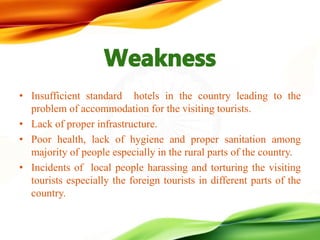
• Insufficient standard hotels in the country leading to the
problem of accommodation for the visiting tourists.
• Lack of proper infrastructure.
• Poor health, lack of hygiene and proper sanitation among
majority of people especially in the rural parts of the country.
• Incidents of local people harassing and torturing the visiting
tourists especially the foreign tourists in different parts of the
country.
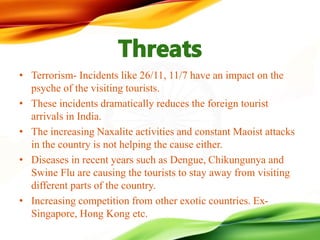
• Terrorism- Incidents like 26/11, 11/7 have an impact on the
psyche of the visiting tourists.
• These incidents dramatically reduces the foreign tourist
arrivals in India.
• The increasing Naxalite activities and constant Maoist attacks
in the country is not helping the cause either.
• Diseases in recent years such as Dengue, Chikungunya and
Swine Flu are causing the tourists to stay away from visiting
different parts of the country.
• Increasing competition from other exotic countries. Ex-
Singapore, Hong Kong etc.
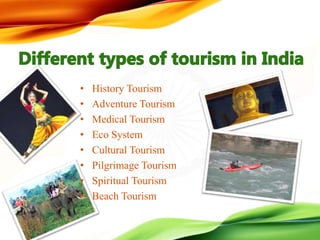
• History Tourism
• Adventure Tourism
• Medical Tourism
• Eco System
• Cultural Tourism
• Pilgrimage Tourism
• Spiritual Tourism
• Beach Tourism
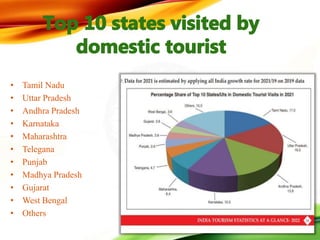
• Tamil Nadu
• Uttar Pradesh
• Andhra Pradesh
• Karnataka
• Maharashtra
• Telegana
• Punjab
• Madhya Pradesh
• Gujarat
• West Bengal
• Others
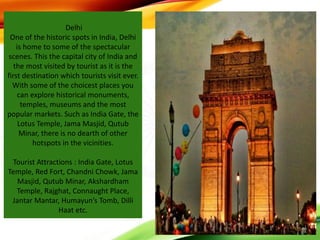
Delhi
One of the historic spots in India, Delhi
is home to some of the spectacular
scenes. This the capital city of India and
the most visited by tourist as it is the
first destination which tourists visit ever.
With some of the choicest places you
can explore historical monuments,
temples, museums and the most
popular markets. Such as India Gate, the
Lotus Temple, Jama Masjid, Qutub
Minar, there is no dearth of other
hotspots in the vicinities.
Tourist Attractions : India Gate, Lotus
Temple, Red Fort, Chandni Chowk, Jama
Masjid, Qutub Minar, Akshardham
Temple, Rajghat, Connaught Place,
Jantar Mantar, Humayun’s Tomb, Dilli
Haat etc.
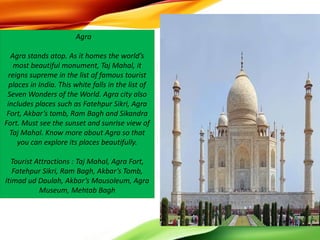
Agra
Agra stands atop. As it homes the world’s
most beautiful monument, Taj Mahal, it
reigns supreme in the list of famous tourist
places in India. This white falls in the list of
Seven Wonders of the World. Agra city also
includes places such as Fatehpur Sikri, Agra
Fort, Akbar’s tomb, Ram Bagh and Sikandra
Fort. Must see the sunset and sunrise view of
Taj Mahal. Know more about Agra so that
you can explore its places beautifully.
Tourist Attractions : Taj Mahal, Agra Fort,
Fatehpur Sikri, Ram Bagh, Akbar’s Tomb,
Itimad ud Daulah, Akbar’s Mausoleum, Agra
Museum, Mehtab Bagh
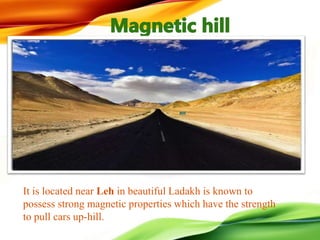
It is located near Leh in beautiful Ladakh is known to
possess strong magnetic properties which have the strength
to pull cars up-hill.
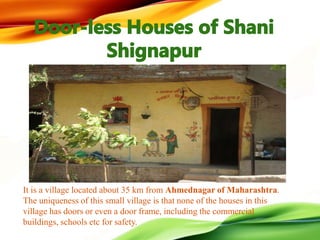
It is a village located about 35 km from Ahmednagar of Maharashtra.
The uniqueness of this small village is that none of the houses in this
village has doors or even a door frame, including the commercial
buildings, schools etc for safety.
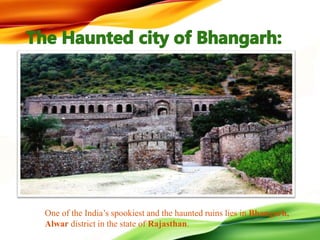
One of the India’s spookiest and the haunted ruins lies in Bhangarh,
Alwar district in the state of Rajasthan.
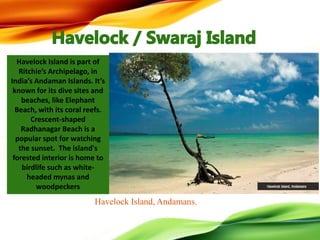
Havelock Island, Andamans.
Havelock Island is part of
Ritchie’s Archipelago, in
India’s Andaman Islands. It’s
known for its dive sites and
beaches, like Elephant
Beach, with its coral reefs.
Crescent-shaped
Radhanagar Beach is a
popular spot for watching
the sunset. The island's
forested interior is home to
birdlife such as white-
headed mynas and
woodpeckers
In the year 2002, the Government of India announced a New
Tourism Policy.
The policy is built around the 7-S Mantra of -
• SWAAGAT (WELCOME)
• SOOCHANAA (INFORMATION)
• SUVIDHAA (FACILITATION)
• SURAKSHAA (SECURITY)
• SAHYOG (COOPERATION)
• SANRACHNAA (INFRASTRUCTURE)
• SAFAAI (CLEANLINESS)
Tourism in india..pptx

Tourism in india..pptx

  • 1.
  • 2.
    • Tourism isthe travel for recreational (fun), leisure (rest), family or business purposes, usually of a limited duration.
  • 3.
    The World TourismOrganization defines tourists as people “traveling to and staying in places outside their usual environment for not more than one consecutive year for leisure, business and other purposes”.
  • 4.
    • India asa tourism destination is the toast of the world at the moment. • Conde Nast ranked India amongst the top 10 tourist destinations. • Travel and tourism industry is the second highest foreign exchange earner for India.
  • 5.
    The number ofFTAs in India during: • 2019: 10.93million • 2020: 2.74 million • 2021: 1.52 million • FTAs in March, 2022 were 3,42,308 with a positive growth rate of 177.9% as compared to 1,23,179 in March, 2021. • FTAs during the period January- March, 2022 were 7,84,750 as compared to 3,06,641 in March, 2021 registering a positive growth of 155.9%.
  • 7.
    • Country ofrich heritage and traditions having a vast and varied history. • Places of ancient civilization and settlements dating back to several centuries present in India. • Unity in Diversity i.e.. Multicultural people staying together in the same country. • One of the fastest growing economies of the world. • India has been maintaining good and cordial relationship with different countries which helps the people of those countries to get the visas easily to visit India.
  • 8.
    • Insufficient standardhotels in the country leading to the problem of accommodation for the visiting tourists. • Lack of proper infrastructure. • Poor health, lack of hygiene and proper sanitation among majority of people especially in the rural parts of the country. • Incidents of local people harassing and torturing the visiting tourists especially the foreign tourists in different parts of the country.
  • 9.
    • Terrorism- Incidentslike 26/11, 11/7 have an impact on the psyche of the visiting tourists. • These incidents dramatically reduces the foreign tourist arrivals in India. • The increasing Naxalite activities and constant Maoist attacks in the country is not helping the cause either. • Diseases in recent years such as Dengue, Chikungunya and Swine Flu are causing the tourists to stay away from visiting different parts of the country. • Increasing competition from other exotic countries. Ex- Singapore, Hong Kong etc.
  • 10.
    • History Tourism •Adventure Tourism • Medical Tourism • Eco System • Cultural Tourism • Pilgrimage Tourism • Spiritual Tourism • Beach Tourism
  • 12.
    • Tamil Nadu •Uttar Pradesh • Andhra Pradesh • Karnataka • Maharashtra • Telegana • Punjab • Madhya Pradesh • Gujarat • West Bengal • Others
  • 14.
    Delhi One of thehistoric spots in India, Delhi is home to some of the spectacular scenes. This the capital city of India and the most visited by tourist as it is the first destination which tourists visit ever. With some of the choicest places you can explore historical monuments, temples, museums and the most popular markets. Such as India Gate, the Lotus Temple, Jama Masjid, Qutub Minar, there is no dearth of other hotspots in the vicinities. Tourist Attractions : India Gate, Lotus Temple, Red Fort, Chandni Chowk, Jama Masjid, Qutub Minar, Akshardham Temple, Rajghat, Connaught Place, Jantar Mantar, Humayun’s Tomb, Dilli Haat etc.
  • 15.
    Agra Agra stands atop.As it homes the world’s most beautiful monument, Taj Mahal, it reigns supreme in the list of famous tourist places in India. This white falls in the list of Seven Wonders of the World. Agra city also includes places such as Fatehpur Sikri, Agra Fort, Akbar’s tomb, Ram Bagh and Sikandra Fort. Must see the sunset and sunrise view of Taj Mahal. Know more about Agra so that you can explore its places beautifully. Tourist Attractions : Taj Mahal, Agra Fort, Fatehpur Sikri, Ram Bagh, Akbar’s Tomb, Itimad ud Daulah, Akbar’s Mausoleum, Agra Museum, Mehtab Bagh
  • 17.
    It is locatednear Leh in beautiful Ladakh is known to possess strong magnetic properties which have the strength to pull cars up-hill.
  • 18.
    It is avillage located about 35 km from Ahmednagar of Maharashtra. The uniqueness of this small village is that none of the houses in this village has doors or even a door frame, including the commercial buildings, schools etc for safety.
  • 19.
    One of theIndia’s spookiest and the haunted ruins lies in Bhangarh, Alwar district in the state of Rajasthan.
  • 20.
    Havelock Island, Andamans. HavelockIsland is part of Ritchie’s Archipelago, in India’s Andaman Islands. It’s known for its dive sites and beaches, like Elephant Beach, with its coral reefs. Crescent-shaped Radhanagar Beach is a popular spot for watching the sunset. The island's forested interior is home to birdlife such as white- headed mynas and woodpeckers
  • 21.
    In the year2002, the Government of India announced a New Tourism Policy. The policy is built around the 7-S Mantra of - • SWAAGAT (WELCOME) • SOOCHANAA (INFORMATION) • SUVIDHAA (FACILITATION) • SURAKSHAA (SECURITY) • SAHYOG (COOPERATION) • SANRACHNAA (INFRASTRUCTURE) • SAFAAI (CLEANLINESS)

Editor's Notes