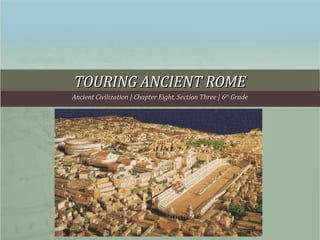
TOURING ANCIENT ROME Ancient Civilization | Chapter Eight, Section Three | 6 th  Grade
BACKGROUND ON ARCHITECTURE Some Roman Architecture was taken from the Greeks. Columns Others were taken from the Etruscans. Rounded Arches
BACKGROUND ON ARCHITECTURE By using arches, domes, vaults, and light-weight concrete the Romans could build huge structures. Every Roman City had the following: Temples Bath-houses Arenas City Walls
THE CITY WALLS OF ROME SERVIAN WALL Named after the 6 th  Roman King: Survius Tullius. Finished around 380 B.C. First stone wall to protect the city. Surrounded almost 700 acres of land.
THE CITY WALLS OF ROME AURELIAN WALL Built during the reign of Emperor Aurelian. Finished around 274 A.D.  Served as the city’s limits up until the 20 th  century.
ALL ROADS LEAD TO ROME VIA APPIA Also known as the Appian Way. Built in 312 B.C. for military transportation. Later used as the main trading route between Rome and Southern Italy. Almost 400 miles long.
THE PANTHEON The Pantheon: Reconstruction The Pantheon: As it looks today.
THE PANTHEON The word Pantheon means: “Of all the Gods.” Built to honor all of the Roman gods. Original temple destroyed by fire in 80 A.D. Best known for its Dome ceiling. The Pantheon as seen from a satellite.
ROMAN FORUM Also known as the Forum Romanum. Nobles and emperors built palaces next to this center of political, social, and religious life.
ROMAN FORUM Roman Forum as seen today.
BATHS OF CARACALLA Roman public baths. Contained shops and a library. Nearly 2,000 Romans visited every day. An aqueduct channeled water into this popular building.
CIRCUS MAXIMUS Used for chariot racing. The largest building ever put up for entertainment purposes. Could hold up to 300,000 spectators. Middle barrier was known as a  spina .
CIRCUS MAXIMUS Circus Maximus as seen today. Circus Maximus: Aerial View.
THE COLOSSEUM Real name is the Flavian Amphitheatre. Vespasian began construction around 70 A.D. First opened by Titus in 80 A.D. Crowds would come to watch gladiators fight wild beasts and each other.
INSIDE THE COLOSSEUM Could seat around 70,000 people. During shows a metal mesh carried on poles and spiked with elephant tusks and ivory rollers was used. Metal mesh kept animals from climbing out of the arena. Gladiator fights banned in 438 A.D. Last show was held in 523 A.D.
BENEATH THE COLOSSEUM
GLADIATOR: THE MOVIE
CLASSWORK/HOMEWORK First  Put Your NAME and CLASS PERIOD on the worksheet. Do Section A. On the backside of the worksheet do Section B. Hand it in when completed. If it is not completed by the end of class, finish it for homework and hand it in on Tuesday.

Touring Roma

  • 1.
    TOURING ANCIENT ROMEAncient Civilization | Chapter Eight, Section Three | 6 th Grade
  • 2.
    BACKGROUND ON ARCHITECTURESome Roman Architecture was taken from the Greeks. Columns Others were taken from the Etruscans. Rounded Arches
  • 3.
    BACKGROUND ON ARCHITECTUREBy using arches, domes, vaults, and light-weight concrete the Romans could build huge structures. Every Roman City had the following: Temples Bath-houses Arenas City Walls
  • 4.
    THE CITY WALLSOF ROME SERVIAN WALL Named after the 6 th Roman King: Survius Tullius. Finished around 380 B.C. First stone wall to protect the city. Surrounded almost 700 acres of land.
  • 5.
    THE CITY WALLSOF ROME AURELIAN WALL Built during the reign of Emperor Aurelian. Finished around 274 A.D. Served as the city’s limits up until the 20 th century.
  • 6.
    ALL ROADS LEADTO ROME VIA APPIA Also known as the Appian Way. Built in 312 B.C. for military transportation. Later used as the main trading route between Rome and Southern Italy. Almost 400 miles long.
  • 7.
    THE PANTHEON ThePantheon: Reconstruction The Pantheon: As it looks today.
  • 8.
    THE PANTHEON Theword Pantheon means: “Of all the Gods.” Built to honor all of the Roman gods. Original temple destroyed by fire in 80 A.D. Best known for its Dome ceiling. The Pantheon as seen from a satellite.
  • 9.
    ROMAN FORUM Alsoknown as the Forum Romanum. Nobles and emperors built palaces next to this center of political, social, and religious life.
  • 10.
    ROMAN FORUM RomanForum as seen today.
  • 11.
    BATHS OF CARACALLARoman public baths. Contained shops and a library. Nearly 2,000 Romans visited every day. An aqueduct channeled water into this popular building.
  • 12.
    CIRCUS MAXIMUS Usedfor chariot racing. The largest building ever put up for entertainment purposes. Could hold up to 300,000 spectators. Middle barrier was known as a spina .
  • 13.
    CIRCUS MAXIMUS CircusMaximus as seen today. Circus Maximus: Aerial View.
  • 14.
    THE COLOSSEUM Realname is the Flavian Amphitheatre. Vespasian began construction around 70 A.D. First opened by Titus in 80 A.D. Crowds would come to watch gladiators fight wild beasts and each other.
  • 15.
    INSIDE THE COLOSSEUMCould seat around 70,000 people. During shows a metal mesh carried on poles and spiked with elephant tusks and ivory rollers was used. Metal mesh kept animals from climbing out of the arena. Gladiator fights banned in 438 A.D. Last show was held in 523 A.D.
  • 16.
  • 17.
  • 18.
    CLASSWORK/HOMEWORK First Put Your NAME and CLASS PERIOD on the worksheet. Do Section A. On the backside of the worksheet do Section B. Hand it in when completed. If it is not completed by the end of class, finish it for homework and hand it in on Tuesday.