Apresentationon
BASICS OF
DESIGN THINKING
Guided by :
Dr. Subhendu Kumar Mishra
• The conoravirus pandemic has created
new challenges that hospitals need to
overcome.
• Hospital is the place where there are
many patients admitted due to
coronavirus, many doctors and nurses
treating them and many come to take
the antigen or RT-PCR test.
• Spread of the virus can take place
when we come in close contact with
people.
• Also, coming in contact with the same
service buttons might lead to the
spread of the virus.
• As nowadays getting to know who is
infected or who is not is very difficult.
2
PROBLEM
AREA
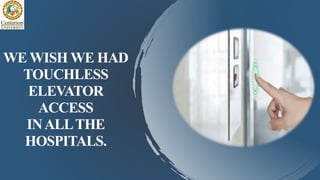
WE WISH WE HAD
TOUCHLESS
ELEVATOR
ACCESS
INALLTHE
HOSPITALS.
BRIEFABOUTTHE
CHALLENGES
4
• Nowadays identifying who is infected
and who is not is very difficult.
• We considered it as a problem because
the virus may spreads when we come
incontact with any object in the hospital.
• Elevators service buttons are the mostly
used in the hospitals. So, to get rid of any
physical contact we can at least make the
elevators of our hospitals touchless.
• Touchless elevator access makes the
process more safe and convenient to use.
• We can design something like a sensor
enabled or Voice/ Speech enabled or
Facial Recognition enabled.
UNDERSTANDING
THE CHALLENGE
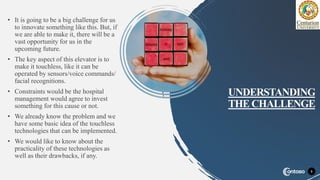
• It is going to be a big challenge for us
to innovate something like this. But, if
we are able to make it, there will be a
vast opportunity for us in the
upcoming future.
• The key aspect of this elevator is to
make it touchless, like it can be
operated by sensors/voice commands/
facial recognitions.
• Constraints would be the hospital
management would agree to invest
something for this cause or not.
• We already know the problem and we
have some basic idea of the touchless
technologies that can be implemented.
• We would like to know about the
practicality of these technologies as
well as their drawbacks, if any.
5
6
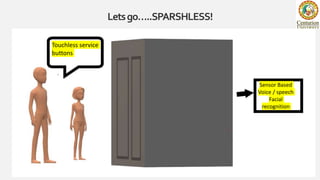
Sensor Based
Voice / speech
Facial
recognition
Touchless service
buttons
Letsgo…..SPARSHLESS!
DEFINEYOUR USER
7
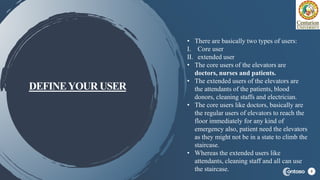
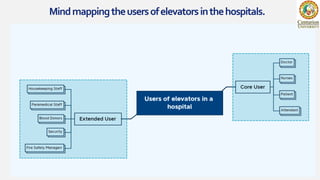
• There are basically two types of users:
I. Core user
II. extended user
• The core users of the elevators are
doctors, nurses and patients.
• The extended users of the elevators are
the attendants of the patients, blood
donors, cleaning staffs and electrician.
• The core users like doctors, basically are
the regular users of elevators to reach the
floor immediately for any kind of
emergency also, patient need the elevators
as they might not be in a state to climb the
staircase.
• Whereas the extended users like
attendants, cleaning staff and all can use
the staircase.
Mindmappingtheusersofelevatorsinthehospitals.
8
9
UNDERSTANDING THE
USER &THEIR
REQUIREMENTS
• To understand the user in a better manner
we need to have a word with all the types of
users – core as well as extended.
• Speaking to many was a lengthy process so
we have designed an questionnaire with
close ended questions that would help us get
a deeper insights of our users.
• We have questions from broad topic to
specific.
• We followed the questionnaire method to
get a primary data about the users.
• We had followed the purposive sample
technique and were successful to collect 100
samples.
• Please click to find the google form: Survey
form for Touchless Elevator Access
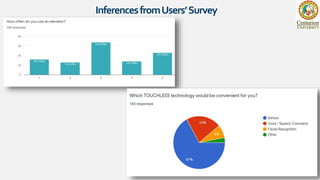
InferencesfromUsers’Survey
10
• To find the solutions in a better
manner we had a word with experts.
• We spoke to them and made points
as well as shared with them a
questionnaire with open ended
questions so that we can document
our findings.
• Please click to find the google form:
Survey form for Touchless Elevator
Access
• We shared the form with three
people
• Person from civil consulting
• Person from software company
• Person from electronics
11
RESEARCH
InsightsfromInterview
12
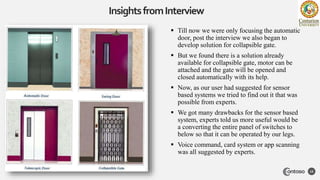
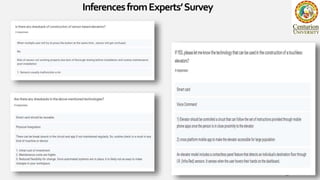
 Till now we were only focusing the automatic
door, post the interview we also began to
develop solution for collapsible gate.
 But we found there is a solution already
available for collapsible gate, motor can be
attached and the gate will be opened and
closed automatically with its help.
 Now, as our user had suggested for sensor
based systems we tried to find out it that was
possible from experts.
 We got many drawbacks for the sensor based
system, experts told us more useful would be
a converting the entire panel of switches to
below so that it can be operated by our legs.
 Voice command, card system or app scanning
was all suggested by experts.
InferencesfromExperts’Survey
13
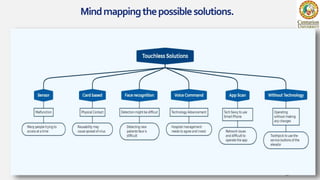
Mindmappingthepossiblesolutions.
14
INSIGHTWHICH CAN
TURN INTOACTIONABLE
OPPORTUNITY
15
• As touchless operation of service buttons
in an elevator is the need of the hour and
technological advancement would take
some time to be implemented.
• So we thought of something which can be
implemented without the use of much
investment and technology.
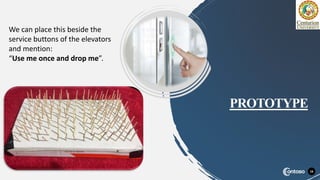
• Operating the service buttons with the
help of toothpicks, it would be for one
time use only.
• It can be immediately adopted and
implemented in the hospitals as it is not a
costlier approach even.
16
PROTOTYPE
We can place this beside the
service buttons of the elevators
and mention:
“Use me once and drop me”.
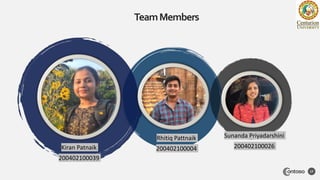
Rhitiq Pattnaik
200402100004
TeamMembers
17
Kiran Patnaik
200402100039
Sunanda Priyadarshini
200402100026
THANK YOU
18

Touchless Elevator Access

  • 1.
  • 2.
    • The conoraviruspandemic has created new challenges that hospitals need to overcome. • Hospital is the place where there are many patients admitted due to coronavirus, many doctors and nurses treating them and many come to take the antigen or RT-PCR test. • Spread of the virus can take place when we come in close contact with people. • Also, coming in contact with the same service buttons might lead to the spread of the virus. • As nowadays getting to know who is infected or who is not is very difficult. 2 PROBLEM AREA
  • 3.
    WE WISH WEHAD TOUCHLESS ELEVATOR ACCESS INALLTHE HOSPITALS.
  • 4.
    BRIEFABOUTTHE CHALLENGES 4 • Nowadays identifyingwho is infected and who is not is very difficult. • We considered it as a problem because the virus may spreads when we come incontact with any object in the hospital. • Elevators service buttons are the mostly used in the hospitals. So, to get rid of any physical contact we can at least make the elevators of our hospitals touchless. • Touchless elevator access makes the process more safe and convenient to use. • We can design something like a sensor enabled or Voice/ Speech enabled or Facial Recognition enabled.
  • 5.
    UNDERSTANDING THE CHALLENGE • Itis going to be a big challenge for us to innovate something like this. But, if we are able to make it, there will be a vast opportunity for us in the upcoming future. • The key aspect of this elevator is to make it touchless, like it can be operated by sensors/voice commands/ facial recognitions. • Constraints would be the hospital management would agree to invest something for this cause or not. • We already know the problem and we have some basic idea of the touchless technologies that can be implemented. • We would like to know about the practicality of these technologies as well as their drawbacks, if any. 5
  • 6.
    6 Sensor Based Voice /speech Facial recognition Touchless service buttons Letsgo…..SPARSHLESS!
  • 7.
    DEFINEYOUR USER 7 • Thereare basically two types of users: I. Core user II. extended user • The core users of the elevators are doctors, nurses and patients. • The extended users of the elevators are the attendants of the patients, blood donors, cleaning staffs and electrician. • The core users like doctors, basically are the regular users of elevators to reach the floor immediately for any kind of emergency also, patient need the elevators as they might not be in a state to climb the staircase. • Whereas the extended users like attendants, cleaning staff and all can use the staircase.
  • 8.
  • 9.
    9 UNDERSTANDING THE USER &THEIR REQUIREMENTS •To understand the user in a better manner we need to have a word with all the types of users – core as well as extended. • Speaking to many was a lengthy process so we have designed an questionnaire with close ended questions that would help us get a deeper insights of our users. • We have questions from broad topic to specific. • We followed the questionnaire method to get a primary data about the users. • We had followed the purposive sample technique and were successful to collect 100 samples. • Please click to find the google form: Survey form for Touchless Elevator Access
  • 10.
  • 11.
    • To findthe solutions in a better manner we had a word with experts. • We spoke to them and made points as well as shared with them a questionnaire with open ended questions so that we can document our findings. • Please click to find the google form: Survey form for Touchless Elevator Access • We shared the form with three people • Person from civil consulting • Person from software company • Person from electronics 11 RESEARCH
  • 12.
    InsightsfromInterview 12  Till nowwe were only focusing the automatic door, post the interview we also began to develop solution for collapsible gate.  But we found there is a solution already available for collapsible gate, motor can be attached and the gate will be opened and closed automatically with its help.  Now, as our user had suggested for sensor based systems we tried to find out it that was possible from experts.  We got many drawbacks for the sensor based system, experts told us more useful would be a converting the entire panel of switches to below so that it can be operated by our legs.  Voice command, card system or app scanning was all suggested by experts.
  • 13.
  • 14.
  • 15.
    INSIGHTWHICH CAN TURN INTOACTIONABLE OPPORTUNITY 15 •As touchless operation of service buttons in an elevator is the need of the hour and technological advancement would take some time to be implemented. • So we thought of something which can be implemented without the use of much investment and technology. • Operating the service buttons with the help of toothpicks, it would be for one time use only. • It can be immediately adopted and implemented in the hospitals as it is not a costlier approach even.
  • 16.
    16 PROTOTYPE We can placethis beside the service buttons of the elevators and mention: “Use me once and drop me”.
  • 17.
  • 18.