Topology
Dr.P.Geetha
Basis for a Topology
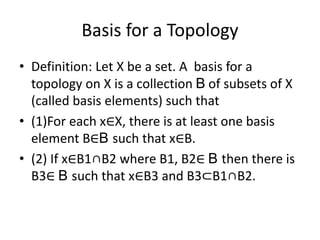
• Definition: Let X be a set. A basis for a
topology on X is a collection B of subsets of X
(called basis elements) such that
• (1)For each x∈X, there is at least one basis
element B∈B such that x∈B.
• (2) If x∈B1∩B2 where B1, B2∈ B then there is
B3∈ B such that x∈B3 and B3⊂B1∩B2.
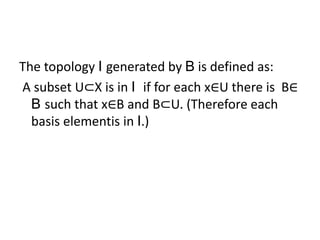
The topology I generated by B is defined as:
A subset U⊂X is in I if for each x∈U there is B∈
B such that x∈B and B⊂U. (Therefore each
basis elementis in I.)
• Theorem : Let B be a basis for a topology on
X. Define I ={U⊂X| x∈U implies x∈B⊂U for
some B∈ B}, the “topology” generated be B.
Then I is in fact a topology on X.
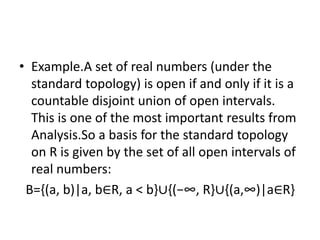
• Example.A set of real numbers (under the
standard topology) is open if and only if it is a
countable disjoint union of open intervals.
This is one of the most important results from
Analysis.So a basis for the standard topology
on R is given by the set of all open intervals of
real numbers:
B={(a, b)|a, b∈R, a < b}∪{(−∞, R}∪{(a,∞)|a∈R}
Example 2: A basis for the standard topology on
RxR is also given by the set ofall open
rectangular regions in RxR.
Example 3: If X is any set,B={{x}|x∈X}is a basis
for the discrete topology onX.
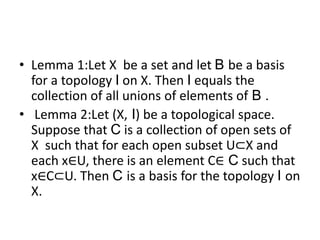
• Lemma 1:Let X be a set and let B be a basis
for a topology I on X. Then I equals the
collection of all unions of elements of B .
• Lemma 2:Let (X, I) be a topological space.
Suppose that C is a collection of open sets of
X such that for each open subset U⊂X and
each x∈U, there is an element C∈ C such that
x∈C⊂U. Then C is a basis for the topology I on
X.
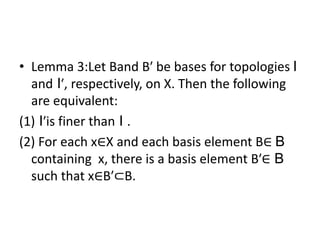
• Lemma 3:Let Band B′ be bases for topologies I
and I′, respectively, on X. Then the following
are equivalent:
(1) I′is finer than I .
(2) For each x∈X and each basis element B∈ B
containing x, there is a basis element B′∈ B
such that x∈B′⊂B.
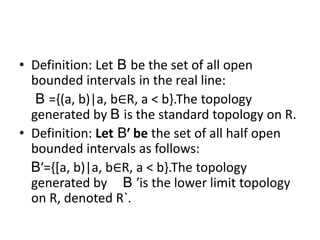
• Definition: Let B be the set of all open
bounded intervals in the real line:
B ={(a, b)|a, b∈R, a < b}.The topology
generated by B is the standard topology on R.
• Definition: Let B′ be the set of all half open
bounded intervals as follows:
B′={[a, b)|a, b∈R, a < b}.The topology
generated by B ′is the lower limit topology
on R, denoted R`.
• Definition: Let K={1/n|n∈N}.
Let B ′′={(a, b)|a, b∈R, a < b}∪{(a, b)K|a,
b∈R, a < b}.
The topology generated by B′′ is the K-topology
on R, denoted by RK.
• Lemma 4: The topologies of R`and RK are each
strictly finer than the stan-dard topology on R,
but are not comparable with one another.

Topology

  • 1.
  • 2.
    Basis for aTopology • Definition: Let X be a set. A basis for a topology on X is a collection B of subsets of X (called basis elements) such that • (1)For each x∈X, there is at least one basis element B∈B such that x∈B. • (2) If x∈B1∩B2 where B1, B2∈ B then there is B3∈ B such that x∈B3 and B3⊂B1∩B2.
  • 3.
    The topology Igenerated by B is defined as: A subset U⊂X is in I if for each x∈U there is B∈ B such that x∈B and B⊂U. (Therefore each basis elementis in I.)
  • 4.
    • Theorem :Let B be a basis for a topology on X. Define I ={U⊂X| x∈U implies x∈B⊂U for some B∈ B}, the “topology” generated be B. Then I is in fact a topology on X.
  • 5.
    • Example.A setof real numbers (under the standard topology) is open if and only if it is a countable disjoint union of open intervals. This is one of the most important results from Analysis.So a basis for the standard topology on R is given by the set of all open intervals of real numbers: B={(a, b)|a, b∈R, a < b}∪{(−∞, R}∪{(a,∞)|a∈R}
  • 6.
    Example 2: Abasis for the standard topology on RxR is also given by the set ofall open rectangular regions in RxR. Example 3: If X is any set,B={{x}|x∈X}is a basis for the discrete topology onX.
  • 7.
    • Lemma 1:LetX be a set and let B be a basis for a topology I on X. Then I equals the collection of all unions of elements of B . • Lemma 2:Let (X, I) be a topological space. Suppose that C is a collection of open sets of X such that for each open subset U⊂X and each x∈U, there is an element C∈ C such that x∈C⊂U. Then C is a basis for the topology I on X.
  • 8.
    • Lemma 3:LetBand B′ be bases for topologies I and I′, respectively, on X. Then the following are equivalent: (1) I′is finer than I . (2) For each x∈X and each basis element B∈ B containing x, there is a basis element B′∈ B such that x∈B′⊂B.
  • 9.
    • Definition: LetB be the set of all open bounded intervals in the real line: B ={(a, b)|a, b∈R, a < b}.The topology generated by B is the standard topology on R. • Definition: Let B′ be the set of all half open bounded intervals as follows: B′={[a, b)|a, b∈R, a < b}.The topology generated by B ′is the lower limit topology on R, denoted R`.
  • 10.
    • Definition: LetK={1/n|n∈N}. Let B ′′={(a, b)|a, b∈R, a < b}∪{(a, b)K|a, b∈R, a < b}. The topology generated by B′′ is the K-topology on R, denoted by RK. • Lemma 4: The topologies of R`and RK are each strictly finer than the stan-dard topology on R, but are not comparable with one another.