Network topologies and
access methods - Agenda
 5 min Warm up motivating video
 15 min Introduction teacher demonstrate
 15 min Act1 – TPS searching about Network topologies
 5 min Act2 - listen to topologies video then asking questions
 10 min Act3 - teacher demonstrate “Network Operating Software”
 10 min Act4 – network access methods
 10 min Act5 - listen to access methods video then
asking questions
 5 min Reflection
 Home work
Osama Ghandour Geris
Assiut
STEM School1
How could to know about network
topologies and access methods?
Example Movie
makerAsk or call a
college
Ask a
teacher
Ask or call an
expert or an
engineer
Search through search
engine such as google
or Bing for ppt or pdf
files using your laptop
or smart phone through
internet connection
Use the help / F1
Search through
YouTube
Search through wiki
Beddia
Osama Ghandour Geris
Assiut
STEM School2
Classroom Norms
Osama Ghandour Geris
Assiut
STEM School3
Introduction teacher demonstrate
Topology 15 min
 The physical topology of a network refers to the
configuration of cables, computers and other
peripherals.
 The main types of network topologies are:
– Linear Bus
– Star
– Ring
– Tree or Hybrid
Osama Ghandour Geris
Assiut
STEM School4
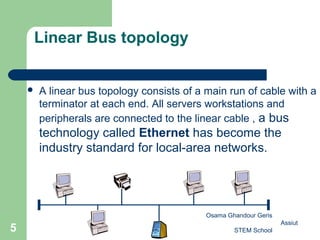
Linear Bus topology
 A linear bus topology consists of a main run of cable with a
terminator at each end. All servers workstations and
peripherals are connected to the linear cable , a bus
technology called Ethernet has become the
industry standard for local-area networks.
Osama Ghandour Geris
Assiut
STEM School5
Star topology
 A star network is
designed with each
node (file server,
workstation,
peripheral) connected
directly to a central
network hub or server
Osama Ghandour Geris
Assiut
STEM School6
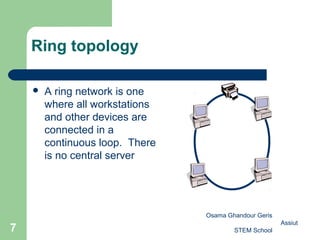
Ring topology
 A ring network is one
where all workstations
and other devices are
connected in a
continuous loop. There
is no central server
Osama Ghandour Geris
Assiut
STEM School7
Osama Ghandour Geris
Assiut
STEM School8
Tree or hybrid topology
 A tree or hybrid
topology combines
characteristics of linear
bus and star and/or
ring topologies.
 It consists of groups of
star-configured
workstations connected
to a linear bus
backbone cable
Osama Ghandour Geris
Assiut
STEM School9
Star-Wired Bus
Osama Ghandour Geris
Assiut
STEM School10
Star-bus-Topology - Star-ring
Topology
Osama Ghandour Geris
Assiut
STEM School11

15 min Act1 – TPS
-Searching about Network
topologies
-Students print A3 and A4
papers about Network
topologies then stick it at the
class room walls
Osama Ghandour Geris
Assiut
STEM School12

5 min Act2 -
listen to topologies
video then asking
questions video
link Osama Ghandour Geris
Assiut
STEM School13
Daisy chain: linked series of devicesDaisy chain: linked series of devices
– Hubs and switches often connected in daisyHubs and switches often connected in daisy
chain to extend a networkchain to extend a network
Hubs, gateways, routers, switches, andHubs, gateways, routers, switches, and
bridges can form part of backbonebridges can form part of backbone
Extent to which hubs can be connected isExtent to which hubs can be connected is
limitedlimited
Backbone Networks: Serial
Backbone
Osama Ghandour Geris
Assiut
STEM School14
10 min Act3 - teacher demonstrate
“Network Operating Software”
 Network operating systems co-
ordinate the activities of
multiple computers across a
network
 The two major types of
network OS are:
– Peer-to-peer
– Client/server
Osama Ghandour Geris
Assiut
STEM School15
Peer to peer network OS
– In peer to peer network OS, there is no
file server or central management source;
all computers are considered equal
– Peer to peer networks are design
primarily for small to medium LANS
– AppleShare and Windows for
Workgroups are examples of programs
that can function as peer to peer
Osama Ghandour Geris
Assiut
STEM School16
Client/Server network OS
– Client/server network OS
centralise functions and
applications in one or more
dedicated file servers.
– The file server provides access to
resources and provides security
– Novel Netware and Windows NT
Server are examples of
client/server network operating
systems
Osama Ghandour Geris
Assiut
STEM School17
Osama Ghandour Geris
Assiut
STEM School18
Network Flow of data / Computer
network access methods
The Function of Access Methods
The set of rules that defines how a
computer puts data onto the network
cable and takes data from the cable is
called an access method. Once data
is moving on the network, access
methods help to regulate the flow of
10 min Act4 – network access methods
Osama Ghandour Geris
Assiut
STEM School19
Traffic Control on the Cable
A network is in some ways like a railroad
track, along which several trains run.
The track is interspersed with
occasional railway stations. When a
train is on the track, all other trains
must abide by a procedure that
governs how and when they enter the
flow of traffic. Without such a
procedure, entering trains would
collide with the one already on the
track. Train pictures
Osama Ghandour Geris
Assiut
STEM School20
What are important
differences between
a railroad system
and a computer
network?. Train pictures
Osama Ghandour Geris
Assiut
STEM School21
Network Flow of data / computer
network access methods
– Carrier-sense multiple-access
with collision detection
(CSMA/CD)
– Carrier-sense multiple-access with
collision avoidance (CSMA/CA)
– Token passing Osama Ghandour Geris
Assiut
STEM School22
10 min Act5 -
listen to access
methods video
then asking
questions Osama Ghandour Geris
Assiut
STEM School23
Carrier-sense multiple-access with
collision detection (CSMA/CD)
Collision occurs if two computers put
data on the cable at the same time
Osama Ghandour Geris
Assiut
STEM School24
Access methods
prevent computers from
gaining simultaneous
access to the cable. By
making sure that only
one computer at a time
can put data on the
network cable, access
methods ensure that
the sending and
receiving of network
data is an orderly
process.
Computers can
transmit data only if
the cable is free
Osama Ghandour Geris
Assiut
STEM School25
Osama Ghandour Geris
Assiut
STEM School26
With these points in mind, the name of
the access method—carrier-sense
multiple access with collision detection
(CSMA/CD)—makes sense. Computers
listen to or "sense" the cable (carrier-
sense). Commonly, many computers on
the network attempt to transmit data
(multiple access); each one first listens to
detect any possible collisions. If a
computer detects a possible collision, it
waits for a random period of time before
retransmitting (collision detection).
Osama Ghandour Geris
Assiut
STEM School27
CSMA/CD is known as a contention method because
computers on the network contend, or compete, for an
opportunity to send data
CSMA/CD Considerations
The more computers there are on the network, the more
network traffic there will be. With more traffic, collision
avoidance and collisions tend to increase, which slows
the network down, so CSMA/CD can be a slow-access
method. Ex. journal exams
Osama Ghandour Geris
Assiut
STEM School28
 After each collision, both computers will have to try to
retransmit their data. If the network is very busy, there
is a chance that the attempts by both computers will
result in collisions with packets from other computers
on the network. If this happens, four computers (the two
original computers and the two computers whose
transmitted packets collided with the original
computer's retransmitted packets) will have to attempt
to retransmit. These proliferating retransmissions can
slow the network to a near standstill.
 The occurrence of this problem depends on the number
of users attempting to use the network and which
applications they are using. Database applications tend
to put more traffic on the network than word-processing
applications do. Ex journal exams
Osama Ghandour Geris
Assiut
STEM School29
 Depending on the hardware components, the cabling,
and the networking software, using a CSMA/CD
network with many users running several database
applications can be very frustrating because of heavy
network traffic. Ex journal exams
Osama Ghandour Geris
Assiut
STEM School30
 Token-Passing Access Method
 In the access method known as token passing, a
special type of packet, called a token, circulates around
a cable ring from computer to computer. When any
computer on the ring needs to send data across the
network, it must wait for a free token. When a free
token is detected, the computer will take control of it if
the computer has data to send.
The computer can now transmit data. Data is transmitted
in frames, and additional information, such as
addressing, is attached to the frame in the form of
headers and trailers
Osama Ghandour Geris
Assiut
STEM School31
 While the token is in use by one computer, other
computers cannot transmit data. Because only one
computer at a time can use the token, no contention
and no collision take place, and no time is spent waiting
for computers to resend tokens due to network traffic
on the cable.
Osama Ghandour Geris
Assiut
STEM School32
 Demand Priority Access Method
 Demand priority is a relatively new access method
designed for the 100-Mbps Ethernet standard known as
100VG-AnyLAN. It has been sanctioned and
standardized by the Institute of Electrical and Electronic
Engineers (IEEE) in its 802.12 specification, which is
discussed later in this chapter.
 This access method is based on the fact that repeaters and end
nodes are the two components that make up all 100VG-AnyLAN
networks. Figure 3.4 shows a demand-priority network. The
repeaters manage network access by doing round-robin
searches for requests to send from all nodes on the network.
The repeater, or hub, is responsible for noting all addresses,
links, and end nodes and verifying that they are all functioning.
According to the 100VG-AnyLAN definition, an end node can be
a computer, bridge, router, or switch.
Osama Ghandour Geris
Assiut
STEM School33
Osama Ghandour Geris
Assiut
STEM School34
 Demand-Priority Contention
 As in CSMA/CD, two computers using the demand-
priority access method can cause contention by
transmitting at exactly the same time. However, with
demand priority, it is possible to implement a scheme in
which certain types of data will be given priority if there
is contention. If the hub or repeater receives two
requests at the same time, the highest priority request
is serviced first. If the two requests are of the same
priority, both requests are serviced by alternating
between the two.
 In a demand-priority network, computers can receive and
transmit at the same time because of the cabling scheme
defined for this access method. In this method, four pairs of
wires are used, which enables quartet signaling, transmitting 25
Osama Ghandour Geris
Assiut
STEM School35
 Demand priority offers several advantages over
CSMA/CD including:
 The use of four pairs of wires.
 By using four pairs of wires, computers can transmit
and receive at the same time.
 Transmissions through the hub.
 Transmissions are not broadcast to all the other
computers on the network. The computers do not
contend on their own for access to the cable, but
operate under the centralized control of the hub.
Osama Ghandour Geris
Assiut
STEM School36
Feature or
function
CSMA/CD CSMA/CA
Token
passing
Demand
priority
Type of
Communic
ation
Broadcast-
based
Broadcast-
based
Token-
based
Hub-based
Type of
access
method
Contention Contention Noncontent
ion
Contention
Type of
network
Ethernet LocalTalk Token Ring 100VG-
AnyLan
Table 3.1 Features of Different Access Methods
Osama Ghandour Geris
Assiut
STEM School37
 Managing data on a network is a form of traffic control.
 The set of rules that governs how network traffic is controlled is
called the access method.
 When using the CSMA/CD access method, a computer waits
until the network is quiet and then transmits its data. If two
computers transmit at the same time, the data will collide and
have to be re-sent. If two data packets collide, both will be
destroyed.
 When using the CSMA/CA access method, a computer transmits
its intent to transmit before actually sending the data.
 When using the token-ring access method, each computer must
wait to receive the token before it can transmit data. Only one
computer at a time can use the token.
 When using the demand-priority access method, each computer
communicates only with a hub. The hub then controls the flow of
data.
Access methods summary
Osama Ghandour Geris
Assiut
STEM School38
Osama Ghandour Geris
Assiut
STEM School39
5 min Reflection
• What is your goal to accomplish in
next week End Using Technology
and Computer Science?
Osama Ghandour Geris
Assiut
STEM School40
Home work
provides a summary
comparison between
Peer-to-Peer and
Client/Server Networks in
a table . Computer-Networks--Introduction_Computer_Networking pdf file
Osama Ghandour Geris
Assiut
STEM School41
https://twitter.com/osamageris
https://www.linkedin.com/in/osamaghandour/
https://www.youtube.com/user/osmgg2
https://www.facebook.com/osama.g.geris
Osama Ghandour Geris
Assiut
STEM School42

topological computer networks and access methods

  • 1.
    Network topologies and accessmethods - Agenda  5 min Warm up motivating video  15 min Introduction teacher demonstrate  15 min Act1 – TPS searching about Network topologies  5 min Act2 - listen to topologies video then asking questions  10 min Act3 - teacher demonstrate “Network Operating Software”  10 min Act4 – network access methods  10 min Act5 - listen to access methods video then asking questions  5 min Reflection  Home work Osama Ghandour Geris Assiut STEM School1
  • 2.
    How could toknow about network topologies and access methods? Example Movie makerAsk or call a college Ask a teacher Ask or call an expert or an engineer Search through search engine such as google or Bing for ppt or pdf files using your laptop or smart phone through internet connection Use the help / F1 Search through YouTube Search through wiki Beddia Osama Ghandour Geris Assiut STEM School2
  • 3.
    Classroom Norms Osama GhandourGeris Assiut STEM School3
  • 4.
    Introduction teacher demonstrate Topology15 min  The physical topology of a network refers to the configuration of cables, computers and other peripherals.  The main types of network topologies are: – Linear Bus – Star – Ring – Tree or Hybrid Osama Ghandour Geris Assiut STEM School4
  • 5.
    Linear Bus topology A linear bus topology consists of a main run of cable with a terminator at each end. All servers workstations and peripherals are connected to the linear cable , a bus technology called Ethernet has become the industry standard for local-area networks. Osama Ghandour Geris Assiut STEM School5
  • 6.
    Star topology  Astar network is designed with each node (file server, workstation, peripheral) connected directly to a central network hub or server Osama Ghandour Geris Assiut STEM School6
  • 7.
    Ring topology  Aring network is one where all workstations and other devices are connected in a continuous loop. There is no central server Osama Ghandour Geris Assiut STEM School7
  • 8.
  • 9.
    Tree or hybridtopology  A tree or hybrid topology combines characteristics of linear bus and star and/or ring topologies.  It consists of groups of star-configured workstations connected to a linear bus backbone cable Osama Ghandour Geris Assiut STEM School9
  • 10.
    Star-Wired Bus Osama GhandourGeris Assiut STEM School10
  • 11.
    Star-bus-Topology - Star-ring Topology OsamaGhandour Geris Assiut STEM School11
  • 12.
     15 min Act1– TPS -Searching about Network topologies -Students print A3 and A4 papers about Network topologies then stick it at the class room walls Osama Ghandour Geris Assiut STEM School12
  • 13.
     5 min Act2- listen to topologies video then asking questions video link Osama Ghandour Geris Assiut STEM School13
  • 14.
    Daisy chain: linkedseries of devicesDaisy chain: linked series of devices – Hubs and switches often connected in daisyHubs and switches often connected in daisy chain to extend a networkchain to extend a network Hubs, gateways, routers, switches, andHubs, gateways, routers, switches, and bridges can form part of backbonebridges can form part of backbone Extent to which hubs can be connected isExtent to which hubs can be connected is limitedlimited Backbone Networks: Serial Backbone Osama Ghandour Geris Assiut STEM School14
  • 15.
    10 min Act3- teacher demonstrate “Network Operating Software”  Network operating systems co- ordinate the activities of multiple computers across a network  The two major types of network OS are: – Peer-to-peer – Client/server Osama Ghandour Geris Assiut STEM School15
  • 16.
    Peer to peernetwork OS – In peer to peer network OS, there is no file server or central management source; all computers are considered equal – Peer to peer networks are design primarily for small to medium LANS – AppleShare and Windows for Workgroups are examples of programs that can function as peer to peer Osama Ghandour Geris Assiut STEM School16
  • 17.
    Client/Server network OS –Client/server network OS centralise functions and applications in one or more dedicated file servers. – The file server provides access to resources and provides security – Novel Netware and Windows NT Server are examples of client/server network operating systems Osama Ghandour Geris Assiut STEM School17
  • 18.
  • 19.
    Network Flow ofdata / Computer network access methods The Function of Access Methods The set of rules that defines how a computer puts data onto the network cable and takes data from the cable is called an access method. Once data is moving on the network, access methods help to regulate the flow of 10 min Act4 – network access methods Osama Ghandour Geris Assiut STEM School19
  • 20.
    Traffic Control onthe Cable A network is in some ways like a railroad track, along which several trains run. The track is interspersed with occasional railway stations. When a train is on the track, all other trains must abide by a procedure that governs how and when they enter the flow of traffic. Without such a procedure, entering trains would collide with the one already on the track. Train pictures Osama Ghandour Geris Assiut STEM School20
  • 21.
    What are important differencesbetween a railroad system and a computer network?. Train pictures Osama Ghandour Geris Assiut STEM School21
  • 22.
    Network Flow ofdata / computer network access methods – Carrier-sense multiple-access with collision detection (CSMA/CD) – Carrier-sense multiple-access with collision avoidance (CSMA/CA) – Token passing Osama Ghandour Geris Assiut STEM School22
  • 23.
    10 min Act5- listen to access methods video then asking questions Osama Ghandour Geris Assiut STEM School23
  • 24.
    Carrier-sense multiple-access with collisiondetection (CSMA/CD) Collision occurs if two computers put data on the cable at the same time Osama Ghandour Geris Assiut STEM School24
  • 25.
    Access methods prevent computersfrom gaining simultaneous access to the cable. By making sure that only one computer at a time can put data on the network cable, access methods ensure that the sending and receiving of network data is an orderly process. Computers can transmit data only if the cable is free Osama Ghandour Geris Assiut STEM School25
  • 26.
  • 27.
    With these pointsin mind, the name of the access method—carrier-sense multiple access with collision detection (CSMA/CD)—makes sense. Computers listen to or "sense" the cable (carrier- sense). Commonly, many computers on the network attempt to transmit data (multiple access); each one first listens to detect any possible collisions. If a computer detects a possible collision, it waits for a random period of time before retransmitting (collision detection). Osama Ghandour Geris Assiut STEM School27
  • 28.
    CSMA/CD is knownas a contention method because computers on the network contend, or compete, for an opportunity to send data CSMA/CD Considerations The more computers there are on the network, the more network traffic there will be. With more traffic, collision avoidance and collisions tend to increase, which slows the network down, so CSMA/CD can be a slow-access method. Ex. journal exams Osama Ghandour Geris Assiut STEM School28
  • 29.
     After eachcollision, both computers will have to try to retransmit their data. If the network is very busy, there is a chance that the attempts by both computers will result in collisions with packets from other computers on the network. If this happens, four computers (the two original computers and the two computers whose transmitted packets collided with the original computer's retransmitted packets) will have to attempt to retransmit. These proliferating retransmissions can slow the network to a near standstill.  The occurrence of this problem depends on the number of users attempting to use the network and which applications they are using. Database applications tend to put more traffic on the network than word-processing applications do. Ex journal exams Osama Ghandour Geris Assiut STEM School29
  • 30.
     Depending onthe hardware components, the cabling, and the networking software, using a CSMA/CD network with many users running several database applications can be very frustrating because of heavy network traffic. Ex journal exams Osama Ghandour Geris Assiut STEM School30
  • 31.
     Token-Passing AccessMethod  In the access method known as token passing, a special type of packet, called a token, circulates around a cable ring from computer to computer. When any computer on the ring needs to send data across the network, it must wait for a free token. When a free token is detected, the computer will take control of it if the computer has data to send. The computer can now transmit data. Data is transmitted in frames, and additional information, such as addressing, is attached to the frame in the form of headers and trailers Osama Ghandour Geris Assiut STEM School31
  • 32.
     While thetoken is in use by one computer, other computers cannot transmit data. Because only one computer at a time can use the token, no contention and no collision take place, and no time is spent waiting for computers to resend tokens due to network traffic on the cable. Osama Ghandour Geris Assiut STEM School32
  • 33.
     Demand PriorityAccess Method  Demand priority is a relatively new access method designed for the 100-Mbps Ethernet standard known as 100VG-AnyLAN. It has been sanctioned and standardized by the Institute of Electrical and Electronic Engineers (IEEE) in its 802.12 specification, which is discussed later in this chapter.  This access method is based on the fact that repeaters and end nodes are the two components that make up all 100VG-AnyLAN networks. Figure 3.4 shows a demand-priority network. The repeaters manage network access by doing round-robin searches for requests to send from all nodes on the network. The repeater, or hub, is responsible for noting all addresses, links, and end nodes and verifying that they are all functioning. According to the 100VG-AnyLAN definition, an end node can be a computer, bridge, router, or switch. Osama Ghandour Geris Assiut STEM School33
  • 34.
  • 35.
     Demand-Priority Contention As in CSMA/CD, two computers using the demand- priority access method can cause contention by transmitting at exactly the same time. However, with demand priority, it is possible to implement a scheme in which certain types of data will be given priority if there is contention. If the hub or repeater receives two requests at the same time, the highest priority request is serviced first. If the two requests are of the same priority, both requests are serviced by alternating between the two.  In a demand-priority network, computers can receive and transmit at the same time because of the cabling scheme defined for this access method. In this method, four pairs of wires are used, which enables quartet signaling, transmitting 25 Osama Ghandour Geris Assiut STEM School35
  • 36.
     Demand priorityoffers several advantages over CSMA/CD including:  The use of four pairs of wires.  By using four pairs of wires, computers can transmit and receive at the same time.  Transmissions through the hub.  Transmissions are not broadcast to all the other computers on the network. The computers do not contend on their own for access to the cable, but operate under the centralized control of the hub. Osama Ghandour Geris Assiut STEM School36
  • 37.
    Feature or function CSMA/CD CSMA/CA Token passing Demand priority Typeof Communic ation Broadcast- based Broadcast- based Token- based Hub-based Type of access method Contention Contention Noncontent ion Contention Type of network Ethernet LocalTalk Token Ring 100VG- AnyLan Table 3.1 Features of Different Access Methods Osama Ghandour Geris Assiut STEM School37
  • 38.
     Managing dataon a network is a form of traffic control.  The set of rules that governs how network traffic is controlled is called the access method.  When using the CSMA/CD access method, a computer waits until the network is quiet and then transmits its data. If two computers transmit at the same time, the data will collide and have to be re-sent. If two data packets collide, both will be destroyed.  When using the CSMA/CA access method, a computer transmits its intent to transmit before actually sending the data.  When using the token-ring access method, each computer must wait to receive the token before it can transmit data. Only one computer at a time can use the token.  When using the demand-priority access method, each computer communicates only with a hub. The hub then controls the flow of data. Access methods summary Osama Ghandour Geris Assiut STEM School38
  • 39.
  • 40.
    5 min Reflection •What is your goal to accomplish in next week End Using Technology and Computer Science? Osama Ghandour Geris Assiut STEM School40
  • 41.
    Home work provides asummary comparison between Peer-to-Peer and Client/Server Networks in a table . Computer-Networks--Introduction_Computer_Networking pdf file Osama Ghandour Geris Assiut STEM School41
  • 42.