Shading Models
• Ashading model, also known as a lighting model, is a mathematical
representation that determines how light interacts with a surface in
computer graphics. It calculates the color and brightness of a surface
point based on various lighting conditions and material properties.
Shading models are essential for creating realistic and visually
appealing 3D graphics.
Parameters of ShadingModels
• Lighting Parameters: These parameters define the properties of the light
sources in the scene, such as the position, intensity, color, and direction.
• Surface Normals: Surface normals are vectors perpendicular to the
surface at each point and are crucial for calculating lighting interactions
accurately.
• Material Properties: These parameters describe the characteristics of the
surface material, including its diffuse color, specular color, shininess,
transparency, and reflectivity.
• Viewing Parameters: The viewer's position and direction affect how the
surface interacts with light and the viewer's perspective.
5.
Types of CommonShading Models
• Lambertian (Diffuse) Shading: The Lambertian shading model is based on
the law of Lambert's cosine, which calculates the diffuse reflection of light
on a surface. It assumes that light is reflected equally in all directions,
making surfaces appear uniformly lit.
• Phong Shading: The Phong shading model includes both diffuse and
specular reflections. It produces smoother highlights on surfaces and
provides a more realistic representation of materials with different
shininess.
• Blinn-Phong Shading: This is a modification of the Phong shading model
that offers improved computational efficiency while maintaining a similar
visual quality.
6.
Types of CommonShading Models..continu
• Gouraud Shading: Gouraud shading calculates the color at each vertex
of a 3D model and then interpolates the colors across the surface. It is
computationally less expensive than Phong shading but can produce
visible color banding on smooth surfaces.
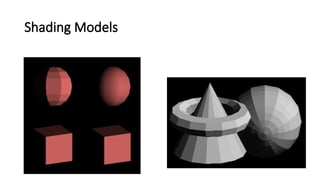
• Flat Shading: Flat shading assigns a single color to each face or
polygon, resulting in a faceted appearance. It is computationally
efficient but lacks visual smoothness.
• Cook-Torrance Shading: The Cook-Torrance model is a more advanced
shading model suitable for realistic rendering of materials with
microfacet surfaces, such as metals.
7.
Advantages of ShadingModels
• Realism: Shading models contribute to the realism of computer-
generated images by simulating how light interacts with surfaces in
the real world.
• Visual Appeal: Properly implemented shading models enhance the
visual appeal of 3D graphics, making them more engaging and
believable to viewers.
• Diverse Effects: Different shading models can simulate a wide range of
materials, from matte surfaces to shiny metals, allowing for diverse
visual effects.
8.
Advantages of ShadingModels..continu
• Dynamic Lighting: Shading models enable dynamic lighting in real-
time applications like video games, where lighting conditions can
change dynamically.
• Artistic Control: Artists and designers can use shading models to
achieve specific visual styles and artistic effects in their creations.
9.
Challenges of ShadingModels
• Computational Complexity: Advanced shading models with realistic
effects can be computationally expensive, leading to reduced
performance in real-time applications.
• Artifacts: Some shading models may produce visual artifacts, such as
aliasing or shading discontinuities, which can degrade image quality.
• Parameter Tuning: Properly setting the parameters of shading models
for specific materials and lighting conditions requires expertise and
artistic judgment.
10.
Challenges of ShadingModels..continu
• Compatibility: Shading models may not be universally supported
across different rendering platforms or hardware, leading to variations
in visual output.
• Global Illumination: Simulating global illumination effects accurately
in real-time applications can be challenging and may require
specialized techniques.