Retailers
Retailers aremiddlemen
They deal with ultimate customers
They link producers and customers
Their transactions are small in volume
They take title of the goods
They buy from wholesalers for reselling
Products can be sold in person, by internet, or at
home
02/02/26 2
3.
Retailers
Retailers aremerchants whose main business is
selling directly to ultimate customers.
Peter D. Bennett
Retailer is a merchant middleman who is engaged
primarily in selling to ultimate consumers
Dictionary of Marketing
02/02/26 3
4.
Retail Definition
anybusiness that directs its marketing efforts
towards satisfying the final consumer based upon
the organization of selling goods and services as a
means of distribution.
David Gilbert
02/02/26 4
5.
Retailing
Retailing encompassesthe business activities
involved in selling goods and services to
consumers for their personal, family or household
use.
Barry Berman & Joel R. Evans
Retailing is the set of business activities that adds
value to the products and services sold to
consumers for their personal or family use
Michael Levy, Barton A. Weitz & Ajaya Pandit
02/02/26 5
6.
Retail Management
Thevarious processes which help the customers to
procure the desired merchandise from the retail
stores for their end use refer to retail management.
Retail management includes all the steps required
to bring the customers into the store and fulfill
their buying needs.
02/02/26 6
7.
Characteristics of Retailing
Links wholesaler and customers
Sells to ultimate customers
Sells in small quantity
Deals in large varieties of products
Requires less amount of capital
Profit margin is higher in retailing compared to
wholesaling
Last link
02/02/26 7
8.
Types of Retailers
On the basis of ownership
Independent store
Chain store
Contract store
Consumer store
On the basis of product line
General store
Single line store
Specialty store
02/02/26 8
9.
Types of Retailers
On the basis of sales volume
Small scale retailers
Large scale retailers
On the basis of method of operation
In-store retailing
Non-store retiling
02/02/26 9
10.
Malls
Many retailstores operating at one place form a
mall.
A mall would consist of several retail outlets each
selling their own merchandise but at a common
platform.
02/02/26 10
11.
E-Tailers
Now adays the customers have the option of
shopping while sitting at their homes
They can place their order through internet, pay
with the help of debit/ credit cards or Cash on
delivery
This kind of shopping is convenient for those who
have a hectic schedule and are reluctant to go to
retail outlets.
02/02/26 11
12.
Department Stores
Adepartment store is a set-up which offers wide
range of products to the end-users under one roof.
In a department store, the consumers can get
almost all the products they aspire to shop at one
place only.
Department stores provide a wide range of
options to the consumers and thus fulfill all their
shopping needs.
02/02/26 12
13.
Super market
Alow price, self service retail store which
generally sells food products and household items,
properly placed and arranged in specific
departments is called a supermarket.
02/02/26 13
14.
Discount Stores
Discountstores also offer a huge range of
products to the end-users but at a discounted rate.
The discount stores generally offer a limited range
and the quality in certain cases might be a little
inferior as compared to the department stores.
02/02/26 14
15.
Warehouse Stores
Aretail format which sells limited stock in bulk at
a discounted rate is called as warehouse store.
Warehouse stores do not bother much about the
interiors of the store and the products are not
properly displayed.
02/02/26 15
16.
Superstores and Hypermarkets
Very large retail establishments
Started in the early 1960s in the UK
Applying the basic principles of discount stores
Superstores: sales area of 25000-50000 sq. ft.
Hypermarket: over 50000 sq. ft. of selling area
02/02/26 16
17.
Franchising
It isthe granting of sole selling rights within a
given geographical area
Franchising company supplies equipment for a
licensee who either pays a franchise fee or a
percentage of turnover
Or contracts to buy supplies from the franchisor
02/02/26 17
18.
Cooperative store
aretail store owned and managed by consumer-
customers who supply the capital and share in the
profits by patronage dividends.
Consumers establish cooperative store in order to
get quality goods at minimum price by eliminating
wholesalers and retailers.
02/02/26 18
19.
Mail order business
Mail-order business is a non-store retailing in
which goods are sold through mail.
Customers send written order to sellers asking to
send goods as demanded.
Then the seller sends the goods to the customers
through mail or post offices.
The customers cannot see the goods until they
reach at their shops or homes.
02/02/26 19
20.
Independent Store
Independentstores are businesses that operate
with a single retail outlet, or are structured as a
small chain with no more than three locations.
Generally, stores of this type are individually
owned, owned by a family, or owned by two
partners.
02/02/26 20
21.
Others
Mobile shops
Automatic vending
Door to door trading
Party selling
Club trading etc.
02/02/26 21
23.
Factors illustrating thegrowing
importance of the retail sector
large and increasing contribution to GDP
economic importance more visible
major employer
retailers as gatekeepers
retailers diversifying their activities
organizations growing on an international scale
size of operations allowing for supply chain control
blurring of areas of retail to include wider area of business
activity
02/02/26 23
Environmental theory
Awhole array of factors shape the nature of retail
environments
factors of an economic, social, political,
regulatory, cultural and demographic nature all
impinge upon the environment in which retailers
operate.
It is easy to see direct links between some
environmental conditions and retail change
02/02/26 25
26.
Changes related tothe consumer
demographic changes – increases or decreases in
population numbers, age groups, racial groups, socio-
economic groups, etc.;
attitudes and preferences to purchasing, brands and
products;
changes in lifestyle, whereby time is more important and
therefore fast food, telephone banking, credit card
payments and suchlike are becoming important;
economic influences based upon real incomes, confidence,
numbers of women working, etc.
02/02/26 26
27.
Changes in technology
microwave cookers, food freezers, motor cars, the
Internet, computer applications to business, just-
in-time delivery systems, and so on.
02/02/26 27
28.
Changes in competition
The competitive strength or otherwise of actual or
alternative channels of distribution, depending
upon the nature and type of the retail organization.
The impact of the Internet is a fundamental
example of new types of competition that can
appear.
02/02/26 28
29.
The wheel ofretailing
Proposed by McNair, 1931,
This concept proposes ‘a more or less definite
cycle’,
When retailers enter a market they compete by
offering goods at the lowest possible price or ‘the
bold new concept, the innovation’, in order to
attract customers.
02/02/26 29
30.
The wheel ofretailing
As retailers develop their experience and gain
capital, they tend to increase their level of service
and quality – and therefore their price.
This success allows mature retailers to move
steadily into an up market position.
However, retailers in this position may become
vulnerable due to high costs, declining efficiency
and, perhaps, stagnating management strategies
which culminate in a downturn in sales.
02/02/26 30
31.
The wheel ofretailing
If this is the case the retailer may plunge into
decline and even be forced to withdraw from the
market.
The consequence of this move around the wheel of
retailing is that a gap is left at the bottom end of
the market – an opportunity for a new retailer to
enter.
02/02/26 31
32.
The retail accordiontheory
The retail accordion theory suggests that retailers
initially enter a market as a general retailer;
with experience they focus down on particular
product sectors and/or consumer groups.
Over time they begin to diversify their offer in
order to grow, but again will revert to
specialization
02/02/26 32
33.
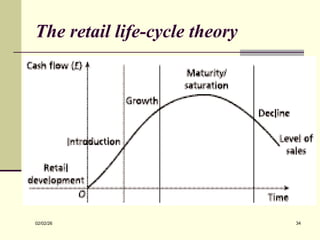
The retail life-cycletheory
Retail developments pass through stages.
At birth there are slow rates of growth due to
limited resources and experience.
This is followed by a time of rapid growth as
efficiency and experience increase.
Eventually growth will level off into the mature
stage due to increased costs and competition and
reduced efficiencies.
In a mature market the competition remains intense,
growth slows and profits begin to fall.
02/02/26 33
Conflict theory
Competitionbetween retailers causes changes in
the nature of the retail environment.
However, it is not so much the day-to-day
competition between companies that causes
institutional change, but rather the imbalance
caused by innovations.
Brown (1987) states that a response to innovation
follows a process of four stages.
02/02/26 35
36.
Conflict theory
Initially,retailers are in shock at the innovation;
secondly, they deny the threat by means of
defensive retreat;
thirdly, they then move into a stage of
acknowledgement and assessment;
finally, they develop a strategy of adaptation
02/02/26 36
37.
Types of retailerresponse to
innovation
shock
defensive retreat
acknowledgement and assessment
adaptation
02/02/26 37
38.
Retailing and Marketing
Retailing comprises all the activities involved in
the marketing and distribution of goods and
services.
Therefore, marketing is a core area for any retail
operation as the success or failure of retailers is
based upon how well they understand and serve
the needs of their customers.
02/02/26 38
39.
Retailing and Marketing
Change in consumer behaviour is constantly
occurring
Any change that occurs has to be underpinned by
an appropriate marketing strategy if it is to be
successful
As part of the development of retail marketing
there is a need to ensure that both the positioning
of any offer, and the image of that offer, are sound
and logically linked.
02/02/26 39
40.
Retailing and Marketing
Positioning as a marketing concept is based upon
a market position of image, price and quality
rather than geographical position.
This position should be perceived clearly by the
consumer so that the retailer gains some
advantage, either through being different from
others in the mind of the consumer or more clearly
identified as offering a particular type of retail
offer by the choice of that position.
02/02/26 40
41.
Retailing and Marketing
The maturation of the retail marketplace has led to
the development of schemes which allow
improved relationship building with the customer.
There is a recognition that relationship marketing
schemes will reduce the long-term costs of
attracting customers owing to the retention
benefits they provide.
Therefore, recent developments in retail
marketing have been associated with building
customer loyalty
02/02/26 41
42.
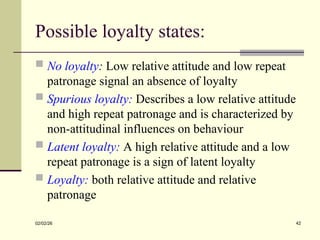
Possible loyalty states:
No loyalty: Low relative attitude and low repeat
patronage signal an absence of loyalty
Spurious loyalty: Describes a low relative attitude
and high repeat patronage and is characterized by
non-attitudinal influences on behaviour
Latent loyalty: A high relative attitude and a low
repeat patronage is a sign of latent loyalty
Loyalty: both relative attitude and relative
patronage
02/02/26 42
43.
Target marketing andmarketing
mix
The ability of a retailer to enhance and build
customer loyalty is highly dependent on
identifying and understanding the target market,
and offering the right type of reward or scheme to
ensure the retention of the bulk of their custom
over the long term.
02/02/26 43
Six different kindsof loyalty:
Sopanen (1996)
monopoly loyalty – where no choice is available;
inertia loyalty – where customers do not seek alternatives;
convenience loyalty – attributed solely to the location of a
retail outlet;
price loyalty – where customers believe in seeking out low
prices, but will shift if lower prices are identified
elsewhere;
incentivized loyalty – based upon loyalty reward schemes
for accumulating benefits;
emotional loyalty – found in brand loyalty: this is the most
elusive to create.
02/02/26 45
47.
Retail Store Administration
Store administration deals with various aspects, like the cleanliness of
the store premises, maintenance of the store facade and the display
windows etc. An administration is also responsible for utilizing the store
personnel effectively. Time keeping for the store staff is important. It is
also necessary to keep track of holidays and the shifts that the staff
may be required to work.
The premises of the store need to be maintained as per the standards
decided upon by the management. This involves the task of cleaning
the store and arranging the merchandise before the first customer can
walk into the store.
An important task of administration involves ensuring that all the
required permissions and licenses to run a retail establishment are
procured from the right authorities.
02/02/26 47
48.
Managing Inventory andDisplay:
At the store the store staff does the management of this inventory. To
enable them to work efficiently the complete procedure for the handling
of merchandise at the store level needs to be documented.
Responsibilities with respect to merchandise at the store level involve
receiving the goods. Once the merchandise is received at the store, the
quantity and other details like color, style and size have to be checked
with the document accompanying the goods to detect any
discrepancies.
Proper documentation also needs to be done when returning goods to
the various locations as and when required. The procedure to be
followed for shop soiled goods and customer returns also needs to be
clear.
The best merchandise may lie unsold if it not displayed in a manner
that is appealing and convenient for the customer.
02/02/26 48
49.
Managing Receipts
Managingreceipts involves defining the manner in which the retailer is
going to receive payment for the sales. The most common method for
receiving payments for goods sold in India, is cash or by credit card.
While most of the large retail stores would accept either of the above
forms of payment, a small local retail store may accept only cash
payments. Other modes of receiving payment are by way of cheque or a
debit card. Some stores also have a co-branded card, which can be
used for payments.
The use of credit cards in India is largely an urban phenomenon. Most
large department stores have started accepting credit cards as a mode
of payment. The credit card charges paid by the retailer depend on the
volume of business transacted by the retailer and the rate negotiated
on the basis of the future business that can be offered by the retailer.
The procedure for accepting payment by way of credit cards and
collecting payment from the bank needs to be clearly understood by the
staff responsible for this function.
02/02/26 49