toolkit
INTRODUCTION TO
CURRICULUM AND
INSTRUCTIONS
NURUL YASMIN BINTI MOHAMAD YUSOF
FEHA KUPTMKL
WEEK
1
toolkit
LEARNING outcomes
After studying this chapter, students should be able to:
1. Explain what components of curriculum are
2. Describe the types of curriculum approaches
3. Discuss the curriculum domains and approaches in teaching and learning
process
EDU3053
toolkit
definition
01
Definition of curriculum and instructions
relationship between curriculum
and instructions
02
Curriculum vs Instructions
Types of curriculum
03
Explicit, Implicit, Null, Extra
Models of curriculum-
instructions
04
Dualistic, Concentric, Circular
EDU3053
toolkit
definition
Definition of curriculum and instructions
01
EDU3053
toolkit
Defining curriculum
According to Bandi & Wales (2005), the
most common definition derived from
the word Latin root, which means “race
course.”
EDU3053
Bandi & Wales (2005) also stated that “ for
many students, the school curriculum is a
race to be run, a series of obstacles or
hurdles (subjects) to be passed.”
toolkit
WHAT IS CURRICULUM
Refers to means and materials with which
students will interact to achieve
identified educational outcomes.
EDU3053
toolkit
Workshop # 1
Earlier curriculum (medieval Europe (5th - 15th century):
Workshop # 2
EDU3053
i. Trivium – Based On The Study Of Grammar,
Rhetoric, And Logic.
ii. Quadrivium – Emphasized On Arithmetic,
Geometry, Music, And Astronomy.
toolkit
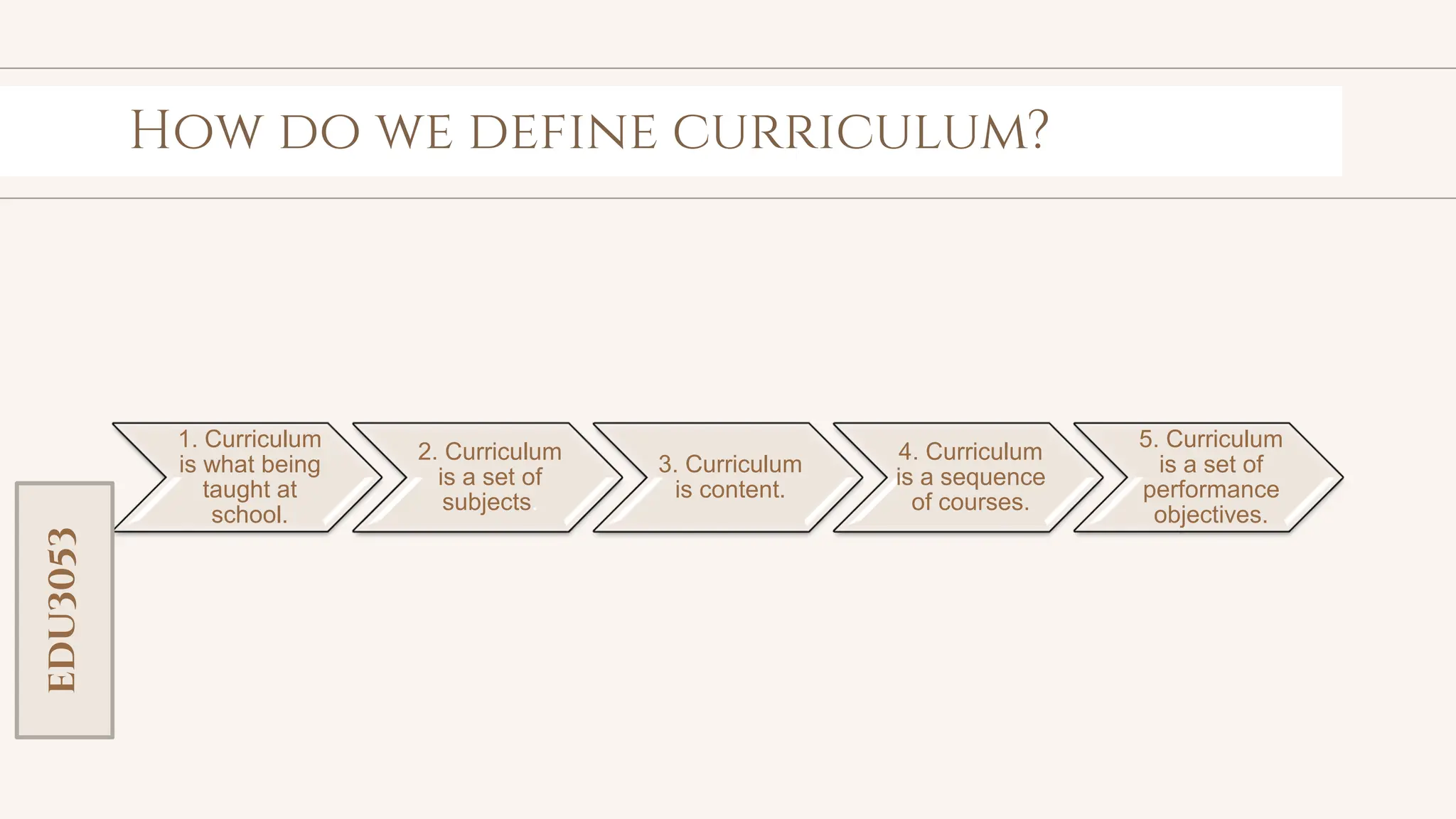
How do we define curriculum?
1. Curriculum
is what being
taught at
school.
2. Curriculum
is a set of
subjects.
3. Curriculum
is content.
4. Curriculum
is a sequence
of courses.
5. Curriculum
is a set of
performance
objectives.
EDU3053
toolkit
Who involved in curriculum design & planning
Theoreticians and practitioners – include curriculum
planners, professors of curriculum, curriculum developers
(curriculum specialists)
a. Curriculum specialists are well-versed in areas
relating to curriculum such as history and origin
of curriculum, curriculum planning and how it is
implemented in schools.
b. Specialists are well-informed about how students
learn, how teachers react to change and obstacles
to improvement.
c. They generate new knowledge by recombining
existing programmes, adapting approaches and
constructing new curriculum.
EDU3053
toolkit
John delnay (1959)
“Curriculum is all the
experiences learners
have under the
guidance of the school.”
EDU3053
toolkit
Relationship
between
curriculum and
instructions
02
EDU3053
toolkit
instructions
the delivery of information and
activities learners’
attainment of intended,
specific learning goals. In
other words, instruction is
the conduct of activities
that we focused on
learners learning specific
things.” (Smith & Ragan,
1993, p.2)
curriculum
Relationship between curriculum and instructions
a system of planed actions for
instruction’ and instruction
is the ‘system for putting
the plans into action”
(MacDonald, 1965)
EDU3053
toolkit
Types of
curriculum
03
EDU3053
toolkit
Types of curriculum
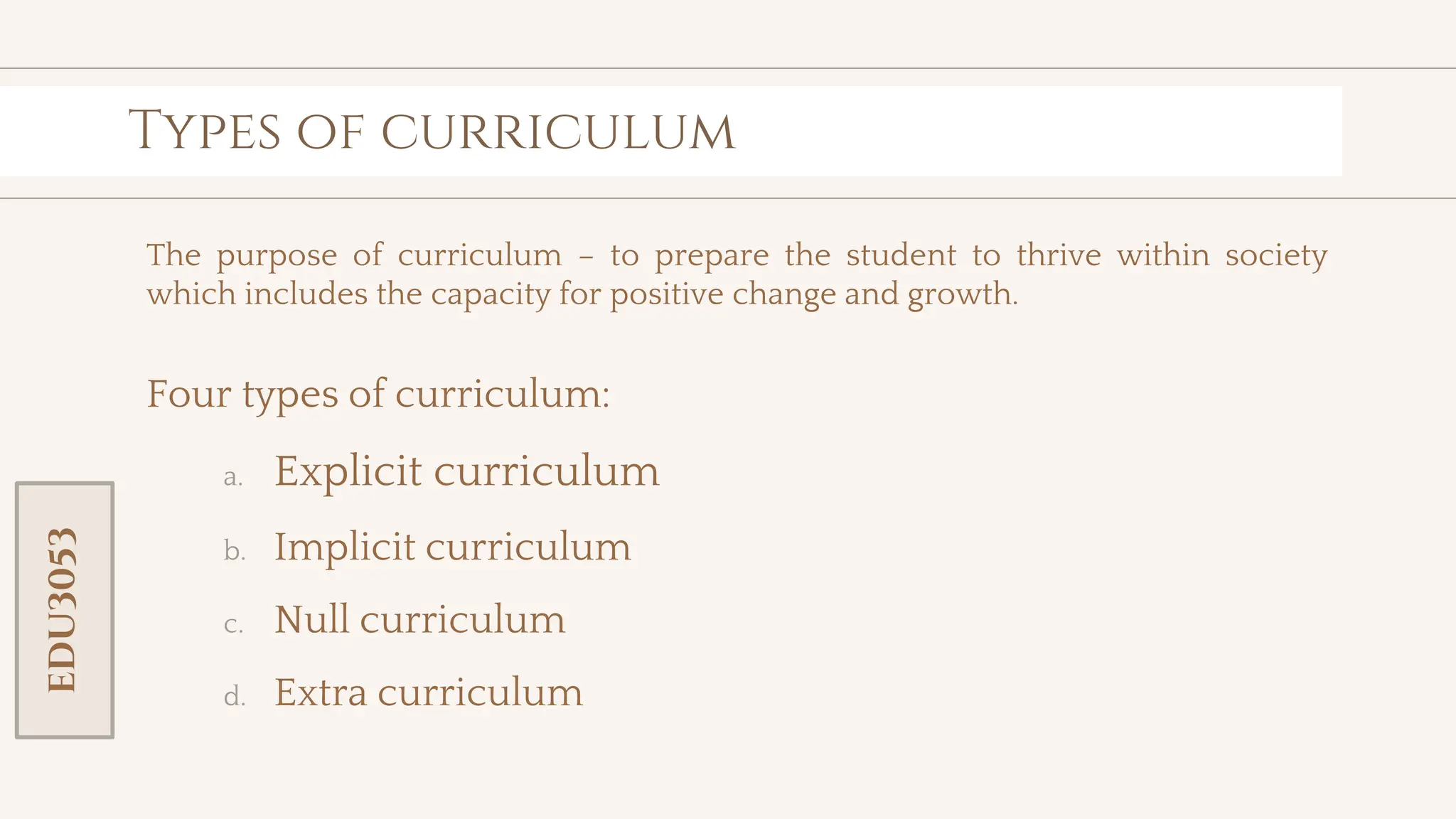
The purpose of curriculum – to prepare the student to thrive within society
which includes the capacity for positive change and growth.
Four types of curriculum:
a. Explicit curriculum
b. Implicit curriculum
c. Null curriculum
d. Extra curriculum
EDU3053
toolkit
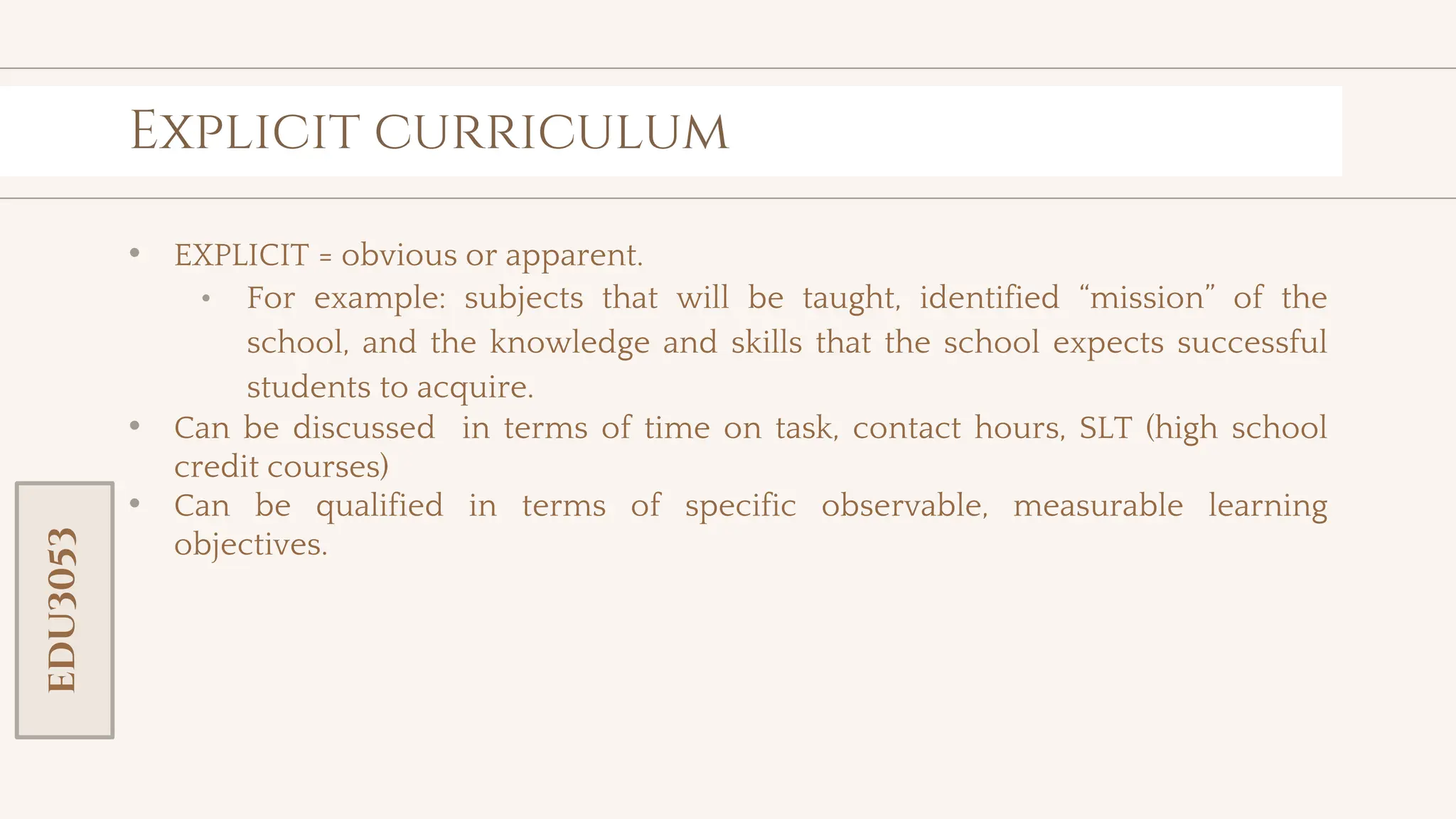
Explicit curriculum
• EXPLICIT = obvious or apparent.
• For example: subjects that will be taught, identified “mission” of the
school, and the knowledge and skills that the school expects successful
students to acquire.
• Can be discussed in terms of time on task, contact hours, SLT (high school
credit courses)
• Can be qualified in terms of specific observable, measurable learning
objectives.
EDU3053
toolkit
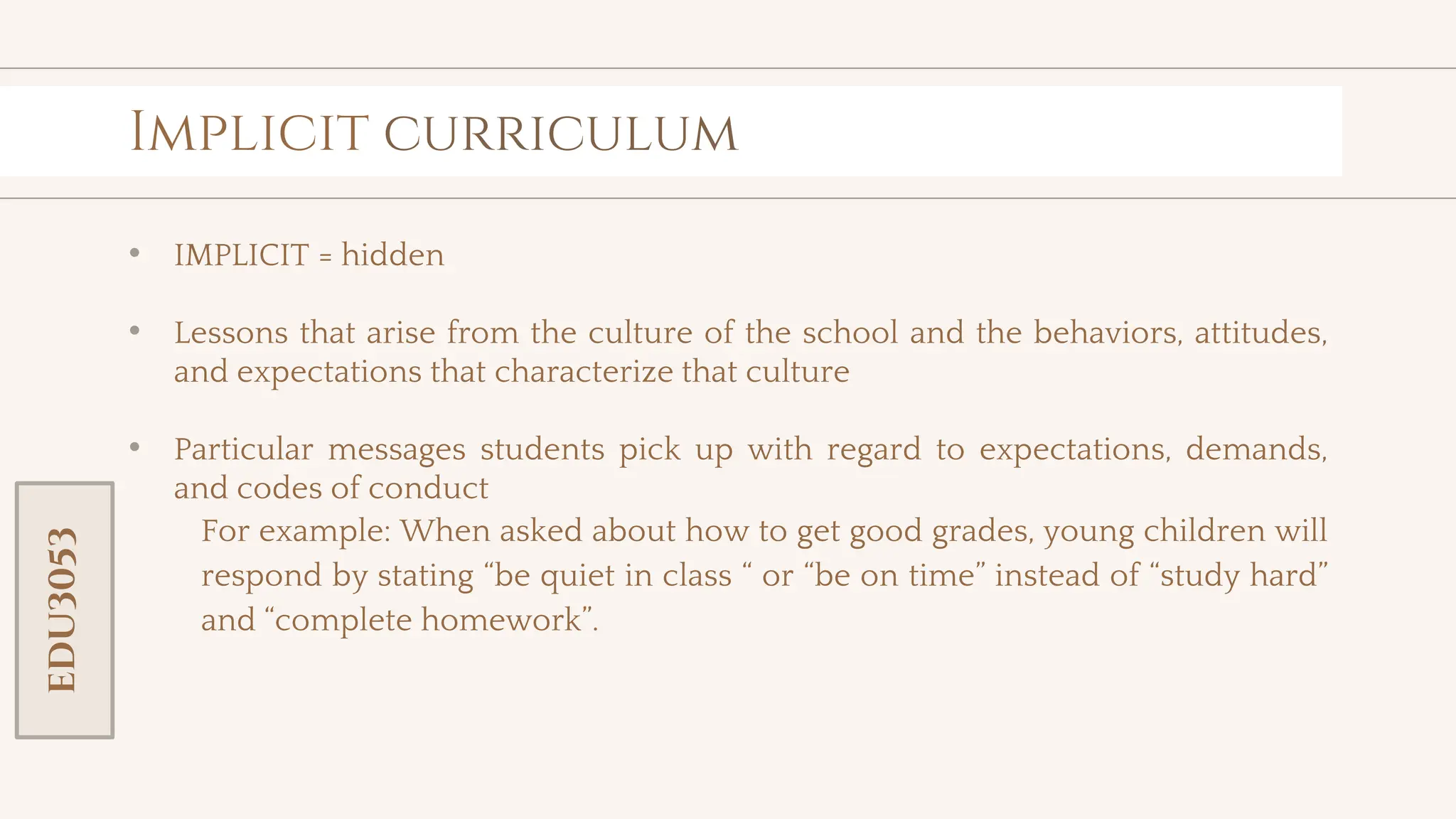
Implicit curriculum
• IMPLICIT = hidden
• Lessons that arise from the culture of the school and the behaviors, attitudes,
and expectations that characterize that culture
• Particular messages students pick up with regard to expectations, demands,
and codes of conduct
For example: When asked about how to get good grades, young children will
respond by stating “be quiet in class “ or “be on time” instead of “study hard”
and “complete homework”.
EDU3053
toolkit
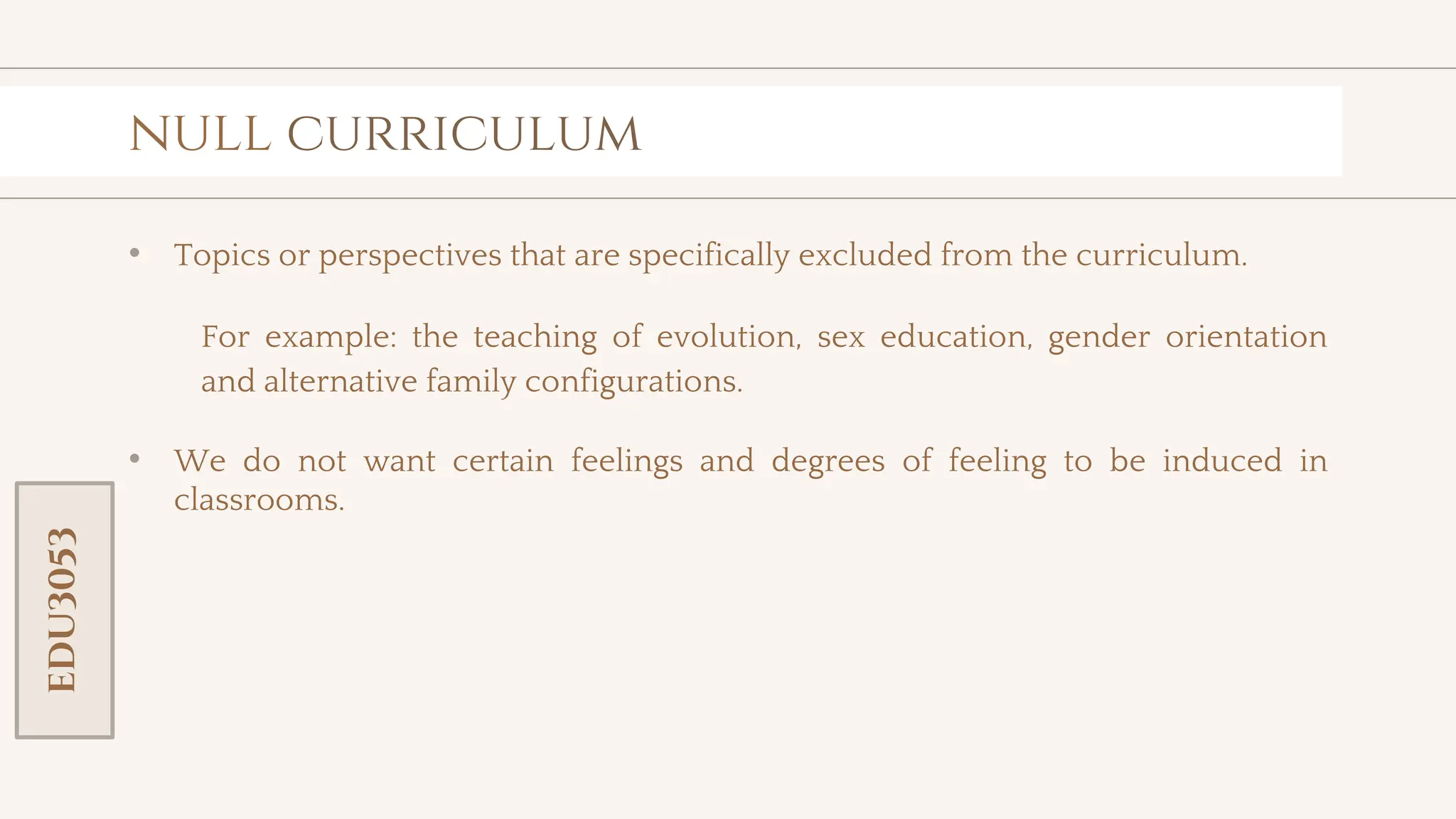
null curriculum
• Topics or perspectives that are specifically excluded from the curriculum.
For example: the teaching of evolution, sex education, gender orientation
and alternative family configurations.
• We do not want certain feelings and degrees of feeling to be induced in
classrooms.
EDU3053
toolkit
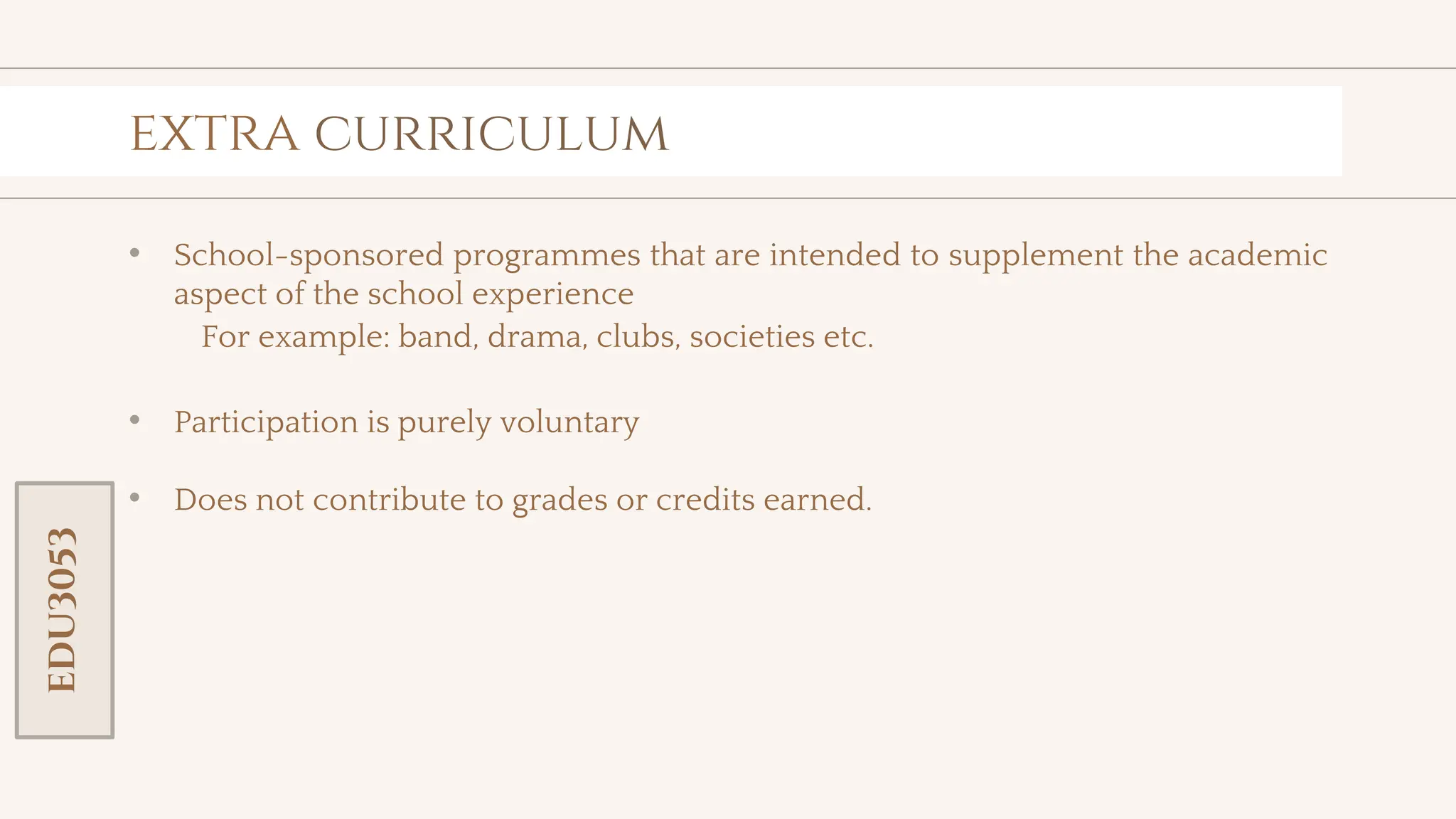
extra curriculum
• School-sponsored programmes that are intended to supplement the academic
aspect of the school experience
For example: band, drama, clubs, societies etc.
• Participation is purely voluntary
• Does not contribute to grades or credits earned.
EDU3053
toolkit
Models of
curriculum-
instructions
relationship
04
EDU3053
toolkit
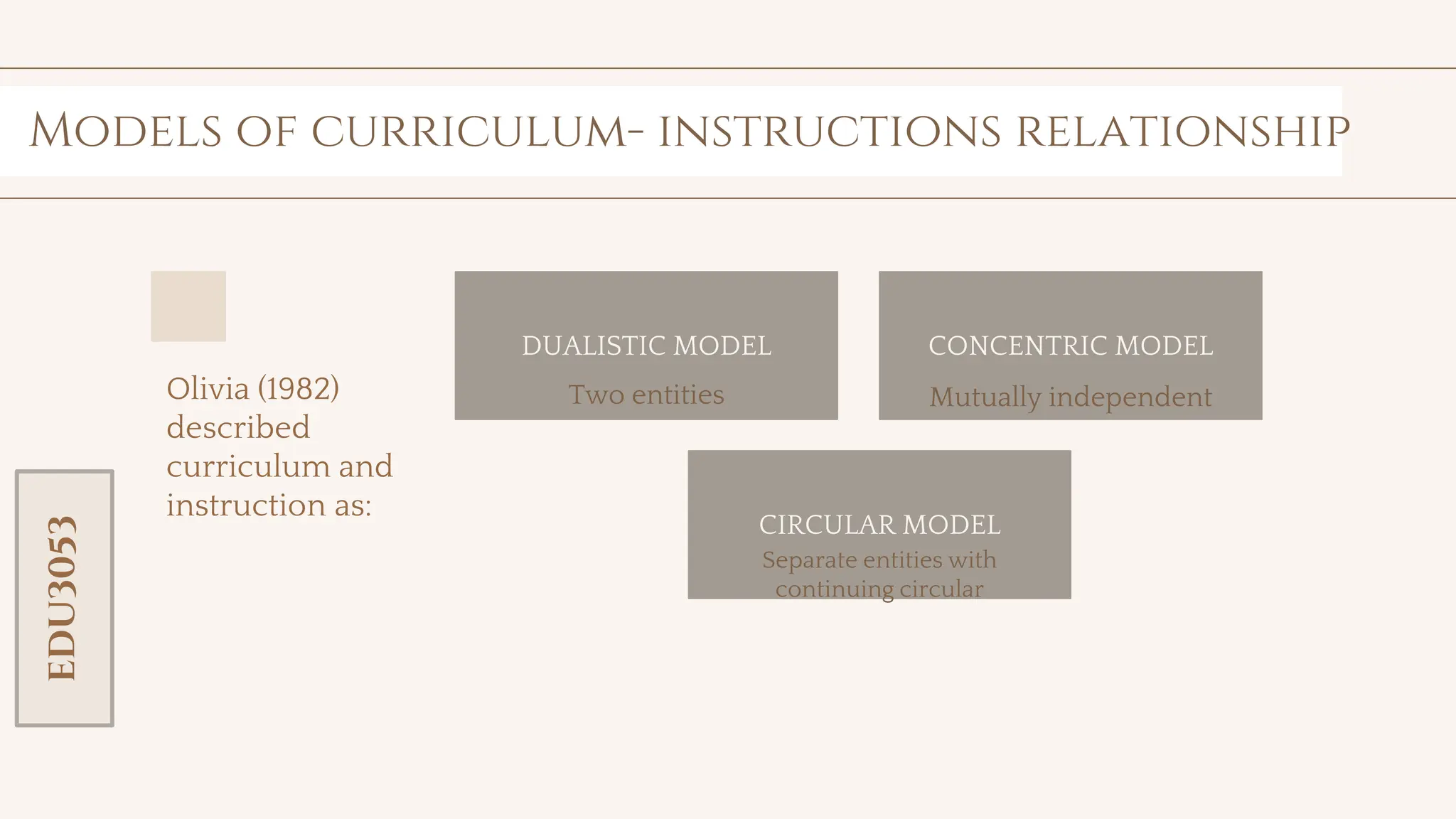
Models of curriculum- instructions relationship
DUALISTIC MODEL CONCENTRIC MODEL
CIRCULAR MODEL
Olivia (1982)
described
curriculum and
instruction as:
Two entities Mutually independent
Separate entities with
continuing circular
EDU3053
toolkit
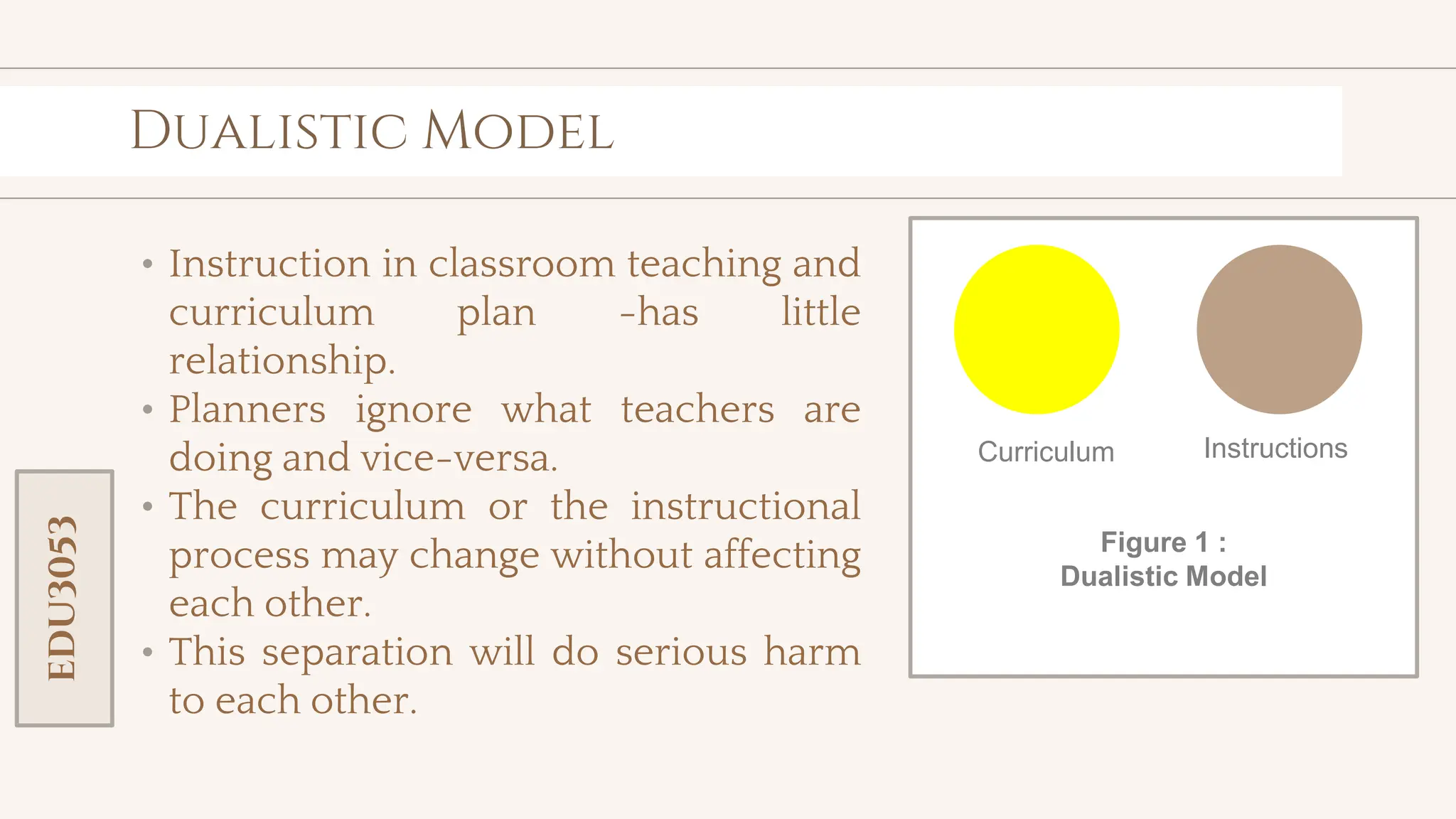
Dualistic Model
• Instruction in classroom teaching and
curriculum plan -has little
relationship.
• Planners ignore what teachers are
doing and vice-versa.
• The curriculum or the instructional
process may change without affecting
each other.
• This separation will do serious harm
to each other.
Curriculum Instructions
Figure 1 :
Dualistic Model
EDU3053
toolkit
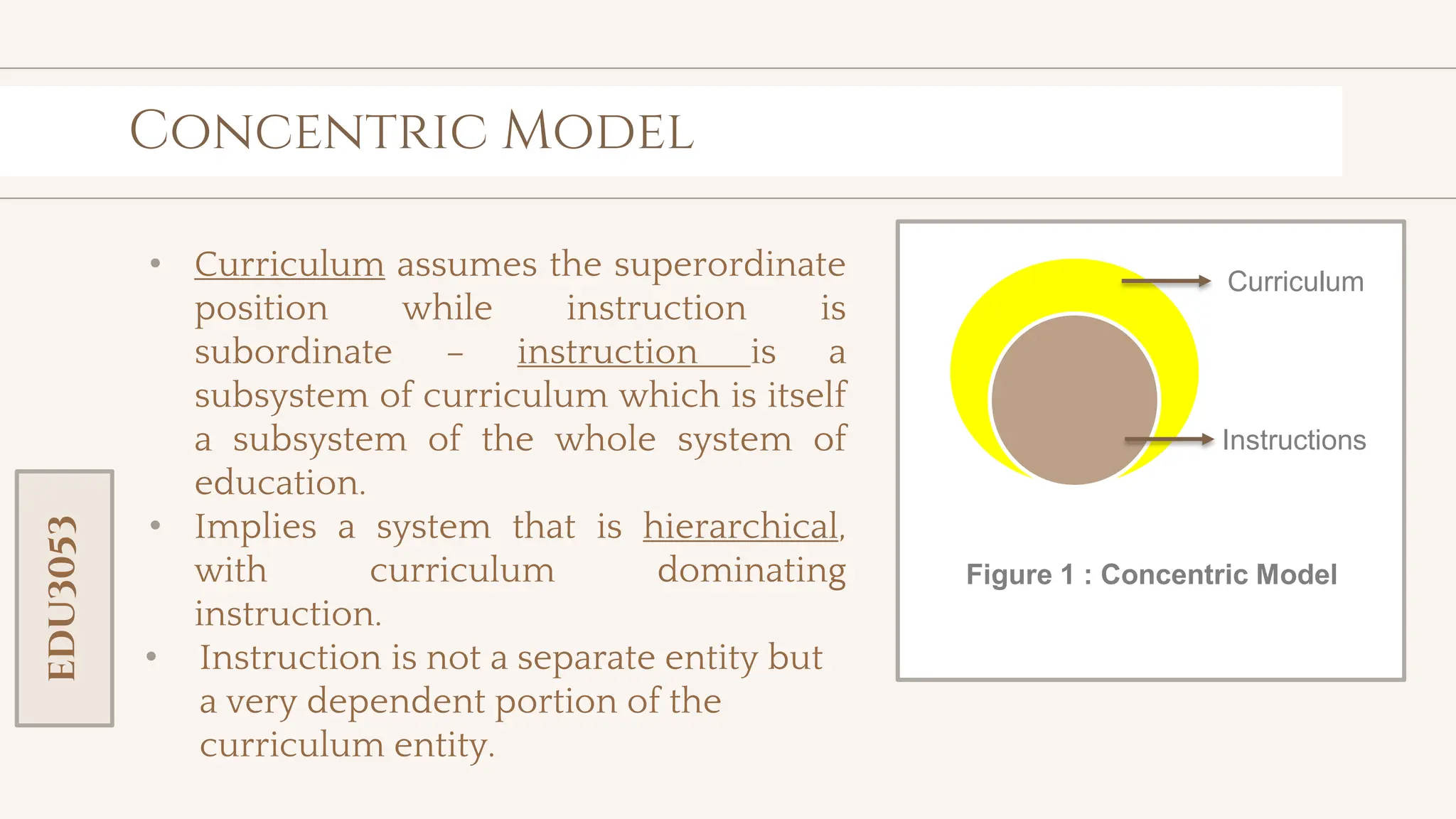
Concentric Model
• Curriculum assumes the superordinate
position while instruction is
subordinate – instruction is a
subsystem of curriculum which is itself
a subsystem of the whole system of
education.
• Implies a system that is hierarchical,
with curriculum dominating
instruction.
• Instruction is not a separate entity but
a very dependent portion of the
curriculum entity.
Curriculum
Instructions
Figure 1 : Concentric Model
EDU3053
toolkit
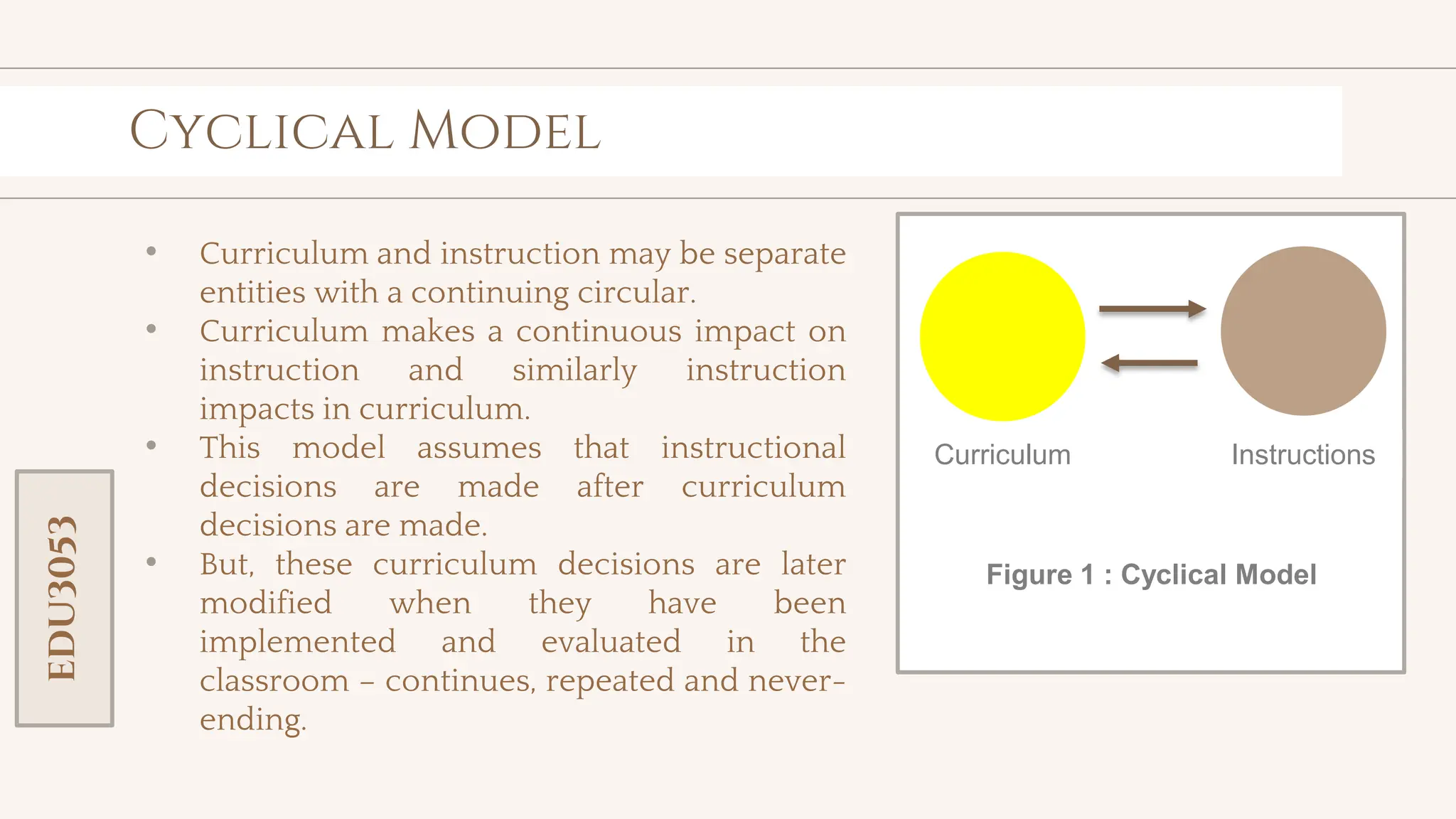
Cyclical Model
• Curriculum and instruction may be separate
entities with a continuing circular.
• Curriculum makes a continuous impact on
instruction and similarly instruction
impacts in curriculum.
• This model assumes that instructional
decisions are made after curriculum
decisions are made.
• But, these curriculum decisions are later
modified when they have been
implemented and evaluated in the
classroom – continues, repeated and never-
ending.
Figure 1 : Cyclical Model
Curriculum Instructions
EDU3053
toolkit
The Best Model
• Of all the models, the Cylical Model seems to the best alternatives as
it emphasize the need for a close working relationship between
implementers and planners.
• Though curriculum and instruction may be different entities, they
are interdependent and cannot function in isolation.
• Constant feedback from the classroom as to what works and what
does not work has to be recycled – make necessary adjustments and
modifications.
• This may explain the need for pilot-testing a curriculum before it is
widely implemented.
EDU3053
toolkit
Summary
• Curriculum is a statement of what students should know, be able to do,
how it is taught, how it is measured, and how the educational system is
organised.
• Curriculum can be approached as content (knowledge, skills and values),
product (desired learning outcomes) and process (interactions in the
classroom)
• Curriculum development is a process involving planning, designing,
implementation and evaluation.
• Curriculum can be considered as a discipline – has an organised set of
theoretical principles, includes body of knowledge and skills and has its
theoreticians and practitioners.
• The relationship between curriculum and instruction is interdependent,
continuous, repeated and never-ending.
EDU3053
CREDITS: This presentation template was created
by Slidesgo, including icons by Flaticon,
infographics & images by Freepik
Do you have any questions?
yasmin_my@kuptm.edu.my
011 3277 4487
FEHA KUPTMKL
Thanks!
Please keep this slide for attribution
TOPIC 1 INTRODUCTION TO CURRICULUM AND INSTRUCTIONS[1].pdf

TOPIC 1 INTRODUCTION TO CURRICULUM AND INSTRUCTIONS[1].pdf

  • 1.
    toolkit INTRODUCTION TO CURRICULUM AND INSTRUCTIONS NURULYASMIN BINTI MOHAMAD YUSOF FEHA KUPTMKL WEEK 1
  • 2.
    toolkit LEARNING outcomes After studyingthis chapter, students should be able to: 1. Explain what components of curriculum are 2. Describe the types of curriculum approaches 3. Discuss the curriculum domains and approaches in teaching and learning process EDU3053
  • 3.
    toolkit definition 01 Definition of curriculumand instructions relationship between curriculum and instructions 02 Curriculum vs Instructions Types of curriculum 03 Explicit, Implicit, Null, Extra Models of curriculum- instructions 04 Dualistic, Concentric, Circular EDU3053
  • 4.
  • 5.
    toolkit Defining curriculum According toBandi & Wales (2005), the most common definition derived from the word Latin root, which means “race course.” EDU3053 Bandi & Wales (2005) also stated that “ for many students, the school curriculum is a race to be run, a series of obstacles or hurdles (subjects) to be passed.”
  • 6.
    toolkit WHAT IS CURRICULUM Refersto means and materials with which students will interact to achieve identified educational outcomes. EDU3053
  • 7.
    toolkit Workshop # 1 Earliercurriculum (medieval Europe (5th - 15th century): Workshop # 2 EDU3053 i. Trivium – Based On The Study Of Grammar, Rhetoric, And Logic. ii. Quadrivium – Emphasized On Arithmetic, Geometry, Music, And Astronomy.
  • 8.
    toolkit How do wedefine curriculum? 1. Curriculum is what being taught at school. 2. Curriculum is a set of subjects. 3. Curriculum is content. 4. Curriculum is a sequence of courses. 5. Curriculum is a set of performance objectives. EDU3053
  • 9.
    toolkit Who involved incurriculum design & planning Theoreticians and practitioners – include curriculum planners, professors of curriculum, curriculum developers (curriculum specialists) a. Curriculum specialists are well-versed in areas relating to curriculum such as history and origin of curriculum, curriculum planning and how it is implemented in schools. b. Specialists are well-informed about how students learn, how teachers react to change and obstacles to improvement. c. They generate new knowledge by recombining existing programmes, adapting approaches and constructing new curriculum. EDU3053
  • 10.
    toolkit John delnay (1959) “Curriculumis all the experiences learners have under the guidance of the school.” EDU3053
  • 11.
  • 12.
    toolkit instructions the delivery ofinformation and activities learners’ attainment of intended, specific learning goals. In other words, instruction is the conduct of activities that we focused on learners learning specific things.” (Smith & Ragan, 1993, p.2) curriculum Relationship between curriculum and instructions a system of planed actions for instruction’ and instruction is the ‘system for putting the plans into action” (MacDonald, 1965) EDU3053
  • 13.
  • 14.
    toolkit Types of curriculum Thepurpose of curriculum – to prepare the student to thrive within society which includes the capacity for positive change and growth. Four types of curriculum: a. Explicit curriculum b. Implicit curriculum c. Null curriculum d. Extra curriculum EDU3053
  • 15.
    toolkit Explicit curriculum • EXPLICIT= obvious or apparent. • For example: subjects that will be taught, identified “mission” of the school, and the knowledge and skills that the school expects successful students to acquire. • Can be discussed in terms of time on task, contact hours, SLT (high school credit courses) • Can be qualified in terms of specific observable, measurable learning objectives. EDU3053
  • 16.
    toolkit Implicit curriculum • IMPLICIT= hidden • Lessons that arise from the culture of the school and the behaviors, attitudes, and expectations that characterize that culture • Particular messages students pick up with regard to expectations, demands, and codes of conduct For example: When asked about how to get good grades, young children will respond by stating “be quiet in class “ or “be on time” instead of “study hard” and “complete homework”. EDU3053
  • 17.
    toolkit null curriculum • Topicsor perspectives that are specifically excluded from the curriculum. For example: the teaching of evolution, sex education, gender orientation and alternative family configurations. • We do not want certain feelings and degrees of feeling to be induced in classrooms. EDU3053
  • 18.
    toolkit extra curriculum • School-sponsoredprogrammes that are intended to supplement the academic aspect of the school experience For example: band, drama, clubs, societies etc. • Participation is purely voluntary • Does not contribute to grades or credits earned. EDU3053
  • 19.
  • 20.
    toolkit Models of curriculum-instructions relationship DUALISTIC MODEL CONCENTRIC MODEL CIRCULAR MODEL Olivia (1982) described curriculum and instruction as: Two entities Mutually independent Separate entities with continuing circular EDU3053
  • 21.
    toolkit Dualistic Model • Instructionin classroom teaching and curriculum plan -has little relationship. • Planners ignore what teachers are doing and vice-versa. • The curriculum or the instructional process may change without affecting each other. • This separation will do serious harm to each other. Curriculum Instructions Figure 1 : Dualistic Model EDU3053
  • 22.
    toolkit Concentric Model • Curriculumassumes the superordinate position while instruction is subordinate – instruction is a subsystem of curriculum which is itself a subsystem of the whole system of education. • Implies a system that is hierarchical, with curriculum dominating instruction. • Instruction is not a separate entity but a very dependent portion of the curriculum entity. Curriculum Instructions Figure 1 : Concentric Model EDU3053
  • 23.
    toolkit Cyclical Model • Curriculumand instruction may be separate entities with a continuing circular. • Curriculum makes a continuous impact on instruction and similarly instruction impacts in curriculum. • This model assumes that instructional decisions are made after curriculum decisions are made. • But, these curriculum decisions are later modified when they have been implemented and evaluated in the classroom – continues, repeated and never- ending. Figure 1 : Cyclical Model Curriculum Instructions EDU3053
  • 24.
    toolkit The Best Model •Of all the models, the Cylical Model seems to the best alternatives as it emphasize the need for a close working relationship between implementers and planners. • Though curriculum and instruction may be different entities, they are interdependent and cannot function in isolation. • Constant feedback from the classroom as to what works and what does not work has to be recycled – make necessary adjustments and modifications. • This may explain the need for pilot-testing a curriculum before it is widely implemented. EDU3053
  • 25.
    toolkit Summary • Curriculum isa statement of what students should know, be able to do, how it is taught, how it is measured, and how the educational system is organised. • Curriculum can be approached as content (knowledge, skills and values), product (desired learning outcomes) and process (interactions in the classroom) • Curriculum development is a process involving planning, designing, implementation and evaluation. • Curriculum can be considered as a discipline – has an organised set of theoretical principles, includes body of knowledge and skills and has its theoreticians and practitioners. • The relationship between curriculum and instruction is interdependent, continuous, repeated and never-ending. EDU3053
  • 26.
    CREDITS: This presentationtemplate was created by Slidesgo, including icons by Flaticon, infographics & images by Freepik Do you have any questions? yasmin_my@kuptm.edu.my 011 3277 4487 FEHA KUPTMKL Thanks! Please keep this slide for attribution