C programming is a powerful, low-level, procedural language used for system programming, offering speed, portability, and direct hardware control.
https://techcaddcomputerinstitute.com/top-programming-training-centre-in-jalandhar.php
WHAT IS AC
PROGRAMMING?
• What is C?
• History and creators (Dennis Ritchie, 1972)
• Importance of C in modern programming
• Applications: OS development, embedded
systems, games
3.
HISTORY OF
PROGRAMMING
C programmingwas developed in the early 1970s by Dennis Ritchie at Bell
Labs as an evolution of the B programming language. It was initially designed
for system programming on the UNIX operating system. C's simplicity,
efficiency, and portability made it popular for software development across
various platforms. In 1978, Brian Kernighan and Dennis Ritchie published "The
C Programming Language," which became the definitive guide for learning C.
Over the years, C has influenced many other languages, including C++, C#,
and Java. It remains a foundational language for system-level programming,
embedded systems, and software development.
4.
TYPES OF CPROGRAMMING
Application Programming:
• C can also be used for
developing software
applications, especially when
performance is a critical factor,
such as in games, graphics, or
scientific computations.
Network Programming:
• C is also used in the
development of network
protocols, sockets, and client-
server applications, often for
performance-critical
networking tasks.
Procedural Programming:
C is primarily known for its
procedural programming
paradigm, where programs are
structured as sequences of
instructions or functions. It focuses
on logic and functions that operate
on data.
System Programming:
• C is widely used for system-
level programming, such as
operating system development,
device drivers, and embedded
systems. Its low-level
capabilities give direct control
over hardware.
Real-Time Programming:
⚬ C is used in real-time
systems where precise
timing and resource
management are critical,
such as in aerospace or
automotive control
systems.
C is a popular choice for
programming embedded systems
due to its efficiency and ability to
interact directly with hardware. It is
used in microcontroller
programming, IoT devices, and
real-time systems.
Embedded Programming:
5.
WHY CHOOSE C?
• Portability: Code written in C can run on different systems
with minimal changes.
• Efficiency: Provides low-level access to memory and
hardware, making it faster.
• Wide Adoption: Used in operating systems (UNIX),
embedded systems, and compilers.
• Foundation for Other Languages: Influenced languages like
C++, Java, and C#.
6.
ARRAY VS STRING
Anarray in C is a collection of variables that
are of the same data type, stored in
contiguous memory locations. The size of
an array is defined at the time of
declaration, and it can hold multiple values
of the same type, such as integers, floats,
or characters.
Key Points to Remember About Arrays in C:
1.Fixed Size: The size of the array must be
specified at the time of its creation and
cannot be changed during runtime.
2.Contiguous Memory: Elements of an
array are stored in adjacent memory
locations.
3.Zero-Based Indexing: Array indices start
at 0, so the first element is accessed via
array[0], the second element via
array[1], and so on.
A string in C is a sequence of characters
stored in a contiguous block of memory. In
C, strings are represented as arrays of
characters, and they are always terminated
with a special character called the null
character ('0').
Key Points About Strings in C:
1.Null-Termination: Every string in C ends
with the null character '0', which
signifies the end of the string. This is
how C functions and libraries know
where the string ends.
2.Character Array: A string is essentially
an array of char type, and each
character is stored in consecutive
memory locations.
3.Fixed Length: The length of a string in C
is fixed once declared, but functions like
strlen() can be used to determine the
length at runtime.
7.
POINTERS IN CPROGRAMMING
• What is a Pointer?: A pointer stores the address of another variable.
• Pointer Syntax:
⚬ int *ptr; declares a pointer to an integer.
⚬ ptr = &var; stores the address of var in ptr.
• Pointer Arithmetic: Allows navigation through arrays.
• Dereferencing: *ptr to access the value at the pointer address.
8.
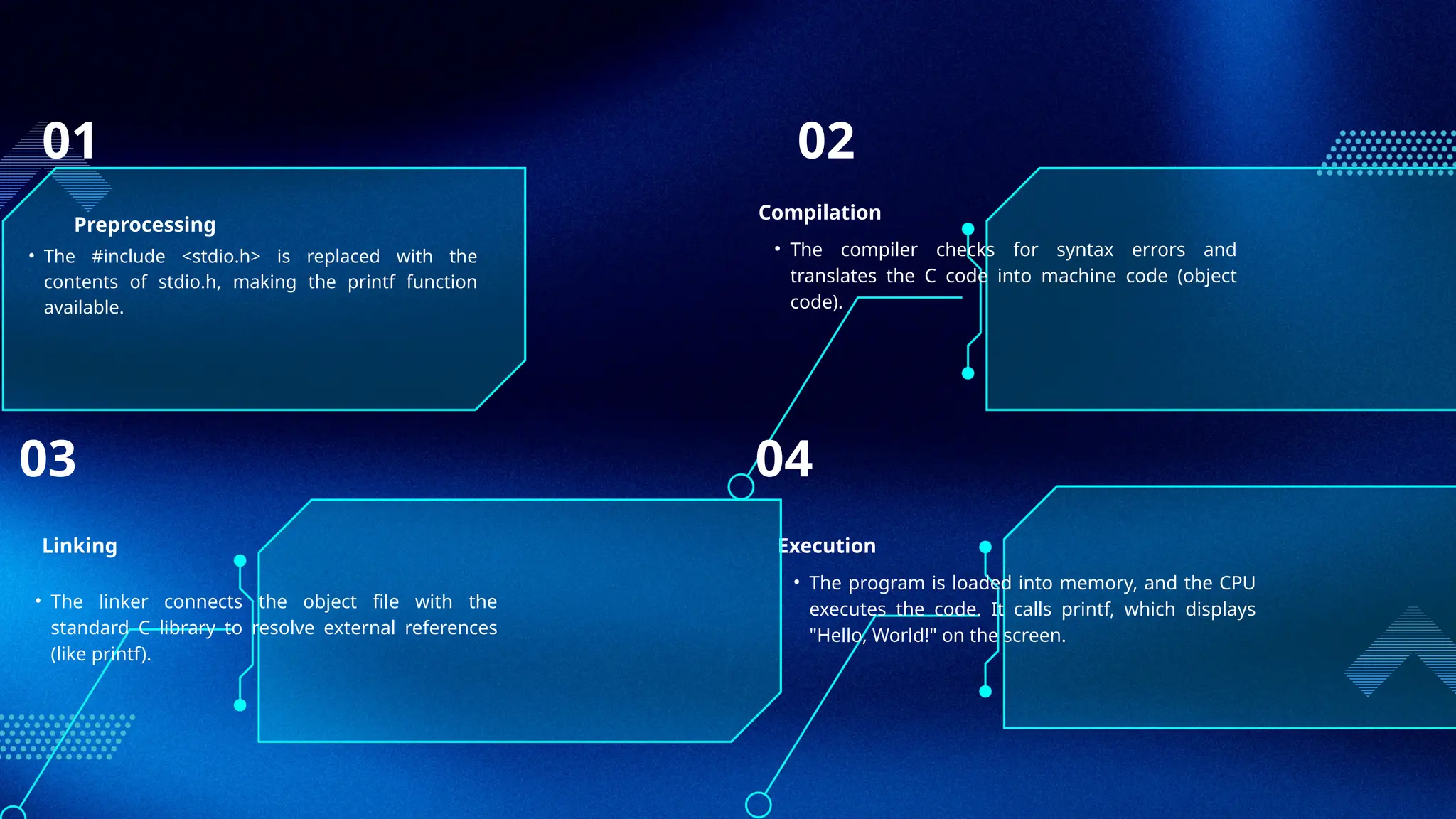
• The #include<stdio.h> is replaced with the
contents of stdio.h, making the printf function
available.
Compilation
• The compiler checks for syntax errors and
translates the C code into machine code (object
code).
01 02
04
Execution
• The program is loaded into memory, and the CPU
executes the code. It calls printf, which displays
"Hello, World!" on the screen.
03
Preprocessing
Linking
• The linker connects the object file with the
standard C library to resolve external references
(like printf).
9.
LIFE OF AC
PROGRAMMING
The life of a C program is an interesting journey, from when you
first write the code all the way through to the program's
execution and eventual termination. It’s a multi-step process
that involves multiple stages, tools, and systems working
together to transform your code into a running application.
Here's a breakdown of the "life cycle" of a C program:
![ARRAY VS STRING
An array in C is a collection of variables that
are of the same data type, stored in
contiguous memory locations. The size of
an array is defined at the time of
declaration, and it can hold multiple values
of the same type, such as integers, floats,
or characters.
Key Points to Remember About Arrays in C:
1.Fixed Size: The size of the array must be
specified at the time of its creation and
cannot be changed during runtime.
2.Contiguous Memory: Elements of an
array are stored in adjacent memory
locations.
3.Zero-Based Indexing: Array indices start
at 0, so the first element is accessed via
array[0], the second element via
array[1], and so on.
A string in C is a sequence of characters
stored in a contiguous block of memory. In
C, strings are represented as arrays of
characters, and they are always terminated
with a special character called the null
character ('0').
Key Points About Strings in C:
1.Null-Termination: Every string in C ends
with the null character '0', which
signifies the end of the string. This is
how C functions and libraries know
where the string ends.
2.Character Array: A string is essentially
an array of char type, and each
character is stored in consecutive
memory locations.
3.Fixed Length: The length of a string in C
is fixed once declared, but functions like
strlen() can be used to determine the
length at runtime.](https://image.slidesharecdn.com/cprogramming-250709082428-e69546d5/75/Top-Programming-Training-Centre-in-Jalandhar-6-2048.jpg)


![Oh Crap, I Forgot (Or Never Learned) C! [CodeMash 2010]](https://cdn.slidesharecdn.com/ss_thumbnails/oh-crap-i-never-learned-c-codemash-2010-100115163750-phpapp01-thumbnail.jpg?width=640&height=640&fit=bounds)


