Contact
C++ PROGRAMMING
1. Introduction to C++
C++ is a powerful general-purpose programming language
created by Bjarne Stroustrup in 1979. It is an extension of the C
programming language with added features such as classes,
inheritance, polymorphism, and templates, making it a
multiparadigm language. C++ is widely used for system/software
development, game development, real-time simulation, and
performance-critical applications.
+919888122255
https://
2.SETTINGUPTHE
ENVIRONMENT
Before writing C++ code, you need to install a compiler. Popular options include:
• GCC (GNU Compiler Collection) — commonly used on Linux and macOS
• Microsoft Visual C++ — included in Visual Studio on Windows
• Clang — a modern compiler for macOS and Linux
You can write C++ code in any text editor (like VS Code, Sublime Text) or IDE (like Visual Studio, Code::Blocks,
CLion).
DATATYPESANDVARIABLES
DATA TYPE AND VARIABLES
Basic Data Types:
• int — integer numbers (e.g., 1, -3)
• float — floating-point numbers (e.g.,
3.14)
• double — double precision floating-
point
• char — a single character (e.g., 'A')
• bool — boolean values (true or false)
DATA TYPES
• int — integer numbers (e.g., 1, -3)
• float — floating-point numbers (e.g.,
3.14)
• double — double precision floating-
point
• char — a single character (e.g., 'A')
• bool — boolean values (true or false)
VARIABLES • int — integer numbers (e.g., 1, -3)
• float — floating-point numbers (e.g., 3.14)
• double — double precision floating-point
• char — a single character (e.g., 'A')
• bool — boolean values (true or false)
Contact
Key Features:
Proficiency In a
Programming
Language
Logical
Thinking and
Problem-
Solving Abilities
Ability To
Collaborate In
Team
Environments
A Growth
Mindset For
Lifelong
Learning
• Object-Oriented Programming (OOP)
support
• Low-level memory manipulation
capabilities
• Extensive Standard Template Library (STL)
• Cross-platform support
3.BASICSYNTAX
AND
STRUCTURE
Every C++ program consists of functions and declarations. The entry point is the main()
function.
cpp
CopyEdit
#include <iostream> // preprocessor directive for input-output libraryint main() {
std::cout << "Hello, World!" << std::endl; // output statementreturn 0; // exit status
}
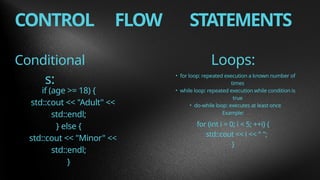
CONTROL FLOW STATEMENTS
Conditional
s:
Loops:
if (age >= 18) {
std::cout << "Adult" <<
std::endl;
} else {
std::cout << "Minor" <<
std::endl;
}
• for loop: repeated execution a known number of
times
• while loop: repeated execution while condition is
true
• do-while loop: executes at least once
Example:
for (int i = 0; i < 5; ++i) {
std::cout << i << " ";
}
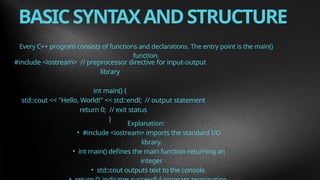
BASICSYNTAXANDSTRUCTURE
Every C++ program consists of functions and declarations. The entry point is the main()
function.
#include <iostream> // preprocessor directive for input-output
library
int main() {
std::cout << "Hello, World!" << std::endl; // output statement
return 0; // exit status
}
Explanation:
• #include <iostream> imports the standard I/O
library.
• int main() defines the main function returning an
integer.
• std::cout outputs text to the console.
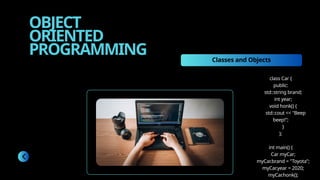
OBJECT
ORIENTED
PROGRAMMING Classes and Objects
class Car {
public:
std::string brand;
int year;
void honk() {
std::cout << "Beep
beep!";
}
};
int main() {
Car myCar;
myCar.brand = "Toyota";
myCar.year = 2020;
myCar.honk();
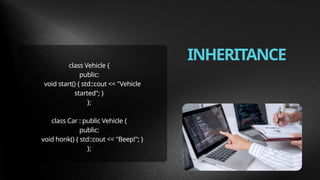
INHERITANCE
class Vehicle {
public:
void start() { std::cout << "Vehicle
started"; }
};
class Car : public Vehicle {
public:
void honk() { std::cout << "Beep!"; }
};
Home About Us Services Contact
THANK
YOU +91 9888122255
www.techcadd.com
info.techcaddjalandhar@gmail.com
opp. All India Radio Station, near Bus
Stand, New Jawahar Nagar, Jawahar Nagar,
Jalandhar,
Get In Touch
Lorem ipsum odor amet, consectetuer adipiscing elit.
Hac nibh vulputate penatibus ultricies pharetra lacinia.
Tempor risus ullamcorper curae augue sociosqu porta
augue nascetur.
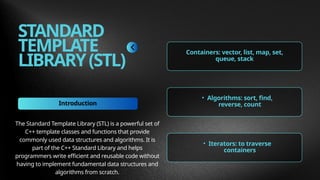
STANDARD
TEMPLATE
LIBRARY(STL)
Containers: vector, list, map, set,
queue, stack
• Algorithms: sort, find,
reverse, count
• Iterators: to traverse
containers
Introduction
The Standard Template Library (STL) is a powerful set of
C++ template classes and functions that provide
commonly used data structures and algorithms. It is
part of the C++ Standard Library and helps
programmers write efficient and reusable code without
having to implement fundamental data structures and
algorithms from scratch.

Best Programming Course in Jalandhar - TechCADD Computer Education

  • 1.
    Contact C++ PROGRAMMING 1. Introductionto C++ C++ is a powerful general-purpose programming language created by Bjarne Stroustrup in 1979. It is an extension of the C programming language with added features such as classes, inheritance, polymorphism, and templates, making it a multiparadigm language. C++ is widely used for system/software development, game development, real-time simulation, and performance-critical applications. +919888122255 https://
  • 2.
    2.SETTINGUPTHE ENVIRONMENT Before writing C++code, you need to install a compiler. Popular options include: • GCC (GNU Compiler Collection) — commonly used on Linux and macOS • Microsoft Visual C++ — included in Visual Studio on Windows • Clang — a modern compiler for macOS and Linux You can write C++ code in any text editor (like VS Code, Sublime Text) or IDE (like Visual Studio, Code::Blocks, CLion).
  • 3.
    DATATYPESANDVARIABLES DATA TYPE ANDVARIABLES Basic Data Types: • int — integer numbers (e.g., 1, -3) • float — floating-point numbers (e.g., 3.14) • double — double precision floating- point • char — a single character (e.g., 'A') • bool — boolean values (true or false) DATA TYPES • int — integer numbers (e.g., 1, -3) • float — floating-point numbers (e.g., 3.14) • double — double precision floating- point • char — a single character (e.g., 'A') • bool — boolean values (true or false) VARIABLES • int — integer numbers (e.g., 1, -3) • float — floating-point numbers (e.g., 3.14) • double — double precision floating-point • char — a single character (e.g., 'A') • bool — boolean values (true or false)
  • 4.
    Contact Key Features: Proficiency Ina Programming Language Logical Thinking and Problem- Solving Abilities Ability To Collaborate In Team Environments A Growth Mindset For Lifelong Learning • Object-Oriented Programming (OOP) support • Low-level memory manipulation capabilities • Extensive Standard Template Library (STL) • Cross-platform support
  • 5.
    3.BASICSYNTAX AND STRUCTURE Every C++ programconsists of functions and declarations. The entry point is the main() function. cpp CopyEdit #include <iostream> // preprocessor directive for input-output libraryint main() { std::cout << "Hello, World!" << std::endl; // output statementreturn 0; // exit status }
  • 6.
    CONTROL FLOW STATEMENTS Conditional s: Loops: if(age >= 18) { std::cout << "Adult" << std::endl; } else { std::cout << "Minor" << std::endl; } • for loop: repeated execution a known number of times • while loop: repeated execution while condition is true • do-while loop: executes at least once Example: for (int i = 0; i < 5; ++i) { std::cout << i << " "; }
  • 7.
    BASICSYNTAXANDSTRUCTURE Every C++ programconsists of functions and declarations. The entry point is the main() function. #include <iostream> // preprocessor directive for input-output library int main() { std::cout << "Hello, World!" << std::endl; // output statement return 0; // exit status } Explanation: • #include <iostream> imports the standard I/O library. • int main() defines the main function returning an integer. • std::cout outputs text to the console.
  • 8.
    OBJECT ORIENTED PROGRAMMING Classes andObjects class Car { public: std::string brand; int year; void honk() { std::cout << "Beep beep!"; } }; int main() { Car myCar; myCar.brand = "Toyota"; myCar.year = 2020; myCar.honk();
  • 9.
    INHERITANCE class Vehicle { public: voidstart() { std::cout << "Vehicle started"; } }; class Car : public Vehicle { public: void honk() { std::cout << "Beep!"; } };
  • 10.
    Home About UsServices Contact THANK YOU +91 9888122255 www.techcadd.com info.techcaddjalandhar@gmail.com opp. All India Radio Station, near Bus Stand, New Jawahar Nagar, Jawahar Nagar, Jalandhar, Get In Touch Lorem ipsum odor amet, consectetuer adipiscing elit. Hac nibh vulputate penatibus ultricies pharetra lacinia. Tempor risus ullamcorper curae augue sociosqu porta augue nascetur.
  • 11.
    STANDARD TEMPLATE LIBRARY(STL) Containers: vector, list,map, set, queue, stack • Algorithms: sort, find, reverse, count • Iterators: to traverse containers Introduction The Standard Template Library (STL) is a powerful set of C++ template classes and functions that provide commonly used data structures and algorithms. It is part of the C++ Standard Library and helps programmers write efficient and reusable code without having to implement fundamental data structures and algorithms from scratch.